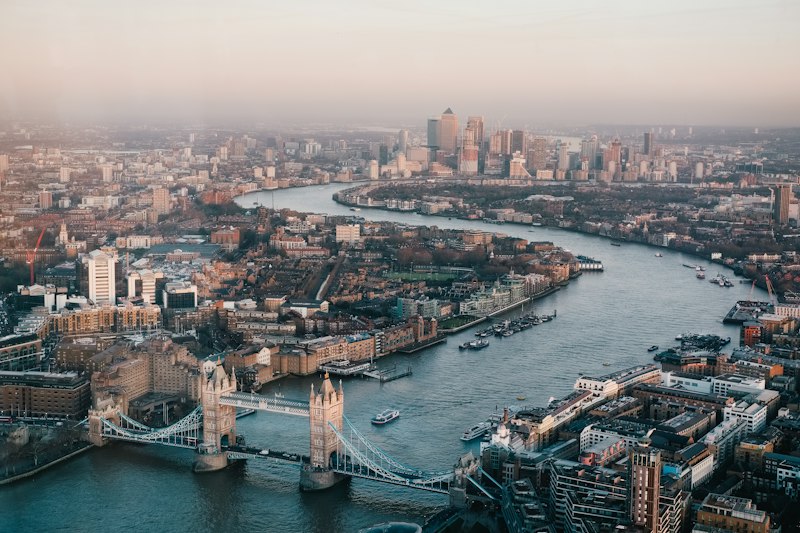
London is a city built on layers of the dead. Not metaphorically — literally. Here are five places where the city's darkest history is hiding in plain sight.
1. Dead Man's Hole, Tower Bridge
Under the northern abutment of Tower Bridge, there's a white-tiled alcove that most people walk right past. This was the body collection point for the Thames.
Due to tidal currents, corpses of the drowned, murdered, and discarded naturally washed up at this exact spot. The alcove was lined with white tiles for a practical reason: decomposing bodies would sometimes explode from gas buildup, and the tiles could be hosed down more easily than stone.
Bodies were retrieved with grappling hooks via L-shaped steps leading into the water, then displayed for public identification.
2. Crossbones Graveyard, Southwark
The medieval Church of Winchester licensed prostitutes to work in Southwark's red-light district. It taxed their earnings. And then it refused to bury them on consecrated ground.
An estimated 15,000 people were buried at Crossbones — prostitutes, paupers, plague victims. Archaeologists found bodies piled on top of each other, many showing signs of smallpox, tuberculosis, and vitamin D deficiency.
In 2019, after years of activist campaigns, the site became an official Garden of Remembrance dedicated to "the outcast dead."
3. Execution Dock, Wapping
For four hundred years, pirates were brought to Execution Dock at low tide and hanged with a deliberately shortened rope. The short drop wouldn't break their neck — they died slowly by strangulation, limbs convulsing in what was called "the Marshal's dance."
After death, the bodies were left hanging until three tides had washed over them. The worst offenders were tarred and hung in iron cages along the Thames estuary. Captain William Kidd's corpse hung in a cage for three years after his 1701 execution.
Today, three riverside pubs fight over which one sits on the exact spot.
4. Tyburn Gallows, Marble Arch
Every time you walk from Oxford Street to Marble Arch, you're retracing the exact route that an estimated 50,000 condemned prisoners took to the gallows over six centuries.
The "Tyburn Tree" erected in 1571 was a triangular gallows that could hang 24 people simultaneously. Prisoners made a public procession from Newgate Prison down what is now Oxford Street, traditionally stopping for a final drink at a pub in St Giles — the origin of the phrase "one for the road."
The site is now marked by a tiny circular plaque embedded in a traffic island that most people walk right past.
5. The Charterhouse, Clerkenwell
Beneath Charterhouse Square lie an estimated 20,000 plague victims from the Black Death of 1348. Crossrail excavations in 2013 found skeletons with confirmed plague bacteria DNA still present.
But the story gets worse. The Carthusian monks who later prayed over these graves refused to accept Henry VIII as head of the church. Prior John Houghton was hanged, drawn, and quartered. The remaining monks who wouldn't sign were sent to Newgate Prison and starved to death.
The site has been, in sequence: a plague pit, a monastery, a Tudor mansion, a school, and an almshouse for elderly gentlemen — which it still is today.
London doesn't hide its dead. It just builds on top of them and hopes nobody looks down.