Walking Tours in Edinburgh
Edinburgh: Grassmarket, Greyfriars & the Vaults
The dark side — Diagon Alley, Tom Riddell real grave, a woman who survived hanging, body snatchers, underground city.
Edinburgh: Royal Mile
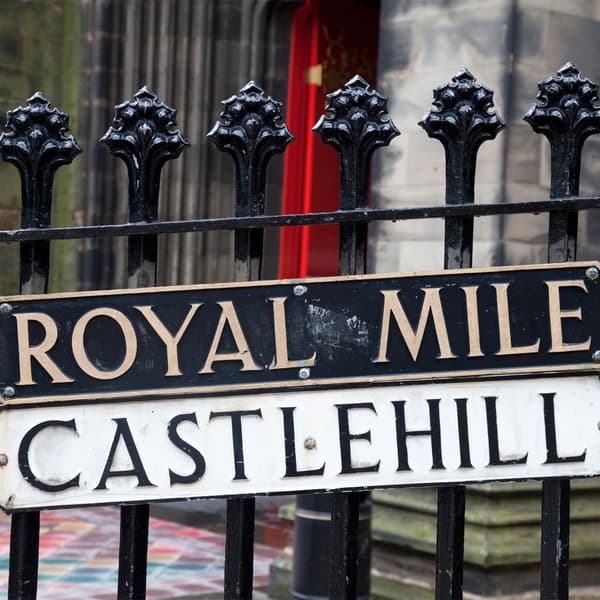
A 17-stop walking tour through the heart of Scotland. Visit Castlehill, Lawnmarket, Lady Stair’s Close, Writers’ Museum, and Bank Street Intersection — with narrated stories at every stop.
Edinburgh: Royal Mile — Castle to Holyrood
Down the spine of Old Edinburgh — 300 witches burned, a stool that started a war, a sealed plague street, and a murder scene.
Edinburgh: The Royal Mile, Castle & Arthur's Seat
Stand on the volcanic rock where Edinburgh began, walk the Royal Mile past closes and wynds where body snatchers operated and Knox thundered, descend to the Palace of Holyroodhouse where Mary Queen of Scots watched her secretary murdered, then climb Arthur's Seat for the view that explains why this city has haunted writers for three hundred years.
30 Landmarks in Edinburgh
Advocate's Close
High Street, The High Street, Edinburgh, EH1, United Kingdom
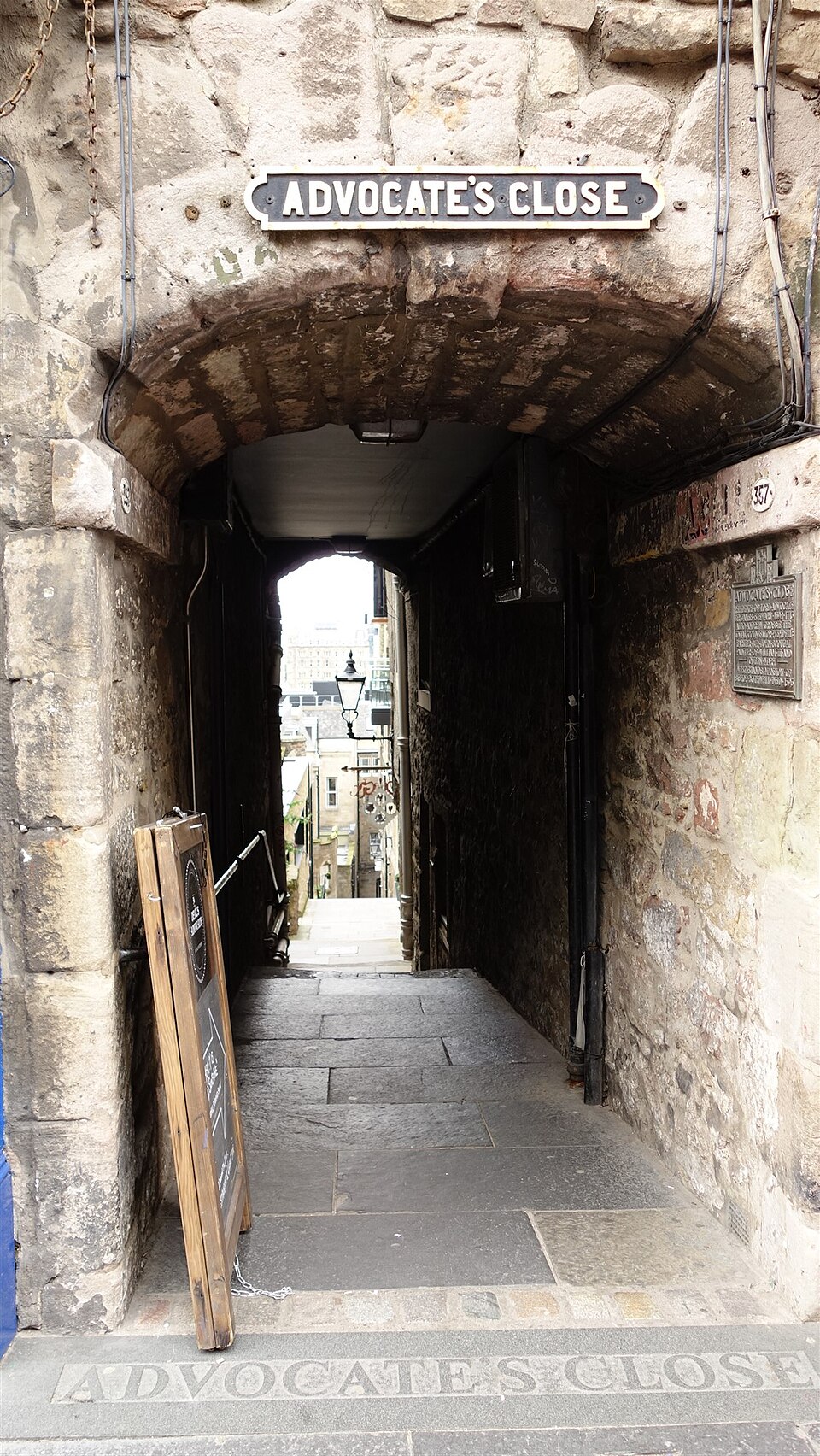
Of the ninety-odd closes that survive along the Royal Mile, Advocate's Close offers perhaps the most perfect Edinburgh moment: a narrow medieval lane plunging steeply from the High Street, framing the Scott Monument and the New Town rooftops at its base like a painting. This view is actually accidental — buildings on the west side of the close were demolished in the 1920s, opening up a sightline that would have been invisible for the previous five hundred years. The close dates to at least the fifteenth century and takes its name from Sir James Stewart of Goodtrees, who lived here from 1635 to 1713 and served as Lord Advocate of Scotland from 1692 to 1709. In Edinburgh's medieval hierarchy, your address on or near the Royal Mile signified your social standing, and the Lord Advocate's presence made this one of the most prestigious closes in the city. Lawyers, merchants, and Scottish gentry jostled for space in the tall tenements that lined both sides. Edinburgh's closes were not alleyways in the modern sense — they were self-contained communities. Each close had its own well, its own unofficial rules, and was locked with iron gates at night. At their peak, around 250 of these lanes threaded off the Royal Mile, housing tens of thousands of people in the tall "lands" (tenements) that gave Edinburgh its unique vertical skyline. A close was named for its most prominent resident, its trade, or its most notorious incident. An extensive but sympathetic redevelopment in the 2010s converted the historic buildings along Advocate's Close into restaurants, bars, and boutique spaces while retaining the close's medieval character. The descent from the Royal Mile to Cockburn Street below takes you past centuries of exposed stonework, carved lintels, and the kind of atmospheric dimness that Edinburgh's Old Town does better than anywhere else in Britain.
Arthur's Seat
Holyrood Road, The Royal Mile, Edinburgh, EH8, United Kingdom
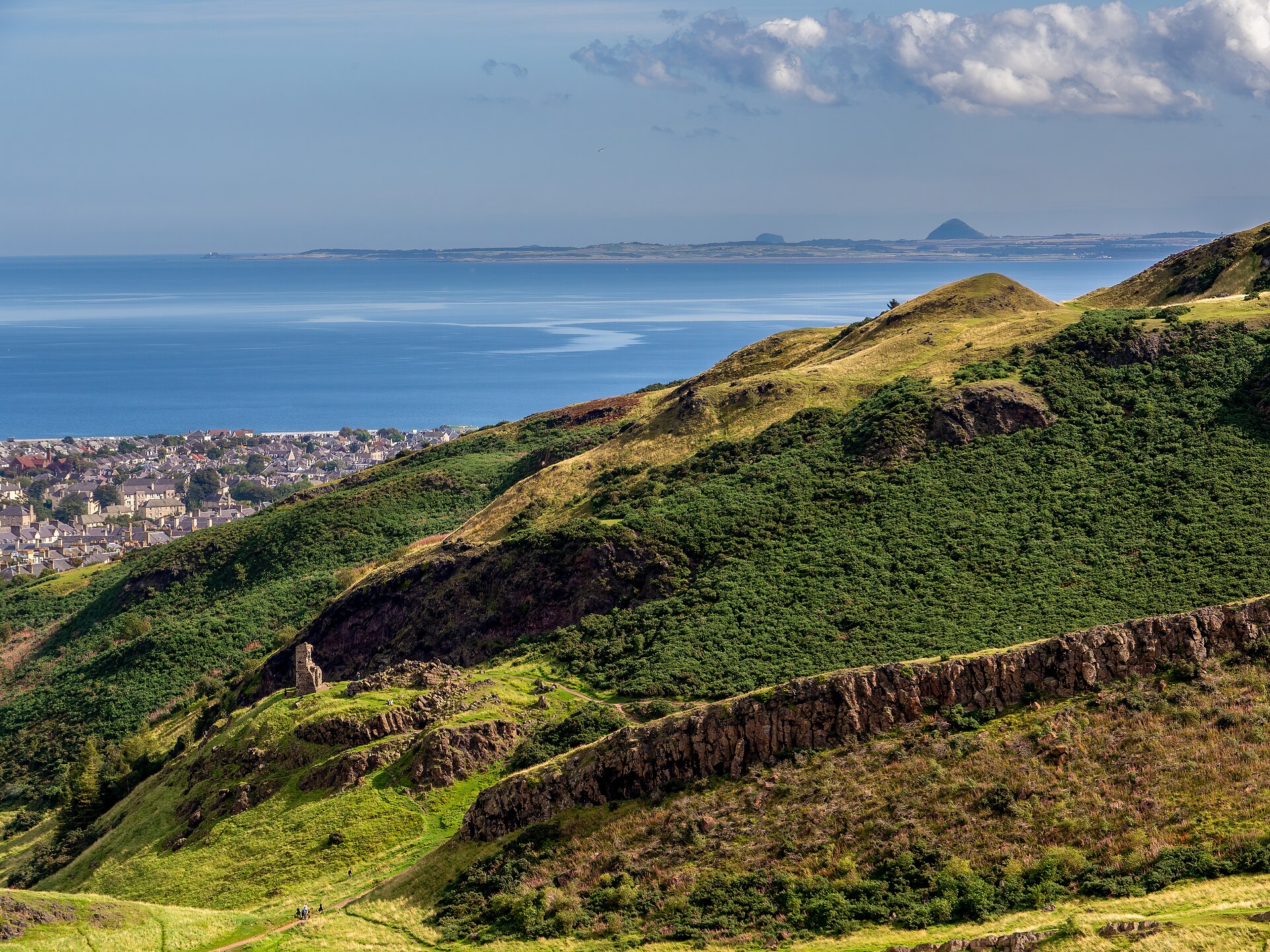
You can climb an extinct volcano without leaving the city centre. Arthur's Seat rises 251 metres above Edinburgh from the heart of Holyrood Park, and its lava solidified somewhere between 341 and 335 million years ago — making it older than the dinosaurs by a comfortable margin. The volcano erupted during the early Carboniferous period, and what you're climbing are the exposed remnants of its central vents, sculpted by glaciers that ground over them during the last ice age and carved the distinctive crag-and-tail formation that also shaped Edinburgh Castle's rock. From certain angles, Arthur's Seat looks like a crouching lion, with two summits forming the "Lion's Head" and the "Lion's Haunch." The name's origin is debated — it may reference the legendary King Arthur, or it may be a corruption of the Gaelic "Àrd-na-Said" meaning "height of arrows." In 1836, a group of boys hunting rabbits on the hill discovered seventeen tiny coffins hidden in a cave, each containing a carved wooden figure. No one has ever explained them convincingly. Theories range from witchcraft to memorials for Burke and Hare's murder victims. Eight of the coffins survive in the National Museum of Scotland. The Salisbury Crags, the dramatic cliff face on Arthur's Seat's western flank, were where the geologist James Hutton made observations in the 1780s that helped him formulate the theory of deep geological time — essentially proving that the earth was millions of years old, not thousands. A section of the crags is named "Hutton's Section" in his honour. His work, done while looking at these rocks, is considered the foundation of modern geology. The climb takes about forty-five minutes from Holyrood and rewards you with panoramic views stretching to the Pentland Hills, across the Firth of Forth to Fife, and on clear days all the way to the Highlands. It's the only European capital where you can summit a proper mountain and be back in a pub within the hour.
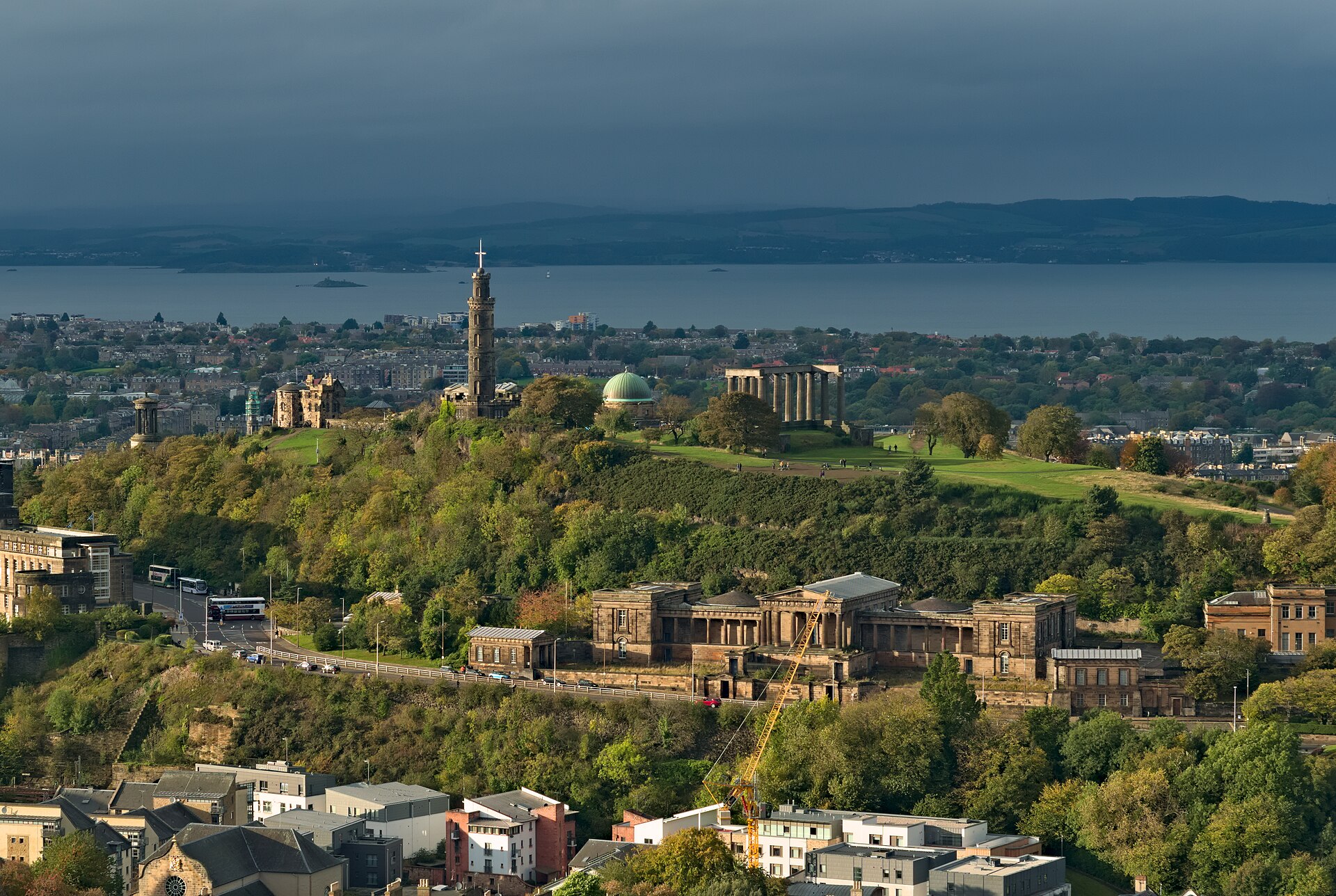
Calton Hill
Calton Hill, Holyrood, Edinburgh, EH7 5AA, United Kingdom
Edinburgh's most embarrassing monument sits on this hill, and the city has spent nearly two centuries trying to decide whether to be proud of it or pretend it doesn't exist. The National Monument was meant to be a full-scale replica of the Parthenon, honouring Scottish soldiers killed in the Napoleonic Wars. Construction began in 1826, but the public appeal raised less than half of the £42,000 needed, and work stopped in 1829 with only twelve columns standing. The nicknames came fast: "Scotland's Disgrace," "Edinburgh's Folly," and the brutal "Scotland's Pride and Poverty." Multiple proposals to complete it over the following two centuries have all been abandoned. The Nelson Monument is the hill's other landmark — a 32-metre tower shaped like an upturned telescope in honour of Admiral Nelson. Completed in 1816, it gained its most useful feature in 1852 when a mechanical time ball was added to the top. Every day at 12:58, the ball rises to the top of its mast, then drops at precisely 1pm, synchronised with the One O'Clock Gun at the castle. Sailors in Leith harbour set their chronometers by watching both: the ball for visual confirmation, the gun for foggy days. The Dugald Stewart Monument, a circular temple modelled on the monument to Lysicrates in Athens, is perhaps the most photographed structure in Edinburgh. It honours a philosopher almost no one has heard of — but the view of the Old Town framed through its columns has appeared on more postcards and Instagram feeds than any other angle of the city. The City Observatory nearby, designed by William Henry Playfair in 1818, is one of several neoclassical structures that earned Edinburgh the nickname "Athens of the North." At Hogmanay, tens of thousands of people climb Calton Hill to watch the fireworks explode over the castle. It's the best free seat in the house for Edinburgh's famously chaotic New Year celebration.
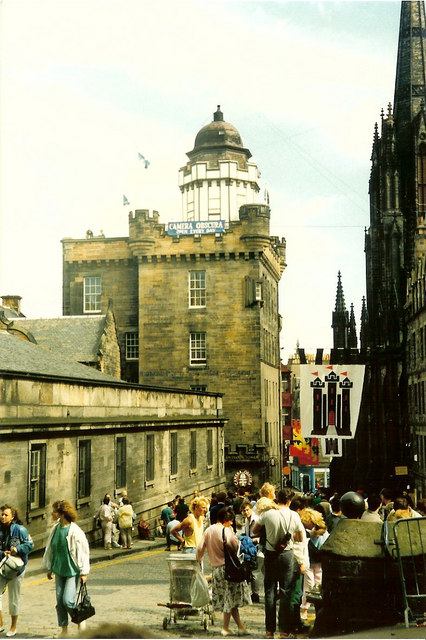
Camera Obscura & World of Illusions
Castlehill, The Royal Mile, Edinburgh, EH1 2ND, United Kingdom
Scotland's oldest purpose-built visitor attraction has been bending light and bending minds since 1835, when entrepreneur Maria Theresa Short set up her optical show on Calton Hill. After authorities demolished her original venue in 1851, she bought a townhouse on Castlehill and added two storeys to create Short's Observatory. The centrepiece is a Victorian camera obscura — a system of mirrors and lenses that projects a live, moving image of Edinburgh onto a white concave table in a darkened room. It was mind-blowing technology in 1853, and honestly it's still pretty magical now. In 1892, the pioneering urban planner Patrick Geddes took over the building and renamed it the "Outlook Tower." Geddes was a visionary who believed cities should be studied like organisms, and he used the tower as a laboratory for understanding Edinburgh from above — literally. He created thematic floors showing the city in its regional, national, and global context, a concept so ahead of its time that town planners still study it. The camera obscura itself was his favourite teaching tool: a living map of Edinburgh that could spy on unsuspecting pedestrians below. Today the building houses five floors of optical illusions, trick rooms, and interactive exhibits alongside the original camera obscura. The Vortex Tunnel — a bridge through a spinning cylinder that convinces your brain you're tumbling — and the Ames Room, where people appear to shrink and grow, are favourites. But the rooftop terrace is the real prize: 360-degree views of Edinburgh with the castle looming directly overhead. The camera obscura operator still demonstrates how you can "pick up" pedestrians on the Royal Mile below using a piece of paper held against the projection table — a party trick that's been delighting visitors for over 170 years.
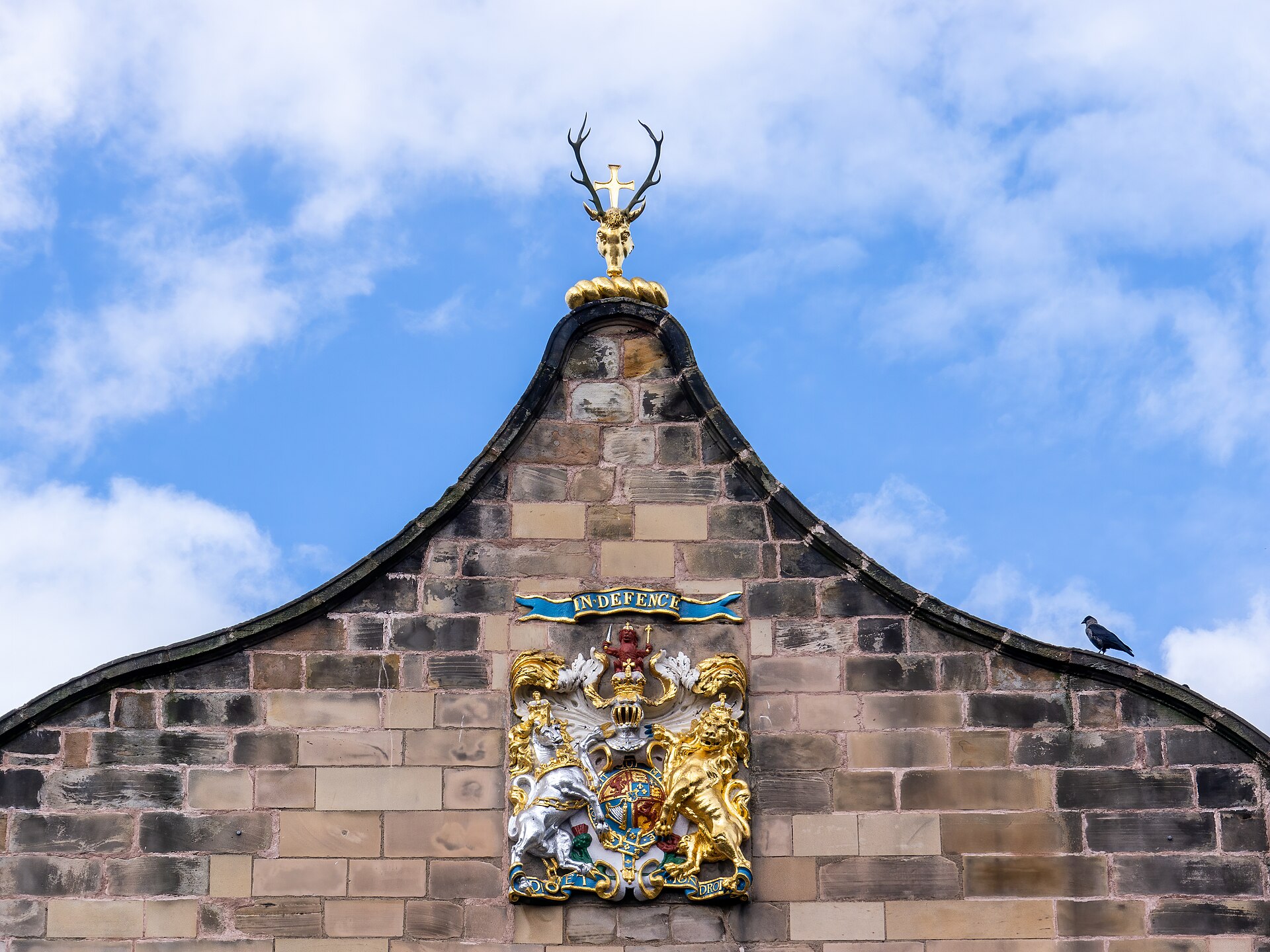
Canongate Kirk
153 Canongate, The Royal Mile, Edinburgh, EH8 8BN, United Kingdom
Adam Smith, the father of modern economics, is buried in a modest grave in this kirkyard, and for most of the twentieth century almost nobody noticed. The author of 'The Wealth of Nations' — arguably the most influential book on capitalism ever written — lived his final years in nearby Panmure House on Lochend Close and died in 1790. His grave received little attention until Edinburgh's financial sector, perhaps embarrassed that the world's most famous economist was rotting in obscurity, funded a restoration and proper memorial. There's a certain irony in the free market needing a charitable donation to honour its founder. The kirkyard's other literary story involves a poet rescuing a poet. Robert Burns visited Edinburgh in 1787 and was appalled that Robert Fergusson — the young poet whose work had inspired Burns to become a writer himself — lay in an unmarked grave. Fergusson had died in the Edinburgh lunatic asylum in 1774 at just twenty-four years old. Burns paid for a memorial headstone, declaring that Fergusson's genius deserved recognition. The headstone was eventually erected in 1789, and Burns himself composed the epitaph. Burns died seven years later, in 1796. The kirk itself was founded in 1688 after James VII evicted the Canongate congregation from Holyrood Abbey to turn it into a chapel for the Order of the Thistle. Completed in 1691, the church has a distinctive Dutch-style gable end facing the Canongate, crowned by a gilded stag's head — a reference to the founding legend of Holyrood Abbey, in which a stag with a cross between its antlers saved King David I from death. The Canongate Kirkyard is also the resting place of Mrs Agnes Maclehose — Burns's "Clarinda" — with whom he conducted one of literature's most passionate epistolary love affairs. Their letters remain some of the finest romantic writing in the English language.
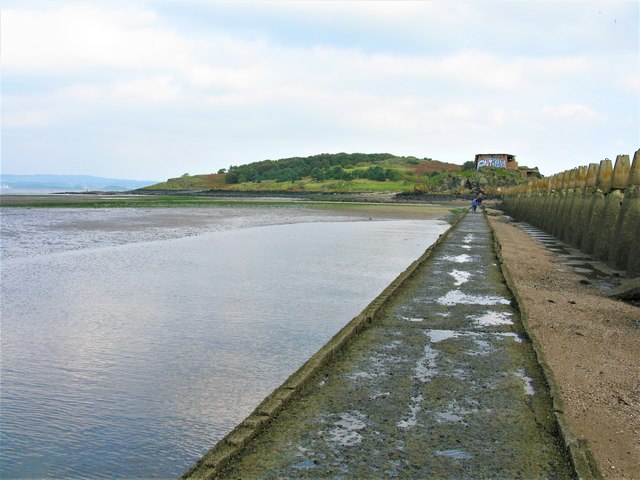
Cramond Island
Almond, Edinburgh, EH4, United Kingdom
Twice a day, the sea parts and you can walk to an island. Cramond Island sits in the Firth of Forth, connected to the mainland by a mile-long concrete causeway that emerges at low tide and disappears completely when the water returns. The causeway was built during World War II as part of coastal defences, and it runs alongside a row of brutalist concrete pylons that once supported an anti-boat boom stretching all the way to Inchcolm Island and the Fife coast — a barrier designed to stop German torpedo boats and submarines from attacking ships and the nearby Rosyth naval dockyard. The island itself is a windswept grass-and-scrub outpost dotted with the decaying remains of WWII military installations. Gun emplacements for 75mm and 12-pounder guns still point seaward, their searchlight housings rusting alongside shelters, stores, and two engine rooms that once powered the island's defences. During the war, soldiers stationed here manned the guns around the clock, watching for any vessel that tried to breach the estuary boom. After 1945, the military left and nature gradually reclaimed the island. The walk across the causeway is extraordinary — sea on both sides, the concrete pylons marching into the distance, the Edinburgh skyline visible to the south. But the tide is no joke. Walkers who misjudge the tidal window get stranded every year, sometimes requiring coastguard rescue. The causeway is passable for about two hours either side of low tide, and local tide tables are posted at the entrance. Ignoring them is an Edinburgh tradition that the coastguard would very much like to end. Cramond village itself is one of Edinburgh's prettiest corners — a small harbour with whitewashed cottages at the mouth of the River Almond. A Roman fort once stood here, and excavations have uncovered a stone lioness sculpture thought to date from the second century AD, now displayed in the National Museum of Scotland.
Dean Village
Edinburgh, United Kingdom
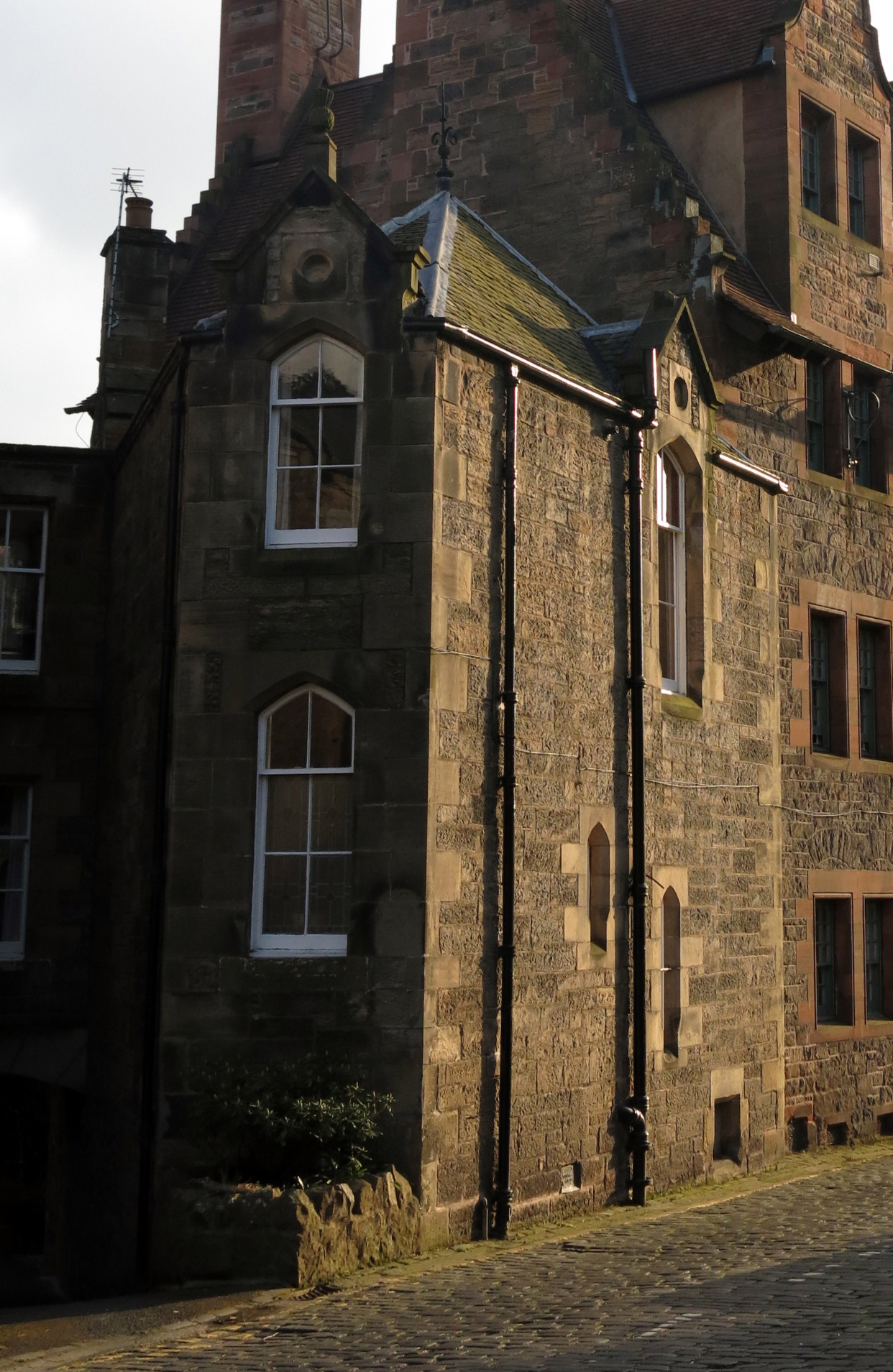
Five minutes' walk from the West End's Georgian crescents, the ground drops away into a steep wooded gorge and you're standing in a twelfth-century milling village that feels like it belongs in the Cotswolds, not the capital of Scotland. Dean Village grew up around grain mills powered by the Water of Leith, established by the monks of Holyrood Abbey in the 1100s. At its peak, eleven watermills worked simultaneously along this stretch of river, grinding the grain that fed Edinburgh for over eight hundred years. The village was formally the territory of the Edinburgh Incorporated Trade of Baxters — bakers, in Scots. Their Tolbooth, or meeting chambers, was built around 1675, and carved stone plaques showing bread, pies, and bakers' peels are still embedded in the walls of several buildings. Look for the inscription on the Baxters' building that reads "God bless the Baxters of Edinbrugh who built this hous." Millstones are scattered decoratively around the village as reminders of the trade that sustained the community for centuries. A devastating fire swept through Dean Village in 1824, destroying mills, warehouses, and homes. The area declined further as larger, more modern flour mills at Leith made the Water of Leith mills obsolete. By the mid-twentieth century, the village was derelict. But a series of careful restorations from the 1970s onward transformed it into one of Edinburgh's most desirable residential pockets — old mill buildings converted into flats, the riverbank paths cleared, the industrial heritage preserved. The Water of Leith Walkway, a twelve-mile path from Balerno to Leith created in 1983, runs through the heart of the village. Walking downstream from Dean Village toward Stockbridge, you pass under Thomas Telford's Dean Bridge, a gravity-defying four-arch structure that soars 32 metres above the river and was completed in 1832.
Edinburgh Castle
Castlehill, The Royal Mile, Edinburgh, EH1 2NG, United Kingdom
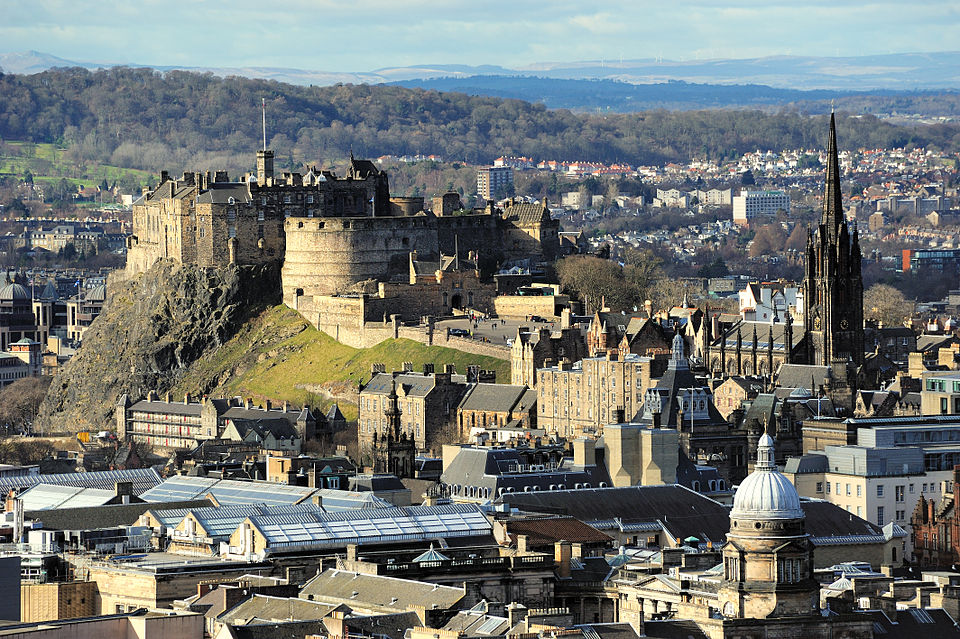
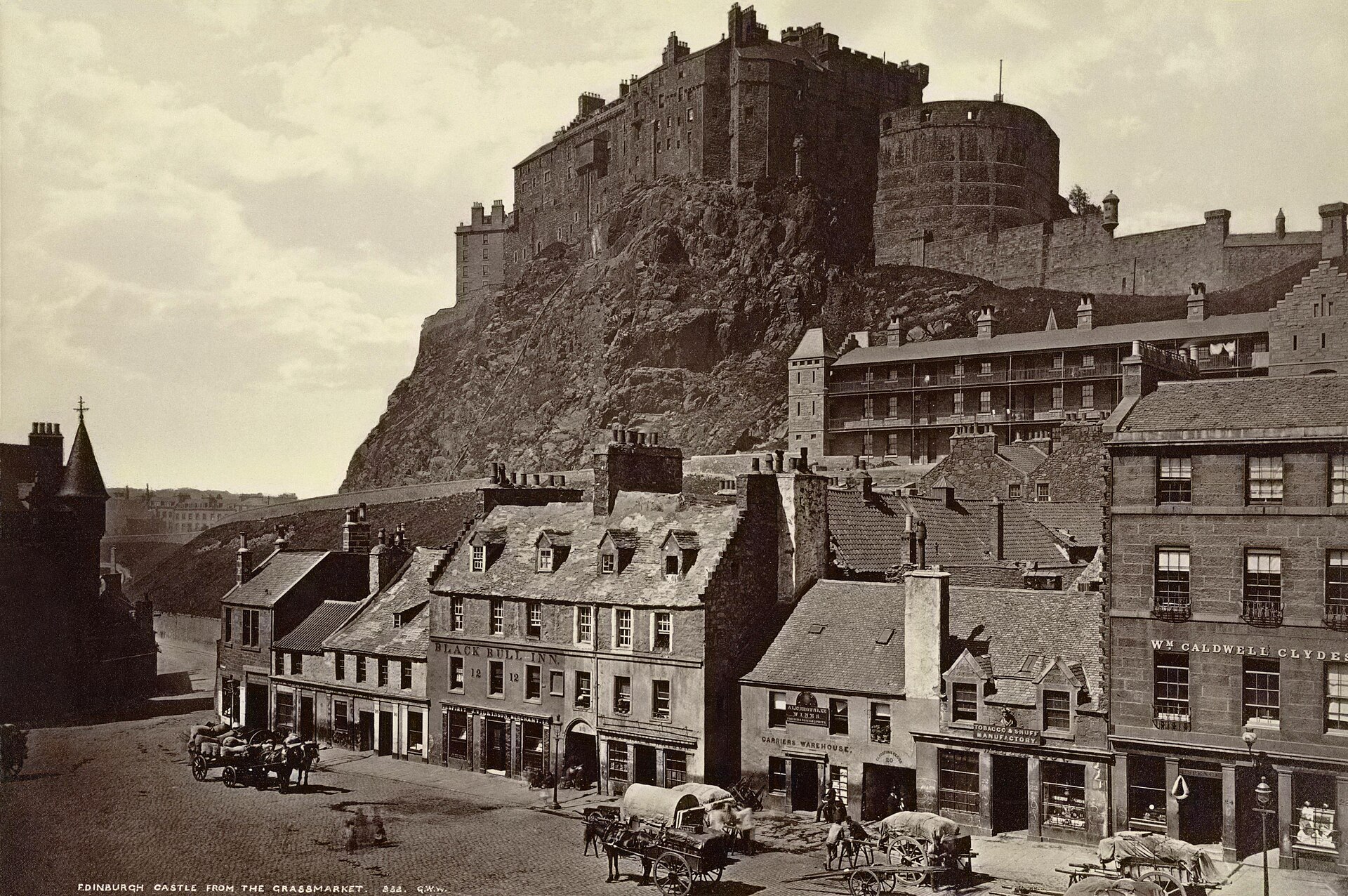
There's a tiny chapel hiding inside one of Europe's most besieged fortresses, and it's been standing since around 1130 — making it the oldest surviving building in Edinburgh. St Margaret's Chapel is so small that only twenty people can squeeze inside, yet it outlasted every assault, fire, and bombardment that reduced the rest of the castle to rubble over nine centuries. Robert the Bruce captured the castle in 1314 and ordered every building destroyed except this one, reportedly because of his reverence for Queen Margaret's story. It was later used as a gunpowder store for two centuries before anyone realised what it actually was. The castle sits on an extinct volcanic plug that's been fortified since at least the Iron Age, and it has been besieged twenty-six times in its documented history — making it one of the most attacked places in Great Britain. The Honours of Scotland, the oldest crown jewels in Britain, were hidden here during Cromwell's invasion. They were bricked up inside a wall and forgotten for over a century until Sir Walter Scott tracked them down in 1818 and pried open the sealed chest. The Stone of Destiny, on which Scottish kings were crowned for centuries, sits alongside them after being returned from Westminster Abbey in 1996. Every day except Sunday, a 105mm field gun fires from the castle ramparts at precisely one o'clock. The tradition dates to 1861, when the blast served as a time signal for ships in the Firth of Forth. It was synchronised with a time ball dropping on Nelson's Monument on Calton Hill — the ball for the eyes, the gun for the ears. The gun has only been fired in anger once, in 1916, when German Zeppelins bombed Edinburgh during World War I. The shells missed. From the Esplanade, the views stretch from Arthur's Seat to the Pentland Hills and across the Forth to Fife. In August, this open space becomes the grandstand for the Royal Edinburgh Military Tattoo, which has been performed here every year since 1950 to audiences of over 200,000.
Edinburgh Vaults
South Bridge, The Grassmarket, Edinburgh, EH1 1LL, United Kingdom
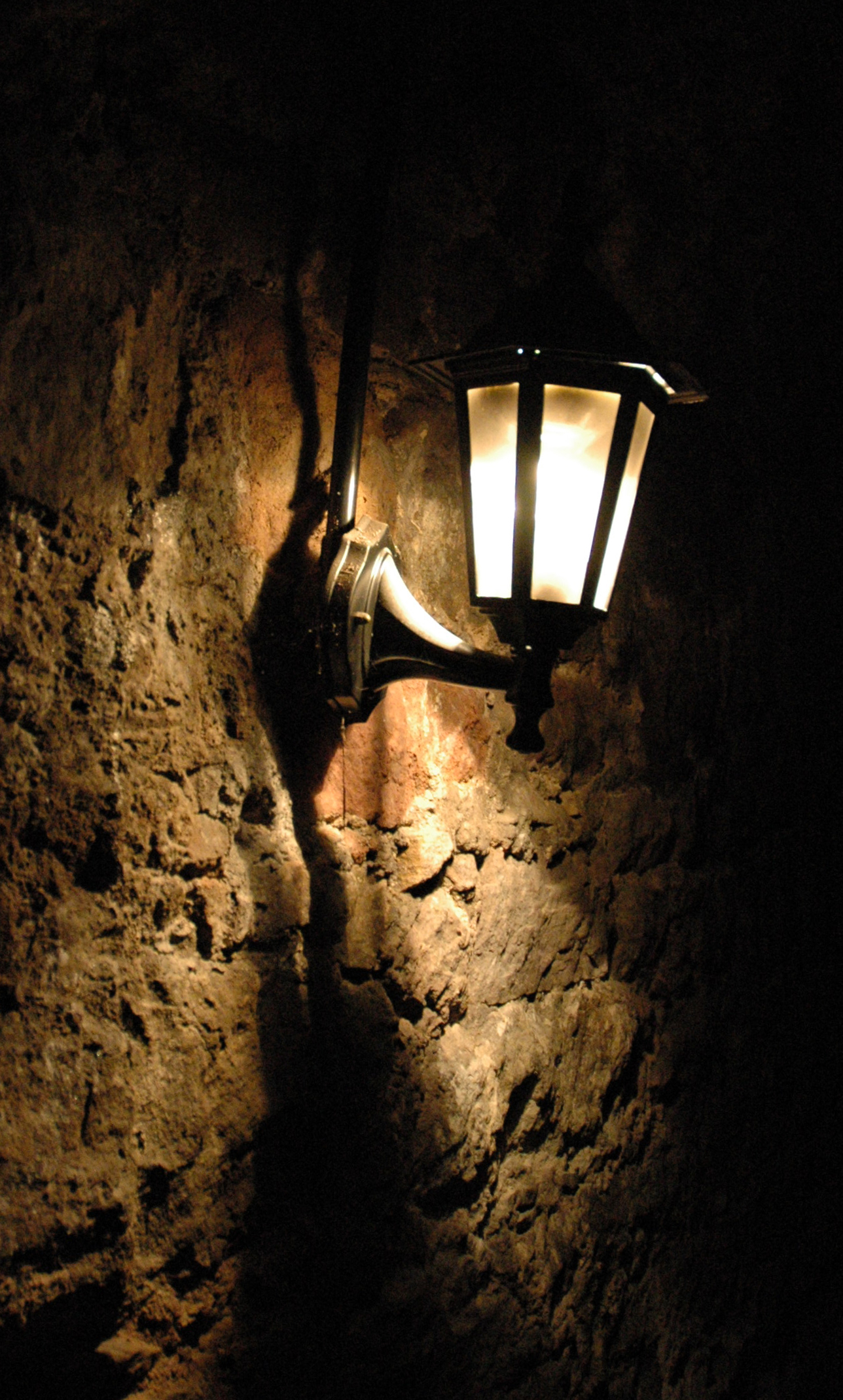
Beneath one of Edinburgh's busiest shopping streets lies a hidden city of approximately 120 rooms that were forgotten for over a century. The Edinburgh Vaults were formed within the nineteen arches of South Bridge when it was completed in 1788 as part of the South Bridge Act of 1785. Only one arch — the Cowgate arch — is visible today. The remaining eighteen were enclosed by tenement buildings, creating a subterranean labyrinth of workshops, taverns, and storage spaces that operated in perpetual darkness. For about thirty years, the vaults hummed with legitimate commerce: cobblers, smelters, and merchants set up shop in rooms ranging from two to forty square metres. But construction had been rushed and the surface was never properly sealed. Water seeped in, the air quality deteriorated, and the businesses fled in the 1820s. What moved in next was considerably less savoury — the destitute poor, illegal whisky distillers, gambling dens, and, according to persistent rumour, body-snatchers who stored corpses overnight. Though there's no hard evidence that Burke and Hare ever used the vaults, the connection has become part of Edinburgh's mythology. By around 1860, even the poorest residents had abandoned the vaults. They were filled with rubble and forgotten until 1985, when a chance excavation revealed the labyrinthine network of chambers beneath South Bridge. Archaeologists found Georgian-era oyster shells, medicine bottles, broken pottery, and the remnants of lives lived in almost total darkness. Today the vaults on the north side of the Cowgate arch host some of Edinburgh's most atmospheric ghost tours, while the south side has been converted into event venues called The Caves and The Rowantree — hosting weddings, concerts, and club nights in the same spaces where eighteenth-century craftsmen once hammered shoes by candlelight.
George Heriot's School
Lauriston Place, Portsburgh, Edinburgh, EH3 9EQ, United Kingdom
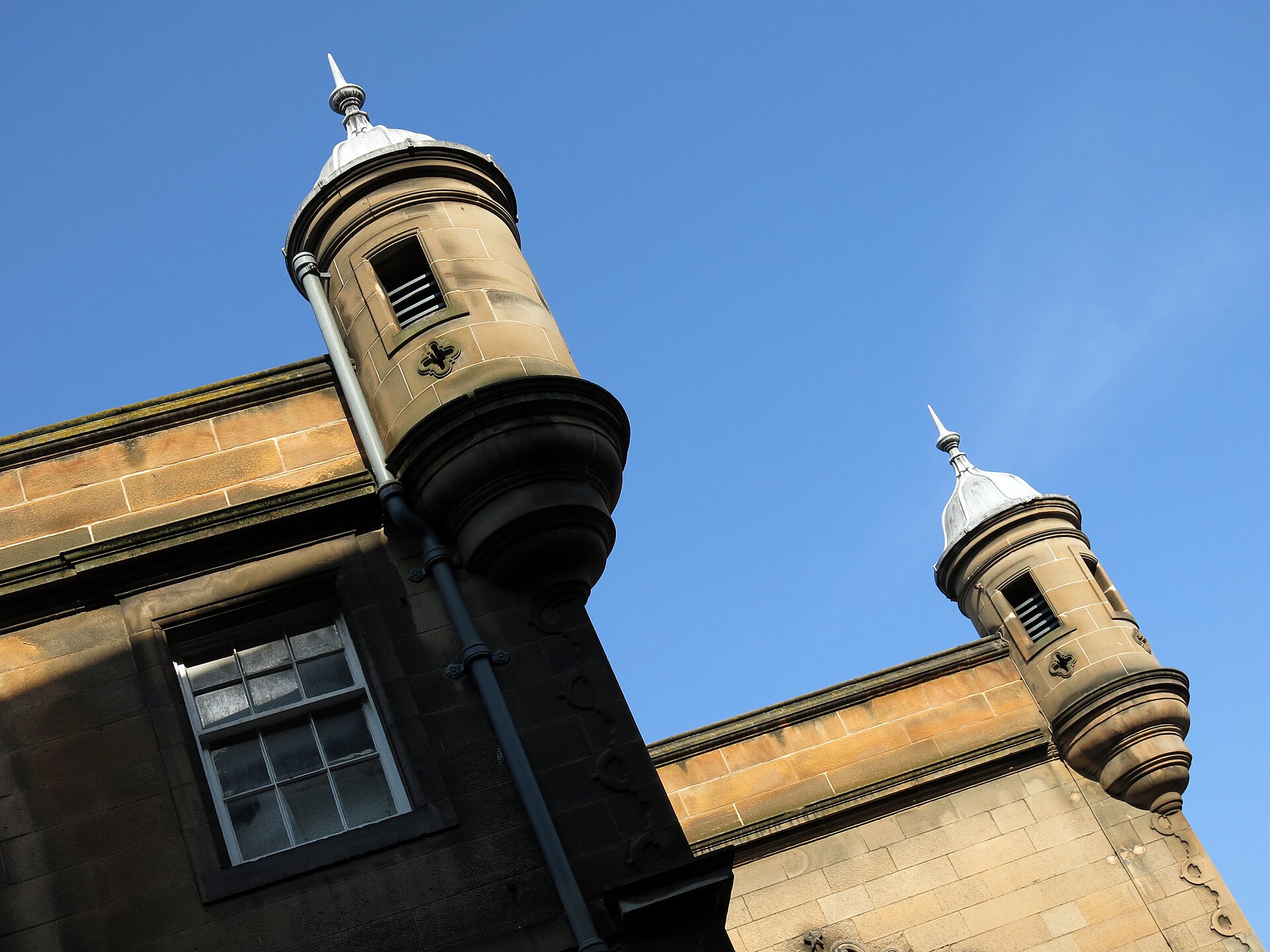
From the back windows of the Elephant House cafe, J.K. Rowling could see this turreted, castle-like school rising above Greyfriars Kirkyard, and the resemblance to Hogwarts is hard to miss. Four towers, four houses, a sacred silver cup trophy, a school for orphans — the parallels between George Heriot's and the fictional wizarding school are remarkable, though Rowling has never officially confirmed the connection. Her own children attended the school, which makes the denial somewhat harder to maintain. George Heriot was James VI's royal goldsmith — essentially the jeweller to the Scottish king who became James I of England in 1603. Known as "Jinglin' Geordie" for the sound of coins in his pocket, Heriot accumulated enormous wealth by lending money to the perpetually cash-strapped royal family. When he died in 1624, he left his fortune to found a "hospital" — a charitable school and almshouse — to care for the "puir, faitherless bairns" of Edinburgh. The school was established in 1628 and opened its doors to students in 1659. The building itself is one of Edinburgh's finest pieces of Renaissance architecture, designed in a Scottish Jacobean style with ornate stonework, a central courtyard, and those four distinctive towers. During the Civil War, Cromwell's troops used it as a barracks — the school didn't actually receive its first students until after the Restoration. The chapel inside features intricate woodwork and stained glass, and the grounds, though not open to the public, can be glimpsed from Greyfriars Kirkyard and the Vennel steps. The school still uses a four-house system — Lauriston, Greyfriars, Raeburn, and Castle — and has produced an impressive list of alumni, including the mathematician Colin Maclaurin and, more recently, the actor Ian Charleson of 'Chariots of Fire' fame.
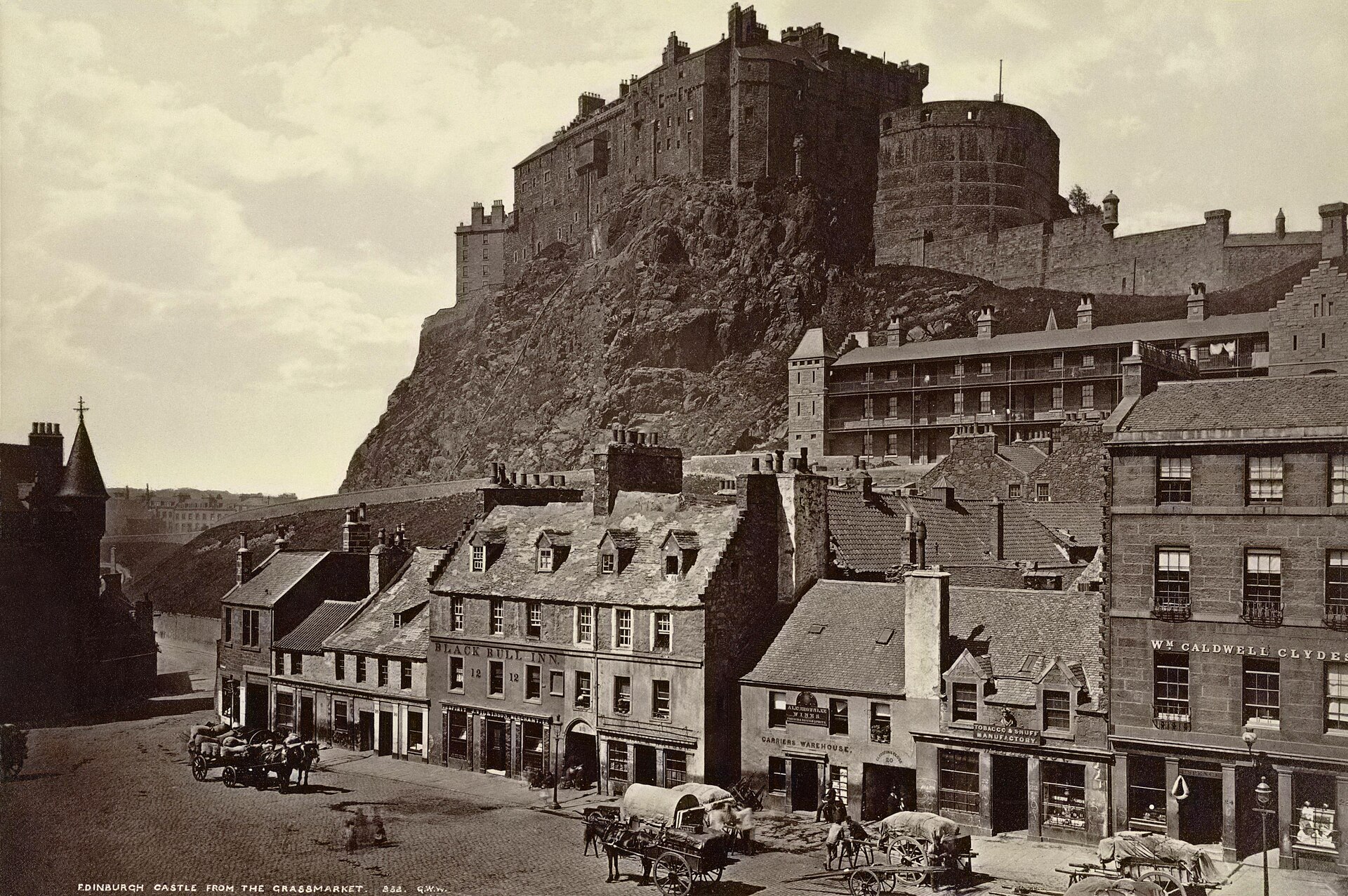
Grassmarket
Grassmarket, The Grassmarket, Edinburgh, EH1 2HS, United Kingdom
From 1660 until 1784, this sunny square in the shadow of the castle was Edinburgh's principal killing ground. Over a hundred people were executed here in the 1680s alone, many of them Covenanters who refused to accept the king's authority over their church. A small rose garden and memorial stone near the eastern end marks where the gallows stood. The last person hanged here was James Andrews in 1784, after which the city moved its executions to a less public location — not out of mercy, but because the crowds were getting unmanageable. The most extraordinary execution story belongs to Margaret Dickson, known as "Half-Hangit Maggie." Hanged in 1724 at the age of 22 for concealing a stillborn pregnancy, she woke up in the carriage taking her body to burial and went on to live a long life. Under Scots law, she couldn't be tried again for the same crime — her death sentence had, technically, been carried out. She reportedly remarried her husband, though the church debated whether she was still legally the same person. The Porteous Riots of 1736 made the Grassmarket internationally infamous. Captain John Porteous of the Town Guard ordered his men to fire into a crowd watching an execution, killing several people. He was sentenced to death, then reprieved by London. The mob broke into the Tolbooth prison, dragged Porteous to the Grassmarket, and lynched him from a dyer's pole. The government never identified anyone responsible — the city's wall of silence was absolute. Today the Grassmarket is one of Edinburgh's liveliest drinking and dining spots, its dark past mostly obscured by pub terraces and Instagram-ready views of the castle. The market itself dates to 1477, when it served as the city's primary livestock market, and the name has stuck for over five hundred years.
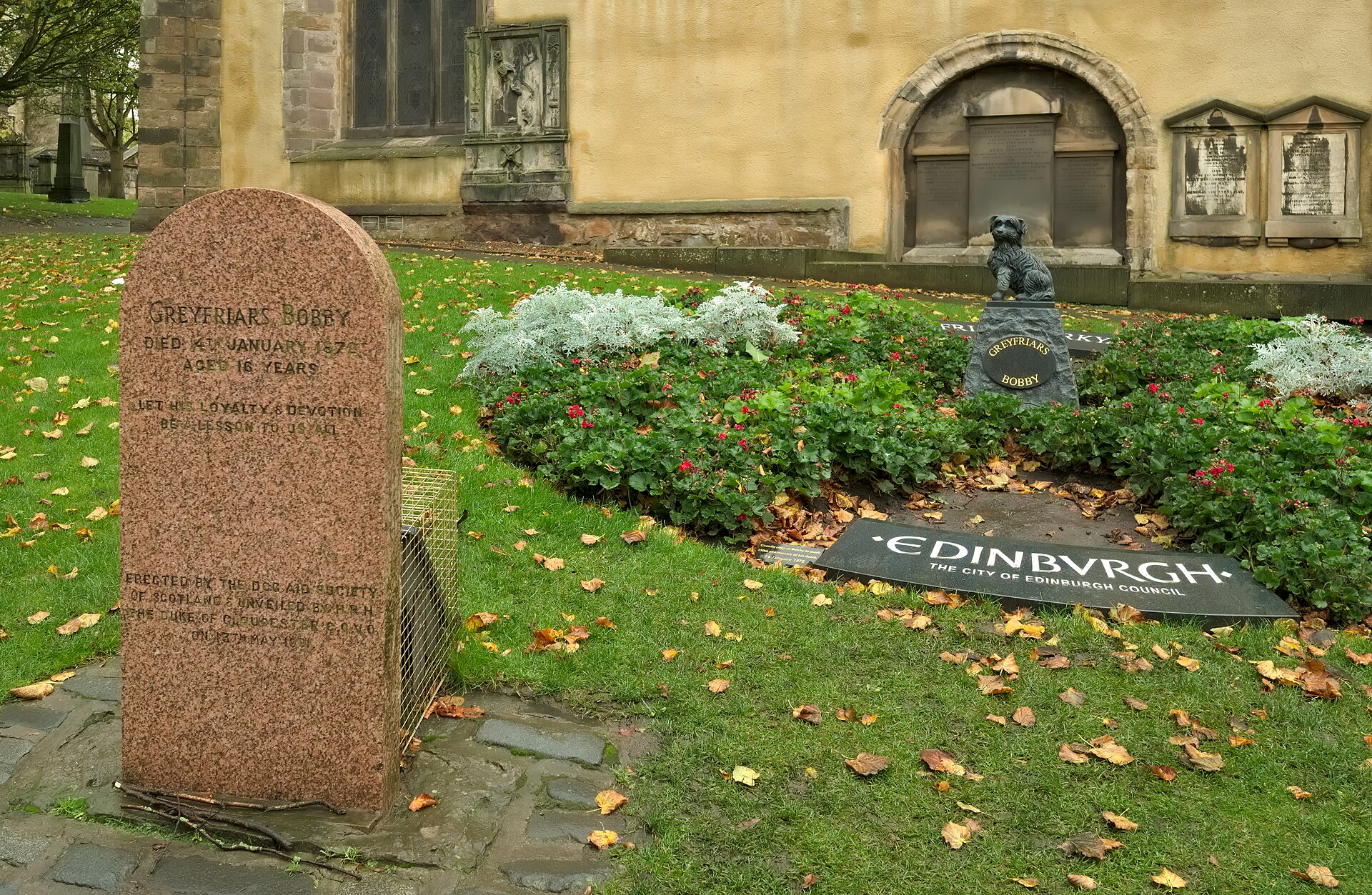
Greyfriars Kirk & Kirkyard
Greyfriars Place, Edinburgh, United Kingdom
A Skye Terrier named Bobby sat on his master's grave here for fourteen years, from 1858 until his own death in 1872, becoming the most famous dog in Scottish history. His master, police constable John Gray, died of tuberculosis and was buried in Greyfriars Kirkyard. Bobby reportedly refused to leave, braving Edinburgh's brutal winters beside the headstone. When the city introduced a dog licence in 1867, the Lord Provost himself paid Bobby's fee to prevent him being put down. His statue, nose shiny from a century of rubbing, sits at the entrance to the kirkyard. But Greyfriars' true historical weight lies in a document signed inside the kirk on 28 February 1638. The National Covenant was a defiant declaration against Charles I's attempts to impose Anglican worship on Presbyterian Scotland. Thousands of Scots signed it, some reportedly in their own blood. The movement it launched would cost tens of thousands of lives and help trigger the English Civil War. After the Covenanters' defeat at the Battle of Bothwell Brig in 1679, some 1,200 prisoners were held in a field adjacent to the kirkyard for months — exposed to the elements, starved, and eventually executed or transported. That field, now called the Covenanters' Prison, is still walled off from the main churchyard. The kirk itself was built between 1602 and 1620 on the grounds of a dissolved Franciscan friary — the "grey friars" who gave it its name wore grey habits. The graveyard is one of Edinburgh's most atmospheric, with elaborate seventeenth-century monuments, skull-and-crossbones carvings, and locked iron mortsafes designed to foil body-snatchers during the era of Burke and Hare. Harry Potter fans hunt for familiar names here: Tom Riddell (a real Edinburgh merchant), William McGonagall (the notoriously bad poet), and several Moodie headstones are scattered among the graves. J.K. Rowling lived around the corner while writing the early books, and the view of George Heriot's School from the kirkyard is said to have inspired Hogwarts.
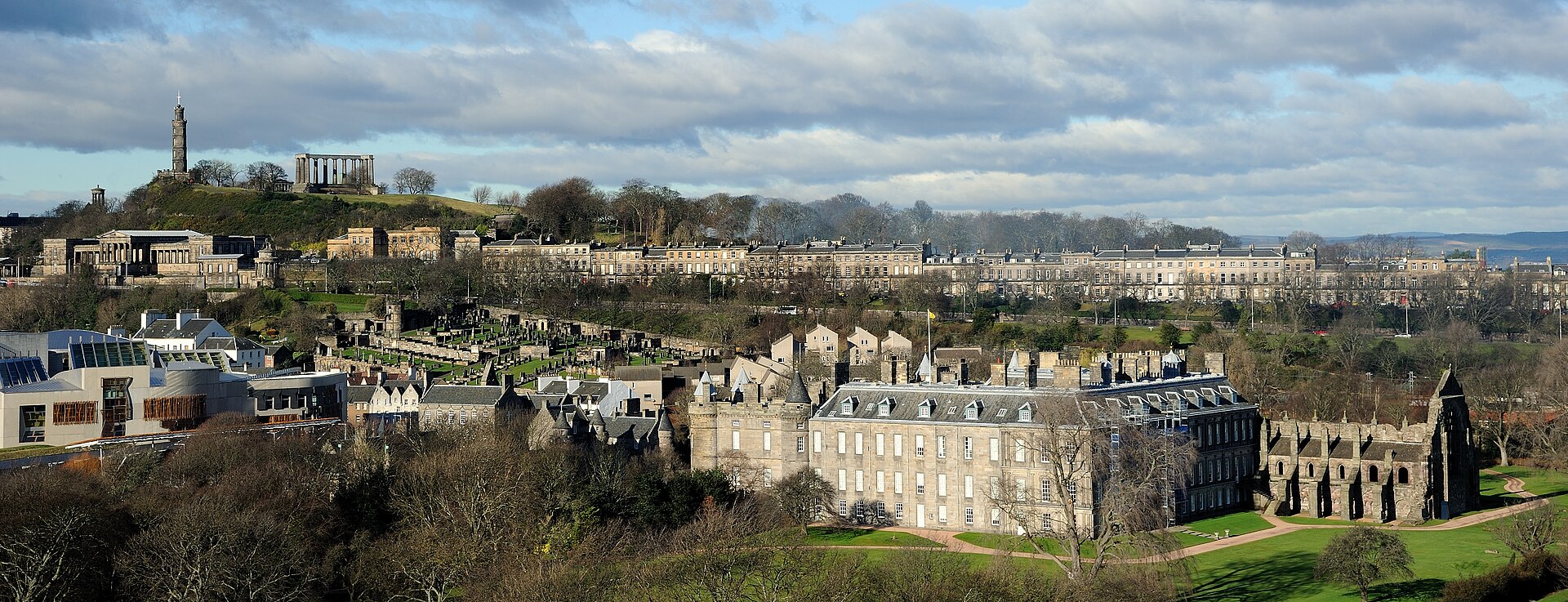
Holyrood Abbey
Canongate, The Royal Mile, Edinburgh, EH8, United Kingdom
These roofless Gothic arches, open to the sky and the Edinburgh rain, are what remains of one of Scotland's most important medieval monasteries. David I founded Holyrood Abbey in 1128 for Augustinian canons, inspired — according to legend — by a miraculous encounter with a stag. While hunting below Salisbury Crags, David was thrown from his horse and nearly killed by the stag's antlers. As he grasped at the antlers to protect himself, a glowing cross appeared between them, and the stag fled. In gratitude, David founded a "monastery of the Holy Rood" — rood being the Scots word for cross. The abbey became one of Scotland's great royal stages. James II, III, and IV were married here. James V and Charles I were crowned within these walls. The Scottish Parliament met here on multiple occasions between 1256 and 1410. But the abbey's strategic importance also made it a target: English troops sacked and burned it in 1544 during the "Rough Wooing," returned to devastate it again in 1547, and by 1570 the transepts and choir lay in ruins. Only the nave was repaired and kept in use. The final indignity came in 1687 when James VII evicted the Protestant congregation to restore the nave as a Catholic chapel for his revived Order of the Thistle. Within a year, a mob ransacked the chapel and James was forced into exile. The nave has been a ruin ever since, its vault collapsing in 1768 during a storm. What survives — the east processional doorway from David I's original building, the thirteenth-century Gothic nave with its delicate tracery — is hauntingly beautiful. The abbey ruins are accessed through the Palace of Holyroodhouse and are included in the palace ticket. Standing in the rootless nave with the sky above and the worn tombstones underfoot, it's easy to forget you're in a capital city.
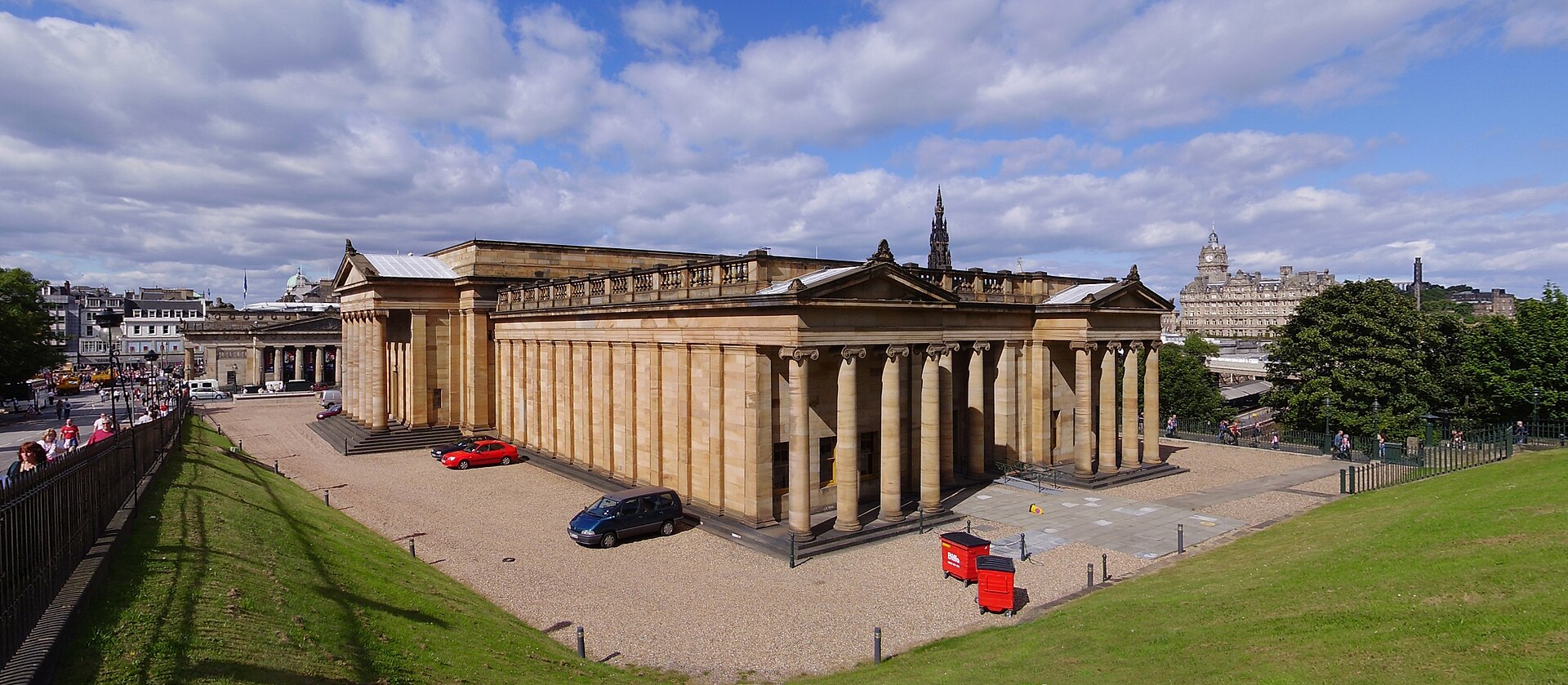
National Museum of Scotland
Chambers Street, Portsburgh, Edinburgh, EH1, United Kingdom
Dolly the Sheep stands in a glass case on the first floor, looking remarkably calm for an animal who changed the course of biological science. Born at the Roslin Institute just outside Edinburgh in 1996, Dolly was the first mammal cloned from an adult cell, a breakthrough that made Edinburgh the unlikely capital of genetic revolution. She lived six years, developed arthritis and a lung disease, and was euthanised in 2003. Her taxidermied body ended up here, next to a display explaining why cloning a sheep was the easy part — the ethical questions are still unresolved. The museum itself is two buildings stitched together: the Victorian-era Royal Museum, with its soaring Grand Gallery of cast-iron columns and glass roof inspired by Crystal Palace, and the modern Museum of Scotland, a sandstone drum designed by Benson & Forsyth that opened in 1998. Together they house over 20,000 objects spanning the entire sweep of Scottish and world history, from Pictish stones to particle physics. Admission is free, which makes it the best free rainy-day option in a city that has quite a lot of rainy days. Among the treasures are eleven of the Lewis Chessmen — twelfth-century walrus ivory pieces discovered on the Isle of Lewis in 1831, their bulging eyes and bitten shields making them the most expressive chess set ever carved. The Monymusk Reliquary, a tiny eighth-century casket said to have been carried before the Scottish army at the Battle of Bannockburn, sits nearby. There's also a full-size Tyrannosaurus rex skeleton, a working Watt steam engine, and the Maiden — Edinburgh's own guillotine, which beheaded around 150 people between 1564 and 1710. The rooftop terrace on the seventh floor offers one of the city's best free viewpoints, taking in the castle, Arthur's Seat, and the Pentland Hills.
Palace of Holyroodhouse
Canongate, The Royal Mile, Edinburgh, EH8, United Kingdom
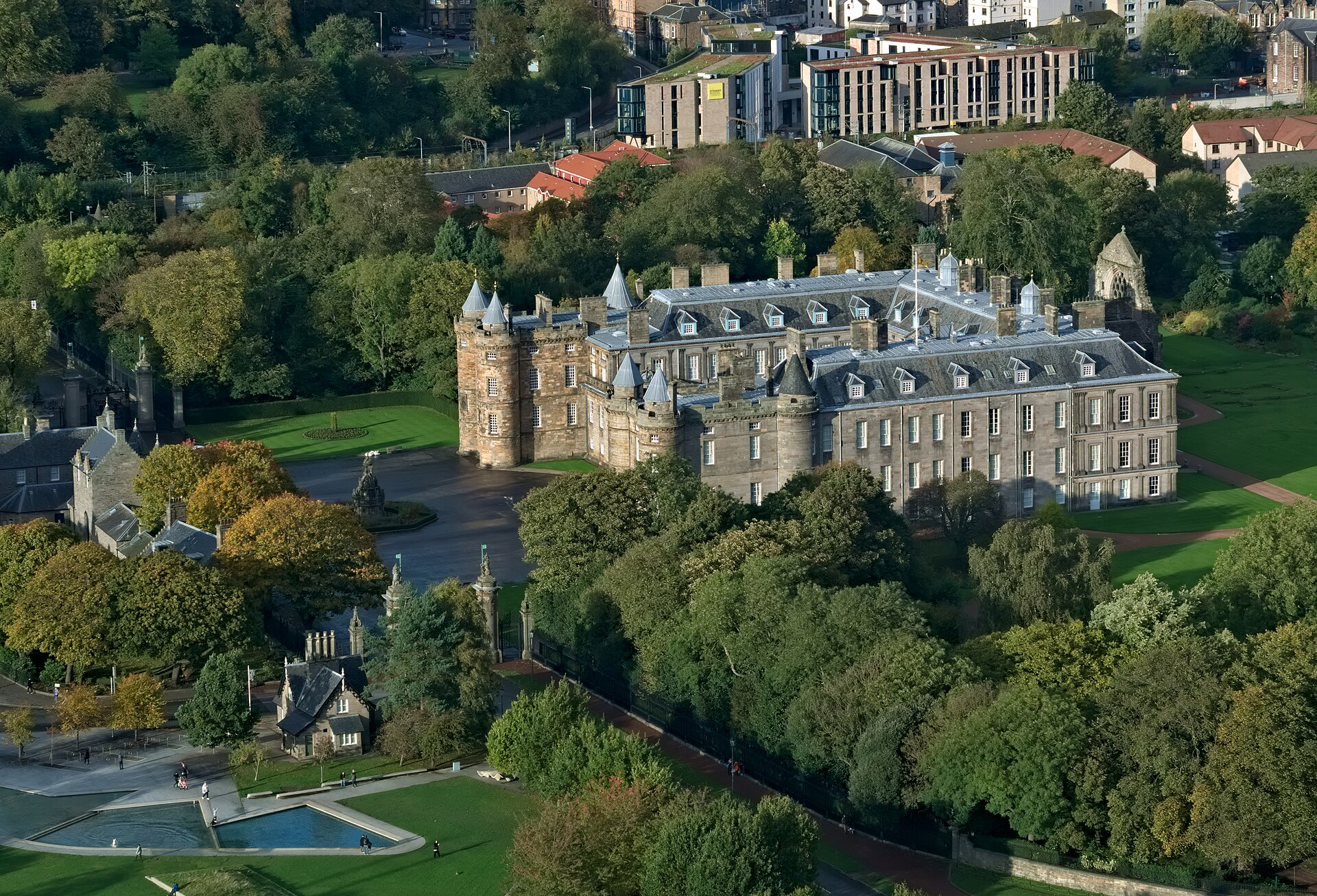
On the night of 9 March 1566, Mary Queen of Scots was having supper in a tiny room off her bedchamber when a group of armed nobles burst in, dragged her Italian secretary David Rizzio from behind her skirts, and stabbed him fifty-six times. The bloodstain on the floor has been pointed out to visitors ever since — though whether it's genuinely Rizzio's blood or a Victorian tourist enhancement is a question no one at the palace is keen to answer. The supper room is barely larger than a cupboard, making the violence that unfolded there feel claustrophobic and immediate even five centuries later. The palace began life as a guesthouse for Holyrood Abbey, which David I founded in 1128 after — legend has it — a miraculous stag with a glowing cross between its antlers saved him from being gored during a hunt. James IV built the first proper royal residence here in 1501 for his bride Margaret Tudor, Henry VIII's sister. His son James V added the massive tower between 1528 and 1532, the same tower where Mary would later witness Rizzio's murder and marry two of her three husbands. Charles II never actually visited Edinburgh, but that didn't stop him from ordering a complete rebuild of the palace in the 1670s. Scottish architect Sir William Bruce transformed it into the baroque and classical palace you see today, creating the symmetrical facade with its twin towers. The Great Gallery inside contains 96 portraits of Scottish monarchs, real and mythical, commissioned from the Dutch painter Jacob de Wet II — who was given just two years to paint all of them, which explains why most of them look suspiciously alike. The palace remains the King's official Scottish residence, and the grounds include the atmospheric ruins of Holyrood Abbey, its Gothic nave open to the sky since the roof collapsed in a storm in 1768.
Portobello Beach
60 Promenade, Portobello/Craigmillar Ward, Edinburgh, EH15 2BS, United Kingdom
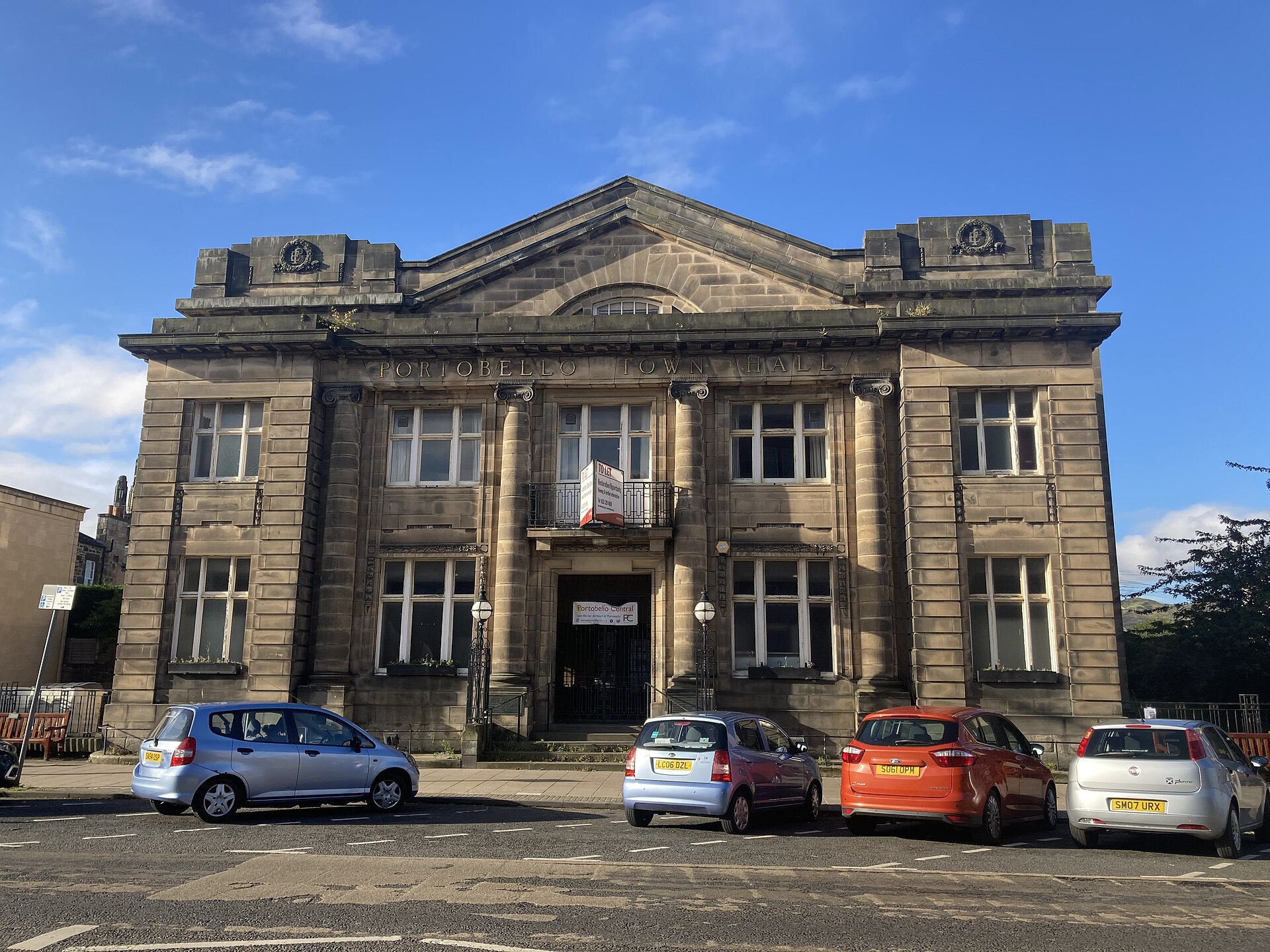
Edinburgh has a beach, and it was named after a battle in Panama. In 1742, a retired sailor called George Hamilton built himself a cottage on what was then uninhabited moorland called Figgate Muir. Having served in the Royal Navy and participated in the 1739 capture of Porto Bello in Panama, he called his home "Portobello Hut." The name stuck as a settlement grew around it, and by the early nineteenth century Portobello had transformed into one of Britain's fashionable seaside resorts. In 1822, over 50,000 people gathered on Portobello's sands to watch King George IV review troops and Highland clansmen during his famous visit to Scotland — the whole event orchestrated by Sir Walter Scott, who essentially staged-managed the king's entire Edinburgh trip. Salt-water bathing pools opened in 1807, a promenade was constructed, bandstands appeared, and Portobello's two-mile beach became Edinburgh's playground. The Victorian heyday brought swimming pools, funfairs, and day-trippers by the thousand — especially from Glasgow, where factory workers flooded east during the annual Glasgow Fair. The decline came in the 1970s and '80s, when cheap overseas package holidays pulled families away from British seaside towns. Portobello's grand outdoor pool closed, the amusements faded, and the promenade grew quiet. But the twenty-first century brought a revival: the beach has become a favourite for wild swimmers, kite surfers, and Edinburgh families who'd rather face the bracing waters of the Firth of Forth than a two-hour drive to anywhere warmer. The promenade still runs the full length of the beach, and on summer evenings the light over the Forth can be genuinely beautiful — pink skies reflecting off wet sand, the hills of Fife dark across the water. It's thirty minutes from the Royal Mile by bus, and it feels like another world entirely.
Princes Street Gardens
Princes Street, Princes Street, Edinburgh, EH1, United Kingdom
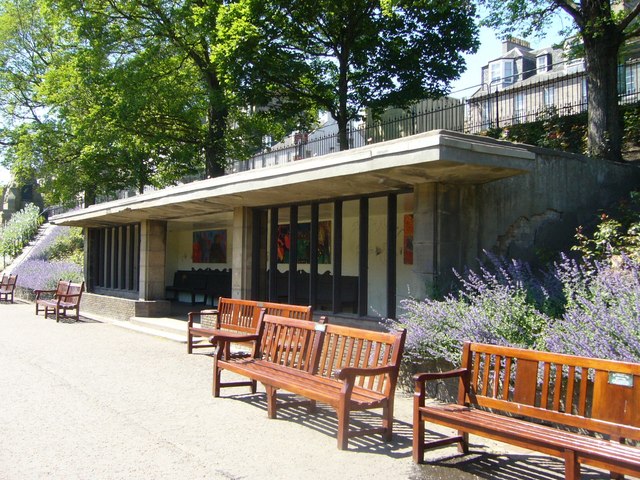
Edinburgh's most beautiful park sits on top of a lake of corpses. That's a slight exaggeration, but only slight. In 1460, King James III ordered the valley below the castle to be flooded, creating the Nor Loch as both a defensive moat and the city's primary water supply. Over the following three centuries, the loch became Edinburgh's unofficial dump: human waste, slaughterhouse offal, and reportedly the occasional murder victim were hurled into its waters. By the eighteenth century, the stench was unbearable and Edinburgh's growing upper classes demanded action. Draining began in 1759 and continued in stages until 1820, supervised by engineer James Jardine. What emerged was a fetid swamp that gradually dried into the landscaped park we see today. The gardens opened in stages during the 1820s and were initially private, accessible only to residents of Princes Street who paid a key fee. They became fully public in the late nineteenth century. The gardens are divided into East and West by The Mound — an artificial hill created from the earth excavated during construction of Edinburgh's New Town in the 1760s. Around two million cartloads of rubble were dumped here to create a link between the Old and New Towns. The Scottish National Gallery and the Royal Scottish Academy now sit on top of it, connected by an underground link called the Weston Link opened in 2004. On a clear day, the West Gardens are one of the finest urban spaces in Europe: the castle soaring above, the Scott Monument piercing the sky, and the Victorian Ross Fountain — controversially purchased from the Great Exhibition of 1862 — glinting in whatever sunshine Edinburgh can spare. During the Christmas Market and Hogmanay celebrations, the gardens transform into a festival ground with a Ferris wheel, ice rink, and approximately seventy thousand people trying to take the same photograph.
Rosslyn Chapel
Chapel Loan, Midlothian West, Roslin, EH25, United Kingdom
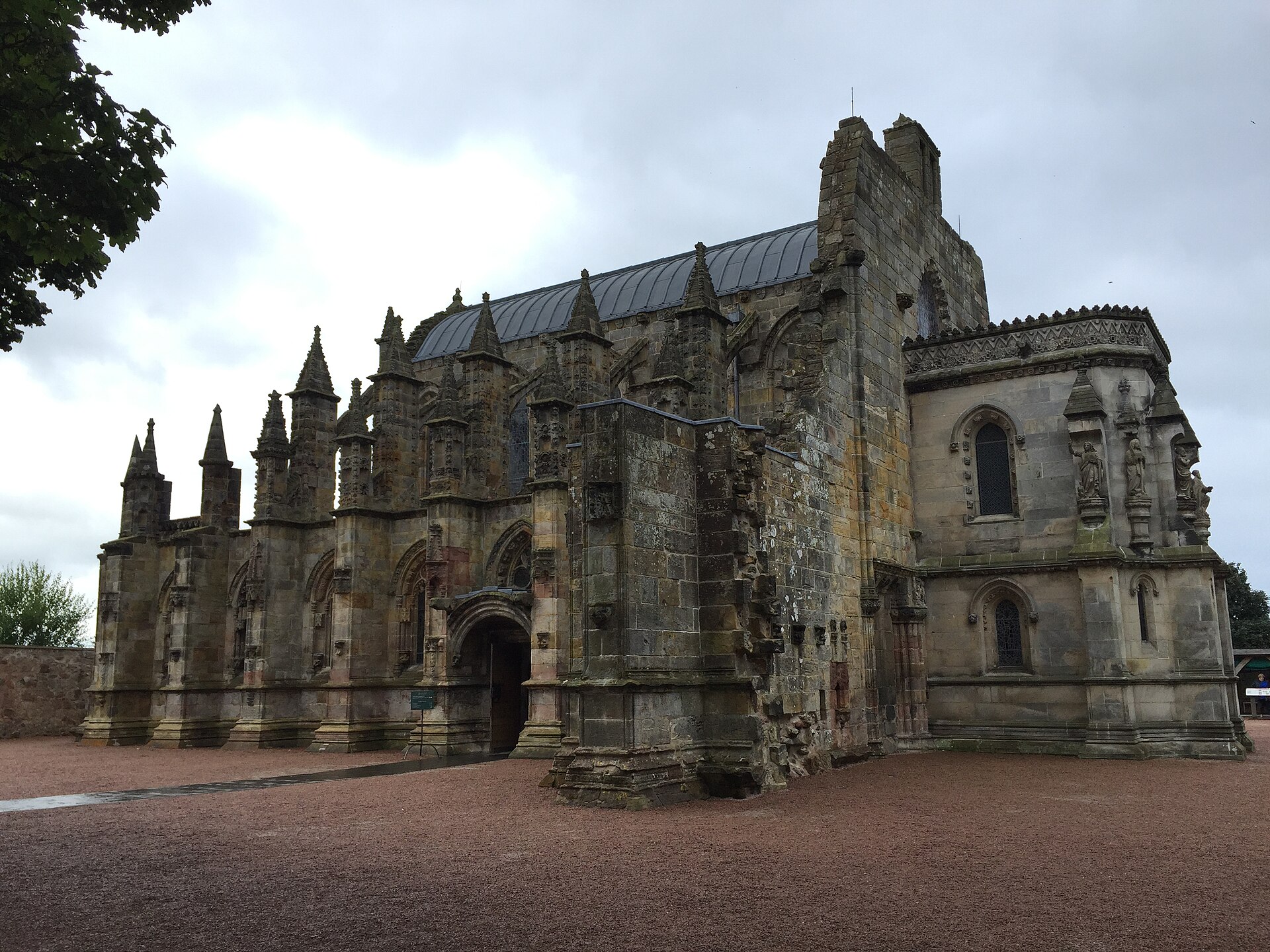
Dan Brown made this chapel world-famous in 'The Da Vinci Code,' but the real Rosslyn is stranger than any conspiracy theory. Built by William Sinclair, 1st Earl of Caithness, with a groundbreaking ceremony in 1456, every surface of this small Gothic chapel is encrusted with carvings so dense and bizarre that scholars have spent centuries arguing about what they mean. Over a hundred Green Man faces — pagan fertility symbols — peer out from the stonework, the highest concentration in any medieval European chapel. That's an odd thing to find in a Christian church, and nobody has satisfactorily explained it. The Apprentice Pillar is the chapel's most famous single feature, and it comes with a murder story. According to legend, the master mason travelled to Rome for inspiration, leaving his apprentice behind. The apprentice, in a burst of youthful ambition, carved the pillar himself — a spiralling masterpiece of intertwined dragons and flowing vines. When the master returned and saw work that far surpassed his own abilities, he was consumed by jealousy and killed the apprentice with a mallet. As punishment, the master's face was carved into the opposite corner, condemned to stare at his apprentice's pillar for eternity. Whether the story is true or a later embellishment is unknown, but the carved heads are there. The chapel also features carvings that appear to depict sweetcorn and aloe vera — plants native to the Americas, supposedly carved decades before Columbus sailed in 1492. If authentic, they suggest the Sinclairs may have had contact with the New World before Columbus, a claim that feeds into theories about the Knights Templar and pre-Columbian voyages. Mainstream historians are sceptical. Rosslyn sits seven miles south of Edinburgh's city centre, in the village of Roslin. The chapel was never completed — the current building is only the choir of what was intended to be a much larger cruciform church. The barrel-vaulted roof was added in the 1860s after decades of exposure to the elements.

Royal Mile
The Royal Mile, Edinburgh, United Kingdom
This street isn't actually a mile long — it's a mile and 107 yards, which happens to be exactly one Scots mile, a measurement that hasn't been used since the eighteenth century. Running downhill from the castle to the palace, the Royal Mile drops over 60 metres across six distinct sections: the Castle Esplanade, Castlehill, the Lawnmarket, the High Street, the Canongate, and Abbey Strand. Each name tells a story of what happened there — the Lawnmarket was where linen ("lawn") was traded, the Canongate was the road of the Augustinian canons from Holyrood. By 1645, as many as 70,000 people were crammed along this single spine, living in tenements that climbed to fourteen storeys — the skyscrapers of the medieval world. With up to ten people sharing a single room and three hundred in a single block, residents emptied chamber pots from upper windows with the warning cry "Gardyloo!" — a corruption of the French "gardez l'eau." The stench was so notorious that Edinburgh earned its nickname "Auld Reekie" from the perpetual haze of smoke and worse hanging over the Old Town. Branching off the main road are over ninety surviving "closes" — narrow alleyways that were once locked at night with iron gates. Each close was a self-contained community named after its most prominent resident or trade: Lady Stair's Close, Advocate's Close, Bakehouse Close. At their peak, around 250 of these lanes threaded through the city. The Great Fire of 1824 destroyed much of the eastern Old Town, and Victorian "improvements" cleared many more, but the closes that survive are time capsules of medieval urban life. The Royal Mile was first referred to as "Via Regis" — the Way of the King — as early as the twelfth century, when David I laid out the High Street and granted trading rights to the township. It has been the stage for coronation processions, riots, executions, and every August, the world's largest arts festival.
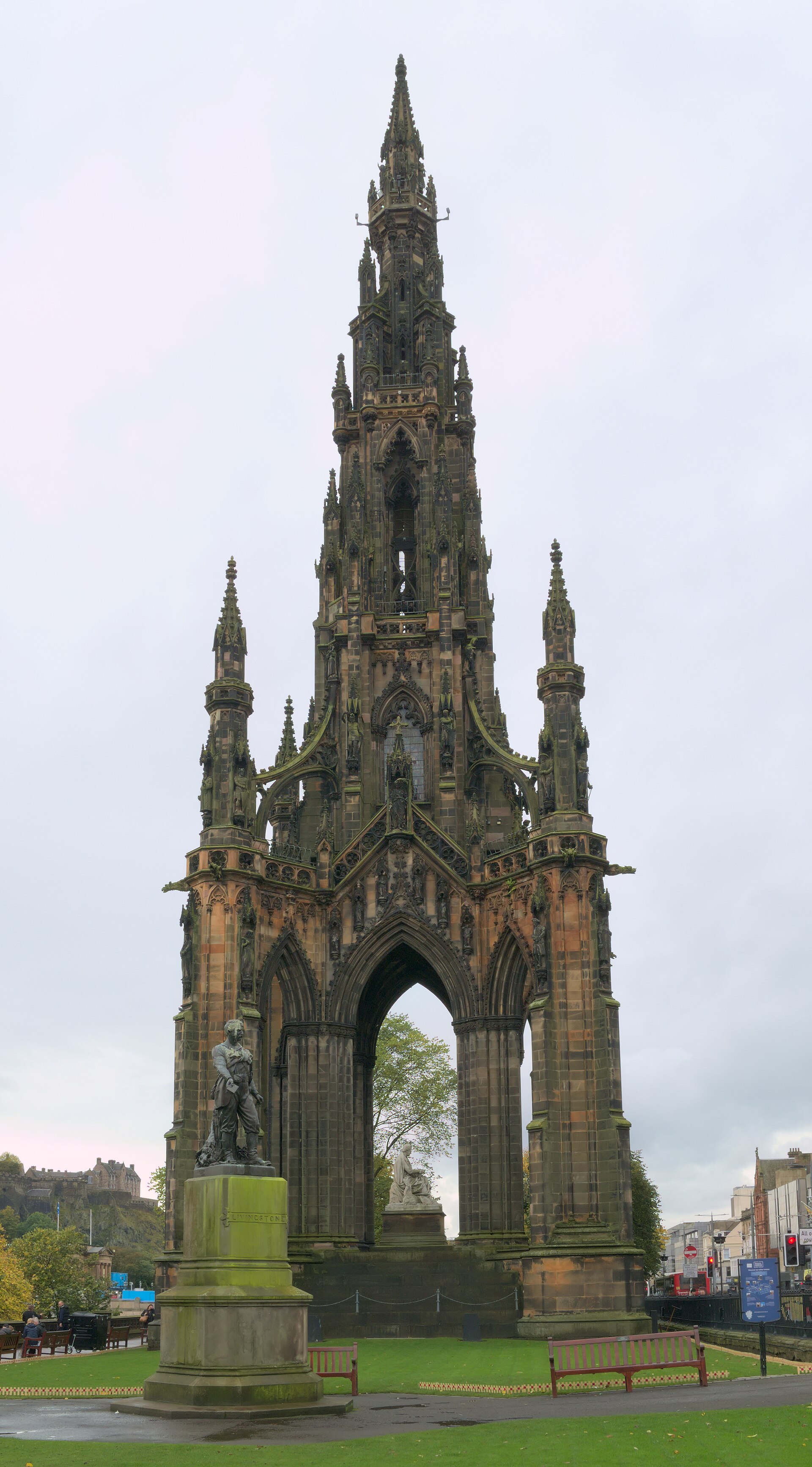
Scott Monument
Princes Street, Princes Street, Edinburgh, EH1, United Kingdom
The largest monument to a writer anywhere in the world stands in the middle of Edinburgh like a Gothic rocket ship. At 61 metres tall, the Scott Monument is a Victorian fever dream of spires, arches, and staircases dedicated to Sir Walter Scott, the novelist who essentially invented the historical fiction genre and single-handedly revived Scottish national identity. The 287 steps to the top viewing platform wind through increasingly narrow spiral staircases that would make a claustrophobe weep, but the panorama from the top — castle, Calton Hill, Arthur's Seat, the Firth of Forth — makes it worth every breathless step. The monument carries 68 statues, not counting Scott and his dog Maida at the base. Sixty-four of these figures represent characters from Scott's novels, carved into every available niche and alcove. The architect, George Meikle Kemp, was a self-taught draughtsman and former shepherd who entered the design competition under a pseudonym and beat out Edinburgh's finest architects. He never saw his masterpiece completed — in March 1844, just months before the inauguration, Kemp drowned in the Union Canal while walking home in the dark. He was forty-nine. The monument was built from Binny sandstone quarried near Ecclesmachan in West Lothian. Unfortunately, this particular stone absorbs soot like a sponge, and within decades the monument had turned jet black from Edinburgh's coal-smoke pollution. It's been cleaned several times but always darkens again, giving it a brooding Gothic quality that suits Scott's romantic sensibility far better than fresh cream stone ever could. Construction ran from 1840 to 1844 and cost around £16,000, raised by public subscription. Scott's contribution to Edinburgh's identity was so enormous — he rediscovered the Honours of Scotland, orchestrated George IV's visit to Edinburgh in 1822, and made the Highlands fashionable — that the city essentially built him a cathedral.
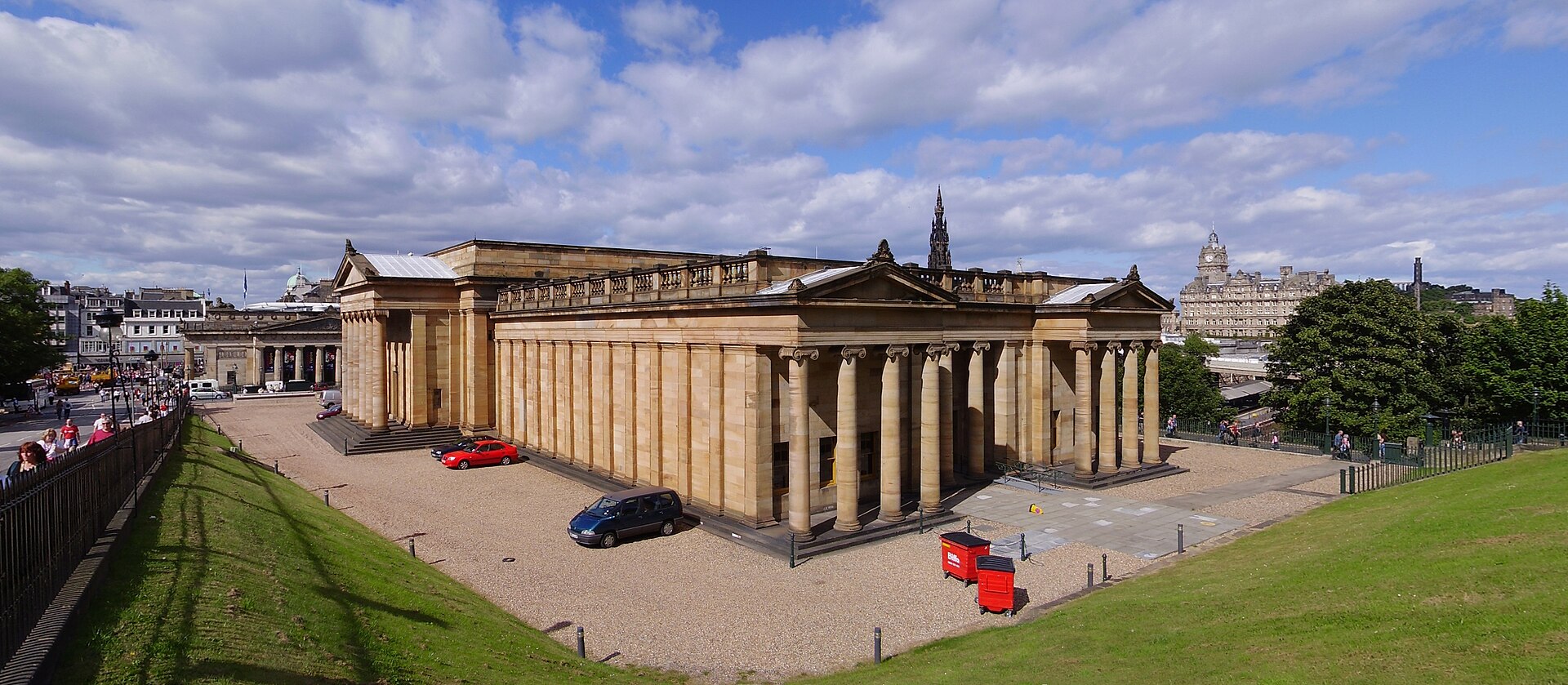
Scottish National Gallery
The Mound, Edinburgh EH2 2EL
William Henry Playfair designed this building in the form of a Greek temple, and Prince Albert laid the foundation stone in 1850. When it opened to the public in 1859, the building was split down the middle: the east half housed the Royal Scottish Academy's exhibitions, while the west half contained the new National Gallery. The Ionic columns of the gallery contrast with the Doric order of the RSA next door — a deliberate architectural conversation between the two buildings, like siblings dressed in different styles. The permanent collection spans from the Renaissance to the early twentieth century and contains over 96,000 works. Highlights include Botticelli's 'The Virgin Adoring the Sleeping Christ Child,' Raphael's 'Holy Family with a Palm Tree,' Velazquez, Vermeer, and a room full of Impressionists that's worth the visit alone — Monet's haystacks, Cezanne's 'Mont Sainte-Victoire,' and Gauguin's 'Three Tahitians.' The Scottish collection is equally strong, with Raeburn's 'Reverend Robert Walker Skating on Duddingston Loch' — the minister skating in his black coat — being perhaps the most reproduced Scottish painting in existence. The Playfair Project in the early 2000s created an underground connection — the Weston Link — between the gallery and the renovated RSA, opening in 2004. This subterranean space includes galleries, a restaurant, and a direct entrance from Princes Street Gardens, solving the problem of how to expand a protected neoclassical building without touching its facade. It's one of Edinburgh's more elegant architectural solutions. Admission is free, and the gallery sits in arguably the finest position of any art museum in Britain: looking north to the Firth of Forth, south to the castle, with Princes Street Gardens flowing below like a moat of green.
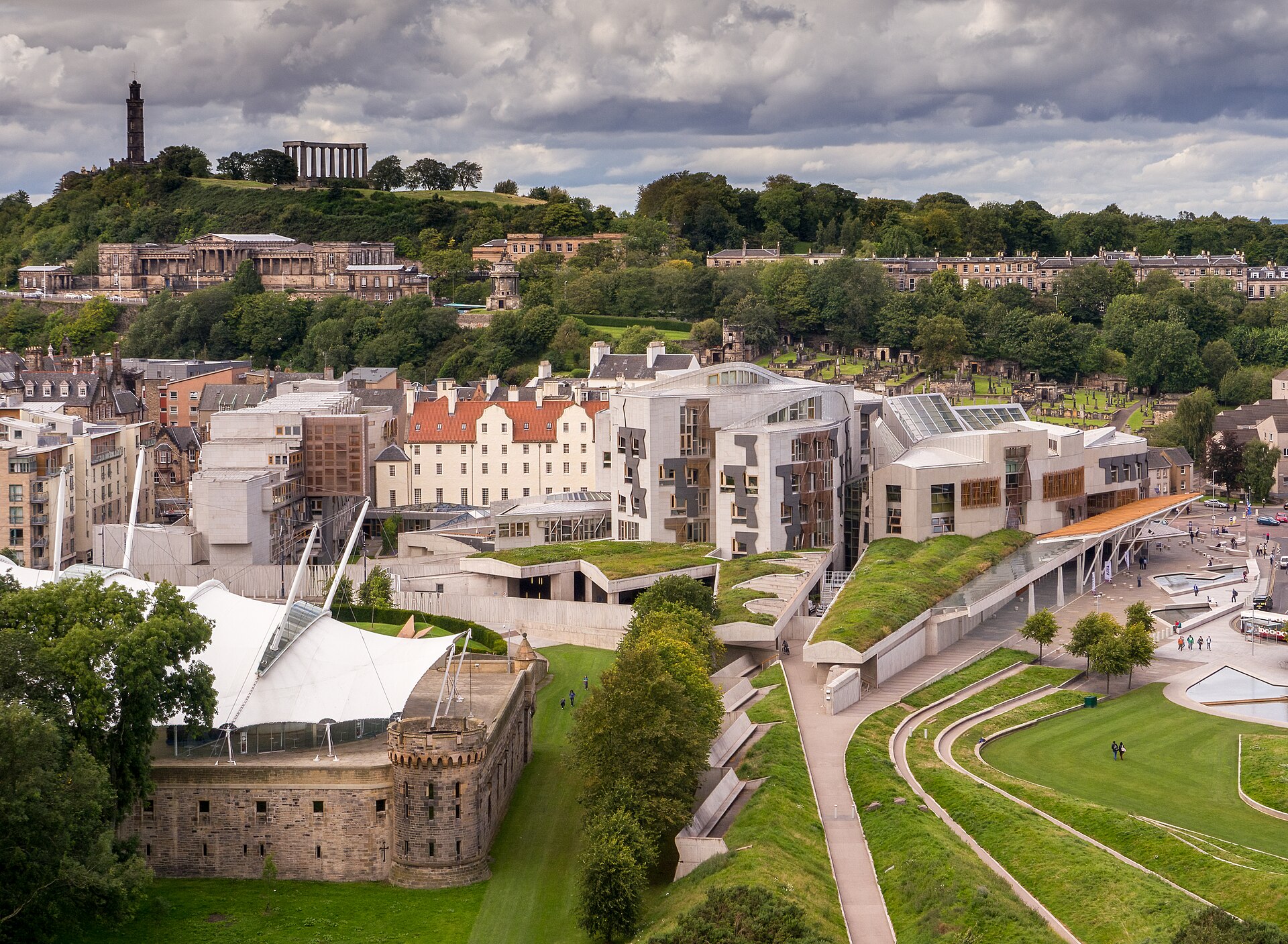
Scottish Parliament Building
Horse Wynd, Edinburgh EH99 1SP
This building was supposed to cost £40 million. It ended up costing £414 million, arrived three years late, and was designed by a Spanish architect who died before it was finished. The Scottish Parliament Building is either a catastrophic waste of public money or one of the greatest pieces of architecture built in Britain in the last century, depending on whom you ask. Among architects and critics, the answer is increasingly the latter — it won the Stirling Prize in 2005, Britain's most prestigious architecture award, posthumously honouring its creator Enric Miralles. Miralles's design is unlike anything in Edinburgh. He drew inspiration from the Scottish landscape, borrowing forms from upturned boats on the nearby shoreline and motifs from Charles Rennie Mackintosh's flower paintings. The result is a building made of steel, oak, and granite that seems to grow organically from the ground at the foot of Arthur's Seat. The three vaults of the Main Hall were cast on-site and include abstract designs of the Saltire cross. Every detail was considered: the windows of the MSPs' offices are shaped like contemplative eyes, the exterior walls undulate like leaves, and the entire structure was meant to embody the connection between the Scottish people and their land. The building opened on 9 October 2004 when Queen Elizabeth II formally inaugurated it, seven years after Scotland voted for devolution in the 1997 referendum. For the general public, the parliament was initially famous only for being overdue and over budget. But attitudes have softened over two decades, and visitors today are struck by how the interior spaces — wood-panelled debating chambers, light-filled corridors, the dramatic Canongate Wall — create a genuinely inspiring democratic space. Tours of the building are free, and you can sit in the public gallery and watch MSPs debate. It's democracy at work, in a building that nearly bankrupted the democracy before it began.
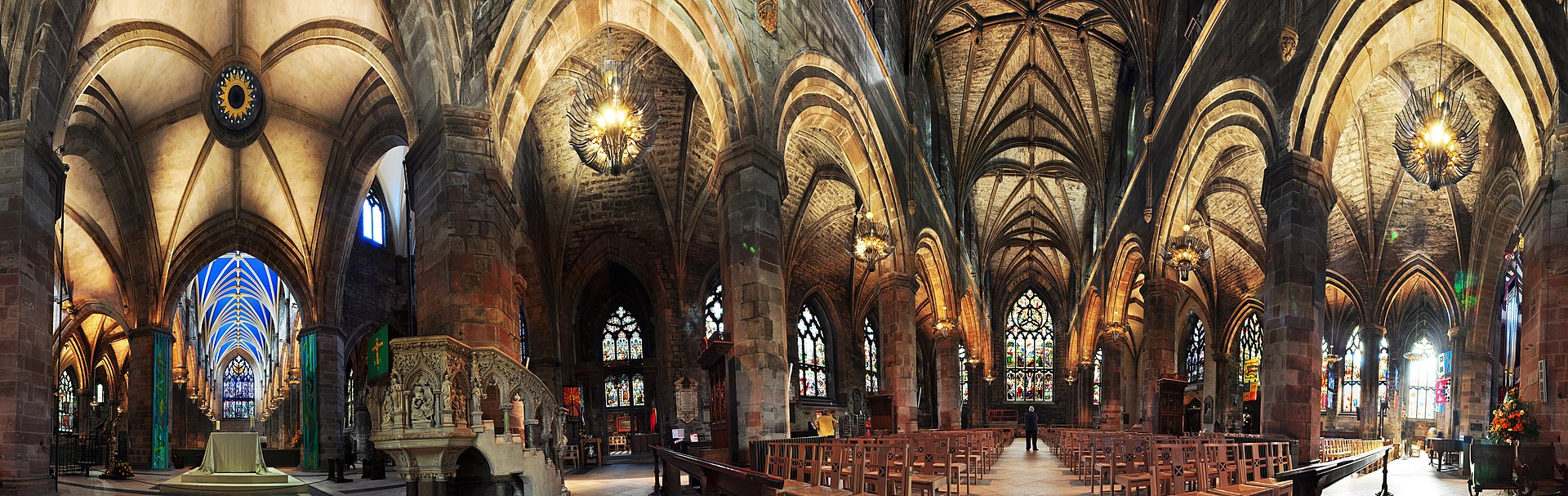
St Giles' Cathedral
High Street, Edinburgh EH1 1RE
In 1637, a market trader named Jenny Geddes supposedly hurled a wooden stool at the minister's head when he tried to read from the new Anglican prayer book that Charles I was forcing on the Scottish Kirk. Whether Jenny was real or a convenient folk legend, the riot that erupted in St Giles' that July day set off a chain of events — the National Covenant, the Bishops' Wars, and ultimately the Wars of the Three Kingdoms that would cost Charles his head. A stool in the cathedral gift shop claims to be hers. The crown steeple is the cathedral's glory — an open imperial crown of stone arches dating to between 1460 and 1467, one of only two surviving medieval crown steeples in Scotland. Eight stone buttresses spring from the tower, four from the corners and four from the centre of each side, creating a structure so distinctive it became Edinburgh's unofficial emblem. John Mylne the Younger repaired it in 1648 and added the decorative pinnacles halfway up the crests that give it its lace-like silhouette. John Knox, the thundering voice of the Scottish Reformation, served as minister here from 1559 and essentially ran the city from this pulpit. The building has been called "the Mother Church of World Presbyterianism" ever since. Before Knox, Richard II of England burned it in 1385. After Knox, it was partitioned into four separate churches, used as a prison, a police station, and even a storehouse for the town's guillotine — Edinburgh's version of the French device, called "The Maiden," which claimed around 150 heads between its first use in 1564 and retirement in 1710. The Thistle Chapel, added in 1911, is one of the finest examples of Gothic Revival in Britain. Every surface is carved — angels, animals, and a bagpipe-playing angel who was the stonemason's private joke. The chapel seats only sixteen members of the Order of the Thistle, Scotland's highest chivalric order.
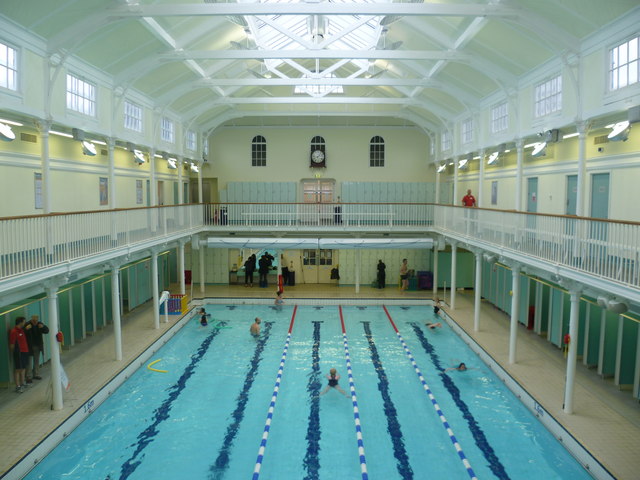
Stockbridge
Stockbridge, Edinburgh EH4
This neighbourhood got its name in the most literal way possible: timber planks laid across the Water of Leith as a "stock bridge" for people to cross. A proper stone bridge replaced the planks in 1786, and the area began its transformation in 1813 when the painter Sir Henry Raeburn — Scotland's finest portraitist — started developing his landholdings here with architect James Milne. The elegant streets Raeburn laid out are still named for his family: Raeburn Place, Ann Street (after his wife), and Deanhaugh Street. Between Glenogle Road and the Water of Leith sit the Stockbridge Colonies — twelve parallel streets of identical workers' cottages built between 1861 and 1911 by the Edinburgh Co-operative Building Company. These were radical social housing: designed to give working-class families their own front doors, gardens, and access to fresh air. The upper flats are accessed from the back, the lower from the front, so every household has ground-level entry. They're now some of Edinburgh's most sought-after addresses, tiny but charming, with communal gardens that bloom extravagantly in summer. The Sunday Stockbridge Market in Jubilee Gardens is a neighbourhood ritual — artisan breads, Scottish smoked salmon, handmade cheeses, craft gin, and enough baked goods to ruin any diet. The original Stockbridge Market was built in 1825, modelled after Liverpool's market, and operated for over seventy-five years before complaints about noise and odours shut it down. The modern version, launched in 2011, is considerably more genteel. Stockbridge maintains a village atmosphere that feels distinctly separate from the city centre, despite being a fifteen-minute walk from Princes Street. Independent bookshops, vintage stores, and artisan bakeries line the main streets, and the Water of Leith walkway threads through it all, connecting Dean Village upstream to the Royal Botanic Garden downstream.
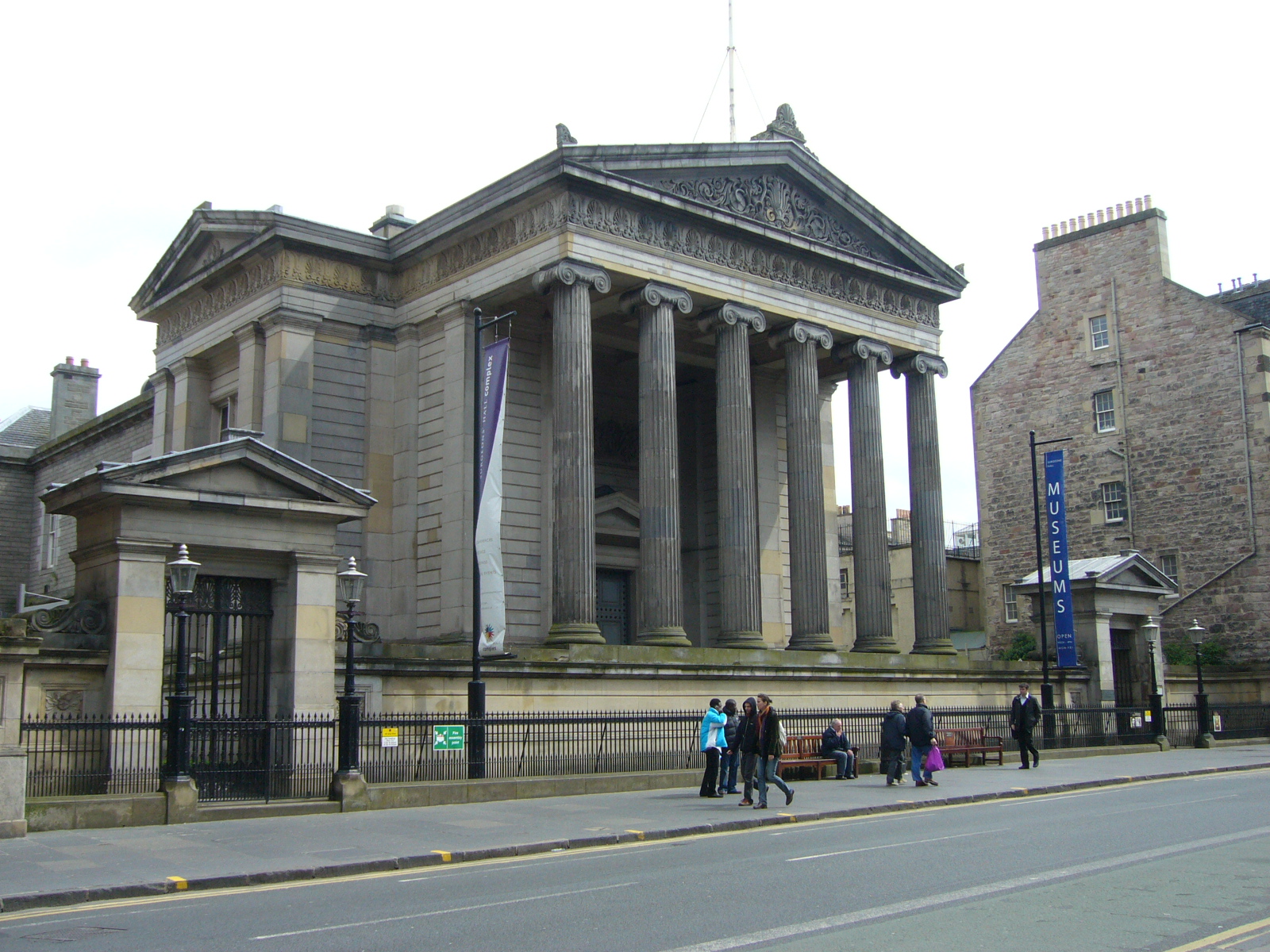
Surgeons' Hall Museums
Nicolson Street, Edinburgh EH8 9DW
There's a pocket notebook bound in the skin of a serial killer on display here, and it's one of the less unsettling items in the collection. William Burke was publicly executed in 1829 for murdering at least sixteen people and selling their bodies to Dr Robert Knox at the Royal College of Surgeons for anatomy dissection. After his hanging, Burke was publicly dissected — fitting justice, the crowd agreed — and his skin was tanned and used to bind several items, including this notebook. His death mask also stares out from a glass case nearby. His partner William Hare turned King's evidence and walked free. The Royal College of Surgeons of Edinburgh received its charter on 1 July 1505, making it one of the oldest surgical corporations in the world. The museum has been collecting "natural and artificial curiosities" since 1699, and the current building was designed by William Henry Playfair and completed in 1832. The collection has been open to the public since then, making it one of Scotland's oldest museums. The neoclassical facade on Nicolson Street is one of Playfair's finest works. The Wohl Pathology Museum upstairs is not for the squeamish. Rows of specimens in glass jars document every manner of disease, injury, and medical anomaly collected over three centuries of surgical practice. The dental collection shows what happened to your teeth before anaesthesia and fluoride. Together they tell the story of medicine's long, painful, and frequently gruesome journey from barber-surgeons to modern science. Edinburgh became the body-snatching capital of Britain because its medical school was so good that demand for cadavers outstripped the legal supply. The Anatomy Act of 1832, passed largely in response to Burke and Hare's crimes, finally regulated the supply of bodies for medical research — but not before Edinburgh's graveyards had been fitted with iron mortsafes and watchtowers to guard the dead.
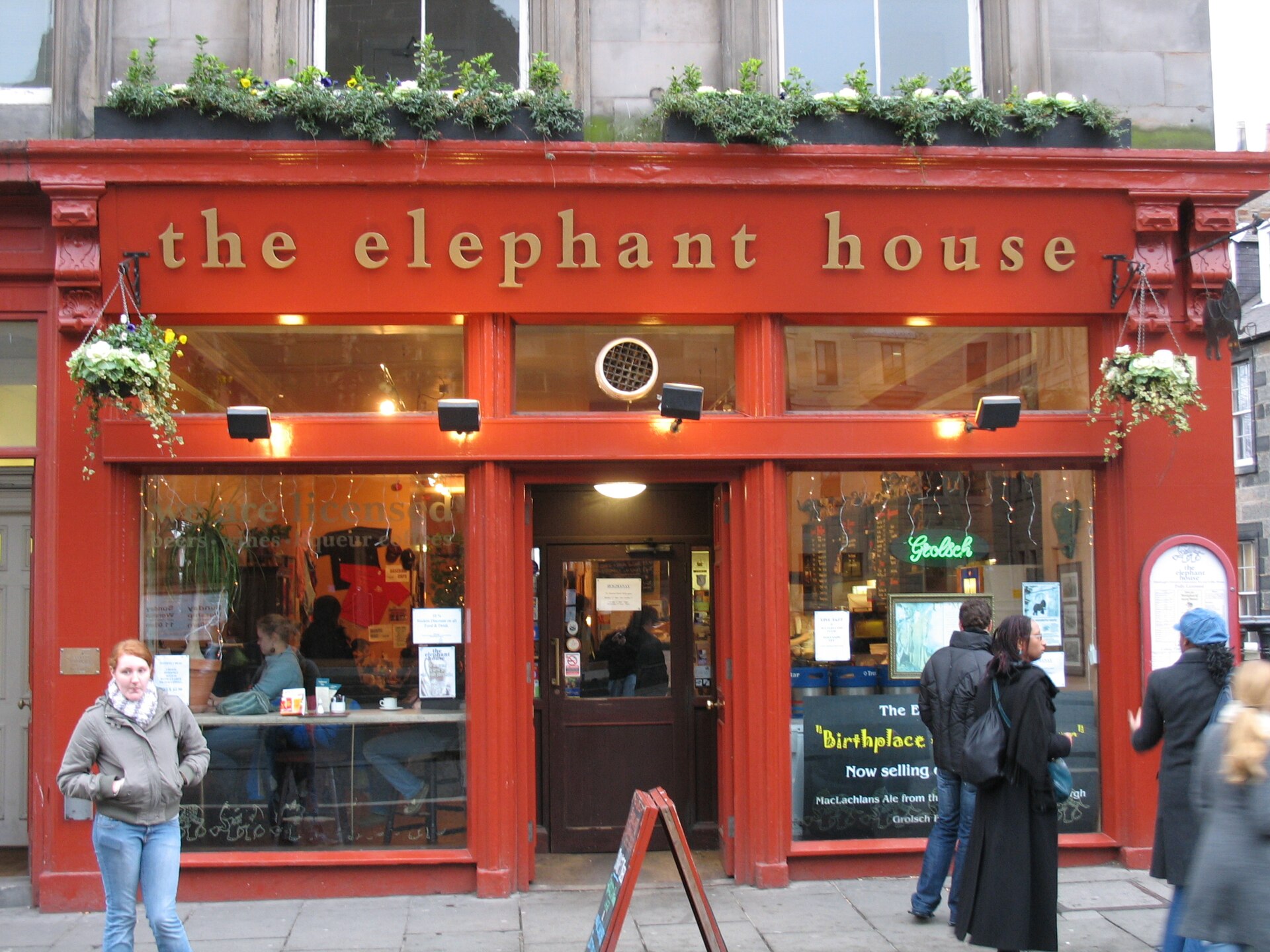
The Elephant House
21 George IV Bridge, Edinburgh EH1 1EN
This unassuming cafe on George IV Bridge calls itself the "Birthplace of Harry Potter," which is not strictly true — J.K. Rowling had been working on the first book for several years before she ever walked through the door. But she did write substantial portions of the early Potter novels at a window table here, nursing cups of coffee while her baby daughter slept beside her. Her favourite seat looked out toward Edinburgh Castle and, more importantly, directly over Greyfriars Kirkyard, where she found headstone names that would become some of literature's most famous characters. Tom Riddell — a real Edinburgh merchant buried in Greyfriars — became Tom Riddle, Lord Voldemort. William McGonagall, Scotland's notoriously terrible poet, lent his surname to Professor Minerva McGonagall. Several Moodie headstones are scattered among the graves below. The coincidence of a struggling writer sitting above a graveyard full of future character names is almost too perfect, like something from one of her own books. The cafe was founded in 1995, and in its early years it was simply a well-regarded coffee shop with an elephant theme. Other notable Edinburgh writers worked here too, including Ian Rankin and Alexander McCall Smith. But the Harry Potter connection transformed it into a global pilgrimage site, with fans covering the bathroom walls in messages and graffiti. The building suffered extensive damage in a fire in August 2021, and after a major renovation it reopened in December 2025 with a dedicated Writers' Room featuring Rowling's salvaged table. On any given day, a queue stretches down George IV Bridge. Most visitors want a photo and a coffee. The view from the back windows — castle, kirkyard, George Heriot's School — remains exactly as Rowling would have seen it while inventing a world that changed children's literature forever.
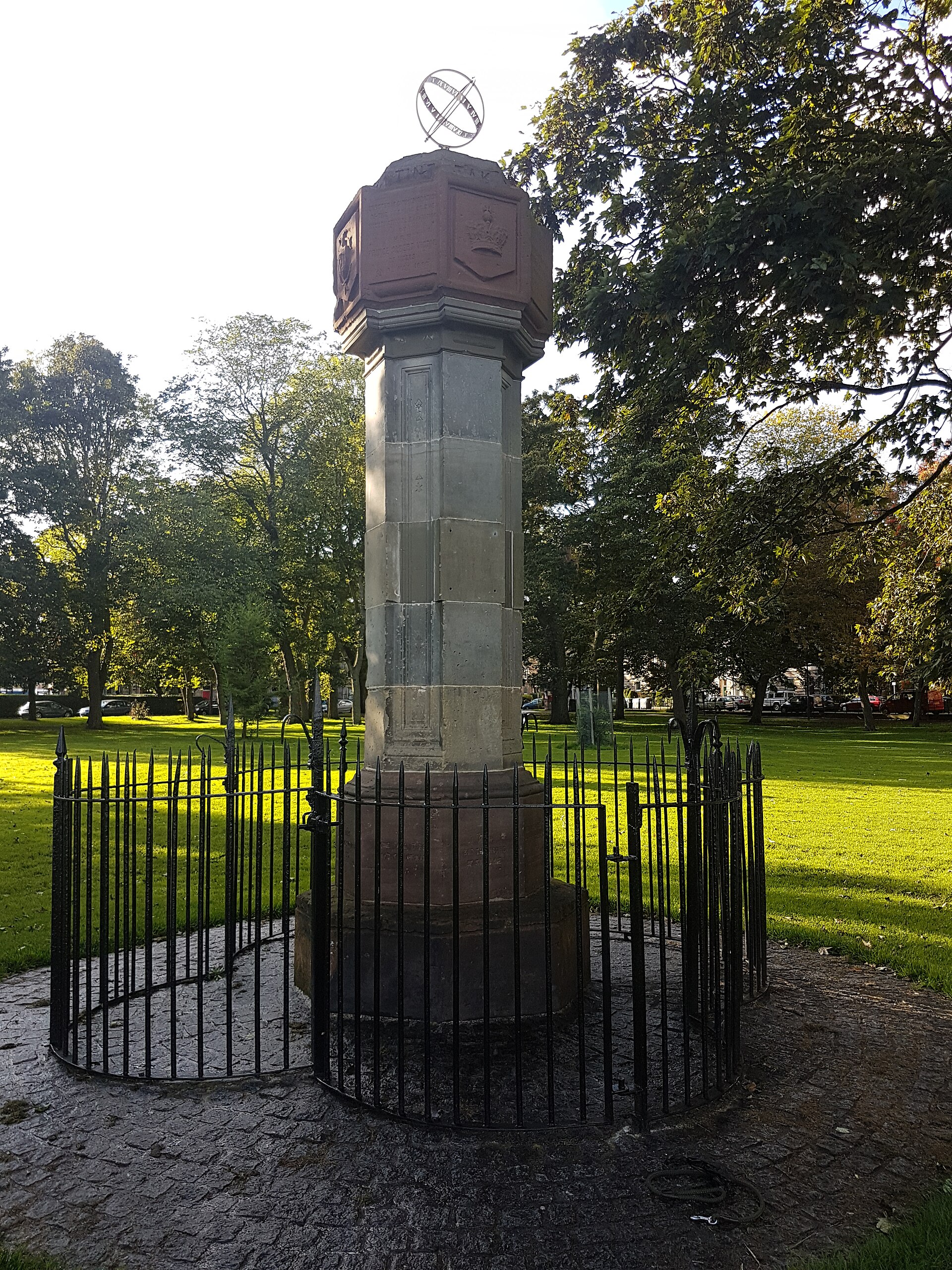
The Meadows
Melville Drive, Edinburgh EH9 1ND
Like Princes Street Gardens to the north, the Meadows was once a loch. The "Burgh Loch" or "South Loch" covered much of this area for centuries — the street names Lochrin Buildings and Lochrin Place in nearby Tollcross derive from the burn that fed it. In 1722, Sir Thomas Hope ordered drainage works and transformed the marshy land into a park with lime tree avenues, hedges, and a summer house. By 1827, an Act of Parliament protected the Meadows from ever being built upon — a piece of legislative foresight that Edinburgh residents have been grateful for ever since. The most extraordinary event in the Meadows' history was the International Exhibition of Industry, Science and Art in 1886, when a substantial portion of the park was temporarily built over with exhibition halls, pavilions, and attractions. It was Edinburgh's answer to the great Victorian exhibitions, drawing enormous crowds. When the exhibition ended, the buildings came down and the Meadows returned to green space. A single whale jawbone arch, gifted by a Shetland whaling company, survived as a park landmark for over a century before being replaced with a replica. Today the Meadows is Edinburgh's communal living room — the flat, tree-lined green space where students study, families picnic, and impromptu cricket matches materialise on any dry weekend. The cherry blossom avenue along the north side explodes into pink every April, drawing photographers from across the city. In summer, circus tents appear, and the annual Meadows Festival — running since 1974 — fills the park with live music, stalls, and community events. The park sits between the university quarter and the leafy southside neighbourhoods of Marchmont and Bruntsfield, making it the natural crossroads of Edinburgh's younger population. After dark in August, you can lie on the grass and watch distant fireworks from the Edinburgh Festival rising over the Old Town skyline.
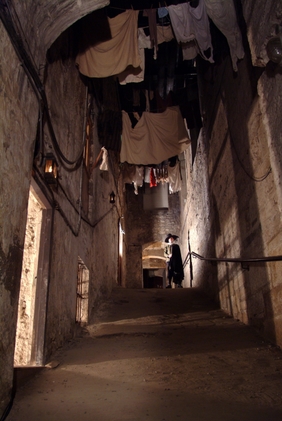
The Real Mary King's Close
2 Warriston's Close, High Street, Edinburgh EH1 1PG
Beneath the Royal Mile, a seventeenth-century street is frozen in time. Mary King's Close was a bustling residential lane where hundreds of people lived in tenements up to seven storeys high, sharing narrow winding passages with no sewers — waste was simply thrown from upper windows into the street below. When the Royal Exchange was built on top in the eighteenth century, the close was sealed and largely forgotten. The last resident left in 1902. In 2003, after careful preservation, the underground warren reopened as a heritage attraction, and visitors now walk through rooms where the original stone walls, fireplaces, and even seventeenth-century graffiti survive. The close is named after Mary King, a fabric merchant who built her business in the 1630s after her husband's death — an unusual achievement for a woman in Restoration Edinburgh. In 1645, the city's worst outbreak of bubonic plague swept through these overcrowded lanes. Contrary to the persistent myth that city officials sealed the residents inside to die, the town council actually managed the outbreak with surprising compassion: sick families unable to move put white flags in their windows so that food and coal could be delivered to their doors. Healthy residents were relocated to Burgh Muir. The plague doctor George Rae walked these closes in leather from head to toe, wearing the famous bird-shaped mask stuffed with herbs. The leather kept fleas from biting him, and he survived the outbreak — which is more than can be said for roughly half of Mary King's Close's residents. The plague killed hundreds in the immediate area alone. One of Edinburgh's most popular ghost stories lives here: a ten-year-old girl named Annie, said to have died of plague, whose spirit supposedly haunts a small room in the close. Visitors leave toys, dolls, and sweets for her, creating a strange and moving shrine in the underground dark.
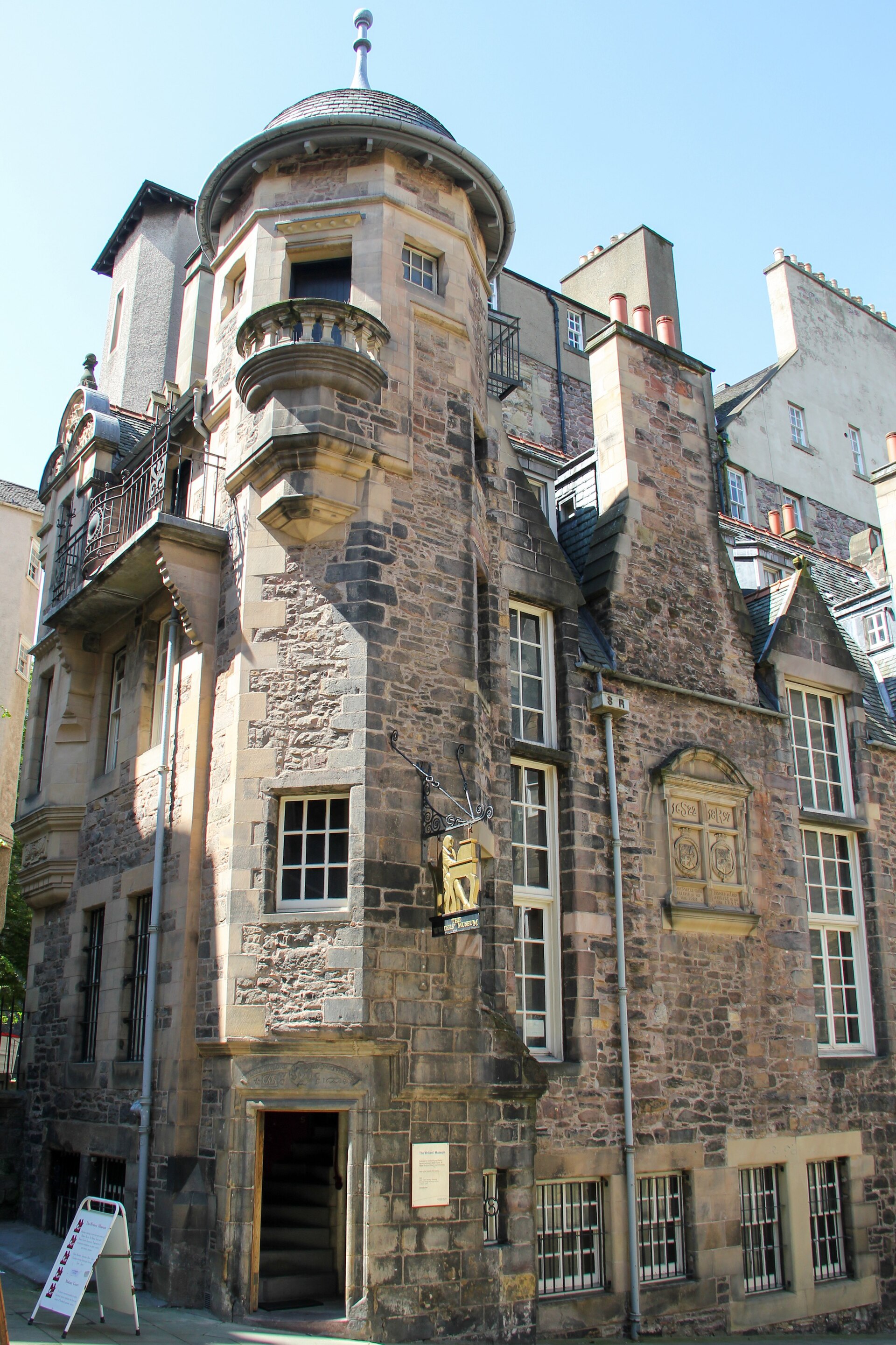
The Writers' Museum
Lady Stair's Close, Lawnmarket, Edinburgh EH1 2PA
Tucked down a narrow close off the Lawnmarket, a seventeenth-century townhouse holds one of literature's strangest collections: a plaster cast of Robert Burns's skull, Sir Walter Scott's rocking horse, and the ring a Samoan chief gave Robert Louis Stevenson. The Writers' Museum celebrates Scotland's three greatest literary exports in a building that's almost as interesting as its contents — Lady Stair's House dates from 1622, though it was substantially rebuilt in 1892 in a faux-medieval style that somehow suits its eccentric cargo perfectly. The Burns room contains his writing desk and one of only three plaster casts ever made of his skull, taken when his coffin was briefly opened in 1834. Scott's collection includes his dining table from 39 Castle Street, his chess set, and that childhood rocking horse — reminders that the man who reinvented Scottish identity was also a deeply sentimental father and homemaker. Stevenson's section has his riding boots from the South Pacific, where he spent his final years in Samoa, worshipped by islanders who called him "Tusitala" — teller of tales. Lady Stair's Close itself is worth the visit. The narrow passage threading between tall stone walls is one of the Royal Mile's most atmospheric approaches, and the small courtyard where the museum entrance sits feels removed from the tourist bustle just metres away. Literary quotations from Scottish writers are embedded in the paving stones of the courtyard, forming a "Makars' Court" (makar being Scots for poet). The museum became the Writers' Museum in 1962, and it's free to enter — a rare bargain for three centuries of literary genius compressed into a few beautiful rooms. Most visitors to the Royal Mile walk straight past the close without noticing. That's rather the point.
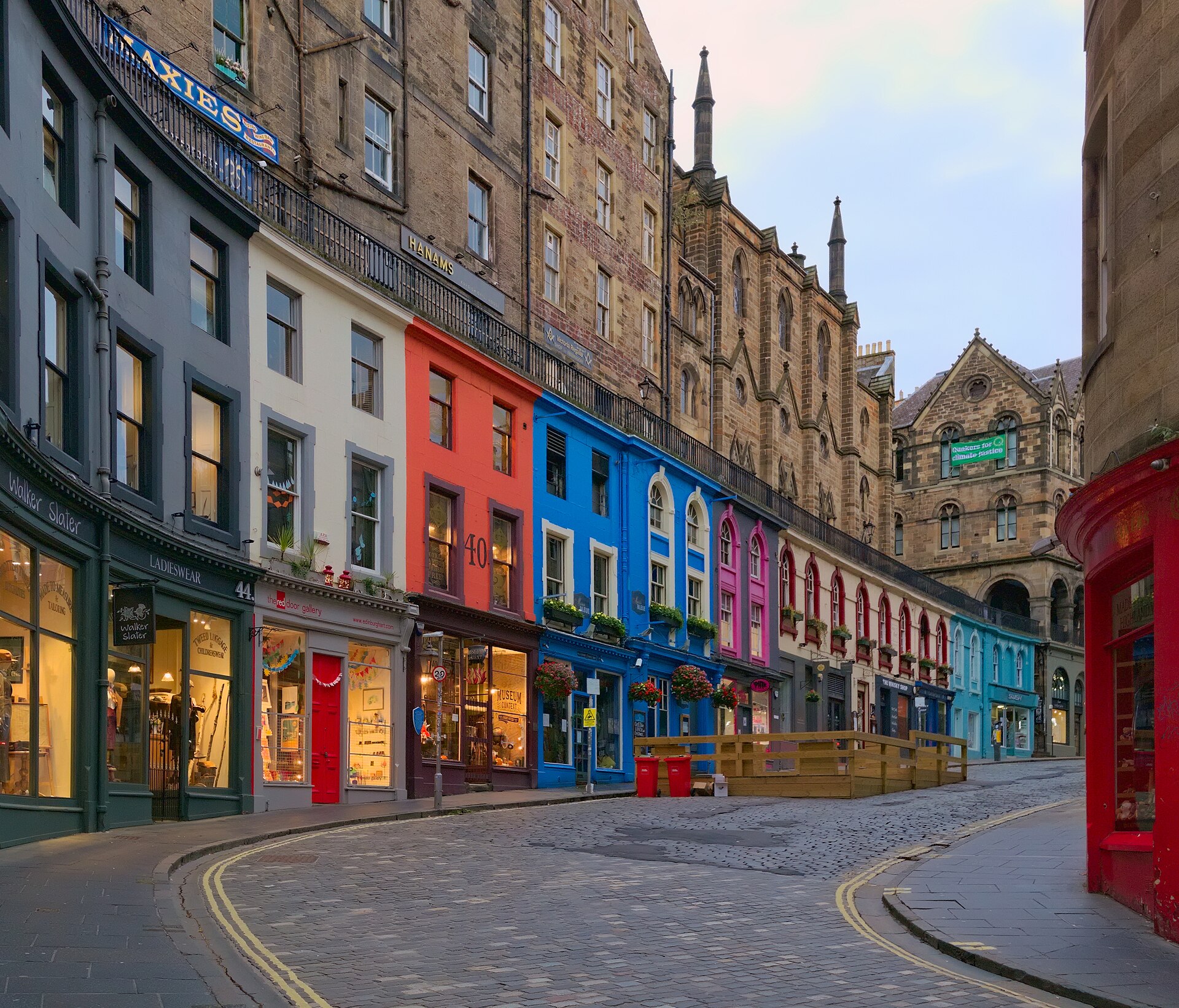
Victoria Street
Victoria Street, Edinburgh EH1 2JW
Edinburgh's most photographed street curves downhill from the Royal Mile to the Grassmarket in a rainbow of painted facades that look like they were designed by someone who'd just read a particularly vivid fairy tale. Victoria Street is widely believed to have inspired J.K. Rowling's Diagon Alley — the cobbled, winding street lined with magical shopfronts where young wizards buy their school supplies. Rowling has never officially confirmed this, but she was living in Edinburgh while writing the early Harry Potter books, and the resemblance is hard to ignore. The street was built between 1829 and 1834, designed by architect Thomas Hamilton as part of a series of improvements to the Old Town. Its purpose was purely practical: creating a better route between the Royal Mile and the much lower Grassmarket. Hamilton's curving design follows the natural contour of the hillside, creating the sweeping arc that makes the street so photogenic. The upper walkway, called Victoria Terrace, runs along the rooftops of the shops below, giving you a bird's-eye view of the street and its surroundings. The colourful facades that make Victoria Street famous weren't part of the original Victorian plan. They evolved organically as different businesses painted their shopfronts to stand out from their neighbours, creating the patchwork of reds, blues, yellows, and greens that gives the street its storybook character. It's a happy accident of commercial competition. Independent shops have always defined Victoria Street. Aha Ha Ha — a joke and magic shop — has occupied one of the curved shopfronts for decades, and there are specialist cheese shops, vintage clothing stores, and whisky bars lining both sides. During the Edinburgh Fringe in August, the street becomes a stage for buskers and performers, with the castle looming theatrically above.