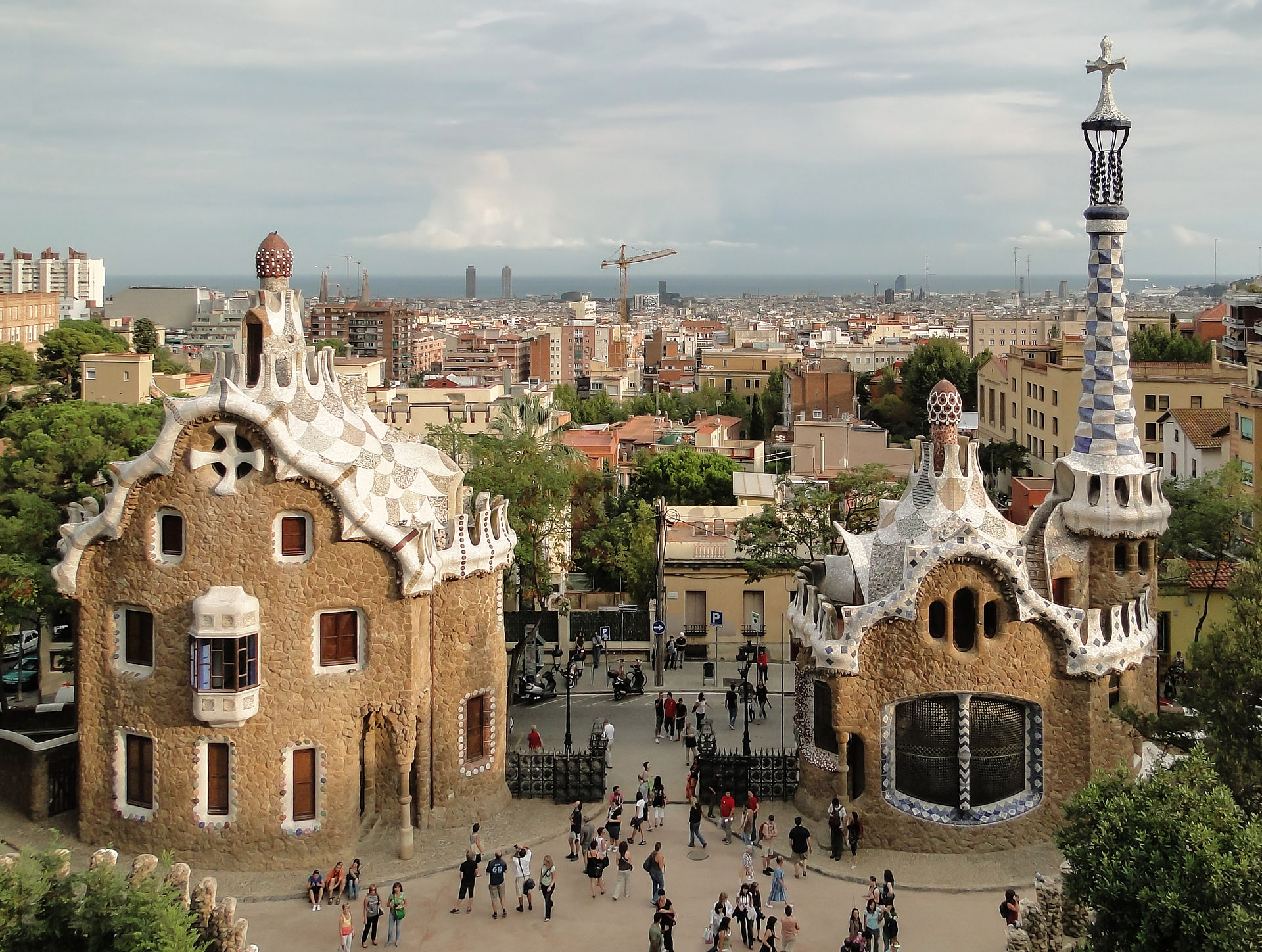
Park Guell was supposed to be a gated community for Barcelona's wealthy elite, and it was a spectacular commercial failure. Industrialist Eusebi Guell commissioned Gaudi in 1900 to build a luxury housing estate on a rocky hillside with views of the city and the sea. The plan called for sixty homes surrounded by gardens, markets, and communal spaces — a Catalan version of an English garden city, which is why it's spelled "Park" in English rather than "Parc" in Catalan.
Construction ran from 1900 to 1914, and in that time exactly two of the sixty planned homes were built. One of them was bought by Gaudi himself, who lived there from 1906 until shortly before his death in 1926 — it's now a small museum. The market area became the famous Sala Hipostila, a forest of 86 Doric columns originally designed to support a marketplace above. Water from the terrace above filters through the columns and feeds the dragon fountain at the entrance.
That dragon — or salamander, depending on who you ask — is probably Barcelona's most photographed non-building. Covered in colorful trencadis mosaic, it guards the entrance stairway and has become an unofficial mascot of the city. The serpentine bench on the terrace above, designed in collaboration with Gaudi's assistant Josep Maria Jujol, is covered in shattered tile fragments and is ergonomically shaped to fit the human body — Gaudi reportedly had workers sit in wet clay to determine the perfect curve.
After Guell died in 1918, his heirs sold the park to the city. It opened as a municipal park in 1926 and was declared a UNESCO World Heritage Site in 1984. The monumental zone now requires timed tickets, but the surrounding forested areas remain free and are where locals actually go to walk their dogs and escape the crowds.
Verified Facts
Originally planned as a luxury housing estate with 60 homes, only 2 were ever built before the project was abandoned in 1914
Gaudi lived in one of the two completed houses from 1906 until shortly before his death in 1926
The Sala Hipostila contains 86 Doric columns originally designed as a marketplace support structure
Declared a UNESCO World Heritage Site in 1984 and opened as a municipal park in 1926 after the Guell heirs sold it to the city
Get walking directions
Carrer d'Olot, 08024 Barcelona