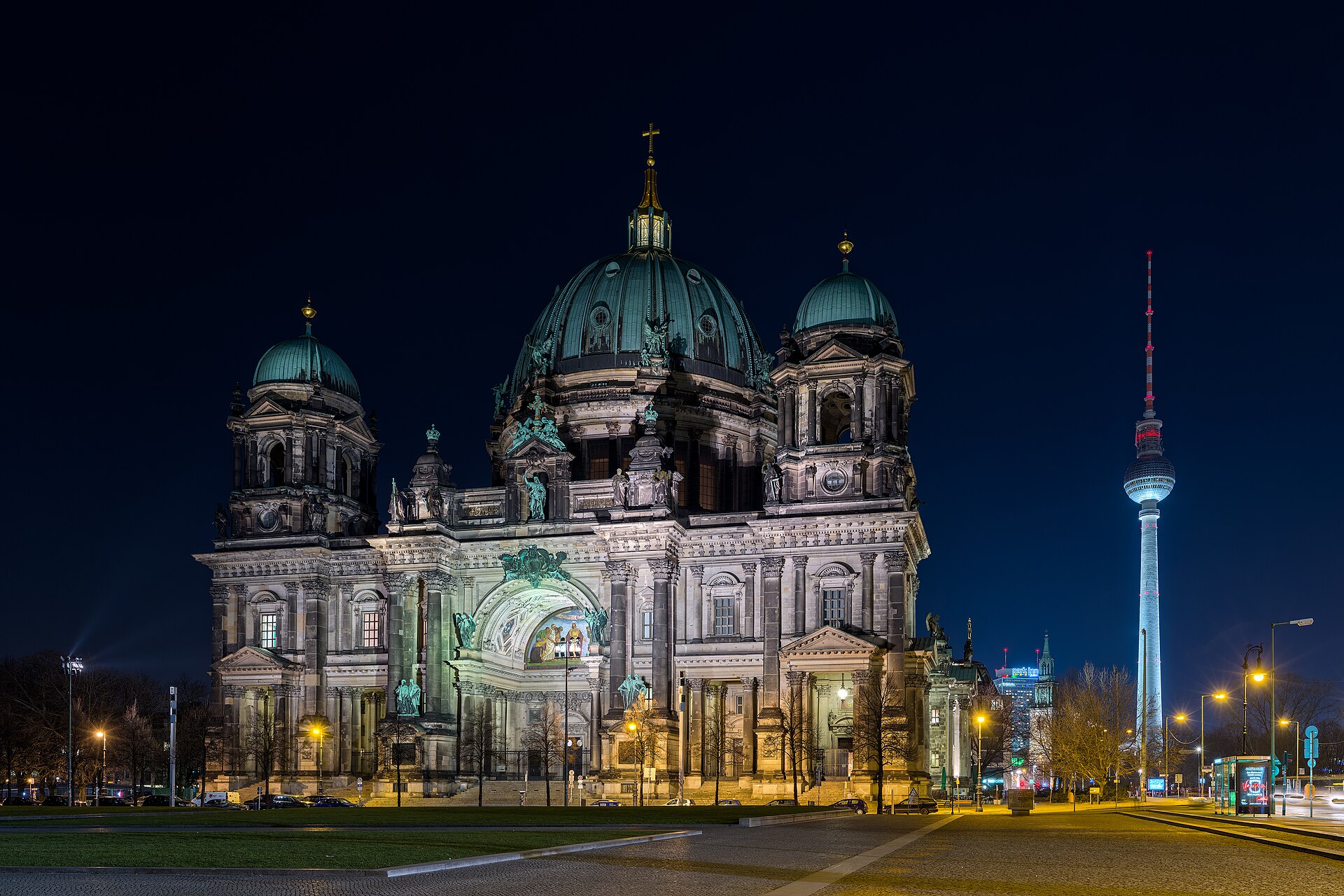
Kaiser Wilhelm II wanted his own St. Peter's Basilica, and this is what he got. Built between 1894 and 1905, the Berliner Dom was designed by Julius Raschdorff to be the grandest Protestant church in Germany — a direct challenge to Catholic Rome. It's technically not a cathedral at all, since it's never been the seat of a bishop, but nobody calls it anything else.
The dome is spectacular from inside — 114 metres high, decorated with mosaics and gilding that were painstakingly restored after the building was bombed in 1944. A British incendiary bomb hit the dome during a raid, and the resulting fire destroyed the interior. It took the rest of the century to repair. The GDR demolished the attached royal chapel in 1975 — they weren't interested in preserving Hohenzollern glory.
Climb the 270 steps to the dome walkway and you get one of the best views in Berlin: Museum Island below, Unter den Linden stretching west, the TV Tower looming to the east. Below the main church is the Hohenzollern Crypt, which reopened in 2026 after a decade of restoration. It contains 91 burials spanning five centuries of Prussian royal history, including elaborately decorated sarcophagi of the Great Elector Friedrich Wilhelm and his wife Dorothea.
The organ inside has 7,269 pipes. During services, the sound fills the entire nave and echoes off the dome in a way that makes the building feel alive.
Verified Facts
Built 1894-1905 by Julius Raschdorff under Kaiser Wilhelm II, intended as the grandest Protestant church in Germany
The Berliner Dom has never been a bishop's seat and is technically not a cathedral
The Hohenzollern Crypt contains 91 burials spanning 500 years of Brandenburg-Prussian history
Climbing to the dome walkway requires ascending 270 steps
Get walking directions
Am Lustgarten, City Centre, Berlin, 10178, Germany