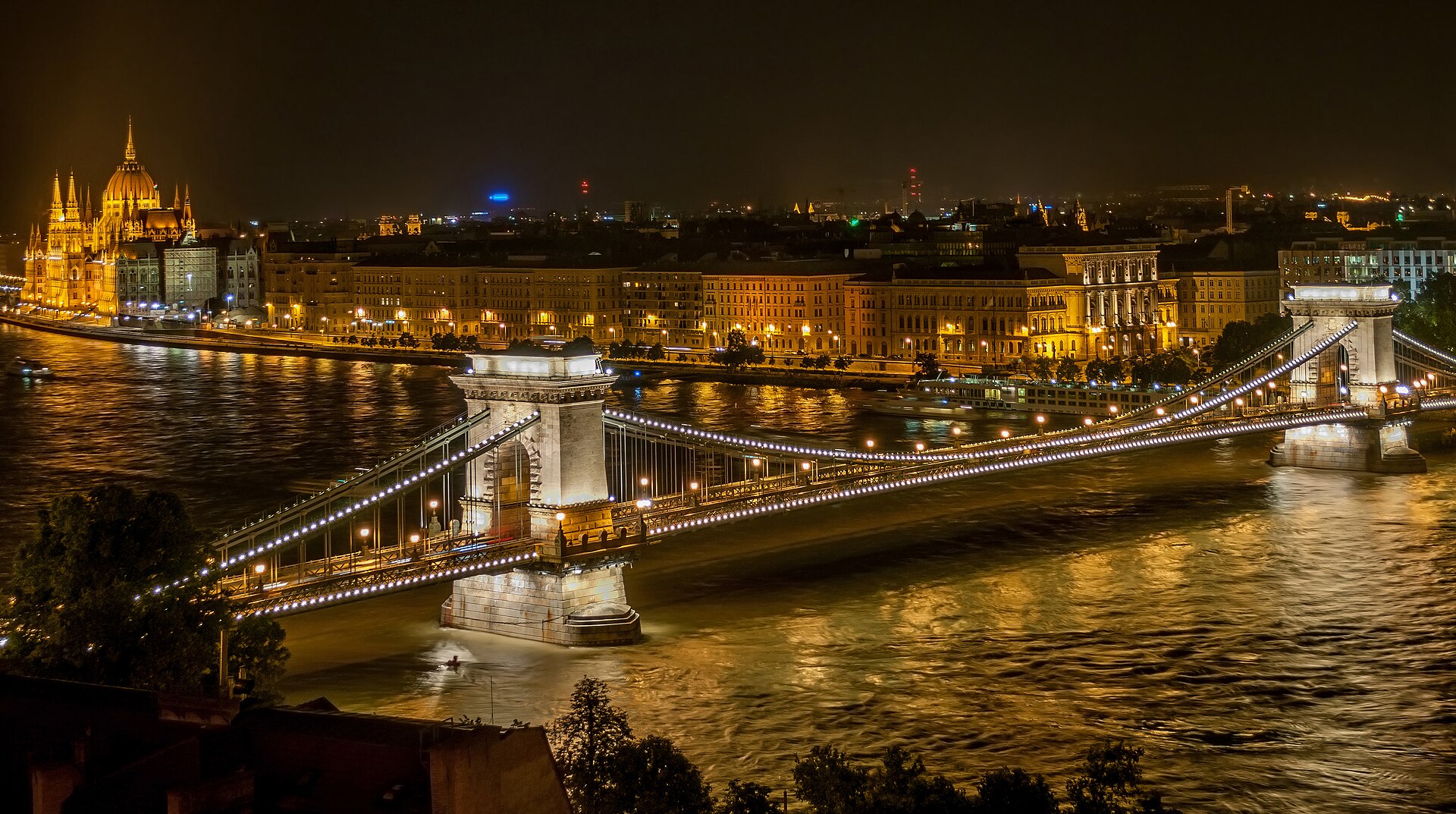
Before this bridge existed, getting from Buda to Pest in winter meant waiting for the Danube to freeze solid and walking across the ice — or not crossing at all. Count István Széchenyi, one of Hungary's greatest reformers, got stuck on the wrong side of the river for a week in 1820 when the ice was too thin to walk on but too thick for boats. He vowed to build a permanent crossing and spent the next two decades making it happen.
The bridge was designed by English engineer William Tierney Clark and built under the supervision of Scottish engineer Adam Clark — no relation, despite the shared surname and shared profession. It is essentially a scaled-up version of Tierney Clark's Marlow Bridge over the Thames in England, which still stands today as a quaint little crossing. The Chain Bridge was a different beast: 375 metres long, it was the longest suspension bridge in Europe when it opened on November 20, 1849. The sections were cast in England and shipped to Hungary for assembly.
Construction nearly ended in tragedy when the first chain was being raised and a link snapped, sending 400 tons of iron crashing into the Danube — almost killing Count Széchenyi, who was watching from a boat below. The stone lion statues that guard both ends were sculpted by János Marschalkó. Legend says a spectator pointed out the lions had no tongues, and Marschalkó threw himself into the river. The tongues are actually there — they are just not visible from ground level.
In January 1945, retreating German forces blew up the bridge, leaving only the stone towers standing. It was rebuilt and reopened in 1949, exactly one hundred years after its original inauguration.
Verified Facts
Designed by English engineer William Tierney Clark and supervised by Scottish engineer Adam Clark (no relation)
At 375 metres, it was the longest suspension bridge in Europe when it opened on November 20, 1849
German forces blew up the bridge in January 1945; it was rebuilt and reopened in 1949
A chain link snapped during construction, sending 400 tons of iron into the Danube, nearly killing Count Széchenyi
Get walking directions
Széchenyi Lánchíd, 1051 Budapest