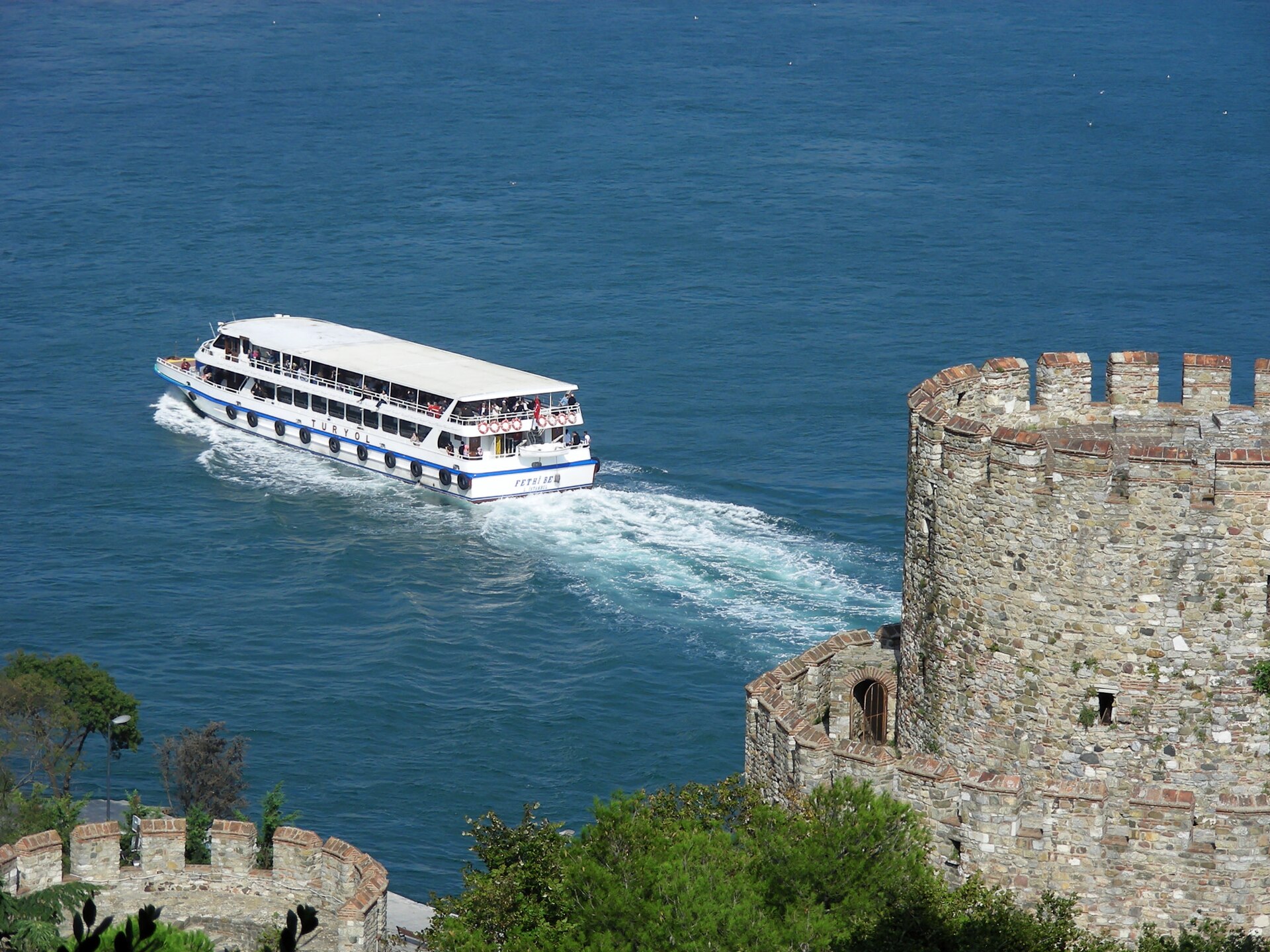
Sultan Mehmed II built this fortress in just four months, and it changed the course of history. In 1452, the 21-year-old sultan was planning the siege of Constantinople and needed to choke off the Bosphorus. He chose the narrowest point of the strait — just 660 meters across — and erected Rumeli Hisarı on the European shore, directly facing the older Anadolu Hisarı on the Asian side. Together, the two fortresses formed a throttle that could strangle all maritime traffic.
The construction speed was extraordinary. Beginning on April 15, 1452, approximately 300 master builders, 800 laborers, and 200 transport workers raised three main towers, thirteen watchtowers, and connecting walls in a project that was essentially a military operation in disguise. The fortress was initially called "Boğazkesen" — literally "strait cutter" or "throat cutter," a name that carried a deliberate double meaning. Any ship attempting to pass without permission was fired upon from the massive cannons mounted on the walls.
Less than a year after the fortress was completed, Constantinople fell. On May 29, 1453, Mehmed earned the title "the Conqueror," and the Rumeli Fortress had served its purpose. It was demoted to a customs checkpoint and later to a prison, and eventually to a kind of architectural afterthought — impressive but seemingly unnecessary once the strait was fully Ottoman.
Today the fortress is one of Istanbul's most atmospheric ruins. The walls climb steeply up the hillside from the Bosphorus waterfront, offering vertigo-inducing views of the strait, the Asian shore, and the Fatih Sultan Mehmet Bridge that soars overhead. The open-air amphitheater built inside the walls hosts concerts in summer, giving you the surreal experience of listening to jazz inside a 15th-century siege engine.
Verified Facts
The fortress was built in just four months beginning April 15, 1452, by approximately 300 master builders, 800 laborers, and 200 transport workers.
It was built at the narrowest point of the Bosphorus (660 meters) to work in tandem with the older Anadolu Hisarı on the Asian shore.
The fortress was originally called "Boğazkesen," meaning both "strait cutter" and "throat cutter," reflecting its military purpose.
Less than a year after the fortress was completed, Constantinople fell to Sultan Mehmed II on May 29, 1453.
Get walking directions
Yahya Kemal Cd., Hisar Ustu, Sariyer, 34470, Türkiye