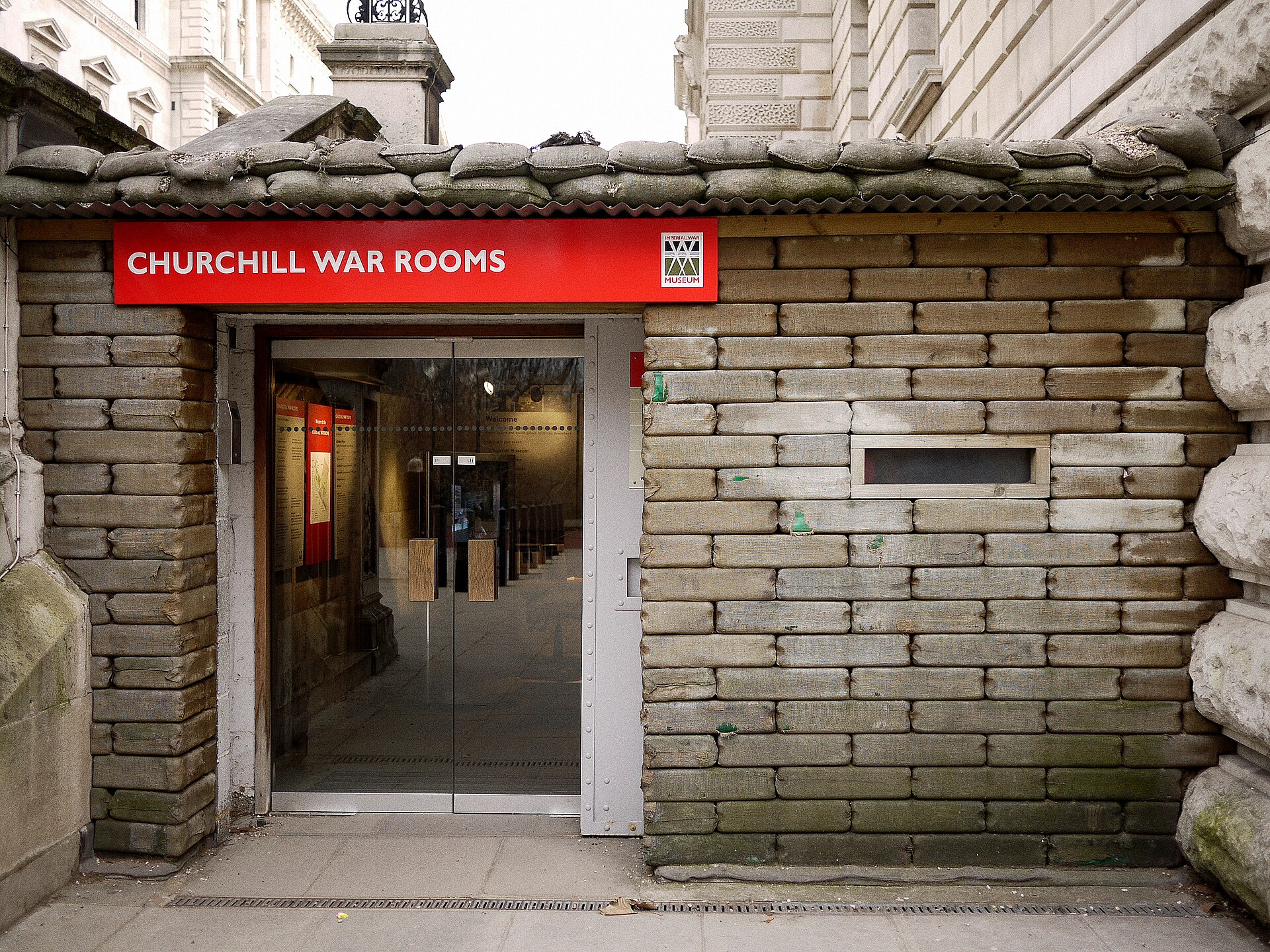
Churchill War Rooms
Beneath your feet right now is the bunker where the British government ran the Second World War. These rooms were operational from August nineteen thirty-nine to August nineteen forty-five — six years without interruption. The Map Room was manned twenty-four hours a day, every single day, for the entire war. When the lights were finally switched off on the fifteenth of August nineteen forty-five, the clocks, the maps, the pins — everything was left exactly as it was. That's what you see today. Not a recreation. The actual room.
Now, here's the detail that always gets people. Churchill needed a secure telephone line to President Roosevelt. Transatlantic calls were being intercepted by the Germans, so they installed a scrambled line with a device called SIGSALY that weighed eighty tonnes and filled a room. But they didn't want anyone to know it existed. So Churchill's end of the line was hidden inside a cupboard labelled as a toilet. The Transatlantic Telephone Room — arguably the most important phone in the war — was disguised as a lavatory.
One hundred and fifteen Cabinet meetings were held underground between nineteen thirty-nine and nineteen forty-five. The last was on the twenty-eighth of March nineteen forty-five. But despite building himself a bomb-proof bedroom down here, Churchill almost never slept in it. He stubbornly preferred to sleep at Ten Downing Street or the Number Ten Annexe above ground, even during the worst of the Blitz. His staff were apparently terrified. He didn't care.
The concrete slab protecting these rooms is only three feet thick. Government engineers privately assessed it wouldn't survive a direct hit. They chose not to tell Churchill.
Verified Facts
Map Room was manned 24 hours a day from August 1939 to August 1945 without interruption
Transatlantic Telephone Room to Roosevelt was disguised as a toilet cupboard
Churchill almost never slept in his underground bedroom, preferring 10 Downing Street even during the Blitz
115 Cabinet meetings held underground between 1939 and 1945, last on 28 March 1945
Get walking directions
King Charles Street, City of Westminster, London, SW1A, United Kingdom