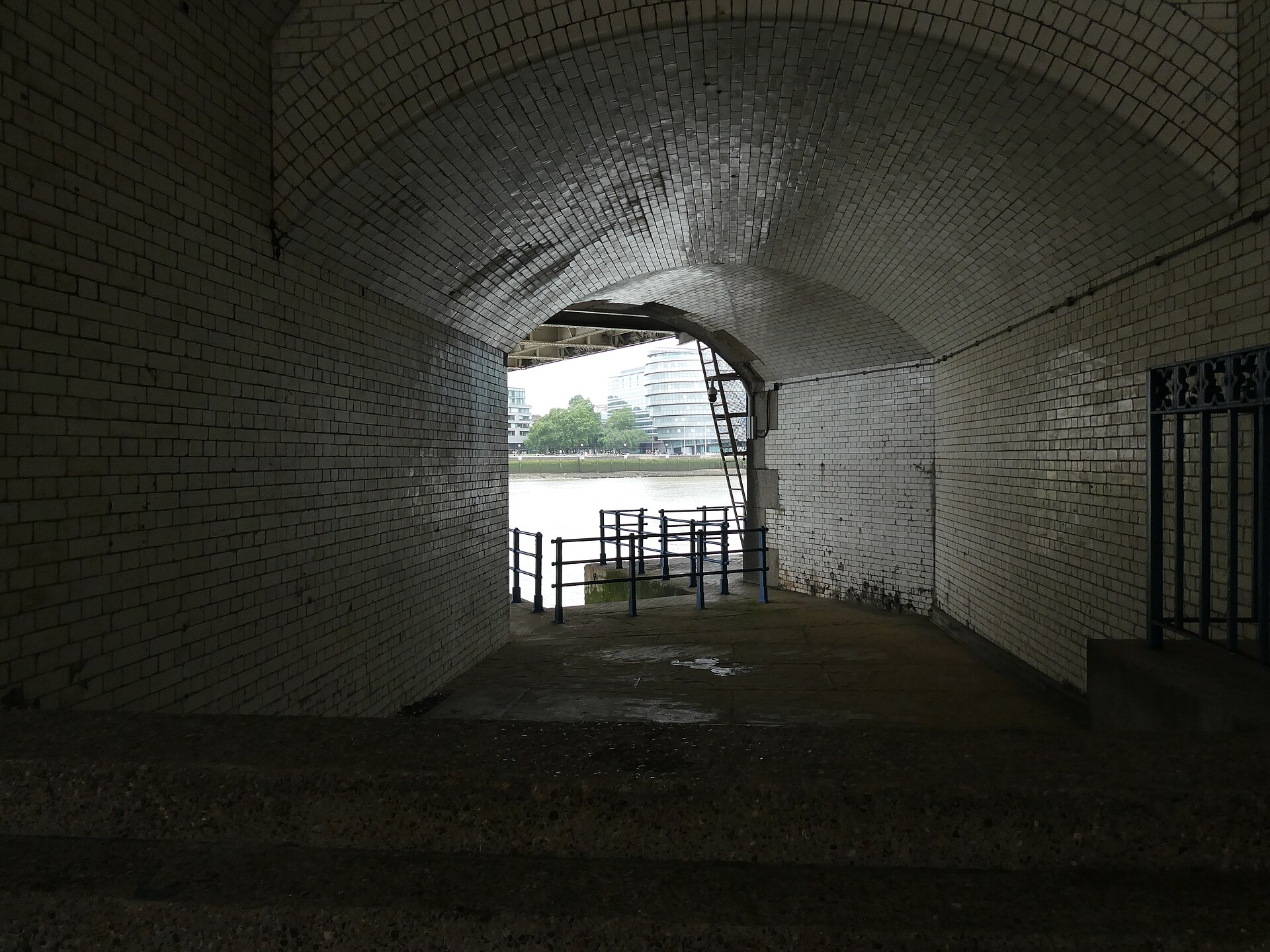
Walk along the north side of Tower Bridge, toward the Tower of London end, and look down at the river's edge. There's a small alcove built into the bridge's northern abutment, lined with white tiles. This is Dead Man's Hole, and the name is not a metaphor.
Due to the tidal currents of the Thames, this particular spot is where bodies naturally congregate. People who drowned, people who were murdered and dumped in the river, people who fell in drunk — the currents would carry them downstream and deposit them right here, against the bridge's foundations. For decades, this alcove served as an unofficial body-collection point.
The white tiles aren't decorative. Decomposing corpses — especially those that had been in the water for days or weeks — would sometimes explode from the buildup of gases inside the body. The tiles could be hosed down more easily than bare stone. That's the kind of practical Victorian engineering you don't read about in the guidebooks.
L-shaped steps led down from the bridge approach to the water level, and river police would use long grappling hooks to pull bodies out of the Thames. The recovered dead were then laid out for public identification. If nobody claimed them, they were buried as unknowns. Bodies of people executed at the Tower of London were also transferred through here.
Millions of tourists photograph Tower Bridge every year. Almost none of them look down and to the left, where a white-tiled alcove quietly tells one of the grimmest stories on the river. It's still there. The tiles are still visible. The Thames still delivers.
Verified Facts
Thames tidal currents naturally deposited bodies at this spot, making it a body-collection point
White tiles installed because decomposing corpses would explode from gas buildup — tiles could be hosed down
L-shaped steps and grappling hooks used to retrieve bodies; corpses displayed for public identification
Bodies executed at the Tower of London were also transferred through here
Get walking directions
Newham, London, E13, United Kingdom