Natural History Museum
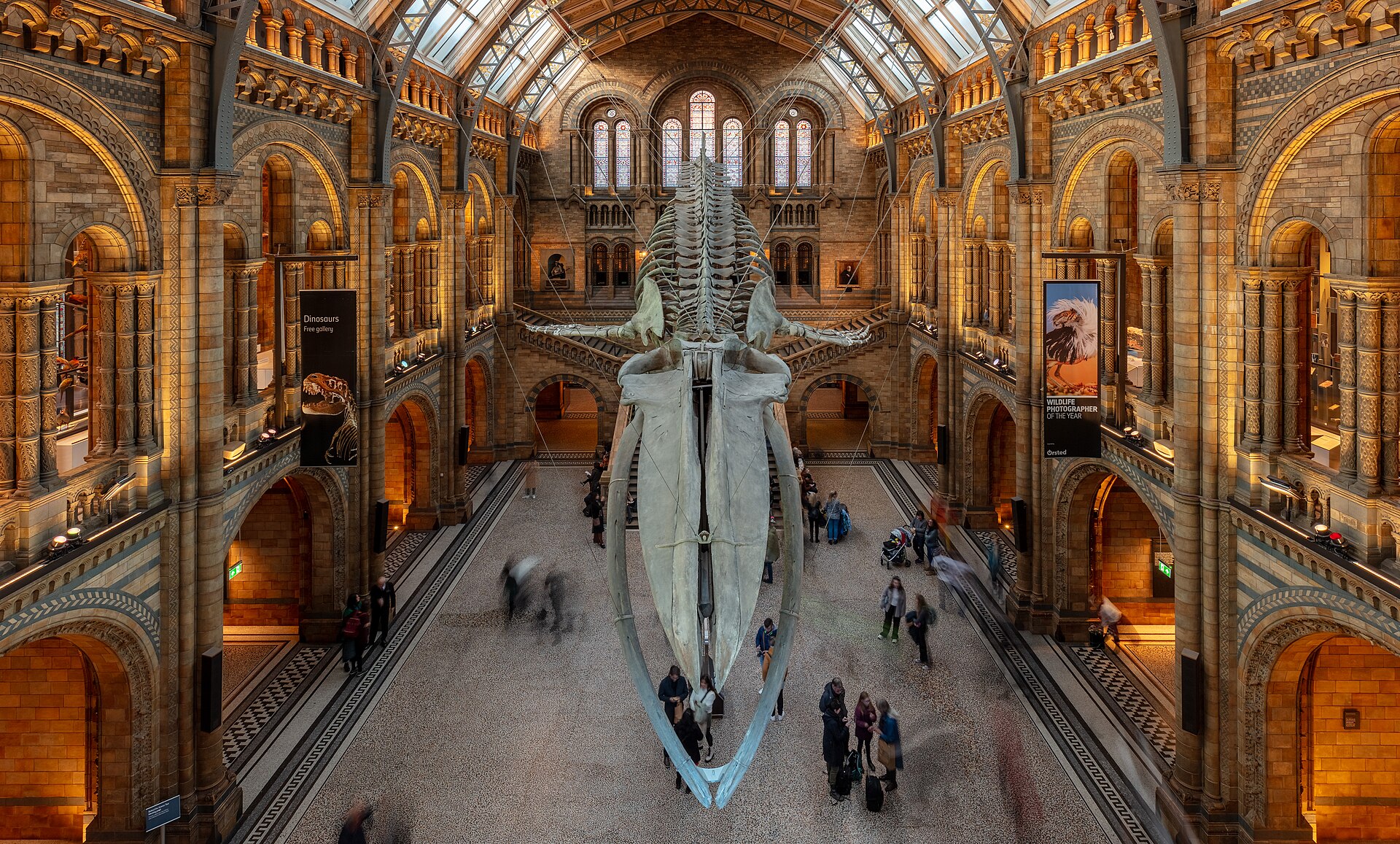
The building itself is a specimen. Alfred Waterhouse designed it as a "cathedral to nature" in the 1870s, covering the entire facade in terracotta tiles depicting living creatures on the west wing and extinct ones on the east — a taxonomic decision baked into the architecture. The Romanesque arches and soaring central hall were deliberately intended to inspire the same awe as a gothic cathedral, except the religion here is natural science.
For over a century, the star of the main hall was Dippy — a plaster-cast replica of a Diplodocus carnegii skeleton that arrived from Pittsburgh in 36 packing cases in 1905, a gift from the Scottish-American steel magnate Andrew Carnegie. Dippy became the most famous dinosaur in Britain, but in 2017 the museum replaced it with Hope, a 25-metre-long blue whale skeleton, to highlight the urgent issue of species conservation. Dippy went on a national tour and returned for a triumphant comeback in 2024.
The museum holds over 80 million specimens spanning 4.5 billion years of life on Earth. Its collection includes specimens collected by Charles Darwin and the first Tyrannosaurus rex fossil found in Britain. The Darwin Centre, opened in 2009, houses the museum's scientific research collections in a striking cocoon-shaped structure designed by C.F. Moller Architects.
The building is so enormous that five Dippys could line up nose to tail inside the central hall. It was originally part of the British Museum's collection before the natural history specimens outgrew their Bloomsbury home and were moved to South Kensington in 1881. Admission has been free since 2001.
Verified Facts
The facade terracotta tiles depict living creatures on the west wing and extinct ones on the east
Dippy the Diplodocus replica arrived in 36 packing cases from Pittsburgh in 1905, a gift from Andrew Carnegie
The museum holds over 80 million specimens spanning 4.5 billion years of Earth's history
Dippy was replaced in 2017 by Hope, a 25-metre blue whale skeleton, to highlight conservation
Get walking directions
Cromwell Road, Kensington and Chelsea, London, SW7 5BD, United Kingdom