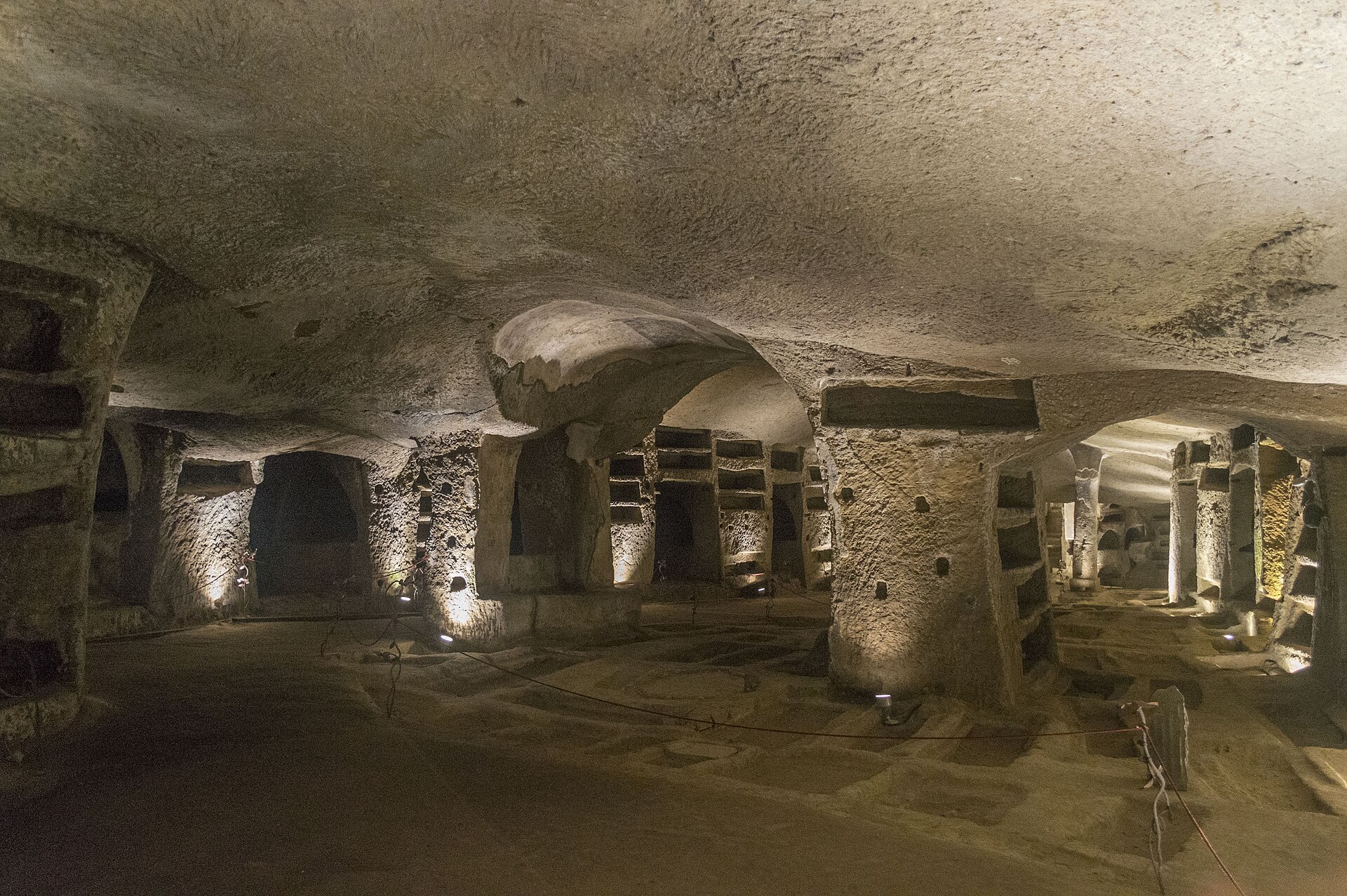
Beneath the Capodimonte hill lies the largest underground early Christian burial site in southern Italy, and it's been down here since the 2nd century AD. The Catacombs of San Gennaro started as the private tomb of a noble family, but when the remains of Sant'Agrippino — Naples' first patron saint — were brought here in the 3rd century, everyone wanted to be buried nearby. Then in the 5th century, the relics of San Gennaro himself arrived, and the place exploded into a major pilgrimage site. Suddenly being buried here was the most prestigious thing you could do with your body after death.
The catacombs are arranged on two levels carved into the soft tuff rock, and they're dramatically larger than anything you'd see in Rome. The upper catacomb features the Crypt of the Bishops, where successive bishops of Naples were buried in arched niches decorated with 5th-century mosaics and frescoes that are among the oldest examples of Christian art in Italy. One fresco shows the earliest known portrait of San Gennaro, complete with his halo — painted centuries before the blood miracle became the city's defining ritual.
What makes visiting these catacombs special is who runs them. In 2006, a youth cooperative called La Paranza took over management from the church, staffing the tours with young people from the Rione Sanita neighborhood above — one of Naples' poorest and most marginalized communities. The catacombs became an engine of social renewal, generating jobs and tourism revenue for a district that mainstream Naples had largely written off.
The transformation has been remarkable. Rione Sanita, once avoided by tourists, now draws thousands of visitors who descend into the ancient dead and emerge into a neighborhood that's very much alive.
Verified Facts
The catacombs date to the 2nd century AD and are the largest underground early Christian burial site in southern Italy
The relics of San Gennaro were transferred here in the 5th century, turning it into a major pilgrimage destination
The Crypt of the Bishops contains 5th-century mosaics and frescoes including the earliest known portrait of San Gennaro
Since 2006, the catacombs have been managed by La Paranza, a youth cooperative from the Rione Sanita neighborhood
Get walking directions
13 Via Capodimonte, Municipalità 3, Naples, 80136, Italy