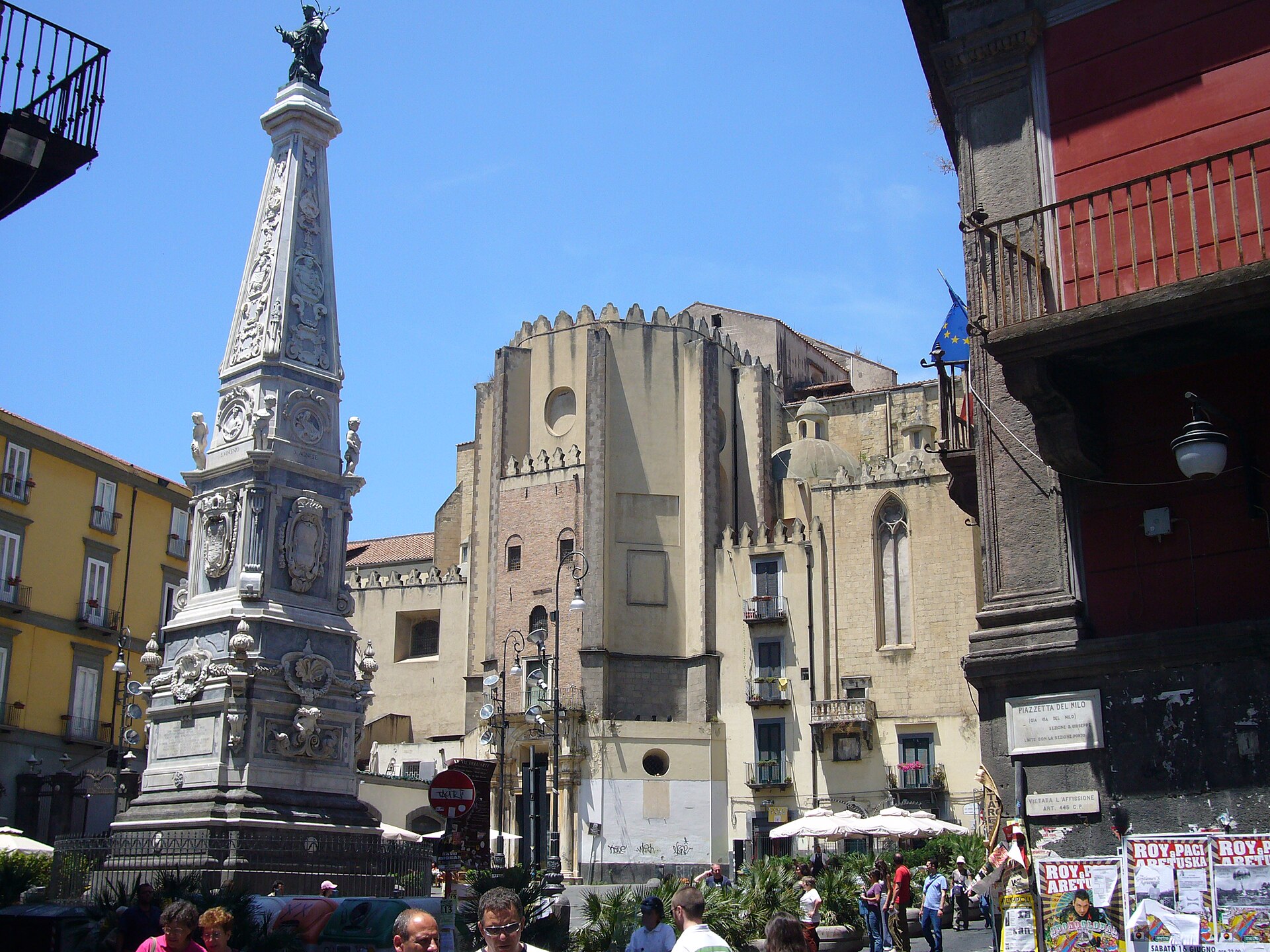
This church sits on one of the most beautiful piazzas in Naples, anchored by a Baroque plague column erected in 1737 — because in this city even the monuments to mass death are gorgeous. San Domenico Maggiore was begun in 1283 by order of Charles II of Anjou and served as the royal church of the Angevin dynasty. Thomas Aquinas studied and taught in the adjacent Dominican monastery, which makes this one of the most important sites in the history of Western philosophy and theology.
The interior is a study in Neapolitan excess: frescoed ceilings by Francesco Solimena, a carved wooden ceiling from 1621, and 45 chapels crammed with paintings and sculptures. But the most unsettling objects are upstairs in the sacristy: 45 wooden coffins containing the mummified remains of Aragonese royals and nobles, some still wearing fragments of their original clothing. The coffins are stacked on balconies ringing the room, staring down at visitors with the blank authority of people who expected to be remembered and largely weren't.
Caravaggio's "Flagellation of Christ," originally painted for a chapel here around 1607, hung in this church until it was moved to the Capodimonte museum in the 1970s. A copy now hangs in its place. The loss is still felt: Caravaggio painted it during his fugitive years in Naples, on the run from a murder charge in Rome, and the painting's violence has a desperation that feels personal.
The piazza outside is one of Spaccanapoli's best people-watching spots. University students, street musicians, and tourists mingle beneath the plague column while the church's facade — unusually, it's a Gothic apse, since the main entrance faces a different street — looms overhead.
Verified Facts
The church was begun in 1283 by order of Charles II of Anjou and served as the royal church of the Angevin dynasty
Thomas Aquinas studied and taught at the adjacent Dominican monastery
The sacristy contains 45 wooden coffins with mummified remains of Aragonese royals and nobles
Caravaggio's Flagellation of Christ was originally painted for this church around 1607 and later moved to Capodimonte
Get walking directions
Piazza San Domenico Maggiore 8A, 80134 Naples