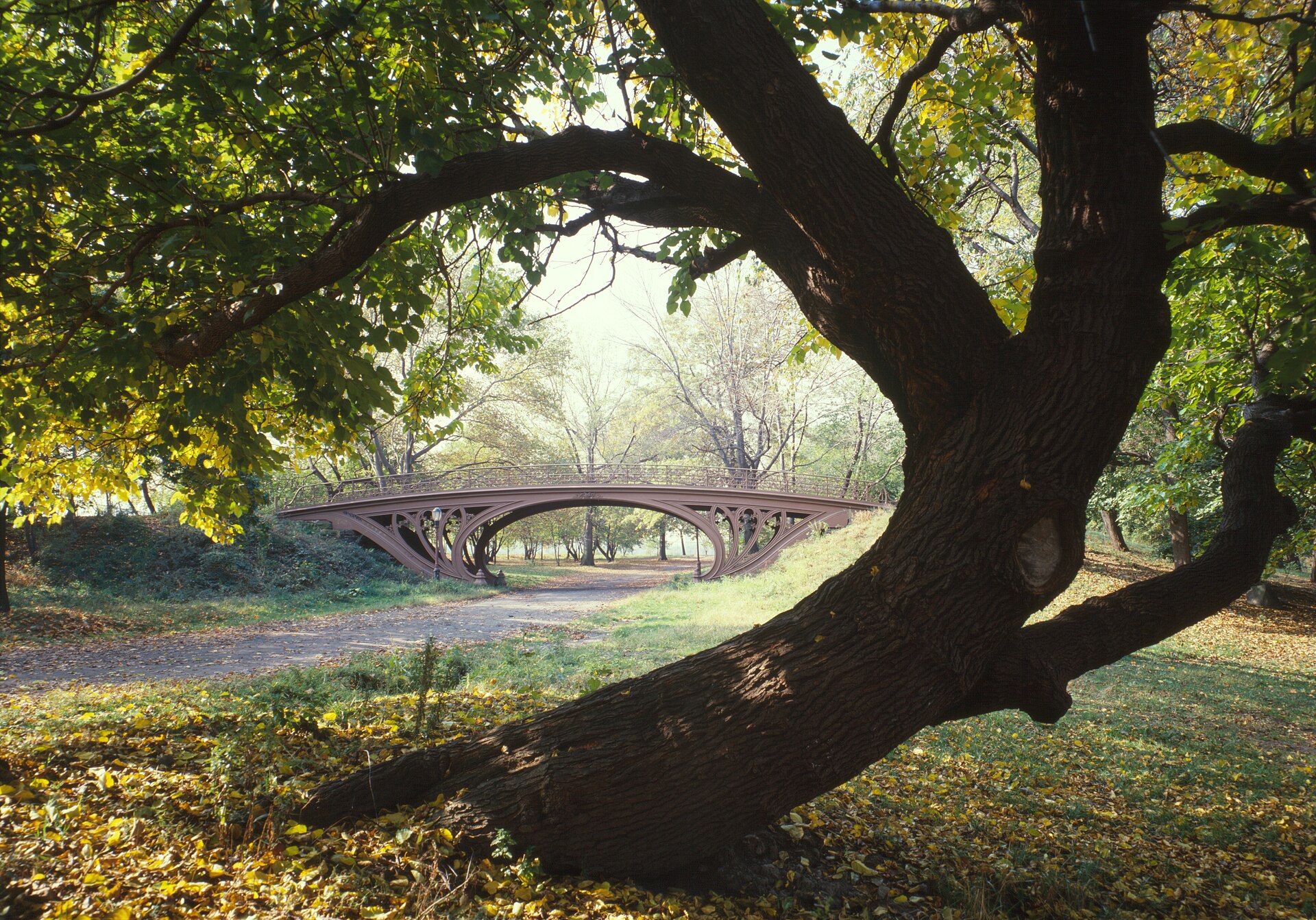
Central Park is eight hundred and forty-three acres of engineered wilderness in the middle of Manhattan. Every rock placement, every sightline, every curve in the path was designed by Frederick Law Olmsted and Calvert Vaux, who won the design competition in eighteen fifty-eight. Nothing here is natural. Everything is meant to look like it is.
The Bethesda Fountain, at the heart of the park, is topped by the Angel of the Waters — designed by Emma Stebbins in eighteen seventy-three. Stebbins was the first woman to receive a commission for a major public work in New York City. The fountain celebrates the eighteen forty-two opening of the Croton Aqueduct, which brought clean water to the city for the first time. The angel represents the healing power of that water.
On the west side, near the Seventy-Second Street entrance, is Strawberry Fields — a five-acre memorial to John Lennon, who was shot outside the Dakota apartment building directly across the street on December eighth, nineteen eighty. The black-and-white Imagine mosaic was a gift from the city of Naples. Yoko Ono worked with landscape architect Bruce Kelly on the design, which was officially dedicated on October ninth, nineteen eighty-five — Lennon's forty-fifth birthday.
Between these two landmarks, the Ramble is a thirty-six-acre woodland so dense you can lose sight of every building. It is one of the best birdwatching spots on the East Coast.
Verified Facts
Designed by Olmsted and Vaux, who won the design competition in 1858; the park is 843 acres
Emma Stebbins designed the Angel of the Waters atop Bethesda Fountain in 1873 — the first woman to receive a major public art commission in NYC
Strawberry Fields was dedicated on October 9, 1985 (Lennon's 45th birthday); the Imagine mosaic was a gift from Naples
John Lennon was shot outside the Dakota apartment building across from the park on December 8, 1980
Get walking directions
New York, United States