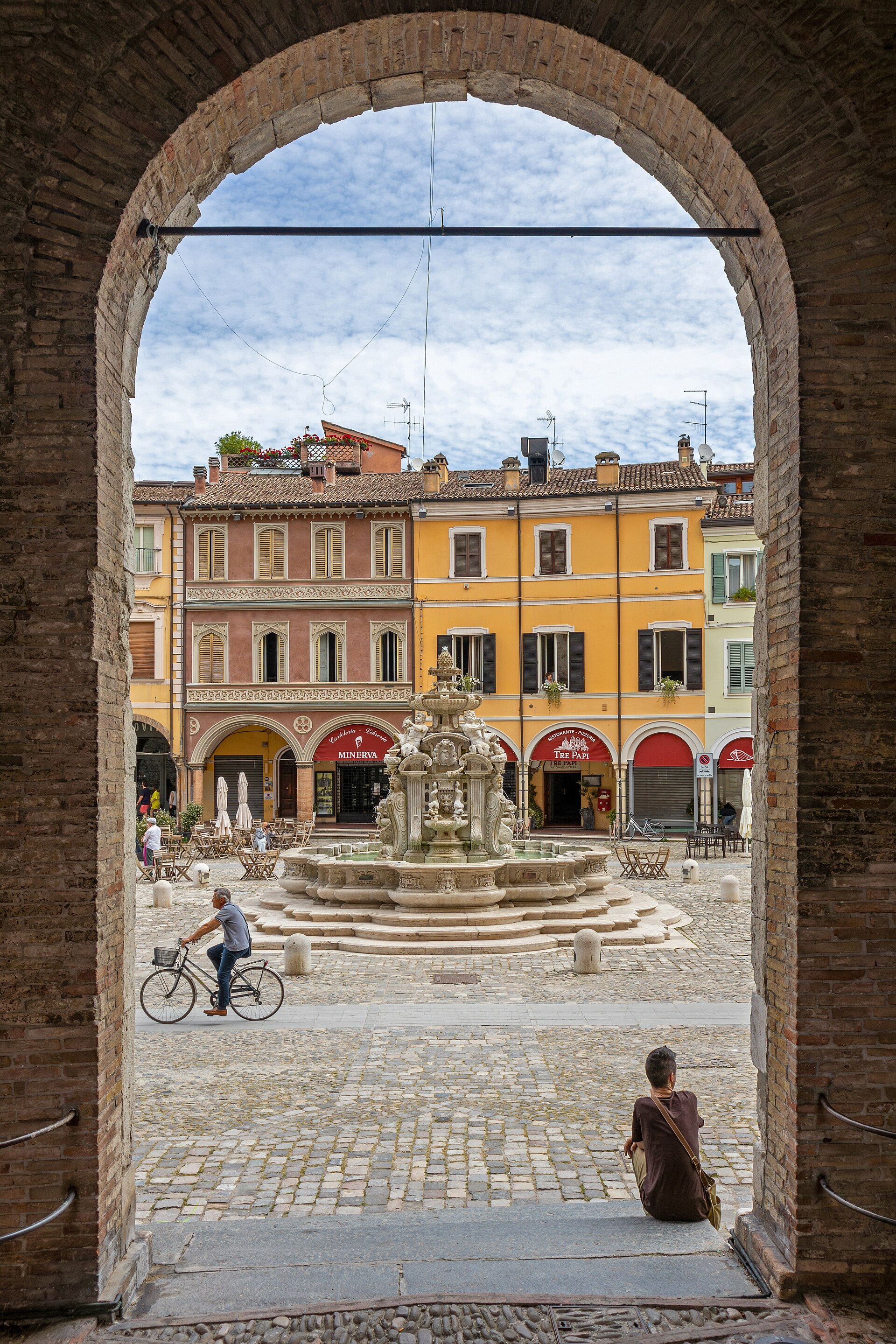
For centuries, this was the first thing visitors saw when they arrived in Rome. The Via Flaminia — the great road from the north — entered the city through the Porta del Popolo, and this piazza was the welcome mat. Goethe arrived here in 1786 and wrote about the overwhelming impact of the view. Napoleon's troops marched in through this gate. Every Grand Tour traveller, every pilgrim from northern Europe, every invading army came through this space.
The Egyptian obelisk in the centre is thirty-six metres tall, originally from Heliopolis, and was brought to Rome by Augustus in 10 BC. It is the second oldest obelisk in Rome and was originally used as a sundial in the Circus Maximus before being moved here in 1589 by Pope Sixtus V — the same pope who moved obelisks around Rome the way normal people rearrange furniture. Sixtus moved four obelisks in his five-year reign, a feat of engineering that required Domenico Fontana to design a massive system of winches, pulleys, and nine hundred men working in coordinated silence.
The twin churches flanking the south end — Santa Maria dei Miracoli and Santa Maria in Montesanto — look identical from the piazza, which was entirely the point. But they are not actually identical. The plots they sit on are different sizes, so architect Carlo Rainaldi cheated: one has a circular dome and the other has an oval dome, but from the viewer's perspective in the piazza, they look perfectly symmetrical. It is a Baroque optical illusion.
Climb the steps to the Pincio terrace above the piazza for one of Rome's definitive sunset views. The entire piazza spreads below you, with the dome of St Peter's floating on the horizon. Caravaggio's first two public commissions — paintings of Saint Matthew — are in the church of Santa Maria del Popolo at the north end, alongside works by Raphael, Bernini, and Pinturicchio. This one piazza could fill an entire art history semester.
Verified Facts
The obelisk was brought from Heliopolis by Augustus in 10 BC and moved to the piazza by Sixtus V in 1589
The twin churches have different-shaped domes (circular vs oval) but appear identical from the piazza — a deliberate Baroque optical illusion
Pope Sixtus V moved four obelisks in his five-year reign using Domenico Fontana's system of winches and 900 men
Caravaggio's first public commissions hang in Santa Maria del Popolo at the piazza's north end
Get walking directions
Piazza del Popolo, I Municipio, Rome, 00187, Italy