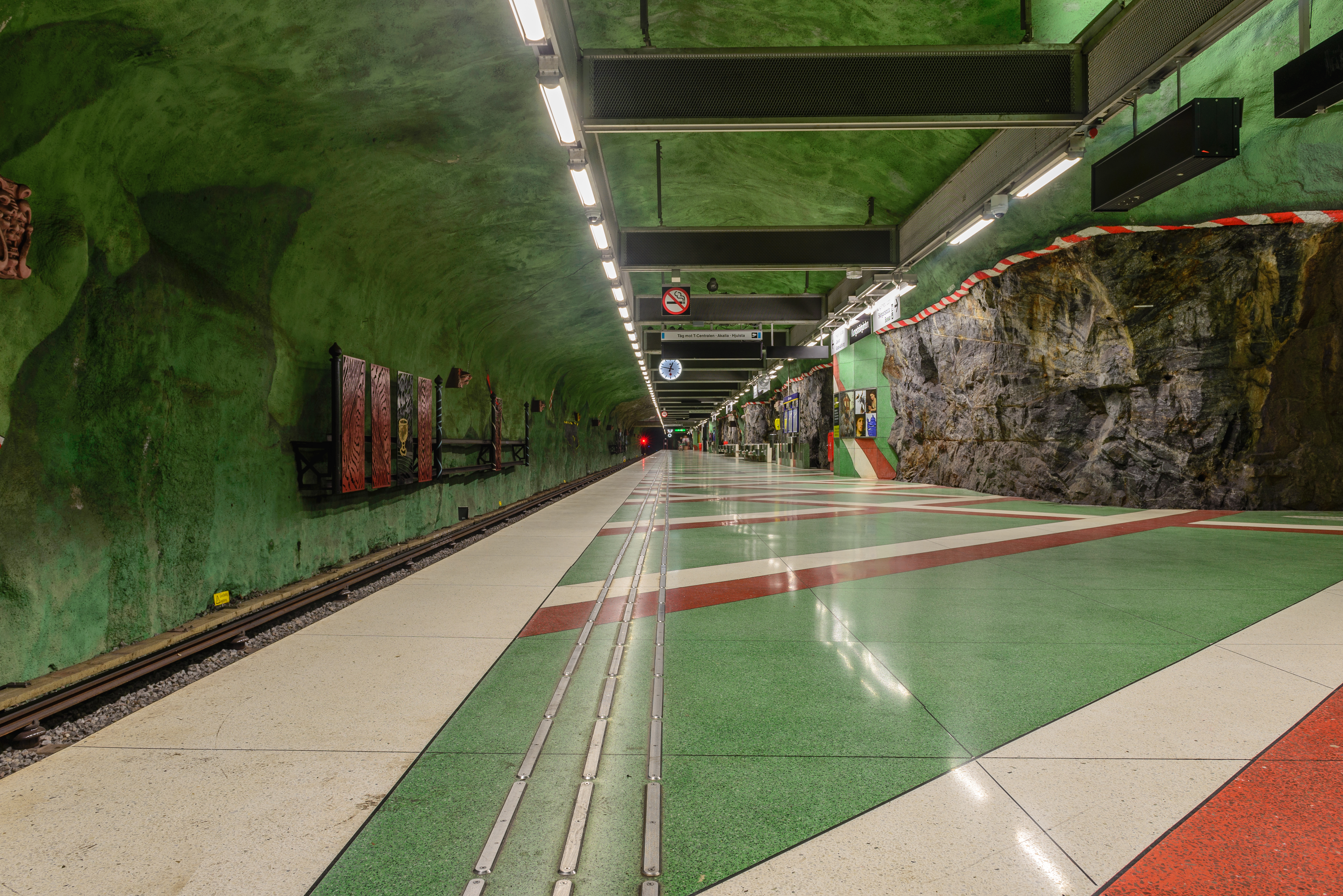
You are about to descend into what looks like an archaeological excavation that someone forgot to finish. The walls are rough-hewn rock, exposed and unpolished, as if the tunnellers broke through and the artists said stop, leave it exactly like that. Vines and vegetation have been painted creeping across the stone. And scattered throughout the station are nearly fifty masks and sculptures that look ancient but have a very specific origin. They were salvaged from the Makalos Palace, once the most extravagant Baroque mansion in Sweden, which burned down in eighteen twenty-five. When the station was designed in the nineteen seventies, artist Ulrik Samuelson decided to turn the whole thing into an underground fantasy, part cave, part ruin, part archaeological site frozen in mid-discovery. It is deeply weird and absolutely beautiful. But here is the bigger picture. Stockholm's metro system is called the world's longest art gallery, and that is not marketing fluff. Over one hundred and fifty artists have decorated more than ninety of the system's one hundred stations since the nineteen fifties. That is over one hundred and ten kilometres of art. Some stations look like rainbow caves. Others have murals depicting Swedish mythology. One looks like a Mediterranean grotto. This is public transit treated as public art on an industrial scale. You could spend an entire day just riding the metro and looking at walls. Kungstradgarden is the showpiece, the station people come specifically to photograph. But it is not the only extraordinary one. It is just the one that happens to have a demolished palace hidden inside it.
Verified Facts
Designed by artist Ulrik Samuelson in the 1970s as an underground archaeological excavation theme
Nearly 50 masks and sculptures salvaged from the demolished Makalos Palace, which burned in 1825
Stockholm metro has over 150 artists decorating more than 90 of 100 stations since the 1950s, called 'the world's longest art gallery'
Get walking directions
Stockholm, Sweden