15 stops
GPS-guided
2 km
Walking
1 hour
Duration
Free
No tickets
About this tour
A 2 km GPS-guided walk through the heart of Austria. Visit Salzburg Town Walk, Mozartplatz, Residenzplatz, and New Residenz, Glockenspiel — with narrated stories at every stop.
15 stops on this tour
Salzburg Town Walk
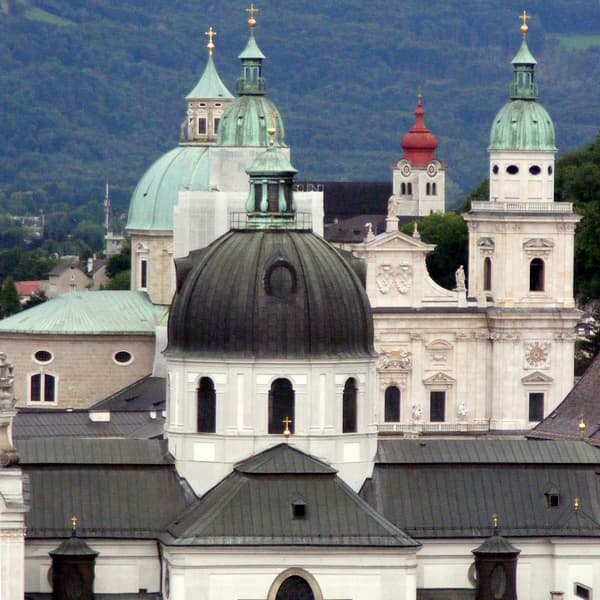
Salzburg Town Walk Welcome to Salzburg. Salzburg is made for visitors. It's the city of Mozart, castles, gardens, Baroque towers, pleasant cafes, and everywhere you go, the sound of music. Hi, I'm Rick Steves.
Thanks for joining me on a walk through Salzburg's old town. This pleasant stroll gives a good orientation to the city and introduces you to sites you may want to explore in more detail later. We'll pass through harmonious squares lined with pastel buildings. We'll visit the huge cathedral, famous for its music.
Read more...Show less
We'll see sites associated with famous Salzburgers, like Mozart and the sound of music's von Trapp family. We'll squeeze produce at a lively open-air market and stroll down Main Street with its centuries-old shops. All along the way, there are striking views of the castle-topped hill that borders the town. Allow about an hour for this mile-long walk.
Now, get ready. The hills are alive with the sound of my voice as we visit this gracious town with a rich history, Salzburg. To help us along the way, I've invited a good friend and virtual travel buddy. Welcome, Lisa.
Guten Tag, Herr Steves. Lisa will give us helpful directions and sightseeing tips throughout the tour. And my first tip is to be sure you get our tour updates. Just press the icon at the lower right of your device.
You'll find any updates and helpful instructions unique to this tour. Things like closures, opening hours, and reservation requirements. There's also tips on how to use this audio tour and even the full printed script. Yes, so pause for just a moment right now to review our updates and special tips.
It's okay. We'll wait. And then... Let the tour begin. The tour begins.
Tour Begins: View from River
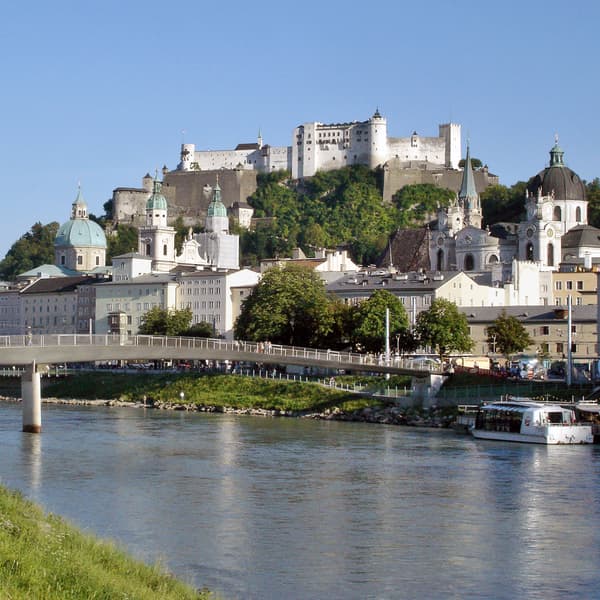
The view from the river. Begin at the Mozartstag, the pedestrian bridge over the Salzach River. Get your bearings. On the north bank is the new town.
The south side is the old town, dominated by a castle on a hill. Focus your attention on the old town. Rick? Take in the charming, well-preserved historic core of Salzburg's old town.
Read more...Show less
The skyline bristles with Baroque steeples and green copper domes. Overlooking it all is the castle called the Hohensalzburg Fortress. Salzburg is a city of 150,000 people. It's Austria's fourth largest and the regional capital.
The old town, sitting between the Salzach River and its string of hills, holds the most important church in the city. It has nearly all the charm and most of the tourists. Notice all the churches. Salzburg, nicknamed the Rome of the North, is considered the greatest Baroque city north of the Alps.
It has 38 Catholic churches plus two Protestant churches and a synagogue. The biggest green dome is the cathedral. We'll visit that shortly. Atop the hill is the fortress, which you can tour.
Far to the right of the fortress you'll find the Museum of Modern Art. It looks like a museum of modern art. It looks like a museum of modern art. It looks like a museum of modern art.
It looks like a museum of modern art. It looks like a museum of modern art. It looks like a museum of modern art. It looks like a museum of modern art.
It looks like a mini castle, but that's actually a water reservoir alongside the modern building. The museum is worth a visit more for the view from its restaurant than for the art. Still further to the right, in the far distance, you may catch a glimpse of a bell tower with a green copper dome. That's the Augustine Church, site of the Augustiner Brauchstubel, the best beer hall in town.
The Salzach River thunders under your feet. It's called Salt River, not because it's salty, but because of the precious cargo it once carried. The salt mines of Hallein are just nine miles upstream. In medieval times, barges carried the precious salt from here to the wider world, to the Danube, the Black Sea, and then on to the Mediterranean.
As barges passed through here, they had to pay a toll on their salt. The toll was enforced by soldiers of the local castle, or Salzburg. Salzburg grew into an important trade town. Salzburg grew into an important trade town.
It was conveniently located at the crossroads of the East-West River trade and the north-south highway between Italy and northern Europe. It became an independent city in the Federation of States called the Holy Roman Empire. Salzburg was governed by a prince-archbishop, with both the political powers of a prince and the religious authority of an archbishop. The pedestrian bridge you're on is named after Salzburg's most famous son, Mozart.
As a musical mecca, the city puts on a huge music festival every summer, as well as concerts throughout the year. And, of course, the movie The Sound of Music is based on the life of the real-life von Trapp family, and many of the scenes are set right here in Salzburg. Before we enter the old town, consider a few things on the north bank. The new town has the Mirabelle Palace and Gardens and Mozart's residence, though they're not visible from here.
Mozart's residence, now a museum, is where he lived when he was a teenager, famous across Europe. One bridge upstream from here, find the Stein Hotel. Its terrace café on the roof offers some of Salzburg's best views. Just behind the hotel, you'll find a road called Steingasse.
It runs parallel to the river one block inland. Steingasse is a tranquil, untouristy place to stroll. At night, you can bar hop from one classy cocktail lounge to the next. Notice that both sides of the river have bike paths.
They're flat, pleasant, and very scenic. Now, let's plunge into Salzburg's old town. From the bridge, walk one block toward the hill-capping castle into the old town. At the end of the bridge stands what was once a toll house.
It's now a cute and friendly little coffee kiosk. Continue straight ahead, crossing the busy street and heading inland one block. Passing through the remains of the city wall and its medieval fortifications. Rick, I'm giving the directions here.
A block in, you'll come to some traffic barriers. Just past the barriers, turn right. This leads into a big square. Mozart plots.
Head for its centerpiece, the statue of the great composer and hometown boy, Mozart. Who wrote the following delightful piece? Eine kleine Nachtmusik. A little night music.
So head for the square and the Mozart statue as we enjoy his music. piano plays in bright rhythm piano plays in bright rhythm Mozart Plots
Mozartplatz
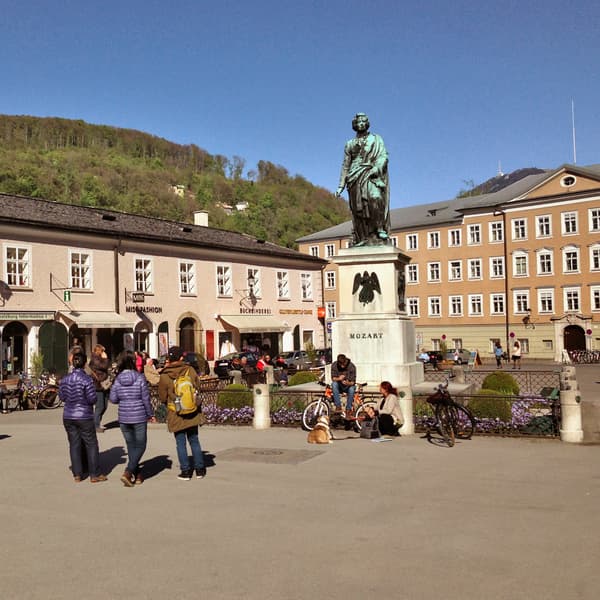
All the happy tourists around you probably wouldn't be here if not for the man honored by this statue. Wolfgang Amadeus Mozart was born in Salzburg in 1756 and spent his first 25 years calling Salzburg home. By the way, the statue erected in 1842 is considered by locals to be a terrible likeness. Mozart was born just a few blocks from here.
We'll see the place later. His father was assistant conductor for Salzburg's ruler, the Prince Archbishop. He raised young Wolfgang to play several instruments. By age six, the child prodigy was performing with his sister for Habsburg royalty.
Read more...Show less
They toured the great cities of Europe, always returning to Salzburg. By age 17, Mozart was working as concertmaster for the Prince Archbishop. For the next six years, he conducted the Archbishop's orchestra and served as the organist at the cathedral. He composed masses for church services, and played the harpsichord for nobles as they dined.
He gave music lessons to young duchesses. Dozens of professional musicians and singers were under his baton. He wrote lots of music, including several violin and piano concertos that are commonly played to this day. But Mozart came to disdain Salzburg.
The Archbishop treated him like a common servant. He got tired of playing church music when his heart was in opera and symphonies. His mother died, and he argued with his dad, who wanted him to keep his day job. Eventually, the town of Salzburg came to be too small-time and conservative for a worldly musician who'd traveled Europe's capitals.
In 1777, 25-year-old Mozart traveled with his boss, the Archbishop, to meet the Emperor in Vienna. Instead of a triumphant reception, the young genius was seated at the servants' table. He was forbidden to play for the Emperor. Mozart was humiliated.
He demanded that the Archbishop release him. The Archbishop essentially said, You can't quit. You're fired. Mozart was literally kicked in the hind end on his way out the door.
He left Salzburg for good, eventually settling in Vienna, where he enjoyed both fame and respect. The city of Salzburg is much older than Mozart. The Mozart statue actually sits on bits of Roman Salzburg. Established by the Romans 2,000 years ago, it became an important salt-trading city.
The first Salzburgers settled right around present-day Mozart plots. In the year 800, Salzburg, now Christian, joined Charlemagne's empire as an independent city. The church of St. Michael that overlooks the square dates back to this period.
You mean the yellow church above the Christmas Museum? Yep. As you look around this square, you can see how far the town's come, its popularity, all the businesses hoping to cash in. Eight million tourists crawl its cobbles each year.
And that's a lot of money. A lot of Mozart balls. Walk toward the cathedral and into the big square with the huge fountain. The Residence Plots
Residenzplatz
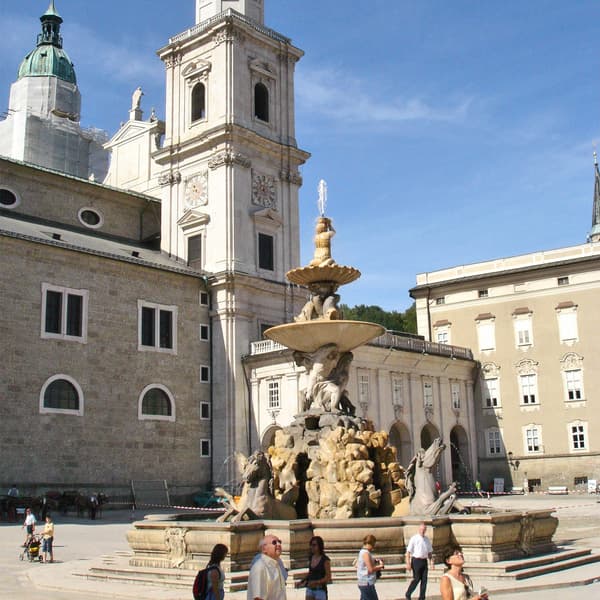
As Salzburg's governing center, this square has long been ringed with important buildings. The cathedral borders the south side. The former palace of the prince-archbishop is to the right as you face the cathedral. To the left is the new residence with its bell tower, built for the prince-archbishop's houseguests.
In the 1600s, this square got a makeover, Italian-style. Salzburg, located on a busy trade route to the south, was well aware of the exciting things going on just over the Alps in Italy. Local artists even Italianized their names in order to raise their rates. The rebuilding started under energetic prince-archbishop Wolf Dietrich, who ruled from 1587 to 1612.
Read more...Show less
Dietrich had been raised in Rome. He counted the Medici as his cousins and had grand Italian ambitions for Salzburg. Fortunately for him, the cathedral conveniently burned down in 1598. Dietrich set about rebuilding the church and the city as the Rome of the North.
This square, with the new cathedral and palace, was the centerpiece of his Baroque dream city. The fountain shows tritons on top, blowing his conch shell horn. It's as Italian as can be, an over-the-top version of Bernini's famous triton fountain in Rome. Notice that Wolf Dietrich's palace, the old residence, has a skyway.
Like so many leaders back then, he wanted an easy commute to the cathedral and a chance to worship while avoiding the public. This square sets the tone for the whole town. From here, a series of interconnecting squares like you'll see nowhere else make a grand procession through the old town. Everywhere you go, you'll see similar Baroque Italian architecture.
The buildings are made from two dominant kinds of stone, a creamy red marble and a chunky conglomerate. Both are quarried nearby. As you walk from square to square, notice how easily you slip from noisy and commercial to peaceful and reflective. Turn your attention to the new residence along the left side of this square as you face the cathedral. The New Residence
New Residenz, Glockenspiel
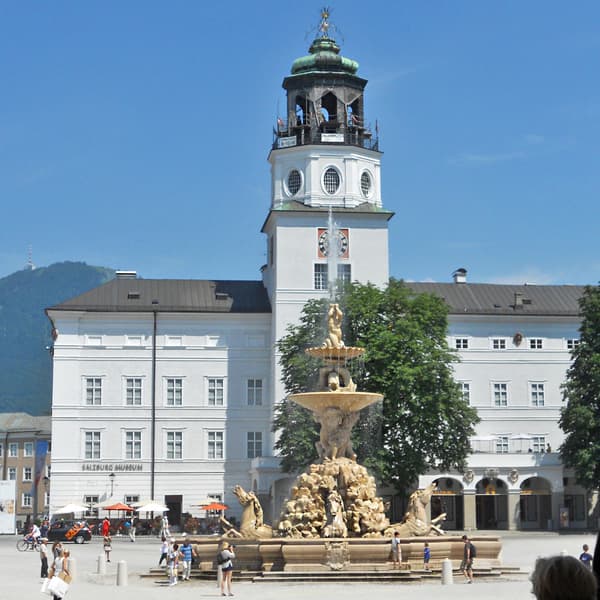
and Glockenspiel This former palace, long a government administration building, now houses the central post office. In the days of the Prince Archbishops, this building hosted parties in its lavish rooms. Salzburg's rulers were great patrons of music. By the 1700s, the Prince Archbishops employed a personal orchestra of dozens of highly trained musicians plus singers and composers.
They played religious music in the cathedral and dinner music here for the entertainment of the nobles. Today, the New Residence houses two important sites. The Salzburg Museum offers the best peek at this town's history. You see a rich display of ceremonial rooms where the Prince Archbishops entertained.
Read more...Show less
The exhibits focus on Salzburg's quirky absolutist rulers who wore two powerful hats at the same time. They were both important church officials and princes of the world. In the 1820s, the New Residence was the centerpiece of the Holy Roman Empire, hence the title, Prince Archbishop. You'll also hear about the many musicians, artists, and writers whose creative talents made Salzburg a fairytale Alpine Arcadia.
Also in the New Residence, the fascinating Salzburg Panorama 1829 displays a painting of the city, giving a 360-degree look at Salzburg in the year 1829. Amazingly, the old town looked essentially as it does today. Also part of the New Residence is the Heimatwerk, a fine shop showing off local handicrafts. The famous Glockenspiel rings atop the New Residence.
This bell tower has a carillon of 35 17th-century bells cast in Belgium. They chime every morning at 7 and 11 and then again at 6 p.m. They also play little tunes appropriate to the month. The mechanism is a big barrel with adjustable tabs that turn like a giant music box.
Pulling the right bells in the right rhythm. Notice the ornamental top. An upside-down heart in flames surrounds the solar system. This represents how God loves all of creation.
Before moving on, look back past Mozart's statue to the 4,000-foot-high Geisberg, the forested hill with the television tower. A road leads to the top for a commanding view. Its summit is a favorite destination for local nature lovers and strong bikers. Exit the square by walking under the Prince Archbishop's Skyway.
You'll step into the Cathedral Square or Dome Plots, where you'll find the Salzburg Cathedral. A good place to view the façade is from the far end of the square. Start walking to the far end. As you walk, you may hear the ringing of Salzburg's beloved cathedral bells.
They've long told the Temple of Life here, calling the people to worship, to holy celebrations, and to festivals. Once you reach the far end of the square, turn around and marvel at the cathedral's façade while you listen to those bells. Hey, I think I can hear them now. The Salzburg Cathedral, the exterior.
Salzburg Cathedral: Exterior
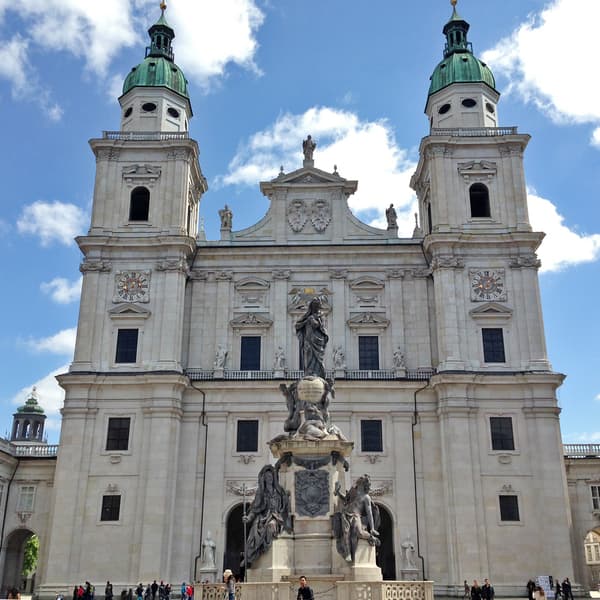
Salzburg's cathedral was one of the first Italian Baroque buildings north of the Alps. The dome stands 230 feet high. Two domed towers flank the entrance. Between them is a false-front roofline.
The windows are flanked with classical half-columns and topped with heavy pediments. The façade is ringed with a Baroque balustrade, decorated with garlands and masks, and studded with statues. The whole look would remind visitors that Salzburg was indeed the Rome of the North. The church, rebuilt under Wolf Dietrich, was consecrated in 1628.
Read more...Show less
Experts differ on what motivated the builders. It may have been to emphasize Salzburg's commitment to the Roman Catholic culture. Europe was bitterly divided between Catholics and Protestants in the midst of the Thirty Years' War. Salzburg's archbishop was the top papal official north of the Alps, but the city managed to steer clear of the war.
With its rich salt production, it had enough money to stay out of the conflict and carefully maintain its independence, helping it earn its nickname, the Fortified Island of Peace. The cathedral was both the religious and political center for the prince-archbishop. The buildings ringing the square were city government buildings for his role as a secular prince. The statue of Mary in the square from 1771 is looking away from the church, welcoming visitors.
Try looking at the statue while standing in the rear of the square, immediately under the middle arch. From that perspective, you'll see that she's positioned to be crowned by the two angels on the church facade. The statue group is called the Coronation of the Virgin Mary. Hey, Lisa, here's a fun photo op.
Let's do the Coronation of the Travel Buddy. So, position yourself in the exact spot so, from my view, Mary's crown seems to sit atop your head, too. And I'll take a photo. Go a little left.
Right, just a tad right. Okay, a bit farther back. Perfect. Now, say, Mozart balls.
Mozart balls. Got it. Now that we're properly crowned, let's start with the coronation. Let's start walking toward the church.
As you stroll, read the facade like a Bible of stone. There's Jesus. He's on top. Moses and Elijah, representing the Old Testament, are next.
And in between are the coats of arms of two prince archbishops. And below that are the four evangelists. Okay, there's Matthew, Mark, Luke, and... Larry?
No, John. And at the bottom are the fathers of the Salzburg church, mixing it up with the fathers of St. Peter's in Rome. From left to right, that would be St.
Rupert. One of the city's founders, always with his cask of salt. Of course, this was Salzburg. And back then, salt was big money.
More on Rupert later. For now, next to him is Jesus' disciple, Peter. He never goes anywhere without his keys. Paul.
With his sword reminding us how he was martyred. And finally, St. Virgil. St.
who? St. Virgil. He's the Irish monk who became Salzburg's bishop.
Back in 774 A.D., he built the original cathedral right here, which made Salzburg a pretty big deal. As you approach the church, pause at the iron gates. The dates you'll see are milestones in the church's history. There's 774, the year Virgil consecrated that first church.
That original church burned in 1598. And then, in 1628, as the next church was built, the next door says, it was replaced by the church you see today. Finally, in 1959, a partial reconstruction was completed, made necessary by a World War II bomb that blew through the dome. Let's go inside the cathedral.
To go inside the cathedral as a tourist, you'll need a ticket. So, pause while you pay and enter. If you're not going inside, you can skip ahead to track 8, Capitol Platz. That's the square to the right of the church, through the arches.
So, pause, that's the audio tour now, and we'll either see you inside the cathedral or on track 8, Capitol Platz. Salzburg Cathedral,
Salzburg Cathedral: Interior
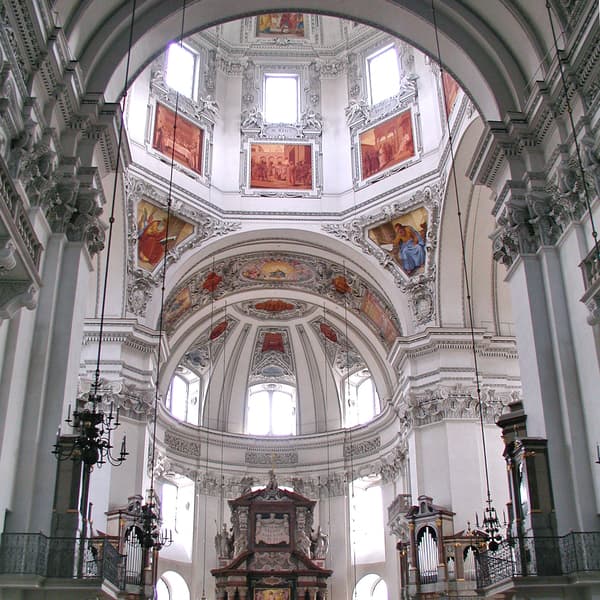
the interior. The interior is clean and white, without excess decoration. Because it was built in just 14 years, from 1614 to 1628, the church boasts harmonious architecture. And, it's big.
330 feet long, 230 feet tall. When Pope John Paul II visited in 1998, some 5,000 people packed the place. Near the entrance, look to the left. In the first chapel on the left is a baptismal font.
Read more...Show less
The dark bronze font is from 1320. It survived the destruction of the previous cathedral. In 1756, little Wolfgang Mozart was baptized here. Over the next 25 years, this would be his home church.
Amadeus, by the way, means beloved by God. Now, make your way slowly up the central nave. Notice how you're drawn toward the light. There's a grand plan for the art.
While the back of the church is fairly dim, the altar area is brightly lit. As you walk, imagine being part of a sacred procession. First, you have to pass through the sorrow of the passion. The nave is dark, and the paintings here depict Christ's arrest and torture.
As you approach the altar, things brighten up with paintings of Old Testament themes that foreshadow Jesus' resurrection. Finally, you reach the altar with its glorious painting of Christ's resurrection bathed in light from the dome overhead. The church never had stained glass, just clear windows to let light power the message. Under the dome, you're surrounded by the tombs of ten archbishops from the 17th century.
You're also surrounded by four organs. Mozart was the organist here for two years. He was part of a long tradition of music that continues today. Sunday Mass here is a musical spectacle.
Imagine all four organs playing and each balcony filled with musicians. Glorious surround sound. Mozart would advise that the acoustics are best in the pews immediately under the dome. The stucco work by an artist from Milano is exceptional.
It's molded into elaborate garlands and picture frames, some of it brightly painted. Study the symbolism of the decor. Intellectual, complex, and cohesive. Think of the altar in Baroque terms as the center of a stage with sun rays serving as spotlights in this dramatic and sacred theater.
Exit the cathedral. As you leave, check out the concert and mass schedules. They're posted at the entrance. The Sunday Mass at 10 o'clock is famous for its music.
As you leave the cathedral, turn left, heading in the direction of the distant, fortress on the hill. You'll pass an underground public toilet on your right. Soon you'll reach a spacious square called Capitol Plots. Head for the modern sculpture, the Golden Orb. Capitol Plots and the Water Wheel
Kapitelplatz, Waterwheel
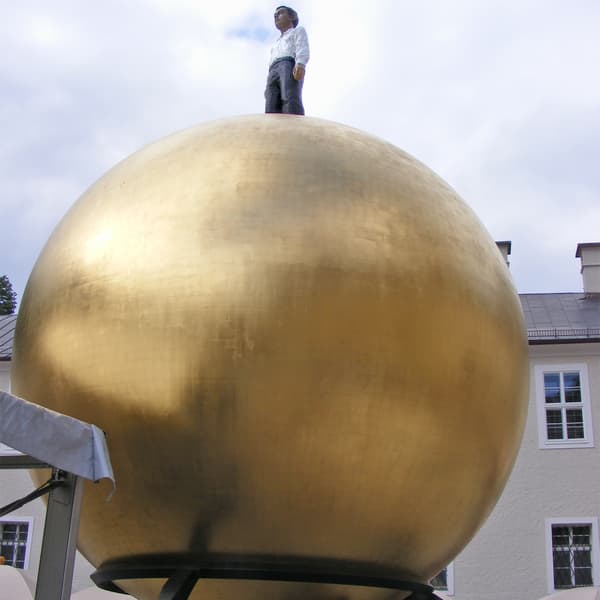
Capitol Plots is an entertaining square. First, enjoy the stunning view of the castle up on the hill. I love the giant chessboard. Locals love it, too.
But my favorite is the man atop the orb. Yes, that playful modern sculpture of a man balancing on a golden orb is just one of many modern artworks scattered all around town. In fact, we'll see his girlfriend later. They're part of what they call the Modern Art Walk, a project with a mission to bring art to the people.
Read more...Show less
It certainly works for me. Now walk across the square to the Capitol Plots. The pond is surrounded by a balustrade and adorned with a trevi-fountain-like statue of Neptune. It looks fancy, but the pond was built as a horse bath, the 18th-century equivalent of a car wash.
Notice the gold lettering above Neptune. It reads, Leopold the Prince built me. But the artist added a clever twist. The inscription uses the letters L-L-D-V-I and so on, and those are also Roman numerals.
Add them up. L is 50, D is 500, and so on. It all adds up to 1732, the year the pond was built. I'll take your word for it.
I have enough trouble with what Super Bowl it is. Anyway, moving on, with your back to the cathedral, leave the square, exiting through the right corner. Just to be clear, we're walking away from the cathedral, toward the castle. We're headed to the right-hand corner of the square.
In the corner, you'll find a small arched gate. Pass through that gate following the sign that reads Zum Peterskeller. Or Peter's Cellar, the name of a nearby restaurant. Once through the gate, notice the entrance to a cemetery on your right, where we'll go in a minute.
But for now, keep going straight ahead a few more steps. You'll reach a water wheel. The water wheel is part of a clever canal system that brings water to Salzburg from the foothills of the Alps 10 miles away. Built in the 13th century the canal is still used today.
Climb uphill a few steps to feel the medieval water power. When the stream reached Salzburg, it was divided into five smaller canals for the citizens' use. The rushing water provided fire protection. It powered water wheels, which powered factories.
There were more than 100 watermill-powered firms here as late as the 19th century. Every Thursday morning, they used the canals to flush the streets. Hygienic Salzburg never suffered from a plague. It's probably the most probably the only town you'll see with no plague monument.
For more on the canal system, you might want to visit the nearby Alm River Canal exhibit. You enter it after exiting the funicular on the way down. This particular water wheel once ground grain into flour. Drop into the adjacent fragrant and traditional bakery.
They sell various fresh rolls, both sweet and savory, as explained on the wall, for less than a euro. From here, at the base of the funicular, turn your attention to the fortress on the hill. View of Hohensalzburg Fortress
View of Hohensalzburg Fortress
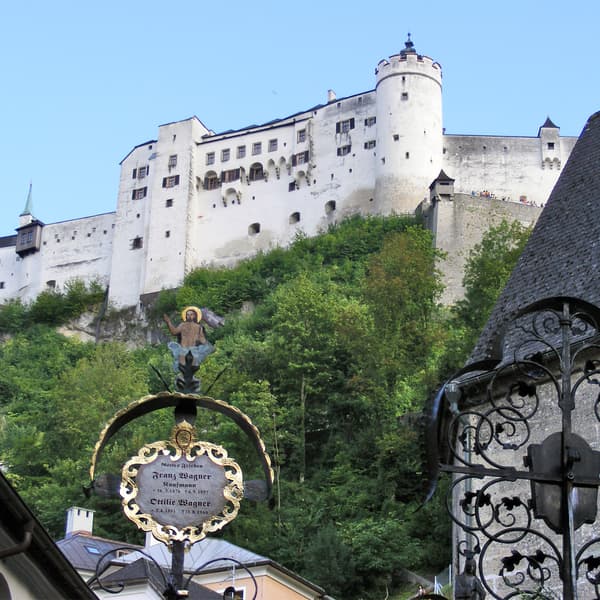
The funicular climbs up Festungsberg Hill to Europe's largest intact medieval fortress. Hohensalzburg Fortress was begun in 1077, built on a rock 400 feet above the Salzak River. Over the centuries, the small castle grew into a mighty whitewashed fortress. It was never really used.
That's the idea. It was a good investment, so foreboding, nobody attacked the town for nearly a thousand years. The city was never taken by force, but when Napoleon stopped by in the early 1800s, Salzburg wisely surrendered. After a stint as a military barracks, the fortress was opened to the public in the 1860s by Habsburg Emperor Franz Josef.
Read more...Show less
The rail line, or funicular, actually dates from as far back as the 1500s when animals pulled up cargo along rails. Today's electric-powered funicular dates from 1910. Hohensalzburg remains one of Europe's mightiest castles, dominating Salzburg's skyline and offering incredible views. Again, thanks to its fortress, Salzburg managed to avoid the ravages of war for over 900 years.
But during World War II, much of the city was destroyed by Allied bombers, mainly north of the river. Fortunately, the historic old town and its castle survived. Now find the sign that says Katakomben, or catacombs. Step into the cemetery.
It's free to enter. Silence is requested. St. Peter's Cemetery
St. Peter’s Cemetery
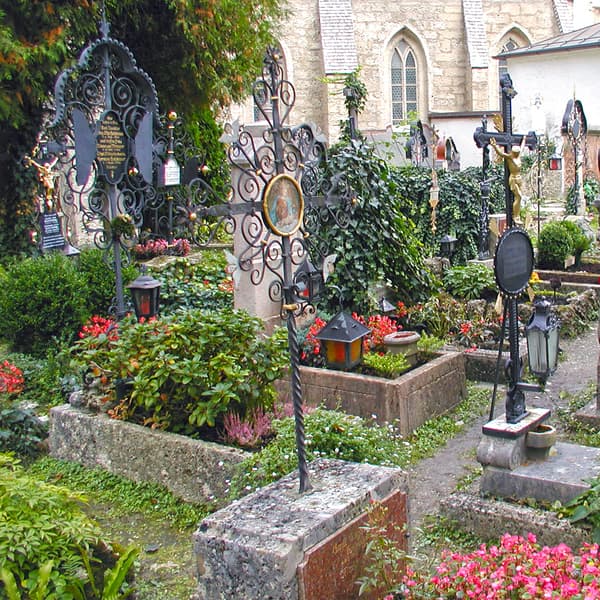
Once inside the cemetery, keep making your way deeper in, about 50 yards. It's a pleasant, pleasant stroll through a collection of lovingly tended mini-gardens that abuts the sheer rock wall called the monksburg. The monksburg, or monk's rock, is a hillside some 500 yards long. On top, it's laced with a set of wooded trails, which the locals really enjoy.
Keep going through the cemetery until you reach the intersection of lanes at the base of the cliff, marked by a stone ball. Uh, Rick? What are you doing with that ball? It's seemingly made to order for a little back-stretching break.
Read more...Show less
Excuse me just a minute. I think I need a stretch. Oh, yeah. Ah.
Okay, your turn. I'll wait. You're surrounded by three churches, each founded in the early Middle Ages atop a pagan Celtic holy site. St.
Peter's Church is closest to the stone ball. We'll visit that in a minute. Notice the fine Romanesque stonework on the apse of the chapel nearest you. Also notice the fancy rich guy's Renaissance-style tombs decorating its walls.
Why are the tombstones in the walls and not in the cemetery like the others? That's because, wealthy as those guys were, they ran out of caring relatives. The graves surrounding you are tended by descendants of the deceased. In Austria, grave sites are rented, not owned.
Rent bills are sent out every ten years. If no one cares enough to make the payment, your tombstone is removed. The cemetery plays a role in the story of the von Trapp family, real-life Salzburgers whose adventures were portrayed in the movie The Sound of Music. The ex-Navy captain and his large family were well-known in Salzburg for their musical talents.
But when Nazi Germany annexed Austria in 1938, the von Trapps feared for their future. As portrayed in the movie, they hid here in St. Peter's Cemetery as they made their daring escape. The scene was actually filmed on a Hollywood set, inspired by St.
Peter's Cemetery. Look up the cliff. Legendary medieval hermit monks are said to have lived in the hillside. But catacombs, they're not.
For a small fee, you can climb lots of steps to see a few old caves, a chapel, and some fine city views. At the catacomb entry is a chapel carved into the hillside. It's number 54. This has the tomb of Mozart's sister, Nannerl.
As children, Mozart and his sister performed together on grand tours of Europe's palaces. Number 54 also has the remains of the composer Joseph Haydn's younger brother, Michael. He was also a composer of great note and was the one who succeeded Mozart as church organist for the Salzburg Cathedral. Take a moment to pause and appreciate these memory gardens, tended with love as seasonal flowers blossom in family's visit.
Appreciate the long tradition of fine Austrian craftsmanship that surrounds you. Imagine being here on Christmas when candles are lit and families gather to sing carols and be close to lost loved ones. Graveyards like this used to be commonplace all over Europe, but during the age of Napoleon, most were removed in the interest of public health and for a more practical use of space. Appreciate this rare survivor.
Our next stop is St. Peter's Church. We're at the back end of the church. To reach the entrance, continue downhill through the cemetery and exit the cemetery at the opposite end.
Just outside, you'll hook right, which puts you at the front door to St. Peter's Church. It'll take a while. So, pause the audio tour now and restart it when you're at the front door to St.
Peter's Church. See you there. St. Peter's Church
St. Peter’s Church
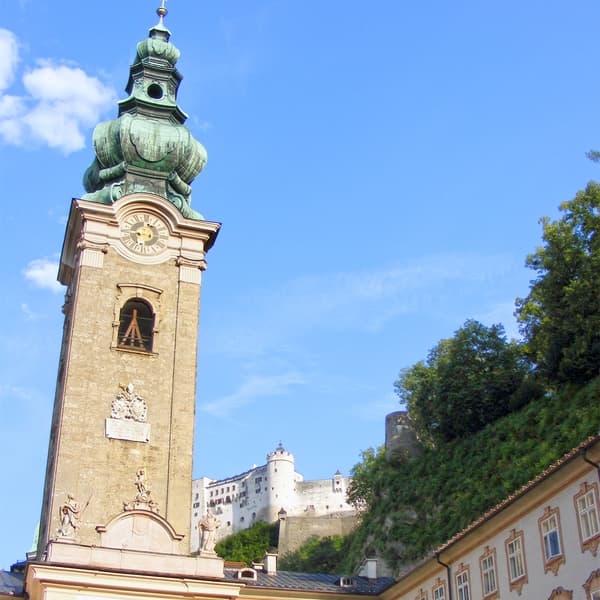
By now, you should be at the church entrance. Let's go inside. Let's. Just inside, enjoy a carved Romanesque welcome.
Over the inner doorway, a fine tympanum shows Jesus on a rainbow flanked by Peter and Paul. Beneath them is a stylized tree of life and overhead, a Latin inscription reading, I am the door to life and only through me can you find eternal life. Enter the nave. Notice how the once purely Romanesque vaulting has since been iced with a sugary rococo finish.
Read more...Show less
Salzburg's only rococo interior feels Bavarian. That's because it is. The fancy stucco work was done by Bavarian artists. Rick, what exactly is rococo?
Rococo is a super decorative architectural style and this church is a fine example of that. Whitewashed walls and ceiling, golden altar pieces, pink marble columns, and colorful paintings and statues. The ceiling, a round barrel vault, is, as I mentioned, Romanesque. It's about 800 years old.
But the rococo decoration only dates from the 1760s. Highly ornamented, it builds on the earlier Baroque style, but it's even more decorative, lighter and frillier. The circle and oval shapes of Baroque became more complex. Like some of the painting frames on the ceiling.
Exactly. And the stucco work squiggles are geometry gone wild. Let's explore a little deeper. Head up the right aisle and find the tomb of St.
Rupert. It has a painting showing Salzburg in 1750. One bridge, salt ships sailing the river, angels hoisting barrels of salt to heaven, and St. Rupert praying for his city.
Around the year 700, Rupert arrived as a Christian missionary in what was then a largely pagan land. He preached the gospel, reopened the Roman salt mines, and established the city. He named it Salzburg. Continue up the aisle where you'll find pillars with faded bits of 13th century frescoes.
Similar frescoes throughout the church now lie hidden under Rococo whitewash. Take a moment to enjoy the frescoes, statues, and altarpieces. It's a quiet riot of great art. In some ways, it's better than a museum.
It's art in situ, where it was originally meant to be seen. You can find it and appreciate these paintings better, seeing them where they were intended to be seen, rather than hanging on a wall in some gallery. When you're ready, leave the church. As you go, think of the mood in Salzburg back in the 1700s when this church was decorated.
They were exhausted from the horrible religious wars of the Reformation and ready to stop fighting and to simply enjoy the diversion provided by Rococo art. As you exit, notice on the left the Stiftskiller St. Peter restaurant, known for its Mozart dinner concert. Charlemagne ate here in 803 A.D., allowing locals to claim that it's the oldest restaurant in Europe.
I hope they've updated their menu. Let's continue on. Keep walking away from the church. We'll exit the square opposite where you entered, through that arch.
Walk across the square, pass through that arch, and head into the church. We're walking through courtyards and buildings that were once part of the St. Peter's Abbey, home to centuries of priests, monks, and theology students. As you emerge from the tunnel, you'll see a statue.
Hey, it's St. Rupert. He's welcoming us into the square. You're surrounded by early 20th century Bauhaus-style dorms for student monks.
Just keep going straight ahead, past Rupert, toward the modern crucifix from 1926 that's painted on the far wall. As you walk, you may be able to notice the two different locally quarried stones so prevalent all over town. There's marble and conglomerate. Pass through the archway under the cross.
We're heading for one more courtyard. This one's dedicated to Salzburg's other religion, music. We're approaching ground zero for the Salzburg Music Festival, that explosion of culture. concerts and performances that draws music lovers from across the planet every summer. You'll enter a square dominated by a large theater. The Toscaninihof.
Toscanini Hof
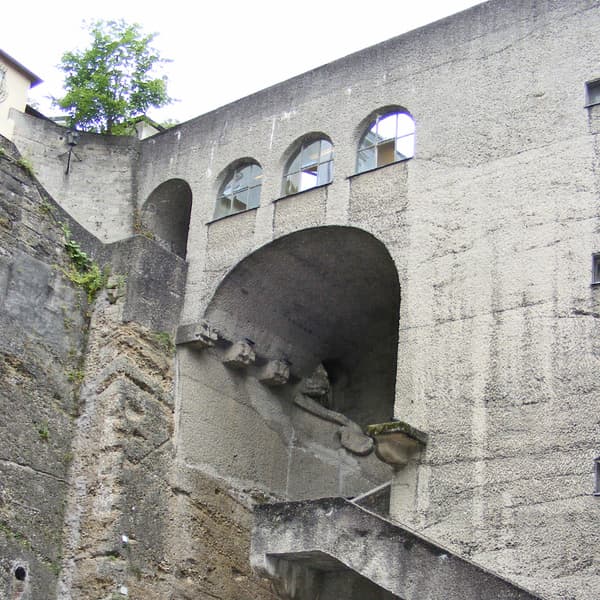
The festival hall, or Toscaninihof, was built in 1925. Its three theaters seat 5,000 people. Every summer, during the Salzburg Music Festival, it's one busy place. The von Trapp family performed here.
In the movie, this is where Captain von Trapp nervously awaited before walking on stage to sing Edelweiss. Then the family slipped away to begin their escape from the Nazis. The square is named for Arturo Toscanini, the 20th century's greatest classical music conductor. When he agreed to conduct here in the 1930s, it confirmed how important the festival was.
Read more...Show less
On the left is the entrance to the city's huge 1,500 space inside the mountain parking lot. Ahead, behind the Felsenkeller sign, is a tunnel which is generally closed, leading to the actual concert hall. To the right is the backstage of a smaller hall. Here, you can sometimes look through the door to see carpenters building stage sets for an upcoming show.
The stone stairway leads a few flights up for a panoramic view. The stairs continue up to the top of the cliff and the Stade Alm Café and Youth Hostel. Find the Woman in the Rock. There she is, looking like a gothic Madonna above the tunnel in her red dress.
She's the partner of the little man on the golden sphere we saw earlier. Now start walking downhill. As you walk, think of being here during the Classical Music Festival, dressed to the nines, enjoying a glass of local white wine, caught up in all the festivities. The festival is mainly classical music and opera, but it's a celebration of all kinds, like the folk music of the von Trapp family.
By the way, Lisa, when the Nazis annexed Austria, sending the von Trapp family fleeing, Toscanini also had to leave, eventually finding a home in the United States. I imagine Toscanini had an easier time. As you enter Max Reinhardtplatz, pause and look left to survey the impressive line of Salzburg Festival concert halls. The festival started in the 1920s, an austere time after the devastation of World War I.
So, rather than building new buildings, they remodeled existing ones. These were the Prince-Bishop's stables and the writing school. Continue straight, passing the big church on your left. You're heading about a hundred yards toward Universitate's plots.
Along the way, let Rick point a few things out. As you stroll, you'll pass by several popular sausage stands offering the best of the versed. Hey, Rick, about the movie The Sound of Music, I know it was based on the real-life Von Trapp family, but just how factual is it? Well, not very.
Salzburg is the happy city of the movie The Sound of Music. It tells the story of a stern captain who needs a governess for his unruly children. He hires Maria and ends up marrying her. Though based on a real family, the movie took plenty of Hollywood liberties.
First, Edelweiss is not an old folk tune. It was written for the movie. The Von Trapp house in the film was not their real house. And when they escaped the Nazis, it was not by hiking to Switzerland.
They just caught the train to Italy. Also, the movie is strictly an American phenomenon. Locals just don't understand all the fuss. As you pass by a public toilet, you'll enter Universitate's plots. Universitate's plots.
Universitätsplatz: Market

The market. This square hosts Salzburg's liveliest open-air produce market. It generally runs mornings, Monday through Saturday. The market is at its bustling best early Saturday mornings when the farmers are in town.
Half of Austria's produce is grown organically, and locals are happy to pay more here to get it fresh. Notice the fountain. It's further down to the left, towards the end. Stroll on over.
Read more...Show less
It's worth checking out. Like with public marketplaces elsewhere, it's for washing fruit and vegetables. This fountain is still part of a medieval-era water system. The water plummets down a hole and onto the river.
Notice the sundial over the water hole. It's accurate, except during daylight savings time, and two-dimensional. It shows both the time, that's obvious, and the date. Less obvious, We're nearing the end of our walk.
Just to get oriented, the fancy yellow façade overlooking the square Back near where we entered. That marks the rear end of Mozart's birthplace. His front door is where we'll end our tour shortly. For now, continue past the fountain toward the end of the square.
Along the way, we'll pass several characteristic and nicely arcaded medieval tunnels. They're on the right. These tunnels connect the market square to Salzburg's old main street, Getreidegasse. After about a hundred yards, duck into any one of these and wander under the medieval walls and past the modern shops until you pop out on Salzburg's most famous street, a traffic-free street filled with shoppers and tourists, lined with seductive storefronts, and ornamented with fancy old-fashioned shop signs hanging above the crowds.
So go exploring. Again, pop into one of the arcaded tunnels and just keep going. Keep going until you emerge at our next stop, the street called Getreidegasse. So pause the audio tour now and restart it once you reach Getreidegasse. See you there! Getreidegasse.
Getreidegasse
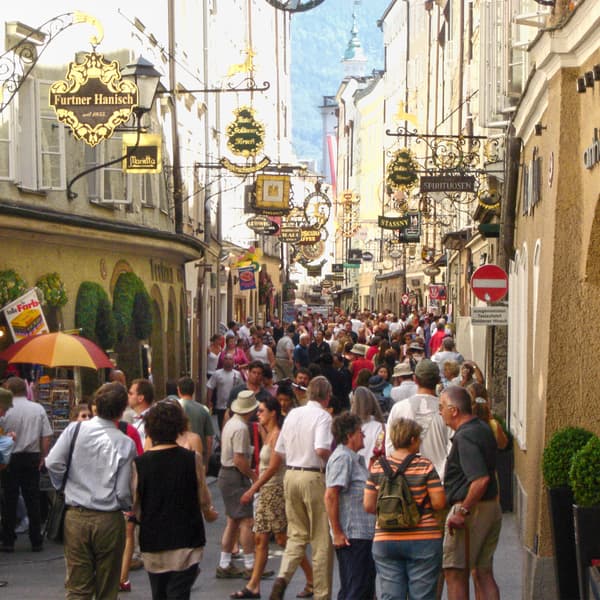
As you emerge onto Getreidegasse, turn right and gaze down the street. We'll be walking that way in a bit, but first, take a moment to enjoy this delightful little street. This street was Old Salzburg's colorful main drag. Getreidegasse has been a center of trade since Roman times.
Check out all the old wrought iron signs that advertise what's sold inside. This is the Salzburg of prosperous medieval burghers, or businessmen. The buildings date mainly from the 15th century. They're tall and narrow for the age.
Read more...Show less
That's because this neighborhood was prime real estate, and there was nowhere to build but up. Space was tight as the town was squeezed between the river and the mountain, and lots of land was set aside for the church. The architecture still looks much as it did in Mozart's day, though many of the buildings themselves are now inhabited by chain outlets. Enjoy the traditional signs and try to guess what they sold.
Over the course of your walk, you'll see a sign advertising spirits, a bookmaker, a horn indicating a place for the postal coach, a brewery has a star for the name of the beer, Sternbrau. Let's start walking up the street, about a block, toward Mozart's birth house. Enjoy more shop signs along the way. There's a window maker, a key maker, a pastry shop, a tailor, a pretzel maker, a pharmacy, and a hat maker.
Is that a hamburger? Yes, mein Fraulein, ye olde hamburger shop, too. McDonald's is allowed, but required to keep its arches baroque, and low-key. By now, you should be approaching our final stop, Mozart's birth house.
Near the end of Getreidegasse, the nod of excited tourists and salesmen hawking goofy gimmicks marks the home of Salzburg's most famous resident. It's Mozart's birthplace, or Geburt's house. It's famous, of course, but the building is really just a basic apartment flat. You can even see the individual wires which let visitors ring individual apartments.
Imagine that. Ding-dong! Can Wolfie come out to play? Although our tour won't be going inside, it's worth pausing here a moment to appreciate Mozart and his impact on this great city.
Enjoy a little Mozart sonata, and then join us on the final track. piano plays in bright rhythm Mozart's birthplace.
Mozart's Birthplace
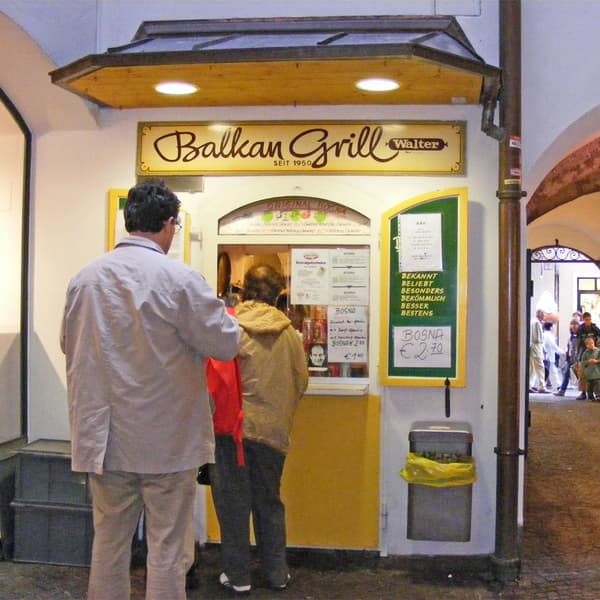
The tour ends. Mozart was born here in 1756. It was in this building that he composed most of his boy genius works. Inside, you'll see paintings, letters, personal items, and dioramas of his operas.
A period living room shows what Wolfgang's world likely looked like, and portraits introduce you to the family. A highlight is an old clavichord he supposedly composed on. Mozart is a great way to bring this tour to a close. A hometown boy who represented how such a relatively small, beautiful city could be such a cultural force.
Read more...Show less
Rick, bring us home. As we've seen, Salzburg is a city steeped in history. We've traveled from the town of the Romans to St. Rupert in the medieval salt trade.
We've seen the Baroque world of prince-archbishops with their Italian-flavored residence and cathedral. From the fortress to the river to the beautiful music of Mozart, Salzburg is a pleasure to visit. There's lots more to see. And you're right in the center of it.
Gute Reise. Have a great trip. We hope you enjoyed this tour of Salzburg's Old Town. Thanks to Jean Openshaw, the co-author of this tour.
Remember, this tour was excerpted from the Rick Steves' Vienna, Salzburg, and Tyrol guidebook. For more details on eating, sleeping, and sightseeing in Salzburg, refer to the most recent edition of that guidebook. For more free audio tours and podcasts, and for information about our guidebooks, TV shows, and more, visit our website at ricksteves.com. This tour was produced by Cedar House Audio Productions. Thanks. Auf Wiedersehen. And goodbye for now.
Free
GPS-guided walking tour
No account needed. Walk at your own pace.
Free
15 stops · 2 km