18 stops
GPS-guided
2.5 km
Walking
1.5 hours
Duration
Free
No tickets
About this tour
A 2.5 km GPS-guided walk through the heart of Austria. Visit Vienna City Walk, Café Sacher, Albertinaplatz, and Kärntner Strasse — with narrated stories at every stop.
18 stops on this tour
Vienna City Walk
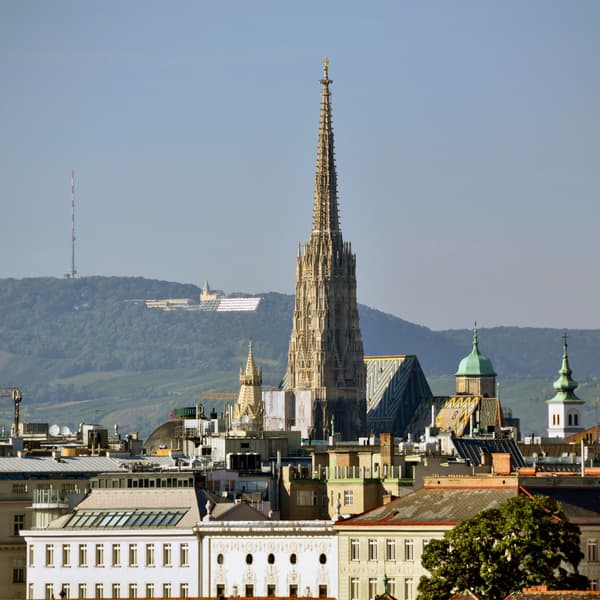
Vienna City Walk. Welcome to Vienna. Vienna is the capital of Austria, the cradle of classical music, the home of the rich Habsburg heritage, and one of Europe's most livable cities. Hi, I'm Rick Steves.
Thanks for joining me on a walk through the historic core of Vienna, or Wien as it's known in Austria. On this walk, we'll lace together the city's three most important landmarks. We'll start at the Opera House, ground zero for Vienna's international reputation for classical music. Next is the Cathedral, with its skyscraping spire, the symbol of the city.
Read more...Show less
We end at the Hofburg Palace, once the home of the mighty Habsburgs, now brimming with top-notch museums. This walk is a great first look at the city. Use it to get the lay of the land and an overview of sites you may want to explore in more depth later. Allow about 90 minutes for this mile-and-a-half walk.
Now let's get started as we explore Vienna's intriguing past and the Vienna of today. It's a laid-back world of genteel shops, inviting cafes, delicious chocolate, and soccer tort. It's the city where civilized Austrians continually perfect their knack for good living. Vienna.
To help us along the way, I've invited a good friend and virtual travel buddy. Welcome, Lisa. Guten Tag, Herr Steves. Lisa will give us helpful directions and sightseeing tips throughout the tour.
And my first tip is to be sure you get our tour updates. Just press the icon at the lower right of your device. You'll find any updates and helpful instructions unique to this tour. Things like closures, opening hours, and reservation requirements.
There's also tips on how to use this audio tour and even the full printed script. Yes, so pause for just a moment right now to review our updates and special tips. It's okay. We'll wait. And then... Let the tour begin. The tour begins.
Tour Begins: Opera House
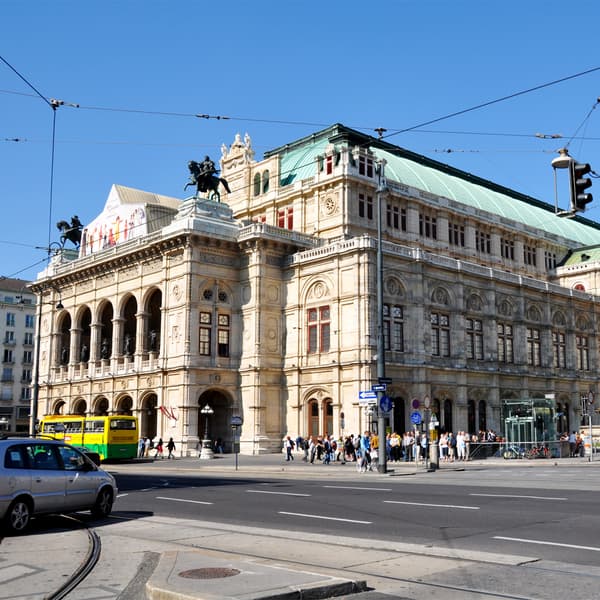
The Opera House. Begin at Vienna's landmark Opera House. The closest U-Bahn stop is Karlsplatz. Start in the pedestrian square along the side of the Opera House.
From here, you can take in the sheer length of this impressive green-roofed building. Get oriented. The opera sits on the busy ring road called the Ringstrasse. The Ringstrasse circles Vienna's historic core.
Read more...Show less
We're on the south edge of the ring. On our walk, we'll be heading north into the heart of the old city. That is, to the right as you face the Opera House. Got it?
For now, turn your attention to Vienna's Opera House. Rick? If Vienna is the world capital of classical music, this building is its throne room. At Vienna's peak in the 1800s, the city was the epicenter of European culture.
Generations of great musicians flocked to Vienna. Think of it. Haydn, Mozart, Beethoven, Brahms, Johann Strauss, Sr. and Jr.
It's a star-studded list of classical musicians. The Opera House, built in 1869, is a symbol of that golden age. The opera's architecture is typical of many buildings you'll see here in Vienna. It revives an older style, in this case, Neo-Renaissance.
Notice the Renaissance-style arches over the windows and the classical half-columns. The sloping copper roof is like a French Renaissance chateau. Nearly all of opera's luminaries have passed through here. Gustav Mahler and Richard Strauss served as musical directors Luciano Pavarotti, Maria Callas, Placido Domingo.
They've all sung from its stage. Today, the opera still belts out 300 shows a year, both traditional and cutting-edge. Notice the giant outdoor screen where some performances are projected to an adoring public. Check the posted schedule to see what's coming up.
The opera's interior is sumptuous. The chandeliered lobby with carpeted stairs is perfect for making the scene. The theater itself has five wraparound balconies, golden-red decor, and a bracelet-like chandelier. To see the inside, you could attend a performance.
Notice there's a box office under the big screen. Actually, standing-room tickets are surprisingly cheap, and no one will shoot you if you want to leave at intermission. How boorish! Well, then, you can get inside by taking a guided tour.
That ticket office is on the opposite side of the building. The opera house is just one venue in this incredible, incredible city of music. There's the world-famous Vienna Boys Choir at the Hofburg. I'll point that out later.
The Vienna Philharmonic, a world-famous symphony orchestra, occasionally performs here on the opera house stage. And music fans will want to visit a museum called Haus der Musik. It's just two blocks away. Notice the pavement under your feet.
In the sidewalk are star-shaped plaques. These honor the stars of classical music, famous composers, singers, musicians, and conductors. It's like a Hollywood walk of fame, but Vienna-style. Before we move on, remember, the opera sits on the Ringstrasse.
That's the broad ring road that circles the old town. If you're interested, I have an audio tour of the Ringstrasse. It starts right here from the opera tram stop. Now let's plunge into the heart of Vienna.
Lisa. From the pedestrian square alongside the opera, start circling to the right around the big building. Circling counterclockwise around the opera house. Got it?
This will put you on the street called Philharmonicstrasse. An appropriate name for a street alongside the opera house. As you walk west along Philharmonicstrasse, keep an eye out for the dark red awning at number four. This marks the entrance to Vienna's famous Café Sacher. ♪ ♪ Café Sacher
Café Sacher
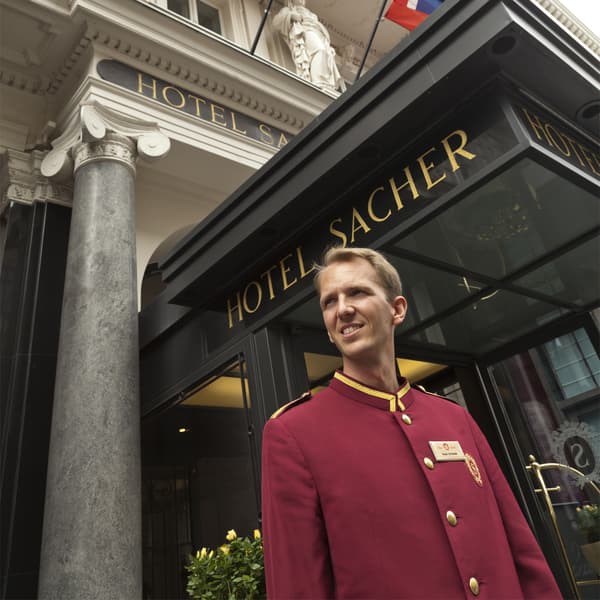
This is the home of the world's classiest chocolate cake, the Sacher Torte. It's two layers of cake separated by apricot jam and covered in dark chocolate icing. Top it off with a dollop of whipped cream. The cake was invented in a fit of improvisation in 1832 by Franz Sacher.
He was the dessert chef of Prince Metternich, the mastermind diplomat who redrew the map of post-Napoleonic Europe. The cake became world-famous when the inventor's son served it next door at his hotel. You may have noticed the Hotel Sacher's fancy doorman. Since the café's heyday, many locals complain that the cakes have gone downhill.
Read more...Show less
You may be surprised by how dry they taste. You really need that dollop of whipped cream. And the café has become pricey and grotesquely touristy. Still, coffee and a slice of cake here in Café Sacher can be worth it for the historic ambiance alone.
That's so tempting. But let's move on. Continue past Hotel Sacher. By the way, Lisa, the coffee shop as we know it was practically invented here in Vienna.
We'll be seeing one of the city's most venerable cafés just ahead on the next square. At the end of the street is a small triangular cobbled square adorned with modern sculptures. Albertina Platz. Albertina Platz.
Albertinaplatz
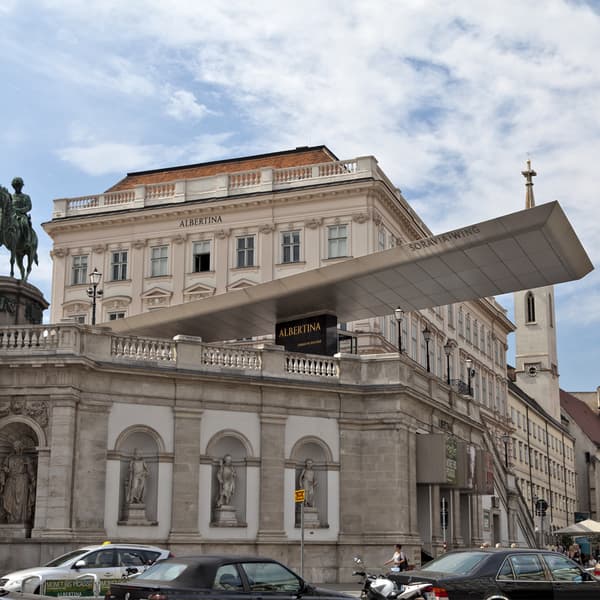
On your left is the Albertina Museum. Its modern entrance is topped by a sleek titanium canopy. Critics call it the diving board. The museum is worth a visit for its chandeliered rooms and its paintings from Impressionism to modern art.
The Albertina is housed in a large, tan and white neoclassical building. It's the tip of the Hofburg Palace, the sprawling complex of buildings that the Habsburg emperors called home. We'll end this walk at the center of the Hofburg. But first, walk across Albertina Platz and to the left for a closer look at a small freestanding hot dog stand.
Read more...Show less
Great idea, Lisa. The hot dog stand has a green rabbit on its roof. A green rabbit? Oh, right.
That's an homage to Albrecht Durer's famous etching, The Hare, which is in the Albertina Museum, right behind the diving board. It's a reminder of how much great art it has to offer. But just as important as that, a traditional Viennese hot dog. A Wurstel stand offers a variety of hot dogs, pickled side dishes, and a convenient place where locals like to just hang out and chat.
The Wurst, usually pork sausage, is a staple of the Austrian diet. What's the best of the Wurst? They're too numerous to mention. Be adventurous.
Bratwurst is a generic term that simply means grilled sausage. A Burenwurst is similar to what we'd call kielbasa. There's also Bockwurst, Weisswurst, Beinwurst, Liverwurst, and much more. Generally, the darker the weenie, the spicier it is.
The Wiener we know, the basic hot dog, is named for Vienna. Wien, Wiener. But the guy who invented the Wiener actually studied in Frankfurt. Then he moved to Vienna with his new friend, but he named it in a fit of nostalgia for his old hometown, a Frankfurter.
So only in Vienna are Wieners called Frankfurters. Got that, Lisa? Got it. I enjoy your spicy anecdotes with relish.
That reminds me. When you order, your Wurst comes on a paper plate with a squirt of mustard, called sanf, or with ketchup, called ketchup, or with curry ketchup. That would be very spicy. You can ask for your mustard either sweet, sous, or spicy.
Or sharp, scharf. You also have a choice between bread or a roll. Brot oder Semmel. Neither one of these resemble an American hot dog bun.
So to avoid looking like a tourist, don't try to put your sausage in your bread like a hot dog. Eat it like a local. Take a bite of Wiener, then a bite of bread. As they say, that's why you have two hands.
Hey, Rick, how does a Buddhist order a hot dog? Make me one with everything. How do you ask for change? Change, Lisa, comes from within.
Let's change the subject. From the hot dog stand, in the distance, you can see the lacy spire of St. Stephen's Cathedral across Albertina Square. We'll be heading there soon, but for now, cross under that diving board and into the square.
Albertina Plots, with its white marble statues, is the site of a World War II tragedy and home to a powerful memorial. This is the powerful, thought-provoking Monument Against War and Fascism. It remembers the dark years from 1938 to 1945 when Austria came under the rule of Nazi Germany. It's also a poignant reminder of the brutality of all war.
Start with the split white stone monument. These are called the Gates of Violence. Standing directly in front of it, you're at the symbolic gates of a concentration camp. It's a montage of wartime images.
There are clubs and World War I gas masks. A dying woman gives birth to a future soldier. Chained slave laborers sit on a pedestal of granite. The stone comes from the infamous quarry at the Mauthausen concentration camp.
It's just up the Danube from Vienna, where 100,000 prisoners died. Behind the Gates of Violence, the hunched-over figure on the ground, is an Austrian Jew forced to scrub anti-Nazi graffiti off the street with a toothbrush. Of Vienna's 200,000 Jews, about a third died in Nazi concentration camps. The nearby statue, with its head buried in the stone, is Orpheus entering the underworld.
He reminds Austrians, and the rest of us, of the horrible consequences of turning a blind eye to the fascist threat. Finally, behind Orpheus stands the Declaration, a declaration that established a democratic Austria in 1945, and once again restored the country's basic human rights. One more thing. This monument stands on the spot where World War II bombs struck, demolishing a cellar and burying several hundred people alive.
Austria had been led into World War II by Germany, which annexed the country in 1938, saying Austrians were wannabe Germans anyway. But Austrians are not Germans, never were, never will be. They're quick to tell you that, whereas Germany wasn't a nation until 1870, Austria has a thousand-year heritage. After the war, Austria lived through ten years of joint occupation by the victorious Allies.
Then, in 1955, it was granted total independence, and Austria was a free nation once again. Beyond Albertinaplatz, just past some trees, in the corner opposite the hot dog stand, is Café Terollerhof. Pull on over for a closer look. Whether or not you choose to go inside, this is one of many classic Viennese cafés.
In Vienna, the living room is down the street at the neighborhood coffeehouse. It's another example of that Viennese expertise in good living. Each coffeehouse has its individual character and characters. Admittedly, some classic cafés can be a bit tired and shabby with famously grumpy waiters, but most are welcoming for those who take the time to see the coffee.
They offer things that time has passed by. Chandeliers, marble tables, upholstered booths, waiters in tuxes, and printed newspapers. It's great for a pastry or light lunch with local office workers. It's also a great place for tourists to take a break in relaxing elegance for the price of a cup of coffee.
Coffee in Vienna are forever linked. It dates from the 17th century when coffee was introduced from Turkey. There are several colorful legends of how it was introduced during the time of the Ottoman invasion back in 1683, but no one knows for sure. In the 18th century, coffee boomed as an aristocratic drink.
In the 19th century Industrial Age, when people were expected to work 12-hour shifts, coffee became a hit with the working class as well. By the 20th century, the Vienna coffee scene became incredibly refined. Old-timers still remember when waiters came around with a sheet of paper with various shades of green. Customers could make clear exactly how milky they wanted their coffee.
Before you leave the square, take note of the Tourist Information Office. Here you can pick up the free city map with a list of museums and hours. They have the free monthly program of concerts and other handy brochures. There's also a handy ticket office here.
Facing the Café Terollerhof, turn right and leave the square, heading east up Führungsgasse. Heading up Führungsgasse. Got it. Continue along Führungsgasse one long block.
We're headed for what was the traditional spine of the city, and it still is. Continue up the street to where it intersects with a busy pedestrian-only street. This is Kartnerstrasse. ¶¶ ¶¶ ¶¶
Kärntner Strasse
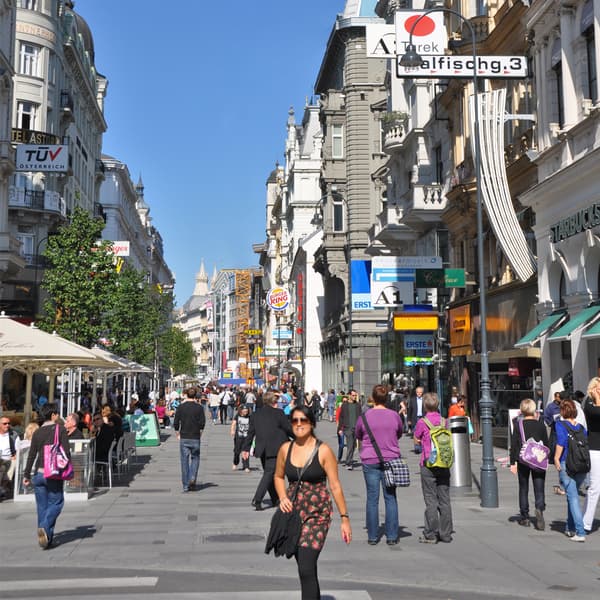
Kärntner Strasse
Kaisergruft
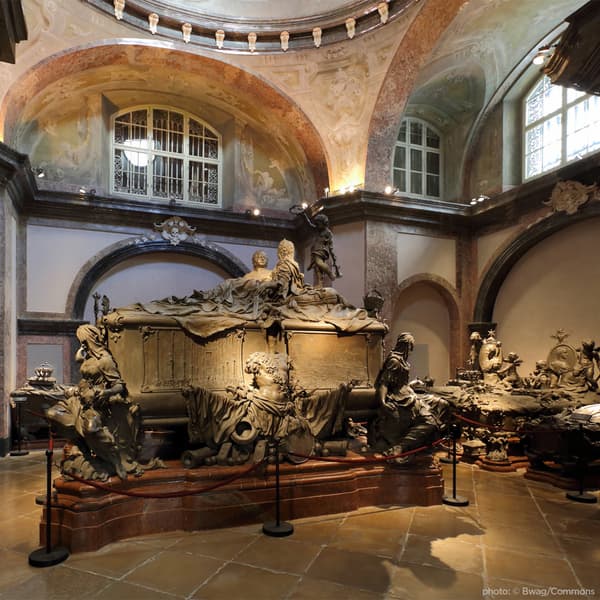
The Kaiser Gruft In the church's basement sits the imperial crypt. It's filled with what's left of Austria's emperors, empresses, and other Habsburg royalty. For centuries, Vienna was the capital of a vast empire ruled by the Habsburg family. If you pay admission to go inside, you'll see the fancy pewter coffin of beloved Empress Maria Theresa, who ruled for 40 years from 1740 to 1780.
Besides reforming the government, banning torture, and funding schools, Maria also found time to have 16 children. The original practitioner of make-love-not-war, she married her children off to Europe's crowned heads to cement a new era. Her youngest daughter, the famous and ill-fated Marie Antoinette, married the king of France. The Kaiser Gruft also has the tomb of Maria Theresa's eldest son, Emperor Joseph II, who freed the serfs and took piano lessons from Mozart.
Read more...Show less
Joseph inaugurated Vienna's Golden Age, which was presided over by another Kaiser Gruft resident, the Emperor Franz Joseph, who ruled the Habsburg Empire for 68 years until World War I. Fans of the Habsburgs want to make a trek outside Vienna to their summer home, the Schönbrunn Palace. This immense Versailles-like complex is one of Europe's great sights, well worth the trouble to get there. Let's continue our walk.
The Kaiser Gruft sits in the corner of a square called Neuermarkt. Start walking north through the square, one block, toward the fountain in the center of the square.
Neuer Markt to Cathedral
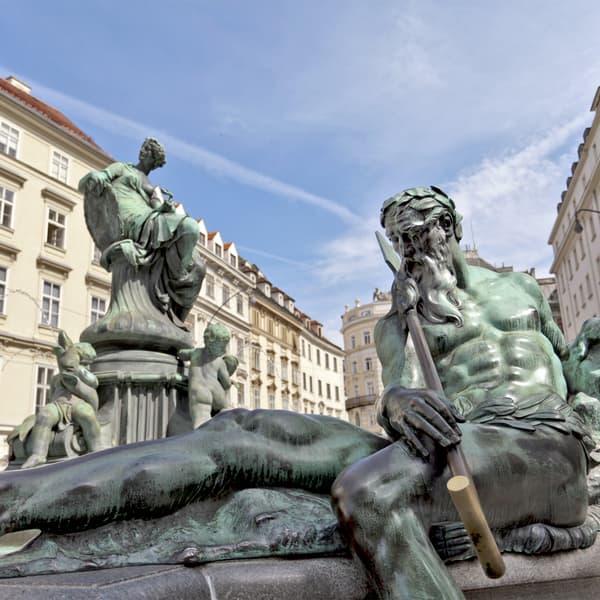
Neuermarkt to the cathedral, Vienna's Golden Age. Survey the architecture lining this square. It's a good mix from the 1700s to post-World War II. You can tell which buildings replaced bombed-out ones.
A few years ago, this square was congested with parked cars. Then, in 2022, the city dug and opened a four-level underground garage and planted trees, making Neuermarkt the people-friendly space it is today. In the center of Neuermarkt is the Four Rivers Fountain. It shows Lady Providence, surrounded by figures symbolizing the rivers that flow into the Danube.
Read more...Show less
The sexy statues offended Maria Theresa. While the empress wasn't busy making babies, she actually organized chastity commissions to defend her capital city's moral standards. From here, we return to Kärntnerstrasse, 50 yards away. Lady Providence is one bare breast, points the way.
As you walk back to Kärntnerstrasse, notice the buildings all around you. Most are fairly modern, having been rebuilt after World War II. Half of the old city was intentionally destroyed by Allied air raids. Winston Churchill intended to demoralize the Viennese, who were disconcertingly enthusiastic about the Nazis.
Keep going back to Kärntnerstrasse. World War II, with its massive bombings, nearly destroyed, destroyed the character of Vienna. But when they rebuilt after the war, they did it thoughtfully. Much of the old style was preserved, while sprinkling in a few newer buildings and urban concepts.
That mix of old and new blends especially well back on Vienna's pedestrian-friendly main street. When you reach Kärntnerstrasse, turn left. Continue north down Kärntnerstrasse, which leads to the cathedral and Vienna's main square. As you walk down Vienna's main street, so full of life, it's clear the city has bounced back after the world wars of the 20th century.
But Vienna's true peak, its golden age, was the 19th century. Back then, the Habsburgs still ruled a vast empire, with Vienna as their glorious capital. As we've seen, it was one of Europe's cultural capitals. It was the city of fine wine, exquisite art, coffee and chocolates, dress-up balls, and the good life.
Composers came here to launch their careers, Mozart, Beethoven, Brahms. Johann Strauss, senior and junior, whipped the masses into a delirious frenzy with their new dance craze, the waltz. Architects redrew the city skyline. Vienna was a center of cutting-edge science.
Christian Doppler studied wave frequencies, the Doppler effect. Sigmund Freud, launched psychoanalysis. He focused on repressed sexual desires, the unconscious mind, and couches. The painter Gustav Klimt shocked the world with women in erotic poses and come-hither looks.
By the year 1900, Vienna had 2.2 million people, bigger than it is today. It was the fifth-largest city in the entire world. Vienna sat balanced on the cusp between traditional old-world elegance and subversive modern trends. Vienna was the first city in the world to have a city.
Vienna was the first city in the world to have a city. But Vienna's Belle Epoque, or Beautiful Age, would come to a shattering end with the pull of an assassin's trigger in 1914 that launched World War I. Vienna sure has a lot of history. Its medieval roots, the Habsburg Empire, the introduction of coffee, then came its peak in the 1800s, Beethoven, Strauss waltzes, then came its exciting turn of the century with Klimt and Freud, and then, a difficult period, the bloody end of the Habsburg Empire with World War I, Hitler, and the mass bombings of World War II, and the rebuilding since.
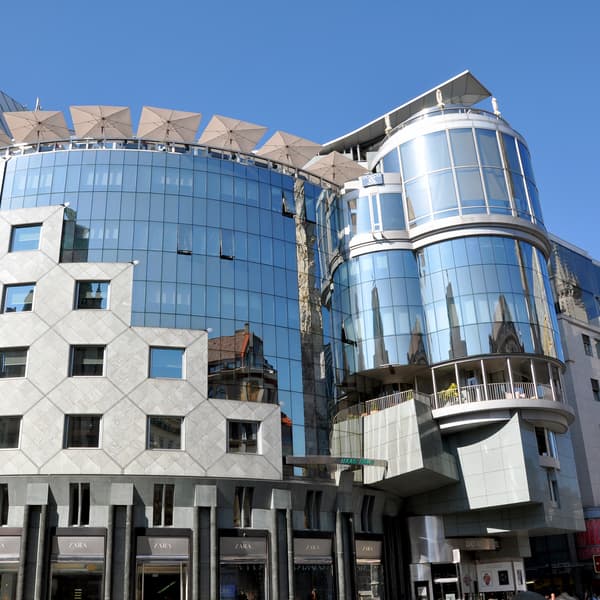
And all those layers of history can be found in Vienna's most important building. By now, you should be approaching St. Stephen's Cathedral. You're likely to see it first as a reflection in the round glass windows of the modern building that faces it.
Walk past the U-Bahn, the U-Bahn station. Here, the street spills into Stefan's Platz, Vienna's main square, dominated by the enormous Cathedral of St. Stephen. St. Stephen's Cathedral,
St. Stephen’s Cathedral
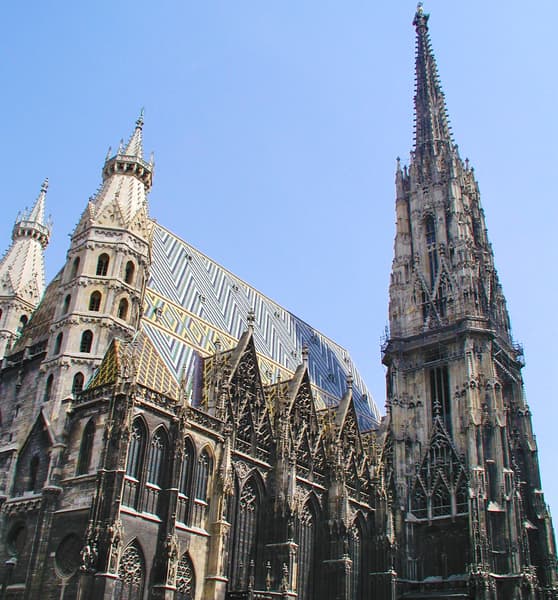
the center of Vienna. The cathedral's frilly spire looms overhead. Worshippers, and tourists pour inside the church. And shoppers, and top-notch street entertainers buzz around the outside.
You're at the center of Vienna. St. Stephen's Cathedral is known for its 450-foot-tall south tower, for its colorful roof, and for its place in Viennese history. It was built in medieval times, roughly 1300 to 1450, in the Gothic style, with pointed arches, buttresses, and gargoyles.
Read more...Show less
At the time, it was a huge church for a tiny town. Its sheer size brought prestige and attracted both church authorities and tourists to the town. It helped put fledgling Vienna on the map. At this point, you may want to take a break from the walk and tour the church.
If you go inside, you'll see its impressive vaulted nave studded with statues. There's a marvelous carved pulpit, the chapel where Mozart was married, and assorted altarpieces, tombs, and icons. I have another audio tour that covers the cathedral, inside and out. But for now, let's continue our city walk.
You're standing at the center of Vienna. Think of the city map as a target. The bullseye is St. Stephen's Cathedral.
Surrounding that is the Ringstrasse, the grand boulevard that circles the old town. The road marks where the city wall once stood. On the south border of the ring is the opera house, where we started this walk. The ring's north border, a few blocks to your left as you face the church, is the Danube River.
The Ringstrasse contains the first district, called a Bezirk. Outside the city center is another ring road, called the Gürtel, that contains the rest of downtown. Beyond the Gürtel lies the industrial sprawl of modern Vienna. About ten miles to the southwest are the famous hills known as the Vienna Woods, a popular playground for hikes and sipping new wine.
As big as greater Vienna is, for the tourist, it's quite manageable. Almost everything of interest to the tourist lies here, within the ring. The cathedral and Steffen's Platz are the perfect place to talk about Vienna's colorful past. Wander around or find a place to relax while Rick points out several sights in the square. piano plays in bright rhythm Steffen's Platz,
Stephansplatz
a microcosm of Vienna's history. The cathedral and Steffen's Platz put the city's history on display. For much of its history, Vienna has been the dividing line between Eastern and Western Europe. The city was first occupied 2,000 years ago by the Romans.
They built their fort right here, where the cathedral stands today. In fact, a few Roman-era stones are actually incorporated into the cathedral. They're part of the two octagonal towers that flank the main entrance. Roman Vienna was the crossroads of Europe, where the Danube River, traveling west to east, crossed the north-south trade route through the Alps.
Read more...Show less
After Rome fell in about 500 A.D., the city was invaded many times by Germanic barbarians, Hungarian Magyars, and Mongol hordes. Around the year 800, Charlemagne made this the eastern part of his empire, Osterreich, or, Austria. In 1273, a noble family called the Habsburgs claimed Charlemagne's title of Holy Roman Emperor. For the next six centuries, the Habsburgs would rule a vast and expanding empire.
Around 1300, the cathedral was built. It convinced the Habsburgs to move to Vienna from their former capital, in Prague. The church's colorful roof sports black eagles fashioned after the Habsburg family symbol. The Habsburg double-headed eagle faced both sides east and west, symbolizing their control over a far-flung empire.
For the next page in Vienna's history, focus on the cathedral's 450-foot-tall tower. Notice you see the south tower, but not the north tower, which is shorter, about half the size of its taller sister. That's because in 1529, Vienna was invaded by Ottoman Turks. Construction funds had to be diverted to the Defense Department.
For the next two centuries, Vienna was Europe's bastion against a rising tide of Islam. The wars culminated in 1683, when 200,000 Ottomans surrounded the city walls, today's Ringstrasse. The Ottomans were driven off for good. As we learned earlier, they left behind bags of coffee, and Vienna's first coffeehouse opened.
Or so goes the over-caffeinated legend. Vienna became one of Europe's great cities, attracting talent from all over the German-speaking world. Wolfgang Amadeus Mozart, lived here in the 1780s, just a block or so behind the cathedral. For the next century, Vienna enjoyed its golden age of arts, sciences, and the good life.
Politically, the Habsburg Empire was on the decline as rising powers like France, Britain, and Germany came to dominate Europe. But for the city of Vienna, the late 19th century was its cultural high point. One remnant from that time still stands on Steffen's Platz. It's where Kärntnerstrasse hits Steffen's Platz, the grand, soot-covered building with red columns.
This fine neoclassical architecture sums up Vienna's Belle Epoque mix of elegance and modernism. As Vienna entered the 20th century, it was home to a man who would change history forever. Imagine this. In 1907, this struggling young artist stood right here in Steffen's Platz.
He painted a watercolor of the cathedral's north tower. It was just one of many city scenes the poverty of Vienna and the poverty-stricken young man would paint, trying to make it in the world of art. But after eight long years of frustration in Vienna, he gave up and went on a different path in a different country. His name?
Adolf Hitler. As it would turn out, Hitler and the 20th century would prove to be brutal on Vienna. In 1914, the Habsburg Archduke was assassinated in Sarajevo. In revenge, Austria declared war on Serbia, igniting World War I.
Austria was on the losing side. When the dust finally settled, the Habsburgs were deposed and their empire was dismembered by the victors. The war left Austria as a small, landlocked nation and Vienna as an imperial city without an empire, a head without a body. Then things went from bad to worse.
In 1938, Hitler and Nazi Germany forcibly annexed now powerless Austria, leading it into World War II. Bombs destroyed nearly a quarter of the city's buildings, including parts of the cathedral that towers before you now. At war's end, the city was a mess. Like Berlin, it was divided into occupied zones.
Austria was declared neutral, forbidden to join either NATO or the Soviet Union's Warsaw Pact. It became a kind of no-man's land between East and West, a battleground of espionage through the Cold War. But slowly, the city resumed rebuilt. The church's colorful tile roof, though medieval in style, actually dates from the 1950s.
Vienna's U-Bahn system was expanded in the 1970s. Stefan's Platz was completely modernized. The modern glass building that faces St. Stephen's dates from 1990.
The building brings Vienna's history full circle. Its curved façade echoes the shape of the ancient Roman fortress which stood here 2,000 years ago. And notice how the glass catches the reflection of St. Stephen's, blending the old, and the new.
It's a great photo op. Finally, look around the square at the Viennese people of today. Vienna's population is 1.8 million and falling. The average Viennese mother has only 1.3 children, and dogs are the preferred child for many young professionals.
One in every five Austrians calls Vienna home. The truly Viennese person is an ethnic mix, a Habsburg cocktail. Many of their grandparents came from the eastern countries of the former empire, Hungary, the Czech Republic, Slovakia, and so on. Today's Vienna is certainly modern, but compared with most big cities, the pace of life here is slow.
After 2,000 years of turbulent history, Vienna has settled down into a sleepy, pleasant place where culture is still king. Let's continue on. Now we head west, working our way toward the Hofburg Palace. Exit the square.
Backtracking a few steps, arc right, rounding the curved modern glass building. You'll find yourself at the head of a broad pedestrian street known as the Graben. The Graben.
Graben
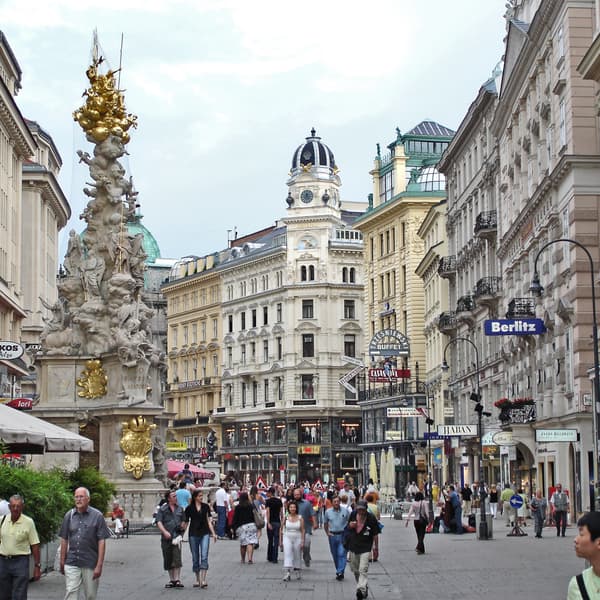
This was once a Graben, or ditch, originally the moat for the Roman military camp. During Vienna's 19th century heyday, this was one of the main streets. In the 19th century, there were nearly 200,000 people packed inside the Ringstrasse. The Graben, like other streets in Vienna, was dirt.
By the 1900s, it was paved with three noisy lanes of traffic. Around the 1970s, it was turned into one of Europe's first pedestrian-only zones. Today, while only 20,000 Viennese live inside the Ring, this popular promenade is as vibrant as ever. Take a moment to consider the scene.
Read more...Show less
History everywhere. Rebuilt after a war. Grand architecture. Fine cafes.
People enjoying life. For me, quintessential Europe. Walk down the Graben two blocks. Turn left on Dorothea Gaza.
We'll side-trip half a block up Dorothea Gaza to peek into three venerable eating spots and watering holes. A café, a buffet, and a bar. And a basil. Dorothea Gaza.
Dorotheergasee
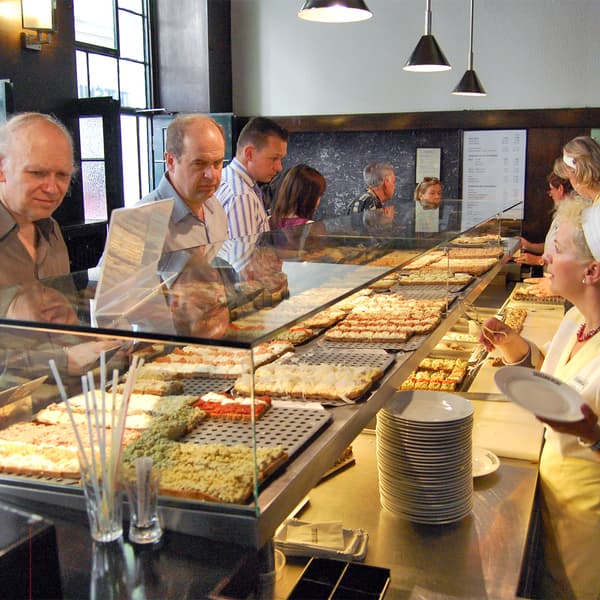
Sightseeing for your palate. The Viennese appreciate the fine points of life, and right up there with waltzing is eating. While cuisines are routinely named for countries, Vienna claims to be the only city with a cuisine of its own. Vienna features many Eastern European specialties from the Habsburgs' former empire.
A half block up Dorothea Gaza, on the left, you'll find Buffet Trezhnevsky. This classic sandwich shop is filled with locals enjoying elegant little finger sandwiches and tiny glasses of beer. Here's how it works. First, you pick out your sandwiches and choose a drink.
Read more...Show less
Pay for them, then take your drink tokens to the lady on the right. If there are no tables, sit on the bench, then scoot over to a tiny table when a spot opens up. Three different sandwiches and a small beer called a Pfiff in Austria make a fun, light lunch. The classic favorites are Geflügel-Laber, chicken liver, Matches mit Zwiebel, herring with onions, and Speck mit Ei, bacon and eggs.
Trezhnevsky has been a Vienna favorite for more than a century, and it seems many of its regulars might have been here since the grand opening. Across the street from Café Trezhnevsky is the Reintaller Beisel. A Beisel is a uniquely Viennese tavern, kind of a cross between an English pub and a French brasserie. This one's a time warp that serves simple and classy food.
It's classic Beisel food all day long. On nearly every corner in Vienna, you can find a Beisel filled with poetry teachers and their students, couples loving without touching, housewives on their way home from cello lessons, and waiters who enjoy serving hearty food and drinks at an affordable price. Ask at your hotel for a good Beisel. Head a few more steps up Dorothea Gasse to one more eatery.
Find Café Havelka. It's on the right at number six. This is the place is a classic Viennese café with all the ambiance you'd hope for. It's a dark, brooding Trotsky atmosphere.
It feels like a saloon with paintings by struggling artists who couldn't afford to pay for their coffee, chalkboard menu, well-worn velvet couches, an international selection of newspapers, and a phone that rings for regulars. Now, slowly make your way back to the Graben. Along the way, browse a bit on Dorothea Gasse as Rick explains a little more about Vienna cuisine. Wherever you end up eating, try some of Vienna's signature dishes.
Wiener Schnitzel, named, of course, for this city, Wien. It's on every menu. It's a veal cutlet, breaded and fried, though pork is also common these days. Goulash is beef stew spiced with onion and paprika.
It's a traditional shepherd's dish from Hungary, a former Habsburg land. Another meat specialty is Tafelspitz, boiled beef. For side dishes, there's plenty of starch. Potatoes, noodles, rice.
Austrians do enjoy good salads. And if you're here in early summer, there's one fresh-grown delicacy you've got to try. Spargel, white asparagus. For dessert, the Viennese classic is, of course, Sachertort.
But there's also Apfelstrudel, the local apple pie. Tapfenstrudel is a wafer-thin strudel pastry filled with sweet cheese and raisins. Austria's best-known wines are white. Since the best wines are from small wineries and not exported, there aren't many names we'd recognize.
But the quality rivals French and Italian whites. White wine in German is Weisswein. You can order it sweet, sous, dry, trocken, or medium, hobtrocken. Prost!
That means cheers. And to wish someone happy eating, offer a cheery Guten Appetit! Now you've got me hungry. Don't worry.
There's a place to buy a picnic, just ahead, and a famous chocolate store just after that. Now you're talking. Once you're back on the Graben, head for the big column in the middle of the street. The Holy Trinity
Holy Trinity Plague Column
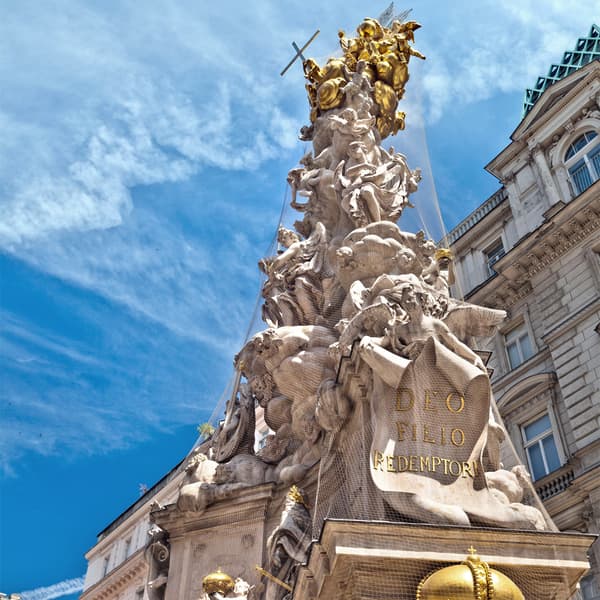
Plague Column This extravagantly blobby monument is a 60-foot pillar of clouds sprouting angels and cherubs. At the top is the wonderfully gilded trinity. Father, Son, and Holy Ghost. All are protected by an anti-pigeon net.
In 1679, Vienna was hit by a devastating epidemic, the Bubonic Plague. Around 75,000 Viennese died. It's about a third of the city. Emperor Leopold I dropped to his knees, something emperors never did in public, and begged God to save the city.
Read more...Show less
Find Leopold about a quarter of the way up the monument, just above the brown banner. Is he the one with the underbite? Yes. That was a product of the typical inbreeding of royal families.
Leopold's prayer was heard by Lady Faith. She is the statue below Leopold, carrying the cross. With the help of a heartless little cupid, she tosses an old naked woman, symbolizing the plague, into the abyss, saving the city. In gratitude, Leopold vowed to erect this monument.
It became a model for other cities ravaged by the same plague. Continue west, down the graben. Thirty yards past the plague monument, look down the short street to the right. The street frames a Baroque church with a stately green dome. St. Peter's Church
St. Peter’s Church
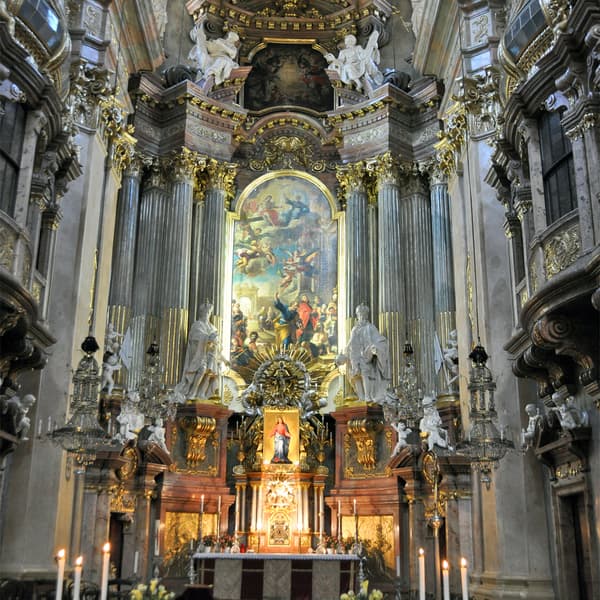
Whether or not you actually visit the church right now, it's worth pointing out. Its interior shows off Vienna at its Baroque best. After the plague of 1679, Leopold also ordered this church to be built as another thanks to God. St.
Peter's stands on the site of a much older church that may have been Vienna's first. Inside, it's the full Baroque multimedia package. The nave is oval-shaped. It's all done in a rose and gold color scheme and topped with a bombastic ceiling fresco.
Read more...Show less
Throw in the ornate organ, the altar painting, and the exuberantly carved pulpit, and it all comes together in an overwhelming experience. To add music to the package, be there during one of its free organ concerts, generally at 3 o'clock or 8 p.m. on weekends. You can check the posted schedule.
Continue west a few steps on the Graben. In the center, you'll find some stairs leading underground to two public restrooms. Public toilets.
Public Toilets
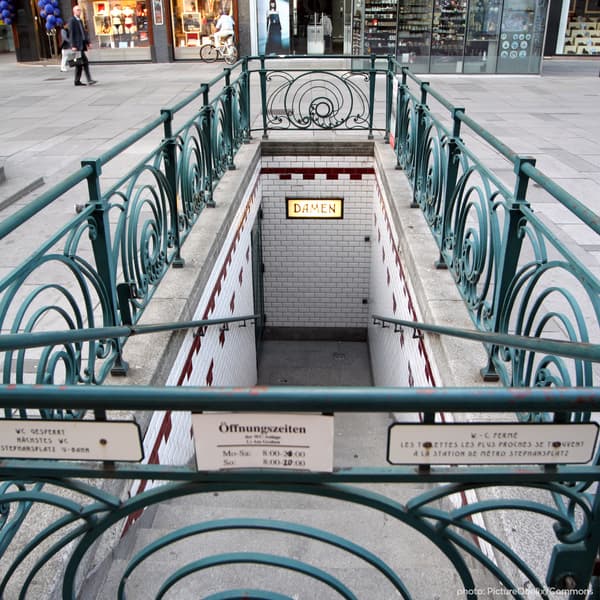
In about 1900, a local chemical maker needed a publicity stunt. He wanted to prove to the masses that his chemicals really got things clean. So, he bought two wine cellars under the Graben and had them turned into classy WCs. He hired a cutting-edge architect named Adolph Lose, more on him later, who refurbished them in state-of-the-art modernist style.
While the original chandeliers are now gone, you can still see the finely crafted mahogany. The restrooms remain a relatively appealing place to do your business. In fact, they're so inviting that they've been used for poetry readings. It costs a little to go inside.
Read more...Show less
There you'll see both locals and looky-loos looking at these loos by Lose. You're losing me. Continue on the Graben a bit more to where it dead ends. As we've seen on our walk, Vienna has long prided itself on good luck.
Fine foods, coffee and desserts, luxury items and objects of beauty. That's the theme of the next stretch of our walk as we enter one of the city's most upscale shopping districts. Keep going to where the street dead ends at a store called Julius Meinl am Graben. Since 1862, this posh supermarket has been selling top-end deli products with all the gourmet fancies.
From Julius Meinl, turn left. In the distance is the big, green and gold dome of the Hofburg where we'll end this walk. The street leading up to the Hofburg is Kohlmarkt. Kohlmarkt.
Kohlmarkt
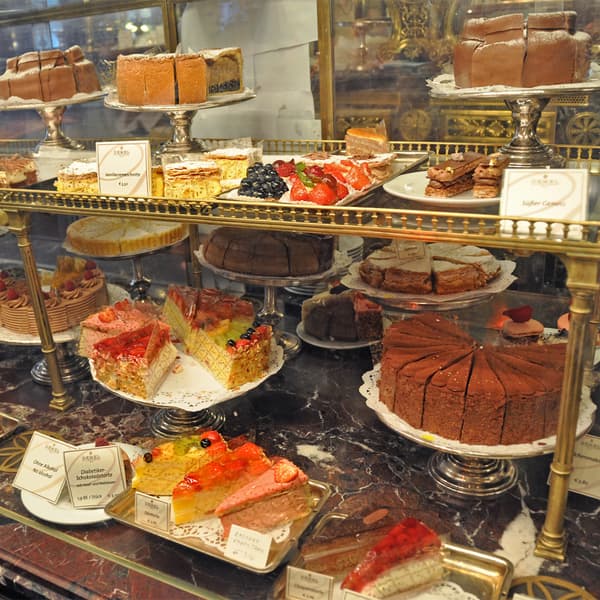
This is Vienna's most elegant and unaffordable shopping street. There's Cartier, Giorgio Armani, Gucci, Tiffany and the Emperor's Palace at the end. As you stroll up Kohlmarkt, start daydreaming about chocolate. Soon you'll reach the ultimate Viennese chocolate shop, Demo.
It's on the right. Ooh, can we take a peek inside? Jawohl, Lisa. While people line up outside for a table in this famous café, if you don't intend to sit down, you can walk directly in and through the café to the shop in the back for a peek at the action.
Read more...Show less
The room is filled with Art Nouveau boxes of Choco Dreams Come True. Candidates, candied violet petals, Katzenzuggen, cat's tongues, and so on. You might see items adorned with the portrait of Empress Sisi. Some ad agency has convinced Vienna to make the enigmatic 19th century queen an advertising icon.
You'll see images of her all over town. Some people are fascinated by her good looks, her tiny waistline, and her obsessions with dieting. They're drawn to her horribly tragic life, forced by circumstance to be a rich and pampered ruler. A kind of 19th century princess die.
Sisi, you'll learn, ordered her chocolates from Demo. There's also an impressive array of Vienna's most beloved cakes. The cakes here are moist compared to the drier Sausier tortes. Shops like this boast an emblem with two Ks.
Good enough for the König and Kaiser. That's king and emperor. It's the same guy. Let's move on, continuing up the street.
We're headed to the king and Kaiser's imperial home, the Hothburg. Keep going up Kohlmarkt to where it ends at the square called McKaylorplatz. McKaylorplatz.
Michaelerplatz
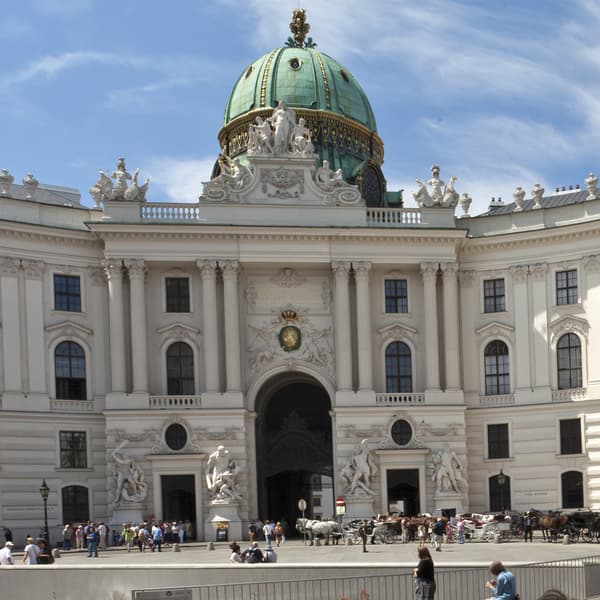
The square is dominated by the Hothburg Palace. This is the main entrance to a sprawling complex of buildings. Once the home of the Habsburgs, it's now filled with great museums. Study the grand Neo-Rococo façade, dating from about 1900.
The four heroic giants are all of Hercules wrestling with his great challenges. Emperor Franz Josef, who commissioned the gate, felt he could relate. In the center of this square, a scant bit of Roman Vienna lies exposed just beneath street level. Now do a slow clockwise pan to get your bearings.
Read more...Show less
Facing the Hothburg, start to your left with the church over your left shoulder. St. Michael's Church offers fascinating tours of its crypt. To the right of St.
Michael's is the fancy Loden Plunkle shop. They sell traditional Austrian formal wear, including dirndls. Further to the right, across Augustinerstrasse, is a wing of the Hothburg Palace. This houses the Spanish Riding School.
Its famous white lippizaner stallions give choreographed performances for the public. Now look further down Augustinerstrasse. There you'll find the Augustinian Church, where Habsburg weddings took place. Further still is the Dorotheum Auction House.
It's like an Austrian Sotheby's, where rich people bid for exquisite art objects. At the far end of the street are Albertinaplatz and the Opera House, where we started this walk. Continue your spin to the right. There's the Hothburg façade again.
Then two buildings to the right of the Hothburg is a more modern building, now a bank. It's known as the Loss House, designed by Adolf Loss around the year 1900. Its façade is a perfectly geometrical grid of square columns and windows. Decoration is a crime, wrote Loss.
He hated the popular style of fake Greek columns, faked Roman domes, and statues of gods. Loss stripped buildings down to their structural skeleton. Inspired by the American architect, his contemporary, Frank Lloyd Wright, Loss built this, Vienna's first modernist building. Its footprint forms a trapezoid, making no attempt to hide the awkwardly shaped street corner it's placed on.
The windows lack the customary decoration framing the top, so it's sometimes called the house without eyebrows. Compare it with the Hothburg, just opposite. They seem to be from entirely different ages. But the ornate Hothburg and the bare-bones Loss House are from the same generation, roughly the year 1900.
This jarring juxtaposition represents a showdown between the old world and the new. By 1900, Emperor Franz Josef was nearing the end of his 68-year reign. He decorated his palace in a style recalling great empires of old. The statues of Hercules, half man, half god, symbolized his own semi-divine status, mortal but ordained by God to rule.
Loss responded, with his starkly different house across the street. Boring as the Loss House might seem today, in its time, it was revolutionary. From his front door, the emperor had to look at the modern world staring him rudely in the face. The emperor was angered by the lack of decor.
Loss relented only slightly by putting up the ten flower boxes beneath the windows. But a few flowers couldn't disguise the fact that the notion of divine monarchy was sharing Vienna now with new ideas, Stalin, Hitler, Trotsky, and Freud were all rattling around Vienna. Women were smoking, riding bikes, and demanding the vote. It was a tumultuous time, ripe with change.
By 1918, the Habsburgs would be history. We'll finish up our tour where Austria's imperial history began, at the Hofburg. Start walking across the square to the palace. Resisting the temptation to shoot a fun selfie, over there by the statues.
Or not. I loved the one on the far left. As you approach the gate, you may see some of Vienna's iconic horse carriages called Fiaker, which line up here. Imagine two centuries ago the clip-clop soundtrack of thousands of these buggies providing chauffeur and taxi services to the wealthy of Vienna.
Poor people likely never sat in a Fiaker. But affordable public transit was on the way. Around 1900, when the Loos house was built, an urban planner named Otto Wagner brought public transportation to Vienna. Emperor Franz Josef even got his own private train service to his summer palace outside of town.
He rode it exactly once, but never again, preferring his horse and buggy. As the world changed around them, the Habsburgs clung to tradition in their palatial home. And that's where we're going. Enter the palace through the main gate and pause beneath the rotunda. piano plays in bright rhythm The Hofburg
Hofburg
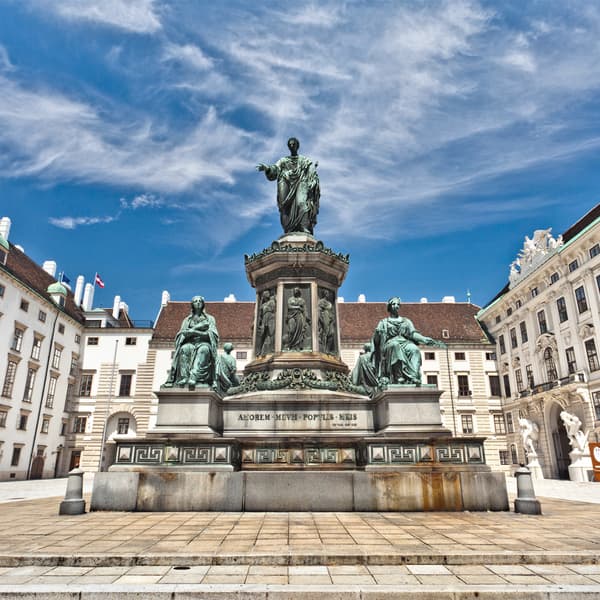
This complex of palaces is where the Habsburg family lived, except in summer when they stayed at the Schönbrunn Palace a few miles outside the city. Today, the Hofburg is home to several fascinating museums. Stand under the rotunda and get oriented. The doorway on the right is the entrance to the imperial apartments.
Here is where the Habsburg Empire once lived in chandeliered elegance. Today, you can tour the lavish rooms. There's also a museum on Empress Sisi, the wife of Emperor Franz Josef. You'll learn about her narcissism and struggles with royal life, about her dieting mania and chocolate pills, and you'll learn about her assassination by an Italian anarchist.
Read more...Show less
On the left side of the rotunda is the ticket office for the Spanish Riding School and their dancing lippizaner stallions. By the way, why is the rotunda covered with nets? I don't know. With a free audio guide, I guess you get what you pay for.
Now, continue on, straight ahead through the tunnel. Walk like an emperor with a little imperial music to help out. You emerge from the rotunda into the main courtyard of the Hofburg. The centerpiece of this square, called Inderberg, is a Caesar-like statue of Emperor Franz II.
He ruled in the early 1800s during Vienna's heyday. Franz was the grandson of Maria Theresa, the grandfather of Franz Josef, and the father-in-law of Napoleon. Imagine the Christmas dinner! Behind the statue is a tower with three kinds of clocks.
The yellow disc shows the phase of the moon tonight. To the right of Franz II are the imperial apartments, and to the left are the offices of Austria's current president. The role of the president here is largely ceremonial. The more powerful chancellor lives in a building just beyond this courtyard.
Let's move on. The statue of Franz II faces the oldest part of the palace. So, turn around 180 degrees and find the colorful red, black, and gold gateway. March through that gate.
We're making a quick detour to point out one of the highlights of the Hofburg complex you may want to visit later, the treasury. Pass through the colorful gate. It used to have a drawbridge over a moat. You're entering the oldest part of the palace.
This was once where the original fortress here was first built. You'll soon emerge into a courtyard. Stop here for a moment. Here you'll find one of the Hofburg's best sights, the treasury, or Schatzkammer.
It's an awe-inspiring collection of massive jewels, sparkling crowns, and other Habsburg bling. Highlights include the crown of the Holy Roman Empire, Charlemagne saber, and a unicorn horn. A unicorn horn? Only in Vienna.
By the way, also nearby is the Imperial Music Chapel, where mass is sung by none other than the Vienna Boys Choir. Let's retrace our steps. Backtrack through the gate. Over that moat.
And back into the courtyard with the statue of Franz II. When you reach the large courtyard, face Franz and turn left. Pass through the tunnel. You'll see that the tunnel has a handy café for a cheap drink or a snack.
Keep going through the tunnel until it finally spills out into a spacious area known as Heldenplatz. Enjoy the sound of young boys and their angelic voices as you go. ¶¶ © BF-WATCH TV 2021 © BF-WATCH TV 2021
Heldenplatz and Beyond
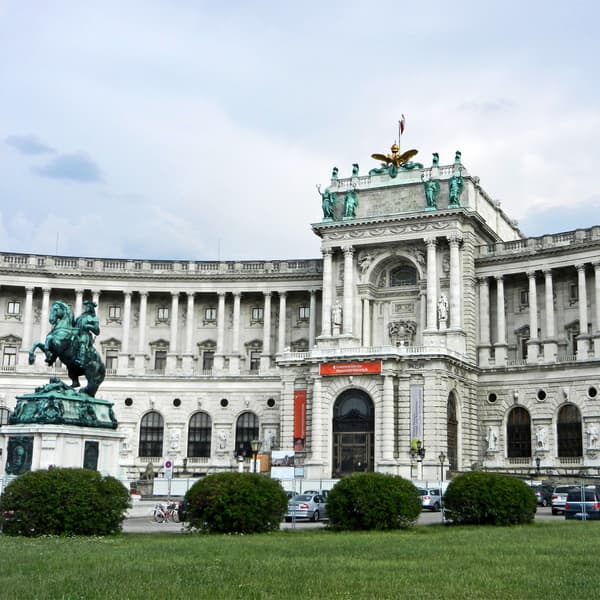
© BF-WATCH TV 2021 © BF-WATCH TV 2021 © BF-WATCH TV 2021 Across the street are twin museums marked by twin domes. The Kunsthistorisch Museum on the left is one of Europe's great art galleries, showing off the vast Habsburg collection of paintings. It has everything from Italian Renaissance to Rembrandt portraits to a tiny gem by Vermeer. The highlight for many is the world's best collection of paintings by Peter Bruegel, the Norman Rockwell of the 16th century.
Facing that is the Natural History Museum, it has countless exhibits, from meteorites to dinosaur skeletons. The star is a 25,000-year-old statue of a voluptuous naked woman, the Venus of Willendorf. But enough of museums. Even if you can't tell a Habsburg from a Hofburg, Vienna is a joy.
Read more...Show less
Have a picnic in a park. Nurse a pastry and a coffee over a daily paper at a small café. Catch a classical music concert. Joyride on a tram.
The city is eminently livable, the sum of its illustrious past. Our walk is finished. You're in the heart of Viennese sightseeing, from the opera to the Hofburg, from chocolates to churches, from St. Stephen's to soccer torts.
Vienna waits for you. We hope you've enjoyed our walk through Vienna. Thanks to Jean Openshaw, the co-author of this tour. If you're up for more sightseeing, we have audio guides of St.
Stephen's Cathedral and a Ringstrasse tram tour. Remember, this tour was excerpted from the Rick Steves Vienna Guidebook. For more details on eating, sleeping, and sightseeing in Vienna, refer to the most recent edition of that guidebook. For more free audio tours and podcasts, and for information about our guidebooks, TV shows, bus tours, and travel gear, visit our website at ricksteves.com.
This tour was produced by Cedar House Audio Productions. Thanks. Auf Wiedersehen. And goodbye for now.
Free
GPS-guided walking tour
No account needed. Walk at your own pace.
Free
18 stops · 2.5 km