10 stops
GPS-guided
3.0 km
Walking
1 hour
Duration
Free
No tickets
About this tour
From an empress's seaside palace to the birthplace of European surfing, this walk traces Biarritz's wild reinvention — from Basque whaling village to imperial playground to surf capital. You'll walk past art deco casinos, peer into a Belle Epoque tearoom that served queens, cross a metal bridge to a rock in the Atlantic, and end on the beach where a Hollywood screenwriter accidentally started a revolution.
10 stops on this tour
Hôtel du Palais
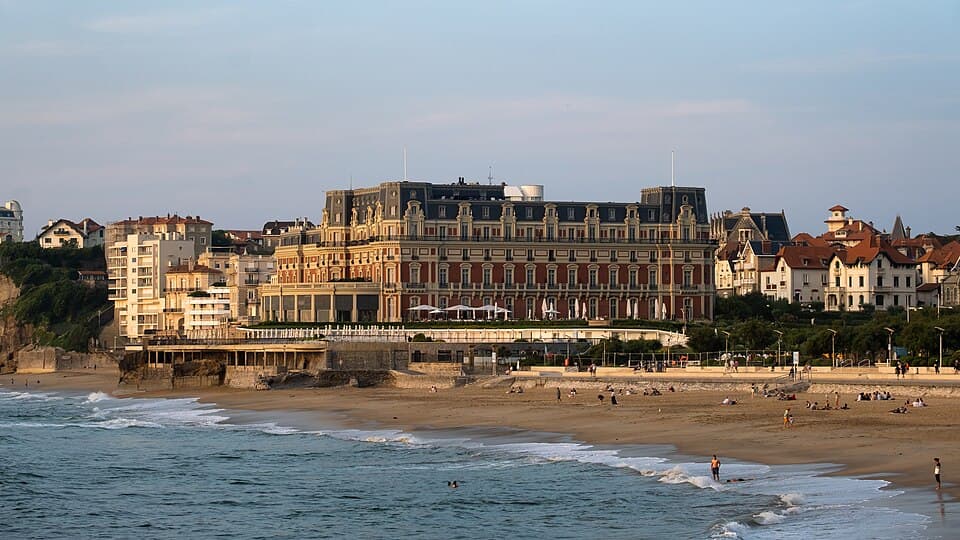
Welcome to Biarritz. You're standing in front of the grandest building on this coastline — the Hotel du Palais. That sweeping facade, those red-and-white striped awnings, the sheer scale of the thing — it looks like a palace because it was one.
In eighteen fifty-four, Emperor Napoleon the Third built a seaside villa right here for his wife, Empress Eugenie. She was a Spanish countess who had fallen in love with this stretch of Basque coast as a child, spending holidays here with her mother from the age of nine. When she married the Emperor of France, she had one request: build me a house by the ocean in Biarritz.
Read more...Show less
He did more than that. He built the Villa Eugenie in just ten months — a sprawling E-shaped residence, the E a tribute to her name. And then he moved the entire imperial court here for the summer. Every summer. For sixteen years, from eighteen fifty-four to eighteen seventy, the most powerful people in Europe followed Napoleon and Eugenie to this beach. Suddenly, a quiet Basque fishing village was hosting Russian grand dukes, Spanish kings, and British aristocracy.
But empires don't last. Napoleon the Third lost the Franco-Prussian War in eighteen seventy, and the couple fled to exile in England. Eugenie sold the villa in eighteen eighty. It became a hotel and casino — and then, on the first of February nineteen oh three, it burned to the ground. Only the imperial chapel survived the flames.
The architect Edouard Niermans rebuilt it bigger, grander, with three hundred rooms where the original had one hundred and ten. Queen Victoria stayed here. So did the Empress Elisabeth of Austria — Sisi. King Edward the Seventh. It became one of the most glamorous hotels in Europe.
Look at the building's shape from here. You can still see that E-plan — three wings reaching toward the sea, an emperor's love letter written in stone.
When you're ready, walk down toward the beach. Head south along the promenade — the Grande Plage will open up in front of you.
Grande Plage
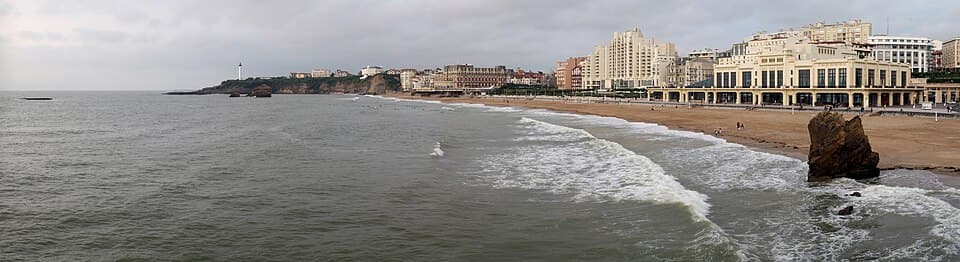
As you walk down to the beach, notice the wide promenade running along the sand. In the Belle Epoque, this is where the European elite came to see and be seen — women in enormous hats, men in full suits, everyone pretending they weren't staring at each other.
Here we are at the Grande Plage — the grand beach. Look at it. A perfect arc of golden sand between two headlands, the Atlantic stretching to the horizon. On a good day, those waves are rolling in from three thousand miles away.
Read more...Show less
But here's the thing nobody tells you: in the early nineteenth century, this beach was called the Plage des Fous — the Beach of Madmen. Because the only people who went into the sea were considered insane. Sea bathing was strictly medicinal, prescribed for the sick. The idea of swimming for fun? Absolute lunacy.
That started to change in the eighteen forties, when writers and artists began visiting. Victor Hugo came in eighteen forty-three and wrote to his wife that Biarritz was a place he could recommend for anyone who had the misfortune of having a doctor tell them to bathe in the sea. Even the endorsement was backhanded.
Then Eugenie brought the court, and suddenly sea bathing was fashionable. The madmen's beach became the beach of kings.
Today, of course, the Grande Plage is all about surfing. Those dark shapes bobbing in the waves — surfers, waiting for the next set. Biarritz has been a surf town since nineteen fifty-seven, but we'll get to that story at our last stop.
By the way, look south along the beach. See that art deco building anchoring the far end? That bold, symmetrical facade with the geometric lines? That's our next stop — the Casino Municipal.
Continue along the promenade toward it. It's about a two-minute walk.
Casino Municipal
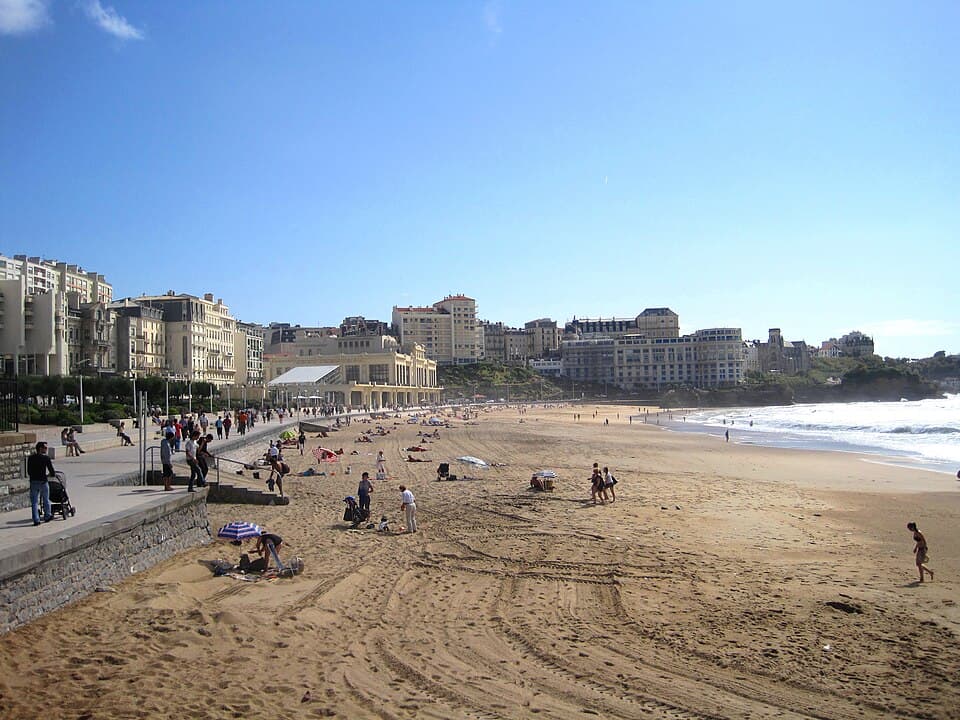
You're standing in front of the Casino Municipal, and it is a show-stopper. That symmetrical facade, those clean geometric lines, the decorative friezes — this is art deco at its most confident. Architect Alfred Laulhe designed it in nineteen twenty-nine, and he clearly wanted a building that could stare down the Atlantic and win.
But the story of gambling in Biarritz goes back further than this building. The city council established its first casino in eighteen ninety-three, and a purpose-built venue opened in nineteen oh one to enormous fanfare. The Paris Opera Ballet performed at the opening. In the early twentieth century, this was where European aristocracy came to lose money in style.
Read more...Show less
The current art deco building replaced that original casino, and it's become the most photographed structure in Biarritz — partly for the architecture, partly because of its position. It sits right on the seafront, with the Grande Plage on one side and the ocean on the other. The symmetry of the facade against the chaos of the Atlantic makes for an irresistible contrast.
Inside, there's more than gambling. The building houses a seven-hundred-and-thirty-seat theatre that serves as the cultural heart of Biarritz — concerts, plays, dance performances throughout the year. There's also a restaurant and a municipal swimming pool, because apparently the entire Atlantic Ocean next door wasn't enough.
The casino was classified as a historical monument in nineteen ninety-two, and underwent a major renovation in nineteen ninety-four costing eighty million French francs. They kept the art deco spirit while modernising the interior.
Now — I want to take you to my favourite spot on this entire walk. Turn around and look across the street. See that elegant shopfront with the old-fashioned awning? That's Patisserie Miremont, and it's been here since eighteen seventy-two.
Pâtisserie Miremont
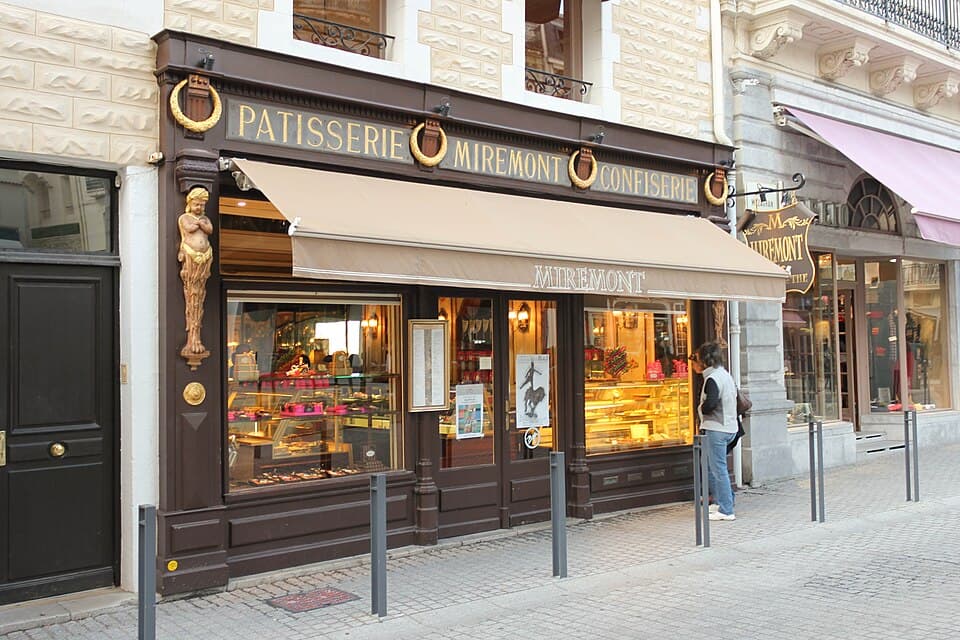
Cross the street and step inside — or at least press your nose against the glass. Patisserie Miremont is one of those places that makes you realise the French don't just eat pastry, they worship it.
The shop was created on the seventeenth of February eighteen seventy-two by Etienne Singher, a young Swiss pastry chef from Saint-Moritz. In eighteen eighty, Joseph Miremont bought the business and hung his name above the door, where it's stayed for nearly a hundred and fifty years.
Read more...Show less
During the Belle Epoque, when Biarritz was the summer playground of European royalty, Miremont became their unofficial headquarters. A writer named Maurice Rostand described the scene perfectly: at five o'clock, there were fewer cakes at Miremont than queens, and fewer rum babas than grand-dukes.
He wasn't exaggerating. Queen Amelie of Portugal liked to take her tea with an almond macaron as close as possible to the bay window, so she could have the ocean at her feet. Queen Nathalie of Serbia personally ordered the house's fourteen varieties of soft caramels with fresh butter — fourteen varieties! — to give as gifts to her relatives' children. King Alfonso the Thirteenth of Spain had a fruit cake specially created for him, making Miremont an official supplier to the Spanish royal house. And Queen Victoria of England made it a patented supplier to Her Majesty.
Look at the interior. The entrance ceiling is made of embossed leather with Moorish-inspired arabesques and Kufic script. The shop and tearoom are separated by a wrought-iron grille, with mirrors and wood paneling mixing classical motifs with delicate scrollwork. The whole place was inscribed as a French historical monument in two thousand and six.
If you have time, sit down and order something. The macarons are extraordinary. If you don't have time, buy a bag of those fresh butter caramels and eat them as we walk.
When you're ready, head west along Rue du Port Vieux, descending toward the sea. In about four hundred metres, you'll see a neo-Gothic church overlooking the old port.
Église Sainte-Eugénie
As you walk down toward the old port, the street narrows and the buildings get older. You're leaving the Belle Epoque glamour behind and entering something more ancient — the original fishing village that existed long before any empress showed up.
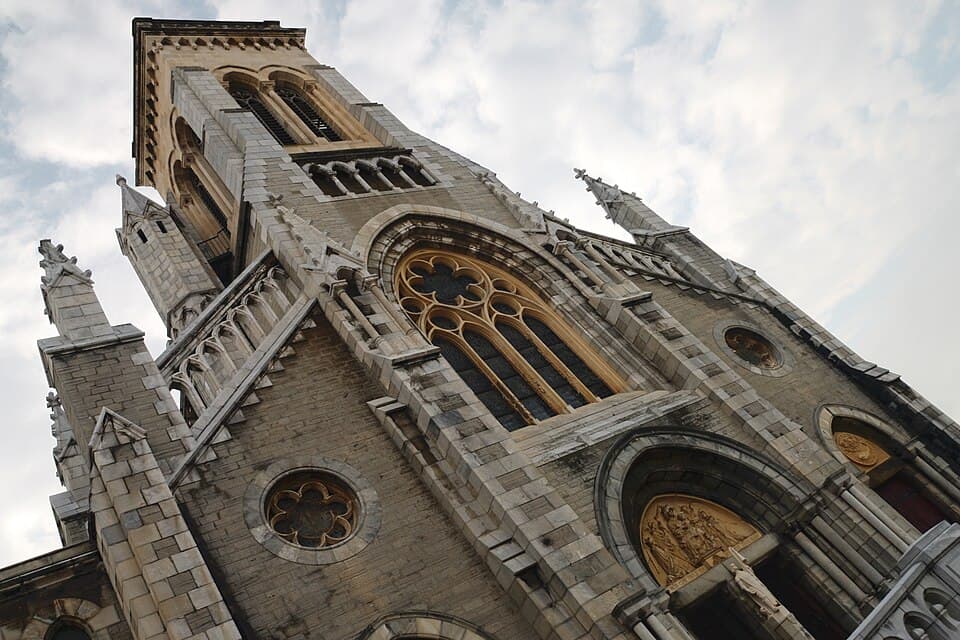
And here's the church that bridges those two worlds. Eglise Sainte-Eugenie — named, of course, after the empress who put Biarritz on the map. Look up at the grey stone facade. This is neo-Gothic architecture, all pointed arches and vertical lines, perched on a rocky ledge overlooking the Port Vieux.
Read more...Show less
The current church was built between eighteen ninety-eight and nineteen oh three, designed by architect Ernest Lacombe. But a chapel dedicated to Sainte-Eugenie had stood here since eighteen fifty-six — one of the empress's first gifts to the town that would make her famous.
Step inside if the doors are open. The stained glass windows are by Luc-Olivier Merson, one of the great French painters of the late nineteenth century, and they're stunning — vivid colours and intricate designs that throw patterns across the stone floor when the light hits them right.
The church follows a Latin cross plan — forty-eight metres long, twenty-five and a half metres wide. The bell tower wasn't added until nineteen twenty-seven, rising thirty-two metres above the nave.
But the detail I love most is inside, near the entrance. Look for the baptismal fonts. They're made from giant seashells — tridacna clams from the Pacific. In a fishing town that once hunted whales, even the holy water comes from the ocean.
Speaking of fishing — look down from the church terrace toward the harbour. See those tiny white cottages with the coloured shutters clustered around a miniature port? That's exactly where we're going next.
Head down the steps toward the Port des Pecheurs. It's just a minute's walk below you.
Port des Pêcheurs
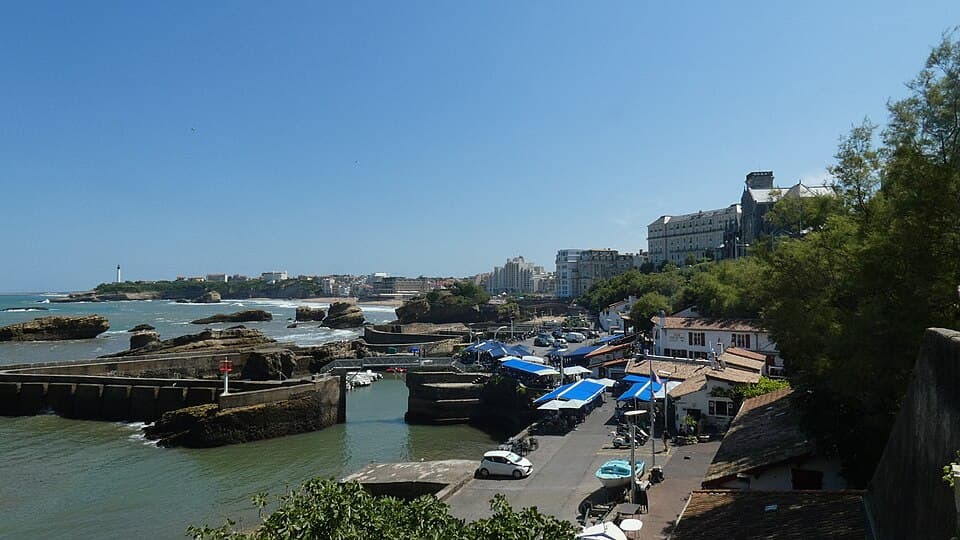
Welcome to the most charming corner of Biarritz. The Port des Pecheurs — the Fishermen's Port — is a tiny harbour tucked between rocky cliffs, and it feels like it belongs in a different century. Which, in many ways, it does.
Biarritz was a fishing village long before it was a resort. The oldest written records, dating from the twelfth century, describe something extraordinary: whale hunting. A lookout posted on the cliff above — the Atalaye, which we'll visit next — would scan the horizon. When he spotted a whale, he'd burn wet straw to create a column of smoke, and crews of about ten men would launch from this harbour in slender boats called biscayennes to hunt the animal with harpoons.
Read more...Show less
The Basques were among the first commercial whalers in history. Their main target was the North Atlantic right whale — so named because it was the right whale to hunt: it swam slowly, floated when dead, and yielded enormous quantities of oil and bone. Biarritz even put a whale on its coat of arms. The industry peaked in the thirteenth century and gradually declined as the whales were hunted out of the Bay of Biscay.
The fishermen moved to this particular harbour around seventeen eighty, after a massive storm destroyed the old port. Napoleon the Third improved it with better breakwaters in the eighteen fifties.
Now look at those tiny buildings lining the harbour. Those are crampottes — traditional fishermen's huts. There are about sixty-five of them, whitewashed with red or blue shutters. At the beginning of the twentieth century, fishermen got permission to build them here to store their nets and salt their sardines. Some still serve that purpose. Others have become tiny restaurants, craft workshops, or boutiques. But they haven't lost their character.
By the way, if you're hungry, this is a brilliant spot for grilled sardines or fresh seafood. The restaurants here are simple, honest, and have the best harbour views in town.
When you've soaked it in, head up the stone steps to the south. We're climbing to the Plateau de l'Atalaye — the old whale-watching lookout.
Plateau de l'Atalaye
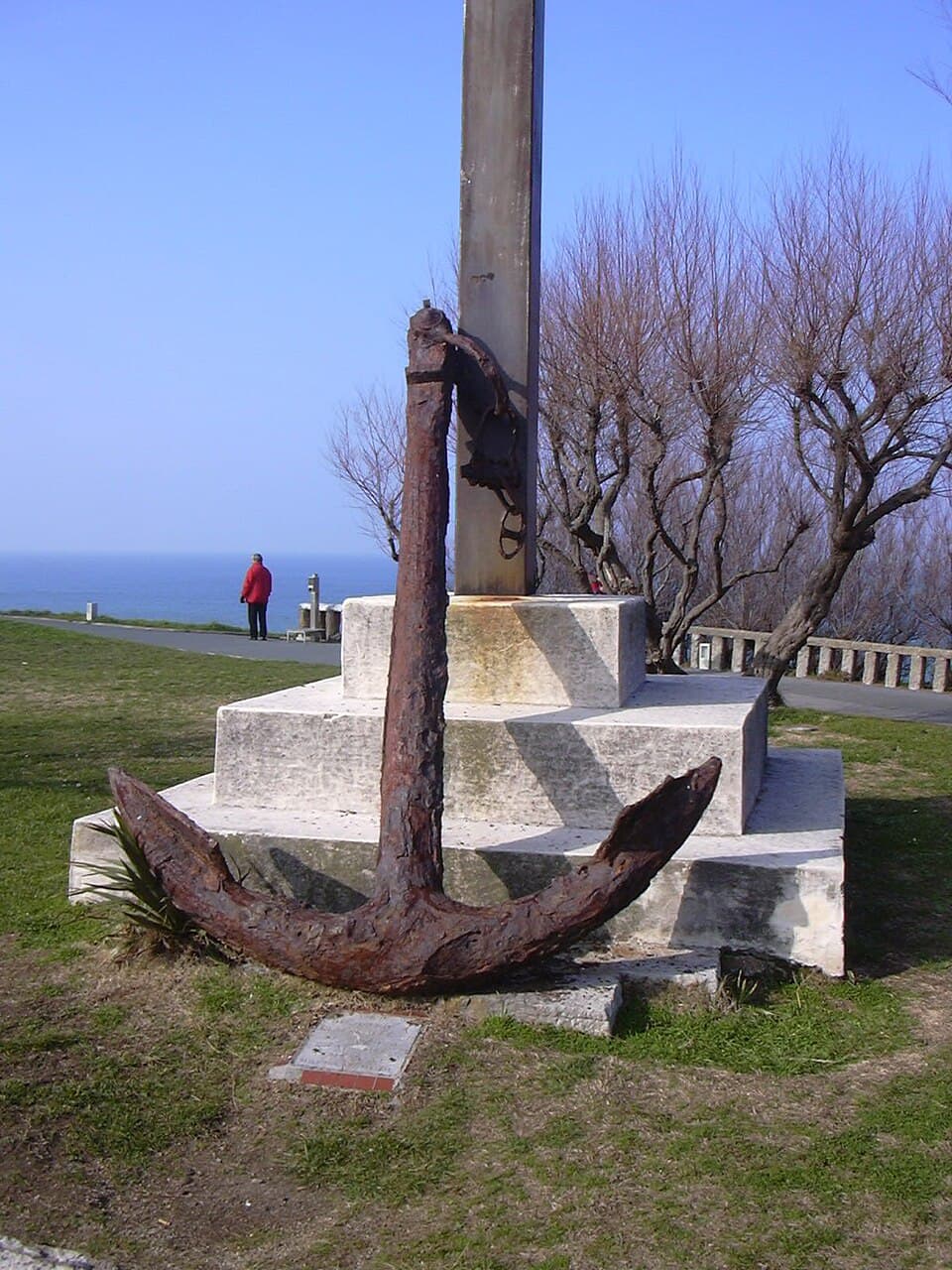
Catch your breath — those steps are steep. But you've earned this view.
You're standing on the Plateau de l'Atalaye, and the word atalaye comes from the Basque word for promontory. This rocky headland has been a lookout point for at least a thousand years.
Read more...Show less
Turn slowly in a circle. To your right, the Port des Pecheurs sits in its little cove below. Ahead, the Atlantic stretches to the horizon — on a clear day, you might just make out the shape of the Spanish coast to the south. Behind you, the rooftops of Biarritz climb the hillside. And to your left, jutting out into the ocean, is a dramatic rock with a statue on top, connected to the mainland by a metal bridge. That's the Rocher de la Vierge — the Rock of the Virgin — and it's where we're headed next.
But first, the history of this spot. During the Middle Ages, a watchtower stood right here — the vigía. When the lookout spotted a whale in the bay, he would burn wet straw to create a huge plume of smoke, signalling the fishermen below to launch their boats. The system was remarkably organised, managed by town guilds who divided the catch according to strict rules.
Later, the English built a fortified chateau on this promontory — the Chateau de Ferragus — on the foundations of what may have been a Roman fortification. It had double walls two metres thick, a drawbridge, and four towers. The last remnant of that fort, a tower locals called La Humade, survived until nineteen forty-three, when the occupying German forces destroyed it.
Today, there's nothing left of the watchtowers or the fort. Just this open plateau, the wind, and one of the finest coastal panoramas in southwest France.
Take a moment. Listen to the waves crashing on the rocks below. This is the sound the whale watchers heard, century after century, as they scanned the grey Atlantic for a spout of breath on the horizon.
When you're ready, follow the path west along the cliff edge toward that metal bridge and the rock.
Rocher de la Vierge
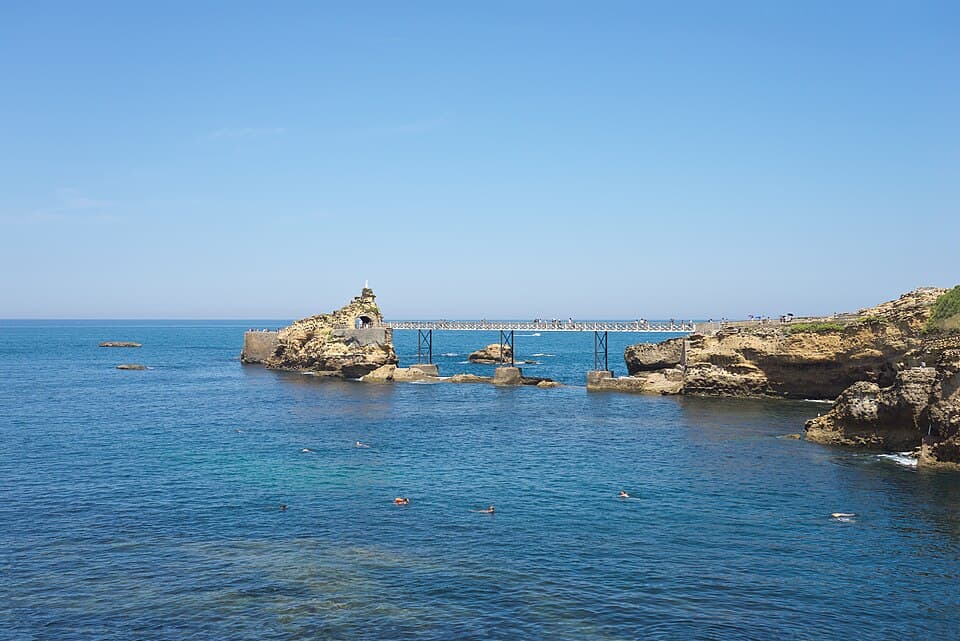
Here it is — the most iconic landmark in Biarritz. The Rocher de la Vierge — the Rock of the Virgin — a dramatic outcrop of rock rising from the Atlantic, crowned with a bronze statue of the Virgin Mary and connected to the mainland by a narrow metal bridge.
The bridge sways slightly underfoot as you cross it, and the waves crash against the rocks below. On a stormy day, the spray can reach the walkway. On a calm day, it's one of the most spectacular short walks you'll ever take.
Read more...Show less
The story starts with Napoleon the Third — again. In eighteen sixty-three, the emperor decided he wanted to build a harbour of refuge for ships along this coast. He ordered the rock to be pierced with a tunnel and connected to the mainland with a wooden footbridge, planning to use it as an anchor point for a sea wall.
The harbour project was never completed, but the footbridge stayed. The original wooden bridge couldn't handle the Atlantic storms, so in eighteen seventy-seven it was replaced with this metal one. Now, you'll hear people say it was built by Gustave Eiffel. It wasn't. The bridge was constructed by the Schryvers workshops from the town of Haumont in northern France. Eiffel gets credit for everything metal in France — the tower, obviously — but this one isn't his.
The bronze statue of the Virgin was installed in eighteen sixty-five, placed here by sailors in gratitude for surviving a terrible storm. It was cast by a Bordeaux foundry and first displayed at a Franco-Spanish exhibition in Bayonne before finding its permanent home on this rock.
Walk out onto the rock if the bridge is open — it closes in extreme weather. From the end, look south along the coast. You'll see the white cliffs dropping away, the waves battering the shoreline, and perched impossibly on a cliff edge ahead, a turreted mansion that looks like it belongs in a Gothic novel. That's Villa Belza.
Cross back over the bridge and follow the coastal path south toward it.
Villa Belza
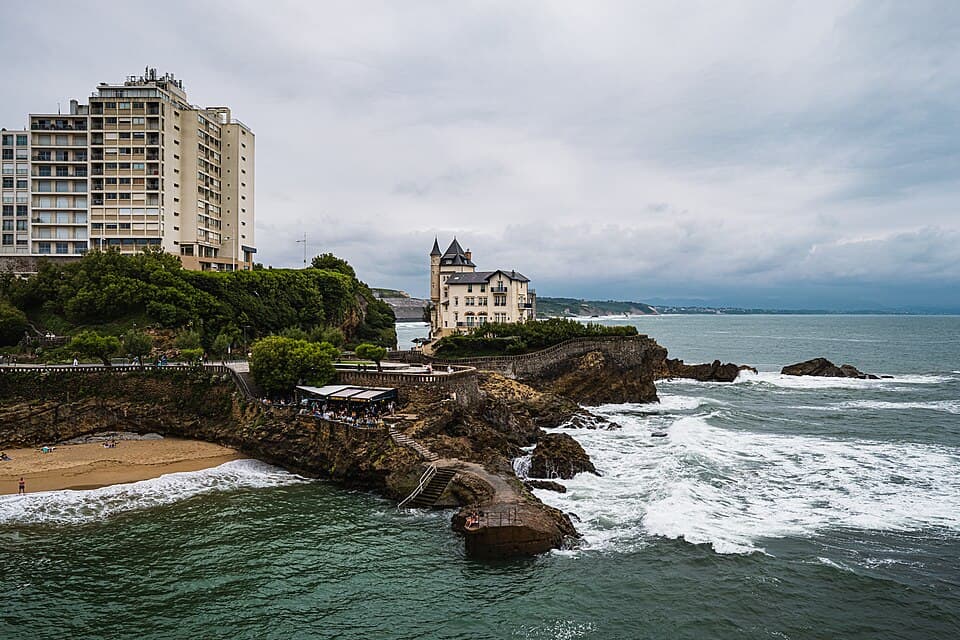
Look at it. Villa Belza clings to the edge of a cliff like it's daring the Atlantic to knock it off. A neo-medieval mansion with turrets and a pepperpot tower, perched above crashing waves, silhouetted against the sky. It looks haunted, and the locals will happily tell you it is.
The name Belza means black in Basque, and the villa was named after Marie Belza Dubreuil, wife of the Parisian businessman Ange Dufresnay who had it built in eighteen eighty-two. The architect was Alphonse Bertrand, who clearly shared his client's taste for the dramatic. The rectangular plan is broken by a neo-medieval keep and that distinctive pepperpot turret, added by the mason Dominique Morin in eighteen eighty-nine.
Read more...Show less
But the villa's wildest chapter came in the nineteen twenties. Gregoire Beliankine — brother-in-law of the composer Igor Stravinsky — transformed it into a Russian restaurant that became the hottest ticket in Biarritz. The Prince of Wales dined here. Russian dukes who had fled the revolution gathered in its rooms, drinking champagne on a cliff edge above the Atlantic, trying to forget everything they'd lost.
Then came the war. The Germans requisitioned the building and turned it into a defensive position. After liberation, a fire gutted the interior, and Villa Belza sat abandoned for nearly thirty years. Wind howled through the empty windows. Shutters banged against stone. And the ghost stories began — tales of spectral figures in the windows, strange lights, unexplained sounds. The locals started calling it the haunted villa.
In the nineteen nineties, developer Jean-Marc Galabert bought the ruin and painstakingly restored it into luxury apartments. In twenty twenty, a flat here sold for forty thousand euros per square metre. Not bad for a haunted house.
The villa sits right above the Trou du Diable — the Devil's Hole — a natural rock formation where the sea surges through a gap in the cliff. You can hear it roaring below on a rough day.
From here, look south. Below the cliffs, a long crescent of beach stretches away to the south. That's the Cote des Basques, and it's where our walk ends — at the birthplace of European surfing. Follow the path and steps down to the beach.
Côte des Basques
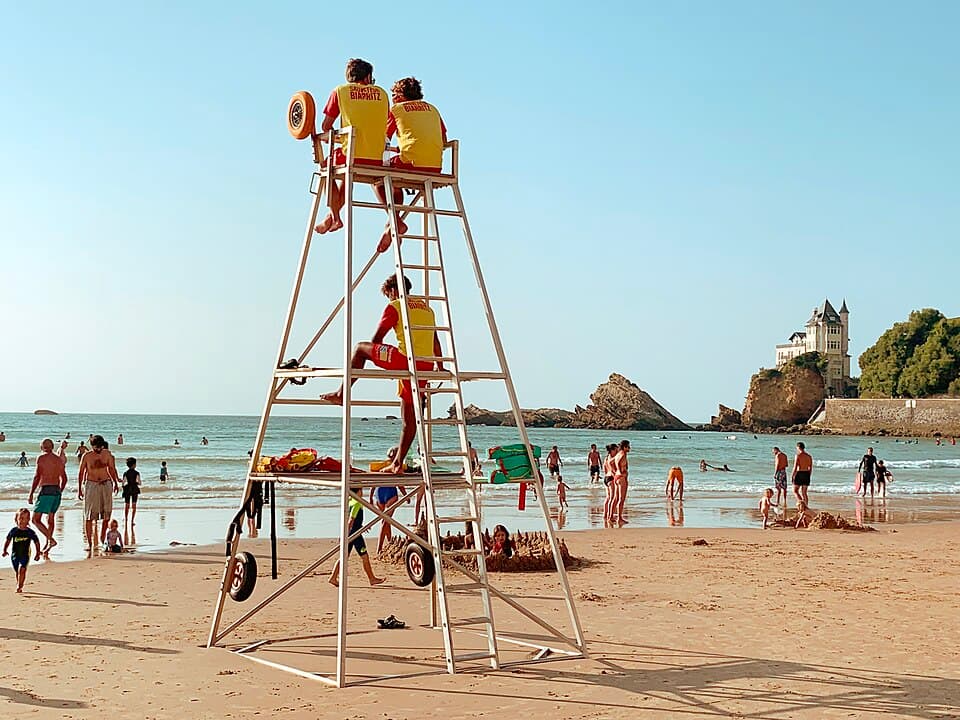
And here we are. The Cote des Basques — a long, wild beach backed by crumbling clay cliffs, the waves rolling in from the open Atlantic, surfers scattered across the water like seabirds. This is where European surfing began, and the story is almost too good to be true.
In the summer of nineteen fifty-six, an American screenwriter named Peter Viertel came to Biarritz. He was here because his partner, the actress Deborah Kerr, was filming nearby. But Viertel was a surfer from Malibu, and when he saw these waves, he couldn't resist. He had a surfboard shipped over — smuggled, really, since nobody had seen one in Europe before — and paddled out right here, at the Cote des Basques.
Read more...Show less
The locals thought he was insane. Remember, a century earlier, people who went into this ocean were called madmen. But Viertel rode those waves, and the curious Biarrots who watched from the cliffs came down to try.
The following summer, nineteen fifty-seven, Viertel returned with three boards. He gave one to a young French scientist named Joel de Rosnay and reconnected with two locals who'd tried surfing the year before — Georges Hennebutte and Jacky Rott. These four men are still known in France as the tontons surfeurs — the uncle surfers. The founding fathers of European surf culture.
From that single Malibu board, an entire movement grew. Today, Biarritz hosts international surf competitions, has dozens of surf schools, and the Cote des Basques is considered one of the best beach breaks in Europe. The waves here are consistent, exposed, and work year-round, with autumn — particularly October — delivering the cleanest swells.
By the way, be careful with the tide here. The beach nearly disappears at high tide, and the currents can be strong. Check the tide tables before swimming.
And that's our walk. You've come from an empress's palace to a surfer's beach, from whale hunters to wave riders, from the eighteen fifties to today. Biarritz keeps reinventing itself, but the ocean stays the same.
If you're hungry — and you should be — head back up the cliff path to the restaurants along Rue du Port Vieux, or grab a board and paddle out. The waves are waiting.
Thanks for walking with me. Enjoy Biarritz.
Free
GPS-guided walking tour
No account needed. Walk at your own pace.
Free
10 stops · 3.0 km