21 stops
GPS-guided
72 min
Duration
Free
No tickets
About this tour
A 21-stop walking tour through the heart of France. Visit Historic Paris Walk, Point Zero, Notre-Dame’s Façade, and Notre-Dame’s Interior — with narrated stories at every stop.
21 stops on this tour
Historic Paris Walk
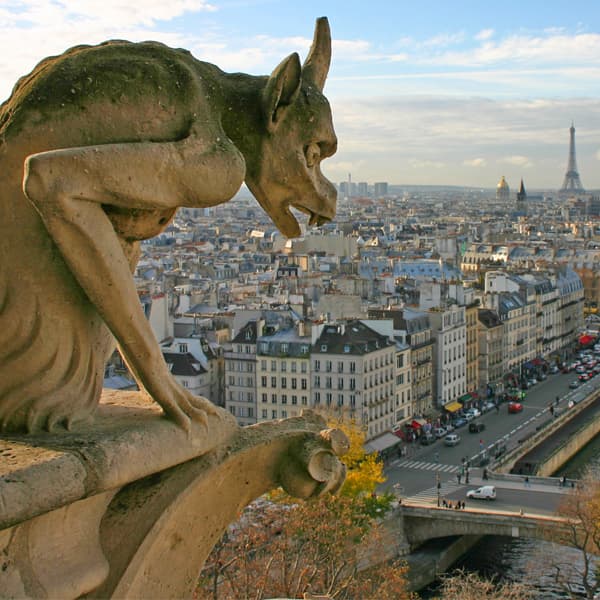
Historic Paris Walk. Paris has been continuously inhabited for over 2,000 years. The city of today is a lively cocktail of both old and new, a place that both thrills and inspires. Hey, I'm Rick Steves.
Thanks for joining me on a walk through the center of this cultural capital. We'll start where Paris did, on the big island in the middle of the river, the Ile de la Cité. We'll marvel at the centuries-old Notre-Dame Cathedral and celebrate its rise from the ashes of a recent fire. Then, we swing through the left bank with its funky energy and bohemian vibe.
Read more...Show less
We'll visit the Church of Saint-Chapelle, a medieval jewel of stained glass, and see where Marie Antoinette spent her last pre-guillotine hours. Along the way, we'll get plenty of great views of the River Seine. Allow about 20 minutes or two hours to simply traverse this extensive three-mile route, plus another two hours if you choose to go inside the sights. Be aware that Saint-Chapelle is one place you should get an advance ticket if you want to go inside.
But even if you don't go in, this tour is still great. Whatever your plans, we'll guide you through your options as we go. Now, let's get ready to lace together 80 generations of history, from Celtic fishing villages, to Roman city, bustling medieval capital, birthplace of the revolution, bohemian haunt of the 1920s café scene, and the working world of today, as we stroll through the heart of this grand city, the city of light, Paris. To help us along the way, I've invited a good friend and virtual travel buddy.
Well, welcome, Lisa. Bonjour, Monsieur Rick. Bonjour, Madame. Lisa will give us helpful directions and sightseeing tips throughout the tour.
And my first tip is to be sure you get our tour updates. Just press the icon at the lower right of your device. You'll find any updates and helpful instructions unique to this tour. Like closures, opening hours, and reservation requirements.
There are also tips on how to use this audio tour, and even the full printed script. Yes. Pause for a moment right now to review our updates and special tips. It's okay. We'll wait. And then... Let the tour begin!
Tour Begins: Notre-Dame Cathedral
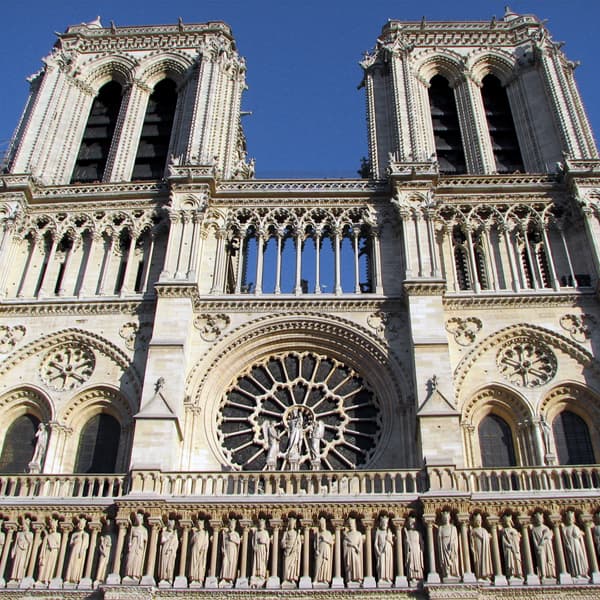
The tour begins at Notre-Dame Cathedral. Start at the Church of Notre-Dame. It's on the island in the River Seine. The physical and historic is in the heart of Notre-Dame Cathedral.
And it's right next to the Cathedral. It's located in the heart of Notre-Dame Cathedral. It's located at the heart of Notre-Dame Cathedral. And it's located at the heart of Notre-Dame Cathedral.
Read more...Show less
And it's located at the heart of Notre-Dame Cathedral. And it's located at the heart of Notre-Dame Cathedral. And it's located at the heart of Notre-Dame Cathedral. And it's located at the heart of Notre-Dame Cathedral.
And it's located at the heart of Notre-Dame Cathedral. And it's located at the heart of Notre-Dame Cathedral. And it's located at the heart of Notre-Dame Cathedral. And it's located at the heart of Notre-Dame Cathedral.
And it's located at the heart of Notre-Dame Cathedral. And it's located at the heart of Notre-Dame Cathedral. And it's located at the heart of Notre-Dame Cathedral. And it's located at the heart of Notre-Dame Cathedral.
And it's located at the heart of Notre-Dame Cathedral. And it's located at the heart of Notre-Dame Cathedral. And it's located at the heart of Notre-Dame Cathedral. And it's located at the heart of Notre-Dame Cathedral.
And it's located at the heart of Notre-Dame Cathedral. And it's located at the heart of Notre-Dame Cathedral. And it's located at the heart of Notre-Dame Cathedral. And it's located at the heart of Notre-Dame Cathedral.
And it's located at the heart of Notre-Dame Cathedral. And it's located at the heart of Notre-Dame Cathedral. And it's located at the heart of Notre-Dame Cathedral. And it's located at the heart of Notre-Dame Cathedral.
And it's located at the heart of Notre-Dame Cathedral. And it's located at the heart of Notre-Dame Cathedral. And it's located at the heart of Notre-Dame Cathedral. And it's located at the heart of Notre-Dame Cathedral.
And it's located at the heart of Notre-Dame Cathedral. And it's located at the heart of Notre-Dame Cathedral. And it's located at the heart of Notre-Dame Cathedral. And it's located at the heart of Notre-Dame Cathedral.
And it's located at the heart of Notre-Dame Cathedral. And it's located at the heart of Notre-Dame Cathedral. And it's located at the heart of Notre-Dame Cathedral. And it's located at the heart of Notre-Dame Cathedral.
And it's located at the heart of Notre-Dame Cathedral. And it's located at the heart of Notre-Dame Cathedral. And it's located at the heart of Notre-Dame Cathedral. And it's located at the heart of Notre-Dame Cathedral.
And it's located at the heart of Notre-Dame Cathedral. And it's located at the heart of Notre-Dame Cathedral. And it's located at the heart of Notre-Dame Cathedral. And it's located at the heart of Notre-Dame Cathedral.
And it's located at the heart of Notre-Dame Cathedral. And it's located at the heart of Notre-Dame Cathedral. And it's located at the heart of Notre-Dame Cathedral. And it's located at the heart of Notre-Dame Cathedral.
And it's located at the heart of Notre-Dame Cathedral. And it's located at the heart of Notre-Dame Cathedral. And it's located at the heart of Notre-Dame Cathedral. And it's located at the heart of Notre-Dame Cathedral.
And it's located at the heart of Notre-Dame Cathedral. And it's located at the heart of Notre-Dame Cathedral. And it's located at the heart of Notre-Dame Cathedral. And it's located at the heart of Notre-Dame Cathedral.
And it's located at the heart of Notre-Dame Cathedral. And it's located at the heart of Notre-Dame Cathedral. And it's located at the heart of Notre-Dame Cathedral. And it's located at the heart of Notre-Dame Cathedral.
And it's located at the heart of Notre-Dame Cathedral. And it's located at the heart of Notre-Dame Cathedral. And it's located at the heart of Notre-Dame Cathedral. And it's located at the heart of Notre-Dame Cathedral.
And it's located at the heart of Notre-Dame Cathedral. And it's located at the heart of Notre-Dame Cathedral. And it's located at the heart of Notre-Dame Cathedral. And it's located at the heart of Notre-Dame Cathedral.
And it's located at the heart of Notre-Dame Cathedral. And it's located at the heart of Notre-Dame Cathedral. And it's located at the heart of Notre-Dame Cathedral. And it's located at the heart of Notre-Dame Cathedral.
And it's located at the heart of Notre-Dame Cathedral. And it's located at the heart of Notre-Dame Cathedral. And it's located at the heart of Notre-Dame Cathedral. And it's located at the heart of Notre-Dame Cathedral.
And it's located at the heart of Notre-Dame Cathedral. And it's located at the heart of Notre-Dame Cathedral. And it's located at the heart of Notre-Dame Cathedral. And it's located at the heart of Notre-Dame Cathedral.
And it's located at the heart of Notre-Dame Cathedral. And it's located at the heart of Notre-Dame Cathedral. And it's located at the heart of Notre-Dame Cathedral. And it's located at the heart of Notre-Dame Cathedral.
And it's located at the heart of Notre-Dame Cathedral. And it's located at the heart of Notre-Dame Cathedral. And it's located at the heart of Notre-Dame Cathedral. And it's located at the heart of Notre-Dame Cathedral.
And it's located at the heart of Notre-Dame Cathedral. And it's located at the heart of Notre-Dame Cathedral. And it's located at the heart of Notre-Dame Cathedral. And it's located at the heart of Notre-Dame Cathedral.
And it's located at the heart of Notre-Dame Cathedral. And it's located at the heart of Notre-Dame Cathedral. And it's located at the heart of Notre-Dame Cathedral. And it's located at the heart of Notre-Dame Cathedral.
And it's located at the heart of Notre-Dame Cathedral. And it's located at the heart of Notre-Dame Cathedral. And it's located at the heart of Notre-Dame Cathedral. And it's located at the heart of Notre-Dame Cathedral. And it's located at the heart of Notre-Dame Cathedral. And it's located at the heart of Notre-Dame Cathedral.
Point Zero
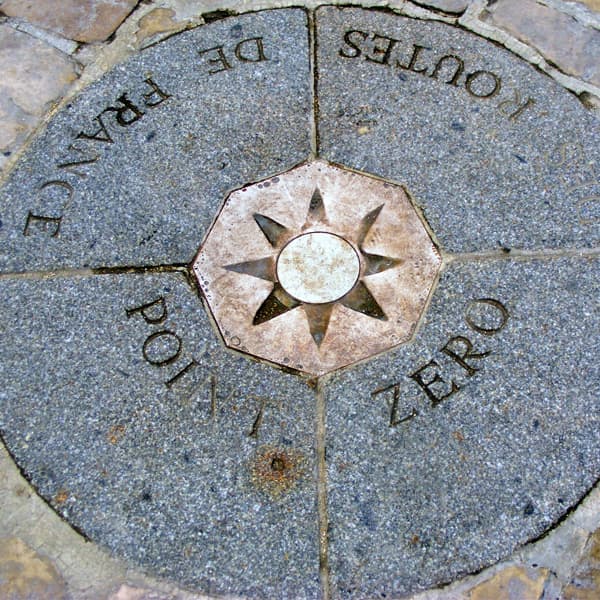
And it's located at the heart of Notre-Dame Cathedral. And it's located at the heart of Notre-Dame Cathedral. And it's located at the heart of Notre-Dame Cathedral. And it's located at the heart of Notre-Dame Cathedral.
And it's located at the heart of Notre-Dame Cathedral. And it's located at the heart of Notre-Dame Cathedral. And it's located at the heart of Notre-Dame Cathedral. And it's located at the heart of Notre-Dame Cathedral.
Read more...Show less
And it's located at the heart of Notre-Dame Cathedral. And it's located at the heart of Notre-Dame Cathedral. And it's located at the heart of Notre-Dame Cathedral. And it's located at the heart of Notre-Dame Cathedral.
And it's located at the heart of Notre-Dame Cathedral. And it's located at the heart of Notre-Dame Cathedral. And it's located at the heart of Notre-Dame Cathedral. And it's located at the heart of Notre-Dame Cathedral.
And it's located at the heart of Notre-Dame Cathedral. And it's located at the heart of Notre-Dame Cathedral. And it's located at the heart of Notre-Dame Cathedral. And it's located at the heart of Notre-Dame Cathedral.
And it's located at the heart of Notre-Dame Cathedral. And it's located at the heart of Notre-Dame Cathedral. And it's located at the heart of Notre-Dame Cathedral. And it's located at the heart of Notre-Dame Cathedral.
And it's located at the heart of Notre-Dame Cathedral. And it's located at the heart of Notre-Dame Cathedral. And it's located at the heart of Notre-Dame Cathedral. And it's located at the heart of Notre-Dame Cathedral.
And it's located at the heart of Notre-Dame Cathedral. And it's located at the heart of Notre-Dame Cathedral. And it's located at the heart of Notre-Dame Cathedral. And it's located at the heart of Notre-Dame Cathedral.
And it's located at the heart of Notre-Dame Cathedral. And it's located at the heart of Notre-Dame Cathedral. And it's located at the heart of Notre-Dame Cathedral. And it's located at the heart of Notre-Dame Cathedral.
And it's located at the heart of Notre-Dame Cathedral. And it's located at the heart of Notre-Dame Cathedral. And it's located at the heart of Notre-Dame Cathedral. And it's located at the heart of Notre-Dame Cathedral.
And it's located at the heart of Notre-Dame Cathedral. And it's located at the heart of Notre-Dame Cathedral. And it's located at the heart of Notre-Dame Cathedral. And it's located at the heart of Notre-Dame Cathedral.
And it's located at the heart of Notre-Dame Cathedral. And it's located at the heart of Notre-Dame Cathedral. And it's located at the heart of Notre-Dame Cathedral. And it's located at the heart of Notre-Dame Cathedral.
And it's located at the heart of Notre-Dame Cathedral. And it's located at the heart of Notre-Dame Cathedral. And it's located at the heart of Notre-Dame Cathedral. And it's located at the heart of Notre-Dame Cathedral.
And it's located at the heart of Notre-Dame Cathedral. And it's located at the heart of Notre-Dame Cathedral. And it's located at the heart of Notre-Dame Cathedral. And it's located at the heart of Notre-Dame Cathedral.
And it's located at the heart of Notre-Dame Cathedral. And it's located at the heart of Notre-Dame Cathedral. And it's located at the heart of Notre-Dame Cathedral. And it's located at the heart of Notre-Dame Cathedral.
And it's located at the heart of Notre-Dame Cathedral. And it's located at the heart of Notre-Dame Cathedral. And it's located at the heart of Notre-Dame Cathedral. And it's located at the heart of Notre-Dame Cathedral.
And it's located at the heart of Notre-Dame Cathedral. And it's located at the heart of Notre-Dame Cathedral. And it's located at the heart of Notre-Dame Cathedral. And it's located at the heart of Notre-Dame Cathedral.
Notre-Dame’s Façade
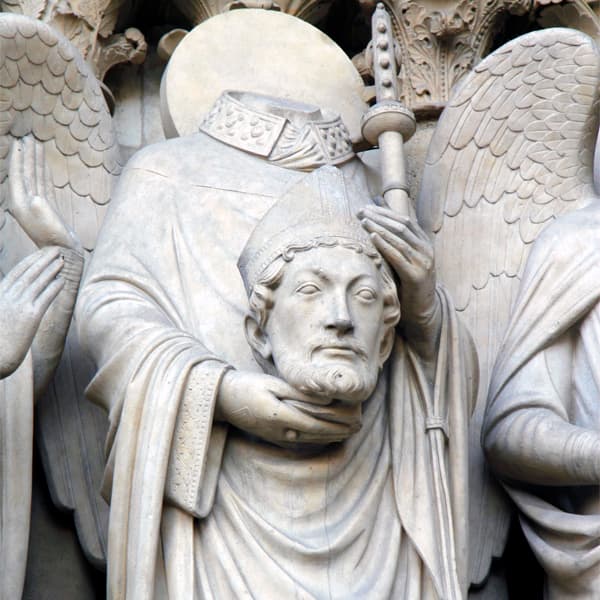
And it's located at the heart of Notre-Dame Cathedral. When Christianity began making converts in Roman Paris, the Bishop of Paris, Saint Denis, was beheaded as a warning for those forsaking the Roman gods. But those early Christians were hard to keep down. Bishop Denis got up, he tucked his head under his arm, headed north, paused at a fountain to wash it off, and continued until he found just the right place to meet his maker.
The Parisians were impressed by this miracle. Christianity gained ground, and a church soon replaced the pagan temple. Now, move over to the central doorway. Above it, you'll find scenes from the Last Judgment.
Read more...Show less
It's the end of the world, and Christ sits on the throne of judgment. He's just under the arches, holding both hands up. Below him, an angel and a demon weigh souls in the balance. The demon, hoping to steal a soul, cheats by pressing down.
The good people stand to the left, gazing up at heaven. The naughty ones are over there on the right, chained up and led off to heaven. It's like a six-hour tour of the Louvre on a hot day. Now, look just to the right of the sinners, to the arch itself.
It's decorated with all kinds of crazy sculpted demons. Follow the arch down to the base. There, you'll find a flaming cauldron with a sinner diving into it head first. Yow!
Remember that medieval peasants were greeted to grim scenes like this every day as they entered the church. Now, turn to the final panel of the last judgment scene, the one below the chain gang of sinners. It shows the dead sleeping in their graves. On the far left and right, angels appear, blowing trumpets.
"Hey, wake up! It's time to be judged!" Look at the array of souls. They're from every class of French society -- knights, ladies, peasants, clergy, even royalty. It reminded all who entered through these doors that everyone will be judged.
Fortunately for the sinners, there was one final figure, the statue of Jesus, who stands below between the double doors. He leads the way to salvation. To either side of the central door are Jesus' 12 apostles. Each is barefoot and carries his identifying symbol.
Yes, there's St. Peter to the left. He never goes anywhere without his keys to the kingdom of heaven. Now take 10 paces back, away from the church.
One, two, three. Come on, do it in French. En français? Oui.
Okay. Un, deux, trois, quatre, cinq, six, sept, huit, neuf, dix. Formidable! Now look up.
Above the arches is a row of 28 statues known as the Kings of Judah. In the days of the French Revolution, from 1789 until about 1799, these biblical kings were mistaken for the hated French kings, and Notre Dame represented the oppressive Catholic hierarchy. The citizens stormed the church, crying, "Off with their heads!" Plop, they lopped off the crowned heads of these kings with glee, creating a row of St. Denis's that wasn't repaired for decades.
But the story doesn't end there. A schoolteacher who lived nearby collected the heads and buried them in his backyard for safekeeping. There they slept until 1977, when they were accidentally unearthed. Today, you can stare into the eyes of the original kings in the Cluny Museum on the left bank, just a few blocks away.
Now, let's leave the 21st century for a few minutes and step into one of Europe's great architectural spaces. One more thing. The church also has the bizarre statues called gargoyles. Look two-thirds of the way up Notre Dame's left tower.
Those with binoculars or very good eyes can find Paris' most photographed gargoyle. Propped on his elbows on the balcony rail, he watches all the tourists below. Picture our old friend Quasimodo up there. Yes, mistress.
I think I see him limping along there among the gargoyles. Yes, gargoyles, my pretty. These grotesque beasts represented souls caught between heaven and earth. They also function as rain spouts when there are no evil spirits to battle.
Which is why the French word for gargoyle comes from the same root as another French word, to gargle. Now, let's enter the church. Good idea, Lisa. But because of long lines or construction closures, some may choose not to bother.
So if you're not going in, you can just listen to the roughly five-minute or so track from outside and imagine being inside, or skip ahead to track six and pick up the tour right here outside the church's front door. Now, let's go inside. Attention! Pickpockets attend church here religiously.
There's often a line, so pause the audio tour and restart it as you leave daylight and enter the church. We'll see you inside. Notre Dame's interior.
Notre-Dame’s Interior
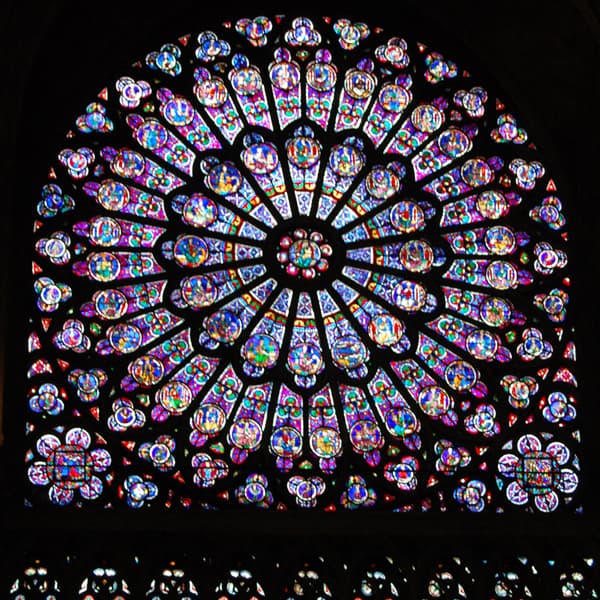
As you enter the church, follow the flow of the crowds. Because of reconstruction, be aware that things may be moved around. So... Be flexible.
Crowd flow permitting. Try to find a spot where you can view the long, high central aisle. Stand and gaze down the long nave. Take some time to let your eyes adjust.
Read more...Show less
Soak in the medieval ambiance of this centuries-old space. Remove your metaphorical hat and become a simple, bareheaded peasant, entering the dim medieval light of the church. Take a minute now and take in the subtle, mysterious light show that God beams through the stained-glass windows. Follow the slender columns up ten stories where those Gothic arches come together like praying hands.
Contemplate the heavens. Let's say it's dedication day for this great stone wonder. The priest intones the words of the Mass that echo through the hall. "Terribilis est locus iste." This place is "terribilis." That means awe-inspiring or even terrifying.
It's a huge, dark, earthly cavern lit with an unearthly light. This is Gothic. Taller and filled with light, this was a major improvement over the earlier Romanesque style. Gothic architects needed only a few structural columns topped by crisscrossing pointed arches to support the weight of the stone roof.
This let them build higher than ever, freeing up the walls for lots of windows. Start walking up toward the main altar, following the flow of the crowds. You may find the church is roped into a one-way system for crowd flow. No worries.
Just go with the flow. Notre Dame is designed in the shape of a cross, with the altar placed where the crossbeam intersects. The church can hold up to 10,000 faithful. And it's probably buzzing with visitors now, just as it was 800 years ago.
The quiet, deserted churches we see so often around Europe these days are a stark contrast to the busy center-of-life places they were in the Middle Ages. The altar marks the place where mass is said, and the bread and wine of communion are blessed and distributed. In olden days, there were no chairs. This was a holy spot for Romans, Christians, and even atheists.
During the French Revolution, the church was stormed, gutted, and turned into a temple of reason. A woman dressed like the Statue of Liberty held court at the altar as a symbol of the divinity of man. Keep following the flow. You'll pass into the transept, then circle behind the altar.
Just browse around, exploring what interests you. While France today is nominally Catholic, it remains aloof from Vatican dogmatism. And it has its own special saints, dear to the heart of the nation. You may see a statue of one of them.
A young woman dressed in armor, with her hands folded in prayer, Joan of Arc. The statue honors the 15th-century French teenager who rallied French soldiers to try to drive the English invaders from Paris. Unfortunately, Joan was arrested, tried for heresy, and burned at the stake for claiming to hear heavenly voices. Almost immediately, Parisians rallied to condemn Joan's politically-motivated execution.
Finally, in 1909, right here in Notre Dame, the former witch was Beate. Joan's first step towards sainthood. Now turn your attention to the center of the church, where you'll see the walls of the part of the church called the choir. This enclosed area is where more intimate services can be held without being overwhelmed by the spaciousness of this vast building.
The choir walls feature colorful Bible scenes. First, the resurrected Christ appears to Mary Magdalene. Next, he appears to his female disciples, and so on. Their starry robes still gleam thanks to a 19th-century renovation.
The niches below these carvings mark the tombs of centuries of archbishops. Continue circling around the choir, checking out the various chapels along the way. The stained glass glows especially bright here. Each of these chapels is dedicated to a particular saint, and funded by a certain guild.
Continue on as you make your way toward the exit. Notice all the candles. Since each of these chapels is dedicated to a different theme, worshipers can choose a particular chapel that speaks to their soul during a particular visit. The faithful can pause here to light a candle as an offering and meditate in the cool light of the stained glass.
Our tour now exits the church. So, pause the audio tour now and restart it again once you're back outside the church. We'll meet you back outside. Notre Dame, view from the side.
Notre-Dame: View from the Side
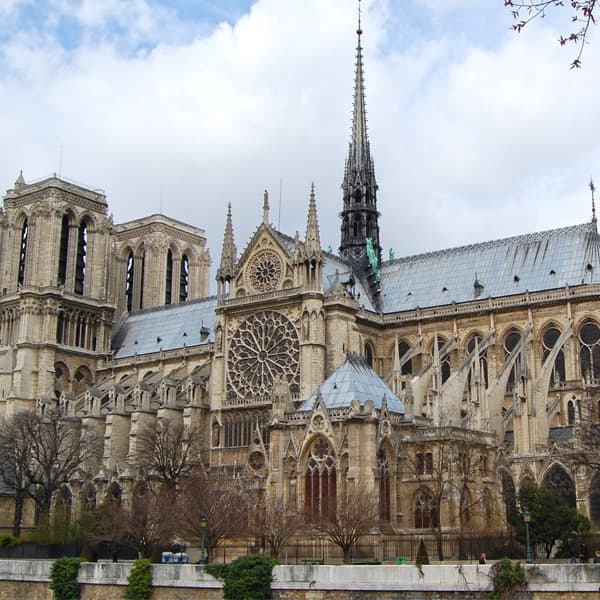
Whether you've visited the church interior or not, by now you should be outside Notre Dame, near the façade. Next up, we'll be strolling to the back end of the church, walking along the entire length of Notre Dame. Depending on the ongoing construction, you may be routed down either the left side of the church or through the park on the right. I like the right best if it's open.
Just follow whatever path you can, while Rick tells us more. As you stroll along the church to the far end, admire the skeletal essence of the Gothic style with its typical elements. There's pointed arches, tall windows with lacy stone tracery, pinnacles jutting out at the top, statues on the rooftops, and the roof is made of lead. Notice that the pointed steeple is covered with prickly ridges.
Read more...Show less
These are meant to suggest the flames of the Holy Spirit. The French word for "flaming," flamboyant, is where the flamboyant Gothic style got its name. Another distinctive element of Gothic architecture is the flying buttress, and this church offers textbook examples. These are the 50-foot-long stone beams that stick out from the church.
Flying buttresses, along with pointed arches, were the essential keys to the complex system of Gothic architecture. Here's how it works. With the round arches of earlier Romanesque churches, the weight of the stone roofs sat squarely on the walls, so the walls had to be beefy and strong, with small windows at most. But architects understand that pointed arches, like the ones we saw earlier, caused the weight of the roof to be pushed not downward, but outward.
And to support the roof, you now need not strong walls holding things up, but flying buttresses pushing back in. Gothic architects were masters at playing architectural forces against each other. Pointed arches and buttresses of the Gothic style, invented right here in Paris in the 13th century, allowed them to build loftier and loftier churches, opening the walls for glorious stained-glass windows. By now, you should be near the back end of Notre Dame.
To reach our next stop, continue straight past the green space directly behind the church. Cross the street, where you'll find the entrance to a small park filling the end of the island. There, you'll find our next stop -- the Deportation Memorial. The Deportation Memorial.
The Deportation Memorial
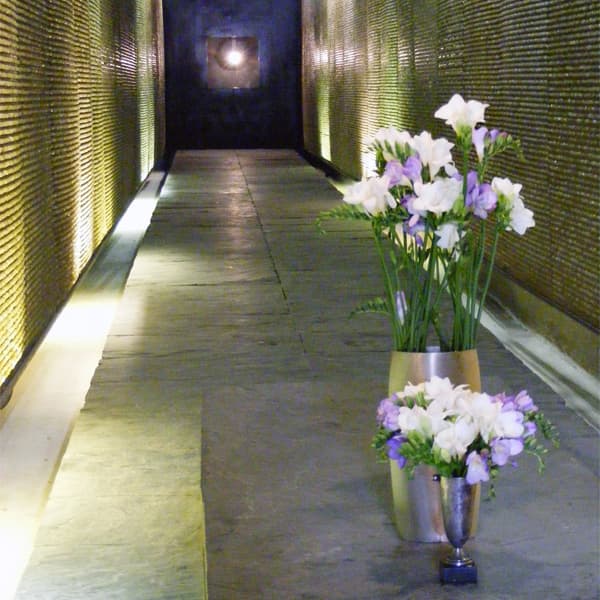
As you enter, continue straight ahead through the small park. Up ahead, go down the stairs into the memorial itself. This memorial to the 200,000 French victims of the Nazi concentration camps, the concentration camps of World War II, is designed to draw you into their experience. As you descend the steps, the city around you disappears.
Surrounded by walls, you've become a prisoner. Your only freedom is your view of the sky and the tiny glimpse of the river below. During the war, France was quickly overrun by Nazi Germany, and Paris spent the war years under Nazi occupation. Jews and dissidents were rounded up and deported, most never returned.
Read more...Show less
Once below street level, enter the dark, single-filed chamber up ahead. Inside, the circular plaque in the floor reads, "They went to the end of the earth and did not return." The hallway stretching in front of you is lined with 200,000 lighted crystals, one for each French citizen deported. Flickering at the far end is the eternal flame of hope. The tomb of the unknown deportee lies at your feet.
Above, the inscription reads, "Dedicated to the living memory "of the 200,000 French deportees "sleeping in the night and the fog "exterminated in the Nazi concentration camps." The side rooms are filled with triangles reminiscent of the identification patches inmates were forced to wear, each bearing the name of a concentration camp. Above the exit, as you leave, is the message you'll find at all Nazi sites. Forgive, but never forget. When you're ready to move on, return to street level.
Climb the stairs, but let's not leave the park just yet. Remember, we're on an island in the Seine. But this isn't the only island that Paris's inhabitants have built on. Let's look at a neighboring isle.
When you reach the top of the stairs, look to the right, that is, toward the north. Find a spot in the park where you can gaze across the river at the buildings on the neighboring island in the Seine, the Île Saint-Louis. Île Saint-Louis.
Ile St. Louis
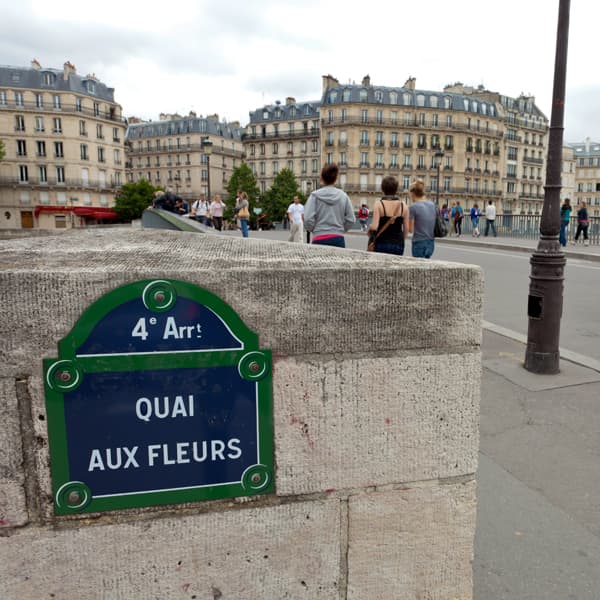
If the Île de la Cité, the island you're on now, is a tugboat laden with the history of Paris, it's towing this classy little residential dinghy, laden only with high-rent apartments, boutiques, characteristic restaurants, and famous sorbet shops. This smaller island wasn't developed until the 17th century, much later than the Île de la Cité. What was a swampy mess is now harmonious Parisian architecture and one of Paris's most exclusive neighborhoods. Its uppity residents complain that the local ice cream shop, Bertillon, draws crowds until late into the night.
Let's move on. Exit the deportation memorial the way you came. As you exit to the street, turn left. Cross this bridge, the Pont de l'Archevêché.
Read more...Show less
We're headed for the left bank. As you cross the Pont de l'Arche... the Pont de... the bridge, look to the left.
That's upstream to the next bridge. Where that bridge meets the left bank, you'll find one of Paris' most exclusive restaurants, La Tour d'Argent. It's the place with the flag flying from the rooftop. This restaurant was the inspiration for the movie "Ratatouille." The top floor has floor-to-ceiling windows, so your meal comes with glittering views.
And a golden price, I hear. Oui, oui, madame. Allow about $300 per person for a meal. Oh, la, la, c'est cher.
Oui, but you do get a free photo of yourself. It shows you dining elegantly with Notre-Dame floodlit in the background. Once you've crossed the bridge and reached the left bank, turn right. The riverbank is lined with characteristic green book stalls. Start walking along the row of stalls browsing your way to the middle. The left bank.
The Left Bank
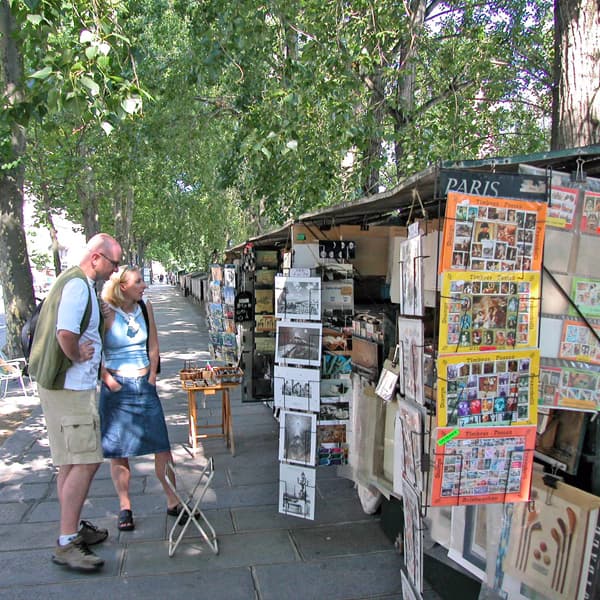
Promenade proudly, enjoying the ambiance of the left bank. The rive gauche, or the left bank of the Seine -- that's left if you're floating downstream -- still has many of the twisting lanes and narrow buildings from medieval times. The right bank is more modern and business-oriented, with wide boulevards and stressed-out Parisians in suits. Here, along the riverbank on the left side, the big business is secondhand books, displayed in green metal stalls along the river.
These literary entrepreneurs pride themselves on their easygoing business style. With flexible hours and virtually no overhead, they run their businesses as they have since medieval times. These booksellers, or bouquinistes, as they're called in French, have been a Parisian fixture since the mid-1500s. Back then, shops and stalls like these lined most of the bridges in Paris.
Read more...Show less
During Reformation times, the booksellers ran afoul of the authorities for selling forbidden Protestant pamphlets in then-Catholic Paris. But after the French Revolution, their business boomed once again. Ideas flowed freely, and the booksellers had plenty of stock. That's in part because they resold entire libraries of books that had been liberated from rich nobles.
Excuse me, Rick, but just a warning not to walk too far. We're headed to about midway along the row of stalls, where there's a gap with a nice Notre-Dame viewpoint. Rick? Today there are about 250 authorized bouquinistes.
To get a license for this popular business, there's a waiting list of eight years. Each bookseller is allowed four boxes. The most coveted locations, like these along here, are awarded based on seniority. Rent is cheap, around 100 euros a year.
Bouquinistes are required to paint their boxes a standard green and stay open at least four days a week. If they don't follow these rules, they lose their license. Notice how they guard against the rain by wrapping everything in plastic. And yes, they do leave everything inside when they lock up at night.
They use metal bars and padlocks to keep things safe. Take a look at what they're selling. Oh, believe me, I have. Their main items are vintage books.
You'll find some classic first editions featuring some of the world's great thinkers. But as you can see, these days, with all the tourists, the big sellers are the more popular items: cat posters and fridge magnets. And I'll take one of each. Keep strolling until you reach that gap in the bookstalls midway along the row. Stop here and enjoy the grand view of Notre Dame. ♪♪
Notre-Dame and the 2019 Fire
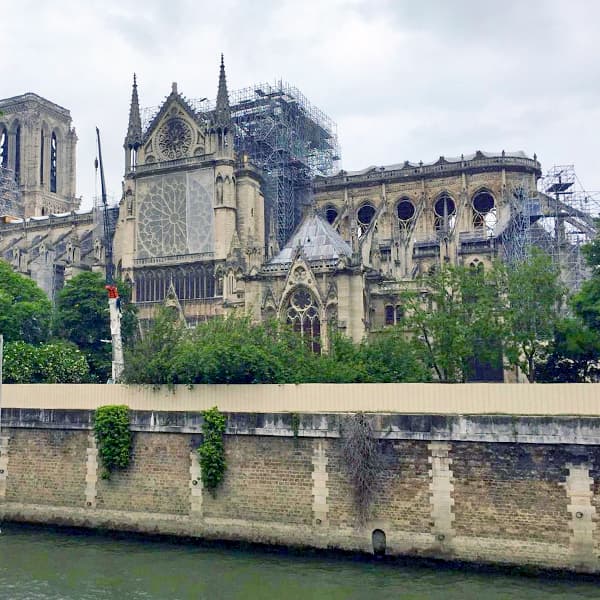
Notre Dame and the 2019 fire. From this great viewpoint, consider the horrific scene of that tragic fire. Think of it. Centuries from now, people standing here will still talk about the night of April 15, 2019, when Notre Dame went up in flames.
It started on top, igniting the huge wood timbers that supported the lead-covered roof. The lead -- some 450 tons -- melted, and the roof collapsed. Dramatically, the beloved 300-foot-tall, lacy, neo-Gothic spire crashed down onto the church floor. Many historic artworks were damaged, but fortunately, the church itself stood.
Read more...Show less
It remained structurally sound. A tribute to those Gothic architects of long ago. Immediately after the fire, Parisians rallied to rebuild. Progress was swift.
The cathedral that took two centuries to build was largely rebuilt in just a few years. And once done, the terrible fire? Just one more episode in the long and dramatic story of Paris. Before we leave this beautiful perch, take in the views of the Seine.
The river once ran wild through here. The banks were muddy, and it occasionally flooded. In 1827, the embankments were built, containing the river. And allowing a wonderful promenade for lovers and poets.
Just like you see in the movies, and in Paris, it still happens. In more recent years, the Parisians have made their embankments even more welcoming. There's a man-made beach in the summer and places to picnic, dance, and gather up and down the river. Imagine -- Paris is a global city of more than 2 million people, yet here we are in the very center, and it still looks much like it did in medieval times.
Let's move on. From the viewpoint, continue our stroll past the rest of the book stalls. Here's the plan. When you reach the last stall at the end of the block, you'll see a small park ahead, kitty-corner across the intersection on the left.
Intersection? Kitty-corner, small park. Got it. Cross the street and enter that little park, called Place Viviani.
While you walk, enjoy some music. We'll see you in the park called Place Viviani. ♪ ♪ Thank you. Thank you.
Thank you. Ah, nice. By now, you should have reached the end of the row of bookstalls. Enter the small park across the street called Place Viviani.
Ah, nice. Ah, nice. Ah, nice. Ah, nice. Ah, nice. Ah, nice.
Place Viviani, Church of St. Julien
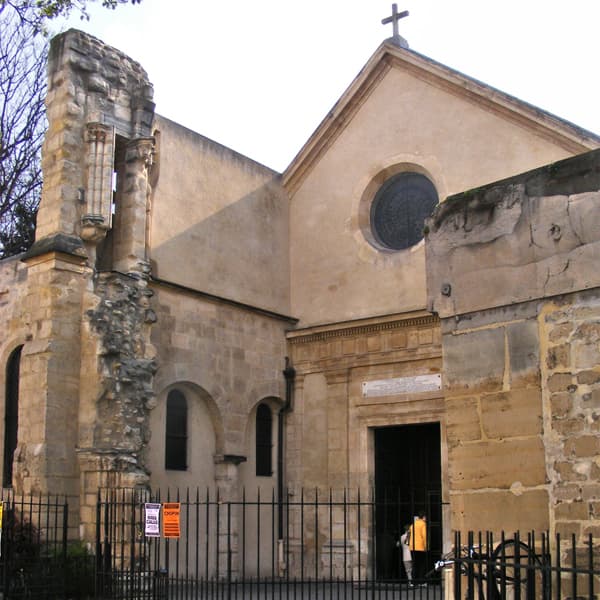
Ah, nice. Ah, nice. Ah, nice. Ah, nice. Ah, nice. Ah, nice. Ah, nice.
Shakespeare and Company Bookstore
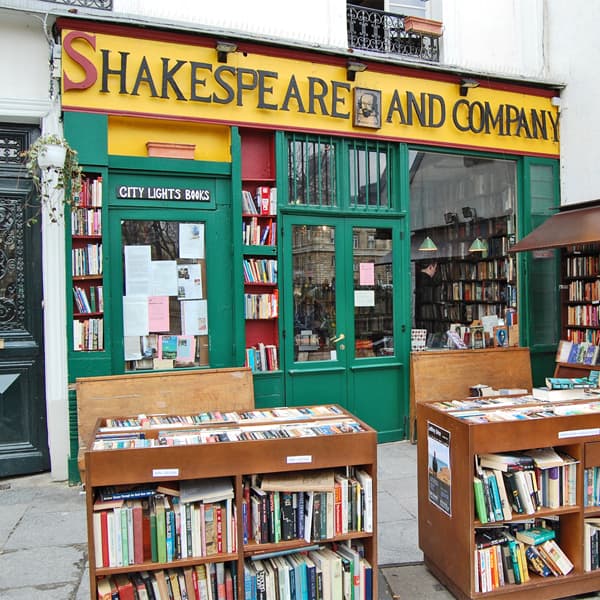
Ah, nice. Ah, nice. Ah, nice. Ah, nice.
Ah, nice. Ah, nice. Ah, nice. Ah, nice.
Read more...Show less
Ah, nice. Ah, nice. Ah, nice. Ah, nice.
Ah, nice. Ah, nice. Ah, nice. Ah, nice.
Ah, nice. Ah, nice. Ah, nice. Ah, nice.
James Joyce struggled to find a publisher for his now-classic novel Ulysses, and then he met Sylvia Beach, and she published it. George Bernard Shaw, Gertrude Stein, and Ezra Pound also got their English fix right here. Today, the bookstore carries on that literary tradition. Struggling writers are given free accommodations upstairs in tiny rooms with views of the Notre Dame.
Downstairs, travelers enjoy a great selection of used English books. Pick up the Paris Voice newspaper. It's in English and designed for expats. It's one of the best sources for what's happening in Paris today.
Let's go see more of that city. Exit the bookstore. Back outside, notice the green water fountain in front of the bookstore. It's one of the many in Paris donated by the English philanthropist Sir Richard Wallace.
Back in 1900, the hooks below the Greek maidens, held metal mugs for drinking the water. From Shakespeare and Company, continue west. Now we're headed a little deeper into the left bank. The street up ahead is a major boulevard called Rue du Petit Pont.
It's also called Rue Saint-Jacques. Turn left on Rue du Petit Pont and go one block away from the river. While the street these days is busy with cars, mentally replace those cars with chariots. You see, even back in the day, back when Paris was a Roman town 2,000 years ago, this street was one of the city's busiest.
Watch out for speeding chariots. Head for the Gothic church one block ahead, where we'll be turning right. You may need to wait for the light at the crosswalk. The left bank community was first established by the Romans who settled here.
The Romans made Paris a sophisticated city. Even after Rome fell, their language, Latin, remained the language of the educated. In medieval times, the left bank became home to educated Parisians, especially the monks and priests who were also the scholars. They established a university here, which attracted more scholars, and the left bank's unique, artsy, intellectual vibe was born.
Turn right at that Gothic church of San Severin. Once across the street, continue straight, walking west along the narrow, pedestrian-only street. This is a street called Rue San Severin. Rue San Severin,
Rue St. Séverin: Latin Quarter
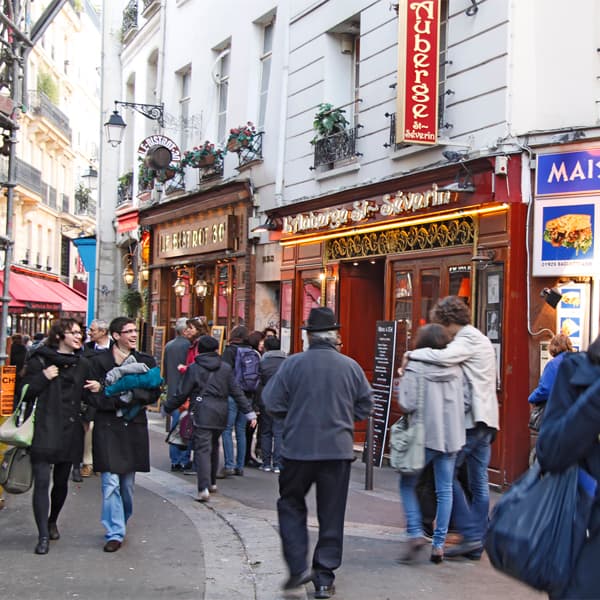
the Latin quarter. Walking along Rue San Severin, you're walking alongside the rather modest Church of San Severin. This is flamboyant, or flame-like Gothic, and you can see the short, prickly spires meant to make this building flicker in the eyes of the faithful. The church gives us a close-up look at gargoyles.
This weird, winged species of flying mammal, now extinct, used to swoop down on unwary peasants, occasionally carrying off small children in their beaks. Today, they're most impressive in thunderstorms when they vomit rain. A few steps further down the street, on your right, at No. 22, Rue San Severin, you'll find the skinniest house in Paris, two windows wide.
Read more...Show less
Pause here for a moment and look down at the pavement. Along Rue Saint-Severin, you can still see the shadow of the medieval sewer system. The street slopes into a central channel of bricks. In the days before plumbing and toilets, when people still went to the river or neighborhood wells for their water, fleshing meant throwing it out the window.
At certain times of day, maids way up on the fourth floor would holler, Guardalot! Watch out for the water, and heave it into the streets, where it would eventually be washed down into the River Seine. Now keep walking west a few short blocks. We're cutting right through the Latin Quarter.
While today this area may look more like the Greek Quarter with all its cheap Greek restaurants, this is Paris' Latin Quarter, named for the language you'd have heard here on these streets if you walked them in the Middle Ages. The University of Paris, founded in 1215, one of the leading educational institutions of medieval Europe, was, and still is, nearby. A thousand years ago, the crude or vernacular local languages were sophisticated enough to communicate basic human needs. But if you wanted to get philosophical, the language of choice was Latin.
Medieval Europe's educated elite was a social class that transcended nations and borders. From Sicily to Sweden, they spoke and corresponded in Latin. Now the most Latin thing about this area is the beat you might hear coming from some of the subterranean jazz clubs. As you wander, remember that before Napoleon III, commissioned Baron Haussmann to modernize the city with grand boulevards.
That was in the 19th century. Paris was like this, a medieval tangle. The ethnic feel of this area is nothing new, by the way. It's been a melting pot in University District for almost 800 years.
Walking straight ahead, you'll soon reach a very big and busy cross street. This is the boulevard Saint-Michel. ¶¶ Boulevard Saint-Michel
Boulevard St. Michel, La Sorbonne
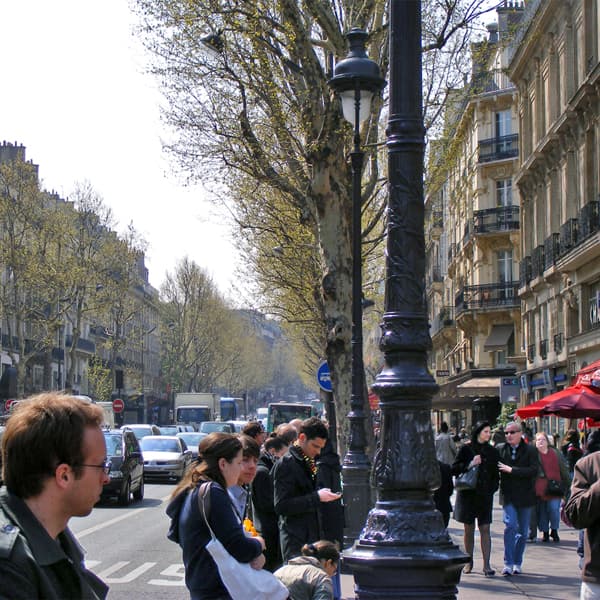
and Le Sorbonne. Busy Boulevard Saint-Michel, or Boulemiche, as locals like to say, is famous as the main artery for Paris' café and artsy scene. It culminates a block away, on your left, where it intersects with Boulevard Saint-Germain. Although these days you're more likely to find pantyhose at 30% off, there are still many cafés, boutiques, and bohemian haunts nearby.
The Sorbonne, still the University of Paris' humanities department, is also nearby, though this tour doesn't go there. Originally founded as a theological school, the Sorbonne began attracting more students and famous professors, such as Saint Thomas Aquinas and Peter Abelard. Its prestige grew. By the time the school expanded to include other subjects, it had a reputation for bold new ideas.
Read more...Show less
Nonconformity is a tradition here, and Paris remains a world center for new intellectual trends. Cross Boulevard Saint-Michel. As usual, you'll need to wait for some lights. Crossing Boulevard Saint-Michel, you step into the pleasant Place Saint-André des Arts, a tree-filled square lined with cafés.
In Paris, most serious thinking goes on in cafés like these. For centuries, these have been the social watering holes, where you can get a warm place to sit, and stimulating conversation for the price of a cup of coffee. Every great French writer, from Voltaire and Jean-Jacques Rousseau to Jean-Paul Sartre, had a favorite haunt. From the pleasant square of cafés, turn right, heading back toward the river.
We have one last stop here on the left bank. After a few steps, you'll enter a small square. The square is triangular-shaped and sandwiched between two busy streets. It's dominated by a gilded square, a gushing fountain with a sword-wielding saint.
This is Place Saint-Michel. There's a metro stop here, and that sword-wielding saint is Saint Michael killing a devil. Place Saint-Michel.
Place St. Michel
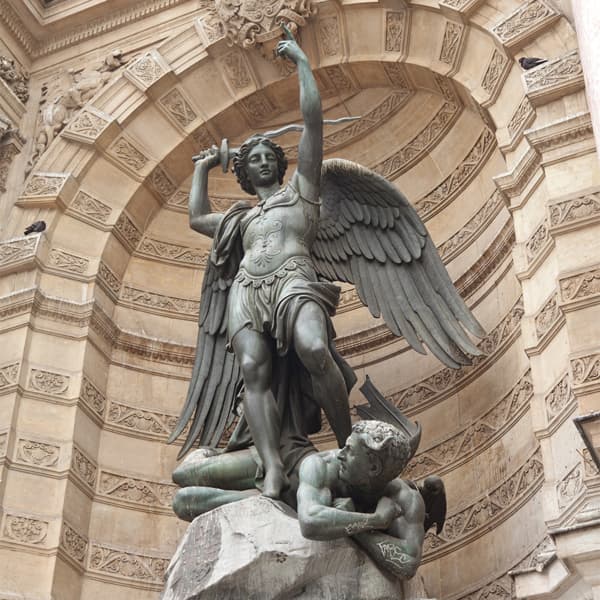
You're standing at the traditional core of the left bank's artsy, liberal, hippie, bohemian district of poets, philosophers, and winos. Nearby, you'll find international eateries, far-out bookshops, street singers, pale girls and black berets, jazz clubs, and, these days, lots of tourists. Small cinemas show avant-garde films, almost always in version original, or VO. For colorful wandering and café sitting, afternoons and evenings are best.
In the morning, the place feels sleepy. The Latin Quarter stays up late and sleeps in. This might be a great place to come back to and explore after finishing this guided walk. In less commercial times, Place Saint-Michel was a gathering point for the city's malcontents, misfits, and revolutionaries.
Read more...Show less
In 1830, 1848, and again in 1871, the citizens took the streets from the government troops. They set up barricades, Les Mis style, and fought against royalist oppression. In World War II, the locals rose up against their Nazi oppressors, as explained on the plaques under the dragons at the foot of the Saint-Michel fountain. And, in the spring of 1968, a time of social upheaval all over the world, young students battled riot batons and tear gas right here.
They took over this square and declared it an independent state. Factory workers followed their call to arms and went on strike, toppling the De Gaulle government and forcing change. Eventually, the students were pacified. The university was reformed, and the Latin Quarter's original cobblestones were replaced with pavement, so future Parisians could never again use the streets as weapons. From Place Saint-Michel
Place St. Michel to Sainte-Chapelle
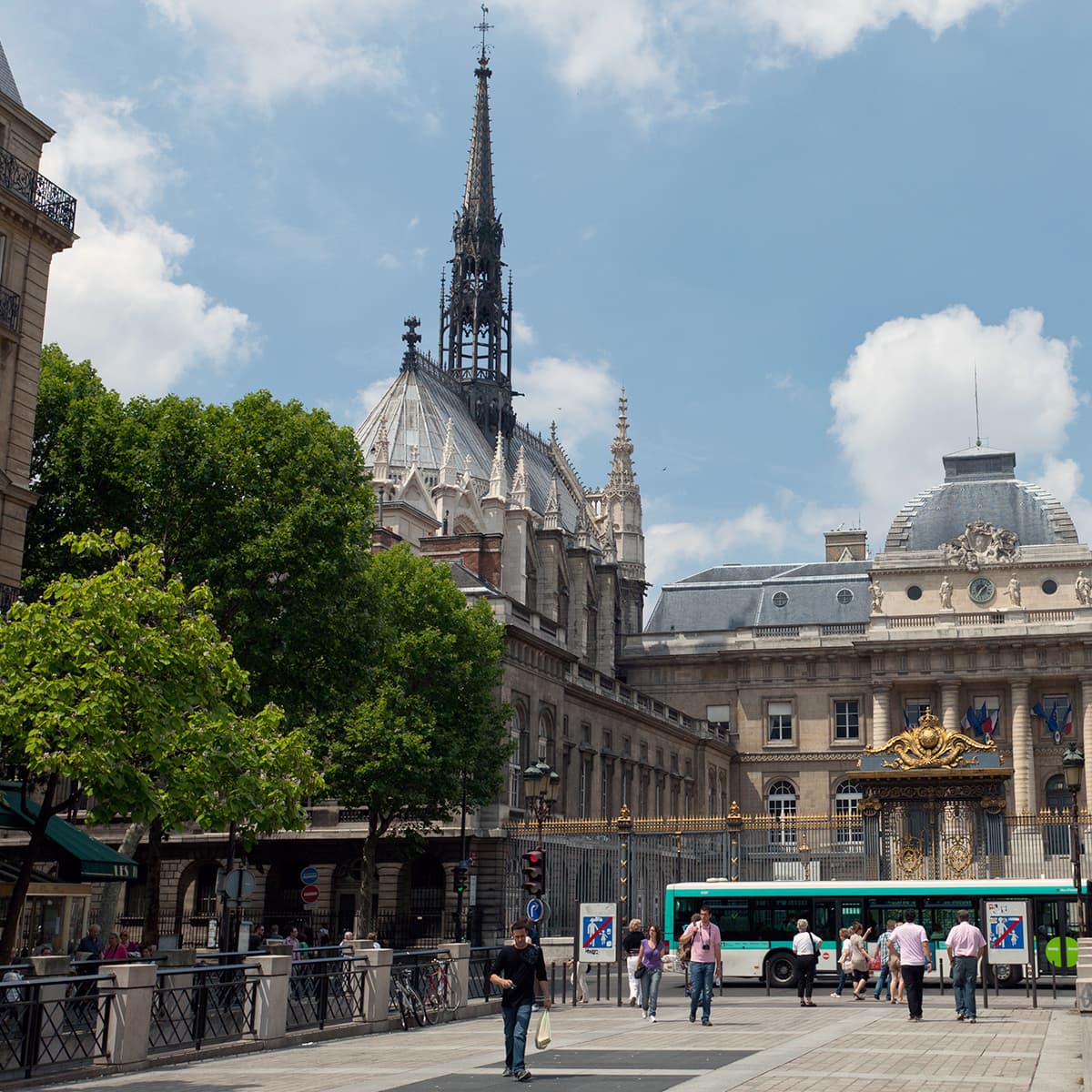
to Sainte-Chapelle. From Place Saint-Michel, look across the street across the river. A few hundred yards away, find a prickly black steeple with its weathervane angel. See it?
That marks our next stop, the Sainte-Chapelle Church. Start walking there now. To get to Sainte-Chapelle, you'll cross the river on the bridge Pont Saint-Michel and continue north along Boulevard du Palais. The spire of Sainte-Chapelle marks the heart of what was once France's royal palace.
Read more...Show less
Back in medieval times, the monarchs lived here on the Ile de la Cité in a vast complex that included their castle, a church, prisons, and a hall of justice. In fact, this was France's royal seat until the 14th century, when the monarchy moved to more lavish digs across the river at the Louvre. In 1248, King Louis IX built a private chapel next to his castle. This is where we're headed next, the Church of Sainte-Chapelle.
Keep going. Keep going north up Boulevard du Palais. Keep an eye out for the entrance to Sainte-Chapelle, a doorway on the left side of the street. Sainte-Chapelle, the triumph of Gothic church architecture, is a cathedral of glass like none other.
It's perhaps Europe's greatest stained-glass experience. Sainte-Chapelle was built by King Louis IX. The only French king, by the way, who's also a saint. He built it to house the supposed Crown of Thorns.
Its architectural harmony is due to the fact that the church was completed under the direction of one architect and it took only five years. That kind of speed was unheard of in Gothic times. Remember that Notre-Dame took over 200 years to build. While the exterior wasn't terribly impressive, its Gothic structure allowed for giant windows of exquisite stained glass.
The muscular buttresses along the sides held up the stone roof so that the church and that the walls could be little more than sheets of glass. By the way, the Lacy Spire is actually neo-Gothic, added in the 19th century. As you continue making your way to the Sainte-Chapelle entrance, let Rick talk through your sightseeing options. This audio tour includes a visit inside Sainte-Chapelle.
That's the next two tracks. But going inside Sainte-Chapelle generally requires either an advanced ticket or a long wait in the ticket line. Plus a security check. So some may choose to visit later.
No problem. If you're not visiting Sainte-Chapelle now, just skip ahead to track 19. That's called the Conciergerie to Place Dauphine. This picks up the tour by the Sainte-Chapelle entrance along Boulevard du Palais.
So as you approach the entrance to Sainte-Chapelle, let's review your options. If you're going inside, keep listening for further instructions. If you're skipping Sainte-Chapelle, jump ahead to track 19. Whatever you choose, we'll see you there. Inside Sainte-Chapelle
Inside Sainte-Chapelle
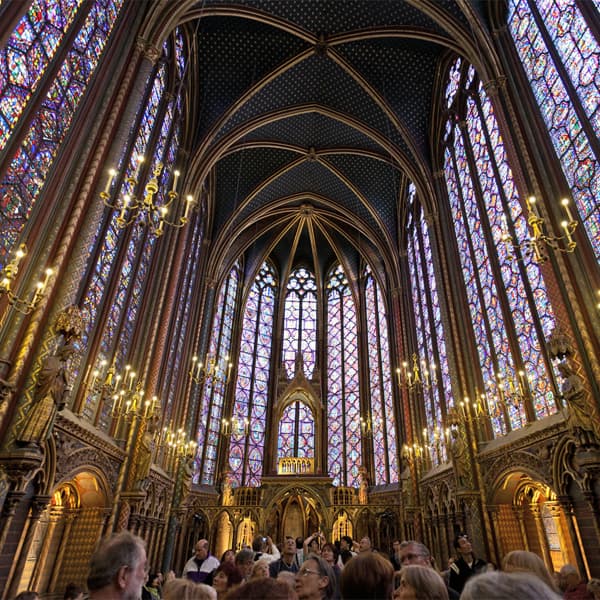
Our visit to Sainte-Chapelle starts once you're actually inside the church on the top floor surrounded by glorious stained glass. To get there, here's the route. You'll enter from the busy boulevard, pass through a metal detector, and walk to the church's entrance. Once inside, you'll climb a tight spiral staircase to the upper chapel.
That's where our tour begins. So pause the audio tour now and restart it once you're inside the church at the top of those stairs amid the stained glass. Wow! Wow!
Read more...Show less
For me, the glory of Gothic shines brighter here than in any other church. Let there be light. From the first page of the Bible, it's clear. Light is divine.
Light shines through stained glass like God's grace shining down on Earth, and Gothic architects used their new technology to turn dark stone buildings into lanterns of light. There are 15 separate panels of stained glass in this room with more than 1,000 different scenes, mostly from the Bible. These cover the entire Christian history of the world, from the creation in Genesis, that's the first window on the left as you face the altar, to the coming of Christ, those are the scenes over the altar, to the end of the world, that's in the round, rose-shaped window at the rear of the church. Each individual scene is interesting, and the whole effect is overwhelming.
Allow yourself a few minutes to just bask in the glory and glow of the colored light before getting up close to look at some specific scenes. Craftsmen made glass, which is essentially melted sand, using this recipe. Melt one part sand with two parts wood ash. Mix in rusty metals to get different colors.
Iron makes red. Cobalt makes blue. Copper green. Manganese purple.
Cadmium yellow. Blow glass into a cylinder shape, cut lengthwise, and lay, flat. Slice into pieces with an iron tool, or by heating and cooling a select spot to make it crack. Fit pieces together to form a figure, using strips of lead to hold everything in place.
And finally, place your masterpiece so high on the wall that no one can read it. Get up close to a welded window and admire the craftsmanship. First, the colors. Red, blue, green, mauve, white.
In many scenes, you can actually see the folds in the robes, the hair, the smiles, frowns, the unibrows. These details were made either by scratching directly on the glass or by baking on paint. It was a painstaking process of finding just the right colors, fitting them together to make a scene, and then multiplying by a thousand. Sainte-Chapelle, up close.
Sainte-Chapelle: Up Close
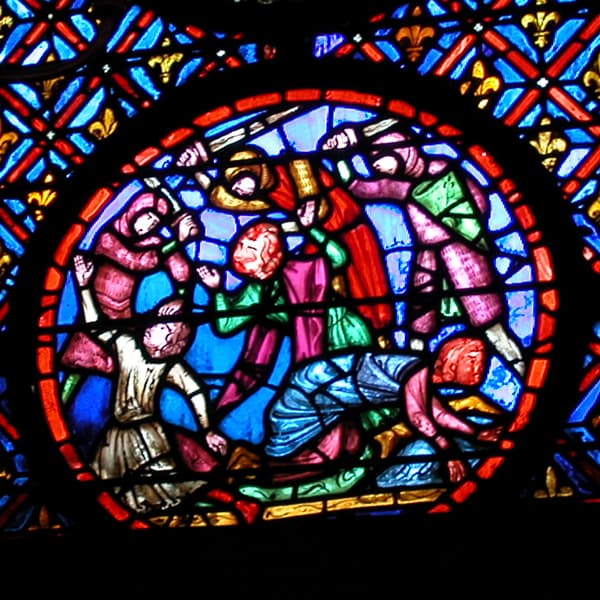
Let's try tackling some details, which, I must admit, can be difficult to find. If you get lost or don't see what I'm describing, don't worry, you're not alone. For some tutoring, there's a little book with color photos on sale downstairs with the postcards. Start at the first window on the left with scenes from Genesis.
By the way, these windows are always dark because of a building that's butting up against it. On the bottom level, in the third circle from the left, we see God creating the round earth and holding it up. On the next level up, we catch glimpses of naked Adam and Eve. On the third level, the far right circle, find Cain.
Read more...Show less
He's in red, clubbing his brother Abel and creating murder. The second window, with the bottom row of diamond panels, has scenes of Moses. In the first panel, baby Moses is in a basket placed by his sister in the squiggly brown river. Next, he's found by the pharaoh's wife, the pharaoh's daughter.
Then, he grows up. And finally, Moses is a man, a prince of Egypt on his royal throne. Now, skip ahead to the windows over the altar. These scenes are from the Passion, Jesus' arrest and crucifixion.
Logically, these were the backdrop for the crown of thorns, which originally was displayed here, high on the altar. Stand a few steps back from the altar to look through the canopy to find Jesus, in yellow shorts. He's carrying his cross. It's the fifth frame up from bottom right.
A little below that, and to the left, see Jesus being whipped. On the right is the key scene in this relic chapel, Jesus in purple, being fitted with the painful crown of thorns. The altar was raised up high to better display the relic around which this chapel was built, the crown of thorns. This was the crown put on Jesus when the Romans were torturing and humiliating him before his execution.
Notice the staircase. Access was limited to the priest and the king, who wore the keys to the shrine around his neck. Also, notice there's no high-profile image of Jesus anywhere here. This chapel was all about the crown.
King Louis IX brought the supposed crown of thorns from Constantinople, that's present-day Istanbul, where, according to legend, it was taken in the fourth century by the mother of the emperor Constantine. Louis, convinced he'd found the real McCoy, spent a lot of money. He paid 135,000 pounds for the crown itself, 100,000 pounds to build the gem-studded shrine to display it in that was destroyed in the French Revolution, and he paid, well, 40,000 pounds to build the church you're standing in right now, the Sainte-Chapelle. Imagine, the crown of thorns cost him three times what the church he built to hold it in cost.
Today, the supposed crown of thorns is kept in the Notre-Dame Treasury, where it shone on the first Friday of the month and during Easter. Finally, look up to the big rose window opposite the altar in the back of the chapel. It's Judgment Day, with a tiny Christ in the center of a galaxy of chaos and miracles. This window is 200 years newer than the rest from the Flamboyant Period.
Facing west, it shines gloriously as the sun goes down. Pretty cool. But it's time to move on. When you're ready, exit Sainte-Chapelle.
We're heading back to where we came in, that busy street called Boulevard du Palais. To get there, you'll go back down the spiral stairs to the ground floor. Back down on the lower level, you'll have a rare opportunity to see how many medieval churches were originally painted. When you're ready to leave, step outside and just follow the crowds to the exit of the Sainte-Chapelle complex.
By the way, as you're walking, you'll be passing France's Supreme Court, and you may see lots of security. So, pause the audio tour now and restart it on the next track once you're back outside the complex on the busy Boulevard du Palais. See you there. The Conciergerie
Conciergerie to Place Dauphine
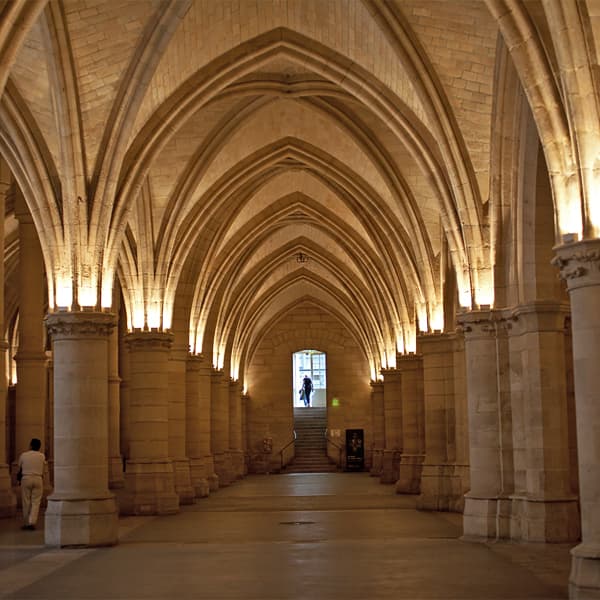
to Place Dauphine Whether you went inside the complex inside Sainte-Chapelle or not, our tour picks up again along the busy street called Boulevard du Palais. Continue up the street a few yards to the entrance of what's called the Conciergerie. The Conciergerie was the courthouse of the medieval palace that once stood here. By the way, these days, those court duties have been taken over by the big Palace of Justice building next door.
After the royals moved to the Louvre Palace, the Conciergerie decayed into a dank, rat-infested prison. That's when it gained eternal infamy as the prison of the French Revolution, where Queen Marie-Antoinette spent her final days before being marched to the guillotine. By now, you should be at the entrance to the Conciergerie. While our tour won't go inside, you might consider it on your own.
Read more...Show less
If you buy a ticket and go in, you'll see the Conciergerie's vast Gothic Hall and the reconstructed cell of Marie-Antoinette. You'll learn about some of the 2,780 aristocrats of the old regime who were decapitated by the revolutionaries. Or, in the slang of the day, had a date with Monsieur de Paris. Yep, made a foot shorter at the top.
The most famous victim was the Queen herself. You can visit her reconstructed cell and imagine her anxious and tragic final moments. Eh, let her eat cake. We're moving on.
You are heartless. From the Conciergerie, continue up the boulevard a few more steps to the end of the block. Paris was transformed by the revolution. The revolution brought chaos, which bred a strong leader, Napoleon Bonaparte.
After Napoleon was toppled, bringing more chaos, France was eventually ruled by Napoleon's nephew. He was called Napoleon III, and he began rebuilding Paris. Excuse me, Rick, but at the corner, what is that clock on the wall of the Conciergerie? This is the city's oldest public clock.
The internal mechanism actually dates from 1334. And even though the more recent casing is Baroque, it keeps on ticking. Did you see what I did there, Lisa? Baroque, like broken?
Yes, got it. Ha ha. Okay, we're moving on. At the intersection, our walk turns left on the street called Quai de l'Horloge.
So, turn left, and start walking west. You'll have the Conciergerie on your left, and the River Seine on your right. Keep walking all the way to the end of the block. As you walk, you'll pass by the round towers of the Conciergerie.
Compare those medieval-looking towers with the more modern buildings on the opposite side of the Seine. The buildings on the right bank are more uniform in height and look. The right bank was developed by Napoleon III's urban planner, Baron Haussmann. Haussmann cleared out the cramped medieval cityscape and replaced it with broad, straight boulevards lined with stately buildings.
The buildings sport many of the same features that give Paris its uniform look, five stories tall, with angled black-slate roofs and formal facades. Notice how the balconies on the second and fifth floors tend to match those of their neighbors. But there was more than aesthetics to Haussmann's plan. It was military strategy designed with an agenda to keep the people in line.
You see, in pre-Haussmann Paris, angry rioters could take over the narrow and winding streets, setting up barricades to hold back government forces. But with Haussmann's new design, government troops could circulate easily and fire their cannons down the long, straight boulevards. With these boulevards, a whiff of grapeshot, as they called a cannonload of chains, nails, and other buckshot-type shrapnel could clear out any band of revolutionaries in a hurry. The result of Haussmann's urban renewal is that Paris today has two distinct neighborhoods with two different looks and different attitudes.
The right bank is more uniform and business-oriented. The left bank remains more medieval and historic. And like its architecture, the left bank is also more individualistic, more artistic, intellectual, and counterculture. In French, the left bank is the rive gauche.
Gauche, meaning left, has come to imply social incorrectness, like giving a handshake with the wrong or left hand. This mix of left bank and right bank of nonconformity and gentility, liberal and conservative, that's part of what makes Paris today so charming. As you continue to the end of the block, notice the bridge crossing the Seine. This is the Pont Neuf, where our friends and our tour will end, but we're headed to Place Dauphine first.
So when you reach the end of the building, veer to the left. It's the first left. As soon as you turn left, you'll see the entrance to Place Dauphine, one of the city's most genteel squares. By the way, Lisa, one of Paris' most genteel customs is the way Parisians greet each other.
You may have seen it along the walk. They don't shake hands or hug each other American-style. Instead, they kiss, a light peck on the cheeks. Observe.
They touch cheeks, pucker their lips, and make a gentle smacking sound. But the lips don't actually touch the cheek. Parisians do two kisses, first the right cheek, then the left. But some people add even more kisses.
If it happens to you, my recommendation is to go for two with confidence and then follow their lead. Coincidentally, we've reached the perfect place for just such a Parisian rendezvous, the little square called Place Dauphine. Place Dauphine
Place Dauphine
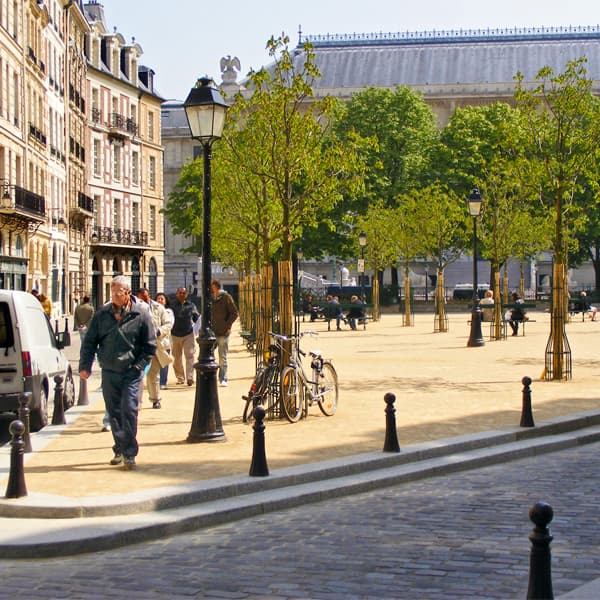
Leave the big city bustle and enter this small leafy oasis. Start strolling to the far end. It's amazing to find such coziness in the heart of Paris. This mighty city of two million is still a city of neighborhoods, a collection of villages.
The French Supreme Court building looms behind like a giant marble gavel. Enjoy the village Paris feeling in the park. A couple of nice restaurants flank either side. You may see lawyers on their lunch break or pensioners playing boule.
Read more...Show less
That's the game so common here in Paris, where players throw steel balls trying to cozy their balls closer to the target than their opponents. The square was commissioned by King Henry IV. We'll talk more about him in a bit. It's named in honor of his son.
The crown prince of France was always known by his title, Dauphine. The word literally means dolphin, because dolphins appear on the French royal family's coat of arms. At the far end of the square, continue down a short little street. We're squeezing between the two oldest buildings in the area.
From around 1600. As you pop out the other end, you find yourself face-to-face with a statue of King Henry IV. Though not as famous as his grandson, Louis XIV, Henry helped make Paris what it is today, a European capital of elegant buildings and quiet squares. He built the Place Dauphine that's behind you, the Pont Neuf to the right, residences like those to the left down Rue Dauphine, the Louvre's long grand gallery.
You can see that downriver on the right, and the tree-filled square Vert-Galant, directly behind the statue, on the tip of the island. The square is one of Paris' most romantic little hideaways. The little triangular park below you is a great place to relax, dangling your legs over the concrete prow of this boat-shaped island. For our final stop, from the statue, turn right onto the old bridge, the Pont Neuf. Start making your way to the center of the bridge. The Pont Neuf
Pont Neuf on the River Seine
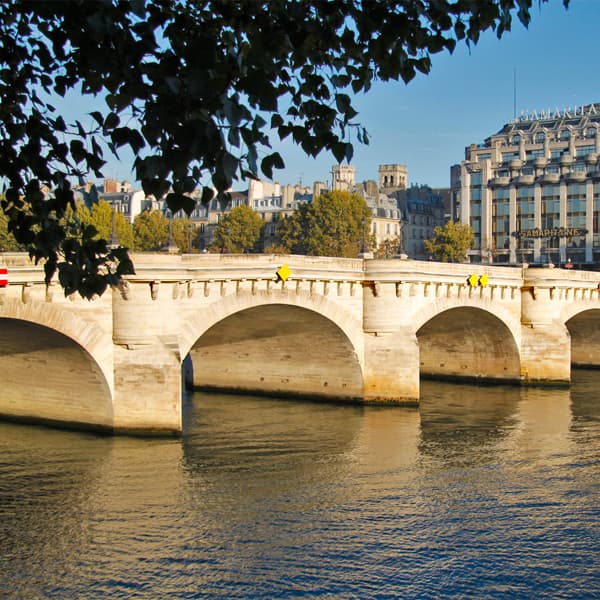
on the River Seine The Pont Neuf, our new bridge, is Paris' oldest standing bridge. It was built around 1600. Its twelve arches span the widest part of the river. Unlike other bridges, this one is the largest.
This one never had houses or buildings on it. The turrets were originally for vendors and street entertainers. In the days of Henry IV, who promised his peasants a chicken in every pot every Sunday, this would have been a lively scene. From the bridge, look downstream, that's westward, to see the next bridge.
Read more...Show less
That's the pedestrian-only Pont des Arts. Ahead, on the right bank, is the long Louvre Museum. Beyond that, on the left bank, is the Orsay train station, now called the Orsay Gallery. Oh, and what's that tall black tower in the distance?
Our walk ends where Paris began, on the Seine River. From Dijon in eastern France near the Alps to the English Channel, the Seine meanders 500 miles, cutting through the center of Paris. The river is shallow and slow within the city, but still dangerous enough to require steep stone embankments. These were built in 1910 to prevent occasional floods.
In summer, the roads that run along the river are replaced with acres of sand, as well as beach chairs and tanned locals. This creates the Paris Plage, or Paris Beach. The success of the Paris Plage event has motivated some city officials to propose the permanent removal of vehicles from those fast lanes, turning this into riverside parks instead. Any time of year, you'll see tourist boats and the commercial barges that carry 20% of Paris' transported goods.
And on the banks, sportsmen today cast into the waters once fished by Paris' original Celtic inhabitants so many centuries ago. We hope you've enjoyed this walk through Paris. Thanks to Jean Openshaw, the co-author of this tour. From here, you can catch the metro to anywhere in the city.
The nearest metro stop is Pont Neuf, just across the bridge on the right bank. Or you can take a boat tour that leaves from the tip of the island, just next to the Pont Neuf. This tour was excerpted from the Rick Steves Paris Guidebook, co-authored by Steve Smith and Jean Openshaw. For more self-guided walks and details on eating, sleeping, and sightseeing in Paris, refer to that guidebook.
We also have other Paris audio tours, including tours of the Louvre Museum, the Orsay Museum, and the Palace of Versailles. For more free audio tours and podcasts, and for information about our TV shows, bus tours, and travel gear, visit our website at ricksteves.com. This tour was produced by Cedar House Audio Productions. Merci. Au revoir. And bon voyage. © transcript Emily Beynon
Free
GPS-guided walking tour
No account needed. Walk at your own pace.
Free
21 stops ·