15 stops
GPS-guided
73 min
Duration
Free
No tickets
About this tour
A 15-stop walking tour through the heart of Germany. Visit Prenzlauer Berg Walk , Metzer Eck Pub , Wasserturm (Water Tower) , and Rykestrasse Synagogue — with narrated stories at every stop.
15 stops on this tour
Prenzlauer Berg Walk
The Prinzlauer Berg Walk. You can't just visit the Brandenburg Gate and say you've seen Berlin. This is a city made up of many small, proud neighborhoods, and one of the trendiest and most charming is just north of the city center, Prinzlauer Berg. Hey, I'm Rick Steves.
Thanks for joining me on a walk through this intriguing corner of today's Berlin. On this walk, we'll see elegant old buildings and trendy shops. We'll step into a 200-year-old beer garden, sample Berlin's famed currywurst, watch people, and pet dogs. Along the way, we'll see how the neighborhood has changed over the years, from 19th-century working class to the 1920s sophistication to World War II devastation.
Read more...Show less
We'll see quirky remnants from the dreary days of communist East Berlin. At a funky home for drag queens, we'll see how the neighborhood revived. And we'll finish our walk where the Berlin Wall came, the event that changed everything. But really, this walk isn't about high-powered sites and tourist hotspots.
Rather, it's a quintessentially Berlin neighborhood, a great place to enjoy a meal, browse the shops, or simply explore. It's easy to reach Prinzlauer Berg, just a quick U-Bahn ride from the city center. Allow about 90 minutes for the walk, or a little more if you're stopping to see the fine museum on everyday life in the DDR. This walk works well any time of day.
It's especially pleasant on a warm evening when locals are out enjoying their neighborhood. Now, to help us along the way, I've invited a good friend and virtual travel buddy. Welcome, Lisa. Guten Tag, Herr Steves.
Lisa will give us helpful directions and sightseeing tips throughout the tour. And my first tip is to be sure you get our tour updates. Just press the icon at the lower right of your device. You'll find any updates and helpful instructions unique to this tour.
Like closures, opening hours, and so on. There's also tips on how to use this audio tour and even the full printed script. Yes. Pause for a moment right now to review our updates and special tips.
It's okay. We'll wait. Now, let's set out and enter a world of ornate buildings, leafy squares, tattooed parents, hipster cafes, and cutting-edge boutiques. All part of the tour. All part of Berlin's most inviting neighborhood, Prenzlauer Berg. The tour begins.
Tour Begins: Senefelderplatz
Sennefelder Platz. Our walk begins at the square called Sennefelder Platz, located a mile north of Berlin's TV Tower. If you're arriving by U-Bahn, get off at the Sennefelder Platz stop. Exit the station following signs to Metzerstrasse.
At the top of the station, turn right, cross the street, and walk toward the TV Tower. You'll see it in the distance poking above the neighborhood buildings. Pause at the corner, face the TV Tower, and take in the busy square around you called Sennefelder Platz. Rick?
Read more...Show less
Thanks, Lisa. Welcome to Prenzlauer Berg. Though this workaday square isn't exactly what you'd call charming, it's a convenient jumping-off point for the neighborhood. As you look toward the TV Tower, you're looking at central Berlin.
Berlin is basically flat, built along the Spree River. As you look downhill, you realize that Prenzlauer Berg really is a berg, or mountain. Well, it's more like a small hill, about 100 feet above sea level. Back in the 1800s, Prenzlauer Berg was just a forested hill on the outskirts of town, dotted with a few windmills.
In fact, back then, it was actually called Windmill Hill. It was a place where Berliners might take a carriage ride. for an afternoon picnic. But by the mid-1800s, Berlin expanded.
Once the Centerfelderplatz-U-Bahn station was built in the early 1900s, the neighborhood really took off. Today, Prenzlauer Berg is just one part of a vast Berlin metropolis. It's kind of like Berlin's Brooklyn, a city within a city. Population?
170,000, with its own unique identity. Let's go deeper. Facing the TV Tower, turn left. Start walking down Metzerstrasse.
As you walk, you'll pass by tiny Sennefelderplatz Park. Which we won't visit. No, keep walking down Metzerstrasse. But in that park is a statue of the man for whom this square is named, Alois Sennefelder.
He was the inventor of the printmaking process called lithography. Lithography, huh? Fascinating. But why...
Why am I telling you this? Because Prenzlauer Berg has long been the home of numerous artists, including one well-known lithographer whose home we'll see in a bit. Ooh, a lithographic teaser. I can't wait.
But for now, keep walking straight down Metzerstrasse for one long block. We've already entered a sleepier, tree-lined, more residential area. The apartment buildings here are nothing special. But Prenzlauer Berg has plenty of charming old buildings, which we'll soon see.
Another teaser. Continue walking on this same street. Prenzlauer Berg got its start in the late 1800s when modern Germany was just coming into its own. In 1871, Germany united as a modern nation-state.
It was on the cutting edge of the Industrial Revolution. National pride was soaring as it became Europe's newest superpower. The bustling center of this growing nation was Berlin. As Berlin's population grew, they tore down the old city wall and expanded north to Prenzlauer Berg.
A new railway line brought factories and workers. The workers needed housing and the area soon became densely packed with crowded tenements. That is, apartment buildings. At first, the buildings were cheap to accommodate poor workers crammed into unsanitary conditions.
But as the area grew more prosperous, the apartments grew fancier. The architectural style was called Wilhelmin. Why? Because the urban expansion took place under Kaiser Wilhelm I and Wilhelm II.
With its decorative neoclassical and neo-Baroque elements, it symbolized the wealth and glory of Germany's growing empire. Many of these old buildings are still intact. Nearly 80% by one count. Which is what gives Prenzlauer Berg its distinctive charm.
These days, it's a hip neighborhood housed in turn-of-the-century elegance. In fact, one of the most atmospheric remnants from that long-ago time is just ahead. After a long block, you'll come to the intersection with Strasburger Straße. Across the street, on the left corner, find a low-key-looking pub called Metzereck.
Make your way to the pub. In fact, let's pop inside. See you at Metzereck. Metzereck Pub.
Metzer Eck Pub
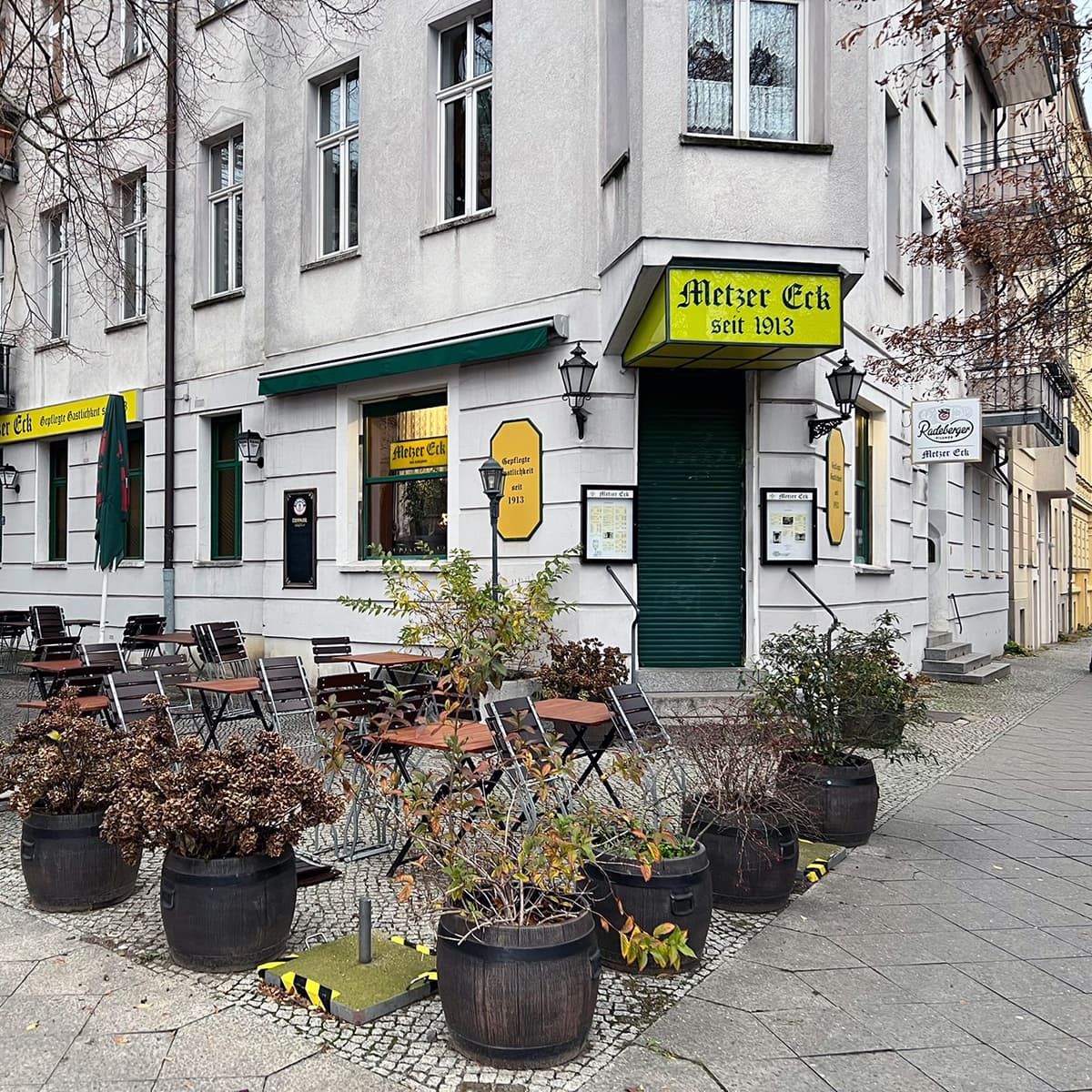
This is a classic neighborhood pub. Or what's called a kniipa. It's on the corner of Metzere Street. In the corner of a building.
And the name itself, Eck, means corner. This pub has been around since 1913 and it's still run by the same family. Let's step inside. Just to check out the menu, of course.
Read more...Show less
Of course. Inside, the decor is simple. Wood paneling, wood tables, rustic chandeliers, old pictures on the walls. Perhaps one of Kaiser Wilhelm.
The place still holds still feels like a worker's neighborhood hangout from Prenzlauer Berg's early days. Back then, when apartments were small and often shared, corner pubs or kniipa like this were like your extended living room. As the neighborhood grew, this pub welcomed a new clientele. Still workers, of course, but eventually poor students, struggling artists, and intellectuals who flocked to Prenzlauer Berg for the cheap rents.
They'd be joined by rich Berliners who'd catch the train here for a relaxed meal away from the gritty city center. Over its many years, Metzereck has played host to numerous artists, writers, and later filmmakers who've used this venue for their premieres, book launches, and after parties. Let's start heading back outside. Yes, let's.
But if you're hungry, this is a great place for something like a no-nonsense schnitzel. That's how I like my schnitzel. They also have other German classics like potato salad and Wursts, and, of course, good local beer. Ooh, there's a lot of Currywurst.
Yes, but not now. Every Berliner's favorite Currywurst joint is coming up later. So, for now, we're moving on. Okay, then let's exit the pub.
And once outside, turn right. Start walking down Strasburger Straße, heading toward the two towers on the hill in the distance, a tall skinny tower and a shorter, fatter one. Those towers we're heading to were once water towers that served this growing neighborhood. As you approach them, check out the buildings along this street.
Now that we're a little deeper into Prenzlauer Berg, the buildings are getting increasingly older and more interesting. Compare the buildings on the left side modern and kind of boring with the ones on the right. Many of these have nice touches, like balconies with fancy ironwork railings or decorative carvings around the windows. In a way, this street is a microcosm of Prenzlauer Berg's history, old Wilhelmine charm mixed with modern gentrification.
Along this street, you may also encounter one of the main features of this walk, namely, real people doing real things. This is a living neighborhood, not a curated historical tourist trap. You may come across everyday workers, parents, kids, probably even some dogs. Berliners love their dogs almost as much as they love their kids.
By the way, you're usually welcome to pet them, but you should always ask permission first. May I? That would be darf ich? Darf ich?
That's right. If you come across someone with a dog, give it a try. Darf ich? Rrrr?
Rrrr. Well, it doesn't always work, but getting a chance to pet a dog can give this walk more smiles, or at least more memories. Keep going toward the water towers. Remember, as Prenzlauer Berg grew, it was not willy-nilly.
This was a well-planned urban development. City planners made sure the residents had all the essentials. They had standard five-story apartments, each apartment had a quiet courtyard in the back, off the busy street, residents had their U-Bahn station nearby, and the ingenious engineers gave them one more crucial element, water. By now, you should be approaching the water tower park.
Keep going straight ahead. We're heading up that small hill to the towers, so cross the street and enter the park by following the footpath off to the left. Go up five steps and then climb the woody staircase on your right to the water tower. To the top of the hill. The Wasserturm,
Wasserturm (Water Tower)
or water tower. Just to repeat, we're climbing up the hill to the towers. Keep climbing to the grassy summit. This mountain is called Mound Your Climbing is actually a dome that covers underground reservoirs.
Beneath your feet are big water storage tanks made of brick. The tanks provided water to the fast-growing district of Prenzlauer Berg. The water system was begun in the 1850s, back when Germany was at the cutting edge of the industrial age. High-tech engineers built these storage tanks and the towers.
Read more...Show less
They chose the highest spot in the neighborhood. That way, the water could flow downhill through a system of pipes with maximum water pressure. Keep going and tell your friends how you reached the top of the hill. Once you reach the top, take a moment to survey the scene.
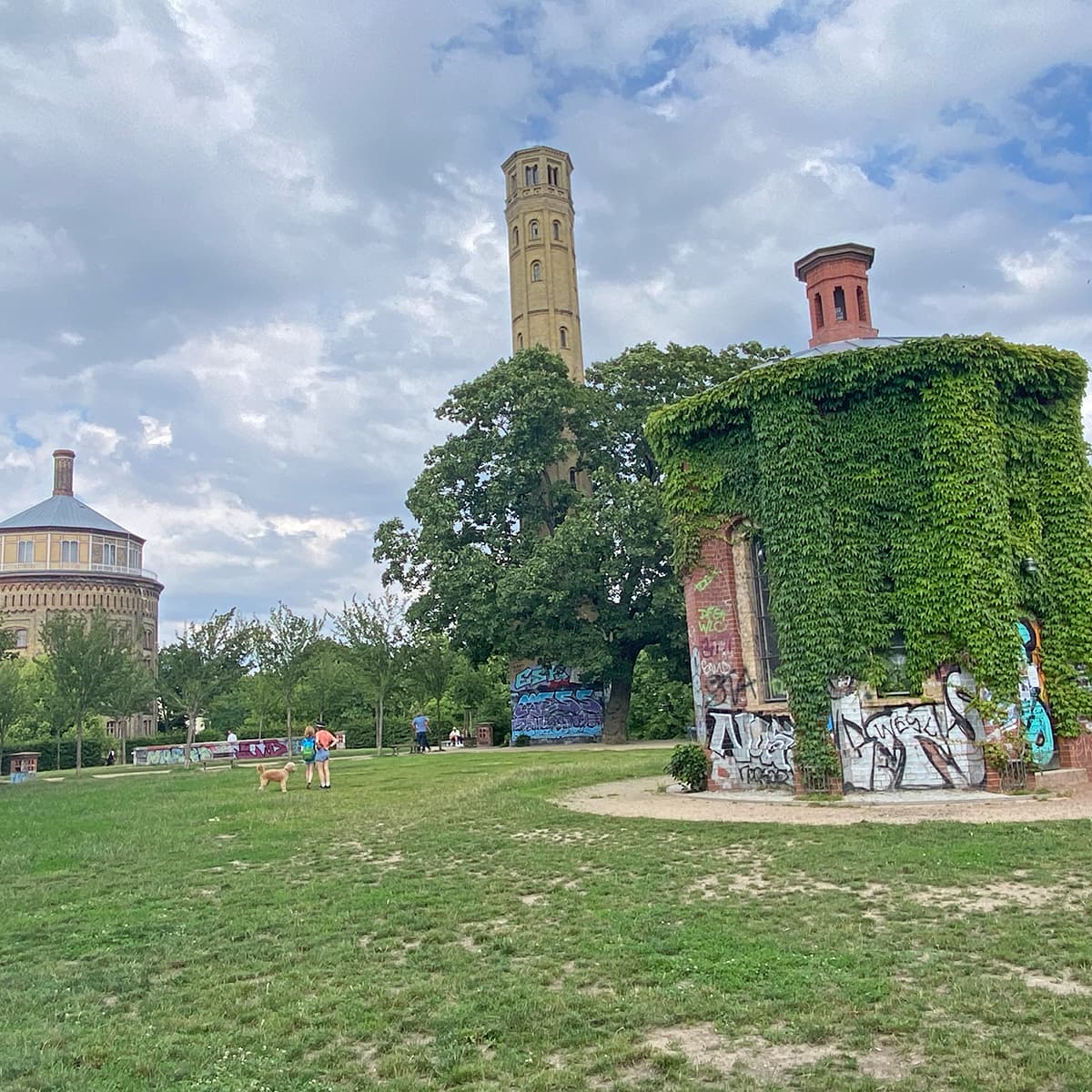
You'll see three different structures, all part of the water system. There's a small red brick structure covered with ivy right in front of you, then a tall skinny tower, and in the distance behind the trees, a big fat tower. But before we explore the structures, enjoy the view overlooking the street you just walked up. Make your way to the edge of the hill where the benches are, off to your right.
Look down the street and fix your gear gaze on the red and white striped TV tower on the horizon. That's where the bustling square of Alexanderplatz is located. Not far from there is where Berlin was founded back around the year 1200. Consider the rapid growth of Berlin.
Way back in medieval times, this city was nothing much smaller than, say, Paris, London, or Rome. But by the 1700s, it was becoming a cultural center, the nucleus of the growing Kingdom of Prussia. And when Germany unified, Berlin became the capital. Berlin was an industrial powerhouse and peasants from the countryside flocked here for work.
From 1860 to 1910, Berlin's population quadrupled from half a million to over two million. For a time, Berlin was the third largest city in the world and the most densely populated city in Europe. It needed to expand. And, as with most German cities, it expanded to the less desirable north, downwind of the factories.
That was Prenzlau, which began as a low-rent workers' district. And it needed water. Let's explore the water system buildings. First, turn your attention to the squat, red-brick structure in the middle.
This is the above-ground entrance to the huge underground cistern below. It was the first part of the complex, built in the 1850s. From here, the water was sent through pipes downhill to Prenzlauer Berg apartments. Start heading for the tall, skinny tower.
In the 1850s, this 70-foot-tall tower was built. It served as overflow for the reservoir and, when filled, added additional water pressure. So, how did they get the water up there? What made this whole system possible was a newfangled invention, the steam pump.
First developed in the 1700s, the steam engine revolutionized the world. Berlin had plenty of groundwater. In times past, they got their water from the neighborhood wells, pumped, by hand. But now, with a steam engine, large quantities of water could be easily pumped uphill to storage tanks like the reservoir, or even further up into this tower.
Then, it was released downhill with plenty of water pressure to reach distant apartments. Nice! Now let's keep going, heading to the next tower, the big tower at the far end of the park. To get there, take the staircase by the skinny tower.
Start down those steps. Down the steps by the tower. Got it. I'm going down, just like water.
Wee-hee! At the base of the steps, turn left and continue walking to the far end of the park. As Prince Lauerberg grew, one skinny tower just wasn't enough. It needed this bigger one.
So, in the 1870s, the big tower was built, some 100 feet tall. This is the one most properly called the Wasserturm, but it's best known by its local nickname, Fat Herman. Well, he probably prefers Heavy Set Herman, but whatever. To reach the tower, keep following the sidewalk as it curves to the left.
At the curve, you'll pass a kiddie playground, yet another fine feature of this very livable neighborhood. Soon, you'll get a close-up view of the Wasserturm. It's a water tank, yes, but notice that it has windows, which may seem odd. From the start, the tower was built with apartments in mind to house the water workers.
They manned the steam pumps in the cellar. Beneath this tower is another reservoir. Taken together, the water system complex, Fat Herman, Skinny Tower, and underground reservoirs met the demand, even as Prince Lauerberg kept growing. In fact, they continued supplying the neighborhood until 1952, when they were finally decommissioned.
Eventually, the area was turned into this lovely park. And today, those apartments for the workers? Now they're rented out to private citizens. That's so cool.
They're very much in demand, and the waiting list is long. Let's move on. Start circling around Fat Herman to his big backside. As you walk, let me add one final detail, a rather grim one.
In the 1930s, when the Nazis overran Germany, the Wasserturm took on a sinister role. The cellar here became one of Hitler's first improvised concentration camps. Yikes! Some of Hitler's political enemies were imprisoned and even tortured here.
That is grim. Yes, but strangely, that historical fact is also a fitting transition to our next site. Once you reach the backside of the Wasserturm, start down the steps to the street. From there, we'll direct you to our next stop, the Rikastrasse Synagogue. ¶¶ The Rikastrasse Synagogue.
Rykestrasse Synagogue
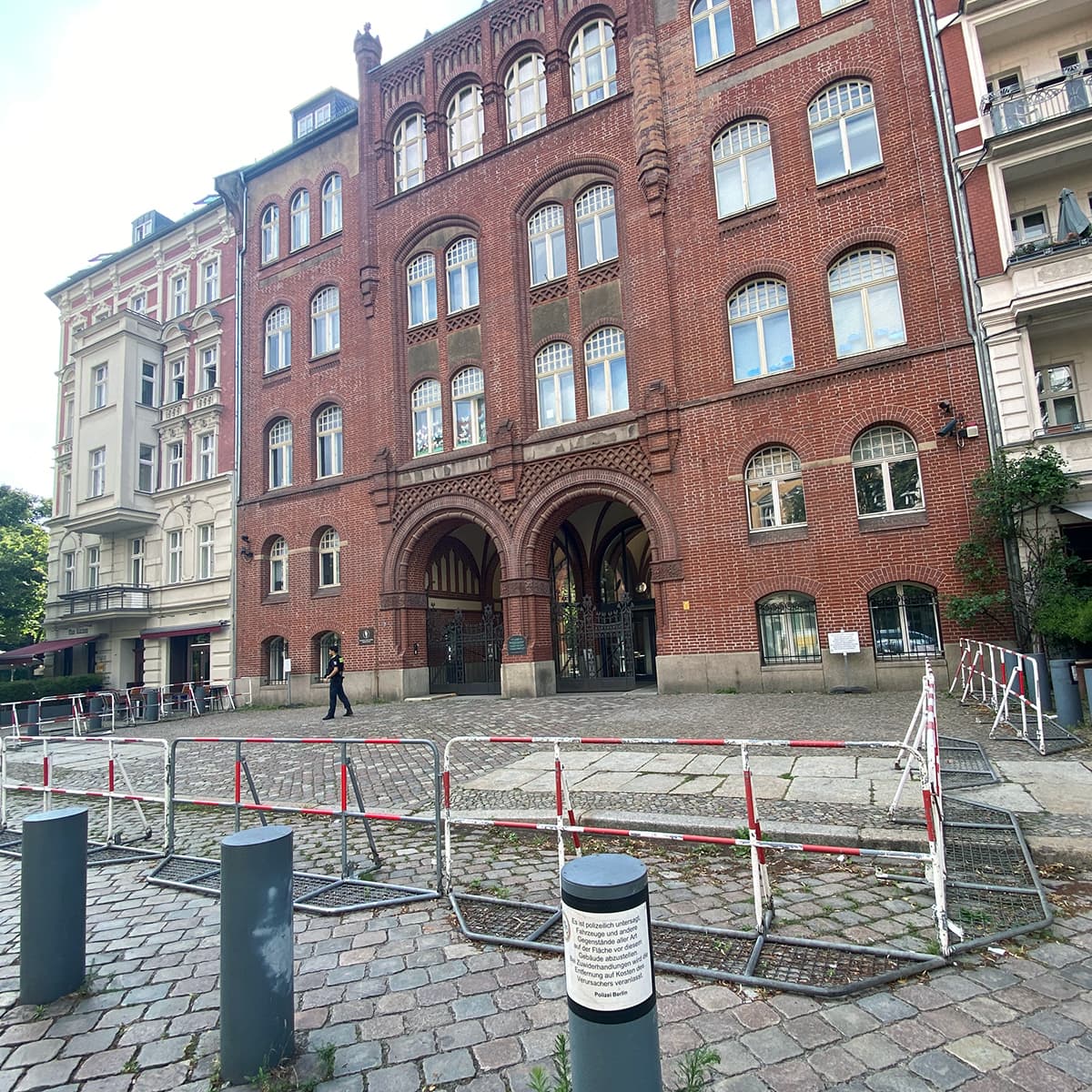
With your back to the big water tower, cross the street. Once across, keep going straight ahead up the broad street called Rikastrasse. By the 1930s, Prenzlauer Berg was becoming a bustling, upscale neighborhood. Home to intellectuals and artists.
One in ten residents was Jewish, and here's where they worshipped. The Rikastrasse Synagogue is the second building on the left. It's the red brick building with two arched entry doors and toll windows in the Byzantine style. Jetting out in front are security barriers.
Read more...Show less
Like all Jewish sites in Berlin, this has a strong police presence. And because of security needs, that means sightseers are generally kept at a distance. The Rikastrasse Synagogue is one of Germany's largest surviving synagogues. It may not look that big from here, because we're seeing it from its less impressive street entrance.
This is just the entrance portal. The synagogue itself is in back, a freestanding building within a courtyard inside the city block. It was typical for synagogues to be set back from the street like this, hiding in a big courtyard and camouflaged out front to blend in with the other houses on the street. As we'll see, this is what helped save this synagogue.
This synagogue persevered through Germany's tumultuous 20th century. It was built in 1904 to accommodate Prince Lauerberg's rapidly growing Jewish population. The place could hold 2,000 worshipers. But in the 1930s, Nazis took over Germany with their anti-Semitic agenda.
Undaunted, this synagogue continued to host frowned-upon Jewish activities. Then came Kristallnacht, Kristallnacht. Kristallnacht. November 9th, 1938.
The Night of Broken Glass. That's when Nazi mobs went on a rampage, a modern-day pogrom. They smashed windows, looted Jewish businesses, assaulted Jews, and set fire to synagogues all over Germany. This synagogue was also torched.
Elsewhere, the fire department simply let them burn to the ground. But the Rikastrasse synagogue was nestled amid surrounding buildings, and letting the synagogue burn would put the non-Jewish homes in jeopardy. So, the fires were extinguished, and the Rikastrasse synagogue survived. The Rikastrasse synagogue faced more challenges.
During World War II, it lay dormant, and after the war, it was East Berlin's only surviving synagogue. Then, when this neighborhood fell behind the Iron Curtain, they faced another hostile government, the Communist Atheist DDR. But the Rikastrasse synagogue dealt with the legal roadblocks and still carried on. Let's carry on, too.
Start backtracking toward the Wasserterm to Knackstrasse, where we'll turn right. As you walk, here's the rest of the story. When the Berlin Wall finally fell in 1989, exiled Jews from around the world returned. Today, Berlin has a thriving Jewish community with eight synagogues.
This one remains a vibrant synagogue, school, and cultural center. Turn right on the right-hand side along Knackstrasse. You'll pass a restaurant on the corner. Café Pasternak is evidence that Jewish culture remains strong in Berlin.
It's a gathering place for people from all corners who come for their traditional blinis and dumplings enjoyed in an old-world atmosphere. Keep going straight along Knackstrasse for one short block. Our next stop, a square called Kollwitzplatz. It's a good place to talk about the event that had such an impact on Prenzlauer Berg and Germany itself.
World War II. We'll see the war's devastating effects through the eyes of a woman who lived through it right here on the square. She was a well-known artist who chronicled that sad tale in stirring works. Her name?
Käthe Kollwitz. You may already be familiar with the work of Käthe Kollwitz. Yeah, she did the famous Pietà statue for the Neue Wacht Memorial on Unter den Linden. That's Germany's primary monument to victims of war and tyranny.
No German artist captured that better than Käthe Kollwitz, who was herself intimately impacted by Germany's 20th century wars. As an artist, Käthe is best known for her graphic arts, that is, prints made from engravings, woodcuts, and... And don't tell me... Lithographs!
Invented... As we all know... By Alois Senefelder. We're so smart!
Keep going to the end of the block and stop on the corner under the sign for Canachstrasse-Kollwitzstrasse. In 1886, Käthe arrived in Berlin to attend art school. She married a doctor named Karl Kollwitz. They settled down here in Prenzlauer Berg, in a home they'd live in for the next 50 years, right in the heart of the neighborhood.
Käthe's former house is right there on your right at the corner of Canachstrasse and Kollwitzstrasse. piano plays piano plays KOLWITZ PLOTS
Kollwitzplatz
KOLWITZ PLOTS First, just take in the scene. The park in the square across the street. The elegant buildings surrounding it. The bustle of cars and people.
KOLWITZ PLOTS is at the heart of one of Prenzlauer Berg's most desirable sub-districts, KOLWITZ KIEZ. Berlin is a city of many such KIEZs, or micro-neighborhoods. Each just a few square blocks in size. They're often named for a nearby landmark.
Read more...Show less
Like this square across the street. And each has its own distinct personality. This particular KIEZ has experienced rapid gentrification. Check out the residences circling this square.
They are very expensive. Now, stand in front of Käthe Kollwitz's house. It's located here on the corner to your right. The address is number 56A.
To be clear, her original home was destroyed, bombed in World War II, so this is now a modern building with a blue stripe around the base. When Käthe and her doctor husband moved in here in 1891, Prenzlauer Berg was an up-and-coming neighborhood, a mix of workers, artists, and intellectuals. Karl had his medical practice here at number 56. Käthe had her art studio, and the couple raised two sons.
As an artist, Käthe was transforming from traditional painter to printmaker. She especially liked the lithographic process, where she could express herself effortlessly while still making high-quality and affordable prints. Käthe's work was gaining recognition, and she taught at the Berlin Academy for Women Artists. Karl was a respected neighborhood doctor.
The family was happy. Their home was an elegant Wilhelmin-style building with fancy neoclassical windows and balconies with balustrades. Since the original Kollwitz house is no longer here, let's get a sense of what it looked like at a building nearby. Walk about 30 yards and check out number 60.
Number 60 dates from the same era with a similar style. Over the doors, it still has the original finely crafted medallions. At the base of the arch, those bulbous barriers once protected the corners from horse carriages scuffing the walls when they entered to reach the courtyard and back. And like Dr.
Karl with his medical practice, number 60 also housed businesses. Notice the two little doors flanking the main entrance with the names of the businesses on each. H. Weigand and Restoration.
Now, standing back in front of the building, look up. You can see another inscription, the date, 9 November 1989, and the word Freiheit, freedom. This commemorates another important chapter in Prenzlauer Berg's history, the fall of the Berlin Wall. More on that later.
But for now, let's return to the Käthe-Kovitz story. Cross the street to the park. We're headed toward a big statue of Käthe located in that park. Once across the street, go into the park.
After about 20 yards, turn right, and you'll eventually reach a statue of a seated woman. In 1914, Käthe-Kovitz's happy life changed completely. World War I broke out, and, along with two million other German men, her son was killed. Käthe was devastated.
As the war trudged on, Käthe witnessed a constant stream of needy citizens coming here to Dr. Karl's office. Increasingly, her art reflected her own trauma and the trauma of the era. Keep going through the park until you find that big metal statue of a seated woman.
Even after World War I, Käthe continued focusing on the poor and downtrodden with anti-war and pro-worker themes. In the 1930s, with Hitler's rise, she witnessed Kristallnacht, which left her highly distressed. Her artwork showing the dire effects of war and oppression now seemed prophetic, signaling yet another war on the horizon. You will soon reach the statue of Käthe-Kovitz.
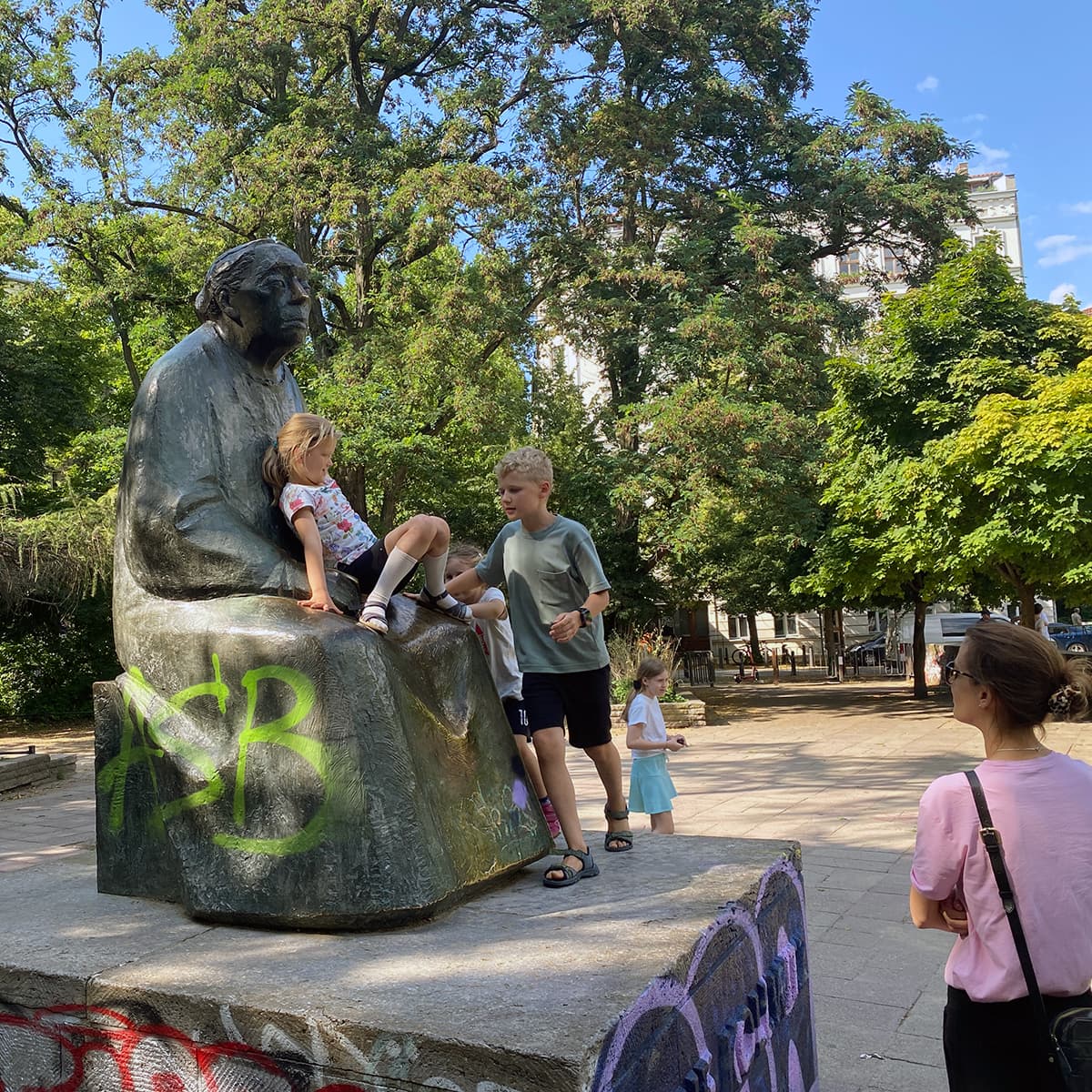
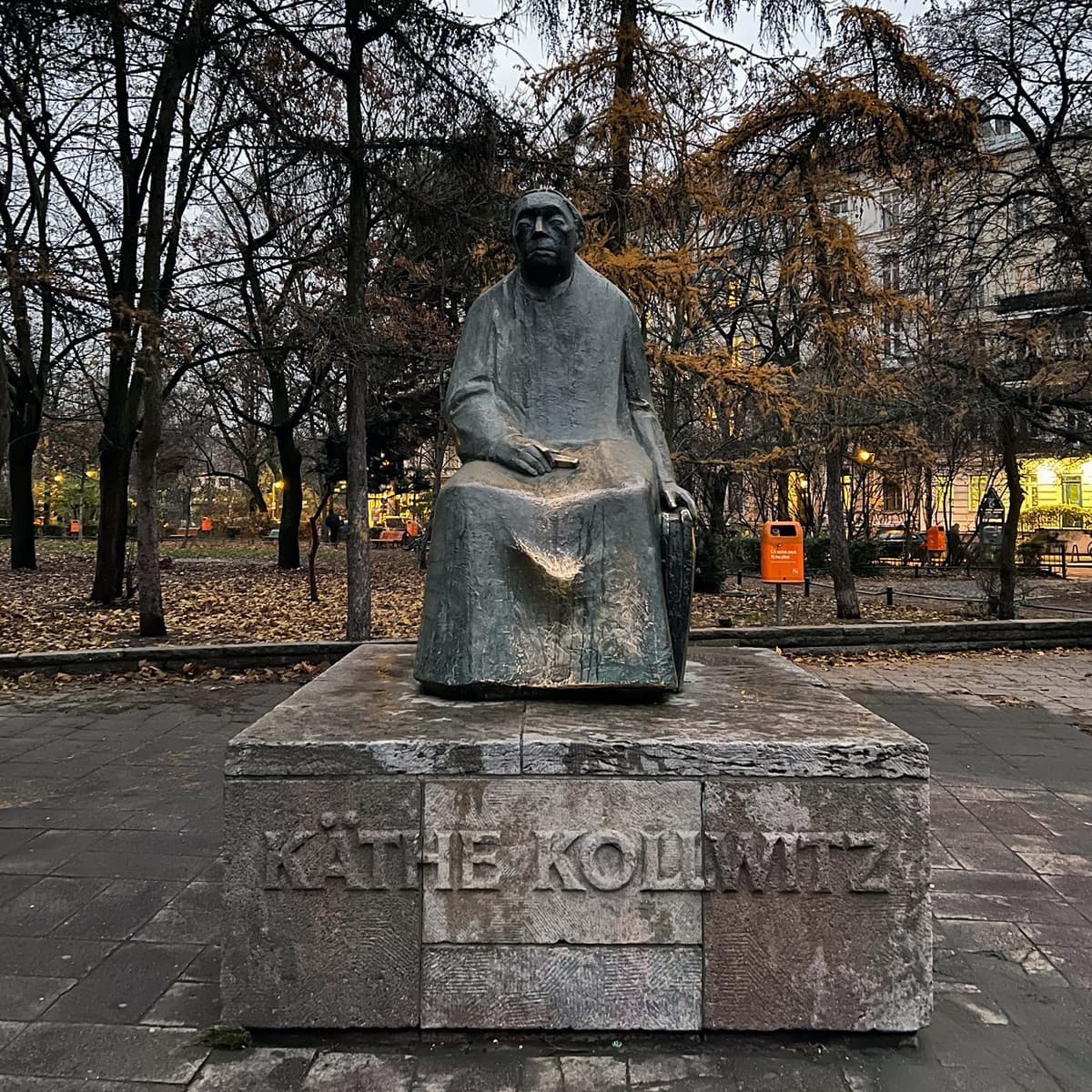
It's big and bronze, showing a seated woman. If you can't find it, look for the kiddie playground, the statues nearby. Now, take in the statue while Rick completes the story. In 1939, World War II broke out.
This time, Germany lost over 5 million men, and one of them was Käthe's grandson. Then, her husband, Carl, died. Then, the Allies started bombing Berlin. Käthe moved to the countryside.
Though Prenzlauenberg was not as severely bombed as other places in Berlin, one home was obliterated, Käthe and Carl's home on this square. Two years later, Käthe Kovitz herself died, just weeks before she could see the end of the war, that her art had foreshadowed. The statue seems to capture Käthe's perseverance through it all. She's so solid and monumental, gazing to the future, even amid all that was going on around her.
The statue was not made by her, but by another artist named Gustav Seitz. He patterned it after Käthe's style and her self-portraits. He even left the surface rough, reminiscent of Käthe's sketches and prints. The statue was commissioned after this, and the square was renamed in honor of its most famous resident.
By the way, one last note. There's an excellent museum on Kovitz and her work at Charlottenburg Palace. Because Prenzlauer Berg's elegant buildings were largely spared during the war, it's still a desirable place to live. Okay, let's move on and see more of this so livable corner of Berlin.
So, face the Käthe Kovitz statue and head to the right. Start making your way out of the park. As you do, you'll likely pass happy, well-dressed people, like mothers with their kids at the playground. This area is very trendy now, almost laughably so.
In fact, a popular satirical cartoon strip called The Mothers of Kovitz Plot slampoons this Käthe's dapperly-diapered toddlers and latte-sipping parents. Keep going till you reach the exit of the park. Yes, but if there's a dog nearby, remember to take the time to stop and pet it. But always ask first.
Vörfich? Vörfich? Exit the park, cross Wurther Street. This street hosts a nice market a couple days of the week, and it's worth a look if it's on.
After crossing Wurther Street, turn left. Go a few steps until you reach the head of a long, straight street. This is Husamonstrasse. HUSAMONSTRASSE
Husemannstrasse
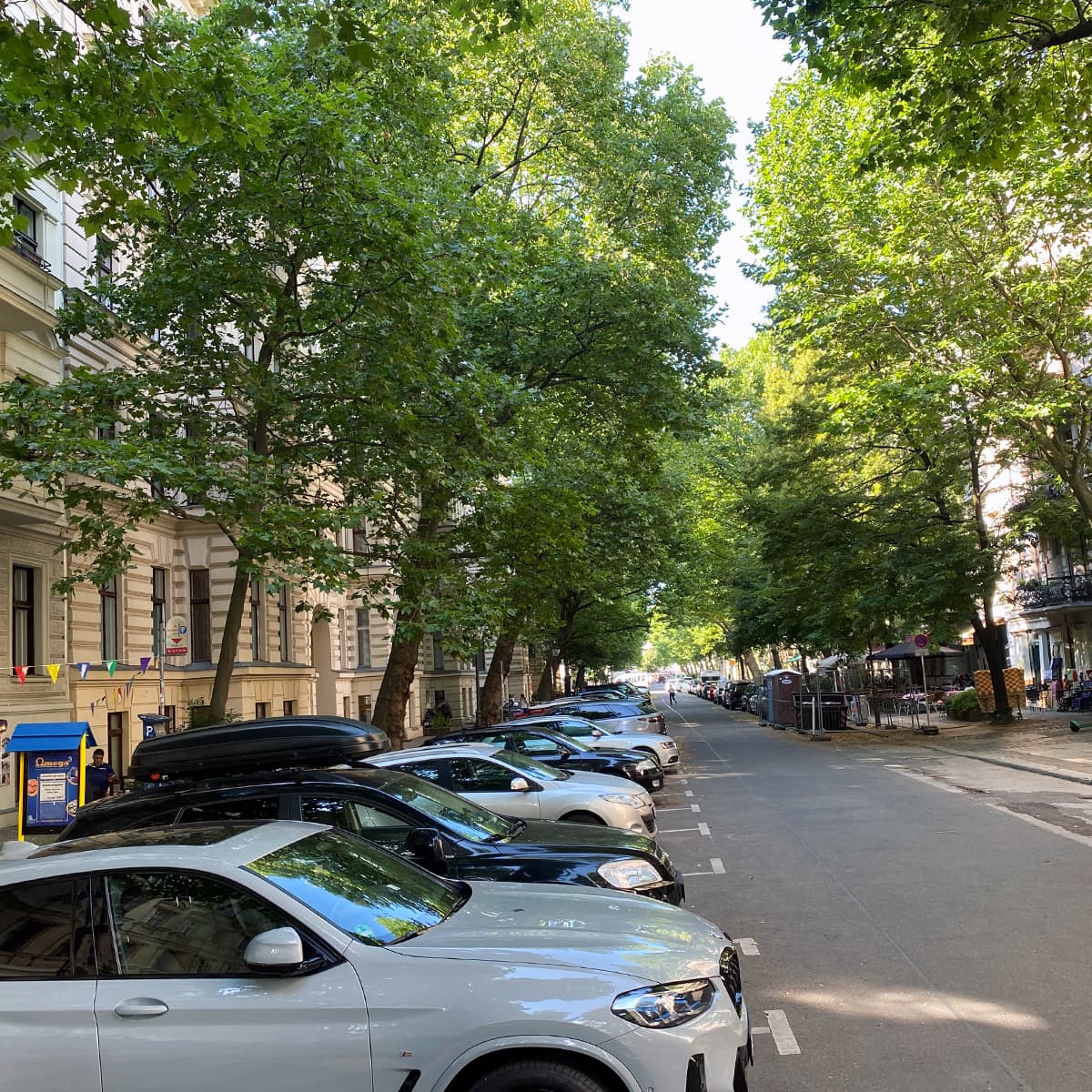
HUSAMONSTRASSE Start strolling down Husamonstrasse along the left-hand side. We're heading for No. 9. It's a pleasant street with less traffic and lots of interesting buildings.
As you walk, let your eyes roam, checking out some of the architectural details. Some buildings have nice balconies. Some have windows topped with ornamental arches. Some have windows topped with ornamental arches.
Read more...Show less
or pediments. Keep going until you reach No. 9 on the left. Many of these buildings are a century old or more.
They survived both World War II and the Wrecking Ball as the rest of Berlin modernized. Now these old buildings have been remodeled. Rents are sky-high, even for a small apartment, if you can even find one. You definitely have to be upwardly mobile.
Like those mothers-of-Kohlwitz plots. Exactly. Stop when you reach No. 9, which is especially nice.
Enjoy the fine little details, starting with the sturdy stones on the ground floor. Check out the two narrow doorways topped with arches and decorative heads. In front of the building, along the street, is a green post. This is an old wellhead.
It dates from before 1930, when this was where residents got their water. Back then, there was no indoor plumbing in working-class apartments and toilets were shared. The wellhead here is hand-powered, and it still works in an emergency. Let's give it a try.
Yep, it still works. Nice! The layout of No. 9 is typical of Prenzlauer Berg homes.
The ground floor was generally for shops and workshops. In fact, No. 9 still houses a few small businesses located in the courtyard in the back. We'll get to see one of these courtyards a little later.
A courtyard teaser. Nice. Now check out the building. Notice that the first floor up has slightly bigger windows.
This means the floor has higher ceilings. It's the most desirable and expensive floor, the so-called Belle Etage. The windows in the upper floors are smaller. These were for servants with the lowest ceilings and the most stairs.
Let's move on. Go another 30 yards down the street to No. 13, where we'll see the next layer of Prenzlauer Berg history. Remember, after World War II, the area became part of East Berlin under the control of the communist regime known as the DDR.
A few elements from that time remain. Stop when you reach No. 13. It's another similar building dating from the early 1900s, but with a few more modern details.
Above the door, note the flagpole holder. This dates from the DDR years, roughly from the 1950s to the 1980s. Under the communists, you were required to fly the DDR flag for holidays, like Workers' Day on the 1st of May. This home kept their flagpole and now, they can fly whatever flag they want.
Also notice the tiny keybox with a keypad to punch in the code. This is a sure sign that this place is used as an Airbnb or short-term rental apartment. Locals see that as the latest threat to the neighborhood. As in so many charming neighborhoods these days, the influx of short-term renters is driving up rents.
That drives away locals, which changes the economy from cozy homes and characterizing characteristic shops serving the locals to touristy businesses, ultimately killing the neighborhood. Let's continue down Husamonstrasse to a round, old-fashioned-looking advertising column at the end of the block. As you go, consider how quickly this neighborhood has changed. Not long ago, Prinzlauer Berg was a bohemian paradise where creative free spirits could afford to live dirt cheap in dilapidated old buildings.
Now the buildings are refurbished and Kohlwitz Kiez is gentrified and really pricey. The very artists who made the neighborhood so interesting have been driven out to the suburbs. Berliners, who are very conscious of class divisions, are resentful of this new wave of wealthy people driving them out. Those darn Mothers of Kohlwitz plots again.
It makes some locals nostalgic for an earlier time. They even get wistful over what was otherwise a dreadful era, the years under the communist DDR. Speaking of which, when you reach the intersection with the round advertising column, check out the street signs. They sit atop slender ironwork posts.
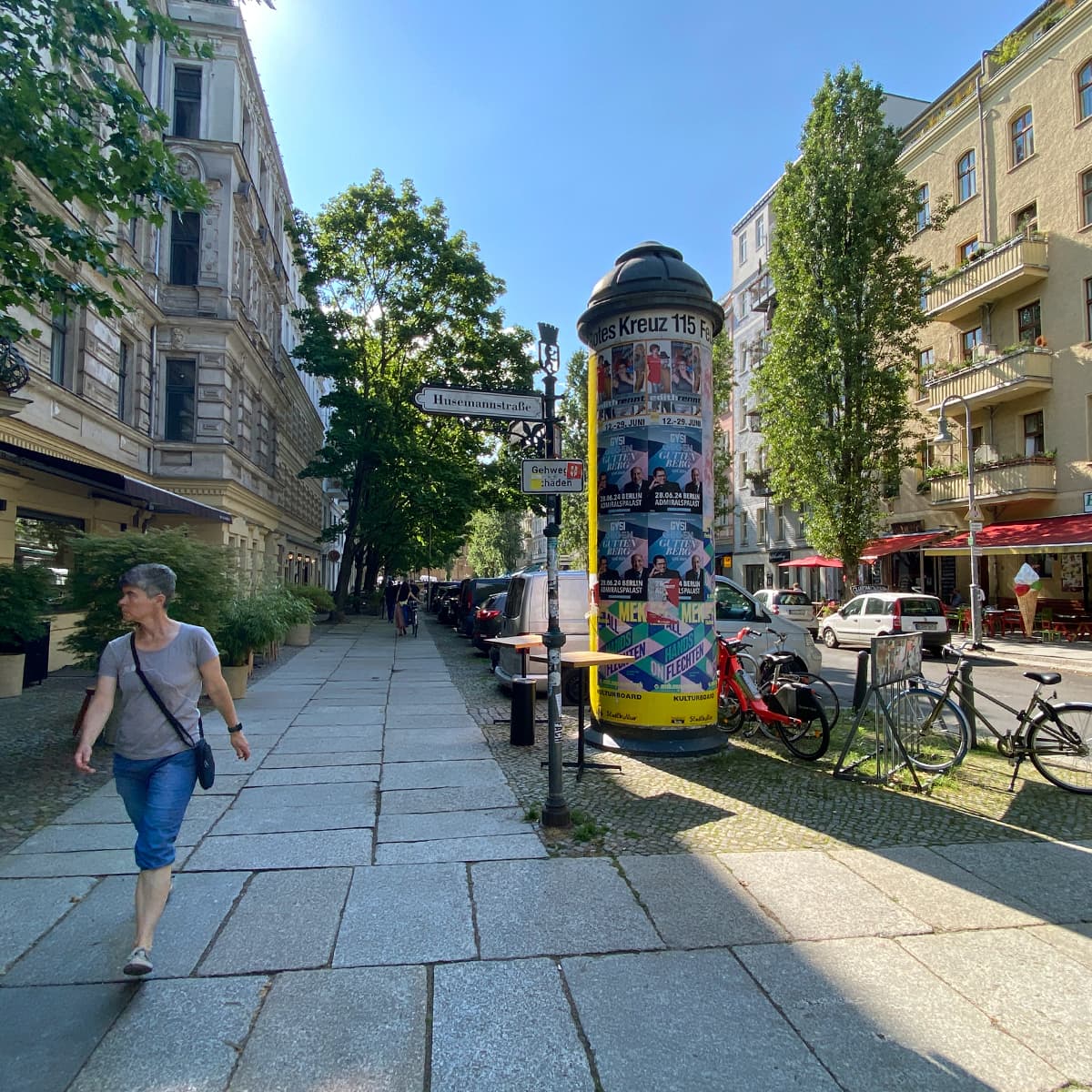
These old-time street signs actually date from the DDR era. In 1987, both East and West Berlin celebrated Berlin's 750th birthday. The DDR government had this street spruced up, complete with these signs topped with the symbol of the city, the Berlin Bear. Now, turn your attention to the round advertising column These columns were invented here in Berlin.
People were tired of the disorderly and random postings on trees, doors, fences, and so on. So these columns provided a chance to make the display of public announcements more orderly and efficient. Very German. Jawohl.
So in 1855, about a hundred of these advertising columns went up all over Berlin and the idea spread throughout Germany. Give this one a closer look. Circling the top are the emergency telephone numbers for police, fire department, and Red Cross. Check out some of the posters for various concerts and artistic events.
It's likely that some of them are for venues at a place called the Kulturbrauerei. That's the place we're headed next. From the intersection, turn left and start walking down Schroedtskistrasse. We're heading toward the big, yellow, castle-like building once a brewery and smokestack in the distance. Schroedtskistrasse.
Sredzkistrasse
At this point in our walk, we're in a new phase of Prenzlauer Berg's history. It's years under communism. So, as we make our way to the big, brick brewery building, let's first recap some of the changes that Prenzlauer Berg went through. First, in the early 1800s, it was just a forested hill with a few windmills.
Then, as we make our way after Germany united in 1871, Berlin expanded and working-class people poured in. Apartment buildings sprouted like dandelions built in that Wilhelmine style. By the way, keep going toward the castle with the smokestack. The street we're on is a little more working-class than some of the elegant streets we've seen already.
Read more...Show less
It's a reminder of Prenzlauer Berg's roots. A century ago, people here lived in almost Dickensian conditions. With so many living in such close quarters, fires were a big threat. That's why the buildings along this street, like all the buildings we've seen so far, were built with a uniform height.
Notice that they rarely exceed 70 feet. That's because that's as far as the fire department's ladders could reach. As Prenzlauer Berg grew more prosperous by the 1920s and 30s, many buildings got more upscale. Like the ones we just saw on Husamonstrasse or Kollwitzplatz.
Then, when world-class World War II hit, Prenzlauer Berg was largely spared and these nice buildings survived. However, after the war, while the democratic and capitalist West Berlin flourished, Prenzlauer Berg here in the communist East languished. The DDR was repressive and badly managed, squelching progress. And once stylish buildings simply decayed.
Yeah, cynical East Berliners would often joke, the DDR is really powerful. Even without weapons, they can create ruins. In fact, this street we're walking down became so run down, it was actually slated for total destruction. The plan was to rebuild it in modern style.
But because the DDR government was so inept in these kinds of things, the project never happened. Our next stop is one of those once-thriving businesses that suffered under communism. Fortunately, its building has been preserved and revived and is now one of Berlin's most vibrant centers of cutting-edge culture. It's a living symbol of Berlin's rise from division and stagnation.
You'll soon reach the big, light-brown castle-like building. This is a former brewery that's now called the Kulturbrauerei. Or Culture Brewery. It's a sprawling, city-block-sized complex of buildings that now houses cafes and art spaces.
When you reach it, keep going straight ahead toward the slender smokestack at the far end of the building. That's where you'll find the entrance. By the way, even if you're here after hours, the complex itself should be open. To enter the complex, go just a few steps past the smokestack.
There, you'll find a set of stairs on the right. Go up the stairs. So, again, past the smokestack and up the stairs. When you reach the top of the stairs, you'll see one of this complex's venues, the Kino, or cinema.
But we're continuing on. Keep going straight ahead toward an arched-out opening to the left of the Kino. Go through the archway and walk down the small passage. You'll soon spill out into an open-air courtyard. You're more or less at the center of the massive complex called the Kulturbrauei. © transcript Emily Beynon
Kulturbrauerei
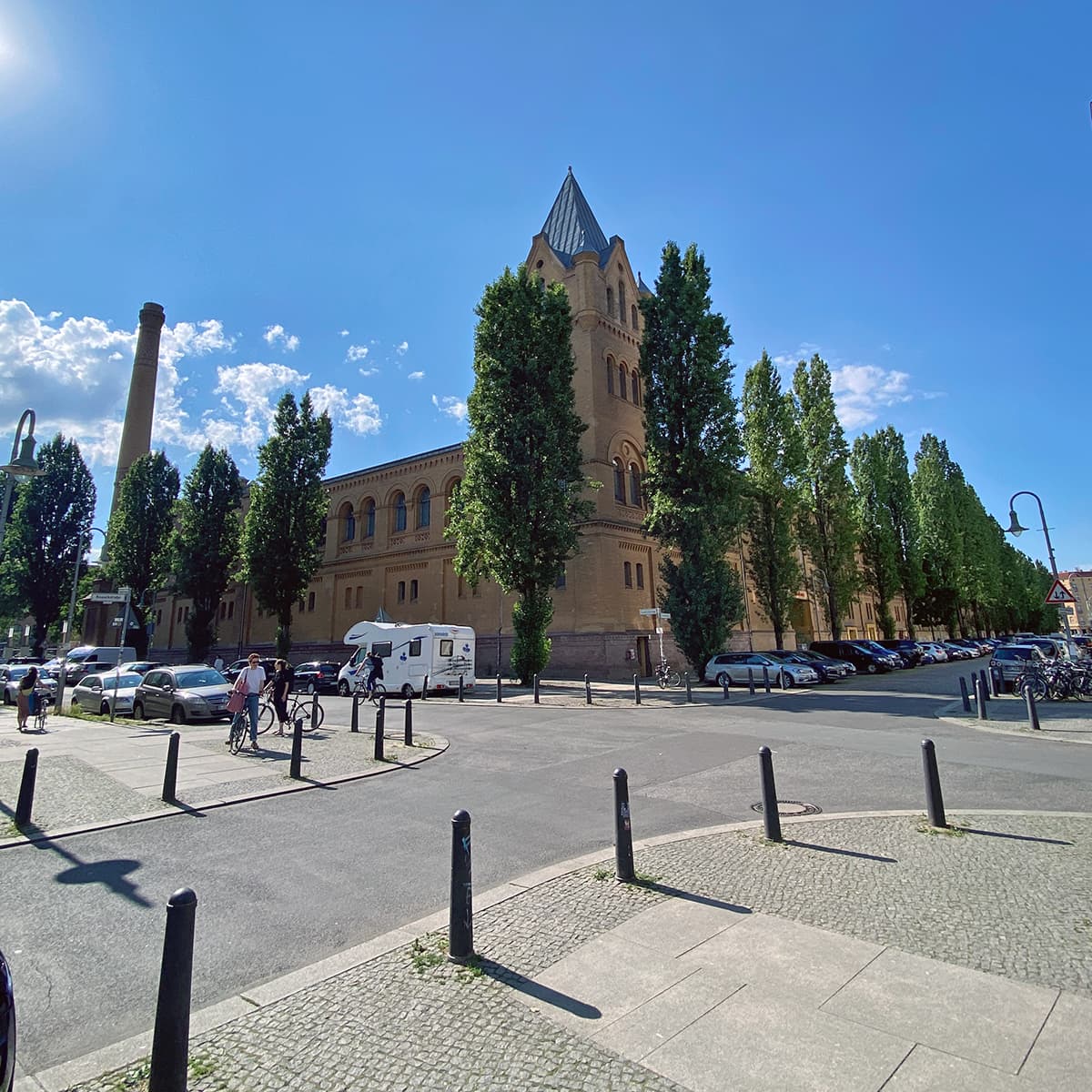
Kulturbrauei Looking around, it's not hard to see that this was once a big, industrial-sized brewery. The vast, cobblestone courtyard is surrounded by big, warehouse-looking buildings made of red and light-brown bricks. One building has a sign on it saying, Flaschenbierabteilung, namely, the beer-bottle department. Way back, when Prince Lauerberg was at Wooded Hill, there were dozens of breweries here, including this one.
They made a beer called Schulteis. When the railroad came, they could easily transport their barrels of beer on the nearby Nordbahn line. By the 1890s, this brewery was huge. The architect modeled it after German castles with their multiple courtyards and ornate brickwork.
Read more...Show less
A castle for beer lovers. I like it. By the 1920s, it was one of the largest breweries in the world, covering six acres. Let's explore.
Start walking to the far end, down the college cobbled road. When World War II hit, the Nazis confiscated the brewery and turned it into a factory for the army, or Wehrmacht. From beer to bombs. Not cool.
After the war, production resumed, but like so many businesses under communism, it struggled and finally closed. It was only saved from the wrecking ball by a public outcry. After the fall of the wall in 1989, the entire site was renovated. Now this complex, named for brewing up good culture, is a thriving venue for cafes, nightclubs, and the arts, a living symbol of Prince Lauerberg's revival.
Stop when you reach a theater on the left called Romba Zamba. This acclaimed company is known for its theatrical productions in German, performed by people with disabilities. But it's just one of many places in this complex. Berlin is on the vanguard of the global art scene.
Poke around, here you'll find art exhibits, film discos, poetry readings, open mics, plus lots of shops, cafes, restaurants. And if you need one, a free WC around back just beyond all the bicycles. It's all wrapped in a 19th century brick industrial shell with much of the original signage intact. On Sunday afternoons, there are food trucks here and in December, a popular Christmas market.
Let's keep going. Past Romba Zamba, Angle slightly to the right toward the passageway in the corner of the complex. By the way, the beer that used to be brewed here, Schulteis, is still made, though production has been moved east of here. Schulteis is best known for its classic Pilsner, which has been made by the Schulteis family since the 1800s.
Enter the passageway. This leads to the museum called Everyday Life in the DDR. The museum is free and interesting if you want to pause the audio. You'll get a fascinating look at East German lifestyles under communism.
There's propaganda posters, people's low-budget appliances, and consumer goods. Like the notorious Trabant car. Plus films that show the way things were. We'll be seeing more remnants from communist days later.
Many Berliners today remember that time with fondness. It's a nostalgia for the East, or Ost, that's been dubbed Ostalcha. But we're moving on. Keep going through the passageway until you leave the Kulturbrauerei complex and reach the sidewalk.
Turn left. Go about 30 yards up Knockstrasse to the busy cross street, Donzigerstrasse. When you reach Donzigerstrasse, turn left again. music music music music Donzigerstrasse.
Danziger Strasse
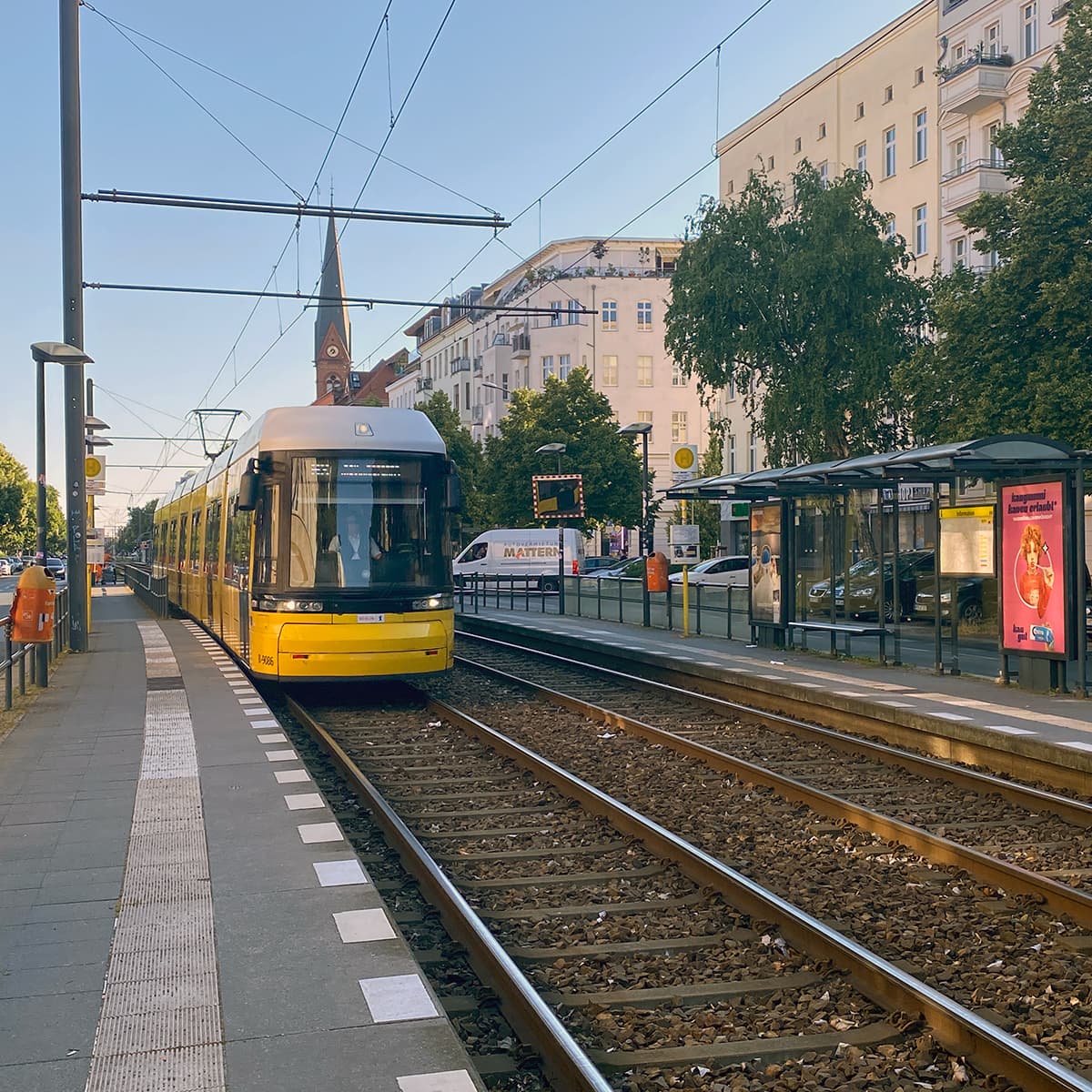
Head down Donzigerstrasse toward the Green Railroad Overpass. You're walking along a workaday street with workaday stores. Still, as one of Prenzlauer Berg's main thoroughfares, it has one of the neighborhood's most attractive features, the tram. Notice the tracks in the pavement and, up ahead, a tram stop.
In the 1920s, the entire city of Berlin was woven together by a massive tram network. But after the wall went up, Western Berlin modernized. Trams were considered old-fashioned and cars ruled, so they tore up their tram lines. But in stagnant and poverty-stricken East Berlin, they had no alternative but to keep their aging trams.
Read more...Show less
Ironically, today, the East is well-served by trams, while the West is spending a fortune to rebuild this now desirable form of public transit. Keep going until you reach the Green Railway Bridge. That's for the U-Bahn system, which is well-connected with Berlin's network of trams. Clearly, Berlin's city planners see a future favoring trams, bikes, the subway, and pedestrians.
The average Berliner is never more than 150 meters from a bus, tram, or train. For less than the cost to park a car, many locals have a pass that covers the entire public transit system. They can swing like Tarzan from vine to vine through their urban jungle. Parents here raise what they call free-range kids, children who roam the city with transit passes and grow up never needing to borrow the keys to the car.
Stop when you reach the bridge. Built in the early 1900s, it serves one of 70 U-Bahn stations that were built during that time of urban expansion that brought us Prenzlauer Berg. This iron-and-glass station still has some of its original, turn-of-the-century Art Nouveau features. Now, from the Green Bridge, glance to the left.
We're headed for a fast-food joint located directly under that bridge. Yep, there it is, about 20 yards away, like a little hut made of metal. The best way to get there is to first cross the street until you're directly under the bridge and then turn left. We'll meet you at our next stop, the fast-food stand under the bridge called Knoppke's Inn, or Knoppke's Imbiss. Knoppke's Imbiss.
Konnopke’s Imbiss
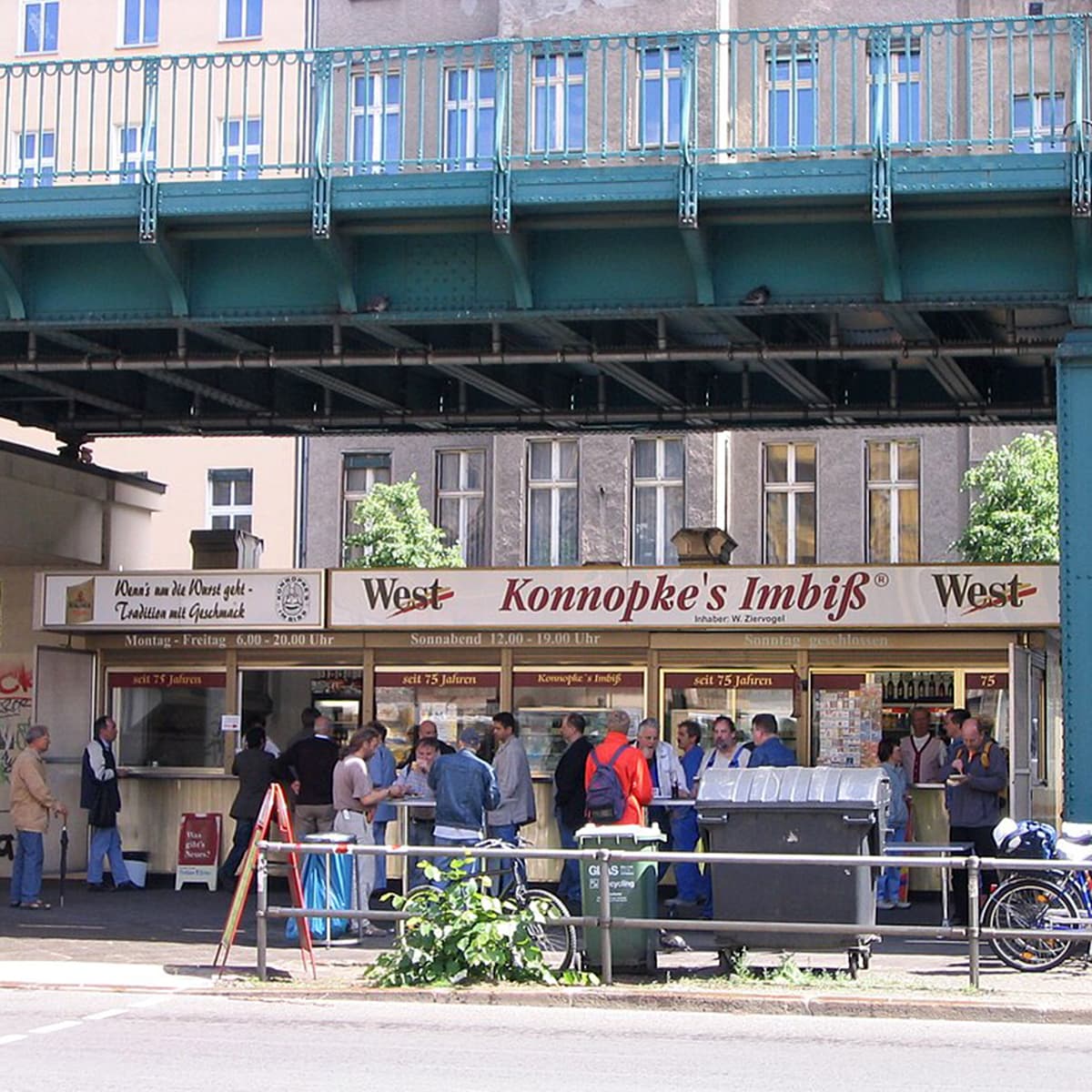
If you have yet to try Berlin's most famous dish, Currywurst, now is your chance. Currywurst is simply sausage smothered in curry ketchup. It's better than it sounds. Knoppke's is a local favorite, not just because they grill up a mean Currywurst, but also because of their long heritage.
Knoppke's has been around since 1930 when Max, the founder, set up a tiny stand right here. It's still run by Max's family. Knoppke's claims to have been the first-to-serve Berlin signature dish in East Berlin back in 1960. What makes their Currywurst special is their secret sauce.
Read more...Show less
Which... let me guess... is... a secret.
Knoppke's survived even through DDR times, a rare feat for a family-owned capitalist business. Back then, opportunities to eat out were rare, so people would enjoy gathering here, under the tracks, to munch on a sausage and meet up with friends. And it looks like they still do. In fact, in 2010, when the original stand had to be demolished for road work, Berliners practically rioted.
So Knoppke's was rebuilt, in this utilitarian glass and steel hut we see today. I'm starving. Let's order something. Check out their window display.
You'll see a variety of German meats. There's Knacker, Bockwurst, Bratwurst. These are all subtle variations on grilled sausages. Bisonwurst is...
ha, you guessed it! Bison. I had bison for breakfast, so I'll skip that. Bulette is a classic Berlin dish, basically a huge meatball.
Whatever meat you choose, it comes with fries. So then comes the big question. Mayo or ketchup? I see they even have a vegan currywurst.
Well, this is Prenzlauenberg, after all. Okay, let's order. I'll have the vegan with mayo. And I'll get the regular currywurst, mit ketchup.
All right, now that that's settled, let's get ready to move along on our tour. Our next site is a delightful shopping street just nearby. When you're ready, turn to the next track, and Lisa will take it from there. Kastanien Allee and Prater Biergarten.
Kastanienallee, Beer Garden
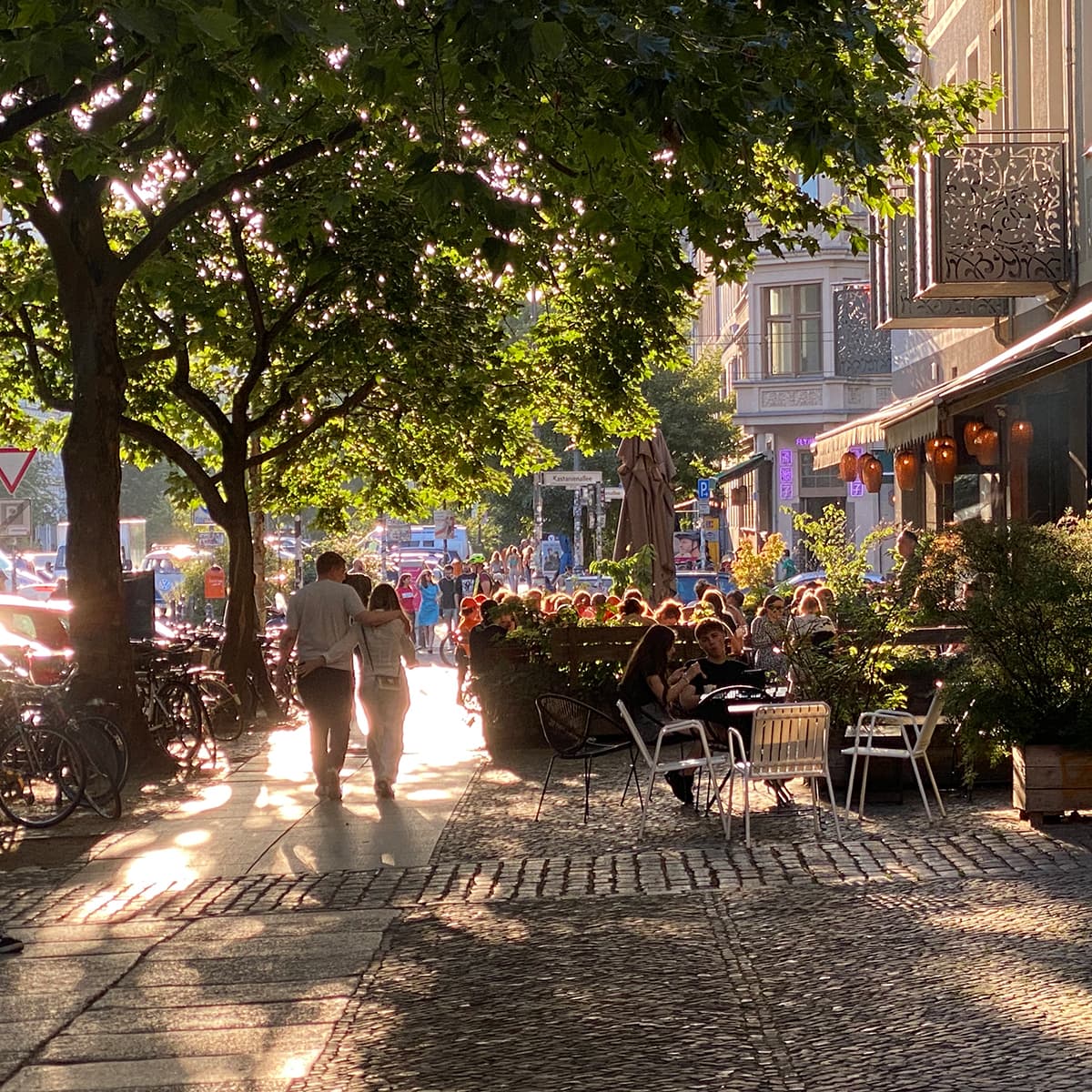
Our next stop is one of trendy Prenzlauer Berg's most trendy streets. With your back to Knopkes, we'll cross the busy street called Schoenhauser Allee, so take a few steps past Knopkes to the handy crosswalk. At the crosswalk, notice the jaunty stop-and-go lights for pedestrians. They still use the classic symbols from DDR days.
It's the beloved little man locals call the Ampelmenschen, or little traffic light guy. Make sure he turns from red to green before you cross. Once across Schoenhauser Allee, keep going ahead, angling a bit to the left. Go about 30 yards, until you reach the head of the street called Kastanien Allee.
Read more...Show less
It's the street with tram tracks in the pavement. As the name Kastanien suggests, it's lined with chestnut trees. Start making your way down the street, walking down the right-hand side. No need to hurry.
This delightful drag leads you through the trendy Greenwich village of today's Prenzlauer Berg. The street has a fun and lively variety of restaurants, shops, and residences. Locals have nicknamed Kastanien Allee Casting Allee. This is where Prenzlauer Berg's fashionable residents go to see and be seen, like movie stars.
You'll pass plenty of inviting eateries, dishing up a variety of cuisines. If you're tempted to stop for a bite, you can almost not go wrong anywhere along this stretch. Ugh, I'm still digesting that currywurst. Then, how about a beer?
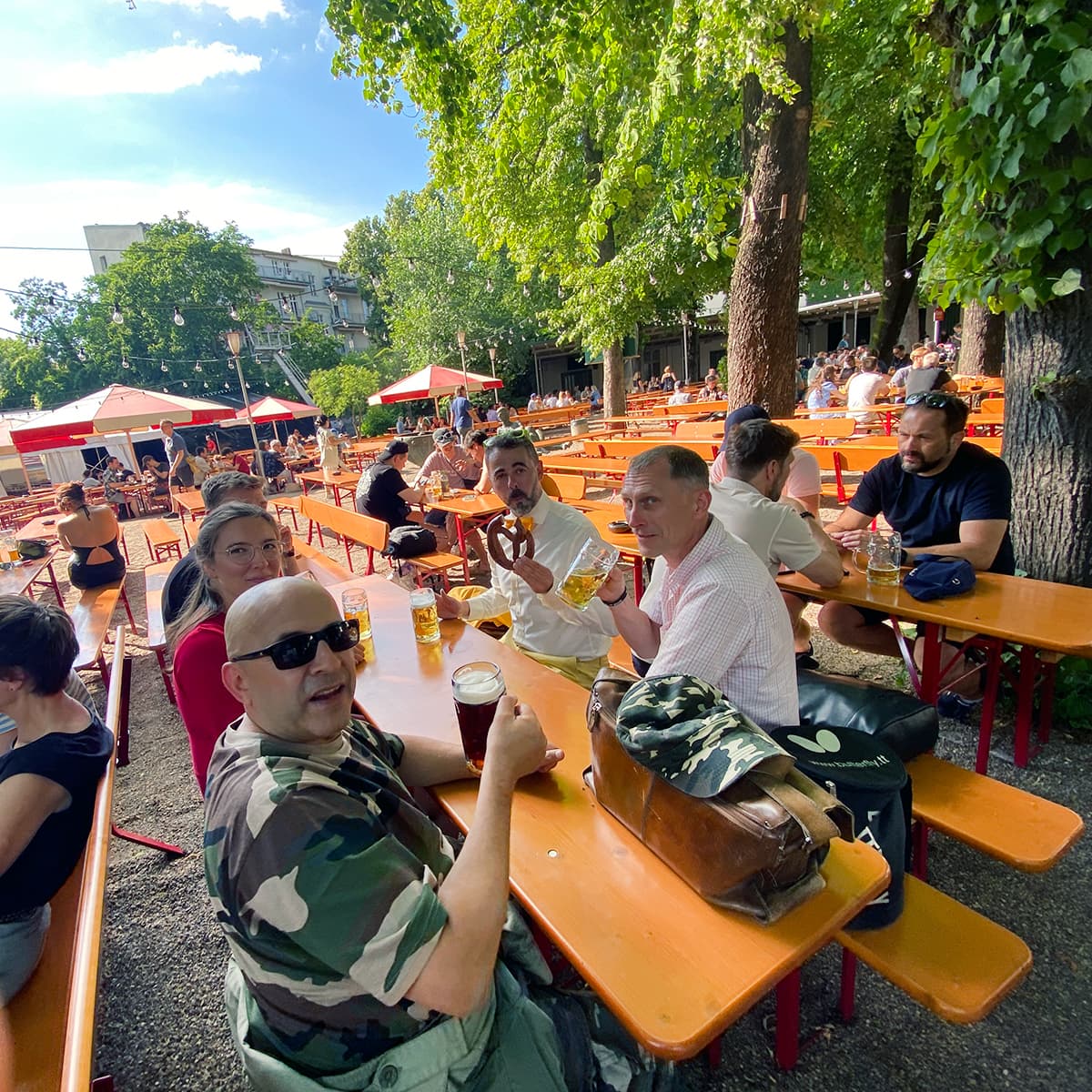
On the right-hand side of the street, you'll soon reach the entrance to the Prater Beer Garden. Even if you don't have a beer, even if you aren't in the mood for a beer, it's worth entering under the arch and checking out the scene. And there's a free toilet if you need one. All right, let's go.
Head in about 50 yards to the heart of the complex. Prater Beer Garden is Berlin's oldest and most famous beer garden. Its roots go all the way back to 1837. In Prenzlauer Berg's infancy, it was just a clearing in the forest, a place where workers, soldiers, and servants could escape their humdrum routine to drink, hang out, and fool around in the bushes.
In its day, Prater Beer Garden has weathered the bombings of World War II and the stagnation of the DDR period. Through all the upheavals, it's been a constant in the lives of generations of Berliners. Once inside, stop and survey the layout. You've got the restaurant to the left, the picnic table straight ahead.
All scattered amid plenty of venerable trees. And way at the front, the far end is a small stage for live entertainment. This is a great scene. You get the feeling that little has changed since it opened nearly 200 years ago.
Even today, it has a Bavarian level of conviviality that's somewhat rare here in a city where cozy beer gardens just are not a thing. Hey, Lisa, how about we pause the audio tour and grab a beer before the last stretch of our walk? I don't know. We probably shouldn't.
I know the magic words. Darfique. Ruff, ruff, ruff, ruff. Well, since you asked nicely, Ruff, ruff, ruff, ruff.
we'll get you a doggy beer. One of the beers on the menu is probably Berlin's most famous beer, Berliner Weiss. It's a cloudy, wheat-based beer that's been popular in these parts for about 400 years. These days, fewer Berliners drink the classic brew as craft beers have kind of taken over.
But many still enjoy the sour tang of a good Berliner. Berliner Weiss. Because of the tartness, some like to add a little raspberry syrup to it. Sounds delightful on a summer day under the leafy trees.
And when you're ready, let's start backtracking to the street. As you make your way out, think of the long tradition of this beer garden. Prater Beer Garden is such a treasured landmark that when housing development swept through this area, the surrounding apartment blocks were actually built around the beer garden rather than disturb it. That's so prinsile.
It's remarkable that a place with so much tradition is still going strong with today's Berliners. It's still a popular place to gather, eat, drink, and socialize. To party like it's 1837. When you reach the exit, pass back underneath the arch and turn right. Then continue making your way down Castagnanalli on the right-hand side. To the Tuntenhaus.
To the Tuntenhaus
As we continue down Castagnanalli, we're headed to a site that symbolizes Prenzlauer Berg's fitful transition from DDR oppression to the vibrancy of today. Our destination is a couple hundred yards away, so if you're interested just keep going straight down Castagnanalli. Ironically, one reason Prenzlauer Berg is so charming and livable today is because of those difficult years under communist control. There was little modernization, almost no new construction.
The old turn-of-the-century charm was frozen in time, just waiting to be rediscovered. As you continue up Castagnanalli, you'll pass through a wide intersection at the cross street called Oderbergstraße. Take note, because we'll return here in just a bit. But for now, just keep going straight up perhaps the most colorful stretch of Castagnanalli.
Read more...Show less
Walk to number 24. Berliners love this neighborhood for its old-time feel. It's become perfect for artsy types, like up-and-coming fashion designers who want to open their own shops. You'll likely see several clothing boutiques along this stretch.
In fact, major fashion houses, and scouts here to check out the latest trends from little-known designers then go back and add it to their own lines. Castagnanalli also has plenty of bookstores, stationery stores, art supplies, the kinds of things that appeal to the neighborhood's educated, artistic clientele. Prenzlauerberg's funky, artistic vibe dates from those crazy years of the 1980s and 90s, that is, the era just before and just after the wall came down. As the DDR decayed, this neighborhood was ruined.
It was run down and really cheap. Bohemians moved in. It became one of East Germany's centers of counterculture and resistance against that repressive regime. Then, in 1989, the Berlin Wall came down.
It was a joyous time, but chaotic as well. Many East Berliners packed up and left to create a new life in the West, leaving their apartments vacant. In the vacuum of power between governments, who could say exactly who owned what? Poor people would go door to door, find an apartment that was empty, move in, change locks, and it was theirs.
Squatters. Yes, squatting was huge in the early 1990s. Illegal, of course, but very common. And back in that wild and crazy time, one especially edgy group of squatters moved in along this street.
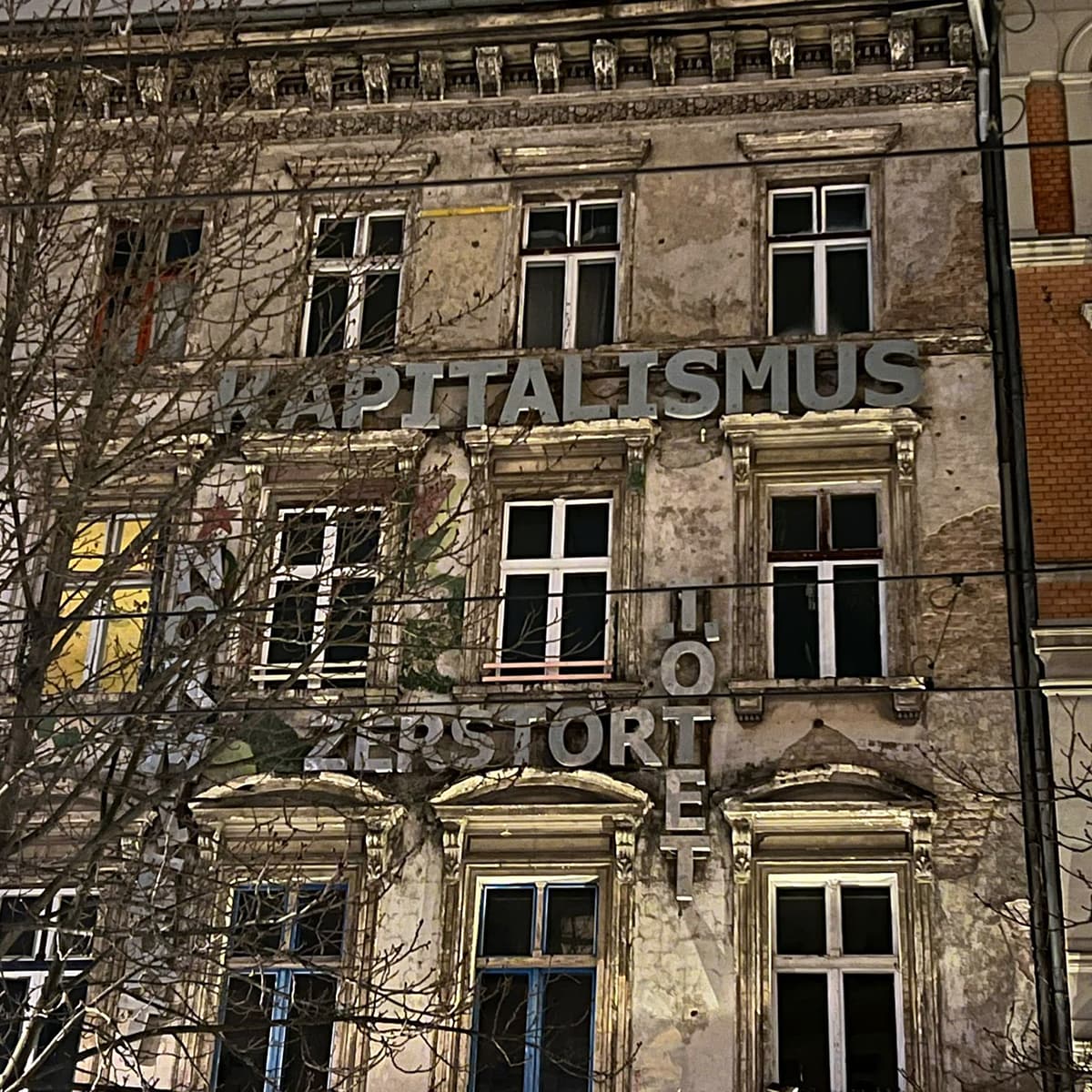
At number 24, look across to the left-hand side of the street for number 86, what's called the Toontown House. Stop here and take in its ramshackle exterior. Number 86 is called the Toontown House, usually translated as House of Queens. By the way, the Toontown House has long been threatened with closure, so if you find that number 86 is no longer the funky Toontown House Rick describes, well, it's lost its battle with big investors.
After the fall of the wall, a group of gay-friendly artists and activists took over this building, dug in, and refused to be evicted. It became a gathering place, not just for the queer community, but for all kinds of people from Berlin's underground counterculture. Yeah, check out the provocative message spelled out on the facade in big silver letters. It reads, What does that mean?
It means, capitalism standardizes, destroys, and kills. The whole neighborhood became a mecca for nonconformists of all types. For a year or two, it was anything goes. Bohemians flocked in from the West.
There were squatters, students, artists, anarchists, tree-huggers, skinheads. Alternative lifestyle idealists formed communes. They opened up soup kitchens to serve the poor, which was pretty much everybody. It was a time of protests, poetry slams, punk bands, and all-night street parties.
Together, they remade the neighborhood in their own edgy image. The Tontenhaus is a rare surviving symbol of that wild time. These days, it's occupied legally, but it still maintains its creative and collective vibe. And it's a pilgrimage spot for the global gay community.
Next door is Café Morgenroth, or the Red Dawn Café. The café is operated by the same Tontenhaus artists collective, They serve vegan goodies, coffee, and cocktails. They also host book readings with a political bent and punk concerts in the cellar. Let's get a closer look at what life must have been like back then.
Our next stop is directly across the street from Café Morgenroth. Find the arch at number 24. At number 24, you'll see a passageway where you can walk into this building's courtyard. Enter the white stone arch passageway.
and walk in, heading deep into the back of the building. But remember, people live here. Okay. You'll soon reach a courtyard.
From Prenzlauer Berg's earliest days, courtyards like this were the norm. While the apartments themselves were tight, this high-density housing was broken up by a series of courtyards. They served as a pleasant break from your stuffy apartment, providing a quiet spot off the street and a place to socialize with your neighbors. In the wild, 1990s, courtyards like this were gathering places where artists, musicians, and rabble-rousers could party the night away.
Most buildings still have their courtyards, and that's thanks to those squatting radicals of the 1980s and 90s. Whenever developers wanted to tear down the old buildings and put up ugly modern ones, the locals refused. To demonstrate their ownership, they'd stake their claim by planting grass and gardens in their courtyards. Urban gardening before it was hip.
Literally a grassroots movement. The way they saw it, they were just reclaiming the land their former communist government had told them was theirs anyway. And their resistance helped preserve the Prenzlauer Berg charm that we enjoy today. Let's head back out to the street to continue the last stretch of our walk.
Once you reach the street, turn left. Start walking back up Castanien Allee, about 100 yards to that intersection we passed through earlier. As you walk as you backtrack up today's trendy Castanien Allee, it's clear that the fall of the Berlin Wall was a watershed moment that changed this neighborhood forever. For a decade, Prenzlauer Berg was a shambles.
Few buildings even had heat. People hauled coal to heat and cook. They shared a toilet down the hall. You waited in line to use the corner payphone.
Keep going till you reach the intersection. Prenzlauer Berg's gentrification was gradual. Over time, squatters were allowed to make things legal by agreeing to pay rent. For a while, rent control policies kept the neighborhood affordable while demoralizing landlords.
But gradually, the once run-down squats became high-rent apartments. The radicals from the 1990s grew up. They got real jobs and had babies. Soon, the neighborhood had fewer edgy clubs and more daycare centers.
By now, you should be approaching the intersection with Oderberger Strasse. You know, Rick, all in all, you could say that squatting was an essential component in the city's recovery. Yes. It's one of those so-called social ills, like graffiti, that contributes to this city's unique personality. When you reach the intersection, turn left and start heading down Oderberger Strasse. Oderberger Strasse Oderberger Strasse.
Oderberger Strasse
We're on the final stretch of our walk where we'll see the Prenzlauer Berg of today in all its glory, completely gentrified. Strolling down this street, so upscale and ultra-livable, serves as a nice bookend for our walk through this ultra-livable neighborhood. This unusually wide and inviting street is a favorite of Prenzlauer Berg locals. The apartments are nice, and much prized.
Many have balconies, windows topped with classy pediments, and warm-toned colors. Locals come here to shop for fashionable clothes and trendy furniture for their apartments. There's vintage and second-hand stores to turn something old into something in vogue. Friends meet friends for a convivial meal with a variety of choices, from Asian to falafel to Mexican.
Read more...Show less
Keep going a long block down as we make our way to a bar on the left at number 44. The world of today sits amid reminders of yesterday. It has the elegant apartments of the Wilhelmine era. The wide street suggests that back in the 19th century industrial heyday, this was a main artery.
From here, goods could be efficiently transported on the Nordbahn train line, which is just ahead. A little further down this street, you'll pass by Berlin's oldest fire station, built in 1883 and still serving the community. There are also reminders of World War II and the years under communism. Yes, but first, waffles.
Yes, first things first. Keep going to a café that's popular with locals. It's on the left at number 44. It's a ramshackle bar called Kaufdich Glücklich.
The name means shop yourself happy. Well, I just might. Darf eek? Woof, woof, woof, woof, waffles.
Of course you can, Lisa. You've earned a little treat. Woof, woof, woof, woof, woof. This place is much loved for its tasty waffles, crepes, and ice cream.
But our walk ends just a long block from here, so let's keep moving. You can easily come back afterward. Okay. Let's carry on.
From the waffle place, look directly across the street. Notice the big gap between the buildings on the other side of the street. That's a clear sign that a bomb hit here. Remember, during World War II, Prenzlauer Berg was largely spared, but not completely.
Late in the war, a bomb struck an engineering factory right here and left this hole. By the way, this gap leads to an historic courtyard, the Hirschhof, or deer courtyard. It's now a community park where kids play under the gaze of a graffiti deer and amid a few pieces of rubble from World War II. You could pause and check out the Hirschhof, but we're moving on.
Continue along Oderberger Straße, past more nice apartments, shops, and eateries. As we walk, we're headed directly toward what was once West Berlin. Think of it. If you were here in the 1980s, you'd be walking straight into a dead end.
The Berlin Wall. We're headed to where that wall once stood and where in 1989 it finally came down. This is a good time to recap what we've seen, the many layers of Prenzlauer Berg. From the neighborhood's early days, we've seen plenty of charming old buildings, a corner pub, and some water towers.
At the synagogue, we learned of the growing Nazi threat. At Katie Kollwitz's house, we considered the heartache of World War II. After the war, this neighborhood was isolated from the world under communist rule. That isolation only deepened in 1961 when the DDR built the notorious Berlin Wall.
After that, this street in particular got really run down. Yeah, who'd want to live on a dead-end street next to a wall manned by snipers? By the 1980s, the DDR was planning to tear the whole block down. But thanks to those grassroots movements, it was preserved just long enough for it to finally be saved and revitalized.
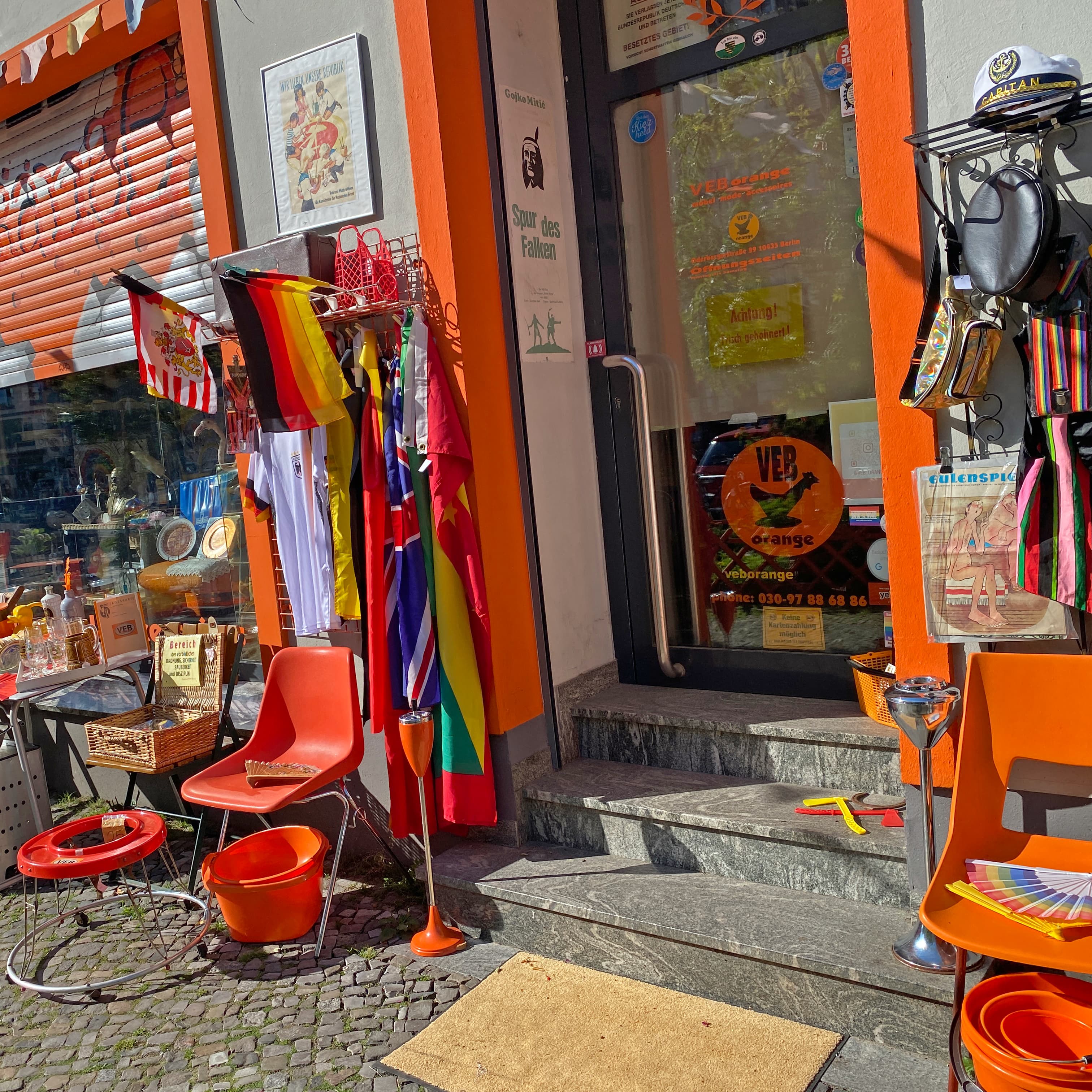
Thankfully, the DDR is now gone. Gone, but not forgotten. Find a store on the right-hand side at number 29 called V.E.B. Orange.
It's a place where the DDR lives on in a quirky way. It's worth crossing the street and popping into V.E.B. Orange. This vintage thrift store has three entertaining rooms just jammed with DDR-era memorabilia.
If it's cheaply made of brightly colored plastic, you'll find it here. East Germany developed its own lifestyle quite different from the West. These days, people here have nostalgia or ostalgia for that troubled but simpler time. Browsing around, you'll find lots of fun, kitschy objects.
You'll see little cups shaped like chickens for eating a hard-boiled egg. These were extremely popular under the DDR and have become a kind of icon of those times. Also, check out the record albums. Since Western rock music was banned as decadent, the DDR had its own pop stars.
You'll see there are politically approved mop-top pop stars, their Ersatz Beatles, and their knock-off Dylans. Today's locals embrace these old mementos as a way to bring Prenzlauer Berg's past into the present. And our walk is coming full circle, too. Step back outside V.E.B.
Orange, turn right, and keep going down the street. After a few steps, the street opens up into a wide plaza where several busy roads meet. This will be the last stop on our tour. Stand here and take in the scene. Former Berlin Wall,
Former Berlin Wall
Maurer Park, and Historic Photo At this big intersection, you're standing where a section of the Berlin Wall once stood. To picture it, fix your gaze straight ahead in the direction of the trees in Grassy Park. Gazing ahead, the Berlin Wall ran left to right. Along what is now Bernauerstrasse.
You're standing in what was the east. Just across the busy street, beyond the trees in Grassy Park, was the west and freedom. The Grassy Park was the no-man's land in between. Think of it.
Read more...Show less
If you were here in the 1980s, guards in watchtowers looked down on you, making sure there was no trouble and you weren't trying to cross. That grassy area is now a park. It's called Maurer Park or Wall Park. It was the so-called Death Strip, that area leading up to the Berlin Wall where East German border guards, armed with rifles, patrolled.
From 1961 to 1989, anyone stepping into this no-man's land would be shot dead. Maurer Park is worth a visit on your own after you finish this tour. Yes, it has one of Berlin's best surviving stretches of the wall. Nowadays, that piece of wall has become an 800-yard-long canvas for graffiti and street artists.
The vast park really comes alive on weekends with concerts and a Sunday flea market. It's a place where Berliners can literally dance on the grave of the wall that once divided their city. By the way, Rick, to learn more of the Berlin Wall, you could visit the Berlin Wall Memorial, which begins about a mile from here. To get there, catch tram number M10 heading left to the Nordbahnhof stop.
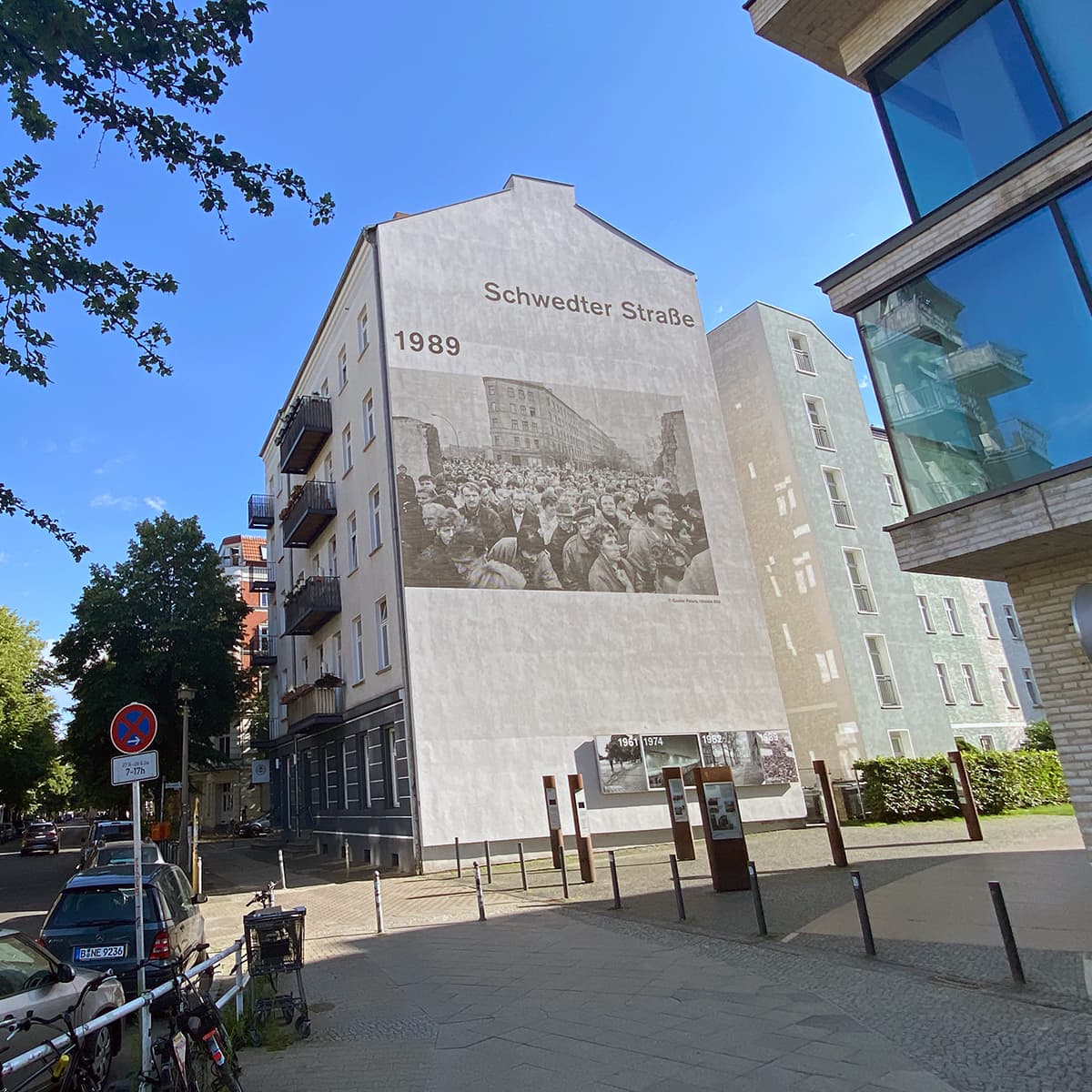
But for now, let's end our walk. Let's see one last reminder of the dramatic moment that figures so strongly in the history of this neighborhood. Facing Mauer Park, turn 90 degrees to the left and walk onto a little square. Walk further to the left heading for the big black-and-white photograph on the side of a building.
It's at Schwedterstrasse number 224. You'll also see a few smaller photographs underneath that capture moments in the history of the wall. But the big photo is the star. The photo shows a crowd of people.
They're standing right where we are now. In fact, in the background, you can see the very street we're on and some of the same buildings. And the buildings in the photo are the ones to your left. The photo was taken during those chaotic and exciting days in November of 1989.
Crowds of East Berliners were gathered here demanding their freedom. And then it happened. The wall was breached. The crowd, looking very intense and serious, seizes the moment.
They push through that hole and step into West Berlin to reunite with long-lost friends and family. Finally, they were free. This is a great place to end this walk, to appreciate all the history that this neighborhood has lived through and how far freedom has taken it and us. We hope you've enjoyed our Prenzlauer Berg walk.
Thanks to Jean Openshaw and Cameron Hewitt, the co-authors of this tour. If you're up for more sightseeing, make sure you check out our Berlin City Walk. This tour was excerpted from the Rick Steves Berlin Guidebook, co-authored with Cameron Hewitt and Jean Openshaw. For more details on eating, sleeping, and sightseeing in Berlin and environs, refer to the latest edition of that guidebook.
For more free audio tours and podcasts, and for information about our guidebooks, TV shows, bus tours, and travel gear, visit our website at ricksteves.com. This tour was produced by Cedar House Audio Productions. Danke. Bye for now, and auf Wiedersehen. Ruff, ruff, ruff.
Free
GPS-guided walking tour
No account needed. Walk at your own pace.
Free
15 stops ·