22 stops
GPS-guided
35 min
Duration
Free
No tickets
About this tour
A 22-stop walking tour through the heart of Germany. Visit Rhine River and Castles, Km 528: Niederwald, Km 530: Ehrenfels, and Km 533: Rheinstein, Reichenstein — with narrated stories at every stop.
22 stops on this tour
Rhine River and Castles
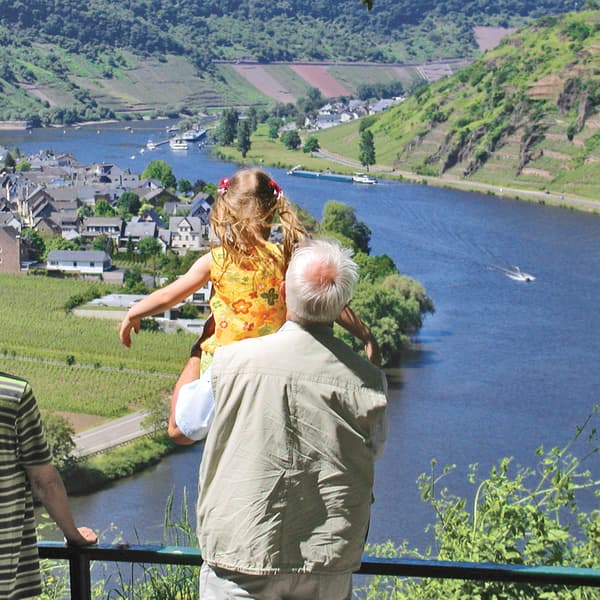
The Rhine River and its castles. Welcome to the Rhine. One of Europe's great thrills is zipping along the Rhine River on a fast train or gliding slowly on a boat. The Rhine Valley is storybook Germany, a fairytale world of medieval castles, vine-covered hills, rugged cliffs, half-timbered towns, and soul-stirring medieval legends.
Hi, I'm Rick Steves. Thanks for joining me on a trip through the Rhine Valley at its most romantic, the castle-studded stretch between Bingen and Koblenz. The Rhine is nearly 800 miles long. It starts as a trickle of melting snow high in the Swiss Alps, gathers strength, enters Germany at Basel, and continues north to Holland, where it joins other rivers before spilling into the North Sea.
Read more...Show less
From the beginning of history, the Rhine has been one of Europe's main north-south trade arterials. Many of its castles were built by medieval robber barons to collect tolls on passing ships. Of the Rhine's 800 miles, we're tackling just 36, the scenic, castle-studded Rhine Gorge. There's another castle about every few kilometers, each with its own history and legend.
For hands-on thrills, you can hop off this tour and climb through many of these castles on your own. My favorites are Rheinfels and Marksburg. This tour covers the stretch of river from Bingen to Koblenz. It can be done by train, by car, or boat.
And you can do it in either direction. Now, get ready for the castles of the Romantic Rhine. But a word of warning first. Be careful as you approach the cliff called the Lorelei.
Many a sloppy tourist has lost his or her way, falling under the spell of this alluring siren. More on her later. To help us along the way, I've invited a good friend and virtual travel buddy. Welcome, Lisa.
Guten Tag, Herr Steves. Lisa will give us helpful directions and sightseeing tips throughout the tour. And my first tip is to be sure you get our tour updates. Just press the icon at the lower right of your device.
You'll find any updates and helpful instructions unique to this tour. Things like closures, opening hours, and reservation requirements. There's also tips on how to use this audio tour and even the full printed script. Yes.
So pause for just a moment right now to review our updates and special tips. It's okay. We'll wait. And then... Let the tour begin. The tour begins.
Tour Begins: Boarding
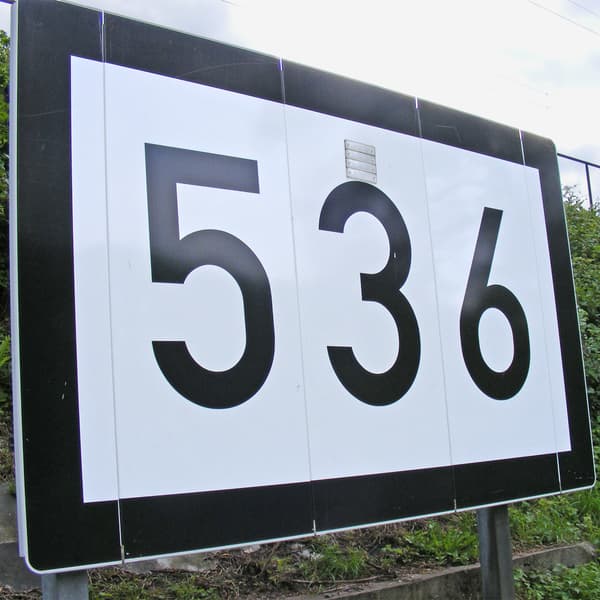
Boarding your transportation. The tour begins in the town of Bingen, where you'll travel north to Koblenz. Remember, this audio tour can work by train, car, or bus. It even works if you're going the opposite direction, heading south from Koblenz to Bingen.
Rick, talk us through the various transportation options. Well, first, remember that whether by train, car, or boat, the key is to use the kilometer markings posted on billboards all along the river. Each audio track is titled with those same kilometer numbers. As you travel, start each audio track as soon as you see that kilometer.
Read more...Show less
If you get out of sync, you can pause, fast forward, or rewind to the appropriate track and pick it up from there. The tour works best heading north, but you can also use it going south. Just play the audio tracks in reverse order, clicking backwards from one audio track to the previous one as you go. The easiest way to do this tour is by train, from Bingen to Koblenz.
The express departs hourly, takes 40 minutes, and makes no stops. The milk run takes longer and makes several stops along the way. This lets you hop off to tour a castle or sightsee a town when you like. Try getting a seat on the river side of your train, where the views are a little better.
But beware that by train, many sights on this tour will be a blur through the train window on this high-speed trip. By car, you have much more flexibility, stopping to tour castles along the way as you like. Drivers should take the road along the west bank. Again, it's a bit more scenic.
By the way, for cyclists, there's even a bike path along the west bank between Bingen and Koblenz. A Rhine boat cruise is the most popular and most relaxing way of all. But it is slow. From Bingen to Koblenz, that is, going downstream, it takes a full four hours.
Going upstream is nearly twice that, far too long for my taste. Consider doing just the hour or two stretch between Bacharach and St. Gore or Bopperd, which has the most castles, by boat, and doing the rest by train. Along our journey, I'll be pointing out sights either on the west bank or the east bank, so learn the basic directions.
The Rhine flows north. Before you board your train, board your transportation, and start this tour, serious students might enjoy listening to track number 16 and track number 19 in advance. These give a quick introduction to the Rhine, the castles, and today's commercial traffic. Now, get ready to enjoy your tour of the romantic Rhine.
Remember, follow the kilometer markings, keep an eye on the big picture, and don't stress if you don't see everything I mention. Okay, all aboard. Board your train, boat, or car, in Bingen. Head downstream and start the next track as soon as you see kilometer 528. Kilometer 528, the Niederwald Monument.
Km 528: Niederwald
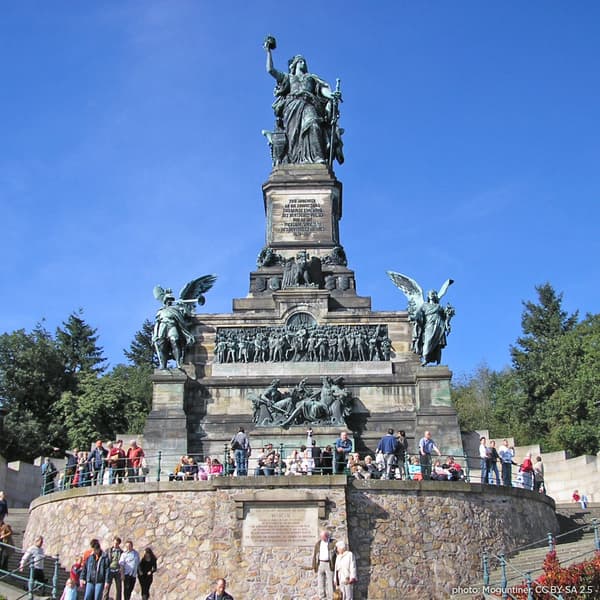
On the east bank of the Rhine, across from the Bingen train station, stands the hill-topping Niederwald Monument. It's 125 feet high, made of 32 tons of bronze, and topped with a tower. With a statue representing Germania. The monument was built in 1877 to commemorate the formation of the German Empire.
Remember, before 1870, the United Germany we know today didn't exist. In medieval times, Germany was a patchwork of literally hundreds of little German-speaking dukedoms, each with its own castle and ruler. The castles we see lining the Rhine today are a remnant of that fragmented medieval world. To visit the Niederwald Monument, you catch a lift from the nearby and extremely touristy town of Rüdesheim, famous for its wine. Kilometer 530, Ehrenfels Castle.
Km 530: Ehrenfels
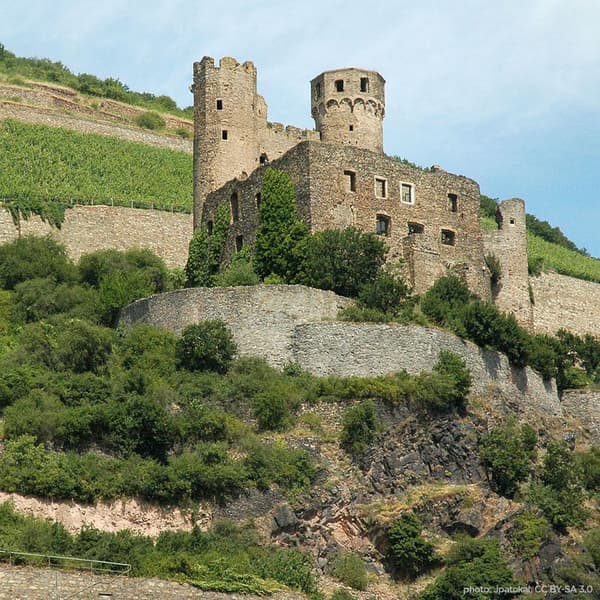
Also on the east bank is the ghostly Ehrenfels Castle. Its partner is the cute white and yellow castle on an island in the river near the Bingen train station. Ehrenfels Castle, like most castles along the Rhine, was built to collect tolls from passing river barges. But this one had no view of the river traffic to the north, so the owner built the cute little mausturm, or mouse tower, in the river.
Ehrenfels Castle was clobbered by the Swedes in 1636 and by the French in 1689. The mouse tower was rebuilt in the 1800s in neo-Gothic style. It's now used as a Rhine navigation signal station. Kilometer 533, Rheinstein and Reichenstein Castles.
Km 533: Rheinstein, Reichenstein
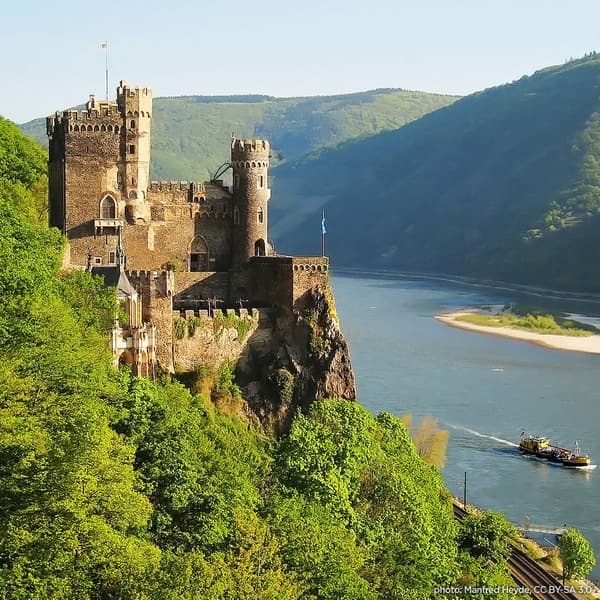
On the west bank stand two castles a kilometer apart. Rheinstein, at kilometer 533, seems to rule its chunk of the Rhine from a commanding position. While its 13th-century exterior looks as medieval as can be, this was among the first castles to be rebuilt in the Romantic 1800s. Remember, this was the time modern Germany was being formed.
Sprucing up ruined castles was a way of uniting the German people by celebrating their common medieval roots. This style is called Romantic, a fanciful castle that evoked images of chivalrous knights and lovely maidens. Both castles are now privately owned but open to the public. Rheinstein's interior is decorated with hunting trophies and armor, like a 19th-century duke's hunting palace. The castles are connected by a pleasant trail. Kilometer 538, Sunic Castle.
Km 538: Sooneck
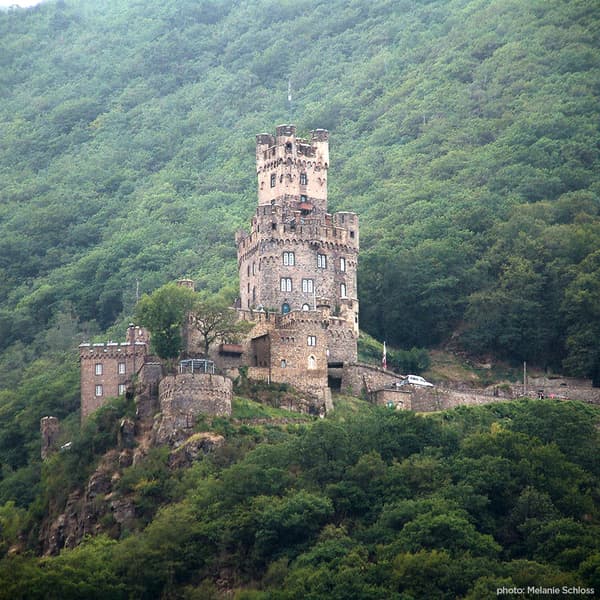
Also on the west bank, Sunic Castle rises like a proud beacon. Built in the 11th century, this castle was twice destroyed by people sick and tired of robber barons. It was leveled for good in 1689 by King Louis XIV of France. A rising French nation swept through the Rhine, destroying many of its castles as a preemptive move in case Germany challenged France in the future.
Many of the castles we see on this journey are at least partially rebuilt, having been destroyed in that disastrous French invasion. Kilometer 541, Lorch.
Km 541: Lorch
Kilometer 541, Lorch. Kilometer 541, Lorch. Look to the east bank. The pathetic stub of a castle near the town of Lorch is barely visible.
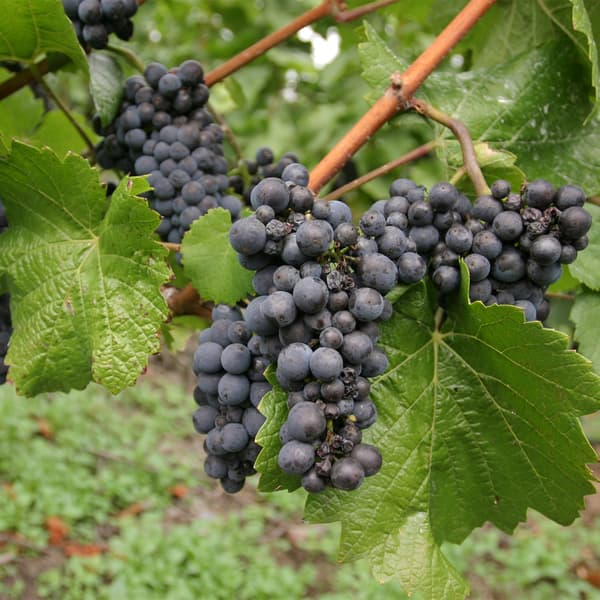
Notice also the small car ferry. There are no bridges between Mainz and Koblenz, so the ferry is how locals get across the river. Check out the hillside vineyards. The Rhine Valley produces some great white wines, particularly the wines known as Rieslings.
Read more...Show less
The ancient Romans planted the first vines here. They found that the steep folds of the Rhine Gorge held in both warmth and moisture, the slate soil absorbs the heat of the sun and stays warm all night, resulting in sweeter grapes. Wine from the flat fields above the Rhine Gorge is easier to produce and therefore cheaper, but it's only good as table wine. Wine from the steep hillsides of the Rhine Gorge, where grapes are harder to grow and harvest, is more expensive, but also tastier.
Because the Twisting Valley has so many microclimates, wine connoisseurs can often, even identify the subtle differences between a wine grown in one village from the next or from the West Bank to the East. Vineyards once covered four times as much land as they do today, but modern economics have driven most of them out of business. The vineyards that do survive require government subsidies. If you see metal rails running up the hillside, that's for transporting grapes during the harvest.
Km 543: Bacharach, Stahleck
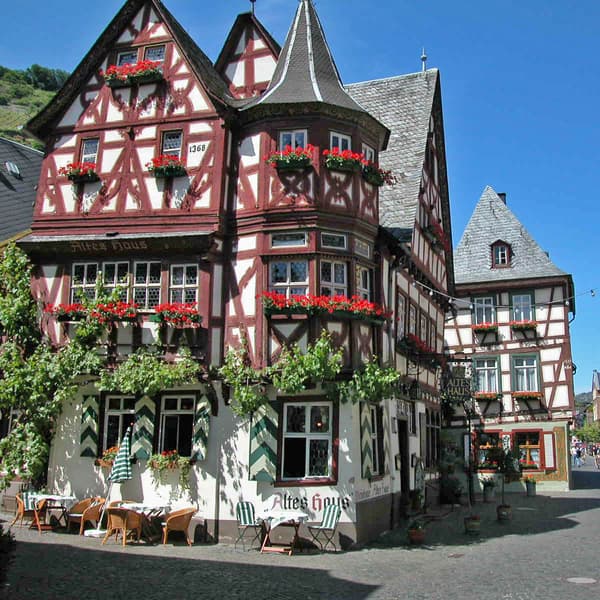
543, Bacharach and Stalek Castle. On the west side of the river is the half-timbered historic town of Bacharach, a great stop. In medieval times, this was an important town of 4,000 people. Stalek Castle was home to one of the seven electors who chose the Holy Roman Emperor.
This little town was even the capital of the empire briefly back in the 1200s. The castle is now a youth hostel, hosting 40,000 backpackers a year. Notice the... The south tower of the town wall.
Read more...Show less
This was originally a crane tower for unloading goods from river barges. Goods needed to be offloaded, then carried around a treacherous reef, and then reloaded nearby. Today, that reef is marked by buoys. For centuries, Bacharach has been famous for its wine.
Notice the big keg along the river. The name Bacharach likely derives from altar to Bacchus, the Roman god of wine. The medieval popes... Pope Pius II ordered Bacharach wine by the cartload.
Today, Bacharach draws lots of tourists for its time-capsule quaintness. You can visit the evocative ruins of a church on the hill, see a house dating from 1368, and walk the town walls. After Bacharach's medieval prosperity, it declined, falling victim to plagues, fires, and the Thirty Years' War of the 1600s. In the 1800s, romantic artists rediscovered it so well-preserved, it was nicknamed the Sleeping Beauty Town. They put it on the Grand Tour map as the jewel of the Romantic Rhine. Kilometer 546.
Km 546: Pfalz, Gutenfels
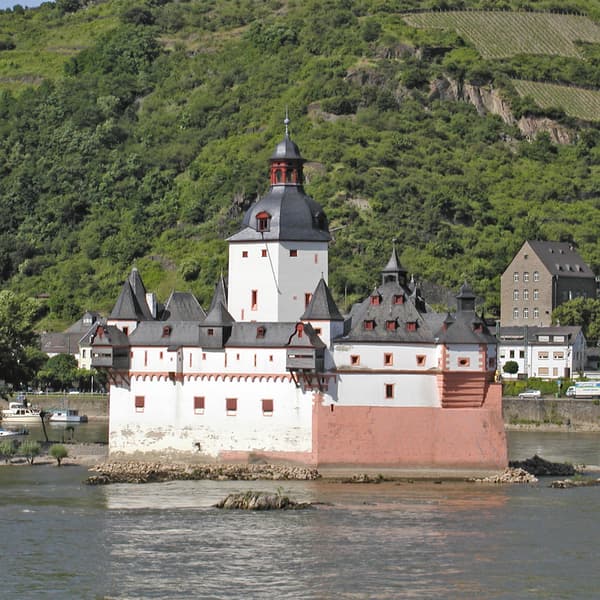
Falt's Castle and Gutenfels Castle. The ship-shaped Falt's Castle sits on an island in the Rhine, one of the classic Rhine views. Along with Burg Gutenfels on the east bank, they collected tolls from passing ships. If need be, the Falt's Castle stretched chains across the river to block the boats, only lowering them when the merchants paid up.
Those who didn't pay spent time touring the Falt's prison on a raft at the bottom of the castle well. Falt's was built in the 1300s. In 1504, a pope called for the destruction of Falt's, but the locals withstood a six-week siege, and the castle still stands. Notice the overhanging outhouse It's the tiny white room between the two wooden ones.
Read more...Show less
Falt's is tourable, but its interior is bare and dull. Burg Gutenfels, overlooking it from the hillside, is now a privately owned hotel. On the east bank, the town of Kaub grew rich from toll collecting. Find the green statue amid waving flags.
It's on the riverfront directly below the castle. The statue honors the German general Gebhard von Blucher. He was Napoleon's nemesis. In 1813, Napoleon swept through the Rhine with Blucher on his heels.
Blucher built a pontoon bridge, the first of its kind across the river here at Kaub. He crossed the Rhine and outflanked the French. Two years later, Blucher and Wellington would team up to defeat Napoleon at Waterloo. On the west bank, immediately opposite Kaub, look for the big, gaping hole in the mountainside.
It's near the ferry dock, which is marked by blue roadside flags. This hole is the last working slate mine on the Rhine. As you travel, notice the roofs on the houses. Rhineland Slate. On the west bank is the town of Oberwesel.
Km 550: Oberwesel
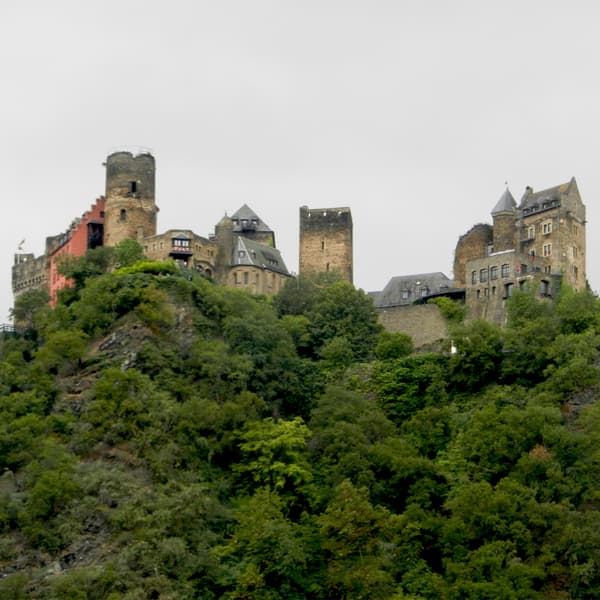
It was a Celtic town as far back as 400 B.C. Later, it was a Roman military station. It now boasts some of the best Roman-era walls on the Rhine, plus medieval-era towers. By the way, notice how many of the train tunnels have entrances designed like medieval turrets.
They were actually built in the Romantic 19th century. Overlooking the town of Oberwesel is the commanding Schoenberg Castle, now a posh hotel.
Km 552: The Seven Maidens
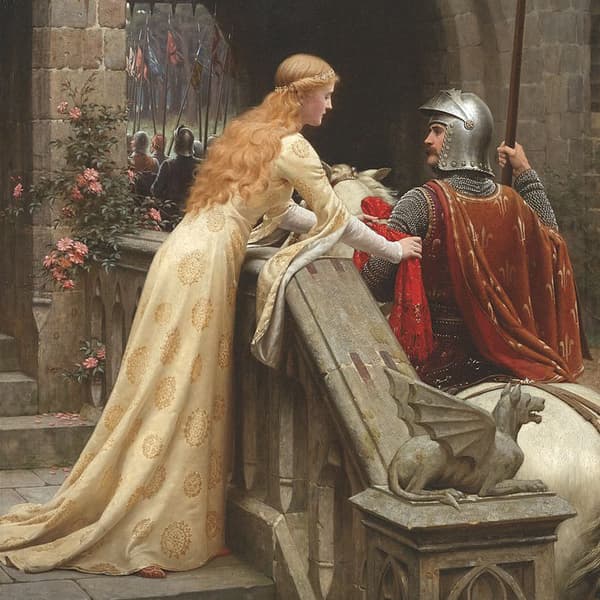
The buoys on the river mark a dangerous reef called the Seven Maidens. According to legend, the prince of Schoenberg Castle had seven spoiled daughters that he needed to marry off. He invited seven knights over one evening and demanded that his daughters choose a husband. But they complained that one was too fat, another had a big nose, and so on.
The rude girls, unimpressed by their suitors, tried to escape by boat. But God punished them by turning them into the seven rocks that form this reef. ♪♪ Kilometer 554, the Lorelei.
Km 554: Loreley
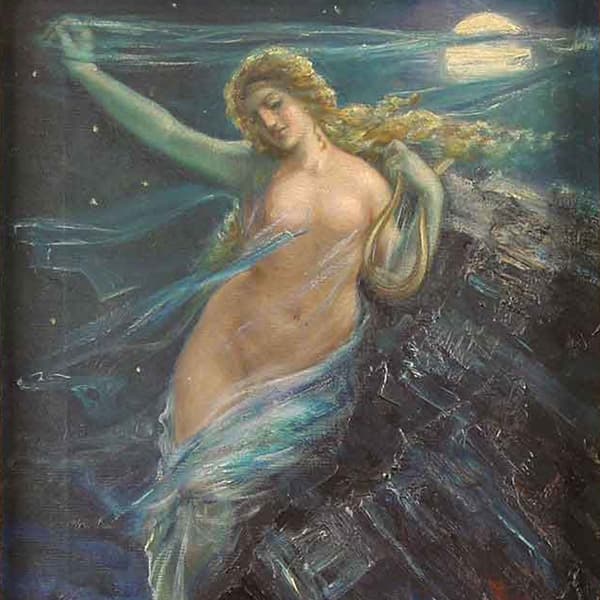
On the east bank is the Lorelei, a big cliff rising 450 feet over the narrowest and deepest point of the Rhine. On top are flags, a visitor's center, and a dramatic viewpoint. The rock has long been a notable point along the Rhine, in pre-Roman days, it was a holy site. In medieval times, this was the most treacherous spot on the river.
Because of the Seven Maidens' reefs just upstream and the sharp bend in the river, many ships crashed here. Sailors blamed their misfortune on a beautiful maiden with long, blonde hair who sang from atop the cliff. Her siren voice distracted the sailors, causing them to be dashed against the rocks. You'll see a statue of the Lorelei, near Kilometer 555.
Read more...Show less
She sits at the end of a long, man-made spit, combing her beautiful hair. Steep a big slate rock in centuries of legend, and eventually it becomes a tourist attraction, the ultimate rhinestone. The rock inspired the poet Heinrich Heine to write the Song of Lorelei. It tells of a sailor who was so enchanted by Lorelei's song that he crashed and drowned.
His father, ordered the nymph killed. As soldiers closed in on the nymph, she called for Father Rhein to help her out. Huge waves carried Lorelei to safety, and she's never been seen since. But alas, when the moon shines brightly, the wine flows, and the tour buses are parked, a soft song can still be heard from the Lorelei.
Listen carefully. Sailors, sailors, sailors, sailors, sailors, sailors, sailors, sailors, sailors, sailors, sailors, sailors, sailors, sailors, sailors, sailors, sailors, sailors, sailors, sailors, sailors, sailors, sailors, sailors, sailors, sailors, sailors, sailors, sailors, sailors, sailors, sailors, sailors, sailors, sailors, sailors, sailors, sailors, sailors, sailors, sailors, sailors, sailors, sailors,
Km 556: Katz
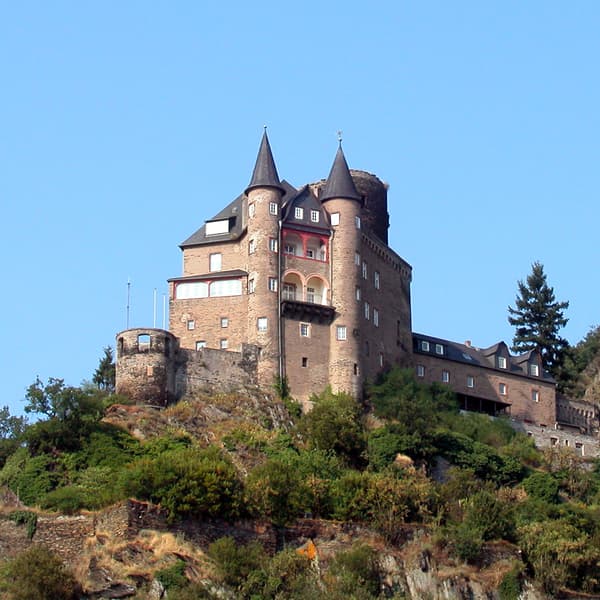
On the east bank stands Berg Katz from 1371. Together with Rheinfels Castle on the west bank, they had a clear view up and down the river, effectively controlling traffic, on this stretch of the Rhine. Remember, there was absolutely no duty-free shopping on the medieval Rhine. Berg Katz was destroyed by the French and rebuilt in about 1900.
In 1995, a wealthy and eccentric Japanese man bought the castle for about $4 million. His vision? To make the castle an exotic escape for his countrymen. But the locals wouldn't allow him to tamper with the historic building. So today, Berg Katz sits empty. The Japanese ghost castle of the Rhine. Kilometer 557.
Km 557: St. Goar, Rheinfels
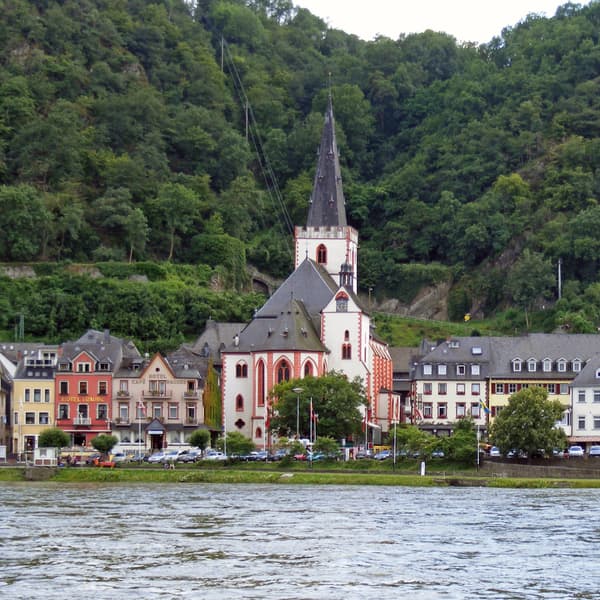
St. Gore and Rheinfels Castle. On the west bank is the pleasant town of St. Gore, overlooked by the mighty Rheinfels Castle.
St. Gore was named for a 6th century hometown monk. For more than 2,000 years, this was the place where sailors would stop, catch their breath, send a postcard home, and give thanks after surviving the seductive and treacherous nearby Lorelei. St.
Read more...Show less
Gore is the classic Rhine tourist town. There's a half-timbered shopping street perfect for buying a souvenir stein and a leafy riverside park, just right for strolling. Rheinfels Castle, once the mightiest on the Rhine, is the single best Rhineland ruin to explore. It's a 15-minute hike up to the castle.
Sitting like a child, like a dead pit bull above St. Gore, Rheinfels rumbles with ghosts from its hard-fought past. First built in 1245 to guard a toll station, it withstood many wars. In the 1520s, it was a thriving cultural center, hosting the artist Albrecht Dürer and the reformer Ulrich Zwingli.
By the 1600s, this castle had become the strongest and most modern fortress in the Holy Roman Empire. It withstood a siege of 28,000 French troops in 1692, but eventually the castle surrendered to the French without a fight. In 1797, the French Revolutionary Army destroyed it. Today, while thoroughly ruined, it offers your single most convenient and evocative castle experience on the river.
Km 559: Maus
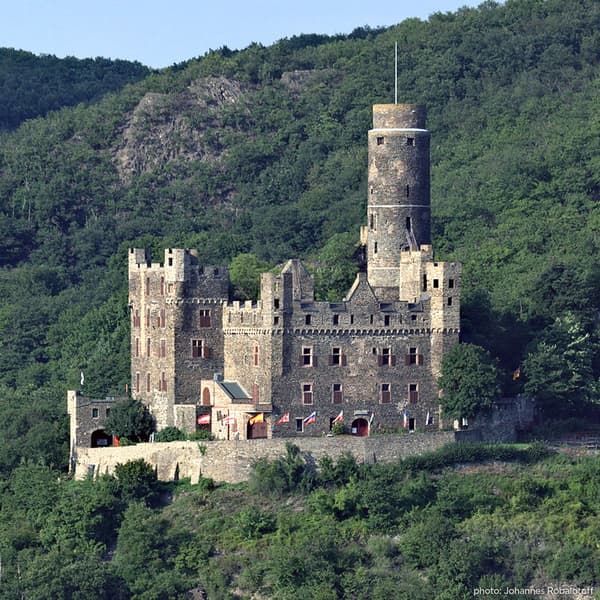
Kilometer 559, Maus Castle. Berg Maus actually means mouse in German. It got its name because the neighboring castle was owned by the rival Katzenboglen family. Katz means cat.
In the 1300s, the Maus Castle was considered a state-of-the-art fortification, until Napoleon Bonaparte had it blown apart in 1806 with state-of-the-art explosives. It was rebuilt true to its original plans in about 1910. Near the Maus Castle, though it's not visible from the river, was a 19th-century lead mine. It operated on both sides of the river with a shaft actually tunneling completely under the Rhine. ¶¶ ¶¶ ¶¶ The stretch between kilometer 560 and 567, Rhine Castle History.
Km 560-567: History
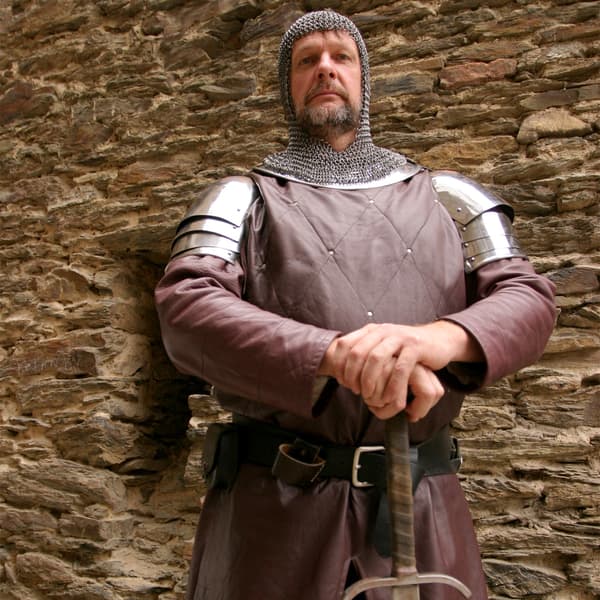
Whichever direction you're traveling, either north or south, take a break. As there are no famous castles to describe for a few miles, enjoy the scenery while Rick fills you in with a general history of the Rhine's castles. Ever since Roman times, when this was the empire's northern boundary, the Rhine has been one of the world's busiest shipping rivers. You'll see a steady flow of barges with 1,000 to 2,000 ton loads.
Tourist-packed buses, hot train tracks, and highways line both banks. Because of all this trade, many of the castles originated as robber baron castles, put there by petty rulers to levy tolls on passing river traffic. In medieval times, before Germany was unified, there were 300 independent little countries, in a region about the size of Montana. A robber baron would put his castle on, or even in, the river.
Read more...Show less
Then, often with the help of chains and a tower on the opposite bank, he'd stop each ship and get his toll. There were 10 custom stops in the 60-mile stretch between Mainz and Koblenz alone. No wonder merchants, eager for freer trade, were early proponents of the creation of larger nation-states. Some castles were built to control and protect settlements, and others were residences of kings.
As times changed, so did the lifestyles of the rich and feudal. Many castles were abandoned for more comfortable, unfortified mansions in the towns. Most Rhine castles date from the 11th, 12th, and 13th centuries. During this period, there was a power struggle between local rulers and the Holy Roman Emperor, who was, at the time, more powerful in name than in practice.
When the Pope successfully... asserted his power over the German Emperor in 1076, local princes ran wild over the rule of their emperor. The castles then saw military action in the 1300s and 1400s. That was when emperors began reasserting their control over Germany's many feudal kingdoms.
The castles were also involved in the Reformation Wars, in which Europe's Catholic and Protestant dynasties fought it out using a fragmented Germany as their battleground. The Thirty Years' War, which raged from 1618 to 1648, devastated Germany. Finally, after a third of Germany was dead, a treaty decided the outcome. Each ruler got the freedom to decide if his people would be Catholic or Protestant.
The French, who feared a strong Germany and felt the Rhine was the logical border between them and Germany, destroyed most of the castles along the river prophylactically. Louis XIV in the 1680s, the Revolutionary Army in the 1790s, and Napoleon in 1806. The castles were rebuilt in Neo-Gothic style in the Romantic Age in the late 1800s. And today, they're enjoyed as restaurants, hotels, hostels, and museums.
As you travel the Rhine, think of how important the river was for trade so long ago. The Black Forest upstream from here was once poor and wood was its best export. Black foresters would ride log booms down the Rhine to the Ruhr north of the Rhine. where their timber fortified coal mine shafts, or all the way to Holland, where logs were sold to shipbuilders.
Many a log boom was busted up by the Rhine's treacherous reefs and curves. If they survived, they'd come home reckless, loaded with money, and likely horny, the German folkloric equivalent of American cowboys after payday. Kilometer 567.
Km 567: Liebenstein, Sterrenberg
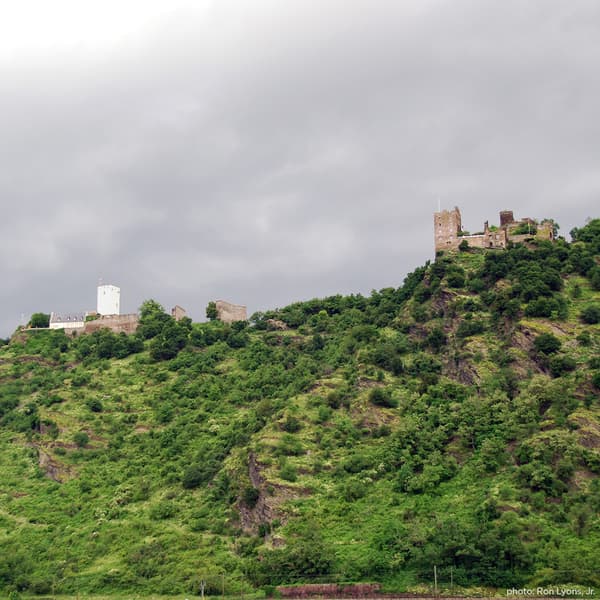
Liebenstein Castle and Sternberg Castle. The Hostel Brothers. On the east bank are neighboring castles nicknamed the Hostel Brothers. Notice how they're isolated from each other by a low-slung wall.
It was built to improve the defenses of both castles. But hey, this is the Romantic Rhine, so there has to be a legend. Take one wall between castles, add two jealous brothers and a fair maiden, and create your own legend. Berg-Liebenstein is now a famous castle. It's now a family-run hotel. Kilometer 570.
Km 570: Boppard
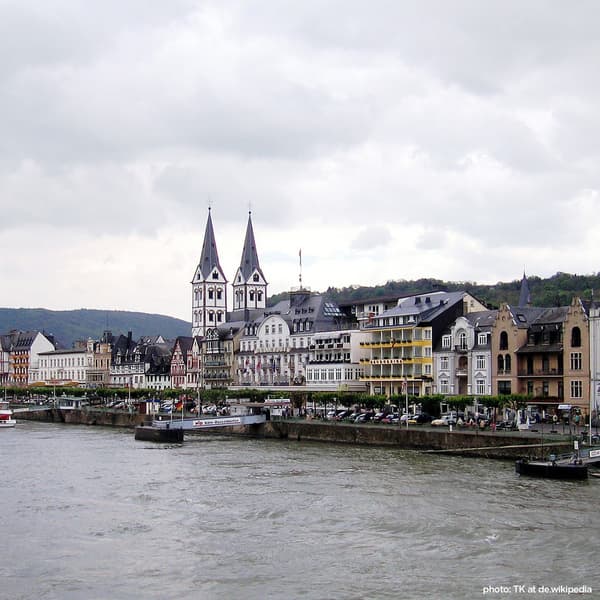
Bopperd. Once a Roman town, Bopperd has some impressive remains of 4th-century walls. Notice the towers and the substantial chunk of Roman wall near the train station, just above the main square. As you look at the homes along the train tracks, you gotta wonder, how do they live with all the train noise?
Well, the train company actually gives people money to install new, soundproof, windows, but only for living rooms and bedrooms. You'll notice a church is a big part of each townscape. Many small towns have two towering churches, one Catholic and one Protestant. The Rhine is the dividing line between Catholic and Protestant Europe.
Read more...Show less
Four centuries ago, after enduring the horrific wars of religion, it was decided that each prince or king got to decide the faith of his subjects. It was generally Protestants north of the Rhine and Catholics to the south. While church attendance in Germany is way down, the towns here, like Germany as a whole, are still split with both Catholic and Protestant churchgoers. The Stretch Between Kilometers 570 and 580
Km 570–580: Trade
Rhine River Trade Whichever direction you're traveling, either north or south, take a break from sightseeing for a few minutes to listen as Rick fills you in on the Rhine as a commercial waterway. The Rhine is great for barge watching. There's a constant parade of action and each boat is different. Since ancient times, this has been a highway for trade.
Today, Europe's biggest port, Rotterdam, waits at the mouth of the river. Barge workers are almost a subculture. Many own their own ships. The captain lives in the stern with his family.
Read more...Show less
The family car is often parked on the stern. Workers live up in the bow. In the Rhine town of Kalb, there was once a boarding school for the children of the Rhine merchant marine. But today it's closed since most captains are Dutch, Belgian, or Swiss.
The flag of the boat's home country flies in the stern. The German flag is black, red, and yellow. Dutch is horizontal red, white, and blue. Belgian, black, yellow, and red.
Swiss is a white cross on a red field. The French flag is a vertical red, white, and blue. Logically, imports go upstream, things like Japanese cars, oil, and coal, while exports go downstream, German cars, chemicals, and pharmaceuticals. A clever captain manages to carry goods in both directions.
You may see a few giant Dutch container ships which transport much more cargo than the others. These have been driving many of the traditional barges out of Belgium. It's a business presenting the German economy with another challenge. Tugs haul much of the cargo.
Going downstream, a tug can push a floating train of up to five barges at the same time. But upstream, they can only manage one at a time. Before modern shipping, horses dragged boats upstream. The faint remnants of their towpaths survive at points along the river.
From 1873 to 1900, workers actually laid a chain from Bonn to Bingen. And with the help of this chain, boats with cogwheels and steam engines hoisted themselves upstream. Today, 265 million tons travel each year along the 530 miles from Basel on the German-Swiss border to the Dutch city of Rotterdam, where the river finally hits the sea. Riverside navigational aids are of vital interest to captains who don't wish to meet the Lorelei.
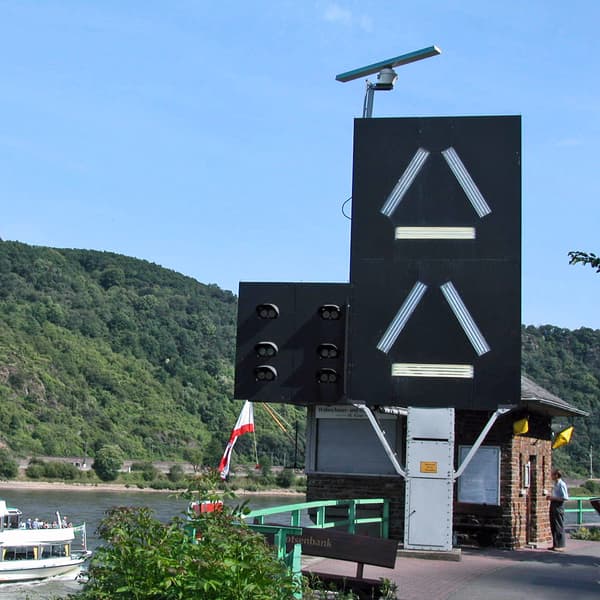
Boats pass on the right unless they clearly signal otherwise with a large blue sign. Since ships heading downstream can't stop or maneuver as freely, boats heading upstream are expected to do the tricky do-si-do work. Cameras monitor traffic all along and relay warnings of oncoming ships. The triangular signs you see posted along the river indicate if a ship is in that particular stretch of river.
They're placed before especially narrow and troublesome bends in the Rhine. If the left side of a triangle is lit, an oncoming ship is in that sector. When the bottom of the river is lit, that sector is empty. There may be two or three triangles per signpost, depending on how many sectors or segments of the river are covered, enabling the captain to anticipate traffic far upstream.
The lowest triangle indicates the nearest stretch of river. You'll also notice the large black-and-white kilometer markers all along the riverbank, which we've been keying our tour into. I erected these years ago to make our tour easier to follow. Very funny.
Okay, actually, the distance from the Rhine falls. A famous waterfall where the Rhine leaves Switzerland and becomes navigable. River barge pilots use these markers to navigate. Kilometer 580, Marksburg Castle.
Km 580: Marksburg
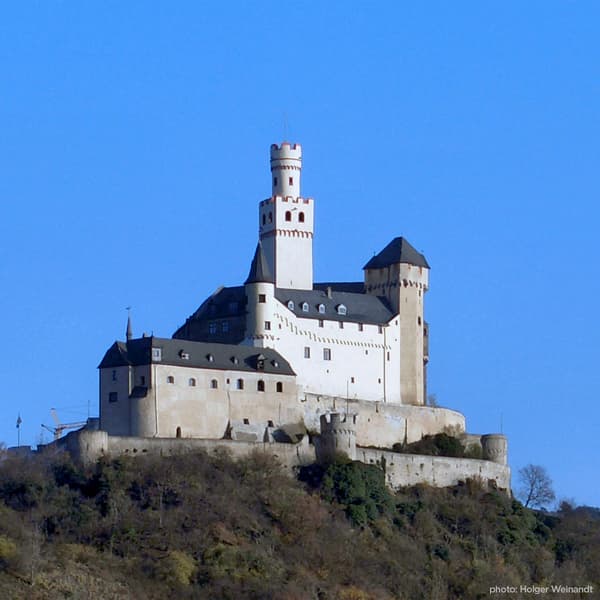
On the east bank, near the town of Spey, is the bold and white Marksburg, this is the best-looking of all the Rhine castles and the only surviving medieval castle on the river. Because of its commanding position, it was never attacked in the Middle Ages. It was, however, captured by the U.S. Army in March of 1945.
Marksburg is now open as a museum, with a medieval interior second only to Burg Eltz on the nearby Mosel River. It's easy to reach Marksburg Castle by train. Inside, you'll see how a castle really looks like a castle. It's a castle that really looked centuries ago.
Read more...Show less
There's part of a battering ram, suits of armor, the hall where knights dined, and a very Gothic chapel. Behind the castle, you'll see three modern smokestacks. These serve as vents for Europe's biggest car battery recycling plant just up the valley. Kilometer 586, Lonnek Castle.
Km 586: Lahneck
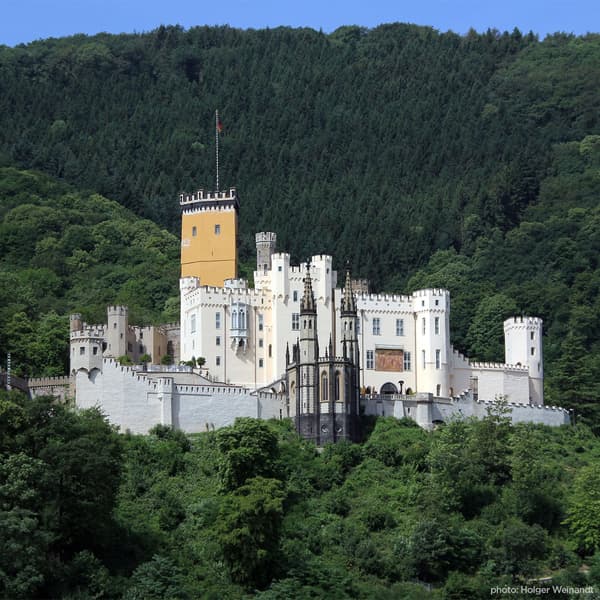
On the east bank, just above the modern autobahn bridge over the Lonne River, stands Burg Lonnek. It was built in 1240 to defend local silver mines. The castle was ruined by the French in 1688 and rebuilt in the 1850s in neo-Gothic style. Burg Lonnek faces another romantic rebuild across the river, the yellow Schloss Stotzenfels. Note that a burg is a defensive fortress, while a schloss is mainly a showy palace. Kilometer 590, Koblenz.
Km 590: Koblenz
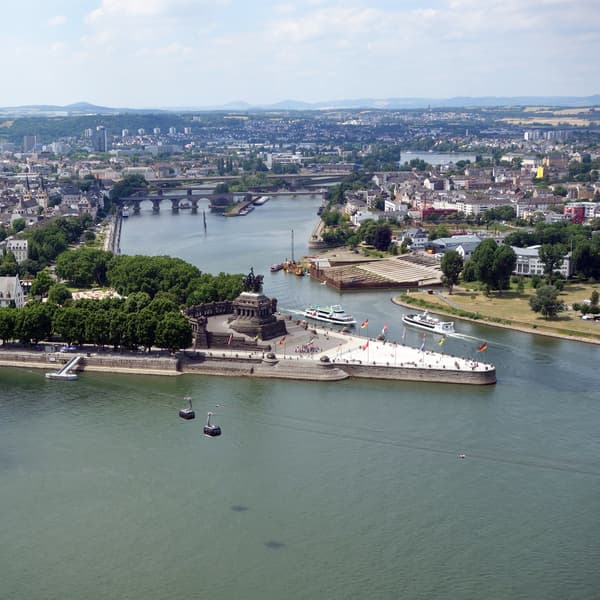
If you're headed north, Koblenz is the last stop on our Rhine Blitz. If you're headed south, it's just the start. Welcome aboard. Industrial Koblenz is not a romantic-looking city.
It was hit hard in World War II, but its place in German history is huge. This is where the Mosel River joins the Rhine. In fact, the name Koblenz means confluence in Latin, from when the Roman Empire stretched this far north and this was a Roman town. If you stop here, take a walk through the park called the Deutsche Eck, or German Corner.
Read more...Show less
That's the tip of land where the Mosel and the Rhine Rivers come together. This piece of land is considered the center or the soul of the German nation, its sacred land for many German nationalists. It has a reconstructed memorial to the Kaiser. Across the river from Koblenz on the east bank is the yellow Ehrenbreitstein Castle.
Not as old as the others, just about 100 years old, it now houses a hostel. Whether you're starting or ending your Rhine tour here, Koblenz is a good spot. It's the place where the industrial present meets the atmospheric past of the Romantic Rhine. We hope you enjoyed our tour of the Rhine, and we'll see you next time.
Thanks to Gene Openshaw, the co-author of this tour. This tour was excerpted from my Germany guidebook. For more details on eating, sleeping, and sightseeing, refer to the most recent edition of that guidebook. For more free audio tours and podcasts, and for information about our guidebooks, TV shows, bus tours, and travel gear, visit our website at ricksteves.com.
This tour was produced by Cedar House Audio Productions. Danke schön! Auf Wiedersehen! And goodbye for now.
Free
GPS-guided walking tour
No account needed. Walk at your own pace.
Free
22 stops ·