20 stops
GPS-guided
70 min
Duration
Free
No tickets
About this tour
A 20-stop walking tour through the heart of Greece. Visit Athens City Walk, Tomb of Unknown Soldier, Evzone Guards, Greek Parliament, and Walking Through Syntagma Square — with narrated stories at every stop.
20 stops on this tour
Athens City Walk
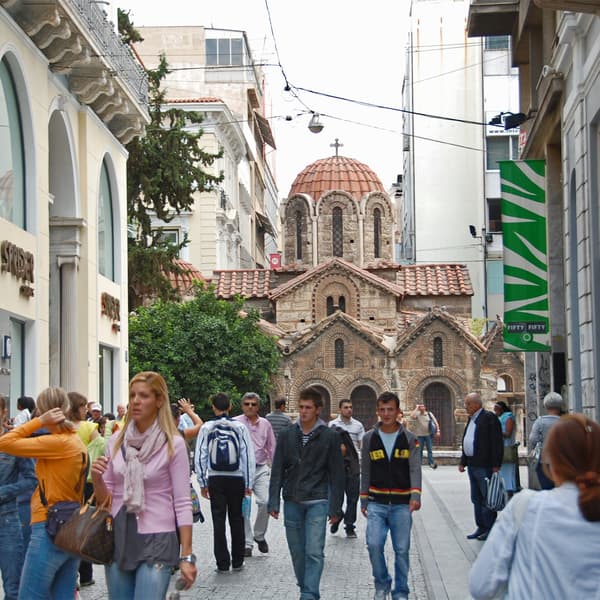
Athens is a bustling metropolis of nearly 4 million people. Its pedestrian-friendly center hums with shops, churches, and atmospheric cafes. And rising above it all are the magnificent ruins of the mighty Acropolis. Hi, I'm Rick Steves.
Thanks for joining me on this walk that's filled with striking contrasts. We'll see chaotic urban zones, candlelit Orthodox churches, dusty Roman ruins, trendy fashion boutiques, and peaceful flower-draped lanes barely wide enough for a donkey. This 90-minute tour is a great way to get your bearings in the sprawling city. Our walk begins at modern Syntagma Square, then meanders through the fascinating old Plaka District.
Read more...Show less
We'll wind up the slope of the Acropolis for fine views, then stroll back down. We finish at the lively Monastiraki Square, right in the heart of things, near the ancient Agora, restaurants, colorful markets, and the metro. This walk is best in the morning or evening since many historic churches are closed from 1 until 5. Now, let's get started as we explore Athens' rich history and rub shoulders with Athenians today as they work, shop, worship, and play.
To help us along the way, I've invited a good friend and virtual travel buddy. Welcome, Lisa. Hi, Rick. Lisa will give us helpful directions and sightseeing tips throughout the tour.
And my first tip is to be sure you get our tour updates. Just press the icon at the lower right of your device. You'll find any updates and helpful instructions unique to this tour. Things like closures, opening hours, and reservation requirements.
There's also tips on how to use this audio tour and even the full printed script. Yes, so pause for just a moment right now to review our updates and special tips. It's okay. We'll wait. And then... Let the tour begin.
Tour Begins
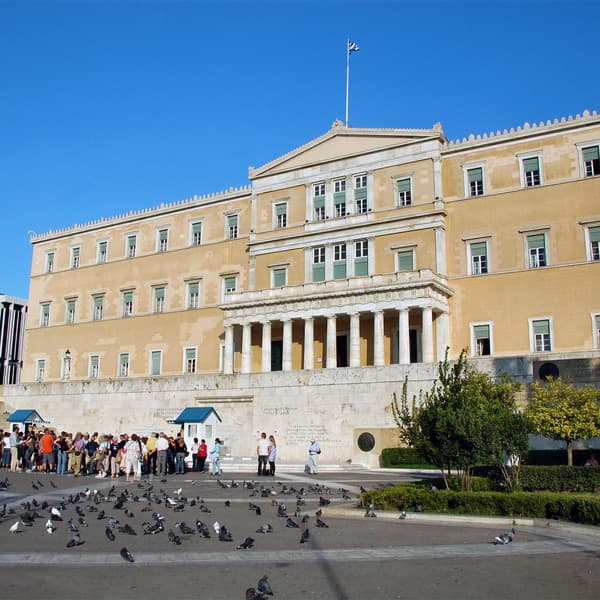
The tour begins. Syntagma Square. Start at Syntagma Square, located at the metro stop called Syntagma. The best overall viewpoint is from the top, or uphill, end of the square.
Climb the stairs, stand at the top, at the top of the square, and take it all in. Rick? Thanks, Lisa. Here in Syntagma Square, you can really feel the pulse of this great capital.
Read more...Show less
Surrounding the square are posh hotels, major banks, and, facing the top end of the square, the Greek Parliament Building. Beneath your feet is the city's busiest metro stop. Around the edges, the streets are choked with buses, cars, taxis, and mopeds. And in the fountain-dotted square, Athenians go about their business.
You'll see people hustling off to work, handing out leaflets, feeding pigeons, or just enjoying a park bench. And perhaps the free Wi-Fi the city provides. The square is shaded by plane trees, chosen for their resilience against pollution. Breathe deep and ponder the fact that until 1990, Athens was the most polluted city in all of Europe.
People advertising cosmetics would actually put up a sign, or actually put a mannequin outside on the street and film it as it slowly turned black. The moral? You need our face cream. But over the last two decades, Athens has worked hard to clean up its act.
Traffic is now restricted in the city center. Check out the license plates of passenger cars. Only cars with even-numbered license plates are allowed in on certain days of the week, those with odd numbers on the others. The rich get around that by owning two cars.
They've instituted other green policies, such as more pedestrian zones, better public transit, and cleaner heating oil. Thanks to this, 21st-century Athens is a more livable place than it was near the end of the 20th century. From this square, sightseeing options spin off like spokes on a wheel. First, with your back to the square, look across the busy highway to face Greece's Grand Parliament Building.
We'll talk about that in a minute. To your left is the opulent Hotel Grand Britannia. Locals go to its rooftop restaurant for a meal or pricey cocktail. Directly to the left of the Parliament Building is the head of a street lined with embassies and several worthwhile museums, the Benaki Museum of Greek History, the Museum of Cycladic Art, and the Byzantine and Christian Museum.
Now, turn your attention to the right side of the Parliament. There is the National Garden, Athens Central Park. The garden houses a building called the Zapion, a conference hall, plus an outdoor cinema and the evocative Panathenaic Stadium. Now, look further to the right, down busy Vassalissi-Somalia Street.
This is Athens' prime transit hub. Besides the metro station, there are buses to the airport plus the Athens coastal tram. Now, turn and face west. That's downhill.
At the bottom of Syntagma Square stretches the traffic-free shopping center, a shopping street called Ermu Street. This runs alongside the Plaka neighborhood heading to Monastiraki Square. We'll head that way soon. But for now, take in the square.
While the Acropolis and the Agora were the heart of ancient Athens, Syntagma has been the city center for the last two centuries. Whenever the Greek people needed to speak their mind, they've gathered here to do it. It was true in the 19th century when they demanded a constitution from their king. In the 20th century, when they demanded freedom from dictators, and it's true in this century when they've demanded accountability from the bankers and politicians that sent Greece to the brink of bankruptcy.
But we're getting ahead of ourselves. Let's look at the events that brought us Syntagma Square. Lisa. Get a closer look at the Parliament building by crossing busy Vassalisa-Somalias Street.
Once you reach the other side, check out the scene in front of the imposing Parliament. There you'll find one of Athens' main tourist attractions, soldiers in funny uniforms standing at attention.
Tomb of Unknown Soldier, Evzone Guards
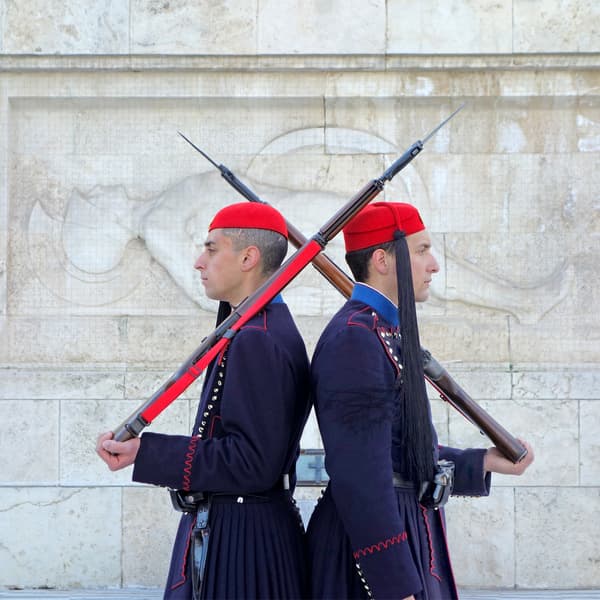
Tomb of the Unknown Soldier and the Evzoni Guards Greece's Tomb of the Unknown Soldier is guarded by the Evzoni Guards. The tomb itself is simple, a marble slab marked only with a cross. Carved into the wall above it is an image of a fallen warrior from ancient times with helmet and shield. On either side are the names of great battles in Greek history since 1821.
They're in the Greek alphabet, but I can make out a few. Let's see. Cyprus, Korea, Crete. The tomb is guarded by the much-photographed Evzoni, an elite individualist, infantry unit of the Greek army.
Read more...Show less
These colorful characters are clad in traditional pleated kilts, white breeches, and shoes with pom-poms. They may look goofy to a non-Greek, but their mothers and girlfriends are very proud. The soldiers do a ceremonial changing of the guard at five minutes before the top of each hour. There's also a less elaborate crossing on the half hour.
During the ceremonies, they march with a slow-motion, high-stepping gait to their new positions. Once there, they stand ramrod straight, just begging for some clown to pose at their side. Try getting one to smile. Hey, Dimitrios, nice pom-poms.
Rick! A full changing of the guard ceremony, complete with marching band, takes place most Sundays at 11 o'clock. The guards remind Greeks of the crucial moment when modern Greece was born. The year is 1821.
After nearly four centuries, under the thumb of the Ottoman Turks, the Greeks rose up. They were led by ragtag bands of mountain guerrilla fighters. Their uniforms were modeled after ancient warriors, complete with Mycenaean pom-poms. Today's Evzoni guards proudly wear the same outfit.
In fact, their winter skirts have exactly 400 pleats, one for each year of Ottoman occupation. And don't you forget it. The Greek War of Independence became a kind of cause célèbre throughout Europe. As a matter of fact, the English poet Lord Byron donned a uniform like this and joined the freedom fighters, even giving his life for the cause.
Finally, in 1829, the rebels drove the Ottomans out. However, no sooner had they driven out the Ottomans when they got an auto. For the rest of the story, take a step back for a wider view of the Parliament Building. The Greek Parliament
Greek Parliament
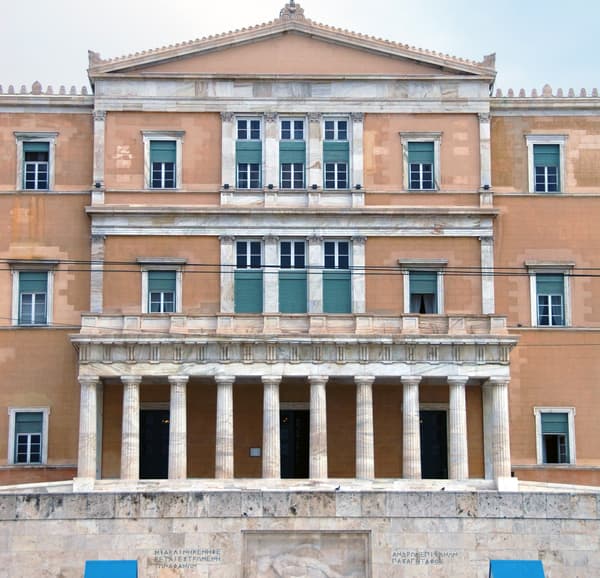
The origins of this Palace of Democracy couldn't have been less democratic. After gaining independence in 1829, the Greeks established a fledgling government. Their original capital was not, as you'd expect, Athens, but the city of Nafplio, a hundred miles to the west. That first government floundered.
So the great European powers stepped in and forced Greece to accept a monarch. And so it was that 17-year-old Prince Otto of Bavaria became King Otto of Greece. Otto was a great admirer of classical Athens, so he moved the capital to Athens. He built himself a royal palace, the building that's today's Parliament.
Read more...Show less
The Greeks grumbled. After fighting so fiercely for independence from the Ottomans, they chafed under another foreign ruler. The atmosphere was tense. Angry rioters gathered in the square, to protest.
Wisely, King Otto stepped onto the balcony of this building, quieted the mob, and gave them exactly what they wanted, a democratic constitution. Modern Athens was born, and the square was dubbed Syntagma, the Greek word for constitution. However, it took decades for Greek self-rule to evolve. It wasn't until 1935 that the royal palace became the Greek Parliament.
Today, this is where 300 Greek rebels and representatives tend to the business of state. Or, as more cynical locals would say, tend to the business of setting themselves up for cushy post-political lives. As we walk through Athens, keep in mind that it was King Otto who really shaped the modern city. His architects created a grand European capital in the style known as neoclassical.
They revived elements from the classical world, things like the Greek columns and triangular pediments you see on the Parliament building. The Hotel Britannia has hints of neoclassical. All over town, you'll see pastel-colored buildings highlighted in white trim. Windows are rectangular, flanked by white Greek half-columns.
The windows are fronted by balconies and topped with cornices. Many of the buildings themselves are also framed at the top with cornices. As you continue along this walk, you'll see neoclassical buildings as well as modern buildings mimicking their geometric symmetry. Now, return to Syntagma Square.
Walk downhill across the square and head toward Ermu Street. It's at the far end, opposite the Parliament building. It'll take a few minutes to get there, so while you're walking, listen to the next track as Rick gives an overview of the city's history. ¶¶ ¶¶ Walking through Syntagma Square,
Walking Through Syntagma Square
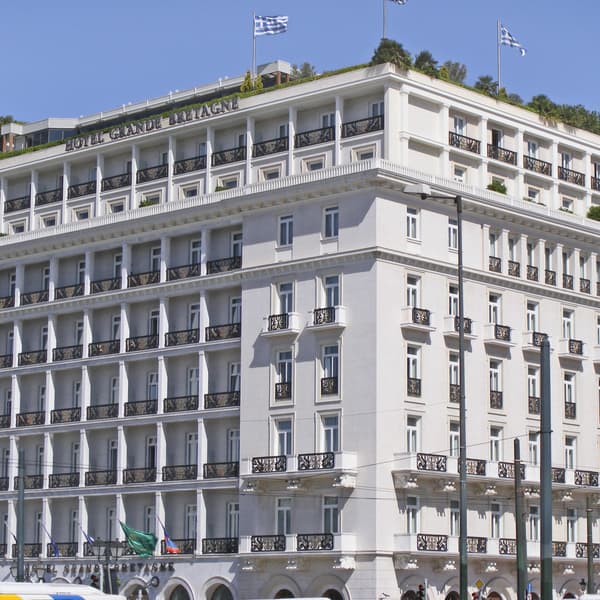
Athens' history. As you stroll through Syntagma Square on the way to Ermu Street, consider the 2,500 years of Athens' history. Athens emerged as a major city around 500 B.C. Before that, it was just another of Greece's small, poor city-states.
But blessed with a harbor, Piraeus, Athens prospered as a center of trade. In 480 B.C., Persia invaded Greece, and Athens was looted and burned to the ground. When the Greeks united to drive out the Persians, Athens emerged as their leader, and the Greek Golden Age began. From 450 to 400 B.C., Athens reigned supreme.
Read more...Show less
Its population was about 80,000. The Parthenon was built atop the Acropolis. Socrates and Plato walked the Agora. Democracy, theater, literature, mathematics, science, philosophy, and art all flourished.
This set the tone for the rest of Western civilization, which followed. Then, in 338 B.C., Athens was conquered by the Macedonians. Their leader, Alexander the Great, was a lover of all things Greek. His conquests spread Greek culture throughout the known world.
Athens thrived as the de facto capital of a vast Greek-speaking Hellenistic empire. When the Romans arrived in 146 B.C., they, too, were won over by the sophisticated Greeks. They made Athens their regional capital, showering the city with some of its greatest temples, theaters, and forums. In 49 A.D., the Apostle Paul visited the cosmopolitan city, preaching the Christian message to skeptical Athenians from atop Mars Hill.
The Roman Empire slowly declined, and so did Athens. In the 3rd century, a horrendous barbarian invasion left the city in ashes. Athens never really recovered. Other barbarian invasions followed.
As the Christian religion established itself in Greece, its pagan sanctuaries were closed and secular learning diminished. When Rome fell in 476 A.D., Greece came under the sway of the Byzantine Empire, namely, the eastern half of the Roman Empire that didn't fall. For the next thousand years, Athens was ruled from far-off Constantinople. That's modern English.
Istanbul. Athens, under Byzantine rule, was Greek-speaking, Orthodox Christian, and neglected. One bright spot was the 12th century, when many of the city's venerable Orthodox churches were built. Also during this time, merchants from Venice established trading ports in Greek territory.
Then, in 1453, Constantinople fell to the Ottoman Turks. For the next four centuries, Athens was ruled from Constantinople by Muslims. The Parthenon, became a mosque, and Greek Christians assumed a low profile. Athens continued its long decline, becoming a rural backwater.
Its population shrank to just 2,000. The once grand city was now just a cluster of red-tiled Turkish houses in the shadow of the Acropolis, today's Plaka. That brings us to the year 1821, when Athens' rebirth began. As we learned, the Greeks rose up, evicted the Ottomans, and then, forced King Otto to give them a Syntagma, or constitution.
They rebuilt Athens in the Neoclassical style, including this square, the Parliament, and Hotel Britannia. Broad new boulevards were blasted through. One of the grandest new streets spilled directly out of the bottom of Syntagma Square. And that's where we're headed next, Ermu Street.
At the bottom of Syntagma Square, near the McDonald's, is the entrance to traffic-free Ermu Street. Start strolling gradually downhill while Rick narrates. Just stroll and listen as you enjoy the first half-dozen blocks of Ermu Street. Your next stop is a little brick church in the middle of the road. You can't miss it.
Ermou Street
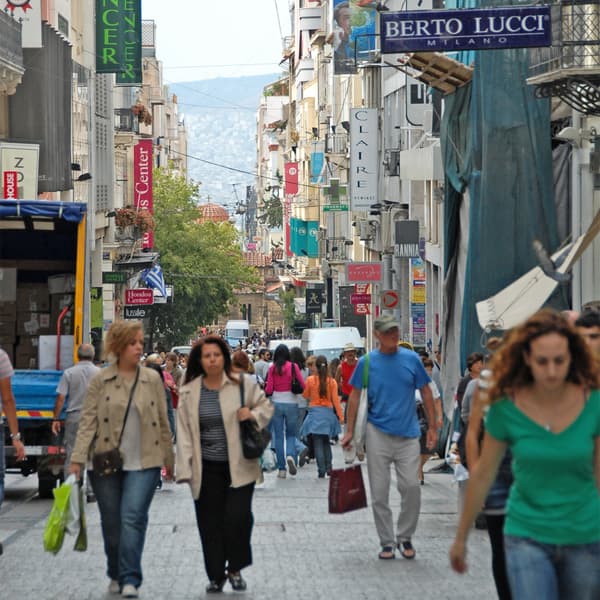
Ermu Street. The pedestrian mall of Ermu Street leads from Syntagma down through the Plaka to Monastiraki Square. From there, it continues westward to the ancient Karamako Cemetery and the Ghazi District. As you stroll, notice that many of Ermu's department stores are housed in impressive Neoclassical mansions.
Talented street performers provide an entertaining soundtrack. All of Athens walks along here. Business people, teenage girls with iPods, Orthodox priests. You'll see men twirling worry beads and activists gathering signatures.
Read more...Show less
You may catch illegal vendors as they sweep up their wares and scurry off when they see the police. Blend in with the local shoppers. Keep an eye out for people selling various local snacks, including pretzel-like sesame rings and slices of fresh coconut. Ermu Street was traditionally the place for women's boutiques, but these days it's dominated by high-class international chain stores.
These appeal to young Athenians, but turn off the older natives who lament the lack of local flavor. For more of the authentic boutiques, many Athenians prefer the streets just to the right. As you continue down Ermu Street to the church, think of how much Athens has changed in the last two centuries. In 1800, this neighborhood was a run-down village of dirt alleyways.
Then, streets like Ermu were blasted through as part of the city's revival. The 20th century brought more and more upheaval to Athens' landscape. World War I and the bitter Greco-Turkish War that followed flooded the city with desperate refugees. In 1923, a million ethnic Greeks living in Turkish lands were expelled and shipped to Greece.
Athens' population doubled overnight, and authorities scrambled to build cheap apartments to house them. In World War II, Athens suffered brutally under Nazi occupation. At war's end, Greeks battled each other in a civil war between left and right. Hundreds of thousands died.
In 1949, Greece emerged desperately poor and bitterly divided. Hungry farmers from the countryside poured into Athens looking for work, overwhelming its infrastructure. It's amazing to think that today's city of four million had fewer than one million just 60 years ago. In the 1950s, Athens' economy recovered somewhat thanks to America's Marshall Plan and tourism.
But Greece always lagged behind the rest of Europe. In the 1960s, Greece's right-wing government outlawed everything from long hair and miniskirts to Socrates and the theme song from Zorba the Greek. Syntagma Square was the scene of violent protests, strikes, and assassinations. Finally, in 1974, Athens became the capital of a truly democratic government.
Unfortunately, as the city slowly modernized, it also created some of Europe's worst pollution chaos and urban sprawl. By the turn of the millennium, Ermu Street epitomized all that was terrible about Athens. It was choked with car traffic. There were tacky neon signs, double-parked trucks, and lousy building codes.
Then, in 2000, Ermu Street was made pedestrian-only. As usual, when it comes to pedestrian zones, at first, the merchants were angry. But now, they love the ambiance. Locals stroll through a people-friendly shopping zone, the area is revitalized, and business is better than ever.
You can't miss our next stop. It's the little church directly ahead, squatting in the middle of Ermu Street. As you approach the church, notice the nearby shopping mall. The entrance is 20 yards past the church at Ermu Street number 54.
At some point, you may want to pop in and enjoy the cool air and cool architecture. Athenians are keen to preserve these slices of 19th-century elegance to make their city more livable. In fact, it's the many layers of Athenian history that make the city so fascinating. For now, let's step out of modern Athens and into its medieval period.
Lisa? Turn your attention to the medieval church. Stranded in the middle of both Ermu Street and the commercial bustle of the 21st century is the little church of Capna Corea. The little church of Capna Corea. The church of Capna Corea.
Church of Kapnikarea
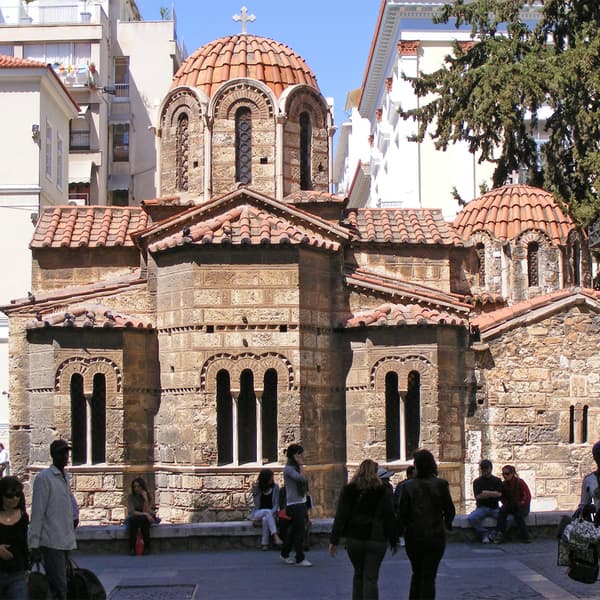
This Eastern Orthodox church built in the 11th and 12th centuries gives a flavor of medieval Athens when it was part of the Byzantine Empire. It's a classic church in the typical Orthodox style. Notice that the church is square. It's topped by a central dome crowned with a cross.
Another typical Byzantine feature is the tall arches that frame doors into the church. and windows. Also, notice that the walls are built with both big white blocks and brick and mortar. The white stones were scavenged from other earlier monuments, typical of Byzantine churches from this era.
Read more...Show less
Make your way to the entrance. Over the door is a mosaic of glass and gold leaf. Though modern, this is made in the traditional Byzantine style. If the church is open, step inside.
Visitors are welcome as long as you're modestly dressed, keep your voice low, and don't take photos. If the church is closed, don't worry. We'll be visiting a similar church later. Once inside, let your eyes adjust to the dim lighting.
Notice the bank of candles and observe the standard routine. Worshippers enter, drop a coin in the wooden box, pick up a candle, say a prayer, light the candle, and place it in the candelabra. Then they make the sign of the cross and kiss the icon, the painting of a saint. You may notice lipstick smudges on the protective glass.
The icon gets changed periodically with the church calendar. Also, notice the candle recycling box behind the candelabra. As you explore deeper into the little church, notice the square, symmetrical floor plan. The church has no nave or long central hallway.
Unlike most churches, like most Western churches, a typical Orthodox church has four equal arms radiating out from the dome. The interior is decorated with standing candelabra, hanging lamps, and tall arches. On the walls are a few icons of saints. There's a wooden pulpit and just a few chairs.
In Greek Orthodox tradition, worshipers stand throughout the service as a sign of respect. Some older parishioners can sit on the seats along the walls. Traditionally, women stand on the left side and men on the right. Both are an equal distance from the altar to represent that all are created equal before God.
And where is the altar, you may ask? It's hidden behind an altar screen called an iconostasis. The iconostasis is that white marble partition. It's a half wall with a central doorway and some ceremonial windows.
The area behind it is blocked with curtains. The iconostasis in almost every Greek Orthodox church has the same icon layout. To the right of the central door always stands a painting of Jesus. John the Baptist is further to the right.
To the left of the door is Mary holding baby Jesus. Further left, the icon usually features the particular saint that this church is dedicated to. The altar stands behind this screen. That's where the spiritual heavy lifting takes place.
The Bible is kept there. During communion, the priests go back there to symbolically turn bread and wine into the body and blood of Jesus. Then they open the doors or curtains and serve the Eucharist to their faithful flock. The idea of separating the priests from the lay community follows the Old Testament tradition of a sacred area called the Holy of Holies.
Symbolically, the iconostasis divides the material world from the spiritual one. Now, look up into the central dome. In the Orthodox world, the dome, illuminated by windows, symbolizes heaven. And looking back at you is Jesus.
He holds a Bible in one hand and blesses us with the other. Most Eastern Orthodox churches have at least one mosaic or painting of Christ in this standard pose. It's called the Pantocrator, a Greek word meaning ruler of all. As king of the entire universe, Christ looks down from above, faces directly out, and surveys his creation.
Behind him is a halo divided by a cross. In Orthodox tradition, only three of the cross's arms are visible, a symbol of the Trinity. Notice the focus on Christ's eyes. You'll find the same penetrating gaze in most icons.
The eyes are considered a symbol of purity and a mirror of the soul. When you're ready, we'll continue our walk. Exit the church, spilling back out onto Ermu Street. As you leave the church, get your bearings.
From here, we head south toward the Acropolis. Find Capnacoreas Street and start walking downhill. As you walk down Capnacoreas Street, you're entering the Plaka. Up ahead, you'll catch a glimpse of the Acropolis.
Go two blocks to where it crosses the traffic-free shopping street called Pandrosou Street. At the intersection, turn left. Walk up the pedestrian Pandrosou Street. After two blocks, the street opens up into a spacious square dominated by Athens' Grand Cathedral. ¶¶ The Cathedral
Cathedral
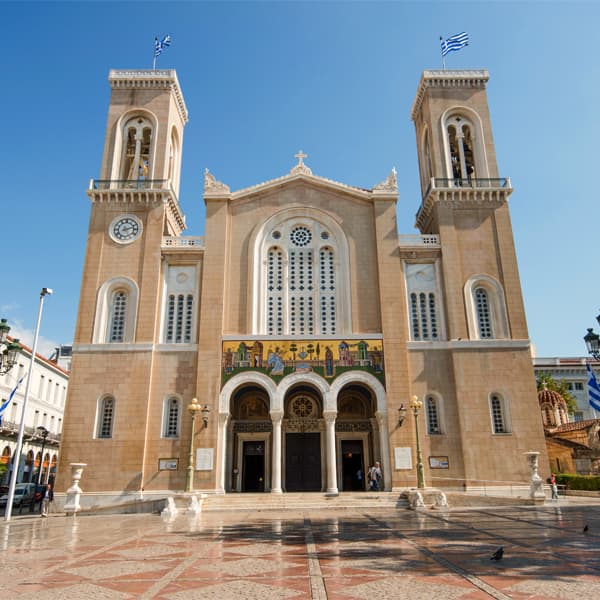
Built in 1842, this is the city's metropolis, or Metropolitan Church. That's what Orthodox Greeks call their cathedrals. It's the home church of Athens' Archbishop, who's the head of the Greek Orthodox faith. If it's open, go inside.
Once inside, check out the cathedral's iconostasis. Typical of most Orthodox churches, this altar screen has the same array of icons. There's Jesus and John the Baptist to the right, and Mary and the Babe to the left. Now, look up, likely through more scaffolding.
Read more...Show less
Notice the balconies. In past times, women worshipped up there, while men occupied the ground floor. But in 1954, Greek women got the vote, and now they worship alongside the men. The Eastern Orthodox faith can seem somewhat foreign to most Americans, who are more familiar with Catholic and Protestant denominations.
Though all Christians practice the same faith, there are some striking differences in the rituals. For example, an Orthodox service involves chanting, a kind of dialogue that goes back and forth between the priest and the congregation. Also, the church is usually filled with incense. The evocative atmosphere created is meant to help the worshiper transcend the physical world and enter communion with the spiritual.
The split in the Christian church between East and West first started back in the 4th century A.D. The Roman Empire split in two, both politically and culturally. Seven centuries later, the Christian faith diverged along similar lines, a split historians call the Great Schism. In the West, Roman Catholicism dominated, led by the Pope at the Vatican in Rome.
Eastern Orthodoxy prevailed in the Byzantine Empire, based in Constantinople. Within the Orthodox Church, there are about a dozen regional branches, the Greek Orthodox Church, Russian Orthodox, Serbian Orthodox, and so on. In Greece today, the Greek Orthodox Church is officially recognized by the Constitution as the country's prevailing religion. So I guess you could say that this cathedral is Greece's Vatican, and the Archbishop of Athens is Greece's Pope.
Exit back outside the cathedral. In the large square, in front of the church, find the statue facing the cathedral. The Cathedral Square
Cathedral Square
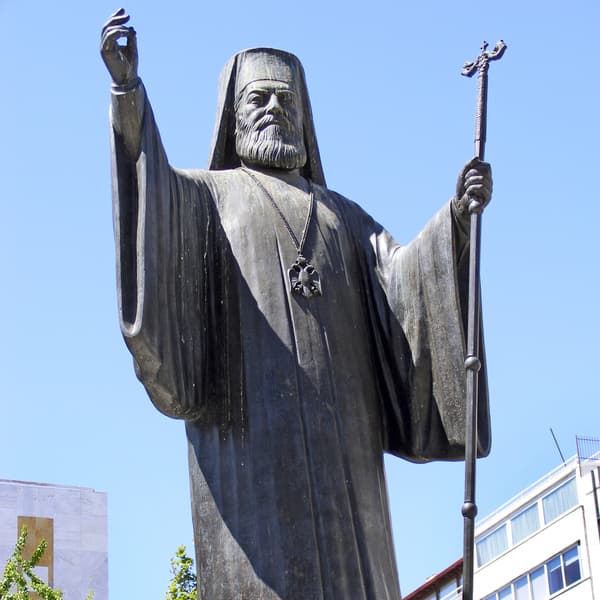
In the square stands a statue of a man with a staff giving a blessing. This is Archbishop Damaschinos, who presided in Athens in the early 20s, during the Nazi occupation of Greece. Damaschinos was one of the rare Christian leaders who spoke out on behalf of persecuted Jews. The Nazis threatened to put Damaschinos before a firing squad.
The feisty Archbishop joked that they should hang him instead, in good Orthodox tradition. After the war, Damaschinos served as Greece's caretaker prime minister, helping bring stability to the war-torn country. This statue was erected by Athens' Jewish community as a symbol of the war. It's a show of thanks.
Read more...Show less
Check out some of the typical Orthodox features. Damaschinos wears the distinctive hat of an Orthodox archbishop. It's a kind of fez with cloth hanging down the sides. He carries a staff and blesses with his right hand.
Look closely at the hand. He's touching his thumb to his ring finger. This is the traditional Orthodox sign of the cross. The gesture forms the letters of the alphabet that spell out the Greek name of Jesus.
Try it yourself. Touch your thumb to the tip of your ring finger. Now your pinky forms the letter I. Your slightly crossed index and middle fingers are an X.
And your thumb and ring finger make the double C. These four letters, I-C-X-C, are short for Jesus Christ. Very clever. So, if you were an Orthodox priest, you'd hold your fingers like this and wave your arm three times, tracing the shape of a cross and chanting, the Father, the Son, and the Holy Spirit.
Notice Damaschino's necklace. It's the double-headed eagle of the Byzantine Empire when Orthodoxy became the state religion. The two heads demonstrated how the Byzantine Emperor ruled both East and West, as well as both the secular and the spiritual worlds. Coincidentally, a similar symbol has been used by other realms, including the Holy Roman Empire and the Austro-Hungarian Empire.
At the far end of the square, furthest from the cathedral, stands another statue of a warrior holding a sword. This is Emperor Constantine XI, the final ruler of the Byzantine Empire. In 1453, Constantinople was toppled by the Ottoman Turks. Soon, Muslims controlled Athens and Christians had to lay low for the next four centuries.
Now find the small church tucked along the right side of the cathedral. Approach the church. This is one of several venerable old structures that date from the time when Greece was still under Byzantine and Christian rule. This small church standing alongside the cathedral is the church of Aeus Elephtherus. The church of Aeus Elephtherus,
Church of Agios Eleftherios
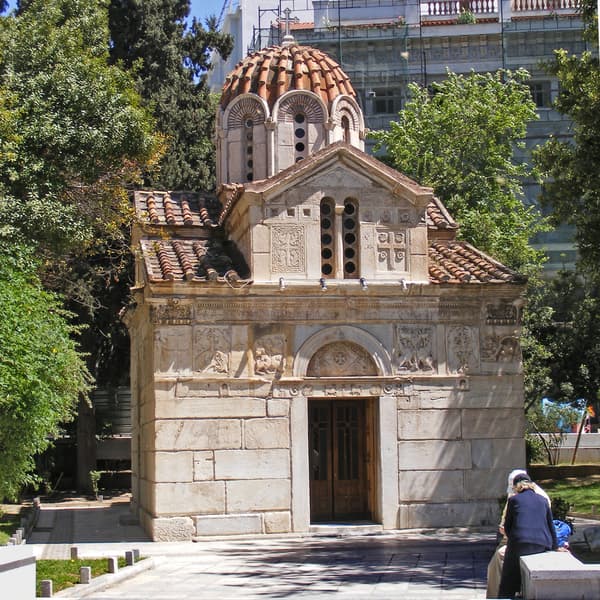
built in the 12th and 13th centuries, this is a favorite of local church connoisseurs. It's dedicated, as many Athenian churches are, to a popular saint, or Aeus. The little church is sometimes referred to as the old cathedral, since it actually was once the cathedral. When the Ottomans took control in the 15th century, they evicted Athens' archbishops from their previous home, the Parthenon.
They turned the Parthenon into a mosque, so the archbishop had to move it out of the way. So the archbishop had to move it out of the way. So the archbishop had to move it out of the way. Let's move into the humble little church you see here.
Read more...Show less
Study the carved stones decorating its exterior. It's a jigsaw puzzle hodgepodge scavenged from earlier buildings. Above the door, find the carved marble reliefs. These date from the 2nd century A.D.
They were once part of a calendar of pagan Athenian festivals that stood in the ancient Agora. Along the top of the building runs a frieze from before the time of Christ. It depicts an ancient procession. There are even old tombstones incorporated into the building.
These pagan elements combined with Christian symbolism to make the church a treasure trove of religious iconography. Notice the wide variety of crosses. The Maltese cross has four V-shaped arms. It was popular with crusaders who passed through here on their way to Jerusalem.
The Latin cross is more common in America. It has a long base and shorter crossbar. This cross's shape evokes the crucifixion, emphasizing Jesus' death and sacrifice. The so-called Greek cross uses four equal arms like a plus sign.
The cross is sometimes inscribed inside a circle. This shape symbolizes God's perfection. As we've seen, the Greek cross shape is used in many Orthodox church floor plans, just as the Latin cross is found in Catholic churches. Besides crosses, you'll find other symbols, both Christian and pagan, carved rosettes, stars, flowers, and mythical griffins feeding on plants and snakes.
Once you've checked out the exterior, consider stepping inside to sample its unadorned Orthodox simplicity. Definitely go inside if you were unable to get into the Capnicaria church we saw earlier. Remember, that's when Rick described the typical elements found in many Greek Orthodox churches. If you missed that, the same description works well here, too.
Click back to track number 7. It's the Church of Capnicaria. When you're ready to move on, we'll head up the nearby street called Aia Philotheis. To get there, face the little church, go around its right side, then turn right, and you're at the head of Aia Philotheis Street.
The street sign is probably only in Greek. Walk slowly up the street, browsing some of the shops. Our first stop is just a few steps along, the Theodoropoulos Shop.
Agia Filotheis Street
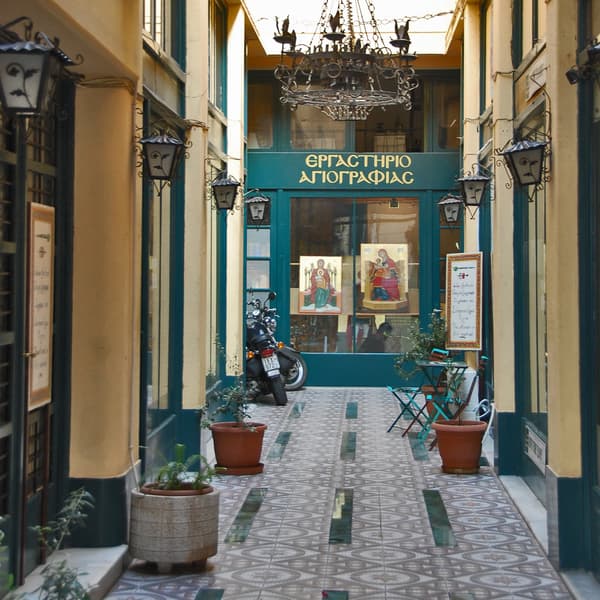
Aia Philotheis Street. This neighborhood is a hive of activity for Orthodox clerics. Notice the many stores selling all kinds of religious objects. First up, the shop of the Theodoropoulos family.
It seems their name strives to use every character in the Greek alphabet. They've been tailoring robes for Orthodox priests here since 1907. You've likely seen a few Orthodox priests along this walk. They dress all in black.
Read more...Show less
They wear beards and don those fez-like hats. While they look like monks, most priests are husbands and fathers. Married priests are welcome, as long as they marry before becoming priests. They're generally well-educated pillars of the community.
In Athens, they serve as counselors and spiritual guides to the cosmopolitan populace. Cross busy Apollonos Street and continue exploring the religious shops of Aia Philotheis Street. As you can see, the Orthodox religion comes with its own unique religious paraphernalia. There's gold candelabra, hanging lamps, incense burners, oil lamps, and chalices.
They're exquisite. Many are made of gold and worked in elaborate repoussé design. First, and foremost, are the icons, those golden paintings of saints. They aren't intended to be lifelike.
They have crude bodies, stiff poses, and almond-shape eyes. But icons emphasize their otherworldly nature. The saints stand amid the shimmering gold of heaven, reminding worshipers of the metaphysical world, where true happiness lies. You'll almost never see statues of saints.
To the Orthodox, statues feel a little too close to the graven images or false idols that the Bible forbids. You'll soon reach No. 15, Aeia Philothes Street, on the left. Pop into the stoa, or covered arcade.
There's another similar arcade just ahead at No. 17. Here, you can see some of the workshops of the local artisans who make these objects. You may see painters at work creating or restoring icons in the traditional style.
Tailors make bishops' hats and robes. And artists carve little devotional statuettes. Continue up Aeia Philothes a few more steps. On the left is the church of Aeia Philothes, named for a patron saint of Athens.
The church is adjacent to an office building at No. 19. It serves as the headquarters for the Greek Orthodox Church. Athenians come here to file the paperwork to make their marriages official and their divorces final.
Continue up Aeia Philothes Street, until you reach a tight five-way intersection. When you reach the intersection, find Adria No Street. It's a few steps to your right. Adria No Street is choked with souvenir stands and tourists. Stand at the intersection and look uphill and downhill along Adria No Street. Adria No Street. Adria No Street.
Adrianou Street
This intersection may be the geographical, if not atmospheric, center of the neighborhood called the Plaka. Touristy Adria No Street is the main pedestrian drag. It cuts through the Plaka, running roughly east-west from Monastiraki Square to here. Remember, back in the early 1800s, the Plaka was basically all there was to tiny Athens.
Let's explore. Start walking uphill on Adria No Street. Go several blocks, curving to the right until the street dead-ends at a T-intersection. As you walk, check out the shops.
Read more...Show less
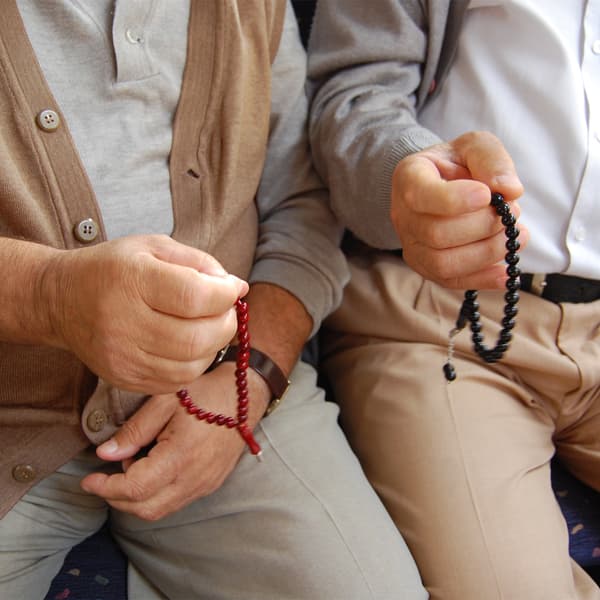
You'll see the full gauntlet of Greek souvenirs. Sea sponges, olive oil, icons, carpets, jewelry, sandals, cheap Greek statues, and tacky T-shirts that say, Got Uzo? There are also plenty of cafes seemingly designed for tired tourists. And what's with all the worry beads for sale?
It seems that everywhere Greeks are spinning, stroking, fondling, and generally fidgeting with a string of beads. Greeks use these to soothe themselves and get focused. They may be based on religious beads used to keep track of prayers, like Catholics use the rosary or Muslims use prayer beads. But today's worry beads have no religious overtones.
Traditionally, only men used worry beads, but they're becoming increasingly popular among Greek women as well. You'll see beads either on a loop or on a single string. The basic tourist version is just cheap synthetic glass. You'll pay more for organic beads, which are considered more pleasant to touch.
Precious stones, bone, horn, wood, coral, mother of pearl, seeds, and so on. The most prized worry beads are made of amber, particularly hand-cut amber. If you're shopping, try several out. Find one that fits well in your hand, one that feels smooth and makes a pleasant clacking sound.
There's no right or wrong way to use your worry beads. Twirl them, finger them, whatever works for you. Using worry beads is one nervous habit that actually seems to have the opposite effect, diffusing stress and calming the nerves. Continue up Adria Noe Street until it dead-ends at a T intersection.
The cross street is Lysakratous Street. When you reach the intersection, turn left on Lysakratous Street. But wait a second. This is a good point to check the fuel gauge in your sightseeing tank.
Our next stop, a Roman ruin called Hadrian's Arch and a look at the awe-inspiring Temple of Zeus is two long blocks away. If you're already feeling like a Roman ruin, you can consider opting out. It won't get you off track since, after seeing the arch, we return to this exact spot at the intersection. So if you're running out of steam, you can start and skip to the next track and move directly ahead to the Lysakrates Monument, track 14.
It's your call. For those who want to visit the impressive Roman ruins, walk down Lysakratous Street. After two blocks, the street runs into a wide, busy boulevard. As you walk, you'll begin to see the ruins of Hadrian's Arch up ahead.
We're headed back in time, back before the Ottomans, before the Byzantines, 2,000 years ago, when the Romans, the Romans ruled Athens. We're approaching some of the grandest ruins from that era. They were built by the Roman emperor, Hadrian, or, as he was known in Greece, Adriano. While Roman, Hadrian loved all things Greek.
He renovated the city with enormous buildings, several of which we'll see along this walk. The area just ahead was his planned neighborhood. It was known as, what else, Hadrianopolis. Continue down Lysicratus Street to where it crosses the busy boulevard called Vasilisa's Amelius Avenue.
Across the street stand the impressive ruins of the Arch of Hadrian. Get a closer look at the arch and the nearby temple by crossing the busy street. ¶¶ ¶¶
Hadrianopolis
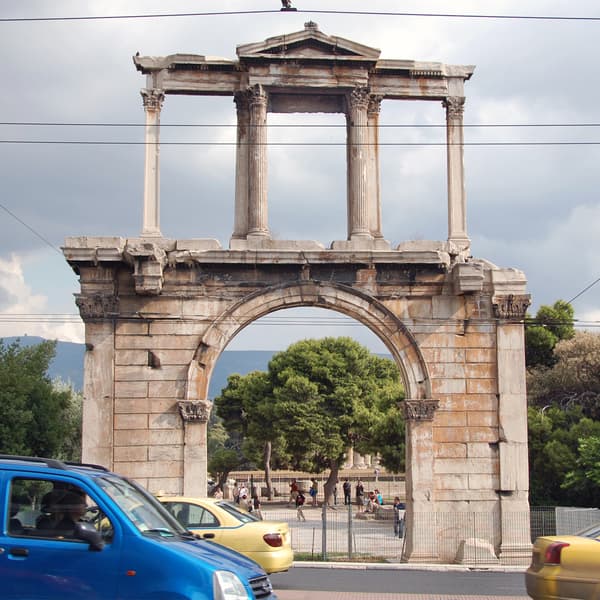
The Arch of Hadrian, a classic triumphal arch in the Roman style, marked the entrance to the emperor's planned community, Hadrianopolis. The arch was once brilliant white, made of the same pentelic marble as the Parthenon. It's now stained by exhaust from some of Athens' worst traffic. The arch is topped with Corinthian marble, with their leafy capitals.
Corinthian was the Greek style preferred by the Romans. Hadrian built the arch in 132 A.D. to mark the line between Greek Athens and the new Roman city. An inscription on the west side reads, This is Athens, ancient city of Theseus.
Read more...Show less
The opposite phrase says, This is the city of Hadrian and not of Theseus. This arch must have been a big deal for Hadrian as the emperor himself came here to celebrate the inauguration. Now, look past the arch and see the huge, and I mean huge, Corinthian columns. This is all that remains of the Temple of Olympian Zeus.
The temple ruins are fenced off and the entry is a long walk from here, so we'll just view it free of charge through the fence. The Temple of Olympian Zeus is the largest temple in ancient Greece. It took almost 700 years to complete. It was begun in the 6th century B.C.
by the Greeks, then lay abandoned half-built for centuries. Finally, the Roman Emperor Hadrian arrived to finish the job in 131 A.D. The temple was huge. Those Corinthian columns are a towering 56 feet high.
Compare that with the 34-foot-high columns of the Puny Parthenon. The finished temple was 360 feet long by 145 feet wide. It was the size of a football field. It was more than twice the square footage of the Parthenon.
The Temple of Olympian Zeus had 104 Corinthian columns, two rows of 20 columns on each of the long sides and three rows of eight columns along each end. Only 15 columns remain standing. The fallen column, you see, like a tipped-over stack of checkers, was knocked over by a storm in 1852. This over-the-top temple was dedicated to Zeus.
Zeus, the king of the Greek gods who lived on Mount Olympus. The temple contained two huge statues, one of the ruler of the gods, Zeus, and an equally colossal statue of the ruler of the Greeks, Hadrian. Retrace your steps back up Lysicratus Street to that same T-intersection with Adriano Street. And I gotta say, Lisa, don't you think those losers who wimped out really missed a lifelong memory?
That may be true, Rick, but you did give them the option. Oh, you're right there. You know, Lisa, the Temple of Olympian Zeus is typical of the Romans. They loved Greek culture, their statues, architecture, and so on.
But as world conquerors, the Romans just had to do everything a little bigger. They borrowed Greek features like Corinthian columns, but built them on an even grander scale. Yes, and it's thanks to the Romans that many aspects of Greek culture survived. Our next stop is a monument that dates from earlier than the Romans.
To get there, head back up Lysicratus Street to the T-intersection. Then continue past the intersection one more block. There, Lysicratus Street spills out into a small, leafy square with the Acropolis rising behind it. In the square is a round, white monument. Lysicrates Monument
Lysicrates Monument and Square
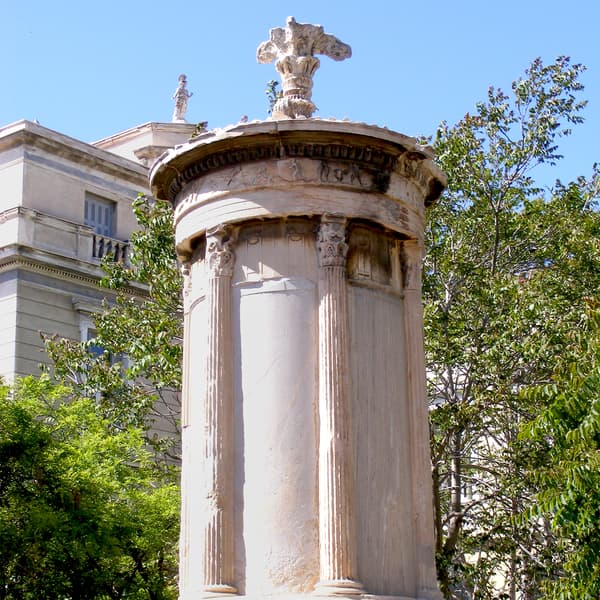
and Square The elegant marble Lysicrates Monument has Corinthian columns that support a dome with a statue on top. The statue is rather damaged. A frieze runs along the top. If you look close, you may be able to see that it represents Dionysus turning pirates into dolphins.
The monument is the sole survivor of many such monuments that once lined this street. This was the ancient Street of the Tripods, so-called because the monuments came with bronze tripods alongside. These three-legged stands, like those you'll see in the museums, held trophies, things like ornamental vases and cauldrons. Here on this street, the ancient Oscars were awarded to winners of theatrical competitions staged at the nearby Theater of Dionysus.
Read more...Show less
The Lysicrates Monument honors one of the winners, the winning choral team from the year 334 B.C. Excavations around the monument have uncovered the foundations of other monuments, which are now reburied under a layer of red sand, awaiting further study. Now, stroll the square itself. Shaded by trees, this is a pleasant place to take a break before we climb the hill.
Have a coffee at one of the café tables, or try a frappe, an iced coffee with foam. Or, you can pop into the hole-in-the-wall grocery store, and have a coffee. Or, you can pop into the grocery store over on the left and grab a cheap cold drink from the cooler. You can sit for free on the benches under the trees.
When you're ready to move on, we'll start climbing the Acropolis. Find the staircase on the left side of the square. The staircase is officially called Epimenidou Street. Climb the staircase up and up toward the Acropolis.
At the top of the stairs, turn right onto Stratonos Street, which leads around the base of the acropolis. The Acropolis Circling the Acropolis
Circling the Acropolis
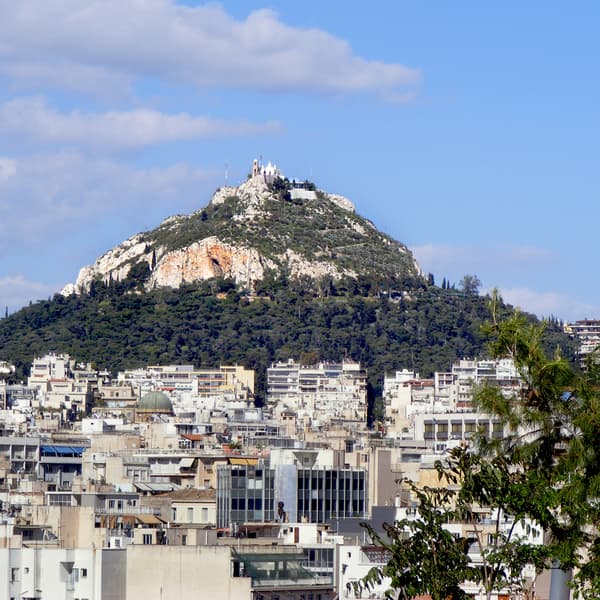
View of Laikavitos Hill Phew! After climbing that staircase... I wish I'd stayed with the losers and skipped the arch. I'm with you.
Once you've reached the top of the staircase, turn right onto Stratonos Street. As you walk along, on your left side is the Acropolis and a row of olive trees. If you happen to hear the sound of the crickets, it's certainly evocative. But it's even more so for Athenians, who grew up watching the black-and-white movies that were filmed in this neighborhood back in the 1950s and 60s.
Read more...Show less
Now look to your right over the rooftops of Athens. You'll catch glimpses of another hill off in the distance. This cone-shaped mound is Laikavitos Hill. It's the highest hill in Athens, topped with a tiny white church at just over 900 feet above sea level.
By comparison, the Acropolis is only 490 feet tall. The Laikavitos Summit, which can be reached by a funicular, has a restaurant and a view terrace. Although it looms high over the cityscape, Laikavitos Hill will always be overshadowed by the shorter hill you're circling right now. Continue along Stratonos, you'll soon reach the small church of St.
George of the Rock. At the church is a fork in the road. Go uphill along the left fork. You'll soon be immersed in a maze of tiny, whitewashed houses. This charming village is the neighborhood of Anafiotika. Anafiotika.
Anafiotika
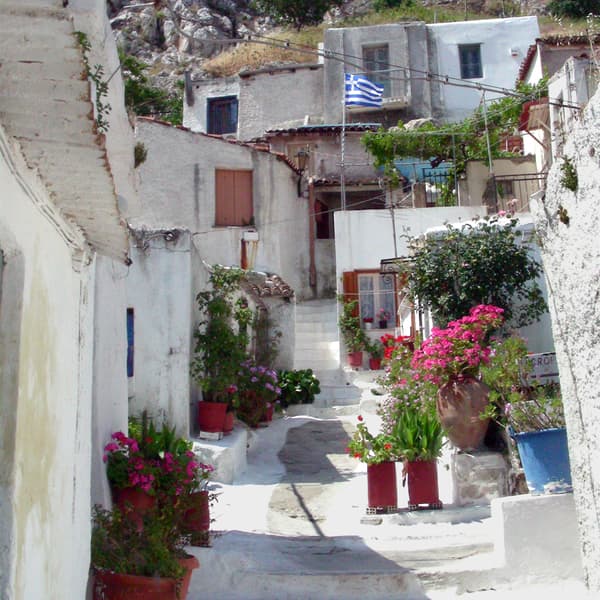
As you enter the narrow lanes of whitewashed homes, don't worry about getting lost. Just keep following signs that point to Acropolis, even if the path seems impossibly narrow. You'll eventually emerge out the other side. Weave through narrow paths lined with flowers and dotted with flowers.
You'll eventually reach the top of the hill, dotted with flowers, and dotted with cats. Cats dozing peacefully in the sunshine or slithering luxuriously past your legs. In this delightful spot, nestled beneath the walls of the Acropolis, the big city seems a world away. This neighborhood of Anafiotika was built by people from the tiny Cycladic island of Anafi.
Read more...Show less
In the 19th century, after Greece gained independence from the Ottomans, they came to Athens looking for work. Posters of Anafi hang here and there, evoking the sandy beaches of the ancestral home island. Some descendants of the original islanders still live here in Anafiotika, or Little Anafi. But it's slowly becoming a place for wealthy locals to keep an island cottage right here in the city.
Keep following the Acropolis signs. As you wander through the oleanders, notice the male fig trees. They're the ones with no fruit that keep away flies and mosquitoes. Smell the chicken manure fertilizer.
Peek into delicate little yards. And enjoy the blue doors and maroon shutters. It's a transplanted Cycladic island world. Keep following those Acropolis signs.
You'll know you're on the right track when you see a religious building with the date 1874 on a wall plaque. If you're not there yet, you can pause the audio guide now and restart it when you reach there. Once you've reached the religious building with the date 1874 on it, listen carefully. The directions get a little complicated.
Follow the narrow walkway a few more steps and you'll emerge from the maze of houses. As you emerge, you'll soon hit a fork in the road at a wider cobbled lane. At the fork, turn right, going downhill. Continue down the steep incline.
You'll soon hit a wider road. Turn left and walk along Theorias Street toward the small Byzantine-style church of the Metamorphosis. Just before the church, on the right, is a steep staircase. It's called Klepsidris Lane.
Look for a sign in Greek letters starting with the letter K. Go down the steep, narrow staircase called Klepsidris. If you're lost, get out your map and find the Metamorphosis Church and the church at the nearby Klepsidris Staircase. Continue down the atmospheric stairs.
Cross the street called Tholu and continue still further down Klepsidris. The lane gets even narrower. Yes, you're okay. Keep going even between the plants.
Eventually, you'll run into a railing overlooking some ruins. Pause at the railing and look down. Survey the field of rubble and the domed ruin called the Tower of the Winds. The Roman Forum
Roman Forum, Tower of the Winds
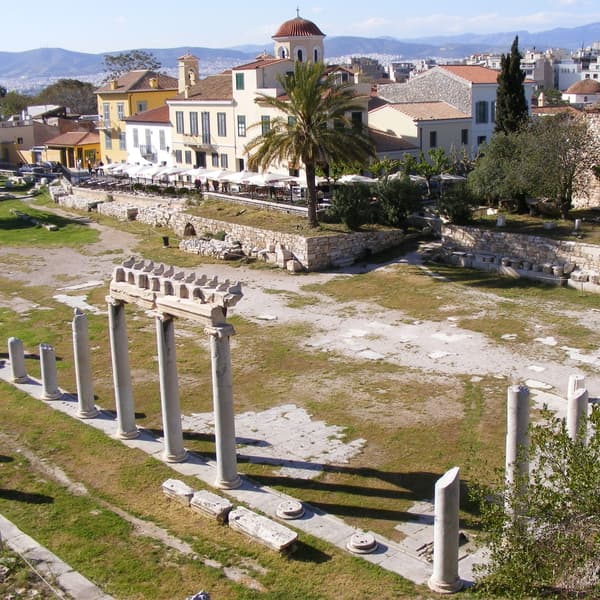
and the Tower of the Winds. The rows of columns framing this rectangular former piazza were built by the Romans. They conquered Greece around 150 B.C. and stayed for centuries.
This square, sometimes called the Roman Agora, was the commercial center or forum of Roman Athens. The columns supported a covered porch providing shade for shoppers browsing the many stores fronting the square. Picture this place filled with Roman bureaucrats and Greek locals. The forum, or open-air piazza, was a feature found in every city Rome conquered.
Read more...Show less
Here, it was dotted with Greek-style buildings and statues. Pretentious Romans, sprinkled their Latin conversation with Greek phrases as they discussed the plays of Sophocles and Aristophanes. Many a Greek slave was more cultured than his Roman master, reduced to the role of warning his boss not to wear a plaid toga with polka-dot sandals. It's possible to enter the forum for a closer look at the rubble.
The entrance is way on the other side. But our walk won't go there since you can see just about everything from this vantage point. Now, take a few steps to the right for a closer look at the octagonal-domed Tower of the Winds. Built in the 1st century B.C., this building was an ingenious combination of clock, weather station, and guide to the planets.
The tower was once capped with a weather vane in the form of a bronze triton, half man, half fish. Bronze rods, no longer visible, protruded from the walls and acted as sundials to indicate the time. And when the sun wasn't shining, people told time using the tower sophisticated water clock powered by water piped in from springs on the Acropolis. Much later, under Ottoman rule, dervishes used the tower as a place for their whirling worship and prayer.
Look close at the tower's carved reliefs. They depict the traditional eight winds of the world as winged humans. They fly in, bringing the weather. Continue walking downhill to our next destination, Agora Square.
To get there, curve right to the left then left around the forum fence going downhill. As you walk down the hill, you'll get a close-up look at the Tower of the Winds. See if you can find these reliefs. First, a boy with a harp.
Then, a boy with a basket of flowers. He represents the summer wind. A relief with a circle. And, a guy blowing a conch shell.
He's imitating Boreas, the howling winter wind from the north. Just below the tower, the Tower of the Winds, find Aolu Street. Continue down Aolu Street one block. The street opens up into the leafy, restaurant-filled area called Agora Square. Agora Square. Agora Square.
Agora Square, Library of Hadrian
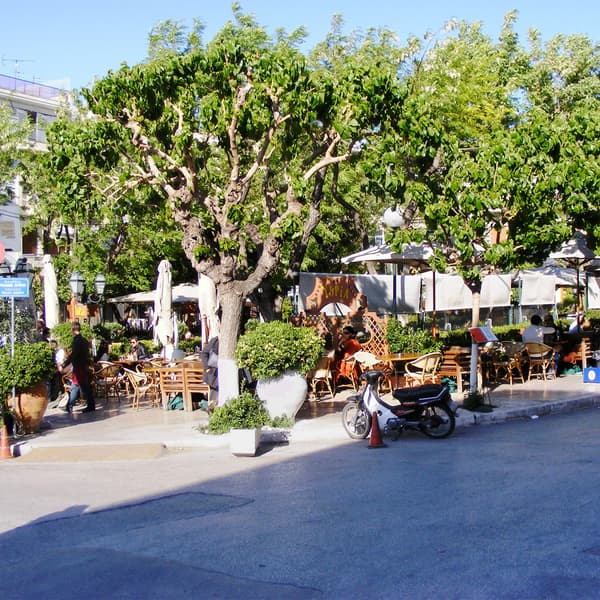
And the Library of Hadrian. Agora Square is the touristy epicenter of the Plaka. You have your choice of restaurants where you can dine with Brits on holiday or have a beer with a group of Aussies. Agora Square is also near internet cafes, souvenir shopping, and it's a stop for one of the city's tourist trains.
The Plaka can be both atmospheric and crassly touristic. Its streets are lined with souvenirs, tacky tavernas, a smattering of small museums, ancient museums, ancient ruins, and exhausted tourists. The narrow, winding streets can be confusing at first, but you can't get too lost with a monument the size of the Acropolis looming overhead. Think of the Plaka as Athens with training wheels for tourists.
Read more...Show less
After this walk, you can decide whether to settle in or to venture outside for a change of scenery. For a very quick change of scenery from the tacky Plaka, look to the left of the square. There you'll see the ruins of the Library of Hadrian. Four lone columns sit atop apse-like foundations.
This was once a cultural center with a library, lecture halls, garden, and art gallery. It was built in the 2nd century A.D. by the Greek-loving Roman emperor. Most likely, it was frequented by sophisticated Greeks while their Roman overlords crowded the nearby tavernas for the wet toga contests.
From Agora Square, continue walking downhill along Aolu Street. Wet toga contests? Yeah. The winner got a statue of Hadrian with sunglasses and worry beads.
Oh, brother. After one block, Aolu Street intersects with the Pandrosu Market Street. Keep in mind that this claustrophobic lane is worked by expert pickpockets. Pause at the intersection and look to the right up Pandrosu Street.
You may see merchants sitting in folding chairs with their backs to each other, competition having soured their personal lives. and personal relationships. Now, turn left on Pandrosu Street, lined with souvenir shops. The second shop is dedicated to the round goddess, soccer.
Soccer widows are as prevalent in Greece as football widows are in the USA. Continue down Pandrosu Street, wading through the tacky tourist souvenirs until you spill out at the big and busy Monastiraki Square. When you reach Monastiraki Square, stand in the center and look to the left. And take it all in.
Monastiraki Square
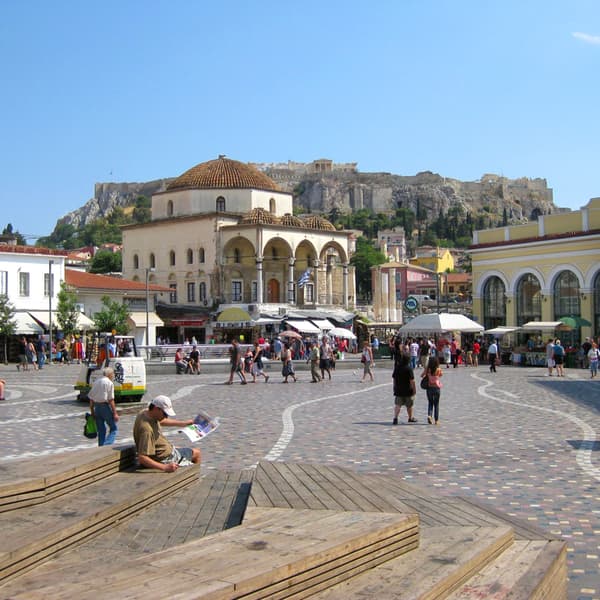
Monastiraki Square. We've made it from Syntagma Square, the center of modern Athens, to the city's other main square, Monastiraki, the gateway to the touristy old town. You'll hear the name Monastiraki a lot. It refers to the square, the flea market action nearby, and the surrounding neighborhood.
To get oriented, stand in the middle of the square and face the cute little church in the center. It's the church with the cross on top. Facing the church, you're facing north. The Church of the Virgin was built in the 12th century in the Byzantine style as part of a big monastery.
Read more...Show less
When the monastery was torn down, this was all that remained, and it gave the area its name, Little Monastery, or Monastiraki. The church is mostly restored with a much more modern bell tower. Beyond the church, looking north, Athenas Street runs north from the square. Strolling up this street, perhaps after this walk, gives you a great feel for thriving, modern Athens.
It leads to Athens' central market, Ammonia Square, and, after about a mile, to the National Archaeological Museum. Now, pan to the right. Just beyond the little church is the head of Ermu Street. That's the bustling shopping drag we walked down earlier on this tour, though here, it's no longer traffic-free.
If you turned right and walked straight up Ermu, you'd be back at Syntagma Square in about 10 minutes. Continue panning to the right. In front of the little church is the head of Metropolio Street, also known as Souffleki Row. This atmosphere, acclaimed as clogged with busy restaurants with outdoor tables.
Their specialties are souffleki and gyros. Souffleki is grilled meat either served on a plate with side dishes or wrapped in a pita bread sandwich. The restaurant on the corner, Biroctaris, is best known. Inside, the walls are lined with photos of famous politicians and artists who've come right here for their souffleki.
Two other joints just next door, Thanassis and Savas, have a better reputation. You can eat a sit-down meal or order a cheap souffleki sandwich to go. For me, the best cheap meal in town. Just pay at the cashier, then take your receipt to the counter and claim your meal.
Continue spinning clockwise. Next comes Pandrosu Street, where you entered the square. Just past that is a building with a balcony. This was a former mosque.
Look over the wooden door to see its original Arabic inscription, known as Tzami, from the Turkish word for mosque. This was a place of worship from the 15th till the 19th centuries. Today, it's a branch of the Museum of Greek Folk Art. You can climb up to the front balcony for fine views over the square.
To the right of the mosque is the head of Ario Street. Behind the fence along Ario Street, you might glimpse some huge Corinthian columns. This was the opposite end of the Library of Hadrian complex we viewed earlier. Ario Street stretches up toward the Acropolis.
If you were to walk a block up this street then turn right, you'd reach the ancient Agora, one of Athens' top sights. Beyond the Agora is the delightful Thessio neighborhood, the ancient Keramikos Cemetery, and the Ghazi district. As you continue panning clockwise, next comes the pretty yellow building that houses the Monastiraki Metro Station, which we'll visit in a minute. The stands in front of the station sell seasonal fruit.
They're popular with local commuters. Just past the station, Efestu Street leads downhill into the flea market. There you'll find antiques, jewelry, cheap clothing, and lots of great people watching. If locals need a screw for an old lamp, they know they'll find it there.
Keep panning clockwise. The area in the distance is the happening Psyri district. For years, a run-down slum, this zone is being gentrified by twenty-somethings with a grungy sense of style. It may seem foreboding and ramshackle, but it's actually fun to explore, packed with cutting-edge bars, restaurants, cafes, and nightclubs.
If you're hesitant, wander through by day and get your bearings. Then, if you're comfortable, head back at night when it's buzzing with activity. Now, finish your walk by stepping into the Monastiraki Metro Station. The Monastiraki Metro Station.
Monastiraki Metro Station
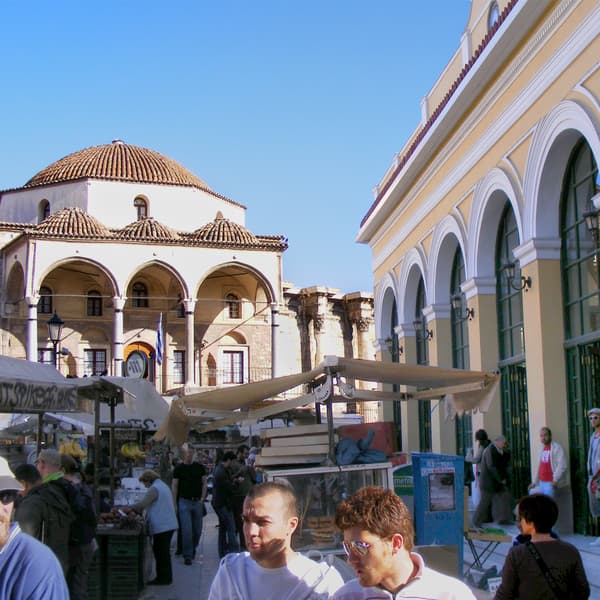
This was Athens' original train station, built by the British in the 19th century. The pleasant yellow exterior is neoclassical, with a dash of Byzantine in the taller-than-usual arches. Now, it's a bustling metro stop at the intersection of two lines. Line 1, the old line, colored green, has connections to the port of Piraeus, the Thessio neighborhood, and Victoria, near the National Archaeological Museum.
The more modern, line 3, colored blue, connects to Syntagma Square and the airport. The metro exemplifies Athens' resurgence in the 21st century. After joining the European Union in 1981 and adopting the Euro in 2002, the Greek economy boomed. EU subsidies flowed in for major infrastructure projects, such as the metro.
Read more...Show less
Ermu Street was pedestrianized. Monastiraki Square, and Athens got the new Acropolis Museum and a new airport. As host of the 2004 Summer Olympics, Athens cleaned up its city to welcome the world. Then, in 2008, the worldwide recession hit, and the Greek government nearly went bankrupt.
Thanks to a massive EU international bailout and austerity measures by the Greek government, Greece is slowly crawling its way back. The metro also illustrates how so much ancient Greek history has been buried in the last couple thousand years. If you were to ride the escalator down, you'd find recent excavations exposing a bit of ancient Athens. As they were digging to build the metro, they uncovered an ancient aqueduct.
It was constructed in the 2nd century A.D. by Emperor Hadrian. The aqueduct channeled water from a river that ran through town. Hadrian's engineers put a roof over it using the Roman brick you see today to turn the river into an efficient sewer system.
A mural shows the treasure trove archaeologists uncovered with the excavations. This walk has taken us through 2,500 years of Athens' history, though in reverse order. We started in modern Athens at Syntagma Square and Ermu Street. Next, we saw medieval Athens, Orthodox churches, and the winding streets of the Plaka.
Finally, we've seen ancient ruins, both Greek and Roman. Now that you know the story of this great city, step back outside into 21st-century Athens. Explore and enjoy this global capital, the springboard for so much of Western civilization and the place that more than one in three Greeks call home. Thanks for joining me on this Athens City Walk.
If you're ready for a break, fill up on Souflaki Row. If you're doing more sightseeing in Athens, we also have audio tours for the Acropolis, the Ancient Agora, and the National Archaeological Museum. Remember, this tour was excerpted from the Rick Steves Greece Guidebook. For more details on eating, sleeping, and sightseeing in Greece, refer to the current edition of that guidebook.
For more free audio tours and podcasts, and for information about our TV shows, bus tours, and travel gear, visit our website at ricksteves.com. Thanks to Gene Openshaw, the co-author of this tour. For more information about our TV shows, this tour was produced by Cedar House Audio Productions. Thanks for joining me, and goodbye for now.
Free
GPS-guided walking tour
No account needed. Walk at your own pace.
Free
20 stops ·