14 stops
GPS-guided
57 min
Duration
Free
No tickets
About this tour
A guided tour of Naples' Archaeological Museum in Italy with 14 stops. Highlights include Naples' Archaeological Museum , Roman Portrait Busts , and Farnese Collection.
14 stops on this tour
Naples' Archaeological Museum
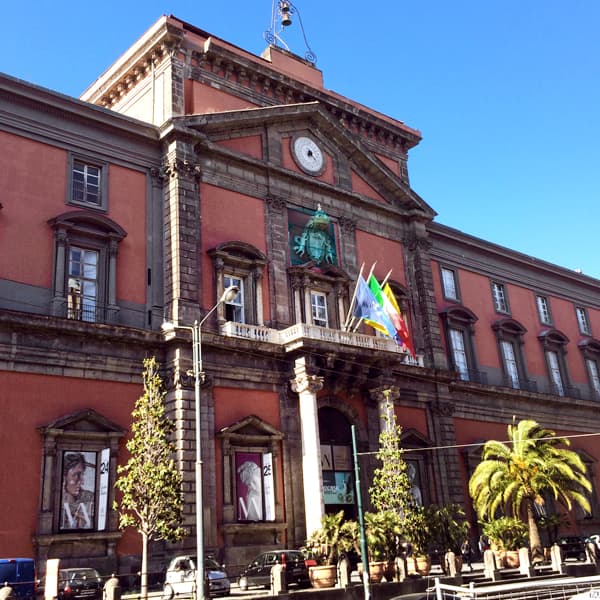
The Naples Archaeological Museum. When Pompeii was excavated in the 1700s, the king of Naples bellowed, bring me the best of what you find. Pompeii's treasures ended up here. For lovers of antiquity, this museum alone makes Naples worth a stop.
Hi, I'm Rick Steves. Thanks for joining me on a tour through one of the world's great museums of ancient art. We'll get up close and personal with the Roman world of 2,000 years ago. We'll see supersized statues, including a 10-foot-tall Hercules and a 15-ton raging bull.
Read more...Show less
We'll get glimpses of ancient celebrities, like Cleopatra and Alexander the Great. And we'll see once-forbidden erotic art, showing ancient Romans doing the nasty. The museum's highlight is its unparalleled collection of mosaics, frescoes, and statues excavated from ancient Pompeii. These give us a fascinating look at those people whose world was suddenly rocked by the eruption of Mount Vesuvius.
Now let's get started to see unforgettable treasures of the ancient world set in the halls of a grand palazzo, the Naples Archaeological Museum. To help us along the way, I've invited a good friend and virtual travel buddy. Welcome, Lisa. Ciao, Ricardo.
Lisa will give us helpful directions and sightseeing tips throughout the tour. And my first tip is to be sure you get our tour updates. Just press the icon at the lower right of your device. You'll find any updates and helpful instructions unique to this tour.
Things like closures, opening hours, and reservation requirements. There's also tips on how to use the tour. There's also tips on how to use the tour. There's also tips on how to use this audio tour and even the full printed script.
Yes, so pause for just a moment right now to review our updates and special tips. It's okay, we'll wait. And then... Let the tour begin! The tour begins.
Tour Begins
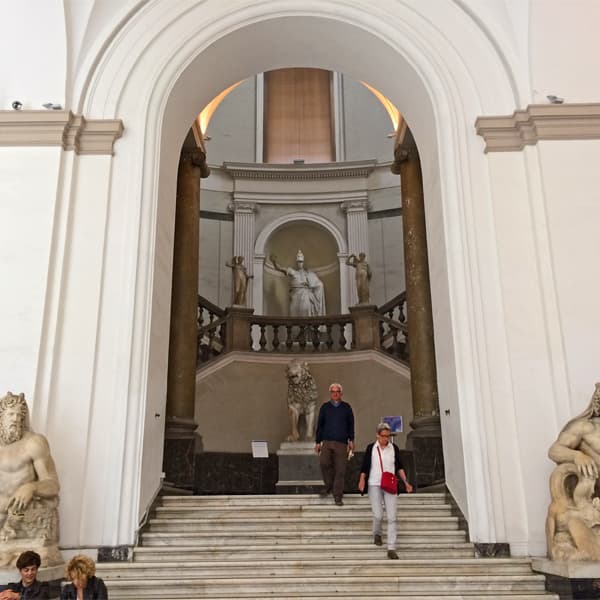
Start in the museum's grand entry hall. As you enter, continue straight ahead through the hall. You'll reach the base of a grand staircase. Stop here, face the staircase with its lion statue, and get oriented.
Rick? On this tour, we'll be seeing statues, mosaics, and frescoes from the ancient Roman world. As you go, make this grand staircase your orientation point. First, we'll see rooms to the right with the Farnese collection.
Read more...Show less
This eclectic set of statues originally used to be a museum, originally came from the city of Rome itself. Next, we'll return here and climb this staircase to see mosaics and frescoes from the Roman city of Pompeii. Finally, we'll ascend this staircase to the top floor to see everyday objects from Pompeii, as well as some exciting statues from Pompeii's sister city, Herculaneum. So, let's get cracking.
Facing the grand staircase, turn right. Enter the door marked COLLEZIONE 4. This is the first room of the Farnese collection. Roman Portrait Busts
Roman Portrait Busts
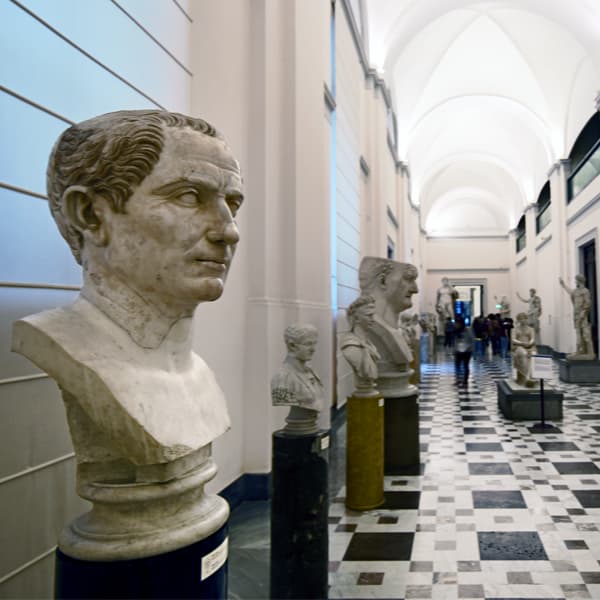
Pause near the entrance and survey this long room. It's lined with portrait busts. You'll see Roman senators, orators, emperors, and first ladies. These were acquired by the wealthy Farnese family of the 15th century.
The Farnese's loved the ancient world. They decorated their lavish homes, villas, and gardens with these priceless gems. Start about a third of the way down the hall, on the left, with several busts of Emperor Caracalla. With his curly hair and scraggly beard, Caracalla is easy to spot.
Read more...Show less
Marvel at how he evolved from an idealistic youth to a cruel tyrant. At the peak of his reign, Caracalla built the mammoth Baths of Caracalla in the city of Rome. At the time, that bathhouse was one of the largest structures on earth, and it was decorated with larger-than-life statues. I sense a bit of foreshadowing here.
Exactly. We'll soon be seeing those very statues. Continue down the Hall of Busts. About two-thirds of the way down, pause at the statue of a woman on a throne called Seated Agrippina.
Look how naturally this Roman noblewoman crosses her legs and just kicks back. She glances to the side with a pensive look. This is no youthful goddess, but an ordinary woman. Notice her hairstyle.
Tight curls, braided in back. This was typical for the time. The Romans excelled at ultra-realistic portraits like this, showing real people with their everyday features. And speaking of ordinary-looking, check out the huge head displayed nearby.
This is the emperor Vespasian. Vespasian's smiling. He had a reputation as a humble man, even as he ruled the vast Roman Empire when it was approaching its peak. Oh, let's say somewhere around the year 79 A.D.
79 A.D.? Sounds like more foreshadowing. You got it. Now, look in Vespasian's right ear.
There's a hole there. Go ahead, look inside and see how the heads hollow. This was hollowed out in medieval times, though nobody knows exactly why. Hmm, that's strange.
Let's continue to the end of the hall. As you go, glance to the right at the most famous Roman of all, Julius Caesar. Exit out the far end of the hall. As you exit, turn right.
After a dozen steps, take your first left. This puts you into room 13. You're now at the heart of the Farnese Collection. The Farnese Collection.
Farnese Collection
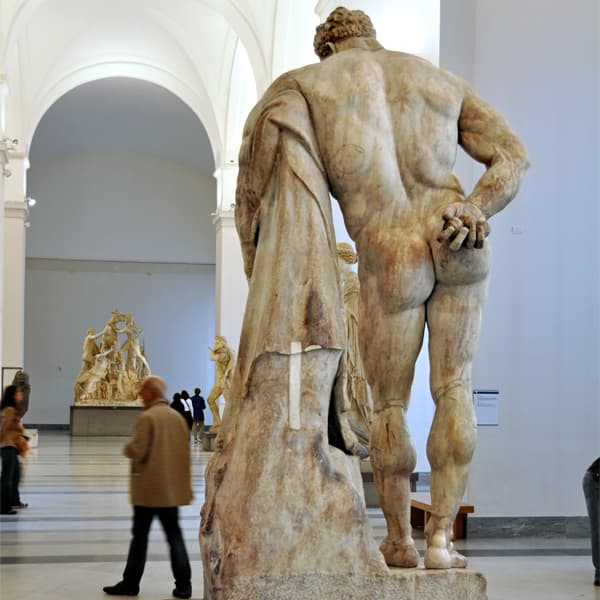
Take a moment to just browse this grand hall filled with larger-than-life statues. Many are over 10 feet tall. You'll see Greek and Roman gods and goddesses. There are heroes and mythological figures.
Find your favorite. One of mine is the so-called Venus Calipage, literally the Venus of the perfect buttocks. As you check her out and the other statues here, consider the fascinating story of how these statues ended up in this museum. Most of these were sculpted around 1,800 years ago to decorate that building I mentioned earlier, the Baths of Caracalla.
Read more...Show less
That was a public bathhouse, a kind of fitness club in the city of Rome. It was massive, covering 60 acres. How big is 60 acres? Well, Lisa, Disneyland is 85 acres.
Okay, so Disneyland without Frontierland. That's it. The bath's main hall was two stories tall, and the place could accommodate 1,600 bathers at the same time. Romans hit the baths daily.
They came to exercise, work up a sweat in the steam rooms, then cool off in the swimming pools. There were shops, cafes, even libraries. Statues like the one surrounding us now were an integral part of the decor. They graced courtyards, fountains, and the Grand Central Hall.
They epitomized the classy culture of the Greek world that the Romans aspired to emulate. The Baths of Caracalla were famed throughout the ancient world, one of the largest building complexes on Earth. These statues themselves were also famous. They were of extremely high quality, done on a colossal scale, rarely attempted before or since.
But when Rome fell, that was around 500 A.D., the Baths of Caracalla fell with it. These statues you're walking among were lost, buried under centuries of rubble. But they were still famous because medieval scholars knew them. They knew them from descriptions by ancient writers.
In the 1500s, with the Renaissance, there was a rebirth of interest in the ancient world. The Farnesis, a wealthy Roman family, financed an excavation. They were led by Alessandro Farnesi, better known as Pope Paul III. Wasn't he the man who hired Michelangelo to paint The Last Judgment?
That's the Pope. The Farnesis excavated the Baths, hoping to scavenge building material for their new palace at the Campo di Fiori in Rome. But when they stumbled on these statues, it was a huge, huge bonus. They cleaned them off, hauled them across town, and used them to decorate their gardens, courtyards, and dining rooms.
These statues became the nucleus of the Farnesi family's renowned collection of antiquities. Each subsequent generation added to the collection. As Farnesi princesses married into royalty, these treasures were soon gracing palaces throughout Europe. By the 1700s, the collection was in the hands of the Farnesi heir Charles III, the highly-cultured king of Naples.
Charles had been raised in Naples and now ruled Spain. In 1734, Charles brought the family collection here to Naples. He commissioned this museum to house the collection. And today, we can see the Farnesi collection fully restored and displayed in this bright and spacious hall.
The hall is designed so that, walking among the statues, you get a glimpse of their original setting in the famed Baths of Caracalla. Let's focus on a couple of the collection's most impressive statues. Hey, Lisa, look. At the end of the hall, there's a woman being tied to a bull.
Can we start there? Okay. Let's start with that one. The Toro Farnesi.
Toro Farnese
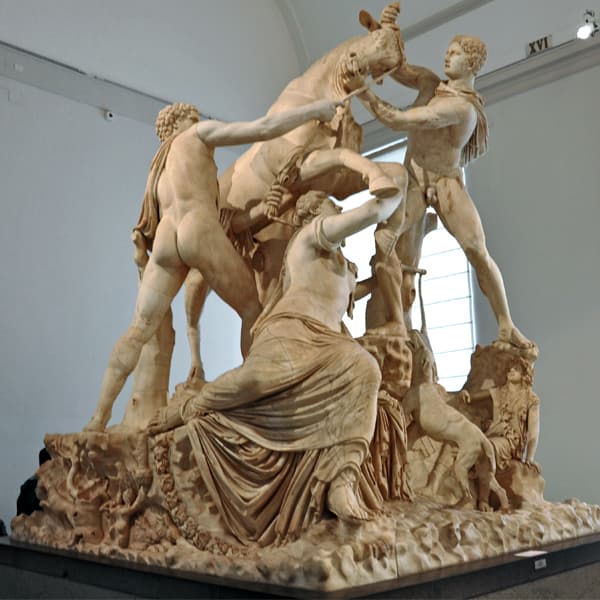
The tangled Toro Farnesi tells a thrilling Greek myth. Two men struggle with a wild bull. They're tying a woman named Dersi, she's on the lower left, to the bull. Dersi had mistreated the men's mother, and now they're getting their revenge.
They tie Dersi to the horns of a bull. Dersi reaches up and pleads for mercy. But the boys are determined, and Dersi is about to be dragged off to be dashed against the mountainside. Slowly circle the statue and watch the action come to life.
Read more...Show less
The men's capes flail as they struggle. The bull twists his head, snorts and rears back, kicking his hooves high in the air. At the bull's feet, a dog looks up at the bull and snarls. As you continue to circle, check out the base of the statue.
Trees and animals evoke the setting, the sacred mountain of Dionysus. Almost overlooked in all this commotion is the central figure of the whole story. There she is, standing at the back, the boy's shamed mother, Antiope. She looks on, overseeing this harsh, ancient justice with a kind of satisfaction.
She carries a spear and gestures with her hand as if to say, well, that's what you get. This statue was understandably famous in its day. It was sculpted for the Baths of Caracalla in the 3rd century. It was based on an even earlier statue done in bronze three centuries before.
For the Baths, the artist supersized it. At 13 feet, the Toro Farnese is the tallest ancient marble group ever found. In fact, it's the largest intact ancient statue, period. All of the main figures, the brothers, the bull, and Dersi, they're all carved out of a single piece of marble.
The block would have weighed 15 tons. Imagine if you made a mistake and ruined all that priceless marble. In the 1500s, the Farneses hired Michelangelo, among others, to restore the statue. For that part of the story, check out the museum's explanatory panels on the wall nearby.
The panels show which pieces were original and which were filled in by the restorers. You'll see various restoration projects done over the years. If you study the panels, you can see that Michelangelo's contributions are in blue. He repaired bits like the head of Antiope, the torso of Dersi, and the dog.
I love the dog. As the people of Dersi as the panels show, the restorers had to piece together broken fragments like a jigsaw puzzle. For example, for the man holding the bull, all they had was a torso. His missing pieces were never found.
So the restorers were asked to use their imagination as they filled in those gaps. As the panels explain, the restoration was done in stages. In the 1500s, restorers added his arms, his legs, head, and the tip of his cape. In the 1800s, other restorers added his genitals, they were done in gesso, or plaster.
The panels also explain that the restorers added a few new details of their own. Things like the shepherd boy near the dog, the lyre, and Dersi's basket. No one knows whether they were part of the original scene, but they do help flesh out the story. Now step back and take in the entire statue.
Imagine the statue in its original setting in the Baths of Caracalla. Mentally undressed, your fellow tourists and picture them as buck-naked Romans strolling by the statue on their way to the pool or the sauna. They'd be impressed by how classy the baths were, with its fancy art and references to Greek myths. The Toro Farnese may have even been used as a fountain.
There's a hole in the base. Water may have been pumped up through it to create the effect of a waterfall cascading down the mountainside. This would have added even more motion, sound, and fury to an already dramatic scene. The Toro Farnese is both massive and masterful.
It brings to life the grandeur that was Rome. Let's move on. Can we put some clothes back on those naked tourists now? Your call.
At the opposite end of the hall stands the next statue we'll see. Start heading toward the big, muscular man, the Farnese Hercules. The Farnese Hercules.
Farnese Hercules
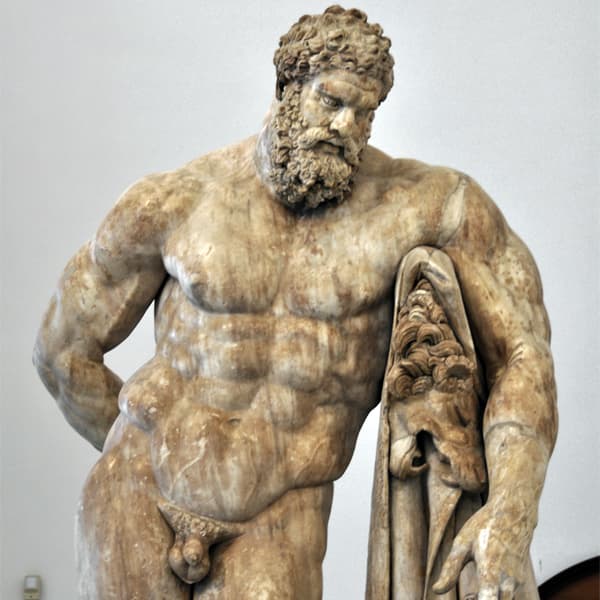
The great Greek hero looks exhausted. He leans on his club and bows his head. His veins bulge and his knotted muscles sag ever so slightly. His face is weary and deep in thought.
Hercules, the strongest man on earth, had been ordered by the gods to perform twelve tasks. This statue shows labor number eleven. Think of what he'd already been through. Labor number eleven.
Read more...Show less
Labor number one. Slaying the lion of Nemea. No problem. Powerful Hercules strangled the lion then skinned it as a trophy.
In fact, you can see the lion's hide draped over Hercules' club. Next labor. Killing the three-headed Hydra. Check.
Done that. And so on. But with each successive labor, the tasks got harder. The travel in between got farther and Hercules got older.
The statue clearly depicts the heavy body of a middle-aged man. Now Hercules is on the daunting eleventh labor, retrieving three golden apples from a far-off garden. To do it, he had to travel the world, fight both men and gods, free Prometheus from his rock, and even carry Atlas's weight of the world on his shoulders. Now he's finally returned with the prize, the golden apples.
Hercules has them cupped in his right hand. You can see the apples if you circle around behind the statue. Hercules should be happy he's almost done, but the gods have just told him he did labor number eleven wrong. He'll have to go all the way back and return the apples.
And after that will come the final labor, number twelve, the most impossible of all, to descend into hell itself. The Farnese statue captures the moment when Hercules gets the bad news, reflects on it all, and thinks to himself, Oh, man! Examine the statue more closely and admire it. Admire the craftsmanship.
It's ten and a half feet tall. His muscles are incredibly well defined. His upper body and arms are almost ridiculously oversized, like a bodybuilder on steroids. Circling around back, you can see his tight buns and bulging, knotted calves.
The Farnese Hercules was sculpted in the 3rd century A.D. for the Baths of Caracalla. On the base, you can see the sculptor's signature. It's done in Greek letters, reading, Glycon of Athens.
Like the Toro Farnese we just saw, this was a large-scale marble copy of an earlier work. That was a famous Greek bronze from the 4th century B.C. This image of Hercules was enormously famous in the ancient world. Dozens of similar statues, some marble, some bronze, have been found in Roman villas and baths.
In 1546, the Farnese Hercules was unearthed at the Baths of Caracalla. It was in fragments. Yes, I can see that. There's a line in his left forearm where it was clearly broken.
Oh, and also the lower part of his legs, just below the knees. The forearm is a modern replacement. It's made of plaster. But the lower legs are original.
At first, those leg fragments were thought to be lost forever, so restorers were hired to replace them. You can see those replacement legs displayed on a wall nearby. Kind of like sculptural prosthetics? Well, you could say that.
Only later were the originals found and Hercules was reunited with his fibulas. Once restored, the Farnese Hercules became famous. Tourists flocked to admire it. Art students studied it from a foreign prince.
Louis XIV made a copy of it for Versailles. And petty nobles everywhere put small-scale knockoffs in their gardens. As a result, this curly-haired hero has become the iconic image we think of today when we think of the legendary Greek hero, Hercules. Our next site is located behind Hercules.
Head for the doorway at the end of the hall behind Hercules. This leads into rooms 9 and 10. They house another aspect of the Farnese collection, gems. Start in the farthest room.
There you'll find a freestanding display case. In it is the jewel of this gem collection. It looks like a real fancy cereal bowl. Yes, but it's a priceless object known as the Farnese cup. The Farnese cup.
Farnese Cup
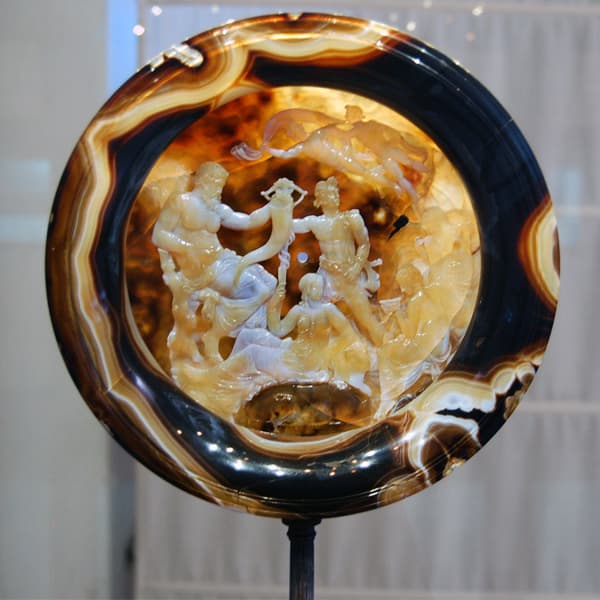
This is a libations cup. 2,000 years ago, a libations cup was an essential part of the everyday ritual of devout pagans. You'd hold the cup in your hand, pour a little water or wine into it, give thanks to the gods, then drink up. This one dates from around 35 B.C.
It was made in Egypt. It's carved out of an agate. Notice how the artist used the rock's different colored layers to create a scene. The bottom layer is amber colored.
Read more...Show less
This makes a neutral backdrop. The people are in white stone. They rise up like cameos. The rim is black with yellow and white ripples.
The cup was carved at a time when Egypt was dominated by Greek culture. The scene depicts both Egyptian and Greek gods. On the left, seated on a throne, is the Greek god Hades, king of the underworld. To the right is the Egyptian god Horus.
He is the god of hunters who made sure there was plenty of game. At their feet sits a woman. It could be either the Greek goddess Demeter or Isis of Egypt. Either way, she represents the fertility of nature.
Between these three figures hangs a cornucopia, another symbol of abundance. And overhead fly the warm winds of prosperity. The symbolism is clear. As ancient pagans drank from this cup, they'd be thanking the gods for being so good to them.
The Farnese cup may also have a political message. Scholars think these gods have the facial features of Egypt's royal family. Take a close look at the goddess Demeter. She may have been a portrait of Egypt's queen, Cleopatra.
By mixing Greek and Egyptian symbols, the cup was proclaiming that Egypt's Greek-speaking rulers would unite the country and bring prosperity. Before we move on, you'll probably want to browse some of the other dazzling objects in these rooms. Take a moment to admire these precious stones, many carved in cameo. Some objects here are ancient, like the Farnese cup.
Others date from Renaissance times. As you browse, think of how coveted these objects have been. They've been fought over, sold, stolen, smuggled, and passed down from generation to generation. The Farnese cup is a perfect example.
Think of its long and winding 2,000-year journey. Get this. The Farnese cup was carved in Egypt back in the days of Cleopatra. But Cleopatra and her lover, Mark Antony, were defeated by Augustus.
He carried the cup off to Rome. As the Roman Empire declined, the cup found a safe home in far-off Constantinople. In 1204, Christian crusaders captured it and awarded it to the German emperor. Next, the cup somehow found itself in far-off Persia.
When it returned to Italy in the 1400s, Lorenzo the Magnificent bought it. It was passed down through the Medici family until a Medici princess married into the family whose name now graces this entire collection, the Farneses. Caught all that, Lisa? I think you lost me somewhere in the Middle Ages.
Well, anyway, our tour's moving on. We're headed now to see more art from the ancient world, this time from the city of Pompeii. Lisa, take us there. The Pompeii collection is upstairs, so from the Farnese gems, start backtracking to where this tour started, the grand staircase in the main entry hall.
Keep walking while Rick sets the scene of what we're about to see. As you backtrack through all these Farnese statues, imagine. It's 2,000 years ago, and statues like these decorated grand structures all across the Roman Empire. One of those Roman towns was Pompeii, located 15 miles from Naples.
Excuse me, Rick, but just a reminder, when you reach Hercules, you'll be turning left, then right, then left again. This puts you back in the hallway of busts. Pass through there, back to the grand staircase. Pompeii was a booming port city of 20,000 people.
It was a typical middle-class Roman town. The streets were jammed with chariots and shoppers. People lived in nice houses. They decorated them with statues in the courtyards, mosaics on the floors, and colorful paintings on the walls.
Then, it all changed. On August 24th, in the year 79 A.D., Mount Vesuvius literally blew its top. The eruption sent a mushroom cloud of ash 12 miles into the air. The white-gray ash began to settle over Pompeii.
In just a few hours, the city was completely covered in a suffocating blanket of fine powder. For the next 1,500 years, Pompeii lay buried and forgotten. Me again. Just a reminder, when you reach the main hall, stop at the foot of the grand staircase.
Me again. In the 1700s, archaeologists discovered the long-lost city. It was a treasure trove, frozen in time. They meticulously removed mosaics piece by piece and cut frescoes from the surviving walls.
The best of it was brought here to the Naples Museum, and that's what we're going to see next. By now, you should be back in the main hall, gazing up at the grand staircase. To reach the mosaics of Pompeii, start heading up the grand staircase. Go up about 15 steps to the mezzanine level.
Say hi to the lion. Turn 90 degrees left at the lion and head up another set of steps. At the top, you'll pass through a doorway under the sign that reads Mosaici. You are now in room 57, the first of the two. Of the mosaic rooms. Mosaics from Pompeii.
Mosaics from Pompeii
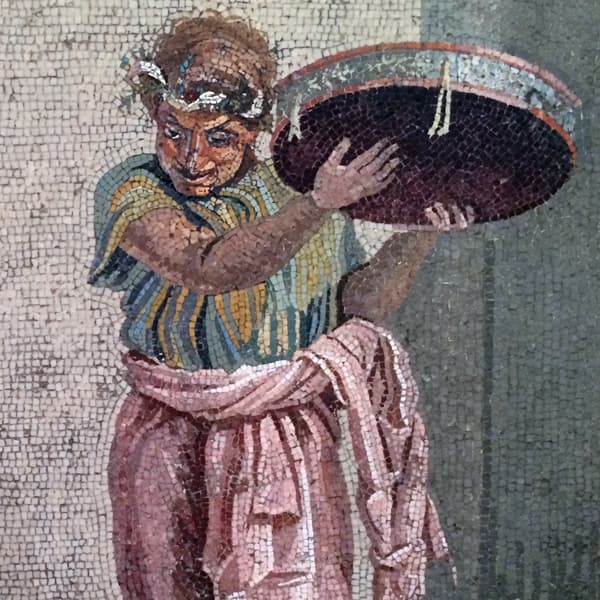
These rooms are lined with mosaics. Imagine them in their original setting, adorning some of Pompeii's ritziest villas. There, they decorated both walls, and floors. But here, they're displayed on the walls like framed paintings.
Start by browsing the mosaics near the entrance. Some of the most popular designs at Pompeii were geometric patterns, battle scenes, and animals. Check out the mosaic of the chained dog. Romans loved their pets.
Read more...Show less
In fact, among the ruins of Pompeii, archaeologists have found a number of dogs preserved in the ash. Many Pompeian homes had dog mosaics like this one gracing the entryway. Some of them, though not this one, came with the Latin phrase cave canum, beware of dog. Stroll into the adjoining room, room 58.
You'll see some colorful columns made of mosaic. These columns once supported an arcade that provided shade for an open-air courtyard. Similar columns and mosaics decorated another popular feature in Pompeian homes, a bubbling fountain. The entire city enjoyed fresh running water brought in by a system of aqueducts.
Continue exploring these rooms of mosaics. In the next room, room 59, there are a number of especially high-quality mosaics. Check out the variety of subjects. A Pompeian family might have had a battle scene on the floor of the den.
Like one on display here. In their dining room, they might have had one of food and a mosaic of a candelabra in the library. They're in remarkably good condition for a city destroyed by a volcano. Well, remember how that eruption of Mount Vesuvius impacted Pompeii.
It wasn't obliterated by hot lava. The destruction came mostly from light ash that fell like snow. The ash collapsed the roofs of the houses but left the walls intact. That's what you see today when you visit Pompeii.
An entire city but without a lot of roofs. In a way, it sealed everything in a preservative layer. Including these mosaics. Get close to one of the mosaics.
I like the one of the street musicians. They're stepping to the beat of a tambourine and cymbals. I like this one, too. The scene was created from thousands of teeny tiny pieces of colored stone or glass.
These were pressed into wet plaster. Admire the realism. The musicians and dancers move in a completely natural way. You can even see their shadows.
This particular mosaic was such high quality that it was even signed by the artist. It's there in the upper left corner. Browse more of this room It's clear that Romans enjoyed scenes of everyday life. Yes, there are portraits of everyday Romans.
I like the ones featuring cute scenes of animals, like doves drinking from a cup. Check out the mosaic of the skull. This symbol of death was a popular theme. It was a constant reminder to the Romans that life is brief, so live it up now.
Yeah, carpe diem. You never know when a volcano's gonna blow. Continue a few steps into the next room, room 60. It has more mosaics plus a small bronze statue. The House of the Fawn
House of Faun, Battle of Alexander
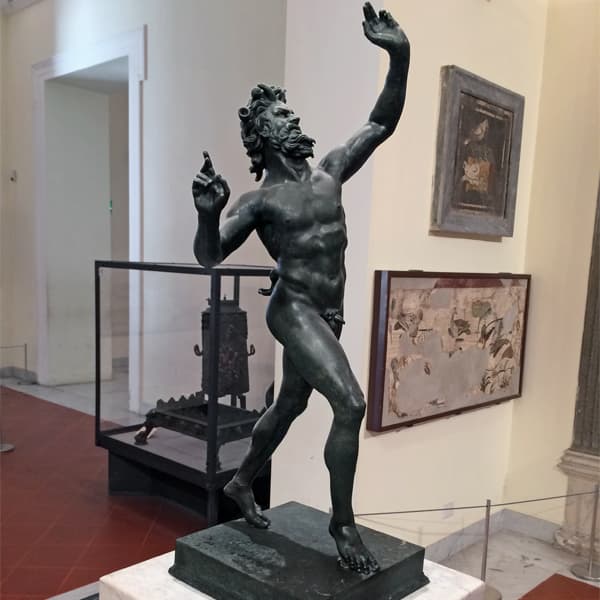
in the Battle of Alexander. The artifacts here in room 60 come from one of Pompeii's grandest villas, the House of the Fawn. This was Pompeii's largest home with more than 40 rooms sprawling across an entire city block. As you can see, it also had some of the best mosaics in town.
One of my favorites is the lion with a baby Dionysus riding on his back. I like the one of the little cat. It looks like he's caught a bird. Oh, and I also like the long frieze made of fruits and vegetation with the two theater masks.
Read more...Show less
The mosaics are lovely, but the real star of the House of the Fawn was its small statue. This is the delightful 20-inch high bronze figure known as the Dancing Fawn. It was the centerpiece of the House of the Fawn and gives the people the house its name. It stood in the main courtyard.
Check it out. It's a masterpiece of natural grace. See how the fawn steps forward with his right leg. Meanwhile, he's raising his left arm.
With this pose, the artist sets his whole body in realistic motion. Ancient people must have been blown away at how the moving world was suddenly frozen in place, like pausing a video. The statue is especially rare because it's a Greek original, not a Roman. So this was actually done hundreds of years before Pompeii's heyday, back in the 4th century B.C.
Back in the days of Plato. And Alexander the Great. Yes, Alexander the Great. I can see where you're going with this.
So let's turn our attention to the right of the statue. You'll see the museum's most famous mosaic, the Battle of Alexander. This mosaic once graced the floor of the House of the Fawn. It's huge, nearly 17 feet wide and 9 feet tall.
It's made of more than a million tiny cubes, or tesserae. Because of its large scale, its subtle coloring, and air of drama, it's considered one of the ancient world's greatest mosaics. What are we seeing here? It's the year 333 B.C.
The Greek conqueror Alexander the Great is fighting the Persians. It's a chaotic scene. The two armies have collided and their spears point every which way. Horses tumble and weapons fall to the ground.
Alexander rides in from the left. He's the one with curly hair and sideburns riding a brown horse. His arch enemy is the Persian emperor Darius, the guy closer to the center. Darius is in a chariot wearing a turban and a beard.
The mosaic captures the defining moment of the battle between these two great leaders. Darius gestures towards Alexander, telling his men, there he is, get him! But Alexander seems completely calm. He locks eyes with Darius.
He's confident he'll defeat him in this pivotal battle. In fact, thanks to Alexander's victory, a great Greek empire soon stretched across the Mediterranean. A couple centuries later, the Romans would inherit this empire. Romans admired and adopted Greek ways.
Educated Romans decorated their homes with Greek motifs like this. Clearly, the owner of the House of the Fawn had class. Our next stop is just a few steps farther in Room 6. We're headed now to the so-called Secret Room.
The what? We're going into the Secret Room. The what? We're going into the Secret Room.
This is the room that displays erotic art from Pompeii. Some of it is rather explicit, so just a heads up. Cave eroticus. Beware of dirty pictures.
Now enter Room 65, also called the Secret Room. Also called the Gabinetto Secreto, or the Secret Room. Erotic art from Pompeii,
Erotic Art from Pompeii
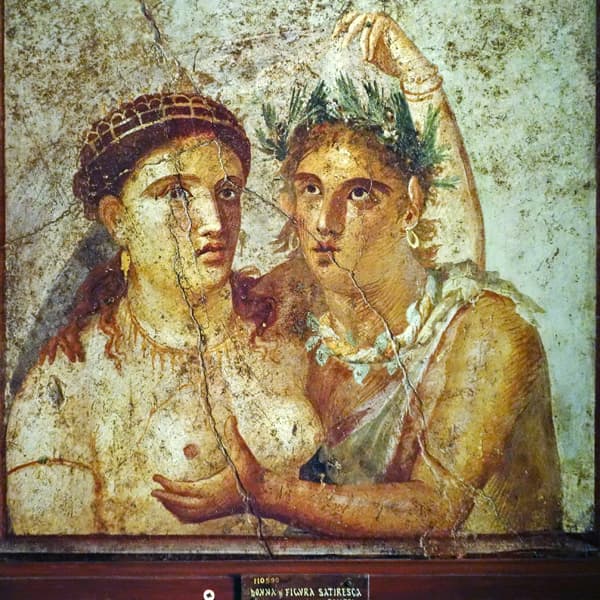
the Gabinetto Secreto. These rooms contain a sizable assortment of erotic frescoes, well-hung pottery, and perky statues. The art once again decorated buildings in Pompeii. They're bedrooms, meeting rooms, shops, and brothels.
Start in the entryway. You're enthusiastically greeted by big stone penises. No wonder this was the Secret Room. These phalluses once graced Pompeii's doorways.
Read more...Show less
A massive phallus was not necessarily a sexual symbol. It could be a magical amulet used to keep evil spirits away from the house. It was a symbol of all things good, fertility, happiness, good luck, riches, straight A's, and general well-being. Step into the next room.
It's lined with frescoes. These paintings depict people having sex. The art is surprisingly realistic and frank. You'll see pale-skinned women and ruddy-skinned men.
They're embracing, kissing, fondling, and more. Many of these body scenes hung on the walls of Pompeii's ritziest houses. They were enigmatic, entertainment for the guests. Check out one particular fresco.
It's on the right wall, high up. It's labeled number 12. It shows a faun, playfully pulling the sheet off of a beautiful woman. But what's this?
He turns away, suddenly grossed out by what he finds, a hermaphrodite. That may be the original Mamma Mia! Lisa, it's nice to see you're showing more interest in ancient art. I should have majored in classics.
Let's continue on just a couple of steps farther. Find display number 27 on the right. Well, that's interesting. It shows horny pygmies from Africa in action.
Romans seem to love the wildest scenes imaginable. Round the corner, find a statue, exhibit number 34. It's a statue of a toga. A toga, yes, but don't mention the embarrassing bulge.
Some of this erotic art was clearly not meant to be used as a symbol. It was clearly not meant to arouse passion, but to amuse. Yeah, think of it like ancient dirty jokes. Nearby, find another statue, number 36.
This depicts a satyr and a female goat. They're engaged in... Yep, that's what I thought it was. Well, let's just say an act of intimate lovemaking.
Take a closer look at the statue. Rick! No, I'm checking out the art. Notice that this statue is actually of extreme importance.
Extremely high quality. It's made from a single piece of marble and polished to perfection. Keep browsing. Erotic imagery was more common and acceptable in ancient Rome than it is today.
Remember that even the Roman gods were notorious for their randy behavior. And speaking of the Roman gods... Yes, watching over the art in this room with remarkable aplomb is an image of... Venus, the goddess of love.
And, by the way, also the patron of the city of Pompeii. Now, continue a few more steps to the final room. This back room is furnished like an ancient brothel. The ten frescoes on the wall functioned as a menu of services offered.
It's a virtual Roman Kama Sutra of sex positions. Strangely, the only position that seems to be missing is the missionary. Brothels were just another business in the freewheeling port town of Pompeii. There were 30 of them.
They weren't luxurious establishments, just a few small bedrooms with a stone bench for a bed. Ouch! The walls were often covered with graffiti. Prostitutes wrote their names and satisfied customers gave their reviews.
Erotic trip advisor. Before leaving, check out the glass display cases where there's more phallic art. The bronze statuettes you see here were party favors. They were given out in swag bags at rowdy banquets.
What are the things that look kind of like phallic wind chimes? That's exactly what they were. These were hung in homes and businesses. The tinkling sound scared away evil spirits and warded off the evil eye.
I can see why this room was kept secret for so long. Yeah, for nearly 200 years, this collection could only be seen with special permission from the king. It wasn't until the year 2000 that the general public was finally allowed in. Hmm.
I'm glad we got in. Oh, and it was amazing. I hope it was as good for you as it was for me. These rooms show an aspect of life that's often kept hidden.
You get a sense of our shared humanity, that those ancient Romans really weren't so different from us. And with that, our tour is moving on. From here, we'll be heading upstairs to the top floor. We'll be seeing more treasures from Pompeii that give us another glimpse into the everyday life of these ancient people.
Lisa, take us there. Start backtracking until you reach the grand staircase. Make your way back through the mosaics of Pompeii. As you stroll, think of how these objects got here to this museum.
Pompeii was one of the world's first true archaeological digs. It was discovered in 1748 when the enlightened King Charles of the Farnese family ruled Naples. Charles personally oversaw the dig, and all the best finds went into his personal collection. When you reach the grand staircase, turn left and climb up to the top floor.
As you ascend, you'll pass by a monumental statue of what looks like a Greek warrior. It's actually the son of King Charles, Ferdinand I. The statue's by the well-known 18th-century sculptor Canova. King Ferdinand inherited his dad's collection.
He gathered it all together into one place and officially inaugurated this museum. The grand staircase you're walking up with its fanciful double stairs is the first of its kind. One of the first stairs was the new museum's architectural centerpiece. When you reach the top of the stairs, stop.
Phew, and take a breath. Now, in the next track, Rick will give an overview of our final sights. The Salone Meridiana.
Salone Meridiana
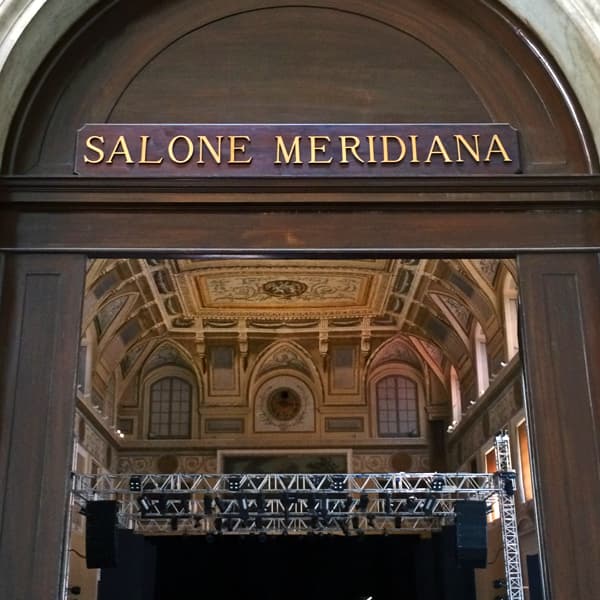
As you stand at the top of the stairs, get oriented. Directly ahead is a doorway marked Salone Meridiana. This leads into a big hall to the left of this grand hall is a series of rooms with more artifacts from Pompeii. To the right are rooms with statues from another city destroyed by Mount Vesuvius, the town of Herculaneum.
First, let's step into the Salone Meridiana. Walk to the center of the hall. Find the long line inlaid in the floor. This is a meridian line laid out in 1791.
Read more...Show less
It's part of a sundial, and it still works. Look up. To the far right corner of the hall. Find the tiny pinhole.
Yeah, there it is. I see it. At noon, a ray of sun enters the hall through this tiny hole. It shines down on the line on the floor.
This shows the month of the year. That is, if you know your signs of the zodiac. Pretty ingenious. Now let's see some more objects from Pompeii.
So enter the rooms to the left of the grand hall. You enter through a doorway marked Vetri e Avorii. If that doorway is closed, don't worry. Just step back out to the grand staircase and find another way in.
Either way, we're headed for room 89. This is the first of a long series of rooms of display cases with artifacts from Pompeii. See you there. Everyday objects from Pompeii.
Everyday Objects from Pompeii
From room 89, start browsing your way through the long row of rooms to the far end. You'll pass by lots of statuettes. Some are made of bronze, some of pottery or ivory. The people of Pompeii had these in their homes.
Many of these statues represented their ancestors. They served like guardian spirits watching over the home. People placed them on a small altar in their house and prayed to them daily. Other statuettes might represent the good spirits who blessed the food.
Read more...Show less
These adorned the kitchen or the dining room table. Keep browsing the display cases as you make your way to the far end. You'll see plenty of bowls and plates, jars and silverware. It's a reminder that the ancient Romans weren't just about big temples and high-class art.
Their daily lives were much like ours. Continue on. You'll see everyday items made out of glass. Before the Romans, glass was extremely rare.
To make it, it required melting sand at very high temperatures, a technological challenge. But the Romans produced glass with relative ease. Even ordinary people might have the things we see here. Vases, drinking glasses, even window panes.
The wealthiest Romans could afford high-quality glass, like the vials for perfume that you'll see. These are practically works of art. Like our next site is. Keep going to the end of the hall.
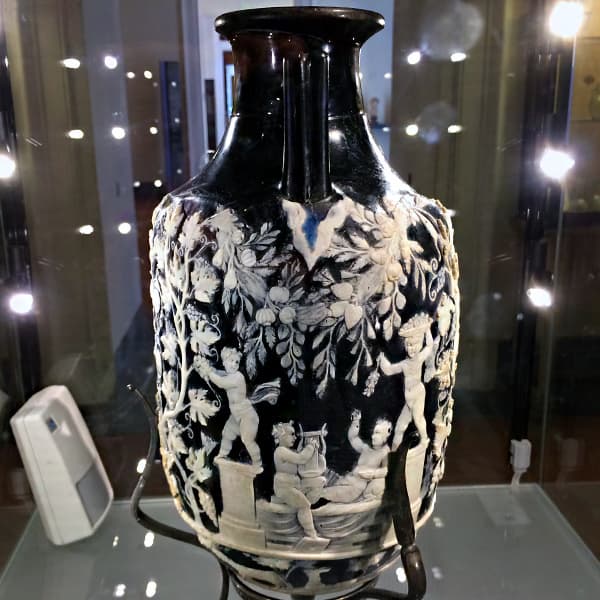
There, in room 85, you run directly into a stunning blue and white vase. This is the so-called blue vase. Walk all the way around it. It's decorated with baby bacchuses.
They harvest grapes and stomp the grapes to make wine. They play music while they work. Then they enjoy the fruits of their labors. The vase is a kind of cameo.
It was made by fusing together two layers of glass, one cobalt blue and one white. Then, the artist etched the scene out of it, creating white figures on the blue background. The detail work is incredible. Though it's a vase, it's actually in the shape of a Roman amphora, a jug for holding wine.
When this fragile object was unearthed at Pompeii, it astounded everyone. Let's learn more about the excavation of Pompeii. From the vase, turn left. In the next room, turn right.
This leads into room 96, a big room, displaying a big model. This model shows the ruins of Pompeii on a 1 to 100 scale. Huh. So Pompeii is exactly 100 times bigger than this model.
Yes. Get oriented to what you're seeing by facing the model from the side labeled Plastico di Pompeii. This is where tourists enter today. You go up that street there.
Do you see it? Yes. Then you spill into the large rectangular area. That's the Forum.
Yes. And I see the Temple of Jupiter at the left end of the Forum. Now, look further up the model. Find the city's two amphitheaters.
Got it. This was all that had been excavated by the time this model was made in 1879. Now turn to another model, the one displayed on the wall. This one shows Pompeii in the year 2004, after another century of digging.
Get oriented to the model. On this one, the tourist entrance is at the lower left. See that? Yes.
Now, find those same two theaters. I see them. And a lot more. Yes.
The model makes it clear that archaeologists have uncovered much more beyond those theaters, all the way up to the huge oval-shaped arena. If you visit Pompeii today, you can see this arena, the theaters, the Forum, and more. And archaeologists are still digging. Our next site, Frescoes from Pompeii, are found in several rooms nearby. So in the next track, Rick and I will lead you there. Frescoes from Pompeii.
Frescoes from Pompeii
The museum has many rooms of impressive frescoes. We'll see just a few. Lisa, get us started. From the model room, continue on.
You'll enter room 83 with exhibits about a temple to Isis. Keep going straight ahead into the next room. Then turn right. I'm with you.
Read more...Show less
Now, turn left and continue on a couple more rooms. Hold on. I'm almost there. This leads into room 75, marked a frescoe.
Stop when you reach room 75. Look for the fresco showing a snake, some birds, and what looks like a puffy man. It's actually Bacchus dressed in a robe of grapes. He stands alongside a mountain.
That, my friends, is Mount Vesuvius, a rare portrait of the volcano painted before it blew its top in 79 A.D. It sure looks like a peaceful scene. In fact, the ancient Pompeians had no idea they were living under a volcano. Vesuvius hadn't erupted for 1,200 years.
When it did blow, the entire top third of the mountain was pulverized instantly. The eruption sent a column of smoke and ash roaring upward, spewing for 18 hours straight. When the dust settled on Pompeii, it buried the city, suffocating 2,000 people. The next day, Vesuvius roared again.
This time, it sent a searing cloud of mud down the mountainside, engulfing the nearby city of Herculaneum. Let's see more frescoes. Turn left and enter room 78. Browse the room.
Imagine these frescoes in their colorful heyday, decorating the walls of Pompeii and Pompeii's homes. You'll see lots of scenes from mythology. Hercules labors, Venus and Mars in love, famous battles, fantastic beasts. Whatever the myth, people tend to be naked, and there's lots of action and drama.
Pompeians also painted their walls with faux architecture to look like classical columns and friezes. Also, there are landscapes. These were designed to turn a wall into a window on the outside world. You'll see everyday market scenes, and there are portraits of everyday Pompeians.
These frescoes had to be carefully extracted from the surviving walls of Pompeii. When you think of it, it seems that paintings from the ancient world are quite rare. Yes. While statues of stone could survive the centuries, paintings rarely did.
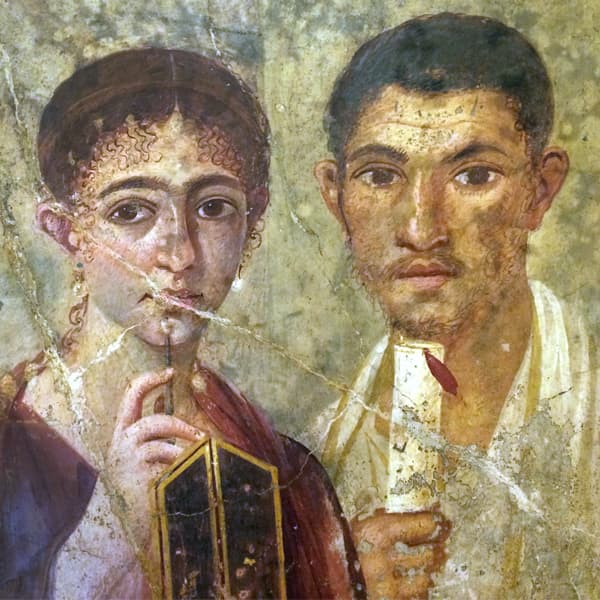
That makes these frescoes particularly precious. One specific fresco in room 78 is worth seeking out. It's a famous portrait showing a man and a woman standing side by side. The man is named Terentius Neo, and the woman is his wife.
Terentius holds a scroll, while Mrs. Neo holds a pen and a writing tablet. This suggests they were typical, educated, middle-class Pompeians. Gaze into their eyes.
They may have been two of the 2,000 people killed by the eruption of Pompeii. of Mount Vesuvius. There are a dozen more rooms of wonderful frescoes. But our tour is moving on.
If we must. Our last stop is the Villa dei Papiri rooms. They're located back near the big hall, the Salone Meridiana. The best way to get there is to just continue ahead, browsing your way through the fresco rooms.
Eventually, you'll spill out into the big Salone. Or you could backtrack the way you came. Whatever route you choose, it'll take a couple of minutes. So pause the audio guide now and restart it when you reach the great hall.
We'll give directions to the Villa dei Papiri from there. So we'll see you back at the Salone Meridiana. The Villa dei Papiri
Villa dei Papiri Scrolls and Statues
scrolls and statues. The Villa dei Papiri rooms are on the other side of the Salone Meridiana. So from either the Salone or from the top of the grand staircase, it's easy to find the entrance to the wing. It's labeled La Villa dei Papiri.
The first room is room 115. These rooms contain artifacts from the town of Herculaneum, which was also destroyed by Mount Vesuvius in 79 AD. The objects all come from a single villa. It was the holiday home of a prominent Roman, in fact, the father-in-law of none other than Julius Caesar.
Read more...Show less
Start to the right of the entrance, in room 114. There's a display case with two shriveled-up and blackened scrolls. They were burned to a crisp when the hot volcanic cloud rushed through Herculaneum. These are just two out of 2,000 scrolls found in the villa.
They were made from papyrus, a kind of paper popular in ancient Egypt. These scrolls are what prompted scholars to give the villa its name, the Villa of the Papyrus. The displays explain how archaeologists have managed to delicately unroll the half-burned scrolls. Some could even be read.
Turns out that most were written in Greek, some in Latin. They cover a wide range of subjects, from Greek philosophy to Latin history. Clearly, Caesar's father-in-law was an educated man. Now, backtrack into room 115 and continue on into room 116.
Here you'll find bronze statues from the villa. As you browse the statues, think of their original location. They decorated the rooms, gardens, and courtyards of one of the largest and most luxurious villas of Herculaneum. Diagrams on the museum wall show the villa's layout with its various courtyards and gardens.
The villa's owner was named Piso, He was the father of Caesar's third wife, Calpurnia. Calpurnia was only 16 when Caesar married her, and Caesar and Piso were the same age. Like Caesar, Piso was a politician. He'd even served as Rome's consul, essentially the de facto ruler of the entire Roman world.
He tangled with the orator Cicero and made alliances with Mark Antony. Piso was a follower of Epicureanism. That was a hedonistic philosophy that urged him to to enjoy life. His fancy villa in the seaside resort of Herculaneum would have allowed him to do just that.
Let's look closer at some of the bronze statues that decorated Piso's home. Find the graceful maidens. They're called the five dancers. They have inlaid ivory eyes and elegant poses.
These statues stood in the villa's main courtyard. These dancing maidens may have served as columns to hold up a portico. Others claim they're not dancers at all, but mythological figures. The myth went that they were wives who'd murdered their husbands.
As punishment, they were condemned to fetch water for eternity. That's what their poses are. They were holding water jugs on their heads. I like dancers better.
Let's check out some of the other statues. Find the intense-looking corradore, or runners. Gaze into their lifelike blue eyes. They stand at the starting line bent on doing their best.
Sporting events similar to the Olympic Games were big in ancient Rome. As these statues show, athletes always competed naked. Winners could become rich and famous and snag endorsement deals. Our tour is nearing the finish line.
Head into the next room, room 117, for our final statues. Find the statue called Resting Hermes. Hermes was the fleet-footed messenger of the gods who flew along with little wings on his heels. Now, he's time to go.
He's tired and needs a break. I know exactly how he feels. The statue of Hermes is extremely high quality. His pose is natural and relaxed.
One hand is resting casually, and his upper body is turned slightly. Browse around the room and admire the technical expertise that went into creating this art. Bronze statues like this were not made by hammering sheets of metal, but with the classic process known as the lost wax, technique. First, the artist would make a full-size version of the statue out of clay.
Then, he'd cover that with a layer of wax. Next, add another layer of clay over the wax. Making a kind of wax sandwich. Exactly.
Then, they'd heat the whole thing in a furnace. The wax would melt, leaving a narrow space between the inner and outer clay molds. They'd refill this space by pouring in molten bronze. The metal cooled, and voila!
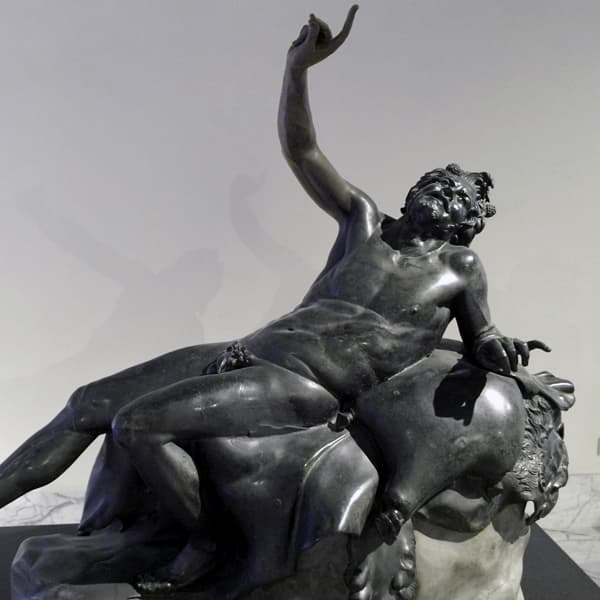
You have a hollow bronze statue. And that's the lost wax technique. For our final stop, let's see one of the finest bronze statues in the room, the drunken faun. Look at him.
He's completely blitzed. He sprawls across his lion-skin blanket, happy as can be. He's singing and snapping his fingers to the beat with a wineskin at his side. This guy is clearly living for today.
He epitomizes the Carpe Diem lifestyle of his age. It was the Epicurean philosophy followed by Caesar's father-in-law and so many other Romans in Herculaneum and Pompeii. They were living the good life. That is, until that fateful morning of August 24th, 79 A.D., when Mount Vesuvius changed everything.
Pfft! Hear that? The artistic explosion you've just experienced in this episode of This Mighty Museum is now over. We hope you've enjoyed our tour through Naples' Archaeological Museum thanks to Jean Openshaw, the co-author of this tour.
If you're up for more sightseeing, we have more audio tours covering the great sites of the area. There's a Naples City Walk, which leaves right from the museum steps. And there's a tour of Pompeii. Remember, this tour was excerpted from the Rick Steves Rome Guide book, co-authored with Jean Openshaw.
For more details on eating, sleeping, and sightseeing in Naples, Rome, and environs, refer to this year's edition of that guidebook. For more free audio tours and podcasts, and for information about our TV shows, bus tours, and travel gear, visit our website at ricksteves.com. This tour was produced by Cedar House Audio Productions. Grazie. Arrivederci. And buon viaggio. ¶¶ ¶¶ ♪ ♪
Free
GPS-guided walking tour
No account needed. Walk at your own pace.
Free
14 stops ·