8 stops
GPS-guided
28 min
Duration
Free
No tickets
About this tour
A 8-stop walking tour through the heart of Italy. Visit Jewish Ghetto, Santa Maria della Pieta, Synagogue, Jewish Museum, and Largo 16 Ottobre — with narrated stories at every stop.
8 stops on this tour
Jewish Ghetto
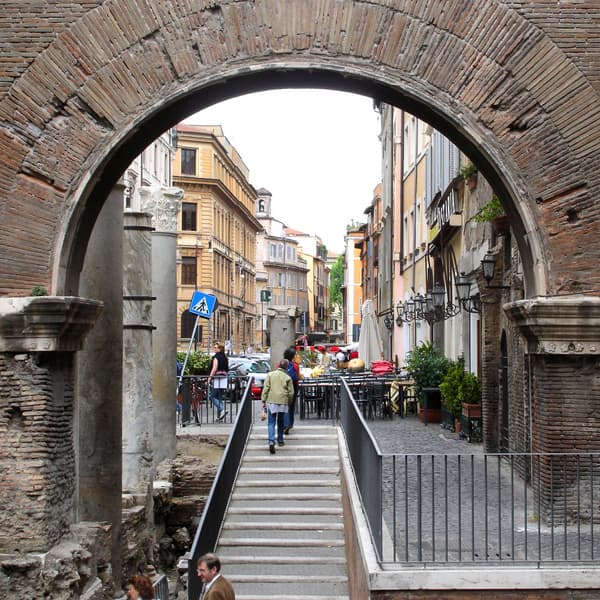
The Jewish Ghetto. For centuries, Rome's Jewish Ghetto has been the site of both relentless persecution and the undying pride and solidarity of a tight-knit community. Hi, I'm Rick Steves. Thanks for joining me on a walk through this often-overlooked part of Rome.
The ghetto, established in 1555 on the banks of the Tiber River, was the forced home of the Roman Jewish population for more than 300 years. Though most of the old ghetto has been torn down, you can still find a few reminders of the Roman Jews' rich past and lively present. On this one-hour walk, we'll visit the heart of the neighborhood. We'll see Rome's main synagogue with its museum of religious items.
Read more...Show less
We'll also see an impressive ancient ruin from the era of Emperor Augustus and a fountain by Bernini. We'll walk the main street past kosher restaurants, enticing bakeries, and Jewish-themed shops. And we'll see the ghetto today. The ghetto is inhabited by both old folks following traditional ways and busy young professionals in this neighborhood in transition.
To help us along the way, I've invited a good friend and virtual travel buddy. Welcome, Lisa. Hi, Rick. Lisa will give us helpful directions and sightseeing tips throughout the tour.
And my first tip is to be sure you get our tour updates. Just press the icon, at the lower right of your device. You'll find any updates and helpful instructions unique to this tour. Things like closures, opening hours, and reservation requirements.
There's also tips on how to use this audio tour and even the full printed script. Yes, so pause for just a moment right now to review our updates and special tips. It's okay. We'll wait. Now, let's plunge into this colorful neighborhood, both old and new. The Jewish ghetto. The tour begins.
Tour Begins
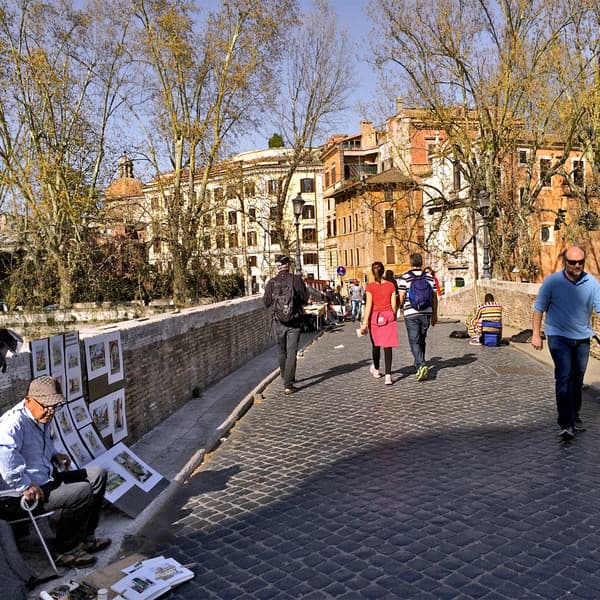
Ponte Fabricio and the history of the ghetto. The Jewish ghetto lies on the right bank of the Tiber River near Isola Tiburina, the island in the middle of the Tiber. Start at the north end of Ponte Fabricio, the bridge over the river at the island. From the bridge, the big synagogue with its square dome is just across the street.
The former ghetto, consists of the synagogue and the several blocks behind it. Stand on the bridge enjoying views of the Tiber, the riverbank, and the synagogue while Rick sets the scene for this guided walk. Rick? Thanks, Lisa.
Read more...Show less
In ancient times, the Ponte Fabricio was called Pons Judaicum, or Jew's Bridge, because Jews would commute across this bridge to get into town. Back then, the Jewish community was not persecuted and they didn't live in a ghetto, but in Trastevere, on the opposite bank. Rome's first Jews were welcomed as esteemed envoys, having arrived from the Holy Land in the 2nd century B.C. to establish business ties here in Rome.
Julius Caesar favored the Jews because they were well-networked throughout the empire and they didn't push their religion on others. Though they weren't persecuted, these early Jews, like all foreigners and immigrants, were forced to live outside the city center. They settled in Trastevere, creating a thriving and prosperous community of 30,000 people. As the empire expanded, things changed for Rome's Jews.
The province of Judea, present-day Israel, proved to be rebellious. After Rome invaded Judea in the 1st century A.D., the POWs were sold into slavery and Jews living in Rome were viewed with suspicion. As Christianity enveloped Rome and the Pope became literally the king of Rome's Jews, the Jews experienced discrimination. There were laws intended to limit the spread of Judaism, such as no proselytizing, no new synagogues, and no intermarriage.
The severity of these laws varied from pope to pope. Still, through most of the Middle Ages, Rome's Jews prospered and were often held in high regard as physicians, businessmen, and confidants of popes. But anti-Semitism began increasing throughout Europe. In Spain in 1492, all of that country's Jews were either baptized or expelled, with similar decrees following, in other European countries.
By the 1500s, the Catholic Counter-Reformation, begun to combat rising Protestantism, turned its attention to anything deemed a heresy or simply not Catholic, and that included Judaism. By 1555, the Pope decided something needed to be done to contain the perceived threat of the city's Jews. Before we head into the ghetto, look down at the river. These days, it's calm and contained.
But before the steep concrete embankment, was built in the late 19th century, this was the worst flood zone along the Tiber. The right bank was often flooded, making it one of Rome's least desirable neighborhoods, and just right for a ghetto for the politically powerless. Head for the north bank, where there's a yellow church across from the Ponte Fabricio. By the way, the Ponte Fabricio is nicknamed Ponte Quattro Capi, Bridge of the Four Heads, for its statues of the four-faced pagan gods, The yellow church is Santa Maria della Pietà, also known as San Gregorio. Santa Maria della Pietà
Santa Maria della Pieta
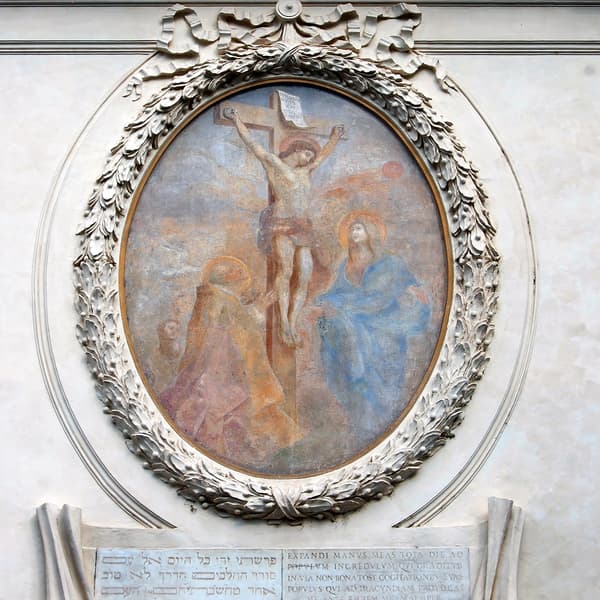
When the ghetto was a walled-in town, this church, stood at one of the entrances. In 1555, Pope Paul IV forcibly moved all of Rome's Jews into the undesirable flood zone here, inside the bend of the Tiber River, creating a ghetto. Some 4,000 Jews were packed into a miserable seven acres of mucky real estate. There they lived, in cramped conditions, behind a wall with a curfew for three centuries.
They could go out by day, but had to return before the gates were locked every night. Jews were forced to wear yellow scarves and caps, and were prohibited from owning property or holding good jobs. During Carnival, that's like Mardi Gras, they were forced to parade down Rome's main drag, Via del Corso, while Christians lined the street and shouted insults. The church of Santa Maria della Pietà was one of several Catholic churches encircling the ghetto that tried to spread their Christian faith to the Jews.
Read more...Show less
Notice the Hebrew script under the crucifix. All day long, it reads, quoting from the book of Isaiah, chapter 65, verse 2, All day long I have stretched out my hands to a disobedient and faithless nation that has lost its way. The plaque is quoting the words of the Jewish prophet Isaiah, but misuses them to give it an anti-Semitic twist. By the way, the word ghetto is Italian.
It was first used in Venice in the 1600s to describe the part of town where Jews lived near the copper foundry. Ghetto came from getare, to cast. Initially, the term meant only Jewish neighborhoods. But as the word spread through Europe and beyond, it was used generically to mean any neighborhood where a single ethnic group is segregated. Now, turn your attention to that big, square-domed synagogue. The synagogue and the Jewish museum.
Synagogue, Jewish Museum
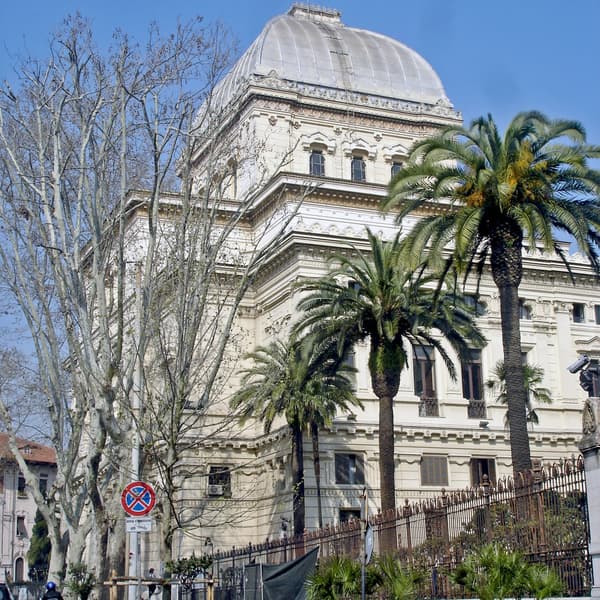
For the three centuries when Jews were forced to live in the ghetto, the community center was the synagogue, built on this site. In 1870, when the ghetto was officially closed, Rome's Jews were offered better real estate for a new synagogue, but they chose instead to rebuild right here. This new synagogue of emancipation from 1904 was built in a remarkable three years with the enthusiastic support of the Jewish community. While its main entrance faces the river, the only way tourists can enter is through the museum entrance on the back side.
Let's head there. So start walking straight into the ghetto, away from the river, walking alongside the synagogue. The synagogue remains a functioning place of worship with 800 seats. If you did go inside, you'd see the layout.
Read more...Show less
Following the Orthodox Jewish tradition, women sit upstairs. The dome is square to distinguish it from a Christian church. Worshippers sit under a ceiling painted with the colors of the rainbow, symbolic of God's promise to Noah that there would be no more floods. The stars on the ceiling recall God's pledge that Abraham's descendants would flourish and be as many as the stars in the sky.
As there were no Jewish architects and no models to study when it was built, this synagogue is built like a Christian church. And it's decorated Art Nouveau with a dash of Tiffany. The sandy color tones inside are a reminder of the community's desert heritage. When you reach the back side of the synagogue, pause a moment.
Our tour will not go inside, but you could visit the museum, which includes a guided tour of the synagogue, by buying a ticket and going through security. The museum shows off historically significant artifacts described in English. You'll see 2nd-century B.C. reliefs with Jewish symbols, finely worked religious items, and other elements of Judaica, or Jewish-themed historical and literary objects.
As the Jews were not allowed to be craftsmen during the ghetto period, they had to commission many of the pieces you'll see from some of the finest Christian artists of that time. The museum also shows a film in English of the Nazi occupation of Rome. More on that bit of history in a moment. As you tour the synagogue and museum, keep in mind the 300 years when this was the cultural heart of a segregated ghetto.
Through this long stretch of oppression, the synagogue was the only place Jews could feel respected and dignified. It's no wonder such loving attention was given to the Jewish tools of worship. As you walk, you may notice security measures around the synagogue. Heavy concrete planter boxes that double as car bomb barriers, policemen in kiosks, and video cameras, on the fences.
Because of divisive Middle East politics and lingering anti-Semitism, the threat of terrorism is always present. As you approach the Roman ruins, pause in the small square in front of the ruins, a piazza called Largo 16 Ottobre. Largo 16 Ottobre
Largo 16 Ottobre
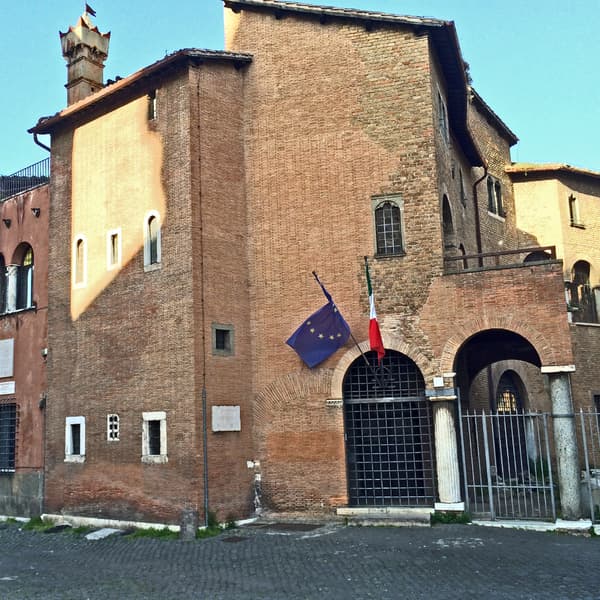
Largo 16 Ottobre, 1943. This square is named for the sad day in 1943 when persecution once again struck the ghetto. In the 19th century, Rome's Jews had enjoyed a little boost in freedom. When Napoleon occupied the city in the early 1800s, he relaxed discriminatory laws.
In 1848, the ghetto walls were physically torn down. But it was only after Italian unification in 1870 when a secular, secular government replaced the religious rule of the Vatican that the ghetto's inhabitants were granted full rights and citizenship. When Rome became the country's capital, the city, ashamed of its shoddy Jewish quarter, destroyed the old ghetto and modernized the district, giving it the street plan we see today. Then came the rise of fascism.
Read more...Show less
Even though Mussolini wasn't rabidly anti-Semitic, he instituted a slew of anti-Jewish laws as he allied himself more strongly with Hitler. When Mussolini was the first to be an anti-Semitic, Mussolini was deposed in 1943. Nazi Germany occupied Rome. Suddenly, the ghetto community was in even greater danger.
In the fall of that year, Nazi trucks parked here in the square and threatened to take the Jews to concentration camps unless the community came up with 50 kilos of gold. That's 110 pounds in 24 hours. Everyone, including non-Jewish Romans, tossed in their precious gold, and the demand was met. The Nazis took the gold, and later, they broke their promise and took the Jews as well.
On the day this community will never forget, October 16, the Nazis started rounding residents up in this piazza. Of the 13,000 ghetto dwellers, 2,000 were sent off to concentration camps. Only a handful came back, and the ghetto never really recovered. A measure of healing and reconciliation came with Pope John Paul II, who took a special interest in fostering relations with the Jewish community.
It was he who finally acknowledged that the Church should have intervened to defend the Jews during the Holocaust. He was also the first pope in history to enter a synagogue, this one, where he made a visit of reconciliation in 1986. John Paul II's final letter before he died was to Rome's emeritus rabbi, thanking him for allowing the pope to initiate this Catholic-Jewish rapprochement he felt was so long overdue. To face the big ancient ruin, on the right is a simple door marking the entry to the Museum of the Shoah in Italy.
By the way, Shoah means destruction in Hebrew, and it's used to refer to the mass murder of the Jewish people under the Nazis. The museum is free, with thoughtfully described exhibits in English, and well worth a short visit, if it's open, for anyone interested in the Holocaust here in Italy. Now, turn your attention to the big Roman ruins. They're not just ruins. Portico d'Otavia.
Portico d'Ottavia
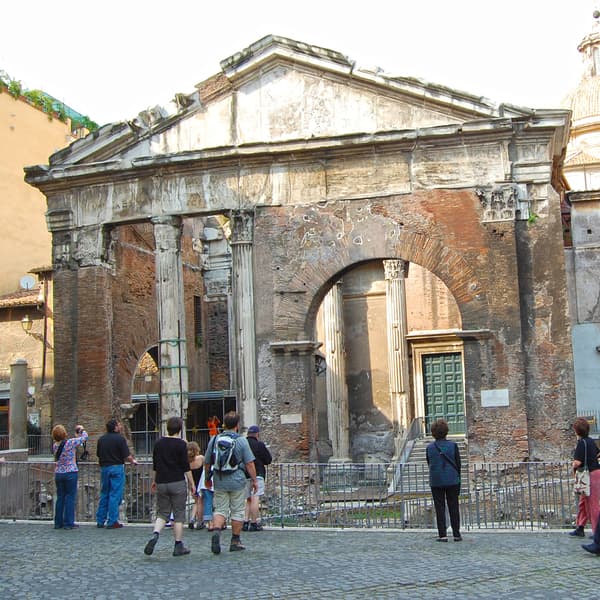
This monumental gateway of columns supporting a triangular pediment shows the many layers of history in this neighborhood. The portico dates from around 27 B.C., long before the establishment of the Jewish ghetto. It was built, by soon-to-be Emperor Augustus, and named for his sister, Octavia. It was part of a covered colonnade, nearly 150 yards long, providing a place where patrons of the nearby Theater of Marcellus could gather.
Flanked by temples and libraries, the passageway served as a kind of cultural center. After Rome's fall, the portico housed a thriving fish market, or pescaria. In the 8th century, the ruins became incorporated into the Church of San Angelo in Pescaria. For centuries, this Christian church was packed every Saturday with Jews, forced by decree to listen to Christian sermons.
Read more...Show less
Notice the faded bits of Christian fresco on the arch. Also, check out the doorway under the arch at No. 25. Locals love to tell of the poor old woman who refused to sell her land and now owns this priceless bit of real estate that includes the ancient church.
To the left of the portico runs the main drag of today's ghetto. We'll head there soon. But first, go to the bridge on your right to look down at the level of the street in ancient Roman times. From the bridge, you get a fine view of the Theater of Marcellus, which predates the Colosseum.
Beyond it is the tree-topped Capitol Hill. From this spot, you get a fascinating peek at how ancient Rome survives under today's street. The Theater of Marcellus was a cultural and arts venue, a kind of Lincoln Center of ancient Rome. You can still see the remains of the fancy colonnaded walk that led to the theater on the left.
The broken pieces of marble below are a reminder of how, in the Middle Ages, much of the ancient marble got recycled. The remains of Rome were broken into small pieces, melted down in kilns, and what was once elegant marble became lime. That raw material was used as a kind of mortar for centuries of later construction by the ragtag community that suffered through the Middle Ages here in the rubble of a once grand empire. For a short detour, you could pause your audio tour here and zigzag down into ancient Rome and let the information boards explain this small slice of a once magnificent ancient city.
Now, walk around the arch and start heading west down the main street of Rome. This is the main street of the ghetto, the Via del Portico d'Otavia. Don't go too fast. The heart of the action is only about a block long. Via del Portico d'Otavia,
Via del Portico d'Ottavia
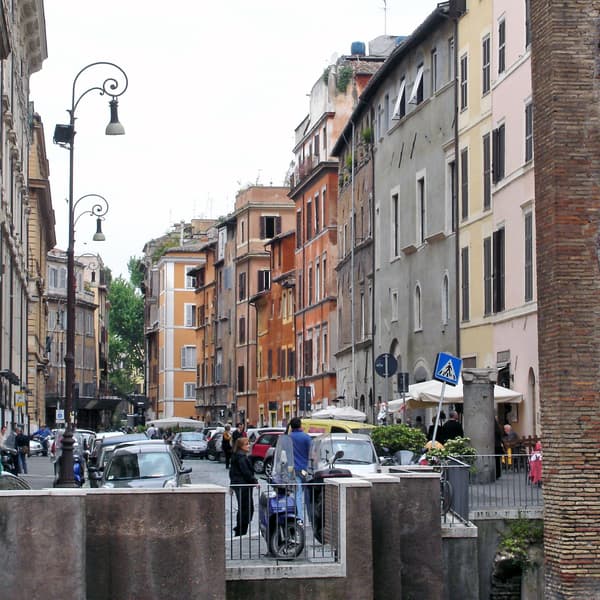
the ghetto's main drag. This main drag is a fine place to get a taste of yesterday's ghetto and today's Rome. From the start, near the Roman arch, look down the street. On the left is a new building from 1911.
On the right, in the distance, is the only surviving line of old ghetto building fronts. Imagine today's street as it was then, much narrower as it is at the far end today. Walking down the street, notice kosher restaurants proudly serving carciofi, that's artichokes, which, only Jewish grandmothers can cook properly, and shops of fine, locally produced Judaica. All these Jewish restaurants!
Read more...Show less
I could come back here for dinner. Yep, and these days, fried artichokes are in season all year long. In earlier times, this was a poor community, so the traditional Jewish dishes were often the food of the poor. Rich Romans didn't eat artichokes, but when you deep-fry anything, it can be tasty, and, today's artichokes are a hit here in the ghetto.
Another dish, cod, was also something that Jewish communities from Portugal to Sicily to Rome could call their own. And when it comes to meat, while the rich would eat the better cuts, the Jews got good at cooking what was called the fifth quarter, the guts, sweet bread, lamb offal, fried brains, My favorite! liver, and so on. You'll see lots of places serving up Israeli and Eastern Mediterranean dishes, and there's even a restaurant and even a kosher sushi place.
Now, let's check out other signs of local life. You might see posters for community events, a few men wearing yarmulkes, and political graffiti, both pro- and anti-Israel. The Palestine Liberation Organization, or PLO, attacked this area in 1982, and a police presence has been here ever since. After a block, you reach the center of the district.
Look right, down via San Ambrose, to see an old surviving street. Looking down this lane, imagine the density of the population here, the flood muck, and the squalor of the past. The pedestrianized square ahead is where older folks hang out together and shoot the breeze, sometimes even bringing their favorite folding chairs from home. Browse around.
The big yellow building on the left houses the Jewish school. Today, of Italy's 35,000 Jews, nearly all of them are Jewish. Nearly half call Rome home. Though the Jewish community has long since dispersed all over Rome, most Roman Jews continue to spend time in this neighborhood to enjoy the strong feeling of community that survives.
Roman Jews have a unique style of worship and even preserve remnants of their own Judaic-Roman dialect. That's because, unlike most of the world's Jewish people, Roman Jews are neither Sephardic, descended from Spain, nor Ashkenazi, descended from Eastern Europe, Italy's Jews came directly from the Holy Land before the Diaspora. Let's move on and explore a little more. Opposite the big school, take a one-block detour down Via della Reginella.
Notice that most of the buildings you pass have six floors. On the right, at number 16, stop for a moment and check out the symbols of Jewish community embedded in the wall. There's a menorah. Yes, and a room.
A relief recalling those terrible events of October 16, 1943. And one that says Circolo Ragazzi del 48. Yes, this home was the Circolo, or meeting place, of the Ragazzi del 48. Remember, the modern state of Israel was founded in 1948.
And this was the clubhouse for the Ragazzi, or Boys, of 48. Let's continue down Via della Reginella. You may see some Jewish art galleries and, in this case, in the pavement are small bronze stumble stones, each a tiny memorial to a Jewish resident who was a victim of the Holocaust, most of whom were taken away to suffering and an early death in a Nazi concentration camp. When you reach number 28, notice a change in the architecture.
The six-floor buildings end, and though the buildings stay the same height, they become more elegant and spacious, three-floor buildings. This marks the end of the ghetto. Continue a little farther to the end of the lane. In the square, Piazza Mattei, check out the fun fountain.
It's a mannerist work from the late 1500s, which was later embellished with turtles by the great Baroque sculptor Bernini. It's said that Bernini cared about the Jews and honored them with the symbol of a turtle, an ancient creature that carries all its belongings on its back. And this fountain provided the Jewish community here with a safer source of energy and a safer source of drinking water than the river. Let's return to the main drag, Via del Portico, Ottavia.
As you backtrack through this residential area, realize that the neighborhood has become trendy recently, and apartment prices are now well beyond the means of most members of this Jewish community. Ironically, when the ghetto was cleared back in 1870, only the richest Jews could afford to relocate. And because the poor had to stay, their descendants today have enjoyed the healthiest life. This is the best real estate appreciation.
When you get back to Via del Portico di Ottavia, turn right and find Bar Toto. More sights on Via del Portico di Ottavia.
More Sights on Via del Portico
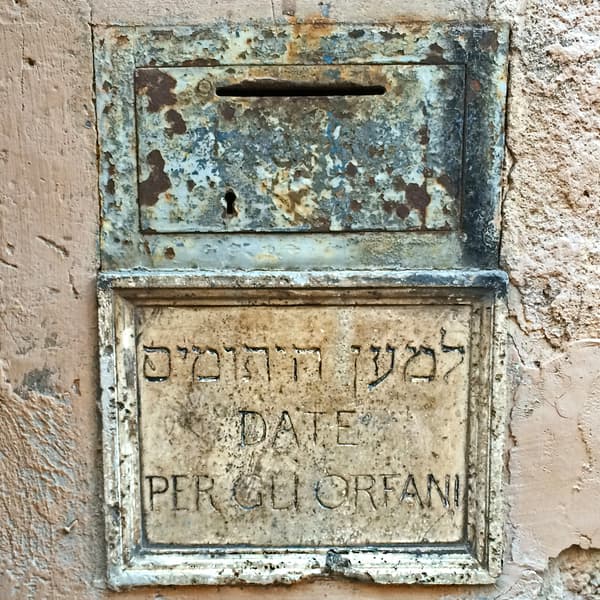
Near the doorway of Bar Toto, you'll see a little slot in the wall. This is a ghetto-era charity box for orphans, and it still accepts donations for worthy causes. The ancient relief above the box marks the home of a big shot who, at the start of the Renaissance age, before the ghetto's establishment in 1555, plugged this chunk of ancient Rome into his facade for prestige. A bit further down the street, at number one, another piece of ancient marble depicts a lion attacking a gazelle.
Notice the big stone inset with the Latin inscription dated MMCCXX. Yes, that's the year 2220. And no, it's not from the future. It marks the years since the birth of Rome in 753 B.C., meaning it was carved in, let's see, 2220 minus 753, yes, A.D.
Read more...Show less
1467. Continue on another 20 steps to the next intersection, Piazza Costiguti. Stand in the middle of the white decorative outline embedded in the cobbles. This marks the place where a fountain once stood.
Back in darker times, the ominous gallows of the Vatican stood right here next to the fountain. But today, that fountain has been moved a block toward the river. And the ghetto survives. Yes, today the neighborhood school is attended by several hundred Jewish children.
Each afternoon feels like a festival when the kids get out and, with security police looking on, are gathered up by their parents. Perhaps the joy is stoked by the joy of the long-gone ghetto heritage of Jews being forced to have their children educated in anti-Jewish Christian convents. By the way, the benches you see scattered around are the only public benches in Rome not fixed to the pavement. Locals, who can no longer afford the rent to live in this now-trendy district, still gather here and move the benches to catch the sun or the shade.
Or to be under the windows of the school in order to hear the laughter, laughter, laughter, of the children. On your right is a traditional Jewish bakery. Go inside to check out the braided challah bread, cheesecakes, almond-paste-filled macaroons, and Jewish pizzas, like little two-year-old fruitcakes. Just beyond the bakery, the curving, white-columned structure is part of a former Carmelite convent.
Imagine the outrage of the Jewish community when the church built a convent in a Catholic school here in the midst of the ghetto to preach to their children, and forced locals to attend mass. Pop into the tunnel-like alleyway next to it and walk through it to the evocative little courtyard. Imagine the tight conditions of thousands of Jews living in this small seven-acre neighborhood. When you're ready, let's head back.
As you make your way back to the main square, think back on how many changes this neighborhood has seen. From ancient times when it was a swamp-ridden flood zone to now, to the medieval era when Jews and Christians tentatively settled here. Then came three dark centuries of persecution when Jews were forced to live within ghetto walls. In the 19th century, the neighborhood was opened up, the new synagogue was built, and the Jewish community thrived.
Then they suffered through Mussolini and the Nazi occupation. But in recent times, the ghetto has rebounded. Today, it's the vibrant anchor of Rome's tight-knit Jewish community. We hope you've enjoyed this slice of Rome.
Thanks to Jean Openshaw, the co-author of this tour. If you're planning more sightseeing, we have lots of audio tours available for Rome, including a walk through the heart of Rome, the Colosseum, the Roman Forum, the Pantheon, St. Peter's, the Vatican Museums, and Sistine Chapel, as well as walks through Trastevere, the Jewish Ghetto, and the remains of Ostia and Pompeii. In one day?
No. Remember, this tour was excerpted from the Rick Steves' Rome Guidebook by Rick Steves and Jean Openshaw. For more details on eating, sleeping, and sightseeing in Rome, refer to the latest edition of that guidebook. For more free audio tours and podcasts, and for information about our TV shows, bus tours, and travel gear, visit our website at ricksteves.com.
This tour was produced by Cedar House Audio Productions. Grazie. Ciao. And buon viaggio.
Free
GPS-guided walking tour
No account needed. Walk at your own pace.
Free
8 stops ·