13 stops
GPS-guided
35 min
Duration
Free
No tickets
About this tour
A 13-stop walking tour through the heart of Italy. Visit Ostia Antica, Necropolis, Porta Romana Gate, and Republican Warehouses — with narrated stories at every stop.
13 stops on this tour
Ostia Antica
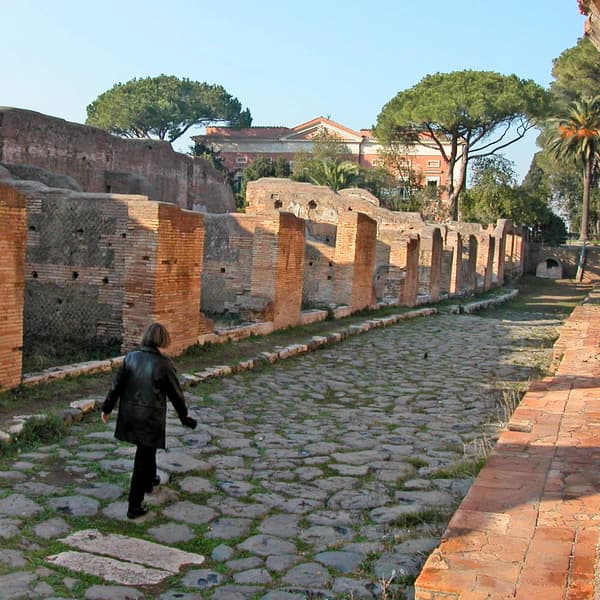
Ostia Antica. For an exciting day trip from Rome, pop down to the ancient port of Ostia, a ruined city that's similar to Pompeii, but less touristed, and in some ways, even more interesting. Because Ostia was a working port town, it shows a more complete and gritty look at Roman life. Hi, I'm Rick Steves.
Thanks for joining me on a walk through Ostia Antica. We'll travel the same streets the ancients did, seeing the warehouses, apartment flats, mansions, shopping arcades, and baths that served a once-thriving port town of 60,000 people. Allow about two hours for the visit, plus an hour each way to get there and back from downtown Rome. Ostia is never crowded, and you can turn your imagination loose.
Read more...Show less
See how everyday Romans lived, worked, shopped, worshipped, worked out, and just enjoyed life here in the seaport that 2,000 years ago was the gateway to the city of Rome. To help us along the way, I've invited a good friend and virtual travel buddy. Welcome, Lisa. Buongiorno, Rick.
Lisa will give us helpful directions and sightseeing tips throughout the tour. And my first tip is to be sure you get our tour updates. Just press the icon at the lower right of your device. You'll find any updates and helpful instructions unique to this tour.
Things like closures, opening hours, and reservation requirements. There's also tips on how to use this audio tour and even the full printed script. Yes, so pause for just a moment right now to review our updates and special tips. It's okay.
We'll wait. And now, lace up your dusty sandals as we tread the ancient cobblestones of... Ostia Antica. Ostia Antica.
Tour Begins
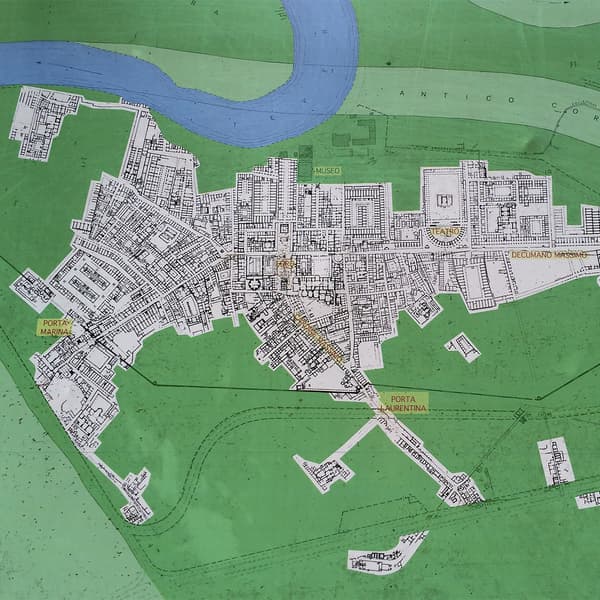
The tour begins entering Ostia. We'll start our tour at the entrance to the ruins, where you buy your ticket. So buy your ticket and enter the site. Once inside the gate, walk about 30 yards in.
Keep an eye out on the right-hand side of the path for a posted sign showing a big map of Ostia. Because this place is so huge, the map is a great place to start. It gets us oriented both spatially and... Historically.
Read more...Show less
As you study the map, let Rick introduce you to the ancient city of Ostia Antica. Thanks, Lisa. The map shows that Ostia was ideally located to be Rome's port town, situated at the mouth, or Ostium, of the Tiber River. The map shows the ancient coastline and the former course of the river, which eventually abandoned its city.
Notice how the core of Ostia was a rectangular Roman military camp with two major roads crossing it. Ostia was founded in the 4th century B.C. and gobbled up early by Rome. Ostia was important both for its salt and for its port.
Its main industry was the salt gleaned from nearby salt flats, which was a precious preserver of meat in ancient times. Ostia, often called Rome's first colony, also served as a naval base, protecting Rome from any invasion by river. By about 150 B.C., when Rome controlled the entire region, there was no more threat of invasion by sea. Ostia's importance became commercial rather than military.
Rome eventually outgrew the port of Ostia, and a vast new port was dug nearby, where Rome's airport now stands. But Ostia remained a key administrative and warehousing center, busy with the big business of keeping more than a million Romans fed and in sandals. Eventually, things really soured for Ostia. Rome fell.
The river changed course. The port was abandoned, silted up, became a malaria-infested swamp, and was eventually forgotten. The mud that buried Ostia actually protected it from the ravages of time and from stone-scavenging medieval peasants. On our tour, we'll head west down the town's main drag, Decumanus Maximus, to the city center, the Forum.
Along the way, we'll make a couple of slight detours before finishing at the Forum. Consider your visit a three-part affair. First, follow this audio tour. Next, enjoy the museum and consider getting a bite to eat at the cafeteria.
Finally, explore the back lanes, going on a visual scavenger hunt as you wander your way back here to the entrance. Ready? Ready. One of four city gates is just ahead, so start walking toward it.
As you approach the gate, the area on your left, just outside the city walls, was... the Necropolis. The Necropolis
Necropolis
Ancient Romans buried their dead outside the city walls. Ostia was a famously pagan town, slow to become Christian. To a pagan, the closest thing to an afterlife was to be remembered. If their families could afford it, they'd have a tomb on the roadside with a thumbnail bio carved into the stone that all could read as they came and went.
For example, My name was Caius. I was a baker. Or, My name was Julius. I made fruity orange drinks.
Read more...Show less
The Romans called this area a Necropolis, or City of the Dead. Christians preferred the term cemetery from the Greek for resting, meaning "resting place." You can detour left off the path to find family sepulchres marked by arches. These were private open-air rooms lined with niches for urns filled with ashes. Until the 1st century A.D., cremation was common.
Later, in the 2nd and 3rd centuries, the Romans here buried their dead in marble and terracotta sarcophagi, which were then placed in tombs. Ahead, where the road narrows, are the scant remains of what was the main entrance to the ancient city of Ostia, the gate called the Porta Romana. The Porta Romana Gate
Porta Romana Gate
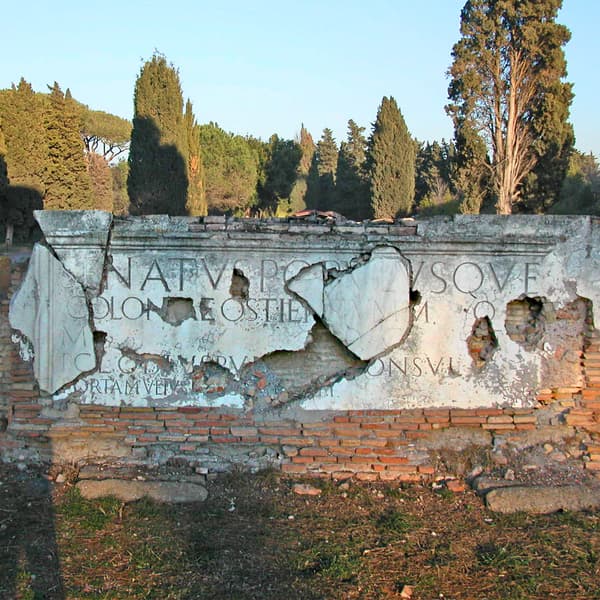
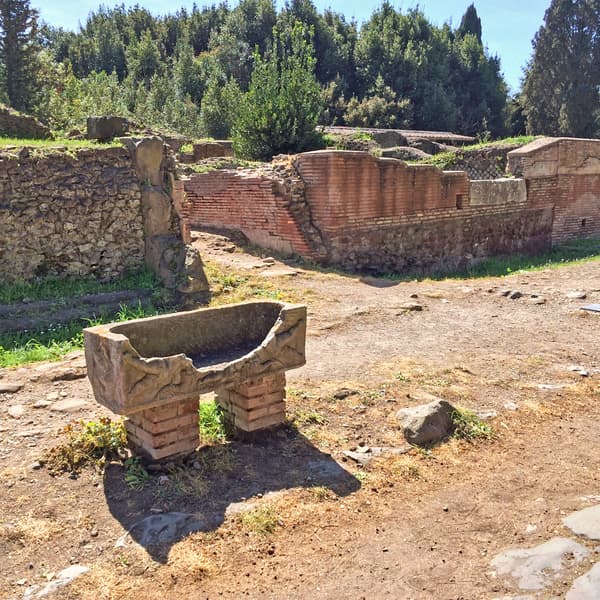
Just as Rome's Porta Ostienza faced Ostia, Ostia's Porta Romana, and Ostia's Porta Romana faced Rome. Logically, just inside the gate, which was locked at night, you'd find a place to leave your animal and a warehouse. We'll see both in a moment. Inside the gate, to the left, under the big tree, you can see the bits of the Latin inscription that proclaimed to all who entered, the Senate and the people of the Colony of Ostia constructed these walls.
The colony reference is a reminder that Ostia was the first bit of the Roman Empire. Beyond that, also on the left, is a big basin, once fed by a fountain. This was where animals could be watered. Check out the information panel with a helpful artist's reconstruction of the site.
Read more...Show less
The less-than-helpful verbiage is what locals refer to as aria frita, fried air, greasy and heavy, but containing nothing of value. From the gate, Ostia's main street, the Decumanus Maximus, leads straight to the forum where this walk ends. Note that this road is elevated above some buildings' foundations. Over the centuries, Ostia's ground level rose.
You can actually identify buildings from the Republic, that's centuries before Christ, and the Empire, centuries after Christ, by their level. Anything you walk down into is from that earlier period. Just inside the gate and to the right is the first of several warehouses. Start walking down the main street, checking out the warehouses all on the right. Republican Warehouses
Republican Warehouses
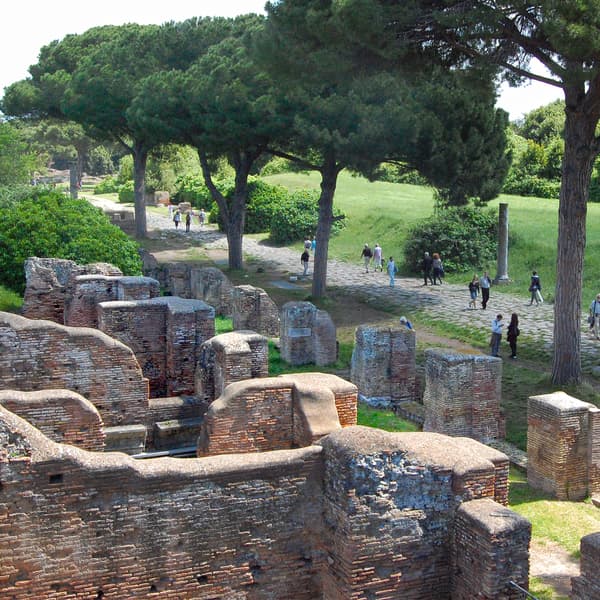
Ostia's 1st century B.C. was busy with activities relating to the river port. The goods of the port, such as grain from Sicily, Egypt, and the rest of North Africa, were processed and stored in warehouses here before being consumed by Rome. The warehouses had elevated floors to keep things dry.
Ahead, you'll see a series of stubby brick columns. These are the remains of a roofing house and a roofed portico that provided a shady walkway into town. Notice the bricks. Generally, rough bricks are ancient originals, while smooth bricks are part of the reconstruction.
Read more...Show less
Ostia has been picked clean since ancient times. The port's treasures, columns, statues, and precious marble, ended up gracing buildings as far away as Constantinople in present-day Turkey. Continue straight ahead about 100 yards, including what were once shops and warehouses. Keep an eye out for an old well in the middle of the road.
Enjoy a little music as you do some imaginary window shopping on the way to the well. You'll find a few of the most iconic buildings in the world. You'll find a few of the most iconic buildings in the world. You'll find a few of the most iconic buildings in the world.
You'll find a few of the most iconic buildings in the world. You'll find a few of the most iconic buildings in the world. You'll find a few of the most iconic buildings in the world. You'll find a few of the most iconic buildings in the world.
You'll find a few of the most iconic buildings in the world. You'll find a few of the most iconic buildings in the world. You'll find a few of the most iconic buildings in the world. You'll find a few of the most iconic buildings in the world.
You'll find a few of the most iconic buildings in the world. You'll find a few of the most iconic buildings in the world. ¶¶ ¶¶ By now, you should be approaching the well in the middle of the road. The little well is actually medieval, a remnant from dark-age squatters who found shelter in these ruins.
From here, look to the right. Find our next stop. It's a viewpoint on the right side of the street. Yeah, it's a platform with railings above on the right.
Start heading there. You'll find some stairs leading up to that viewpoint. Climb on up where you'll have a magnificent view over our road. Our next stop, the Baths of Neptune. ¶¶ The Baths of Neptune.
Baths of Neptune
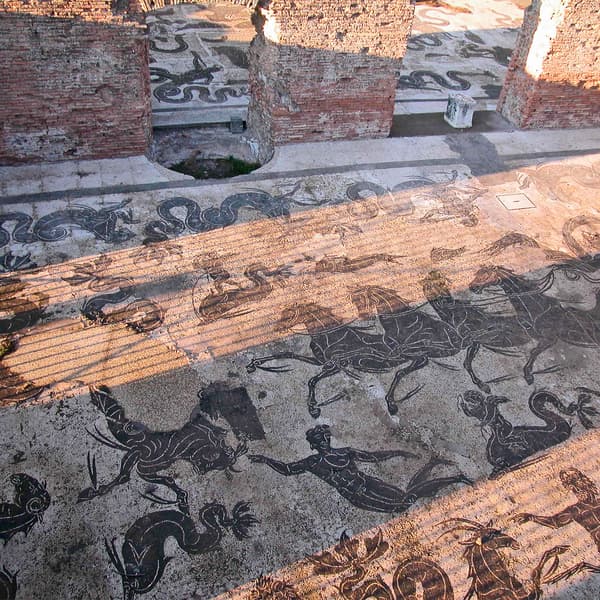
Ancient Romans loved their bathhouses, public places where people could get clean, work out, and socialize. Examine the fine mosaic on the bath's floor. It shows Neptune, the god of the sea, riding four horses through the water. Apart from the cupid riding the dolphin, the sea looks frightening.
It's because it was. The large square to the left of the mosaic would have been busy with people wrestling, stretching, doing jumping jacks, and getting rubdowns. The niches that ring the square housed small businesses. Now, look in the distance.
Read more...Show less
12 Umbrella Pines marks the original channel of the river before it changed course, abandoning the town. Climb back down to the main drag and continue to the right. Our next stop is the theater, another 100 yards further down the road, also on the right-hand side. While you walk, get into the festive spirit with a little music.
¶¶ ¶¶ ¶¶ ¶¶ ¶¶ ¶¶ ¶¶ By now, you should be at the theater on the right side of the street. Theater, or teatro.
Theater
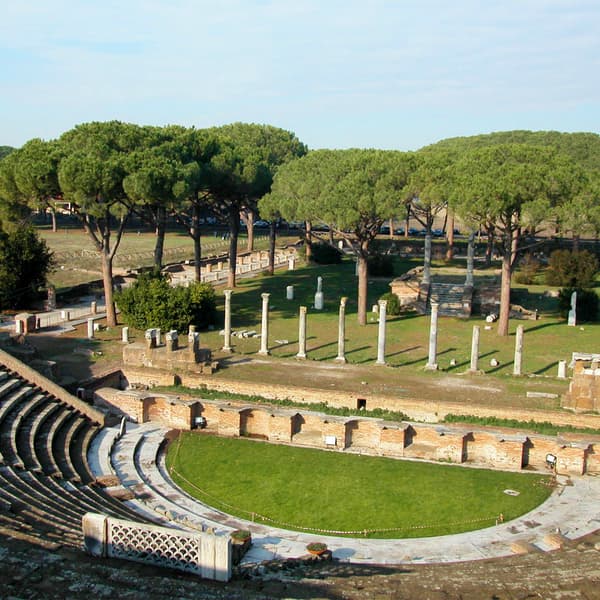
Enter the theater through its main central gate. As you enter under the arch, look up. The scant remains of the stucco decor under the entry arch give a hint of the elegance of this place 2,000 years ago. Now continue to the end of the tunnel.
Here, the men would bid their women farewell and take seats close to the action, while the women went to sit in the higher seats, typical of the gender division of public Rome. Farewell, Lisa. See you later, Max. Before you is a typically Roman complex mixing religion, business, and entertainment.
Read more...Show less
A grand theater facing a temple surrounded by a commercial square. Up to 4,000 residents could gather in this theater. Plays were rowdy daytime events, like going to a day game at the ballpark with lots of audience participation. And heaven help a bad actor.
The three rows of marble steps near the orchestra were reserved for the chairs of big shots. In its day, a wall rose behind the stage, enclosing the theater. Even today, this place, one of the oldest brick theaters anywhere, is used for concerts, concerts, concerts, concerts. You can climb to the top of the theater for a commanding view.
After exploring the theater, turn your attention to some of the nearby buildings. Head for the area behind the stage, that is, farther away from the main street, where you'll find a big square. Originally, this courtyard was lined with offices. Walk counterclockwise around the square. The sidewalks are decorated with mosaics. The most notable are on the right. The square of the guilds.
Square of the Guilds
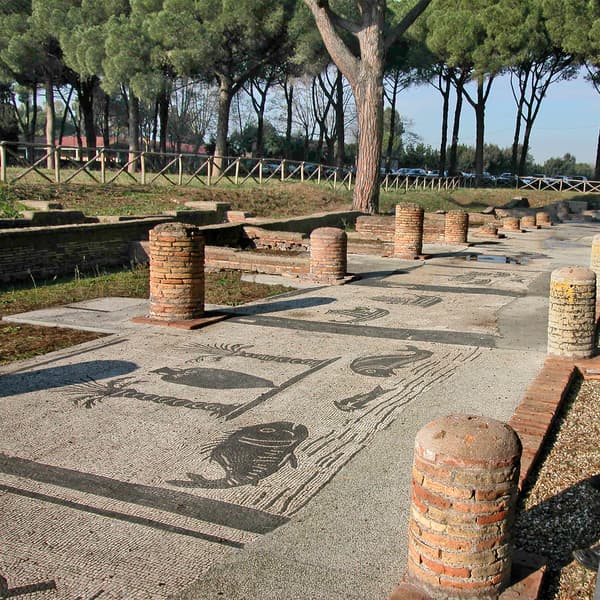
This grand square evolved from a simple place where businessmen would stroll and powwow together to become a monumental square lined with more than 60 offices of shipowners and traders. This was the bustling center of Rome's import-export industry. As you stroll up the right-hand side of the square, enjoy the fine sidewalks. You'll see the word navic, which means ship, and refers to the shipping industry.
Along the sidewalk, 2nd-century A.D. mosaics advertised the services offered by the various shops. Walking counterclockwise, circle the square to read the mosaics that advertised in Latin and in pictograms for illiterate or non-Latin-reading, sailors. Rick, here's a symbol I can read.
Read more...Show less
A lighthouse. Yeah, that was the sign of the port of Ostia. Grain containers are reminders that grain was the major import of Ostia. The elephant marking the office of a place in present-day Libya symbolized the sale of ivory, or perhaps of exotic animals, great for parties, private spectacles, and Colosseum events.
The fine mosaic in the corner shows the innovative Roman ships. When ship technology, enabled boats to tack back and forth and sail into the wind, commerce moved more readily, making the Mediterranean a thriving Roman free-trade zone. So much was on sale here. I see wild animals.
Which were sold to the gladiator arenas for entertainment. I also see some of those tall jugs with the two handles. These amphora would be filled with oil or grain. In other shops facing the square, you could buy some rope or even a boat.
Just keep circling counterclockwise to the far left corner. Statues of notable local guild members and business leaders decorated the courtyard. The temple in the center was likely dedicated to Ceres, the goddess of harvest and abundance, or, in Ostia's case, prosperity from good business. Take some time to explore the rest of the square.
When you're ready to leave, head back toward the theater. As you leave the square, find the small white altar over on the far left. This would have been used to sacrifice animals such as the rams carved into the corners to ask for favor from the gods. The entrails could be read to define the future and determine whether the gods were for or against a particular business venture.
This altar is a copy. The original is back in Rome. Our next stop is the mill, a few minutes' walk from the theater. To get there, return to the main street and turn right.
Continue down the Decumanus Maximus about two blocks until you reach the intersection where the Decumanus Maximus crosses Via dei Molini. You know, Lisa, while we walk, that altar we just saw got me thinking. No wonder it's a copy. Think about the burden on Italy of protecting and preserving what's actually all of Europe's cultural heritage against illegal digging, exportation, vandalism, weather, and pollution.
There's even a special branch of the Carabinieri dedicated to art theft. Okay, so no souvenirs. About two blocks down the Decumanus Maximus, you reach the intersection with Via dei Molini. It's marked by the Tempio Republicano on the corner to the right.
Via dei Molini marks where the town's first wall once stood surrounding the oldest part of Ostia. Remember, Ostia got its start as a fort, a rectangular military camp called a castrum. Before continuing straight into that old town, oldest part of Ostia, turn right, down Via dei Molini. Turn right.
Got it. Okay. Start walking about a block and a half to reach our next stop, the mill. It's on the left-hand side of the street.
But don't take the left onto Via Casa di Diana. We'll pass that for now and return to that street next. Yes, just keep going until you see a sign for Molino del Silvano on the left. See you there. ¶¶
Mill
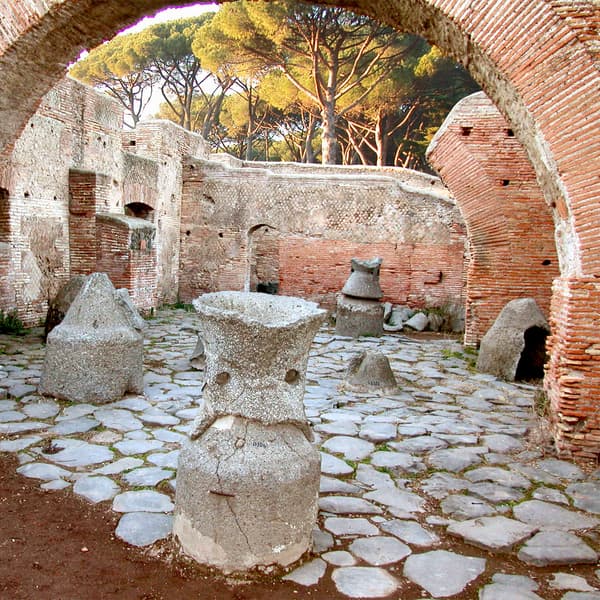
The Mill This mill building, which is also marked as a bakery or beneficio, dates from 120 A.D. The lava millstones in front of you were used to grind grain. Study the workings. A bowl-like lower structure carefully cupped a moving upper section.
Grain would be sprinkled in from a sack hanging from the ceiling. Mules or workers would power the grinding by walking in circles, pushing inserted wooden poles around and around. Powdery flour with not much grit would eventually tumble out of the bottom of the mill, ready to be made into bread. Now, backtrack half a block down Via dei Molini in the direction of the mill.
Read more...Show less
The main street. At the big tree, take the first right onto Via Casa di Diana. Via Casa di Diana
Via Casa di Diana
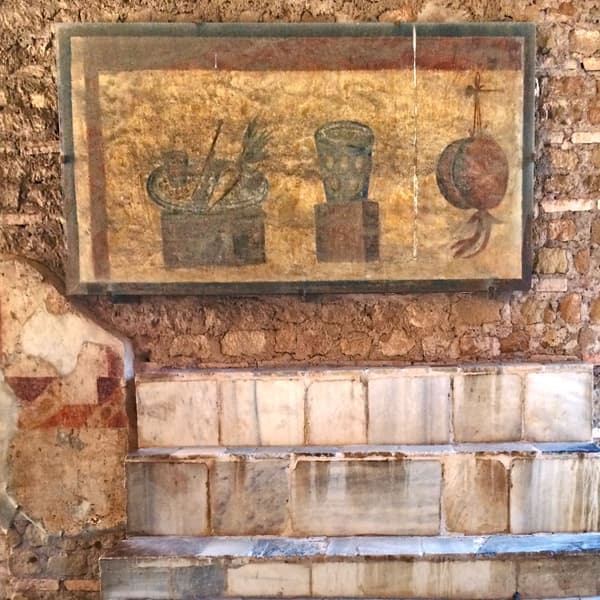
Stroll down the street keeping an eye out for our first stop, a tavern. It's about halfway down the block on the left. This street gives us a look at how ordinary Romans would have lived. We'll be seeing a typical apartment building and, just across the street from that, a tavern where they could eat, drink, and catch a little live music.
We'll start with the tavern called the Insula of the Thermopolium. Again, it's halfway down the block on the left. At the Insula of the Thermopolium, step past the grooved threshold, which once held a sliding wooden door, and belly up to the tavern's bar. You'll see display shelves with food and drinks, drinks for sale, a small sink, and a cute fresco advertising food, drink, and music.
Read more...Show less
Too smoky and noisy? Just step out back and enjoy the quiet courtyard with the fountain. Nice! Hey, Rick, what kind of music did the Romans listen to in taverns like this?
Well, you know who their favorite hard rock band was? I had to ask. Who? ACBC.
Oh, brother. Let's move on. Exit the tavern. Uno, due, tre.
I'm on the highway to Hades. Oh, boy. Head across the street to our next stop, the Insula of the Paintings. Find the staircase and start hiking up.
Climb all the way to the open rooftop for a good view and a chance to imagine life here as an apartment dweller in ancient Rome. An insula was a multi-storied tenement complex where the lower middle class lived. These were miserable cramped apartment buildings up to ten floors high. The average was about five floors.
People living on the higher floors climbed ladder-like stairs to get to their rooms. There was no plumbing. It was stinky. Windows were just open holes covered with shutters or curtains of cloth dipped in grease.
They let in all the street noise. Buildings were made cheaply of wood with weak foundations. That's why so many burned or collapsed. The apartments had no heat and no cooling.
There was no kitchen. Food was cooked or purchased elsewhere. Garbage was just tossed out the windows. Chariot and cart traffic were allowed only at night and there was lots of night noise.
The wealthier classes, on the other hand, lived in sprawling and luxurious mansions. These were generally built on one floor with a series of rooms facing a central open courtyard. Decorative pools collected rainwater. Statues, mosaics, and frescoes were everywhere.
Rome's wealthy were as comfortable as its poor were wretched. From this rooftop perch, find the museum. It's the modern building. Behind the museum, modern pleasure boats mark where today's Tiber spills into the Mediterranean.
After Rome's fall, the Tiber River changed course. It continued to deposit silt at the river mouth, pushing the coastline further and further away. Today, the mouth, or ostium, for which the town is named, is, far away. Our next stop is the Forum, the center of town in ancient Ostia, located a half block away.
To get there, you'll go back downstairs and continue down via Casa di Diana to the end of the street. When you run into the high brick temple called the Capitolium, you'll turn left, which leads to the grand open space called the Forum. It'll take a while, so rewind to review Lisa's directions if you need to, then pause the audio guide and restart it when you reach the Forum. See you there! The Forum.
Forum
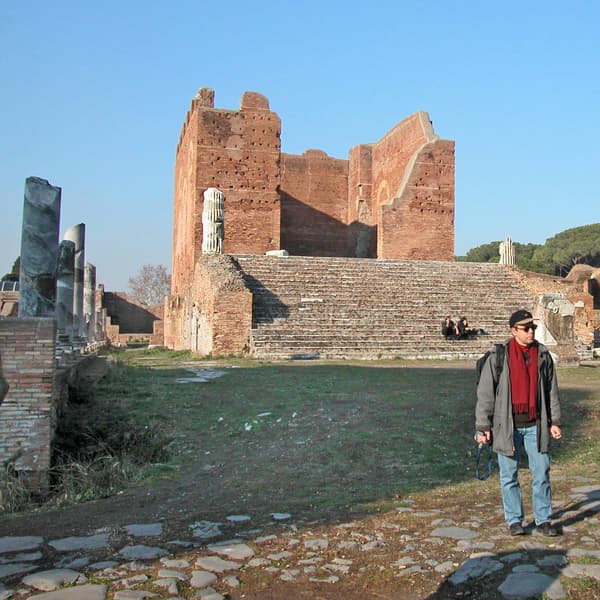
This square marks the center of Ostia. After Rome conquered Ostia in about 400 B.C., it built a military camp, or castrum. That was a rectangular fort with east, west, north, and south gates and two main roads converging here on the Forum. Throughout the empire, Roman citizens found comfort in this standard city plan.
While people found it no fun to be conquered, the empire brought order and stability to their lives through laws and through the creation of grid-planned cities and grand squares such as this one. Over time, Ostia's main square became filled with monumental structures. Dominating this square was its grand temple from 120 A.D. The marble veneer was scavenged in the Middle Ages, leaving only the main square and only the core brickwork we see today.
Read more...Show less
Note the reinforcement arches in the brick. The temple, called the Capitolium after the original atop Capitol Hill in Rome, was dedicated to the pagan trinity of Jupiter, Juno, and Minerva. A forum dominated by the Capitolium temple was a standard feature of colonies throughout the empire. The purpose?
To transport the Roman cult of Jupiter, Juno, and Minerva to the newly conquered population. On the opposite side of the square, distinguished by its sawed-off column, is a temple celebrating the power of the empire itself, the temple of Roma and Augustus. Its position is powerfully symbolic. The power of the emperor, who himself was divine, stands equal, facing the power of the Capitolium's big three.
The basilica also faces the forum square. With your back to the Capitolium temple, it's to your right and consists today of little more than a footprint of the original temple. It's a traditional building. Dating from about 100 A.D., this was where lawyers and businessmen formalized deals.
Its central nave and two side aisles led to a high altar where the judge sat. Let's move on. With your back to the Capitolium temple, start walking across the forum to the left of that temple of Roma and Augustus. You're looking for a grand arch on the left side of the forum.
By the way, we're nearing the end of our tour, which ends on the left side of the forum. It ends at the Ostia Museum. There, you'll find lots of tourist services, including a public toilet. But first, let's see something you don't see featured in most guidebooks on Rome, an ancient toilet.
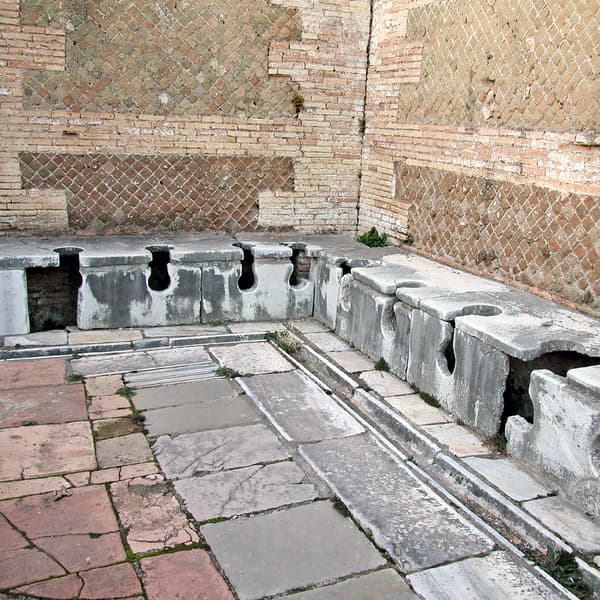
All right, a BCWC. To get there, find that grand arch on the left side of the forum. Pass through it onto an old street. Just a few steps in on the left, you'll find an almost inviting ancient 20-hole latrine.
Study the remains of this public toilet. At the entrance, you can still see the pivot hole in the floor that once supported its revolving door. Now, check out those 20 toilet holes. The cutout below each seat was to accommodate what they used instead of toilet paper, a washable, reusable sponge on a stick.
Rushing water below each seat, brought in by an aqueduct, did the flushing. Not a lot of privacy here. Nope. Privacy was not a concern.
In fact, even today, there's no word for privacy in the Italian language. They just use our word and roll the R. Privacy. Privacy.
Bene. Let's move on. Our next stop, the forum baths, are that sprawling complex just opposite the toilets. But to get there, you'll need to backtrack a bit toward the forum.
Got it. Backtracking to the big arch. Walk back under that arch and take a U-turn left. A few yards down, just before a tree, you'll find five stone steps that lead into the baths.
Head on in. Of all the public baths in Ostia, including the Neptune baths we saw earlier, these here were Ostia's best and largest. Just wander around here looking at the various pools. Think of the sophisticated infrastructure of Ostia while Rick tells the story. The Forum Baths
Forum Baths
As you wander around this huge complex, try to imagine it filled with naked people, steaming and busy. Government-subsidized bathhouses were a popular place in any Roman city. Like health clubs today, baths were a place to work out and relax, as well as an important social and business center. The floors and walls were heated.
Roman engineers were experts at radiant heat. A huge furnace under the floor heated water and air that was then sent through pipes under the floors and in the walls. In fact, you can still see some of the hollow bricks in the walls. Notice the fine marble steps, great for lounging.
Read more...Show less
They led into the pools. People used olive oil rather than soap to wash, so the water needed to be periodically skimmed by servants. Like a high-end spa, there was a laconicum, that's a sweating room, and two tepidaria, where Romans were rubbed down by masseuses. And there was a steamy caldarium with three pools.
Our final stop is the Ostia Museum. To get there, return to the forum. Once at the forum, look for the museum. It's the modern pink building in the distance, located behind the Capitolium.
At the museum, you'll also find a cafeteria, a shop next door, and toilets. When you're done, don't forget to wash your sponge on a stick. Rick! For now, pause the audio guide and restart it when you reach the museum. Ring it out. The Ostia Museum.
Ostia Museum
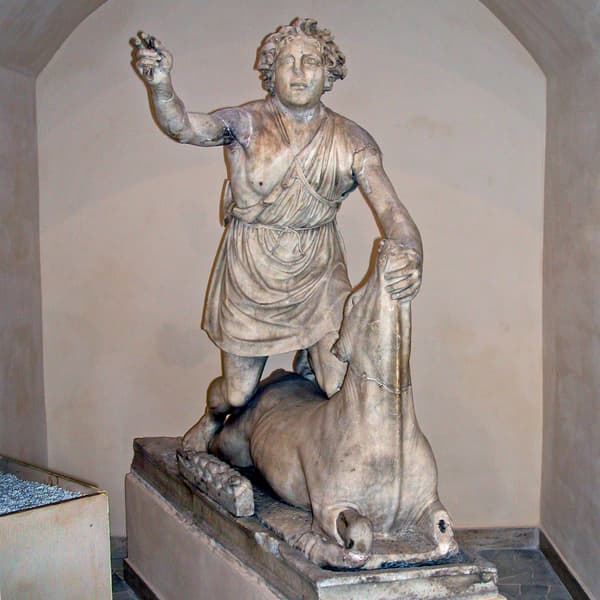
This small museum offers a delightful look at some of Ostia's finest statuary. As you browse, don't worry too much about exactly what's what. Just wander and imagine these fine statues. Tangled wrestlers, kissing cupids, playful gods, adorning the courtyards of wealthy Ostia families.
Most of the statues are 2nd and 3rd century A.D. Roman pieces, inspired by earlier and famous Greek originals. The portrait busts are of real people, the kind you'd sit next to in the baths or on the toilets. Realistic busts were a forte of Roman sculptors.
Read more...Show less
Roman religion honored the man of the house and his father and his grandfather. A statue of daddy and grandpa was common in the corner of any proper house. Also, with the emperor considered a god, you'd find his bust in classrooms, at the post office, and so on. The sarcophagi, the marble coffins, generally feature mythological scenes.
Perhaps the most interesting room is to the left, as you enter, just before the steps. It features statues from religions of foreign lands. Being a port town, Ostia accommodated people and their religious needs from all over the known world. For example, the large statue of a man sacrificing a bull is a Mithraic altarpiece.
While this museum is the end point of our tour, Ostia has more to offer. As you make your way back to the entry gate, you can go on an archaeological scavenger hunt through Ostia, Ostia's back streets. Find the hidden mosaics, fading frescoes, and fast food joints of these ancient and fascinating people. Or just take a break in the museum cafeteria, reflect on the passage of time, and stick something tasty in your Ostium.
We hope you've enjoyed this slice of Rome. Thanks to Gene Openshaw, the co-author of this tour. If you're planning more sightseeing, we have lots of audio tours available for Rome including a walk through the heart of Rome, the Colosseum, the Roman Forum, the Pantheon, St. Peter's, the Vatican Museums, and Sistine Chapel, as well as walks through Trastevere, the Jewish Ghetto, and the remains of Ostia and Pompeii.
In one day? No. Remember, this tour was excerpted from the Rick Steves Rome Guidebook by Rick Steves and Gene Openshaw. For more details on eating, sleeping, and sightseeing in Rome, refer to the latest edition of that guidebook.
For more free audio tours and podcasts, and for information about our TV shows, bus tours, and travel gear, visit our website at ricksteves.com. This tour was produced by Cedar House Audio Productions. Grazie. Ciao. And buon viaggio.
Free
GPS-guided walking tour
No account needed. Walk at your own pace.
Free
13 stops ·