9 stops
GPS-guided
27 min
Duration
Free
No tickets
About this tour
A 9-stop walking tour through the heart of Italy. Visit The Sistine Chapel, Entering the Chapel, Creation of Man, and Nine Scenes from Genesis — with narrated stories at every stop.
9 stops on this tour
The Sistine Chapel
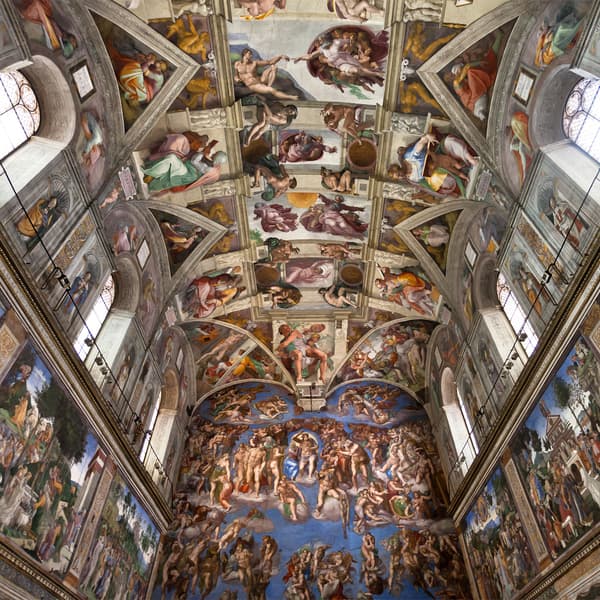
The Sistine Chapel. The Sistine Chapel is the personal chapel of the pope and the place where new popes are elected. But its claim to fame is its paint job. Colorful frescoes by Michelangelo depicting the entire Christian history, from creation to the Last Judgment.
Hi, I'm Rick Steves. Thanks for joining me on a visit to this superstar of tourist sites. We'll see Michelangelo's frescoes on the ceiling and on the altar wall, and talk about the monumental task of plastering and painting it all. The Sistine Chapel is the finale of a visit to the sprawling Vatican Museum, which, by the way, has a strict dress code, basically no shorts or bare shoulders, and it can have very long lines to get in.
Read more...Show less
Consult a guidebook to help get the most out of your visit. Allow about half an hour for the chapel as we stand under dramatic episodes from the Bible, including that iconic scene of God giving Adam the spark of life. To help us along the way, I've invited a good friend and virtual travel buddy. Welcome, Lisa.
Hi, Rick. Lisa will give us helpful directions and sightseeing tips throughout the tour. And my first tip is to be sure you get our tour updates. Just press the icon at the lower right of your device.
You'll find any updates and helpful instructions unique to this tour. Things like closures, opening hours, and reservation requirements. There's also tips on how to use this audio tour and even the full printed script. Yes, so pause for just a moment right now to review our updates and special tips.
It's okay. We'll wait. When you're ready, let's head for one of Western civilization's greatest sites, the Sistine Chapel. The tour begins.
Tour Begins
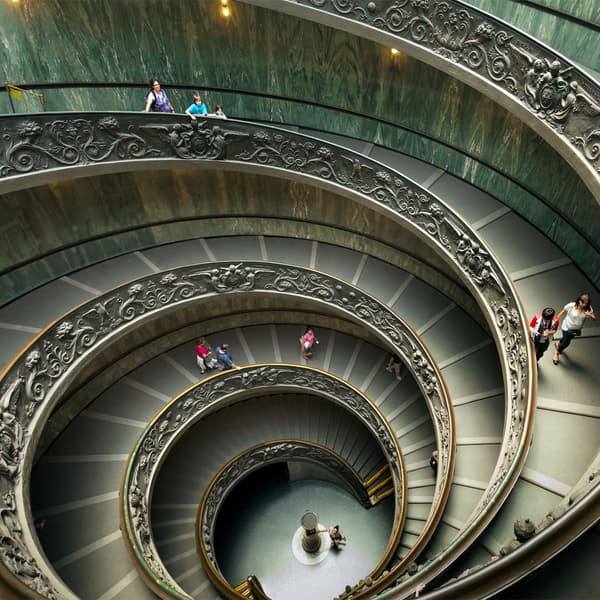
The Sistine Chapel is located within the large Vatican Museum, about a quarter mile from the entrance. Once inside the museum, you'll see plenty of signs directing you to the chapel. Besides, the museum has a one-way crowd flow, so eventually, all roads lead to the Sistine Chapel. The Vatican Museum can teach you a lot about eternity, so don't burn out before you get to the Sistine.
To direct you to the most important sites, you can use our companion audio tour, or get a good guidebook. And I bet you could recommend one. Gladly. For now, we'll assume you've found your way into the Vatican Museum and have made it to the Sistine Chapel.
Read more...Show less
If you're not there yet, pause the audio guide and restart it at the next track when you reach the entrance to the Sistine Chapel. See you there! Entering the Chapel
Entering the Chapel
Understanding what you're standing under You enter the chapel from the altar end. Take in the scene. The room is big, and usually very crowded. Don't freak out.
Ideally, you'll find yourself a place to sit. There are benches along either side. The very best place to view the chapel is about midway down. Find a spot near the screen that divides the chapel in two.
Read more...Show less
Go ahead. Take a little time to find your place. Now, let's get oriented. Face the altar wall, which is painted top to bottom with Michelangelo's Last Judgment.
That wall will be your orientation point throughout this tour. If you're using the map of the Sistine ceiling that comes with this audio tour, you'll face the Last Judgment and hold the map over your head up to the ceiling. Got it? Got it!
Now, let's get started with Michelangelo's ceiling. Face the Last Judgment on the altar wall, and look up. As you crane your neck up at the colorful ceiling, you'll see dozens of saints, prophets, nudes, fake columns. It's a lot to take in all at once.
So, focus your eyes on the very center of the ceiling. Yep, there it is. The famous scene of God reaching out His hand to touch the hand of Adam. You have arrived.
Enjoy this classic scene. Then let your eyes wander all around the rest of the ceiling as you listen to the story, of Michelangelo and the Pushy Pope. In 1508, Pope Julius II asked Michelangelo to take on this important project. Michelangelo said, No thanks.
Michelangelo insisted. He was a sculptor, not a painter. The Sistine ceiling was a vast undertaking, and he didn't want to do a half-fast job. But the Pope pleaded, he bribed, he threatened, until finally Michelangelo consented.
But only on the condition that the Sistine ceiling be able to do it his own way. Julius had asked for only 12 apostles along the sides of the ceiling. But Michelangelo had a much grander vision. He would portray the entire history of the world until the coming of Jesus.
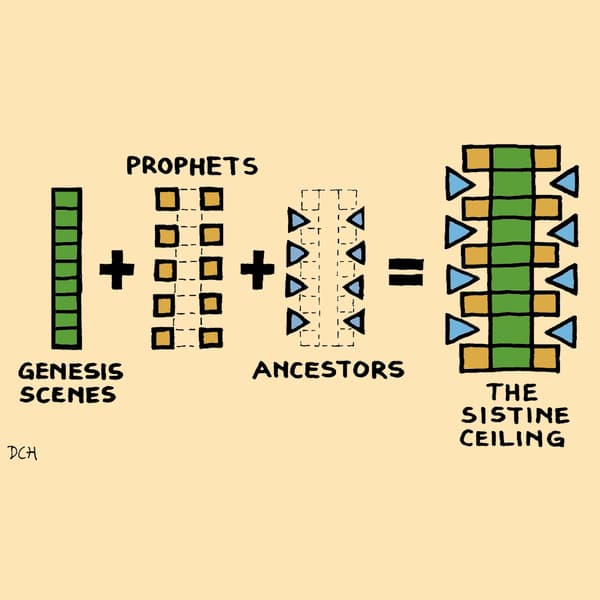
He spent the next four years, from 1508 to 1512, craning his neck on scaffolding six stories up, covering the entire ceiling with frescoes depicting epic scenes from Christendom. Michelangelo's vision is a complex one. Let's try to sort it out. The key to making sense of the tangle of bodies is to see three simple divisions, the central spine of Bible scenes, prophets on thrones, and more figures in triangles.
So here we go. Face the altar wall and find the central spine of nine rectangular scenes. These depict episodes from the creation of the world at the altar end to Noah, the king of the world, and Noah and the flood at the far end. Next, flanking these central scenes, where the ceiling starts to curve, are prophets seated on thrones.
Finally, in the triangles or lunettes on the outer edges of the ceiling are the so-called ancestors of Christ. These are figures from Scripture and lore who foretold the coming of Jesus. Interspersed between all these scenes are fake niches, a painted 3-D illusion. Decorated with nude, statue-like figures, each with a symbolic meaning.
So now, we'll take a closer look at the central spine, the prophets, and the ancestors. Got it? Got it. Let's start with the nine scenes that run down the center of the ceiling.
If you've found a seat with a decent view, you may want to just stay there for now, though at some point, you'll want to get a closer look. Start with the biggie. Zero in once again on the center. On the central panel. The creation of man.
Creation of Man
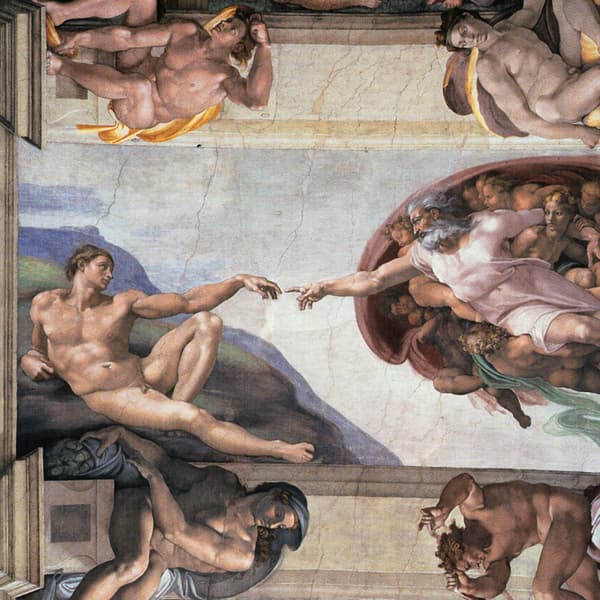
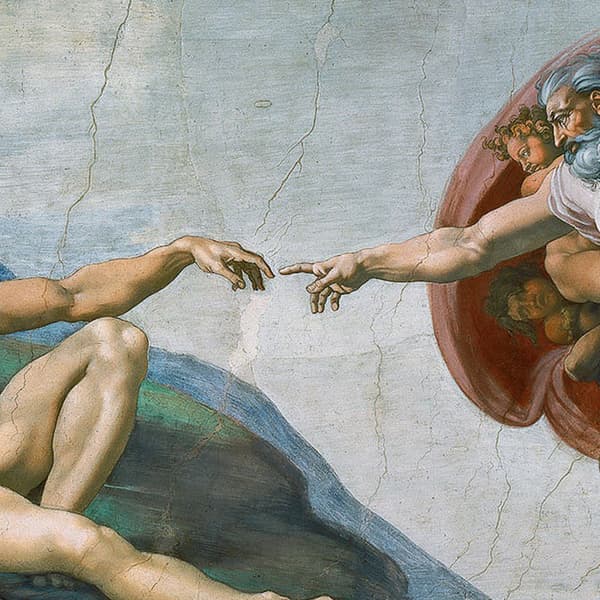
God and man take center stage in this Renaissance version of creation. Adam, newly formed in the image of God, lounges dreamily in perfect naked innocence. God, with his entourage, swoops in in a swirl of activity. The reaching hands of God, and man, are the center of this work.
Adam is limp and passive. God is strong and forceful, his finger twitching upward with energy. Here is the very moment of creation. God passes that spark of life to man, the crowning work of his creation.
Read more...Show less
This is the spirit of the Renaissance. God is not a terrifying giant reaching down to a puny and helpless man from way on high. No, they're on an equal plane. Divide it only by the diagonal patch of sky.
The two exchange meaningful eye contact. God's billowing robe and the patch of green on which Adam is lying balance each other out. They're like two pieces of a jigsaw puzzle. Or two long-separated continents.
Or like the yin and yang symbols, finally coming together, uniting, complementing each other, creating wholeness. This central panel is so Michelangelo. God and man working together in the divine process of creation. This celebration of man and creation permeates the ceiling.
Let's follow the nine central scenes in order. At this point, you'll want to get on your feet to walk from panel to panel. Start at the altar end with the creation. Day one.
Nine Scenes from Genesis
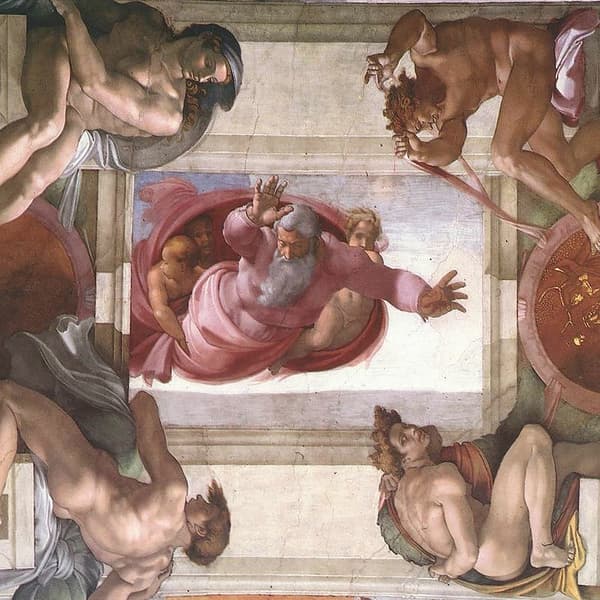
The nine scenes from Genesis. In the first scene, God, in a purple robe, begins to create the world by dividing the light from darkness. As the opening lines of the Bible say, in the beginning, God created the heaven and the earth. And God said, let there be light.
And there was light. And God divided the light from the darkness. In the next panel on the ceiling, God creates the sun, that's the burning orange sphere, and the moon, the pale white sphere to the right. The Bible says, and God made two great lights, the greater light to rule the day and the lesser light to rule the night.
Read more...Show less
Hmm, speaking of moons, you might wonder what's up with God's droopy robe. Well, see Exodus 33, 23 for details. Continuing on to the third panel, God separates the land from the water, or as the Bible says, and God called the dry land earth, and the dry land earth, and the gathering together of the waters, he called seas. And God saw that it was good.
In this scene, Michelangelo, in a tour de force of painting ability, depicts God bursting directly down at us, a difficult angle to draw. Next in the central panel is the center of creation, the creation of man. And the Bible says, in the image of God created he him, male and female created he them. And then came woman.
But first, how's your neck? Is it getting stiff? Just looking at the ceiling is a pain in the neck. Imagine how tough it was for Michelangelo to actually paint it.
More on that later. Now, in the next panel, God creates Eve from one of Adam's ribs. Michelangelo shows Eve almost diving into existence from out of Adam's side. The next panel shows the turning point in creation.
On the left is the leafy Garden of Eden, a paradise where the first man and woman lie around blissfully. But then, the devil comes along, a serpent with a female torso, and winds around the forbidden tree of knowledge. The temptation to gain new knowledge is just too great for these Renaissance people. They eat the forbidden fruit.
At right, an angel with a sword drives them from paradise into the barren plains. They're grieving, but they're far from helpless. Adam's body is thick and sturdy, and we know they'll survive. They'll survive in the cruel world.
Adam gestures firmly to the angel, as if he's saying, all right already, we messed up, we're going, we'll be okay. Eve's look seems to say, shouldn't we be wearing our money belts? From here, Michelangelo fast-forwards to where this original sin leads, to a world filled with sinners. In the next panel, we see the only righteous man, Noah.
He kills a ram and stokes the altar fires to make a sacrifice to God. Continuing on to the next panel, God destroys the rest of mankind with a great flood. The wicked desperately head for higher ground. In the distance, an ark carries Noah's family to safety.
And in the final panel, at the far end of the chapel, Noah's sons happen upon their father, passed out drunk. Perhaps Michelangelo chose to wrap things up with this sorry scene as a reminder that even the best of men are imperfect. Digest these powerful scenes while Rick explains the monumental task Michelangelo faced in covering this vast hall with frescoes. Michelangelo and the Fresco Technique
Michelangelo, Fresco Technique
In sheer physical terms, the ceiling is an astonishing achievement. 5,900 square feet of frescoes, that's roughly the same as painting an entire football field. The vast majority was done by Michelangelo's own hand. Raphael, for example, only designed most of his rooms, letting assistants do all the grunt work.
First, Michelangelo had to design and erect the scaffolding so he and his workers could reach the ceiling. Materials had to be hauled up on pulleys. Then the ceiling had to be plastered. Fresco is painting on wet plaster.
Read more...Show less
The ceiling had to be plastered on wet plaster. When the plaster dries, it locks the colors in so they have a special translucent glow. The trick is, you have to work quickly before the plaster dries. So assistants would mix the plaster and trowel it on.
They'd only do as much as Michelangelo could expect to finish in a day. Oh, that's about a fourth the size of one of the central panels. If Michelangelo didn't get it right the first time, they'd have to scrape the whole thing off and start over. Michelangelo worked standing up, not lying down as popular myth has it.
He bent backward and reached up. If you've ever struggled with a ceiling light fixture or worked underneath a car for even five minutes, you know how heavy your arms get. The physical effort, the paint dripping in his eyes, the creative drain, and the mental stress from a pushy pope all combined to almost kill Michelangelo. But the result was dazzling.
By the way, the bright colors we see today are nearly as glorious as when Michelangelo first painted them. Until this millennium, the ceiling was dim and dark, covered with centuries of preservatives, dirt, and soot from candles, oil lamps, and from the annual papal barbecue. Just kidding. But now the ceiling and the Last Judgment have been cleaned.
The bright, bright colors that emerged were a bit shocking, forcing many art experts to re-evaluate Michelangelo's style. Look toward the altar wall and find the very dark patches left uncleaned in the corner. Now imagine how dreary and dark the whole thing was before the cleaning. Turn your attention to the prophets.
These are the solemn figures on thrones that flank the central spine of panels. Remember, if you're using the Sistine ceiling map to find a particular prophet, you'll face the Last Judgment and hold the map up as you gaze at the ceiling. Let's get started. First, we'll find some prophets. Then, the answer is, in the triangles along the ceiling's edge. Prophets, ancestors, and assorted nudes.
Prophets, Ancestors, Nudes
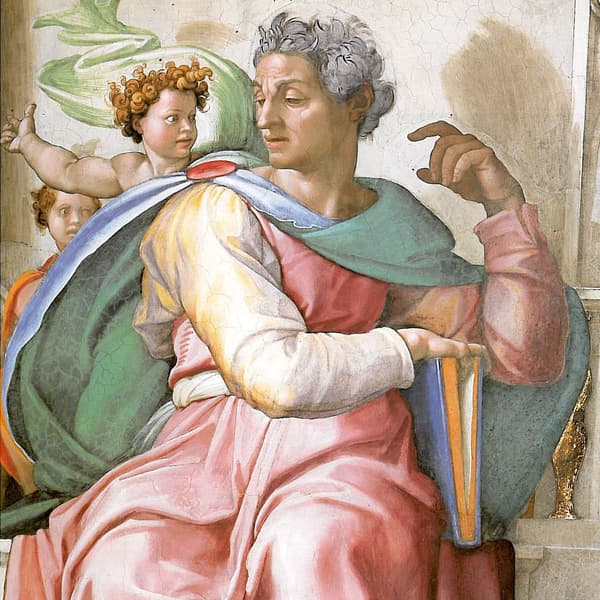
Michelangelo depicted his favorite prophets as monumental robed figures sitting on thrones. A typical one is Isaiah. He's directly above the lattice screen on the left-hand side that's left as you face the altar. Isaiah sits on a throne, and there's one labeled Isaiahs.
Compare him with others nearby, and it becomes clear that each prophet has a completely different personality. To the left of Isaiah, that is, in the rear corner of the chapel, you'll find a female prophet, the so-called Delphic Sybil. She twists her body and looks out curiously, holding a scroll that predicts the coming of Christ. The Delphic Sybil was not a Christian.
Read more...Show less
She was a pagan from ancient Greece, a worshiper of Zeus, Apollo, and the other pagan gods. But in Renaissance times, they imagined that the enlightened Greeks must have foreseen the coming of the Messiah. Now, pagan priestesses, as well as Old Testament prophets, were all a part of God's grand plan. Now, turn your attention to the triangles along the outer edges of the ceiling.
These have still more figures and scenes from the Bible and from Christian legend. Scholars generally label them the ancestors of Christ, though their synonyms, their symbolic meaning, is largely lost on modern eyes. Whatever their symbolism, Michelangelo's figures speak volumes with their dramatic, twisting poses. Look in between the central panels at the Adonises come to life sitting on pedestals.
They squirm and twist to show off their buff physiques. Michelangelo had been inspired by a recently discovered nude statue. You may have seen it on your way to the Sistine, the ancient statue of Laocoon. Michelangelo used that nude's dramatic pose and melodramatic emotions to take this ceiling to a whole new level.
Finish your tour of the ceiling by standing in the center and comparing the two halves, the half near the altar and the half at the far end. Michelangelo's triumph.
Michelangelo’s Triumph
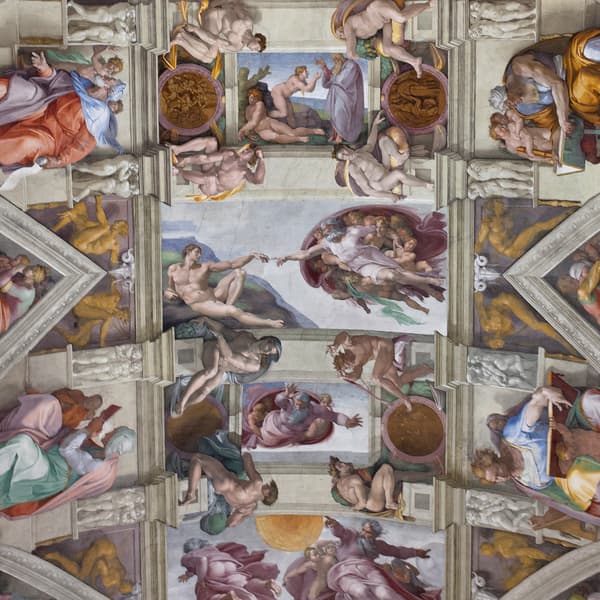
You'll notice that the figures on the ceiling and the figures at the far end of the chapel, farthest from the altar, are a bit smaller than those over the Last Judgment. For example, the scene of Noah's flood features many small people scrambling for safety. On the other hand, the scenes near the altar showing God creating the world have just a few large-scale figures that fill the entire panel. Or compare the prophet Isaiah, so stately and balanced, with the prophet Jeremiah at the altar end.
Here's a figure to the left of the altar labeled "Haramias." This prophet witnessed the destruction of Israel. He slumps, chin in hand, pondering the fate of his people. Why the difference between the two halves? Well, Michelangelo started the project in 1508 at the far end with the Noah scenes and prophets like Isaiah.
Read more...Show less
By 1510, he had finished the first half. When they took the scaffolding down and could finally see what he'd been working on for two years, everyone was awestruck. Everyone except Michelangelo. As powerful as his figures are, from the floor, they just didn't look dramatic enough for him.
So for the other half, Michelangelo pulled out all the stops. His creation scenes became less busy, and the prophets became bigger and more intense. Finally, in 1512, the sealing was finished. The pope and his people gathered here for the grand unveiling, and it simply blew them all away.
It was unlike anything anyone had ever seen before. It both caps the Renaissance and turns it in a new direction. In perfect Renaissance spirit, the Sistine ceiling mixed Old Testament prophets with classical figures. But the style is more dramatic, shocking, and emotional than the balanced Renaissance works before it.
This is a very personal work -- the Gospel according to Michelangelo. But its themes and subject matter are universal. In the opinion of many people, art scholars to humble tourists, the Sistine ceiling is the single greatest work of art by any one human being. Wow.
Who could possibly follow that? Only Michelangelo himself. Exactly. And so it came to pass that, 23 years later, another pope came to Michelangelo to ask if he'd return to the Sistine for one more paint job -- to cover the wall behind the altar.
Compare it -- the optimism of the ceiling -- with the traumatic Last Judgment on the wall, to see how times had changed. ♪♪
Last Judgment
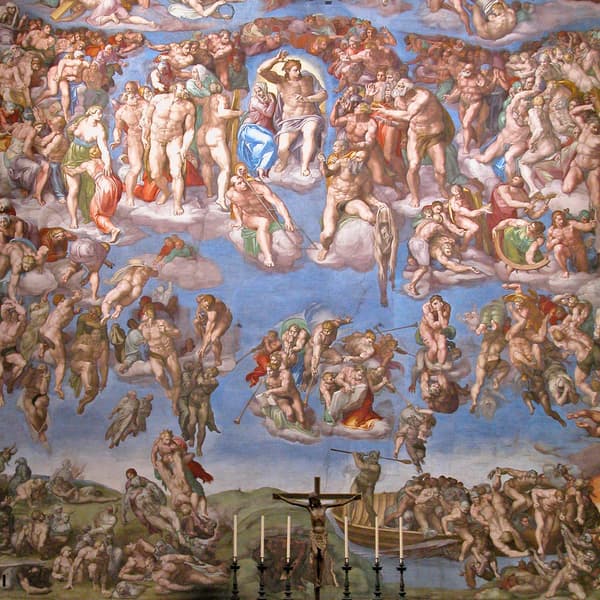
The Last Judgment. In 1535, Michelangelo was asked to complete his Christian history of the world by painting the final event -- the end of time. When he returned to the Sistine, the mood of Europe and of Michelangelo was completely different. The Protestant Reformation had forced the Catholic Church to clamp down on free thought, and religious wars raged across Europe.
Rome had recently been pillaged by roving bands of mercenaries. The Renaissance spirit of optimism was fading. Michelangelo himself, now in his 60s, had begun to question the innate goodness of mankind. It's Judgment Day, and Christ has come down to find out who's been naughty and who's been nice.
Read more...Show less
There's Christ, the power of God, a powerful figure in the center, raising his arm to smite the wicked. Beneath him, a band of angels blows its trumpets, Dizzy Gillespie-style, giving a wake-up call to the sleeping dead. The dead, in the lower left of the painting, leave their graves and prepare to be judged. The righteous ones, on Christ's right hand -- that's our left -- are carried up to the glories of heaven.
The wicked, on the other hand, are hurled down into hell, where demons await to torture them. A baron from the underworld of Greek mythology stands below, ready to ferry the souls of the damned straight to hell. It's a grim picture. No one, but no one, is smiling.
Even many of the righteous being resurrected on the lower left are either skeletons or cadavers with ghastly skin. The angels have to play tug-of-war with underground monsters to drag the saved out of their graves. Meanwhile, over in hell, the wicked are tortured by gleeful demons. One of the damned, the crouched-down guy to the right of the trumpeting angels, has an utterly lost expression.
It's like, "Why did I cheat on my wife?" Two demons grab him around the ankles to pull him down, down into the bowels of hell, condemned to an eternity of constipation. Above all, it's the terrifying figure of Christ that dominates the scene. This is not your love-thy-neighbor Jesus anymore. He's come for justice.
His raised arm sends a ripple of fear through everyone. Even the saints around him shrink back in terror. Even his own mom, Mary, beneath his arm, turns away. Clearly, her interceding days are over.
Christ's expression is completely closed. He turns his head, refusing even to listen to the whining alibis of the damned. Look at Christ's bicep. If this muscular figure looks familiar to you, it's because you may have seen it earlier today.
It's the figure in the Vatican Museum -- the Belvedere torso. When the Last Judgment was unveiled to the public in 1541, it caused a sensation. The pope is said to have dropped to his knees and cried, "Lord, charge me not with my sins when thou shalt come on the Day of Judgment." And this fresco changed the course of art. The complex composition, with more than 300 figures swirling around Christ, was far beyond traditional Renaissance balance.
Painters, shown from every imaginable angle, challenged other painters to just try and top this masterpiece of 3-D illusion. And the sheer terror and drama of the scene was a striking contrast to the placid optimism of, say, the creation of Adam on the ceiling just behind you. Michelangelo had broken all the rules of the Renaissance -- or, should I say, baroken the rules. It signaled a new era of emotional art that would come to be known as Baroque.
Now, move up closer and examine some of the details. Check out the Judgment Day band. Below that, Karen, with Dr. Spock ears and a dolly mustache, paddles the Damned in a boat filled with human turbulence.
Before the cleaning, details such as these were lost in the murk. Michelangelo loved to paint the human body in all its naked splendor. But with the Renaissance fading, these fleshy figures suddenly became politically incorrect and drew murmurs of discontent from church authorities. Michelangelo got even by painting his chief critic in hell.
Look close up in the bottom right-hand corner near the entrance door. He's the jackass guy wrapped in a snake. Look at how Michelangelo covered his critics' privates. Sweet revenge.
As a postscript, though, after Michelangelo's death, those prudish church authorities eventually had their way. And painted the strategically placed wisps of clothing that we see today. Finally, look around the entire chapel and appreciate Michelangelo's grand vision. He's taken us from the creation to the coming of man and woman, to the prophets that foretold Christ, and finally, to Christ's return at the end of time.
The Last Judgment marks the end of Renaissance optimism, epitomized in the creation of man in the central panel of the ceiling. There, he was the wakening man-child of a fatherly god. Here, in the Last Judgment, man cowers in fear and unworthiness before a terrifying, wrathful deity. Michelangelo himself must have wondered how he'd be judged had he used his God-given talents wisely.
Well, look at St. Bartholomew, the bald, bearded guy at Christ's left foot. Bartholomew holds a flayed skin. In the flayed skin, you can see a barely recognizable face.
The twisted self-portrait of a self-questioning Michelangelo. We hope you've enjoyed this slice of Rome. Thanks to Jean Openshaw, the co-author of this tour. If you're planning more sightseeing, we have lots of audio tours available for Rome, including a walk through the heart of Rome, the Colosseum, the Roman Forum, the Pantheon, St.
Peter's, the Vatican Museums and Sistine Chapel, as well as walks through Trastevere, the Jewish Ghetto, and the remains of Ostia and Pompeii. In one day? No. Remember, this tour was excerpted from the "Rick Steves' Rome Guidebook" by Rick Steves and Jean Openshaw.
For more details on eating, sleeping, and sightseeing in Rome, refer to the latest edition of that guidebook. For more free audio tours and podcasts, and for information about our TV shows, bus tours, and travel gear, visit our website at ricksteves.com. This tour was produced by Cedar House Audio Productions. Grazie. Ciao. And... Buon viaggio.
Free
GPS-guided walking tour
No account needed. Walk at your own pace.
Free
9 stops ·