7 stops
GPS-guided
33 min
Duration
Free
No tickets
About this tour
A 7-stop walking tour through the heart of Italy. Visit A Trastevere Walk, Piazza in Piscinula, Trastevere's Back Lanes, and Church of Saint Cecilia — with narrated stories at every stop.
7 stops on this tour
A Trastevere Walk
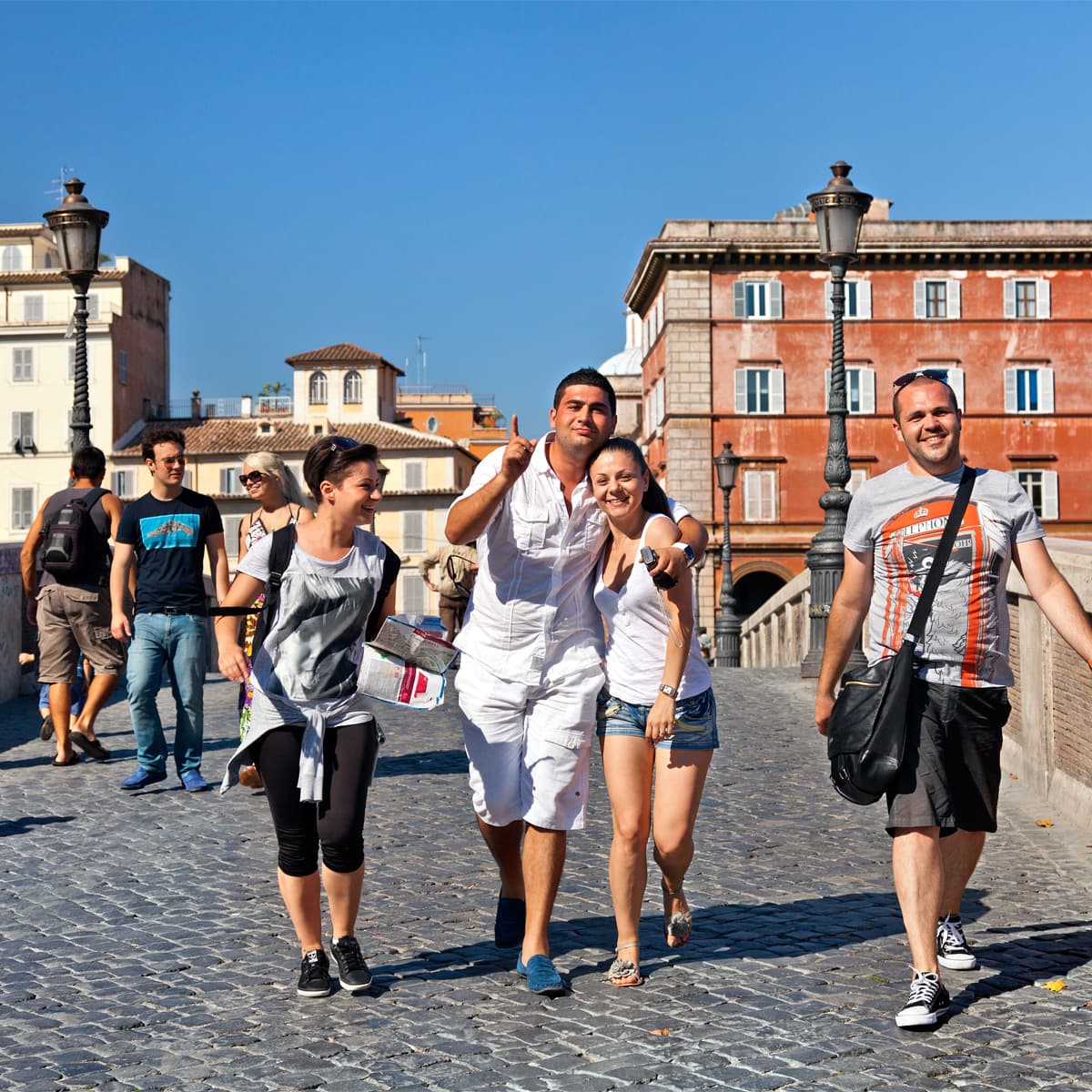
A Trastevere Walk Trastevere, the colorful neighborhood across the river from downtown Rome, is the place to immerse yourself in the crustier side of the Eternal City. You'll discover a secret hidden city of heroic young martyrs, lovers kissing on vespas, and feisty Trasteverini, old-timers who pride themselves on never setting foot on the opposite bank of the Tiber River. Hi, I'm Rick Steves. Thanks for joining me on this half-mile walk from the island in the Tiber River to the Church of Santa Maria in Trastevere.
This walk is designed to train your eye to see Rome more intimately. Along with old churches, statues, and mosaics, we'll see the Rome of today. Apartments with rooftop terraces, kids playing soccer in the piazza, and narrow lanes draped with drying laundry. The walk works well any time of day.
Read more...Show less
In the morning, it's cool, and the churches are open. At dusk, it's especially atmospheric, and you can top off your walk with a memorable meal. However you play it, don't miss a chance to see a slice of backdoor Rome in the district across the river known as Trastevere. To help us along the way, I've invited a good friend and virtual travel buddy.
Welcome, Lisa. Ciao, Ricardo. Lisa will give us helpful directions, and sightseeing tips throughout the tour. And my first tip is to be sure you get our tour updates.
Just press the icon at the lower right of your device. You'll find any updates and helpful instructions unique to this tour. Things like closures, opening hours, and reservation requirements. There's also tips on how to use this audio tour, and even the full printed script.
Yes, so pause for just a moment right now to review our updates and special tips. It's okay. We'll wait. And then... Let the tour begin. The tour begins.
Tour Begins
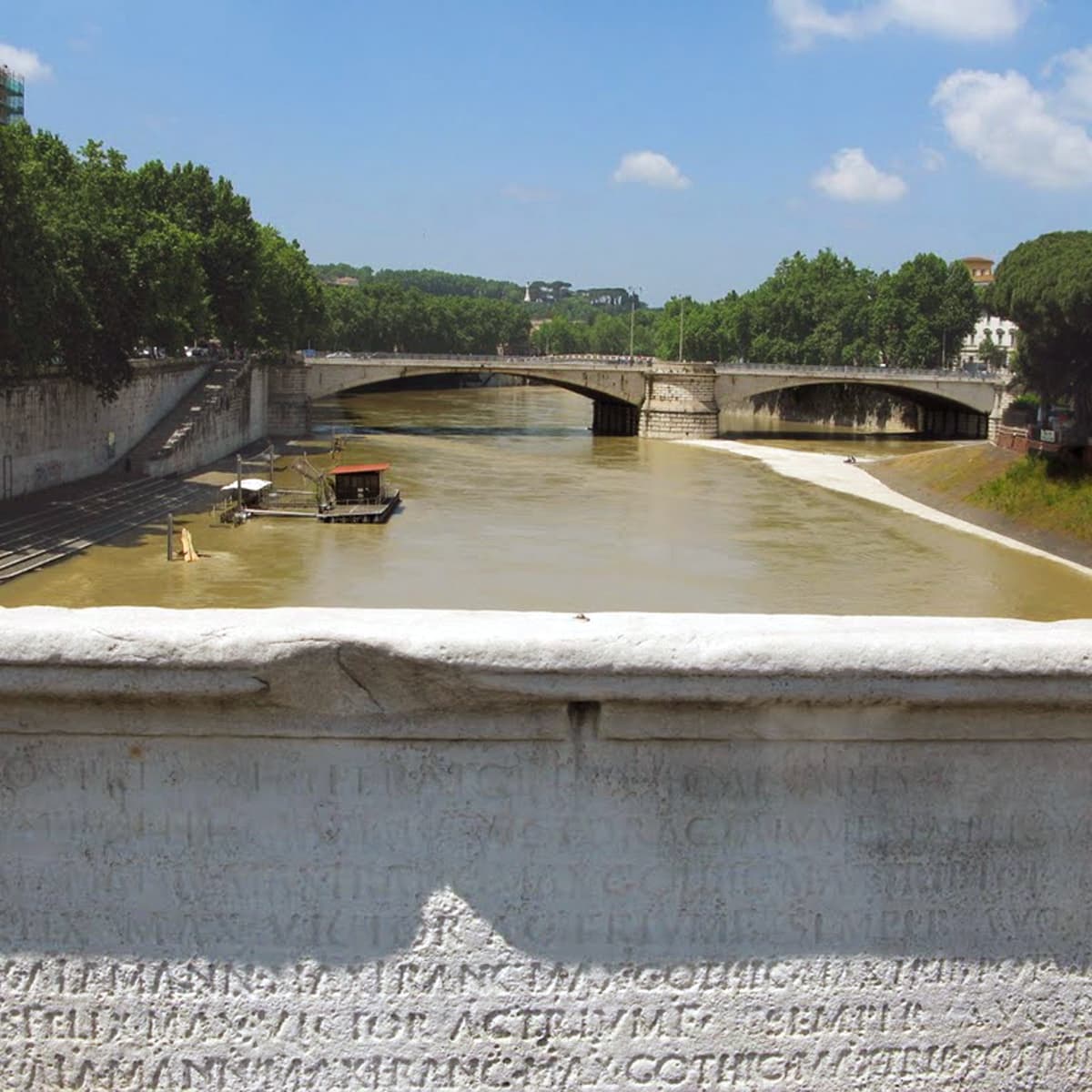
Isola Tiburina and the Tiber River. Start at Isola Tiburina, the island in the Tiber River, crossed by a bridge, Ponte Cestio. This bridge has led from downtown Rome to the Trastevere neighborhood since ancient times. In fact, Trastevere, literally means across the Teveri, or the other side of the Tiber River.
Begin halfway across the Ponte Cestio at the high point of the bridge. Note that the bridge is also called Ponte Fabricio. Enjoy the view of the river and the island from the high point of the bridge as Rick sets the scene. Rome got its start 3,000 years ago along the Tiber River, right about here.
Read more...Show less
This was as far upstream as big boats could sail, and the first place the river could become was the Ponte Cestio, which was one of the first islands to be crossed by bridge. As a center of river trade, Rome connected the interior of the Italian peninsula with the Mediterranean. The area below you would have been bustling in ancient times. Look down and imagine a busy little port, water mills, ramshackle boats, and platforms for fishing.
The island itself was once the site of a temple dedicated to Asclepius, the god of medicine. Ancient Romans who were ill spent the night here and left little statues of their healed body parts -- feet, ears, hearts, and so on -- as thank-you notes. This tradition survives. Today, throughout Italy, Catholic altars are often encrusted with votive offerings, symbolizing gratitude for answered prayers.
During plagues and epidemics, the sick were isolated on this island. These days, the island's largest building is the Fatte Bene Fratelli, the public hospital favored by Roman women for childbirth. The island's reputation for medical care lives on. The high point of the bridge, which you're probably leaning on, is an ancient stone with a faded inscription.
It dates from 370 A.D., when this bridge, which was already at that point 400 years old, was rebuilt. The eroding plaque is stapled into the balustrade like a piece of recycled scrap. Look at the top line, just right of center, and run your fingers over the word: Caesar. This part of the Tiber River flooded frequently, which unfortunately made the once-miserable land on the North Bank the ideal location for the medieval Jewish ghetto.
In the 1870s, the Romans removed the threat of flooding by practically walling off the Tiber. They built the tall, anonymous embankments that continue to isolate the river from the city today. Now, let's plunge into Trastevere. Head south, away from the island and the Tiber.
Along the riverbank, you'll pass the green kiosk called Sora Marella. It's on the right. In warm weather, this is the most famous vendor of the local summer refresher called Gratta Kekka. Shaved ice with fruit-flavored syrup and chopped fruit.
It's similar to an American granita. Mmm. Cross the busy boulevard and go down the steps into the car-filled square. It's called Piazza in Piscinula. I'll grab a Gratta Kekka and catch up later. ♪ ♪ ♪ ♪ Piazza in Piscinula.
Piazza in Piscinula
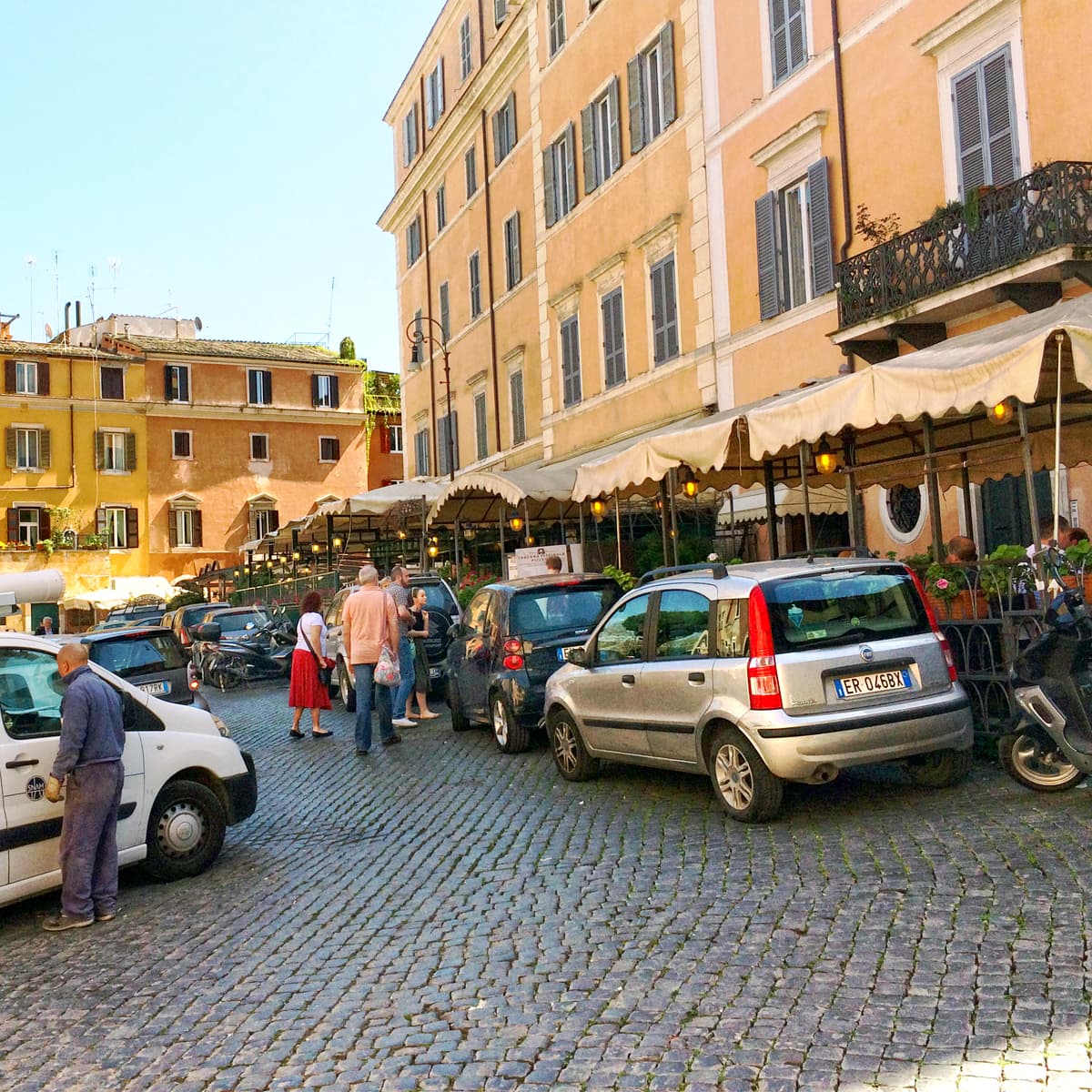
This square is famous for its church bell tower. That's the cute little thing directly across from the bridge. Dating from 1069, it's the oldest working bell tower in the city. Study the brown building on the riverside of the square and spot the faint traces of Renaissance decoration.
The earth-toned shades of today's city echo this original Roman brown. Let's plunge deeper into Trastevere. Facing the tower, exit the square from the far right corner, opposite where you entered. ¶¶ ¶¶ Now, from the corner of the square, ¶¶ head uphill on Via dell'Arco dei Ptolemy, while Rick describes sights along the way. Trastevere's Backlanes
Trastevere's Back Lanes
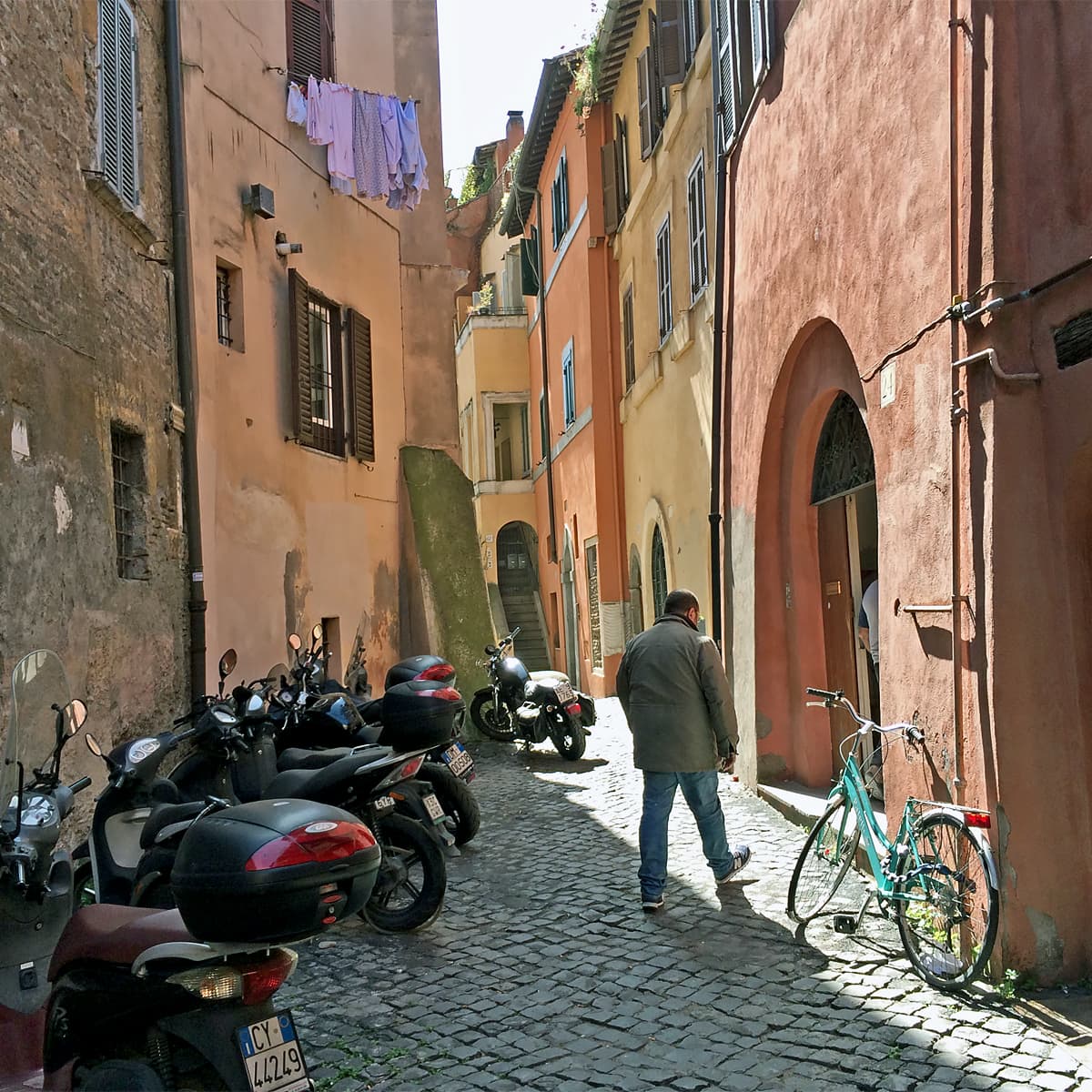
Look up and directly ahead to the top of the hill to see the elegantly restored, freshly painted tower sandwiched between apartments. In medieval times, Rome's skyline had 300 of these towers. Today, about 50 survive. Each noble family competed for the tallest tower until, in about 1250, city authorities got fed up and had them all lopped off.
Later architects incorporated some of the remaining stumps into newer buildings, and you can still see these remnants of medieval Rome all over the old center. Incorporating old structures into new ones was always considered more economical and practical than demolishing and starting again from scratch. In the Middle Ages, Rome had regressed to being little more than a big village. Any idea of town planning was lost for centuries.
Read more...Show less
Notice the plants spilling over the many rooftop terraces, the Roman equivalent of a leafy backyard. An attico con terrazzo, penthouse with a terrace, is every Roman's dream. Continue on, walking under the low arch. Lots of aristocratic buildings were connected by these elevated passages.
Imagine herds of sheep shuffling through here in medieval times while smoke billowed from the windows and doors of humble homes that, in their day, lacked chimneys. Keep going until you reach the intersection with Via dei Salumi, where we'll be turning left. ¶¶ ¶¶ ¶¶ ¶¶ When you reach the intersection with Via dei Salumi, turn left. Via dei Salumi, that's Salami or Cold Cut Street, is one of many alleys here named for the local businesses that once thrived in this neighborhood.
Because of its vicinity to the river, Trastevere was always a commercial neighborhood. The streets rarely paved, were clogged by a commotion of shop stalls. The red-brown building on your right is a school from the Mussolini era. It's pretty ugly, unless you're a fascist.
The fascist leader believed in the classical motto, men sana in coppore sano, a healthy mind in a healthy body. Il Duce loved being seen fencing, boxing, swimming, and riding. Schools built during his rule come with top-end gyms. After passing through the city, passing the school, turn right again, heading up Vicolo dell'Atleta.
Vicolo dell'Atleta. Let me guess. That would be the alley of the athlete. Bravo, signore.
As you amble up the alleyway, check out the latest fashions in underwear, hanging out to dry. Rick, what's up with all that laundry? Well, apartments in Rome tend to be quite small, and electricity is more expensive, in Rome, than in the U.S., and there's plenty of sun. So lots of people don't have clothes dryers.
Strolling here, you'll understand why the Italian language has no word for privacy. They use our word, and just roll the R. Privacy. Si, bene.
Simply reading a letter on the metro attracts a crowd. If someone has a fight, or a particularly good orgasm, the entire neighborhood knows. Young lovers with no place to go are really the best. They're really good at riding Vespas while parked.
That's nice. In a way, parts of Trastevere are like a timeless world, people going about their everyday business just as they have since the ancient Romans settled the banks of the Tiber 3,000 years ago. All around, ancient fragments are recycled ingloriously into medieval buildings. Halfway down the alley on the right is a restaurant that 1,000 years ago was a synagogue.
Find the Hebrew letters faintly inscribed on the base of the columns of the exposed brick. A large part of Rome's Jewish community, which was the most ancient outside Palestine, lived right here in Trastevere. They lived here until the popes moved them over the bridge and into the ghetto on the other side of the river in the 1500s. Our next stop is the Church of St.
Cecilia, or Santa Cecilia. Keep going to the end of the alleyway. When you reach the end of the alleyway, which Via dei Genovesi, turn left. Left on Genovesi.
Got it. After turning, go to the first intersection. First intersection. Got it.
Man, I'm loving the ambience here. When you reach the corner, turn right on Via di Santa Cecilia. Right on Santa Cecilia. Lisa, I'm sure glad you're leading the way.
Of course. Follow the street as it leads into... Piazza di Santa Cecilia. Yes.
I can see the narrow alleyway opening up ahead. And there it is, on the right. The gateway to the church's courtyard. Enter the courtyard through the arched doorway.
Don't worry. If it's open, you're welcome to go in. Very nice. Find a seat by the fountain and take a moment to enjoy the courtyard, the church facade, and the peace and quiet. ♪♪ ♪♪ ♪♪ ♪♪ The Church of St. Cecilia.
Church of Saint Cecilia
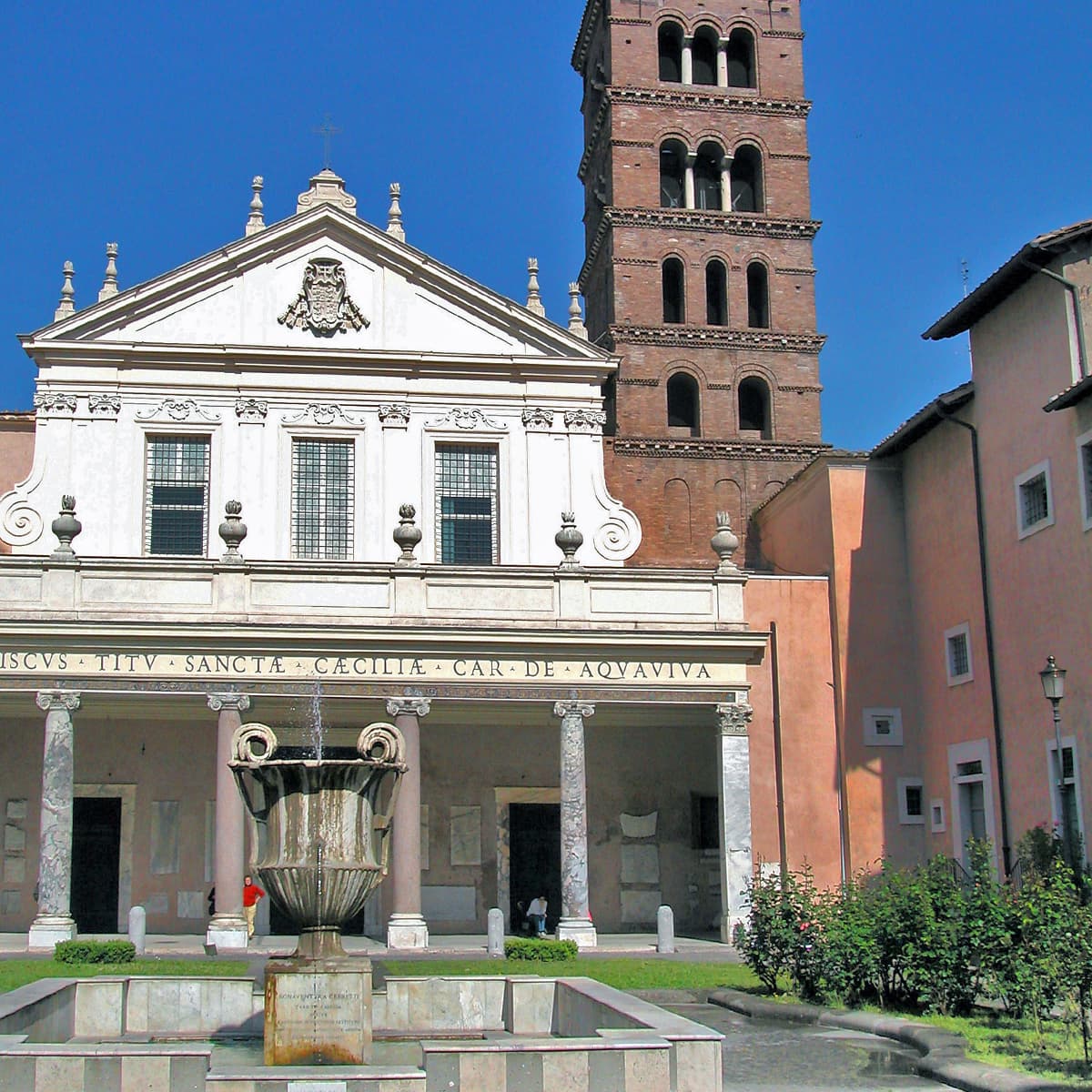
Or Chiesa Santa Cecilia. Trastevere has many early Christian churches like St. Cecilia. This is because in the 2nd and 3rd centuries, a large community of foreigners lived here, including early Christians from Greece and Judea.
They introduced their cultures and religions to the neighborhood. Notice the church's eclectic exterior. The mismatched columns were recycled from pagan temples. The typical medieval bell tower, sports and festivals, and 18th-century façade.
Read more...Show less
Now, go inside the church. ♪♪ ♪♪ ♪♪ ♪♪ ♪♪ ♪♪ ♪♪ ♪♪ ♪♪ ♪♪ ♪♪ ♪♪ The church is dedicated to Cecilia, patron saint of musicians and singers. That's why it's popular for weddings. Of Rome's 40 medieval churches, many have two-year waiting lists for weekend weddings.
Most young Roman couples favor the more sober elegance of medieval churches over the fancy Baroque, which are dismissed as troppo pesante, too heavy. Regardless of the venue, the typical Italian wedding gown is far from understated. Once inside, head for the altar. ♪♪ ♪♪ ♪♪ In a case below the altar, find the statue of Saint Cecilia.
It was sculpted in 1600 by Stefano Maderno. Cecilia was an ancient Roman from a wealthy family who converted to the forbidden faith of Christianity. She revealed her faith to her pagan husband on their wedding night, and told him of her aspiration to remain chaste. Uh-oh.
Lucky for Cecilia, an angel appeared and managed to reason with and then convert the frustrated groom. Cecilia's husband devoted himself to carrying out Christian burials in the catacombs until he himself was martyred. Cecilia was condemned as well. Bummer.
Wait, it gets worse. The Romans tried for three days to suffocate her with steam from her bath to make it appear accidental. Miraculously, she survived. So, they beheaded her.
Cecilia bequeathed her house to the neighborhood community, and this spot has been a place of worship ever since. In the days when Christianity was illegal, wealthy converts like Cecilia hosted Mass for the local community in their homes. When Christians were finally allowed to worship openly and build churches, they often built on the sites of these homes for the sake of continuity. While the Church of Saint Cecilia originated in the 3rd century, what we see today was built in the 9th century and extensively restored in the 18th century.
Viewing Moderno's statue of Cecilia, remember that during the Catholic Counter-Reformation, art was a propaganda tool for the Church. It was charged with great emotional impact in order to counter the Protestants and enhance the Catholic faith. The Counter-Reformation appetite for relics led to a search for Cecilia's remains. When her tomb was opened, the sculptor Moderno was there.
He claimed, along with other bystanders, to have seen her body perfectly preserved for an unforgettable instant before it turned to dust. He created this touching statue from his memory of that scene. Cecilia lies with her face turned and hidden, the violence of her death suggested only by the gash in her neck. The position of her fingers indicates the oneness of the Trinity.
Like Italians today, Cecilia counted, starting with her thumb. The canopy of the Trinity above the altar dates from the 1200s. It represents an innovative fusion of Roman and French Gothic architecture and sculpture. Looking at this, it's clear the artist, Arnolfo di Cambio, both knew his classics and had been to Paris.
The mosaic behind the altar, in the apse, dates from the 9th century. Cecilia stands on the far right. Pope Pascal, on the far left, who built the Church back in the 9th century, holds a little model of it, in his hands. His square halo signifies he was alive when the mosaic was made.
His small head suggests he was less important than the others in the scene. By the way, if you visit late in the morning, you may be able to visit two parts of the Church that are only open a few hours each day. Downstairs is the crypt, which contains the ancient remains of Cecilia's house, where those neighborhood Christians first worshipped back in ancient Roman times. It's pretty bare, but it does have some early Christian iconography, original mosaic floors, and storage bins for grain.
Upstairs in the loft are some wonderful 700-year-old frescoes. To get there, you'll need to ask the nuns to open the door on the left side of the façade. If you get in, you can climb to the loft, where cloistered nuns would view the mass while hidden behind a screen. It contains extraordinary frescoes of angels.
They were painted in around 1300 by Pietro Cavallini, a contemporary, of Giotto. Scholars debate who influenced whom, Giotto or Cavallini. But there's no debate at all that the art here shows cutting-edge, proto-Renaissance realism in the expressive faces of the angels who sit believably in their chairs. Let's move on.
Our next stop, a busy street called Viale di Trastevere, is an eight-minute walk away. And on the way, you could make a quick detour to a classic old Biscotte di Ficcio, a biscotti factory, where Stefania would just love to sell you some of her fresh-baked cookies. So, here's the route. When you leave the church, backtrack to the left, returning to Via de Genovese.
So, back the way we came. At Via de Genovese, turn left and head straight west several blocks until it meets Viale di Trastevere. And for the cookie detour about 50 meters before you reach the big street, turn right on Via della Luce and go half a block to number 21. That's the route.
So, review the directions if you need to, then pause the audio guide, and... We'll see you at the big and busy Viale di Trastevere. Viale Trastevere to Piazza Santa Maria.
Viale Trastevere
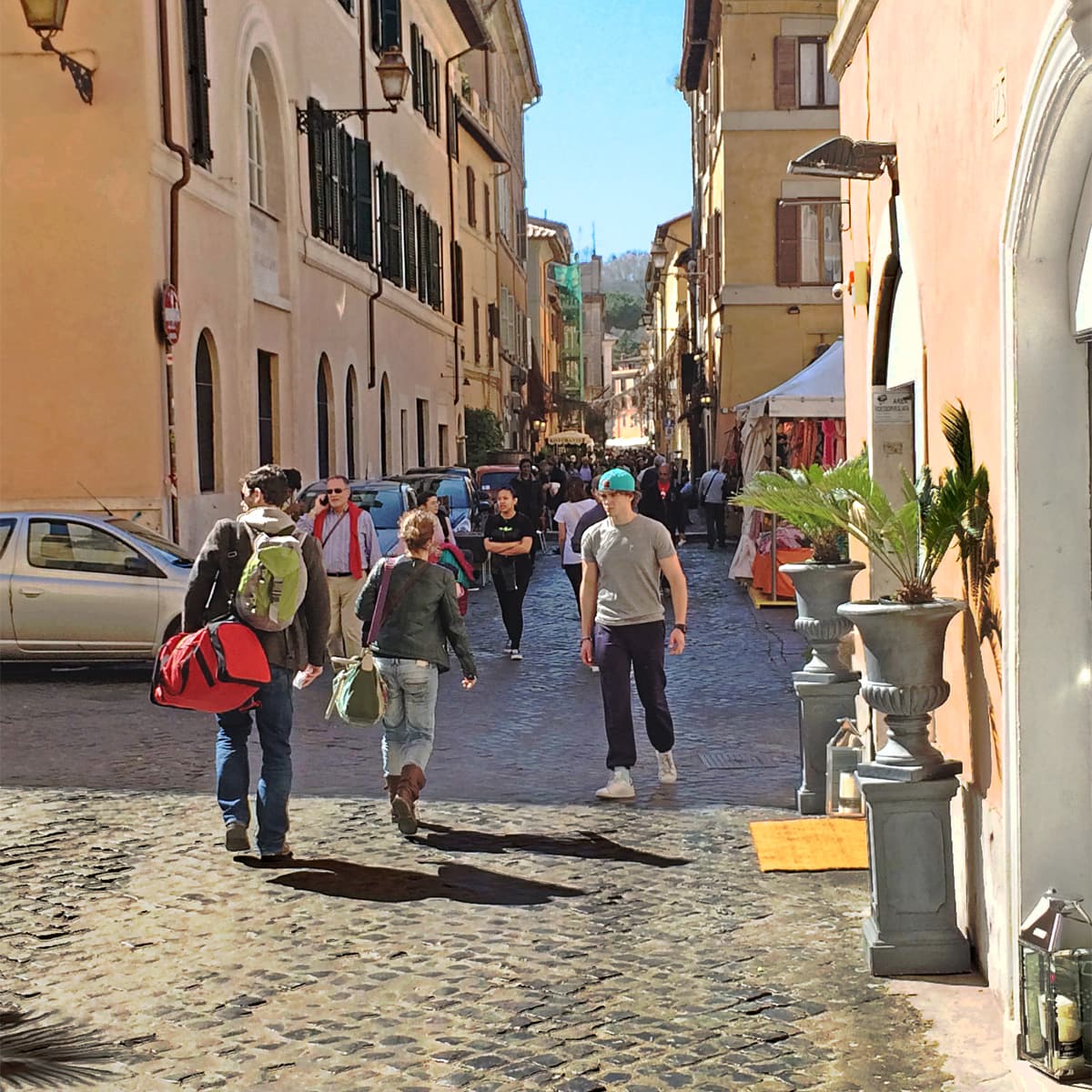
The wide modern boulevard called Viale Trastevere slices through the middle of Trastevere. Trastevere is so interesting today for good reason. Except for the building of this street, the neighborhood was spared the kind of demolishing and rebuilding that transformed and modernized other traditional neighborhoods back when Rome became the capital of a united Italy in 1870. Cross to the other side of Viale Trastevere.
You may need to pause the audio guide until you get there. I'll wait. Once on the other side, turn right, then left, into a little square called Largo San Giovanni di Mata. Pass by the tourist information kiosk and the textbook Baroque facade of the faded yellow church, and continue to Via Lungoretta.
Read more...Show less
Follow Via Lungoretta straight toward our next stop, Piazza Santa Maria. It's several blocks away. Once on Via Lungoretta, you'll notice a change in atmosphere. The quiet, mystical church, and the magical charm of the first part of your walk has given way to livelier, more colorful, more touristy, and higher-rent surroundings.
Look up. Now, along with underwear, you see modern art. Just keep strolling down Via Lungoretta. We'll be going several blocks to where the street emerges into a piazza with a big church.
Rick? You know, Trastevere got its reputation with tourists as a colorful urban jungle about a generation ago. Travel writers, like me, enthused poetically about the simple and characteristic working-class charm of the people who lived here. Then, things started to change.
As is so often the case, think the Ramblas in Barcelona, Montmartre in Paris, fill-in-the-blank in your own hometown. Once this district became trendy for its colorful and rough edges, the neighborhood's popularity attracted people with money. Prices went up. The gang that made it here that made the neighborhood so charming and fun was priced out, and they moved away.
Today, Trastevere is still charming, but it's harder to afford, and rather than families and eccentric characters, you'll find more wealthy people and professional singles living here. Most of the amazing mom-and-pop-run hole-in-the-wall restaurants have been replaced as pricier places that are just faux characteristic have flooded the market. Speaking of markets, the people who used to buy fava beans, gnocchi, and artichokes are rare now, and merchants make more money selling slushies, gifty edibles, and cute bags of potpourri to tourists like you and me. Short-term Airbnb-type rental opportunities resulted in landlords raising their rents and the exodus of the old guard just accelerated.
I still enjoy these neighborhoods, but I sure do miss the old days. By the way, strolling down Via Lungoretta, be mindful that you are inflicting on yourself what I call street bias. The route you're walking along is the highest-rent street in the neighborhood, and consequently, you're only seeing the shops, cafes, and restaurants that can afford the rent. This tour finishes after the next stop.
Taking just a few minutes to get lost in the back lanes is the only remedy to the street bias you're now suffering. Nevertheless, we're continuing on to our final stop. After several blocks, Via Lungoretta spills into the spacious Piazza Santa Maria. Dominating the square is the Church of Santa Maria in Trestavery, with its facade decorated with mosaics of palm trees. Take a seat on the fountain steps and take it all in. ¶¶ ¶¶
Santa Maria in Trastevere
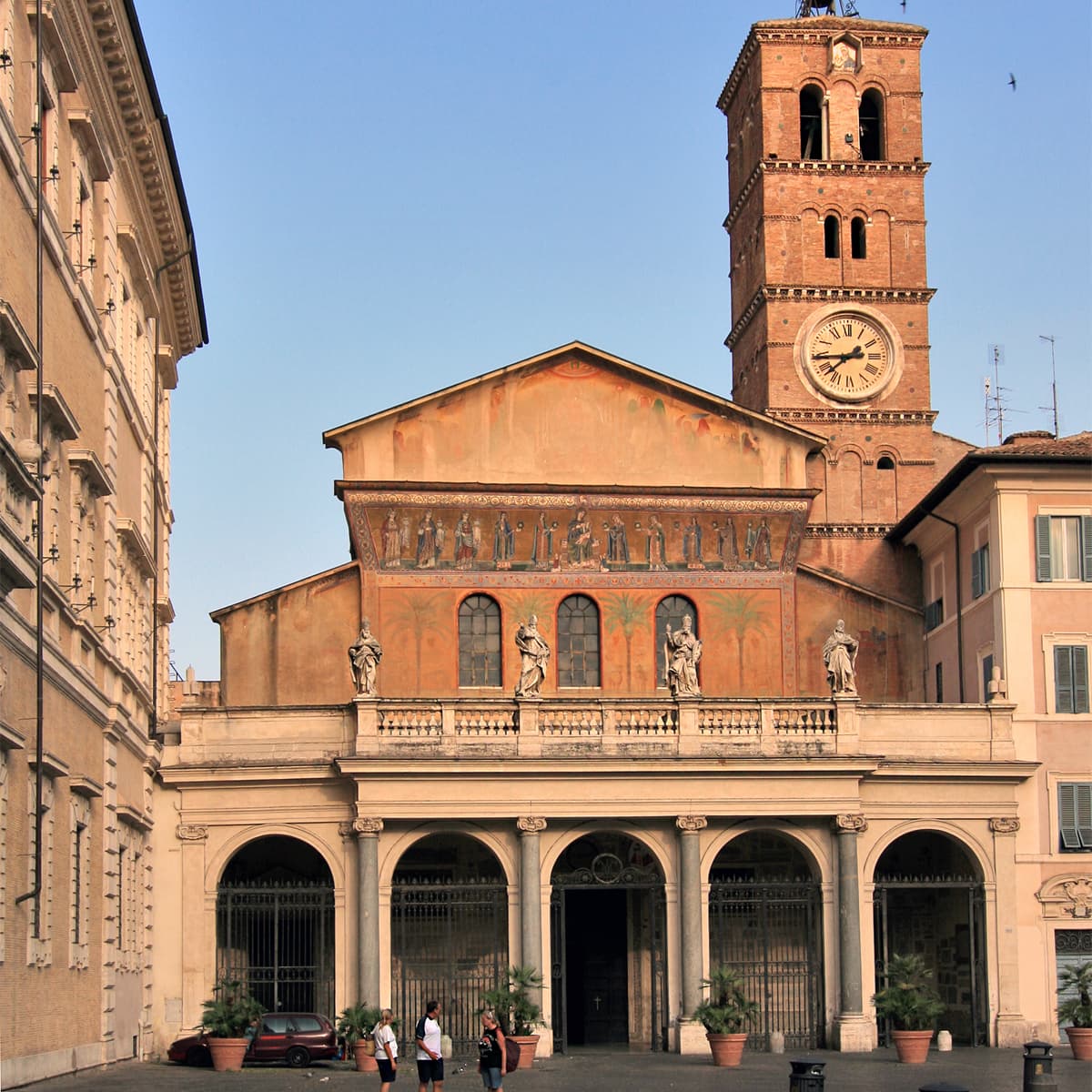
Santa Maria in Trestavery, the piazza and the church. You're in the heart of the neighborhood. Piazza Santa Maria is the district's most important meeting place. The 17th-century fountain was actually designed to be the sofa of the neighborhood, with its broad and inviting steps.
During major soccer games, a large screen is set up here so that everybody can share in the excitement. ¶¶ At other times, children gather here with a ball and improvise matches of their own. The Church of Santa Maria in Trestavery, one of Rome's oldest, was built on the site of another home where early Christians worshipped illegally. Then, after Christianity was legalized in 312, a basilica was built here.
Read more...Show less
This is considered the first church dedicated to the Virgin Mary. The tower survives from the 12th-century church. Approach the church and step into the church. You'll find the portico.
That's the covered area just outside the door. The portico is decorated with ancient fragments carved with early Christian symbolism. Many of these stones were lids to burial niches from the catacombs. Notice how carvings on the fragments show how early Christians prayed with both hands raised, as some Christians do to this day.
Before going inside the church, just take a moment to browse around these fascinating remnants of an earlier time. This is the Church of St. John of Assumption in Trestavery, one of Rome's oldest churches in Trestavery, one of Rome's oldest churches in Trestavery. This is the Church of St.
John of Assumption in Trestavery, one of Rome's oldest churches in Trestavery. This is the Church of St. John of Assumption in Trestavery, one of Rome's oldest churches in Trestavery. This is the Church of St.
John of Assumption in Trestavery, one of Rome's oldest churches in Trestavery. This is the Church of St. John of Assumption in Trestavery. This is the Church of St.
John of Assumption in Trestavery. This is the Church of St. John of Assumption in Trestavery. Now, let's step inside the church.
Immediately to the left of the entry, a plaque on the wall is dedicated to Olia Sancta. The holy oil was actually a small petroleum deposit discovered here 30 years before Christ. This black liquid was considered almost magical in its ability to power lamps, and it was incorporated into the lore of this church. Grab a pew.
Most of what you see dates from around the 12th century, but the granite columns are from ancient Roman buildings. Later architects tried hard to match them, but notice how the shorter columns have taller bases and how the capitals are mismatched. Some of the capitals have tiny pagan heads of Egyptian gods. The ancient basilica floor plan and the ancient ambience survives.
Look up. The intricate coffered ceiling has an unusual image at the center. It's Mary, painted on copper. Now, start walking slowly up the center of the nave toward the altar.
Look all around, but especially look down to appreciate an exquisite carpet of marble. The lavish 13th-century floor is a fine example of how the church was built. It's a great example of mosaic work by the famed Cosmati family. Their unique style features intricate geometric shapes, in this case, shapes made with marble scavenged from ancient Roman ruins.
Keep browsing around as you make your way to the left side of the altar. ¶¶ ¶¶ ¶¶ ¶¶ ¶¶ ¶¶ ¶¶ ¶¶ ¶¶ ¶¶ Step up behind the main altar, on the left side. Take a closer look at the fine mosaic work, which dates from the 8th to the 10th centuries. The central scene is one of the few surviving examples of an early medieval mosaic in Rome.
It's rich in symbolism. Christ is flanked by the first two popes. Notice the stature Mary is given. Tour guides claim this is the first mosaic to show Mary at the throne with Jesus in heaven.
He has his arm around his mother as if introducing her to us. Sitting below Jesus, Mary, and the two popes is the throne-like chair of the bishop, giving legitimacy to the church. The flock of sheep is not just any flock. The sheep represent Jesus in the middle, marked by a halo with a cross in it, and the 12 apostles.
The more modern mosaic panels show scenes from the life of Mary. These mosaics date from about 1300. While impressively realistic and expressive, they predate the Renaissance by 100 years. The first of these six panels, to the left of the curved apse, shows the mosaic.
A servant in the corner checks the temperature of the water with her hand before she bathes the baby. This introduces an element of tenderness that breaks the abstract rigidity of medieval art. Next comes five more scenes. The Annunciation, when the angel announces to Mary that she'll be giving birth to the Messiah.
After that, panels show Jesus' birth, the adoration of the Magi, the presentation of Jesus in the temple, and Mary's eternal sleep. Technically, not her death. The gold mosaic background shows buildings that, while still unrealistic, are a good step toward accurate 3D representation. Let's start heading back towards the entrance.
We'll make one more stop in the church. On your way back to the entrance, you'll pass a statue. He's in the back of the church, in the corner opposite the entry. This is St.
Anthony. The popular name for the church is St. Anthony. The popular saint is shown in his brown Franciscan robe and holding the baby Jesus.
You may see scraps of paper laid at his feet or tucked into the statue. Anthony is the patron saint of lost things and, more generally, a saint willing to grant wishes to the poor and desperate. That's why people write down their requests and leave them here. Let's finish our tour by exiting the church back into the square.
As you go, imagine this church empty of pews but full of people. Full of tables and bustling with locals. As part of their mission, each Christmas, the Church of Santa Maria in Trastevere hosts a huge dinner here for those in need. Now, stepping back outside, survey your surroundings one more time.
Santa Maria in Trastevere is the heart of Rome's most colorful district. Explore. The farther you venture from the square, the less touristy and more rustic the neighborhood becomes. Pondering the city, the earthy enthusiasm people seem to have for life here, I can imagine that bygone day when proud Trastevere locals would brag that they never crossed the river.
We hope you've enjoyed this slice of Rome thanks to Jean Openshaw, the co-author of this tour. If you're planning more sightseeing, we have lots of audio tours available for Rome, including A Walk Through the Heart of Rome, the Colosseum, the Roman Forum, the Pantheon, St. Peter's, the Vatican Museum, and Sistine Chapel, as well as walks through Trastevere, the Jewish Ghetto, and the remains of Ostia and Pompeii. In one day?
No. Remember, this tour was excerpted from the Rick Steves Rome Guidebook by Rick Steves and Jean Openshaw. For more details on eating, sleeping, and sightseeing in Rome, refer to the latest edition of that guidebook. For more free audio tours and podcasts, and for information about our TV shows, bus tours, and travel gear, visit our website at ricksteves.com.
This tour was produced by Cedar House Audio Productions. Grazie. Ciao. And buon viaggio. Buon viaggio.
Free
GPS-guided walking tour
No account needed. Walk at your own pace.
Free
7 stops ·