11 stops
GPS-guided
23 min
Duration
Free
No tickets
About this tour
A guided tour of Venice — Frari Church in Italy with 11 stops. Highlights include The Frari Church, Nave, and Titian: Assumption of Mary.
11 stops on this tour
The Frari Church
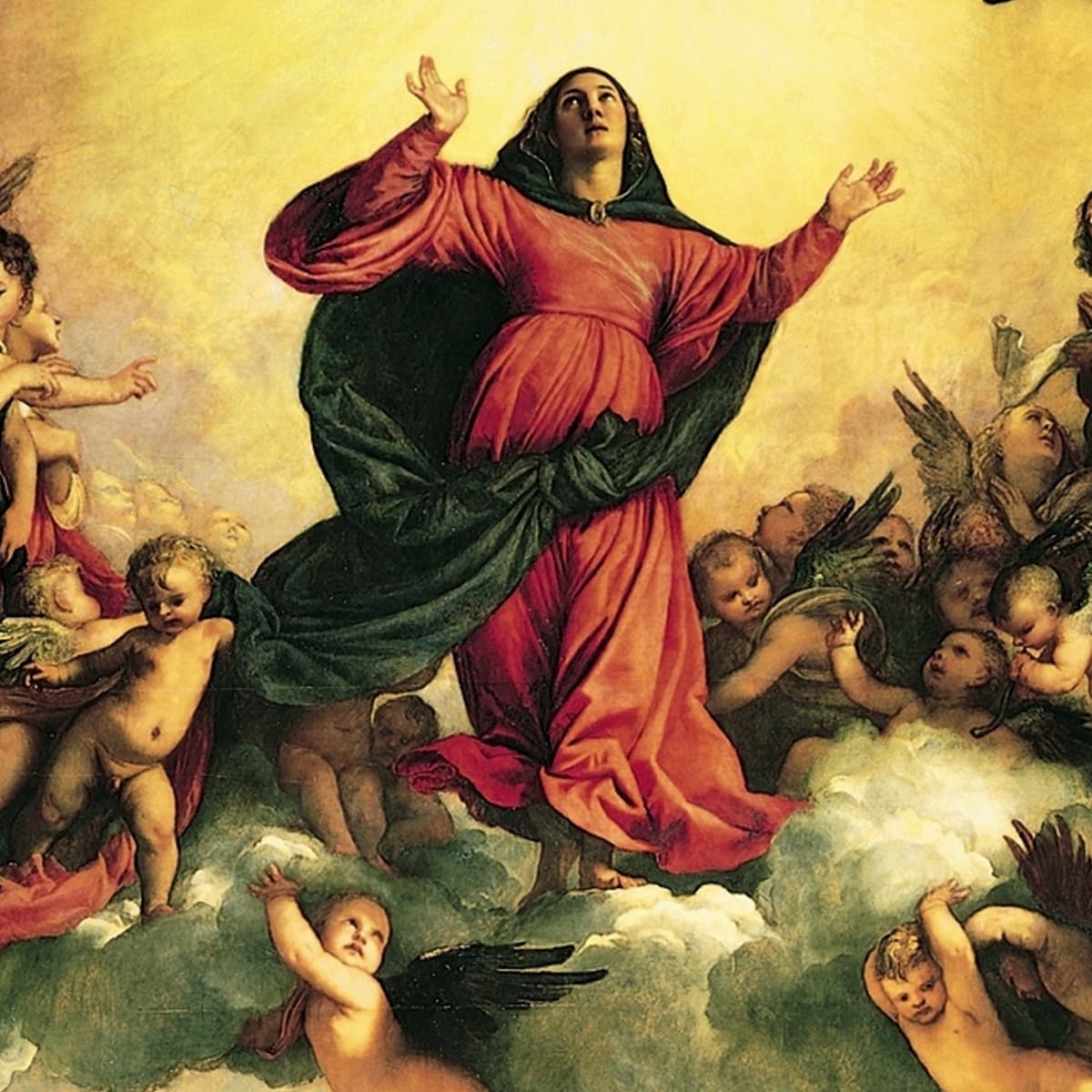
The Frari Church. Venice's Church of the Frari, or Brothers of the Franciscan Order, is filled with art that captures the Franciscan love of man and nature. Hi, I'm Rick Steves. Thanks for joining me on a walk through one of Venice's most underappreciated and out-of-the-way sites.
We'll see altarpieces by Venice's great painters highlighting the Virgin Mary in her various aspects, youthful, meditative, iconic, and fully human. We'll also see the tombs of artists, a Donatello statue, and the spacious architecture of the church itself. For many travelers, the Frari offers the best art appreciation experience in Venice, because so much of its great art is in situ, right where it was designed to be seen, rather than hanging in museums. Allow about an hour for your visit at this church that celebrates the glory of God with art that celebrates the created world.
Read more...Show less
To help us along the way, I've invited a good friend and virtual travel buddy. Welcome, Lisa. Hi, Rick. Lisa will give us helpful directions and sightseeing tips throughout the tour.
And my first tip is to be sure you get our tour updates. Just press the icon at the lower right of your device. You'll find any updates and helpful instructions unique to this tour. Things like closures, opening hours, and reservation requirements.
There's also tips on how to use this audio tour and even the full printed script. Yes, so pause for just a moment right now to review our updates and special tips. It's okay. We'll wait. And then... Let the tour begin! The tour begins.
Tour Begins
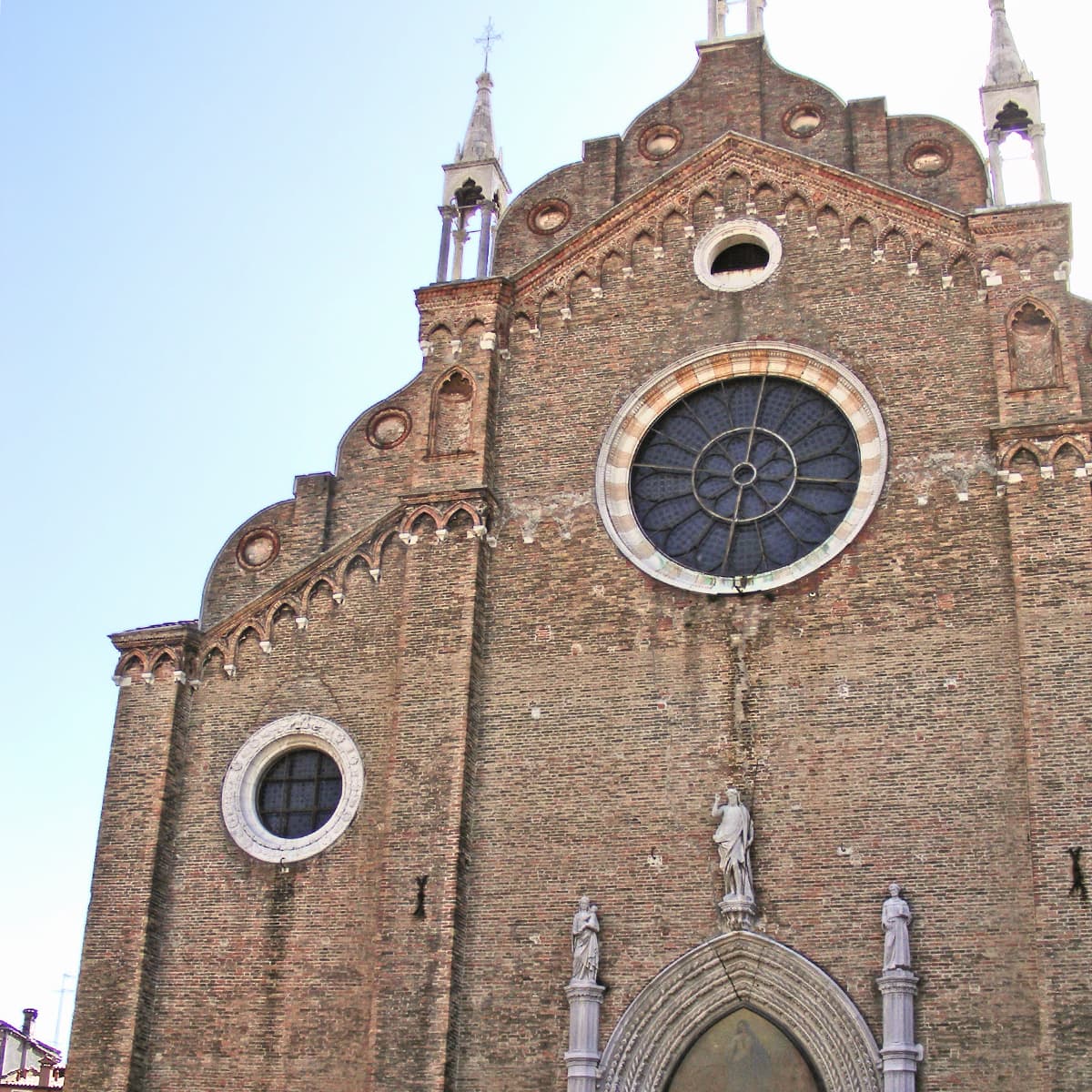
The hardest part of visiting the Frari is simply finding the place. It's on the west side of the Grand Canal, a 10-minute walk from the San Tomà Vaporetto stop, or about 25 minutes from the Rialto Bridge. Don't be afraid to ask locals, Dove la chiesa di Frari? That means, where's the Frari church?
From the outside, the church, made of plain brown brick and wedged into a tiny square, is not very impressive. True, but it's about the only Gothic church you'll tour in Venice. Since Venice's spongy ground could never support a real stone Gothic church like those you'd find in Venice. So, let's go.
Read more...Show less
Let's go. Let's go. The Frari is made of light and flexible brick. The white limestone foundation, you can see, insulates the building from the wet soil.
Enter the church, buy your tickets, and spill out into the nave, or long central hall of the church. Before we approach the main altar, stroll around the nave and just take it all in, while Rick introduces the place. ¶¶ The nave.
Nave
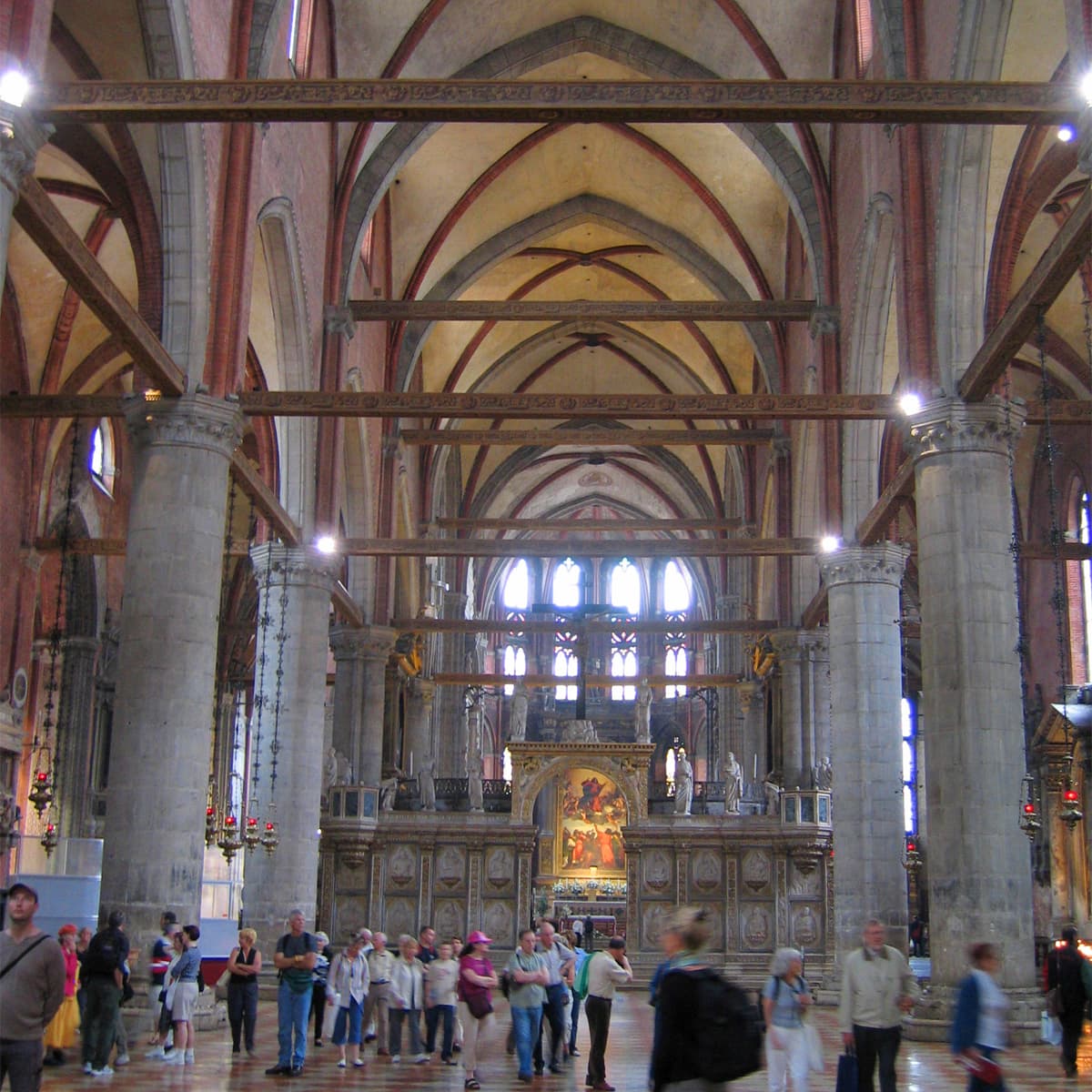
This simple, spacious, well-lit church is truly a remarkable sight in a city otherwise crammed with exotic frou-frou. It's 110 yards long, built with rough wood crossbeams and decorated with a plain red-and-white color scheme. The pointed arches mark it as one of Venice's rare Gothic churches. The church was built over two centuries, roughly from 1250 to 1443, and was dedicated in 1492, Traditionally, churches in Venice were cross-shaped, but since the Franciscans were an international order, they weren't limited to Venetian tastes.
This new T-shaped footprint featured a long, lofty nave, flooded with light, and ideal for large gatherings, where common people heard sermons. The church was built by the Franciscan order, which arrived in Venice shortly after the death of the order's founder, St. Francis of Assisi, in 1226. Francis had dedicated himself to a non-materialist lifestyle, part of a reform movement that spread across Europe in the early 1200s.
Read more...Show less
The church hierarchy in Rome felt distant and corrupt, and there was a hunger for religious teaching that connected with everyday people. While some of these movements were dubbed heretical, the Franciscans eventually earned the church's blessing. The humanistic spirit of Francis warms both the church and the art that decorates it. Francis loved all of creation, nature, as well as man, and this later inspired Renaissance painters to capture the beauty of the church.
Francis loved the beauty of the physical world and human emotions, showing worshipers the glory of God in human terms. Nowhere is this more clear than in the painting over the main altar. As worshipers enter the church and look down the long nave, the site that greets them, framed by the arch of the choir entrance, is Titian's altarpiece. Approach the altar, passing through the choir, the wooden area in the center of the nave.
Structures like this allowed friars to hold smaller, more intimate services. Notice the organs on either side. And check out the fine-carved wooden inlay above the choir chairs, showing the Renaissance enthusiasm for Florentine-style 3D. Surviving choirs such as this are rare.
In response to Luther's challenge, counter-Reformation churches discarded the idea of choirs and altar screens in order to get priests closer to their flocks. Turn your attention to the large, colorful painting behind the main altar. Titian's Assumption. Framed by an arch. Titian's Assumption of Mary, 1518.
Titian: Assumption of Mary
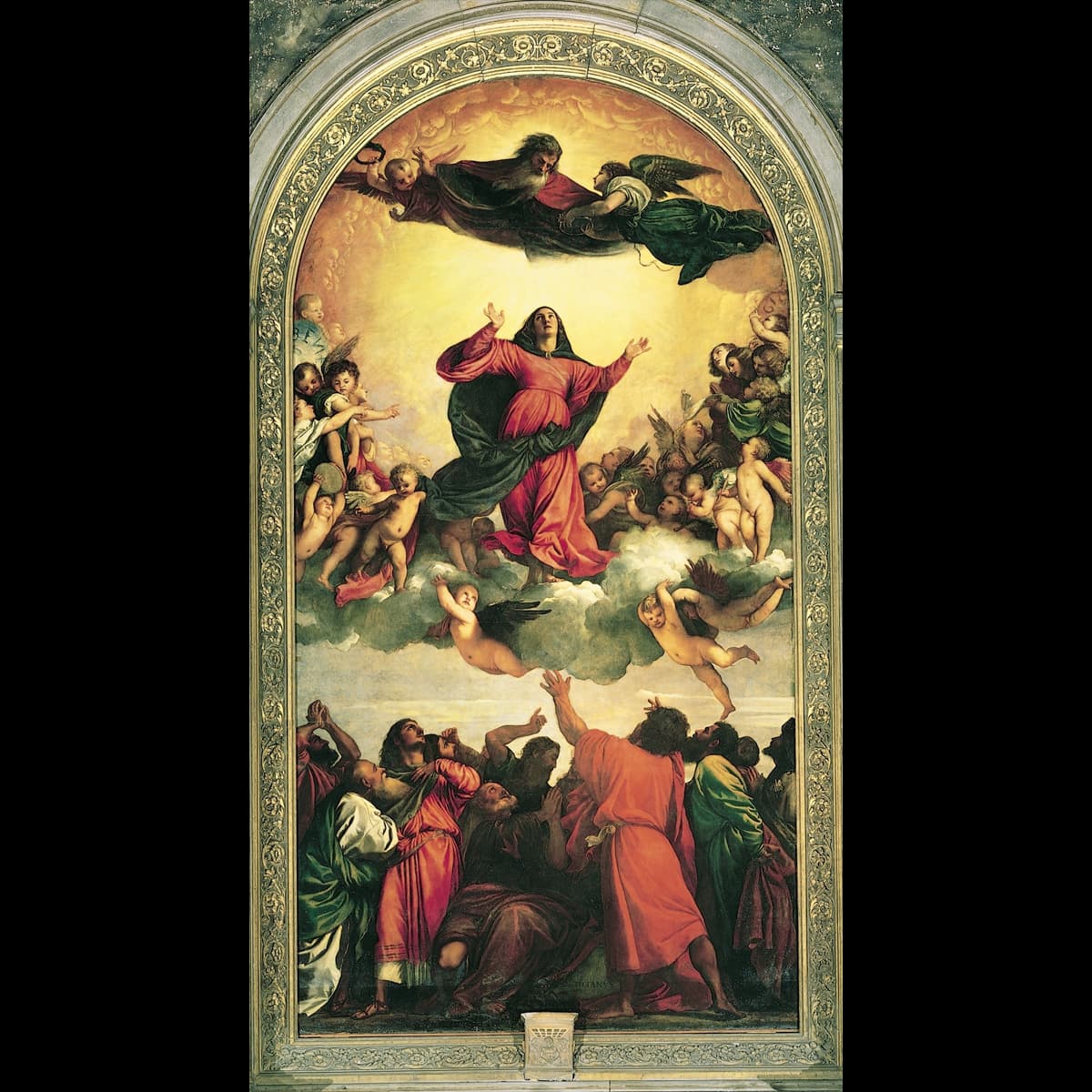
Glowing red and gold like a stained-glass window, this altarpiece sets the tone of exuberant beauty found in the church. It shows Mary at the end of her life, though she looks like she's only 17, when she was miraculously assumed into heaven. As cherubs, lift her up to meet a Jupiter-like God, the stunned apostles on earth reach up to touch the floating bubble of light. Unveiled in 1518, the work scandalized a Venice accustomed to simpler, more subdued church art.
The rich colors, twisting poses, and mix of saccharine angels with blue-collar apostles were unheard of. Most striking, this virgin is fully human, not a stiff icon on a throne. In a burst of youthful innovation, Titian, who lived from 1480 to 1576, had rewritten the formula for church art, hinting at changes to come with the Mannerist and Baroque styles. He energized the scene with a complex composition.
Read more...Show less
He starts with a circle, Mary's bubble, then overlaps that with a triangle. Draw a line from the apostle reaching up to Mary's face and down the other side. All this is arranged on three horizontal levels, God in heaven, man on earth, Mary in between. Together, these elements draw our eyes from the swirl of arms and legs to the painting's focus, the radiant face of a triumphant Mary, assumed body and soul, into heaven.
At first, the Franciscans were unsure about Titian's creation. They thought this teenage Mary aroused, well, excitement rather than spirituality. Only after the Holy Roman Emperor offered to buy the altar if they refused did the Franciscans agree to pay Titian. The official name of the Frari Church is Santa Maria Gloriosa di Ferrari, dedicated to the glorious Saint Mary.
Titian's altarpiece captures the Madonna in all her youthful glory. As you look around, you'll see that the church is littered with chapels and tombs made possible by the generous financial support of rich people who donated to the Franciscans for the good of their souls. As an added perk, they often got a tomb-topping statue of themselves as well. In the same apse as Titian's Assumption are marble tombs lining the walls. The tomb on the right wall is of Doge Foscari. The Tomb of Doge Foscari
Tomb of Doge Foscari
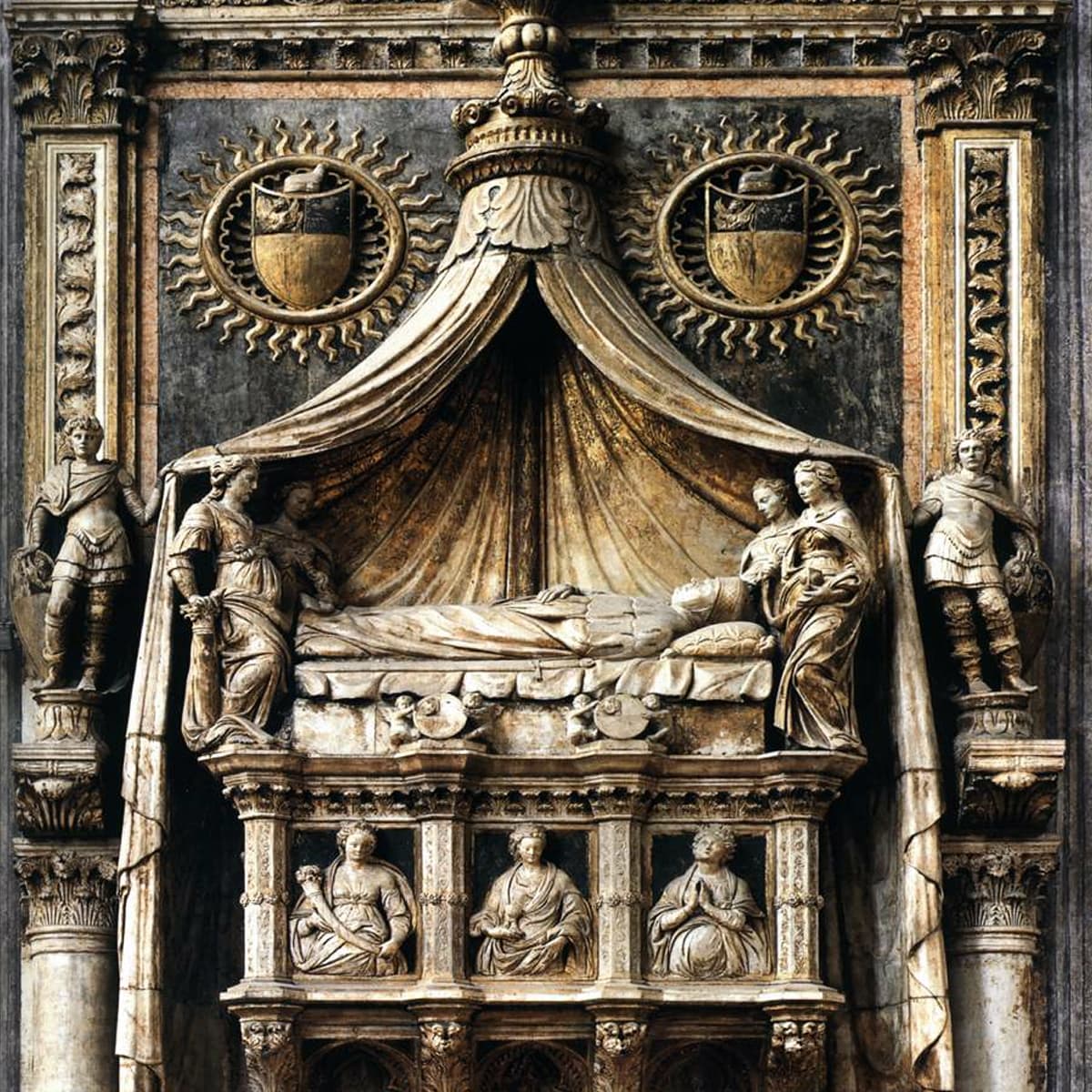
In contrast to the poverty of the Franciscans, this heavy ornate tomb marks the peak of Venice's worldly power. In 1423, Doge Foscari assumed control of Venice's powerful seafaring empire. For the next 31 years, he tried to expand it farther into the mainland, battling Milan in a war of attrition that swept through northern Italy. Meanwhile, on the unprotected eastern front, the Turks took the Christian city of Constantinople, today's Istanbul, and scuttled Venice's trade.
Venice's long slide into historical oblivion had begun. Financially drained city fathers forced Foscari to resign, turn in his funny hat, and hand over the keys to the Doge's palace. Walk a few steps to the right to the first chapel to the right of the altar, where you'll find a life-size wooden statue of John the Baptist. Donatello's John the Baptist, 1438
Donatello: John the Baptist
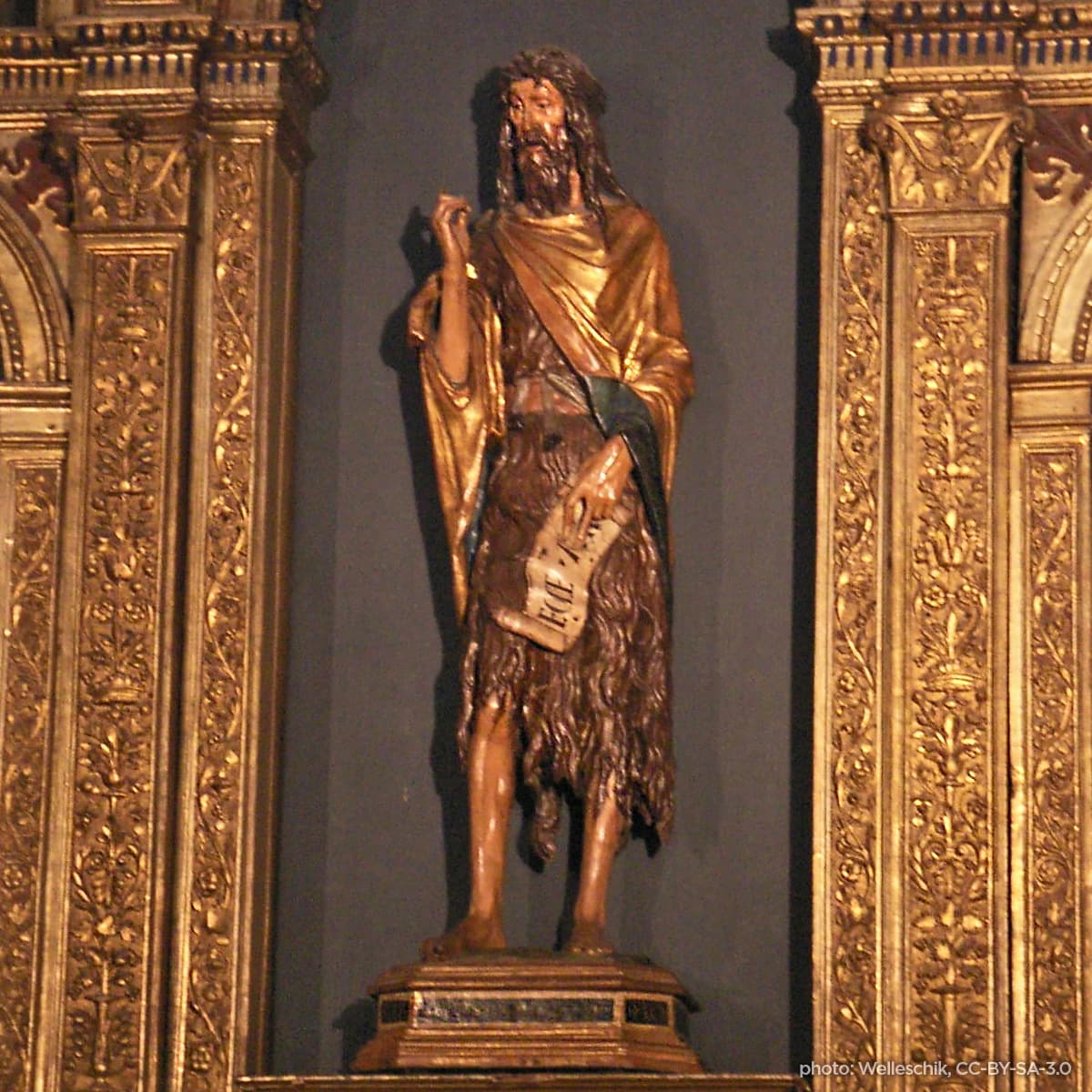
Emaciated from his breakfast of bugs and honey and dressed in animal skins, the cockeyed prophet of the desert freezes in the middle of a rant as he spies out something in the distance. His jaw goes slack, he twists his face and raises his hand to announce the coming of, well, it's either of Christ or of the Renaissance. This is a work by the pioneering Renaissance sculptor Donatello. Florentine expatriates living in Venice commissioned their fellow Florentine to make this statue for their local chapel, and it reflects Florentine tastes.
The Renaissance began in Florence in the 1400s, where Donatello created realistic statues, with a full range of human emotions. Contrast this warts-in-all John the Baptist with, say, Titian's Sweet Mary, and you'll see the difference between Venetian and Florentine art. Florentine art was always more sculptural, even in paintings, with strong outlines, muted colors, and harsh realism. Venetian art was painterly, soft focus, and beautiful with bright colors.
Read more...Show less
Continue walking to the right of the altar. At the far end of the right, go through the door into the sacristy. You'll come face-to-face with an elaborate reliquary altar worth a quick look. Opposite that, near the entrance door, is a clock, intricately carved from a single piece of wood.
Now, approach the far end of the room where you'll find the gold-framed altarpiece by Bellini. The Pesaro family, who funded much of the frari's construction and decoration, built this delightful chapel, dominated, by Bellini's masterpiece. Giovanni Bellini's
Bellini: Madonna and Child
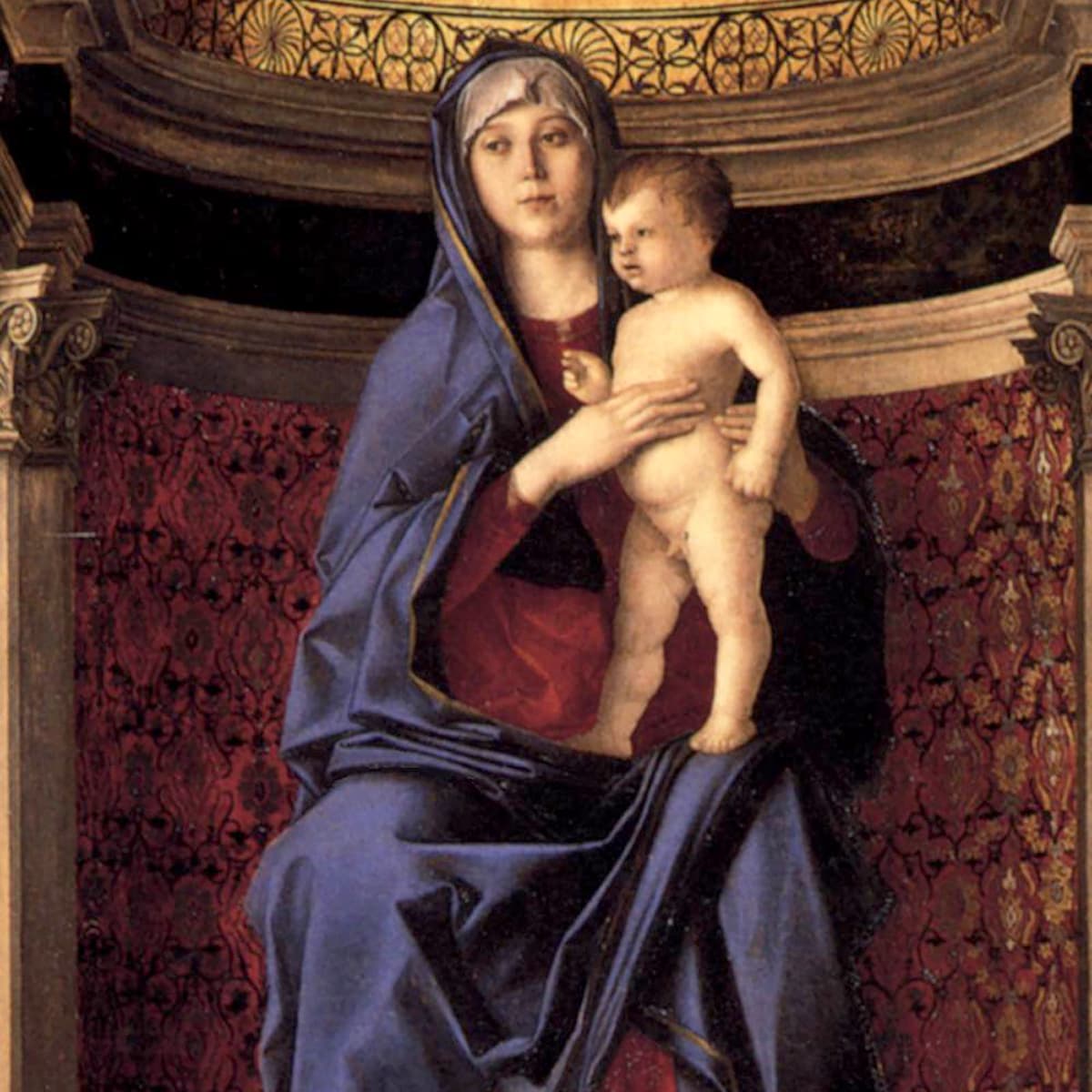
Madonna and Child with Saints and Angels, 1488. Mary sits on a throne under a half-dome, propping up baby Jesus, who's just learning to stand. They're flanked by saints and serenaded by musician angels. Giovanni Bellini, the father of the Venetian Renaissance, painted fake columns in a dome to match the real ones in the gold frame, making the painting seem to be an extension of the room.
He completes the illusion with glimpses of open sky in the background. Next, he fills the artificial niches with symmetrically posed thoughtful saints. Left to right, find Saints Nicholas, Peter, Mark, and Sean Connery. That's Benedict.
Read more...Show less
Oh, yeah, thanks. Renaissance humanism demanded Madonnas and saints that were accessible and human. Bellini delivered in a physical setting so beautiful that it creates its own mood of serene holiness. The scene is lit from the left, but no one casts a harsh shadow.
Mary and the babe are wrapped in a glowing aura of reflected light from the golden dome. The beauty is in the details, from the writing in the dome to the red brocade backdrop to the swirls in the marble steps to the angels' dimpled legs. Bellini combined the meditative poses of the Venetian Byzantine tradition with Renaissance innovations. He pioneered painting in oil, using pigments dissolved in vegetable oil rather than medieval tempera or egg-yolk-based paint.
This let him paint subtler shades of colors made with successive layers of paint. And because darker colors aren't so muddy when painted in oil, they pop, effectively giving the artist a broader palette. Bellini virtually invented the formula for Venetian Renaissance altarpieces. This type is called a sacred condition.
It's a conversation where Mary is placed together with saints from different historical eras in a mythical dialogue. As we've seen, Bellini's iconic formula would later be broken by his brash and precocious pupil, Titian. Now, head for the room adjoining the sacristy and find a painting in the shape of a pointed Gothic arch. If Titian broke Bellini's mold, Bellini broke the mold of altarpieces he'd inherited from earlier Venetians. ¶¶ ¶¶ ¶¶
Veneziano: Madonna and Child
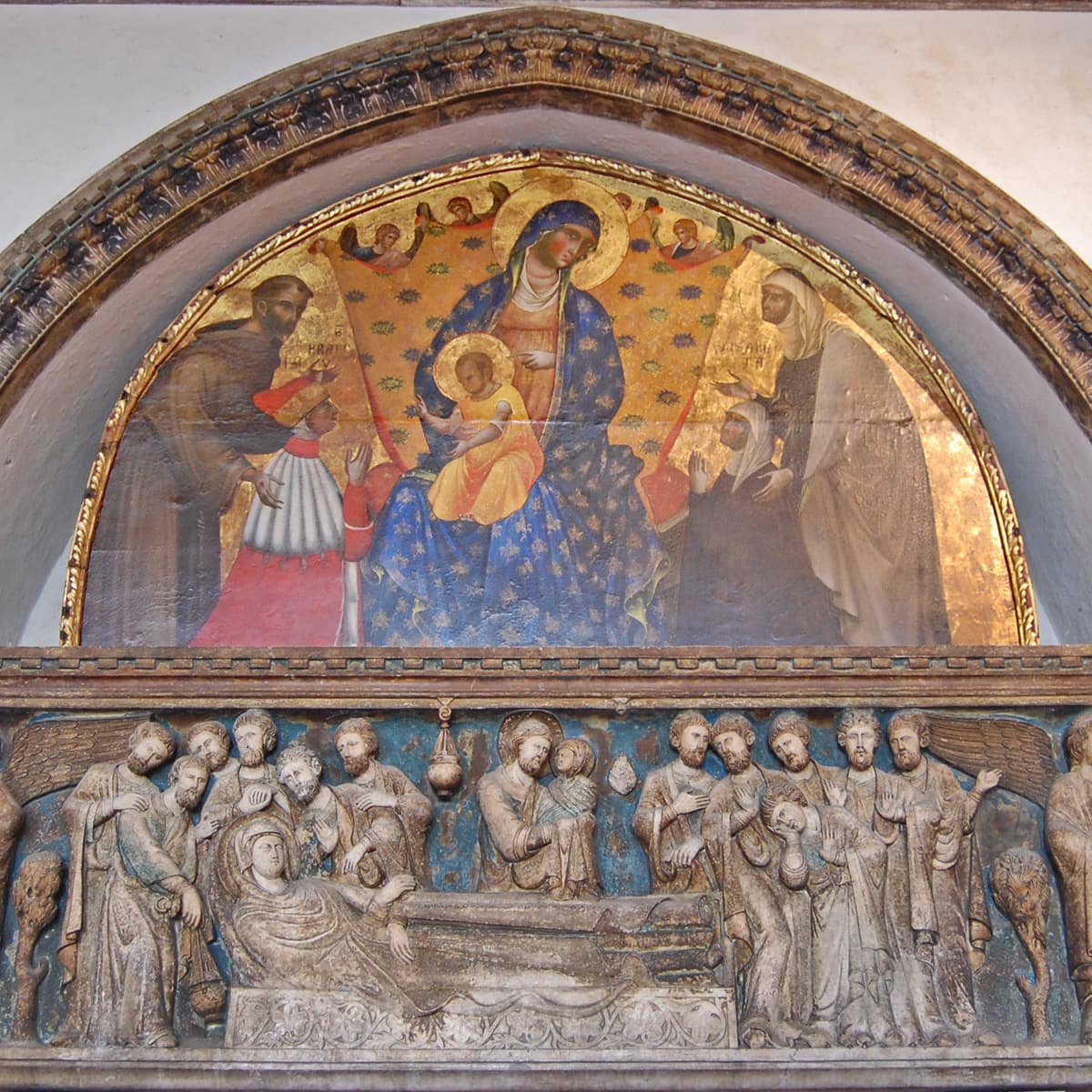
¶¶ Paolo Veneziano, Madonna and Child with Doge Dandolo, from circa 1339. Bellini's Byzantine roots can be traced to the first real name artist in Venice, the man who helped shape the distinct Venetian style, Paolo Veneziano, literally, Paolo the Venetian. In this altarpiece, Veneziano paints simplified Byzantine-style icons, then sets them in motion. Baby Jesus turns to greet a kneeling Doge Dandolo, while Mary turns to acknowledge the Doge's wife.
None other than St. Francis introduces the Doge to the Madonna. Both St. Francis and St.
Read more...Show less
Elizabeth, on the right, bend at the waist and gesture as naturally as 14th-century icons can. With these simple movements, Veneziano gets these uptight icons to lighten up, hinting at the naturalism of the Renaissance. Veneziano was inspired by Byzantine artists who came to Venice in search of more freedom of expression. They had chafed under strict societies, both Byzantine and, in some locales, Islamic, that frowned on painting figurative images.
In Venice, these expats found an eager community of rich patrons who indulged their love of deeper color, movement, luxury, and emotion. Return to the nave and head toward the far end, that is, far from the altar. As you walk down the nave, you'll see that the nave is like in so many European churches. It's lined with tombs and small altars.
Wealthy parishioners wanted a burial spot for their families and a small altar for their descendants to say prayers. They hired famous artists to decorate the chapels and tombs with statues and altar pieces. By donating money to the Franciscans, they were investing in salvation insurance, paying monks to say prayers for their mortal souls. One of the Frari Church's most distinguished parishioners was the painter Titian, whose tomb is in the nave.
As you reach the end of the nave, turn around and face the main altar. The tomb of Titian is in the second bay on your right. That's right as you face the altar. A winged lion stands on top, and on the base, two angels hold a wreath with Titian's name spelled out in Latin, Titiano Ferdinandus. The Tomb of Titian
Tomb of Titian
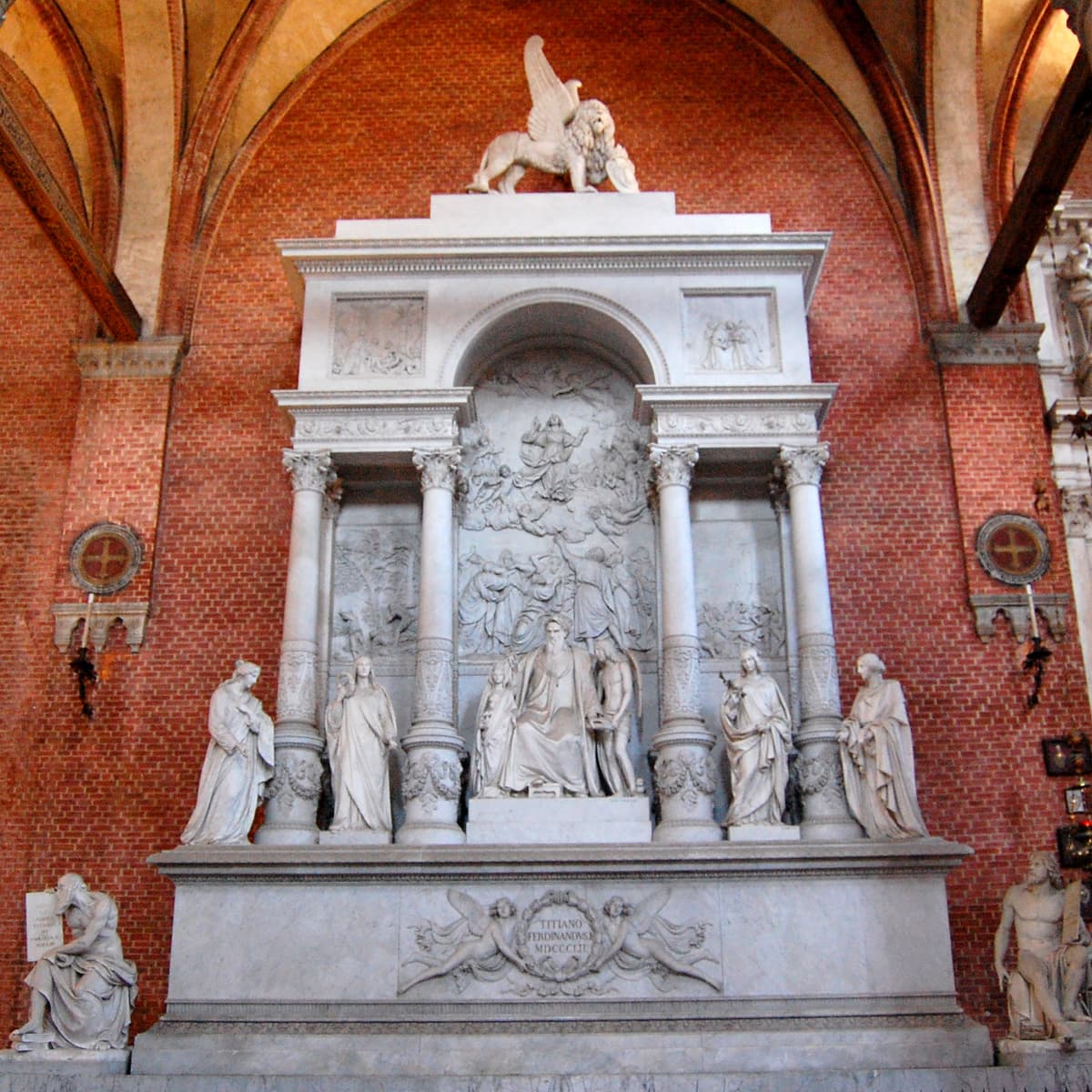
In the center sits a statue of Titian wearing a beard and the crown of laurels given to great artists. The tomb celebrates both the man and some of his famous paintings which are carved into the marble. Titian, who lived from roughly 1488 to 1576, was the greatest Venetian painter and the most famous painter of his day, perhaps even more famous than Michelangelo. He moved to Venice as a child, studied first as a painter, as a mosaic maker, and then under Bellini.
He made a name for himself with a bold new style starring youthful Madonnas. Notice the relief carving of the Ferrari church's Assumption of Mary behind Titian's statue. Titian became wealthy and famous, traveling throughout Europe and hobnobbing with the aristocracy. He excelled in every subject, painting portraits of dukes, kings, and popes, racy nudes for their bedrooms, solemn altarpieces for churches, and pagan scenes from Greek mythology.
Read more...Show less
He was cultured and witty, a fine musician, and a shrewd businessman, an all-around Renaissance kind of guy. Titian resisted the temptation of big money that drew so many of his contemporary Venetian artists to Rome. Instead, he always returned to his beloved Venice and his favorite place of worship, the Ferrari church. In his old age, Titian made arrangements to be buried in the Ferrari.
To decorate his tomb, he began painting a dark, tragic masterpiece called the Pietà. You can see a relief of it in the upper left. Nearing 90, Titian labored to finish his Pietà as the 1576 plague enveloped Venice. One in four people died, including Titian's son.
Heartbroken, Titian died soon afterward of natural causes. He was buried here at his request in a humble spot, but his unfinished Pietà ended up in the Accademia Museum. Three centuries later, in the year, let's see, M-D-C-C-C-L-I-I, I think that's 1852, this big monument was erected to remember and honor Venice's greatest painter. Venice's greatest sculptor is honored on the opposite side of the nave in a pyramid-shaped monument. The Canova Monument.
Canova Monument
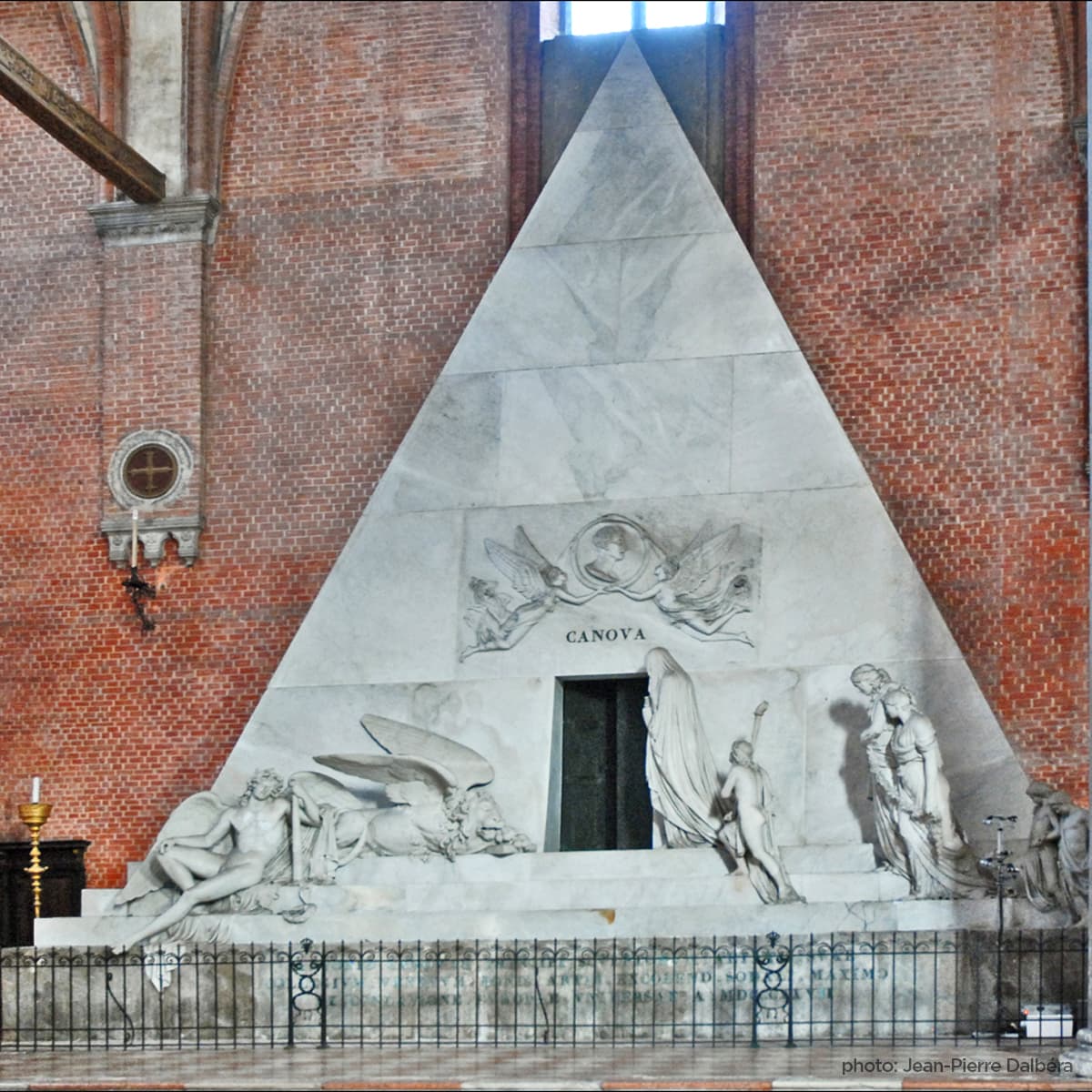
Two centuries after Titian, Antonio Canova, created gleaming white, highly polished statues of beautiful Greek gods and goddesses in the neoclassical style. Canova himself designed this monument and its statues. The pyramid shape is timeless, suggesting pharaohs' tombs or the symbolism of the Christian trinity. The statues represent mourners, bent over with grief, who shuffle up to pay homage to the master artist.
Even the winged lion is choked up. A portrait of Canova is carved above the door. If you're interested in more Canova, who lived from 1757 to 1822, several of his works are displayed at the Carrere Museum on St. Mark's Square.
Read more...Show less
Follow me here. Canova designed this pyramid-shaped tomb not for his own use, but as the tomb of an artist he greatly admired, Titian. But the Ferrari Church used another design for Titian's tomb, so Canova used the pyramid design for an Austrian princess in Vienna. After his death, Canova's pupils reused the design here to honor their ancestors.
In fact, Canova isn't buried here. Instead, his body lies in southern Italy. But inside the tomb's open door, you can barely make out an urn which contains Canova's heart. Those Europeans and their body parts.
I tell ya. Our final stop is a little further up the nave. Start walking. I left my heart And on the left wall Inside the Ferrari Please.
On the left wall is a big, gaudy tomb with black and white slaves. Past that is our final stop, a small altar with a painted altarpiece. Titian's Madonna of Capesaro
Titian: Madonna of Ca’ Pesaro
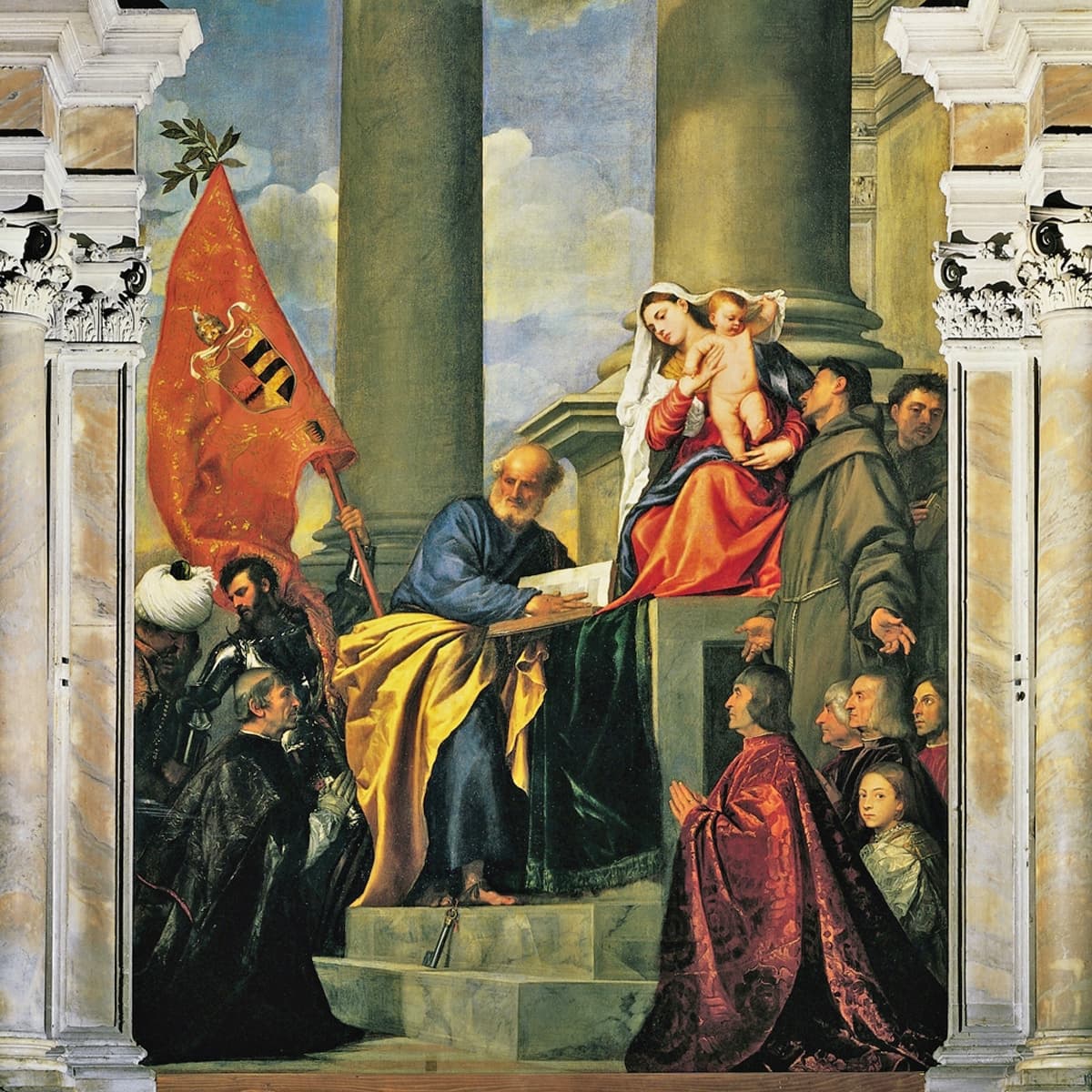
from 1526. Titian's second altarpiece for the Ferrari Church displays all of his many skills. Like his teacher Bellini, he puts Mary seated and baby Jesus standing in the midst of saints having another one of those sacred conversations. And, like Bellini, he paints fake columns that echo the church's real ones.
But wait. Mary is off-center, and the traditional Renaissance symmetry is off-kilter. Titian's idealized saints mingle with Venetian's sporting five o'clock shadows. And the stairs run diagonally away from us.
Read more...Show less
Mary sits not on a throne, but on a pedestal. Baby Jesus is restless. The precious keys of St. Peter seem to dangle unnoticed.
These things upset traditional Renaissance notions, but they turn a group of figures into a true and believable scene. St. Peter sits in the center in blue and gold with a book. He looks down at the head of the noble Pesaro family, who kneels to thank the Virgin for his recent naval victory over the Turks.
A flag-carrying lieutenant drags in a turban to captive. Meanwhile, St. Francis talks to baby Jesus while gesturing down to more members of the Pesaro family. At the lower right, the little guy looking out at us is the Pesaro descendant who administered the trust fund to keep prayers coming for his dead uncle.
Titian combines opposites, a soft-focus Madonna with photorealistic portraits, chubby-winged angels with a Muslim prisoner, and a Christian cross with a belt. It's a battle flag. In keeping with the spirit of St. Francis' humanism, Titian lets mere mortals mingle with saints, and we're right there with him.
We hope you enjoyed your walk through the Ferrari Church. Before you leave the neighborhood, consider a visit to the nearby Scuola San Rocco with masterpieces by Tintoretto. If you're up for more sightseeing, we have audio tours covering St. Mark's Square, the Basilica, and the Grand Canal.
Remember, this tour was excerpted from the Rick Steves Venice Guidebook, co-authored with Gene Openshaw. For more details on eating, sleeping, and sightseeing in Venice and the environs, refer to this year's edition of that guidebook. For more free audio tours and podcasts, and for information about our TV shows, bus tours, and travel gear, visit our website at ricksteves.com. Thanks to Gene Openshaw, the co-author of this tour.
This tour was produced by Cedar House Audio Productions. Gracias. Arrivederci. And buon viaggio.
Free
GPS-guided walking tour
No account needed. Walk at your own pace.
Free
11 stops ·