13 stops
GPS-guided
3 km
Walking
1.5 hours
Duration
Free
No tickets
About this tour
A 3 km GPS-guided walk through the heart of Netherlands. Visit Amsterdam City Walk, Damrak: Station to Stock Exchange, Damrak: Stock Exchange to Dam Square, and Dam Square — with narrated stories at every stop.
13 stops on this tour
Amsterdam City Walk
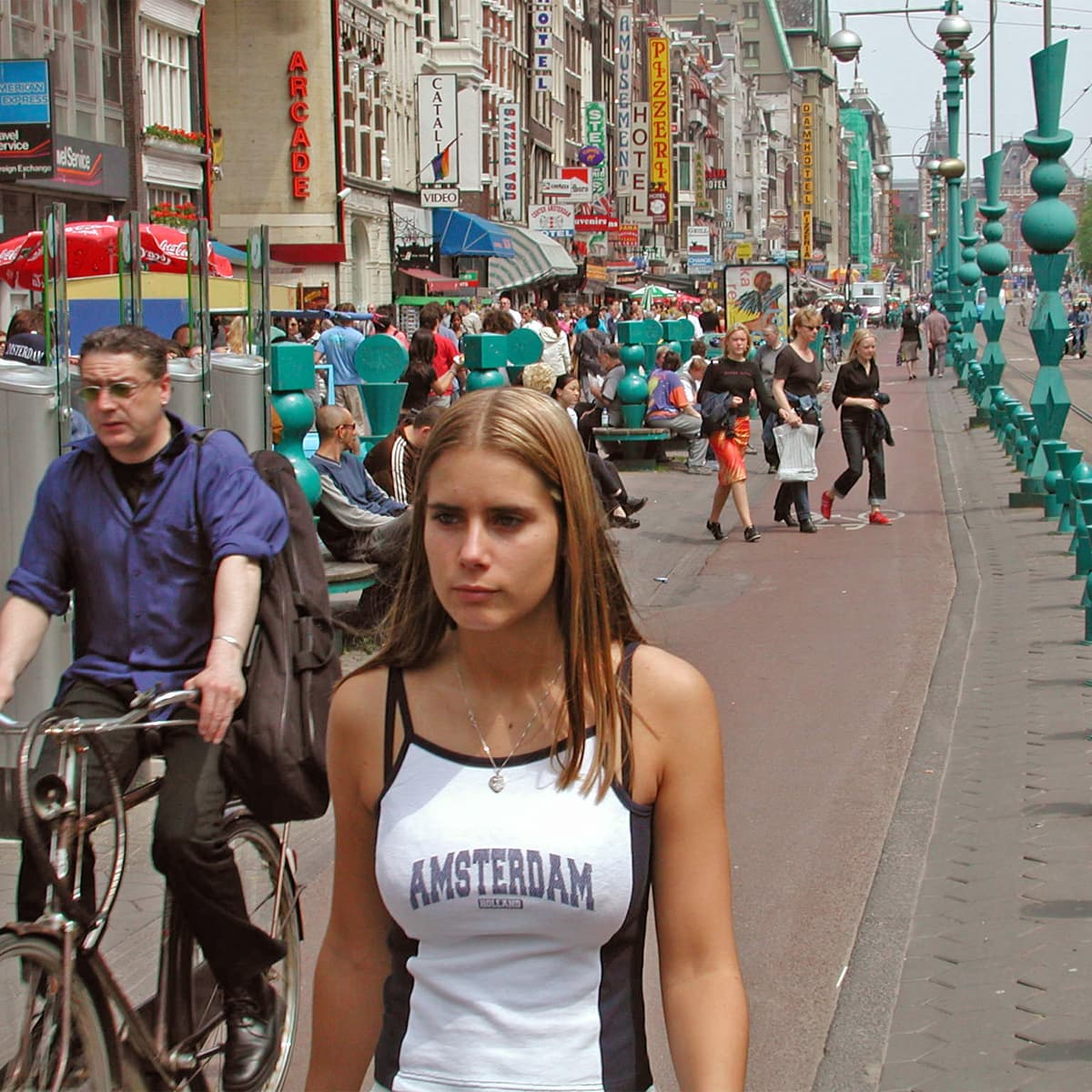
Amsterdam today looks much as it did in its golden age, the 1600s. It's a retired sea captain of a city, still in love with life, with a broad outlook and a salty story to tell. Hi, I'm Rick Steves. Thanks for joining me on this walk through the historic core of Amsterdam.
It's a great way to get oriented to the city and some of the sites you may want to visit in depth later. During the Dutch Golden Age, Amsterdam was the world's richest city, an international sea trading port, and the cradle of capitalism. Wealthy democratic burghers built the city almost from scratch. They created a wonderland of canals lined with townhouses topped with fancy gables.
Read more...Show less
Immigrants, Jews, outcasts, and political rebels were drawn here by its tolerant atmosphere, while painters such as Rembrandt captured that atmosphere on canvas. Allow about two hours for this two-mile walk down the city's spine, from the train station to the Mint Tower, which sits roughly in the center of Amsterdam's historic core. We'll end on a pleasant square nearby. The walk is best during the day when churches and sites are open.
A word of warning. Everywhere in Amsterdam, be aware of silent transportation, such as bikes and trams. This is especially true when you're wearing earbuds and absorbed in your surroundings. Now, let's get going.
Today's Amsterdam is a progressive place of 700,000 people and almost as many bikes. It's a city of good living, cozy cafes, great art, street-corner jazz, stately history, and a spirit of live-and-let-live. We'll approach Amsterdam like an anthropologist observing a strange culture. It's a place where carolons chime quaintly alongside coffee shops, where everyday people go to smoke pot.
Take it all in. Then pause to watch the clouds blow past stately old gables and see the golden age reflected in a quiet canal. To help us along the way, I've invited a good friend and virtual travel buddy. Welcome, Lisa.
Hi, Rick. Lisa will give us helpful directions and sightseeing tips throughout the tour. And my first tip is to be sure you get our tour updates. Just press the icon at the lower right of your device.
You'll find any updates and helpful instructions unique to this tour. Things like closures, opening hours, and reservation requirements. There's also tips on how to use this audio tour and even the full printed script. Yes, so pause for just a moment right now to review our updates and special tips.
It's okay. We'll wait. And now, let's dive into the city walk through Amsterdam. Amsterdam.
Tour Begins: Central Station
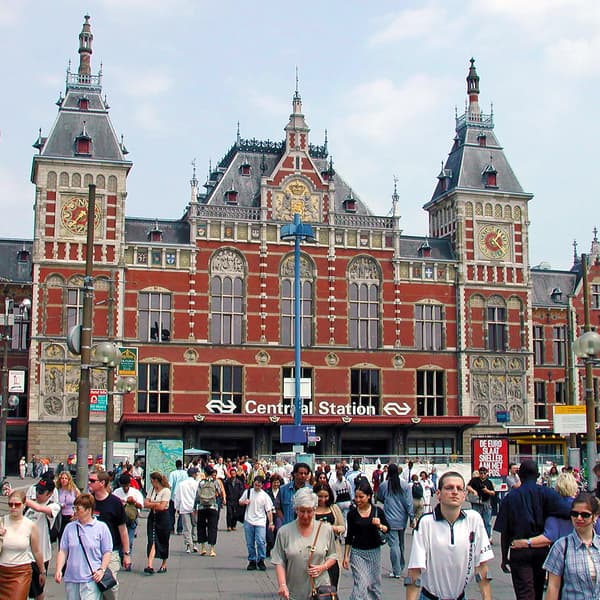
The tour begins. Central Station. Start at Central Station. Stand on the square fronting the station and take in the city, which stretches before you.
Here, where today's train travelers enter the city, sailors of yore disembarked from seagoing ships. They were met by street musicians, pickpockets, hotel runners, and ladies carrying red lanterns. Central Station, built in the late 1800s, sits on reclaimed land that was once the mouth of the harbor. It's a place where you can find a lot of things.
Read more...Show less
It's a place where you can find a lot of things. It's a place where you can find a lot of things. The station, with warm red brick and prickly spires, is neo-Gothic from the late 1800s, built during Amsterdam's economic revival. One of the towers has a clock dial.
The other tower's dial is a weather vane. Watch the hand twitch as the wind gusts every direction. N-Z-O-N-W. Let's get oriented.
Nord, Zuid, Oost, and West. Facing the station, you're facing north. Further north, on the other side, is the Eye, a body of water that gives Amsterdam access to the open sea. Now, turn around 180 degrees and, with your back to the station, face the city, looking south.
The city spreads out before you like a fan in a series of concentric canals. Ahead of you stretches the street called Damrak, which leads to Dam Square, half a mile away. And that's where we'll be heading. To the left of Damrak is the city's old side, These days, that historic neighborhood has become the red-light district.
The big church towering above the old side is St. Nicholas Church. It was built in the 1880s when Catholics, after about three centuries of oppression, were finally free to worship in public. We'll learn more about Catholic oppression on our walk.
To the right of Damrak is the new part of town, where you'll find the Anne Frank House and the peaceful Jordan neighborhood. The train station is the city's transportation hub, many trams and taxis leave from out front. Beneath your feet is the newly expanded metro line, built to accommodate the tens of thousands of people living in North Amsterdam, a fast-growing suburb beyond the eye. On your far right, in front of the Ibis Hotel, is a huge, multi-story parking garage.
This is for bicycles only. Biking in Holland is the way to go. The land's flat, distances are short, and there are designated bike paths, everywhere. This bike parking garage is completely free, courtesy of the government, to encourage this green and ultra-efficient mode of transportation.
Let's head out. With your back to Central Station, start walking south from the station into the city, to the head of Damrak. Once again, be careful crossing the street. Be aware of trams, bikes, and cars.
As you walk to Damrak, notice that we're crossing a bridge. Amsterdam is built on water. It's a sea-level mountain, a metropolis laced with some 1,200 bridges connecting 90 islands and 100 canals. The major canals are a series of concentric rings that ripple out from the station.
They're lined with houseboats and old, crooked townhouses, some of which you can see already. On our walk, we'll be essentially knifing through all that on a north-south axis, starting on the street known as Damrak. When you reach the head of Damrak, keep going straight, following the crowds south on Damrak, walking along the right side of the street.
Damrak: Station to Stock Exchange
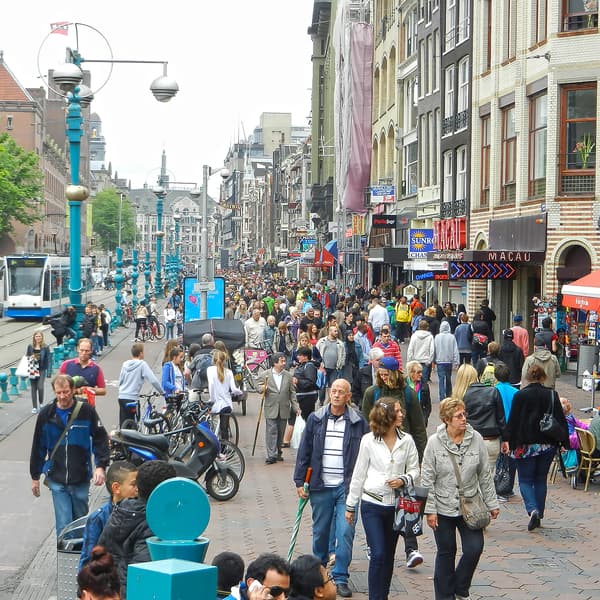
Damrak, from the station to the Stock Exchange. This street was once a riverbed. It's where the Amstel River flowed north into the eye, which led to a vast inlet of the North Sea called the Zuiderzee. It's this unique geography that turned Amsterdam into a city of beauty.
Amsterdam into a center of trade. Boats could sail up the Amstel into the interior of Europe or out to the North Sea to reach the rest of the world. As you stroll along Damrak, look left. There's a marina lined with old brick buildings.
Read more...Show less
Though these aren't terribly historic, the scene still captures a bit of Golden Age Amsterdam. Think of it. Back in the 1600s, this area was the harbor, and those buildings warehoused exotic goods from all over the world. All along Damrak, you'll pass a veritable gauntlet of touristy shops.
These seem to cover every Dutch cliché. You'll see wooden shoes, which the Dutch used to wear to get around easily in the marshy soil. There's tulips, real and plastic, from Holland's famed fresh flower industry. Heineken fridge magnets advertise one of the world's most popular Pilsner beers.
You'll listen to a hand-cranked barrel organ and see windmill-shaped salt shakers. There's all things orange, hats, and T-shirts, because that's the official color of the Dutch royal family. At Damrak No. 18, you'll find the city's most notorious commodity on display.
It's the Damrak Sex Museum. As a port town catering to sailors and businessmen far away from home, Amsterdam has always accommodated the sex trade. This museum tells the story of sex since Roman times. Every deviation is revealed in various displays.
It touches on the history of sex, touches on sex around the world, has a Marilyn Monroe tribute, and some nifty S&M displays. Yeah, nifty. Let's keep walking. By the way, one of the delights of Amsterdam is its many museums.
From houseboats to tobacco pipes, from marijuana to tattoos, and from handbags to Bibles, it seems there's a museum for everyone. Some are even located inside old townhouses, letting you experience a bit of life in Amsterdam's golden age. Keep walking up Damrak, taking in the vast array of touristy delectables. You'll almost certainly pass places selling the popular local fast food, French fries.
Here they're called Flamse Frites, or Flemish fries, since they were invented here, in the Low Countries. The stand at Damrak No. 41 is a favorite. Locals dip their fries in mayonnaise, not ketchup.
All along Damrak, you'll pass many restaurants. It quickly becomes obvious that international cuisine is almost like local cuisine here in cosmopolitan Amsterdam. Indonesian restaurants are especially popular since that was a former Dutch colony. There you can order rice taffel, a sampler assortment of Indonesian dishes that's big enough for two or three.
Also popular in Amsterdam are Argentinian steakhouses. Amsterdammers on the go usually just grab a simple sandwich called a broja or a pita bread wrap called a broja. Or called a shawarma from a Middle Eastern takeout joint. Keep going up Damrak.
Keep an eye out for a long brick building on the left. Remember, we're walking along what was once the Amstel River. Today, the Amstel is channeled into canals, and its former mouth is covered by the central station. But Amsterdam still remains a major seaport.
That's because, in the 19th century, the Dutch dug the North Sea Canal. Today, more than 100,000 ships a year dock in the outskirts of Amsterdam, making it Europe's fourth busiest seaport. For all of Amsterdam's existence, it's been a trading center. And the Stock Exchange continues that tradition. The Stock Exchange is the long brick building with the square clock tower on the left.
Damrak: Stock Exchange to Dam Square
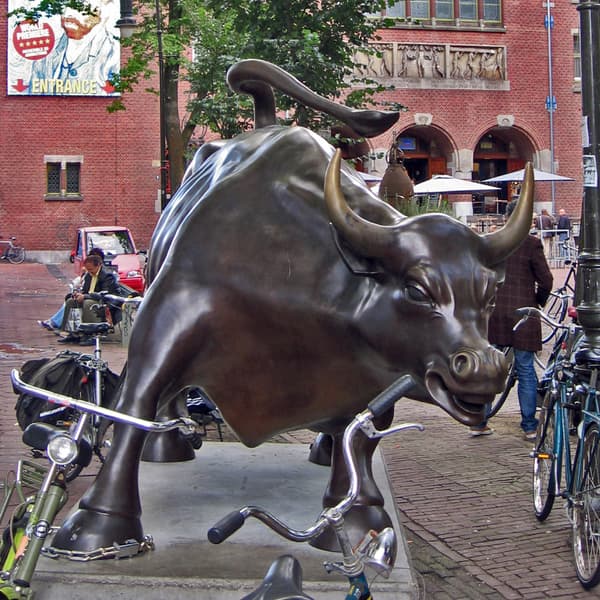
Damrak. From the Stock Exchange to Dam Square. This impressive structure, the Stock Exchange, or Burs, was erected in 1903, made of 9 million bricks. Like so many buildings in this once marshy city, it was constructed on a foundation of pilings, some 5,000 tree trunks hammered vertically into the soil.
When the Stock Exchange opened in 1903, it was one of the world's first modernist buildings. It has the geometric, minimal, no-frills, modernist style. It helped set the architectural tone for many 20th-century buildings that followed, emphasizing the importance of the stock exchange. The Stock Exchange's operating function overlooks.
Read more...Show less
Continue walking up Damrak, making your way to the end of the long building. The Stock Exchange building is only a century old. But Amsterdammers have gathered in this neighborhood to trade since medieval times. Back then, trading stock meant buying and selling any kind of goods that could be loaded or unloaded onto a boat, goats, chickens, or kegs of beer.
Over time, they were exchanging slips of paper, or futures, rather than actual goods. Traders needed money changers, who needed bankers, who made money by lending money. By the 1600s, Amsterdam had become one of the world's first great capitalist cities, loaning money to free-spending kings, dukes, and bishops all over Europe. It was a time of free trade and capitalism with gusto, but they recognized that the money ultimately came from the hard work of everyday people.
When you reach the end of the world, you reach the end of the building. Pause for a moment. Look across the street at the square called Bursplein. In 1984, the Stock Exchange building was turned into a cultural center, and the exchange moved next door to the Euronext complex.
Euronext is a joint attempt by France, Belgium, and the Netherlands to compete with the Power of Britain Stock Exchange. Notice the stock price readout board. Green is going up, and red is losing value. How's your Heineken stock doing?
Amsterdam still thrives as the center of Dutch business. It's the home to global giants like Heineken, Shell Oil, Philips Electronics, and Unilever. Before moving on, pop into the inviting little passage on your right at No. 68, Damrak.
Step into the entrance at No. 68 and explore. It's a tiny shopping mall done up in a fancy faux-art nouveau style. There's a nice marble floor and mosaic ceiling, and fun Amsterdam imagery.
You can fill your water bottle in the mouth of a fish. On the ceiling, you can sort through a primordial soup of things found in a canal. Everything from bike tires to Van Gogh's ear. Enjoy a little music as you explore, and we'll see you back on Damrak.
If you found something interesting, like a the best ? ! ? If you liked the video, hit the thumbs up button down below.
And, I'll see you in the future. Take care and Amazonilles thank you! Thank you for watching! Nice.
When you're ready to move on, return to Damrac and turn right. Continue south along the busy boulevard toward Dam Square. As you make your way to Dam Square, where Amsterdam was born, let's review the physical layout of the city. Again, it sits in the marshy delta at the mouth of the Amstel River.
The city's completely man-made, built from scratch. First, the land itself had to be drained. The excess water was channeled into canals. Dykes were built to protect the city from the sea's tidal surge.
Buildings had to be constructed atop a foundation of millions of pilings. These had to be driven 30 feet deep into the soggy soil, first through a layer of unstable mud and then into a layer of more stable sand. The locals built of brick because wood buildings too often caught fire. Even today, buildings lean this way and that as the land settles.
Though Amsterdam was an engineering nightmare, you couldn't beat the location. Boats could arrive here from Germany by riverboat down the Rhine or from England across the Channel or from Denmark by entering the Zuiderzee Inlet of the North Sea. No wonder that St. Nicholas, protector of water travelers, became the city's patron saint.
Even in medieval times, Amsterdam was a bustling trade center. They exchanged locally caught herring for German beer, cloth, bacon, salt, and wine. In the year 1300, the region's leading bishop granted the town a charter. Amsterdammers could then set up law courts, judge their own matters, and be essentially autonomous.
The town thrived, and the center of it all was just up ahead, Dam Square. Continue up Damrach until it opens into Dam Square. It's a vast open space stretching to the left and right and ringed with historic buildings. Damn, it's impressive.
Let's get a better vantage point. Start making your way across the street to the Kampenberg. Take your time, and again, be careful crossing the street. Remember those trams and bikes.
They can be silent. Once on the cobblestones, keep going a little further, heading to the middle of the square. Which, in some ways, is also the symbolic middle of the Netherlands. Now, stand in the midst of Dam Square and take it all in. Dam Square.
Dam Square
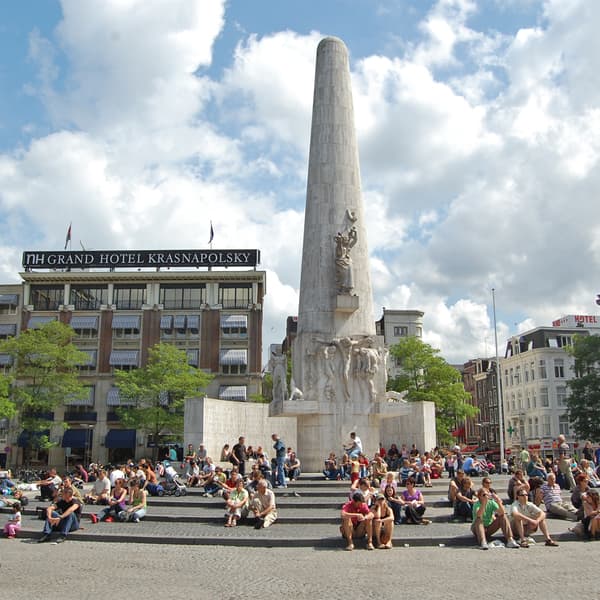
This is the historic heart of Amsterdam. The city got its start right here in about the year 1250. That's when fishermen in this marshy delta settled along the built-up banks of the Amstel River. They built a dam blocking the Amstel River, creating a small village called Amstel Dam.
To the north was the Damrach, meaning outer harbor, a waterway that eventually led to the sea. That's the street we just walked. To the south was the Rokin, or inner harbor, for river traffic. Nowadays, Rokin is also a main street.
Read more...Show less
With access to the sea, the fishermen were soon trading with German riverboats traveling downstream and with seafaring boats from Stockholm, Hamburg, and London. Land trade routes also converged here, and a customs house stood on this spot. Dam Square was the center of it all. Today, Dam Square is still the center of Dutch life, at least symbolically.
It's home to the ceremonial town hall, and the country's major department stores. Mimes, jugglers, and human statues mingle with locals and tourists alike. As Holland's most recognizable place, Dam Square is where political demonstrations begin and end. Pan the square clockwise and take in the sights.
First, the Royal Palace. That's the large domed building on the west side. Despite its name, it's really the former town hall, and Amsterdam is one of the cradles of modern democracy. In medieval times, this was where the city council and mayor met.
Amsterdam was a self-governing community that prided itself on its independence and thumbed its nose at royalty. In about 1650, when Amsterdam was one of the richest cities on the planet, the old medieval town hall was replaced with this one. Its style is appropriately classical, recalling Greece, the birthplace of democracy. The triangular pediment features denizens of the sea cavorting with Neptune and his gilded copper trident, all appropriate imagery for sea-trading Amsterdam.
The building became known as the Royal Palace in 1806 when Napoleon invaded and installed his brother, Louis, as king. Even after Napoleon was defeated, the victorious powers dictated that the Netherlands remain a monarchy under a noble Dutch family called the House of Orange. Today, the palace remains one of the first, four official residences of the current ruler, King Willem-Alexander. Though Amsterdam is the nominal capital of the Netherlands, all governing activity and the king's actual permanent home are in The Hague, a city about 30 miles away.
Amsterdam's Royal Palace is open to visitors. Inside, you can see a grand hall and about 20 lavishly decorated rooms. The chandeliers, paintings, statues, and furniture reflect Amsterdam's former status as a capital city. The Royal Palace is also home to the Royal Palace, the Royal Palace, and the Royal Palace.
The Royal Palace is also home to the Royal Palace. The Royal Palace is also home to the Royal Palace. The Royal Palace is also home to the Royal Palace. The Royal Palace is also home to the Royal Palace.
The Royal Palace is a center of global trade. Now, pan to the right of the Royal Palace to the New Church, or Nieuwkerk. Though called the New Church, it's actually 600 years old, a mere 100 years newer than the Old Church, which is in the Red Light District. The sundial above the entrance once served as the city's official timepiece.
That custom may be gone, but the New Church still holds a vital place in the Dutch history. It's a place that's a part of the Dutch tradition. Inside is the coronation spot for their kings and queens. It's also a popular wedding venue for young royals.
Let's continue panning to the right, around the square. There's the proud old department store called de Bijenkorf, or the Beehive. The store's upstairs café is a great place to rise above it all for a light meal and pleasant views. Further right, the Grand Hotel Krasnopolsky has a lovely circa-1900 winter garden.
The Grand Hotel Krasnopolsky has a lovely circa-1900 winter garden. A few blocks behind the hotel is the edge of the Red Light District. To the right of the hotel stretches the street called The Ness, lined with some of Amsterdam's edgy live-theater venues. Panning further right is Rokien Street, Damrak's counterpart.
Next, just to the right of the touristy Madame Tussauds, is Kalverstraat, a busy pedestrian-only shopper's mall, where we'll walk in just a moment. Standing tall on Dam Square is a white obelisk, the National Monument. It was built in 1956 as a World War II memorial. The Nazis occupied Holland from 1940 to 1945.
They deported 100,000 Amsterdam Jews, driving many, including young Anne Frank and her family, into hiding. Near the end of the war, the hunger winter of 1944-1945 killed thousands and forced many to survive on little more than tulip bulbs. The obelisk, with its carvings of the crucified Christ, men in chains, and howling dogs, remembers the suffering of that grim time. Now the structure is also considered a monument for peace.
Let's move on, but before we do, let me remind you that I've got two more audio tours of Amsterdam, a walk through Amsterdam's Jordaan neighborhood, and a tour of the Red Light District. Both tours start right here on Dam Square. Let's continue south. From Dam Square, head south down Kalverstraat. You'll find the entrance to the busy pedestrian mall just to the right of Madame Tussauds.
Kalverstraat and De Papegaai
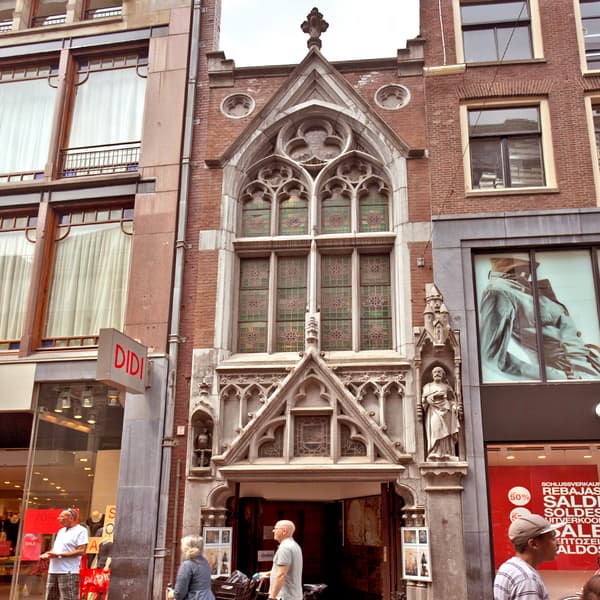
Kalverstraat and De Puppegei Church. Start walking down this pedestrian-only shopping street, even bikers need to dismount and walk. This has been a traditional shopping street for centuries, but today it's notorious among locals as a noisy shopping ghetto with chain stores and no soul. For smaller, more elegant stores, you can try the adjacent district called Daneenstraatjes, the Nine Little Streets.
It's about four blocks west of Kalverstraat. There you'll find about 200 shops and cafes mingling among pleasant canals. As you continue, you'll continue up Kalverstraat, past a vast array of international stores. Remember that Amsterdam has always been a global city.
Read more...Show less
Part of it is history. Amsterdam has always been a port town. Part is necessity. The country is tiny, and almost nobody else speaks Dutch, so they have to adapt to do business with the rest of the world.
Excuse me, Rick, but keep a sharp eye out for our next site, which is easy to miss. It's near the McDonald's. McDonald's. Right.
Holland is becoming increasingly diverse. The population of the country at large is about 75% ethnic Dutch, 5% from other EU countries, and approaching 20% from Holland's former colonies, places like Indonesia and Suriname and so on. The city of Amsterdam itself is even more diverse. It's hard work assimilating all these different cultures into a harmonious community.
Which is also the story behind our next stop. Our next site is just before the McDonald's. It's on the right-hand side, at No. 58, Kalverstraat.
This is the Petrus in Pauluskirk, better known as Die Papagei Hidden Catholic Church. Although the entrance is very low-profile, it's actually a welcoming place. Once you find the door, step inside. This Catholic church is an oasis of peace tucked amid 21st-century, crass commercialism.
It's called a hidden church, though I guess it's not since you found it. But it still keeps a low profile. That's because it dates from an era when Catholics in Amsterdam were forced to worship in private. You see, in the 1500s, Protestants were fighting Catholics all over Europe.
Pragmatic Amsterdam tried to stay neutral, doing business with all parties. But in 1578, Protestant extremists took control of the city. They expelled Catholic leaders and bishops and outlawed the religion. Catholic churches were stripped of their lavish decoration and converted into Dutch Reformed churches.
Simultaneously, Amsterdam was rising up politically against their Spanish overlords, who were Catholic, and eventually threw them out. For the next two centuries, Amsterdam's Catholics were driven underground. Catholicism was technically illegal, but it was tolerated. Kind of like marijuana these days.
Yeah, Catholics could worship, as long as they didn't inhale. Actually, Catholics could worship so long as it was practiced in humble, unadvertised places, like this church. By the way, this church gets its nickname, De Papagei, from a parrot that was carved over the entrance of the house that formerly stood on this site. Now, a stuffed parrot hangs in the nave to remember that original Papagei.
Today, the church asks visitors for a mere 15 minutes for God. You'll see the sign, In Quartier for God. The church stands as a metaphor for how religion has long been a marginal part of highly commercial and secular Amsterdam. Return to Calverstraat and continue south.
We're headed for the Amsterdam Museum, which is about 50 yards further down Calverstraat. As you walk, do some people-watching. The Dutch are unique. They're a handsome and healthy people, among the world's tallest.
The average height for a man is 6'1", and for a woman, 5'6". They ride their bikes all over town. Their average income is higher than in the United States. They're among the most open and honest people you'll find anywhere, refreshingly blunt.
They like to laugh, are connoisseurs of world culture, appreciate Rembrandt paintings, Indonesian food, and the latest French film. But they do it all with an unsnooty, blue-jeans attitude. The way I see it, the Dutch have to be pretty easygoing. Their country is so small, geographically, that they're forced to live very close together.
In fact, the population density of the Netherlands is 15 times that of the United States. Our next stop is coming up on the right, at number 92. It's where Calverstraat crosses Wijdkappelstieg. Pause at number 92 Calverstraat and look to the right. Peruse the colorful archway that leads to the Amsterdam Museum. The Amsterdam Museum.
Amsterdam Museum
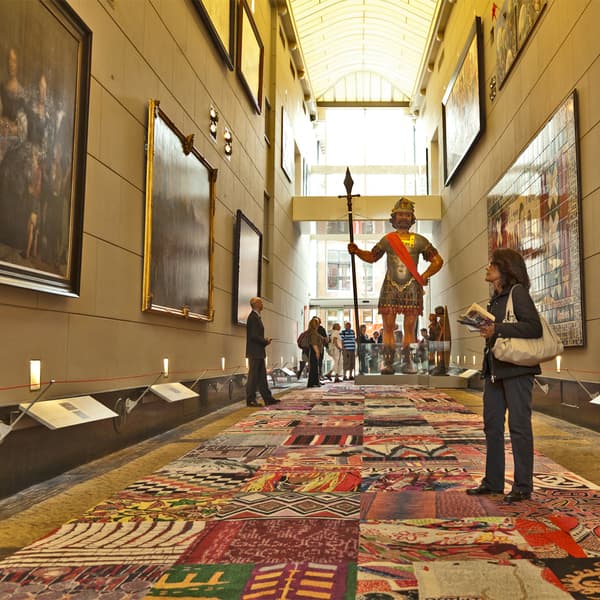
Though we won't be going inside the museum, its historic archway is worth a look. On the slumping arch is Amsterdam's coat of arms, a red shield with three X's and a crown. The X-shaped cross represents the crucifixion of St. Andrew, the patron saint of fishermen.
There's three X's to symbolize the three virtues of heroism, determination, and mercy. But this symbolism was only declared by the queen after the Dutch experience in World War II. Before that, it's thought that they symbolized the three great medieval threats, fire, flood, and plague. The crown dates to 1489 when Maximilian I, a Habsburg emperor, also ruled the Low Countries.
Read more...Show less
He paid off a big loan with help from Amsterdam's city bankers and, as thanks for the cash, gave the city permission to use his prestigious trademark, the, Habsburg Crown. Now, check out the relief above the door, dated 1581. It shows boys around a dove asking for charity, reminding all who pass that this was once an orphanage. People would donate by putting a coin in the slot of a donation box.
Let's move on, strolling further up Kalverstraat. But as we go, let me mention that the Amsterdam Museum's collection is definitely worth a look at some point in your visit. But we're powering ahead. Keep going up Kalverstraat to number 128 on the right.
It's about 50 yards ahead. We're headed for one of my favorite corners of Amsterdam, the religious complex known as the Begeinhof. The Begeinhof tells a similar story to what we saw at the hidden church earlier. It shows the religious side, both Catholic and Protestant, of Amsterdam's heritage.
As we approach number 128, start looking for a small lane that branches off to the right. The lane is called Begeinensteg. When you reach number 128 Kalverstraat, turn right on Begeinensteg. This lane leads directly to the entrance to the Begeinhof.
The Begeinhof is a walled-off complex of churches and homes. Admission into this sweet little haven is free, but it may be limited to about 50 people at a time. As we approach, I should mention, besides being a tourist attraction, the Begeinhof is also a place where people live. So be considerate and don't photograph the residents or their homes.
Begeinensteg runs right into the Begeinhof's old door, marked 1574 on its brick gable. By the way, when you're done with the Begeinhof, we'll be returning to this exact spot to continue down the little street to your left. Now, put on your best medieval reverence, fold your hands, and enter the Begeinhof.
Begijnhof
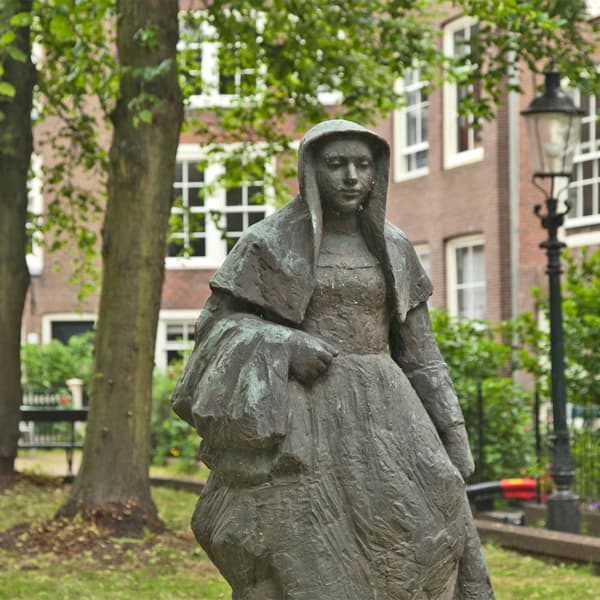
The Begeinhof. This quiet courtyard, lined with houses around a church, has sheltered women since 1346. What a contrast with the noisy Kalverstraat just steps away. This was, for centuries, the home of Begeins, pious and simple women who removed themselves from the world at large to dedicate their lives to God.
When it was first established, it literally was a woman's island, a circle of houses facing a peaceful courtyard, completely surrounded by water. Begin your visit by finding the statue of one of these charitable sisters. You'll find it just beyond the church. The Begeins were a lay order of Christian women.
Read more...Show less
Their ranks swelled during the Crusades when so many men took off never to return. Leaving society with an abundance of single women. Later, women widowed by the hazards of overseas trade lived out their days as Begeins as well. Poor and rich women alike turned their backs on materialism and marriage to live here, in Christian poverty.
And though obedient to a mother superior, the members of the lay order of Begeins were not nuns. The Begeins were very popular in their communities for the lives they led. Unpretentious, simple, and with a lot of love. They were the first women with a Christ-like dedication to serving others.
They spent their days deep in prayer and busy with daily tasks, spinning wool, making lace, teaching, and caring for the sick and poor. In quiet seclusion, they provided a striking contrast to the more decadent and corrupt Roman church, inspiring one another as well as their neighbors. Now turn your attention to the brick-faced English Reformed church. The church was built in 1420 to serve the Begein community.
But in 1607, this church became Anglican. The church served as a refuge for English traders and religious refugees fleeing persecution in England. The famous pilgrim stopped here in tolerant Amsterdam and may have even prayed in this very church before sailing to religious freedom in America. If the church is open, its hours are sporadic, step inside.
At the far end, you'll see a stained glass window. It shows the pilgrim, praying before boarding the Mayflower. Along the right-hand wall of the church is an old pew they may have sat on. On the altar is a Bible from 1763 with lots of old-style language and lettering.
Now head back outside. Find the church that faces the English Reformed church. This is the Catholic church. Because Catholics were persecuted, this had to be a low-profile, hidden church.
Notice that, painted-out windows on the second and third floors. Step inside, going through the low-profile doorway. You can pick up an English brochure near the entry. This church served Amsterdam's oppressed 17th-century Catholics who refused to worship as Protestants.
It's lovingly decorated, if on the cheap. Try tapping softly on a column. That's not real marble. Amsterdam's Catholics must have joyfully celebrated the day when, in the 19th century, they were legally allowed to say Mass.
Step back outside. Survey the houses around the courtyard, but be discreet and stay near the churches. The last Beguin died in 1971, but today, this Beguinhof thrives. It still provides subsidized housing to about a hundred needy single women, mostly Catholic seniors.
The Beguinhof is just one of a few dozen other hafiyas, or little housing projects surrounding courtyards, that dot Amsterdam. The statue of the Beguin faces a black wooden house at number 34. This structure dates from 1477. It's the city's oldest house.
Originally, the entire city consisted of wooden houses like this one. They were eventually replaced with brick houses to minimize the fire danger of having so many homes packed so close together. Now, stroll a few steps to the left of the old house. There's a display of colorfully painted and carved gable stones.
Stones like these once adorned house fronts and served as street numbers all over Amsterdam. Let's move on. Start heading to the exit of the Beguinhof, back at the same place where you entered. It's a shame we have to leave this peaceful place, but frankly, compared to most big cities with a lot of car traffic, Amsterdam is pretty peaceful everywhere.
That's true at our next site, the people-friendly square called Spouw. Leave the Beguinhof through that old gate. As you exit, turn right and walk 50 meters. The lane leads into that lively modern square called Spouw. The long square called Spouw
Spui to the Mint Tower
is lined with cafes and bars, especially at its far right end. It's one of the city's more popular spots for nightlife and sunny afternoon people-watching. We'll be ending our walk back here in this square in about half an hour, but first, we have a few more sites to see. From Spouw, turn left and walk a short block returning to the busy pedestrian-only Kalverstraat.
As you walk, think of how Amsterdam continues to evolve. In medieval times, it was strictly Catholic. In the 16th century, it became rabidly Protestant. And today, Holland still has something of a religious divide, but not a bitter one.
Read more...Show less
Amsterdam itself is, like many big cities, pretty unchurched. But the Dutch countryside is much more religious, including a Bible Belt region where 98% of the people are Protestant. Overall, in the Netherlands, the country is divided fairly evenly. About a third are Catholics, a third Protestants, and a third are those who see Sunday as a day to sleep in and enjoy a lazy brunch.
Pause when you reach the intersection with Kalverstraat. From here, if you continue to head another block, you'd reach a canal, the busy street called Rokin, and a dock that offers reliable canal boat cruises. But our tour continues up Kalverstraat, so turn right, walking south on pedestrian-only Kalverstraat. We'll be walking a couple hundred yards to where Kalverstraat runs into an old clock tower.
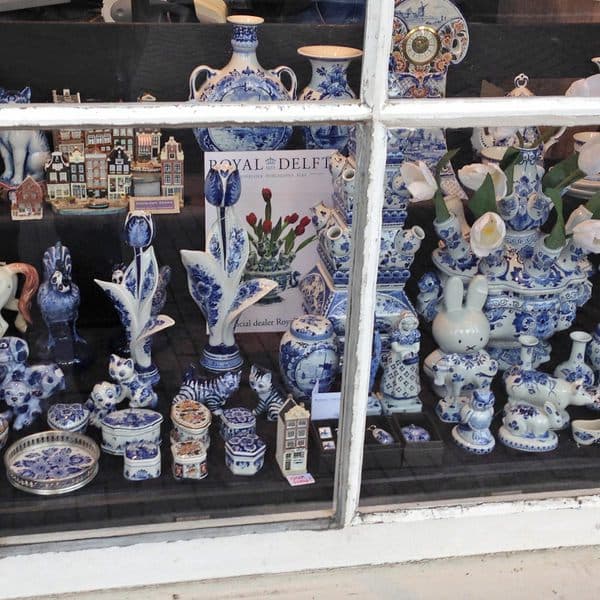
This stretch of Kalverstraat offers more modern shopping. As you stroll, let me mention some souvenirs popular for visitors to the Netherlands. There's Delftware, ceramic plates, vases, and tiles painted blue and white. The good stuff is very expensive, but fireplace tiles sold at gift shops are reasonable.
Diamonds have been a big Dutch commodity ever since Golden Age traders first exploited the mines of Africa. Dutch gin, called jenever, is sold in traditional stoneware bottles. For chocolate, there are many proud and local makers. Old maps and books capture the musty days of the Golden Age.
And there's always a good selection of art-related gifts. Van Gogh posters, Rembrandt mousepads, and so on. As you begin to approach the mint tower, you'll find a modern mall on the right, the Kalvertoren Complex. Inside, there's a slanting glass elevator.
You could ride it to the top-floor café to enjoy something that's rare here in altitude-challenged Amsterdam, a commanding city view. But we are moving on. Kalverstra leads directly to an old tower with a clock on it, the Mint Tower.
Mint Tower
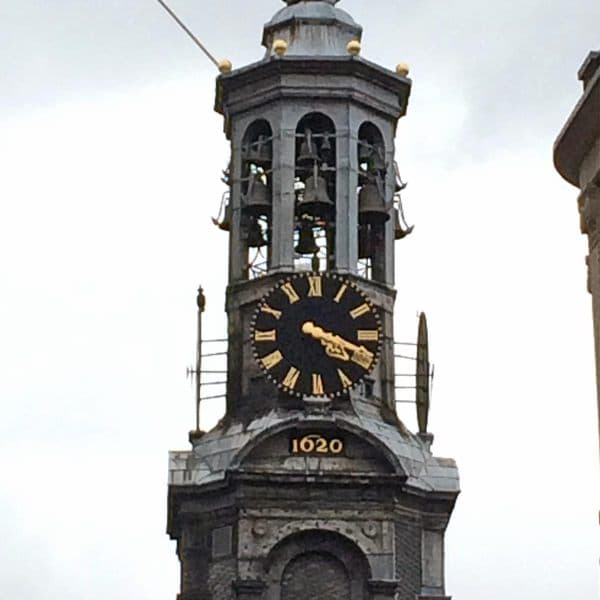
The Mint Tower This tower, which marked the limit of the medieval walled city, served as one of the original gates. The city walls were girdled by a moat, now called the Single Canal. Until about 1500, the area beyond here was nothing but marshy fields and a few farms on reclaimed land. The Mint Tower's steeple was added later, in the year 1620, as you can see written below the clock face.
Today, the tower's a favorite with Amsterdam's marijuana culture. Stoners just love to take a photo of the clock and its 1620 sign at exactly 420. Why? Well, because 420's the universally recognized time when work ends and you fire up a joint.
Read more...Show less
I still don't get it. Okay, Lisa, what time is 1620 on the 24-hour clock? 1620 minus 12, 420. Synchronicity!
Dude! Before moving on, look left and gaze down Regulaire's Bracetrot. Midway down the block, the twin green domes mark the exotic Tuschinski Theater. Here you can see current movies, always in their original language with Dutch subtitles, in a sumptuous art deco setting.
Beyond the theater, way at the end of the long block where you see the trees, is Rembrandtplein, another major center for nightlife. But we won't go there on this tour. Now, continue past the Mint Tower. First, you'll walk a few yards south along busy Weiselstraat, crossing the canal.
As always in Amsterdam, keep an eye out for trams. Then turn right and walk west along the south bank of the single canal. The canal is lined with the greenhouse shops of the flower market.
Flower Market
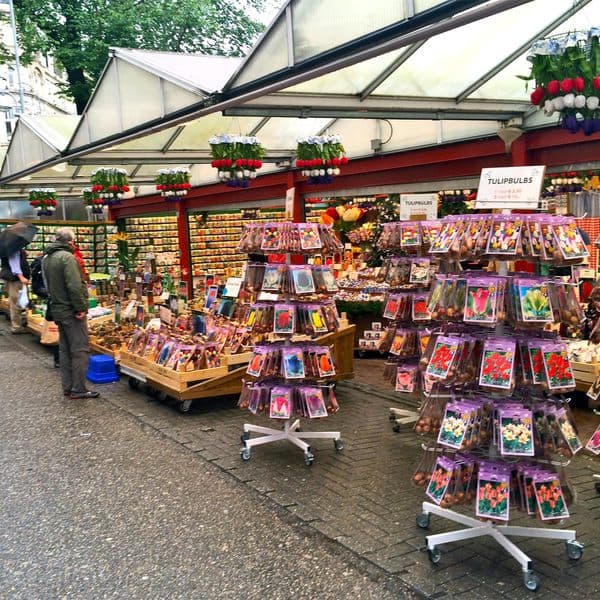
The Flower Market The stands along this busy block sell cut flowers, plants, bulbs, seeds, and garden supplies. Browse your way slowly, headed along the single canal to the end of the block. This market, the Bloemenmarkt, is a testament to Holland's longtime love affair with flowers. The Netherlands is by far the largest flower exporter in all of Europe and a major flower power worldwide.
If you're looking for a souvenir, there's a huge selection here. Certain seeds are marked as OK to bring back into the United States through customs. The best-known Dutch flower is the tulip. They're actually native to Central Asia.
Read more...Show less
The name comes from the flower's hat-like appearance. Tulip. It's from the Turkish word for turban. In the 1500s, a few tulip bulbs found their way from Asia all the way to Holland.
The hardy bulbs thrived in the sandy soil of Holland's reclaimed land and thus began one of the oddest chapters in Dutch history. It was the Golden Age, and merchants had money to burn. They loved buying flowers for their homes. Within a generation, tulips grew from a trendy fad to a new trend.
into an all-out frenzy. Prices shot way up. In fact, a single-priced bulb could sell for the equivalent of thousands of dollars. Speculators jumped in, too, and Amsterdam's stock exchange hummed with frantic businessmen trading tulip futures.
By 1637, it was full-blown tulip mania. Yes, that's what even the Dutch called it. Then, the tulip bubble burst. Overnight, once wealthy investors were left with nothing to buy, nothing but worthless pieces of paper or warehouses full of bulbs nobody wanted.
The crash was devastating, even playing a role in the decline of the Golden Age. But Holland's love affair of this delightful flower lives on. Today, tulips are a major industry and are firmly planted in the Dutch psyche. Continue through the flower market to where it ends at the next bridge.
We're nearing the end of our walk, so take a moment to think of where you are. The Mint Tower is roughly the center of the historic core of Amsterdam. This flower market borders the first of four canals that ripple out from here to the rest of Amsterdam. From here, you have a number of sightseeing options, which Lisa and I will talk you through in a moment.
But for now, let's head for a square that's a fishy place to fortify yourself for the final leg of our tour. At the end of the flower market, keep going straight ahead a few more steps, crossing over the tram tracks. to a square called Koningsplein.
Koningsplein, Herring, and Leidsestraat
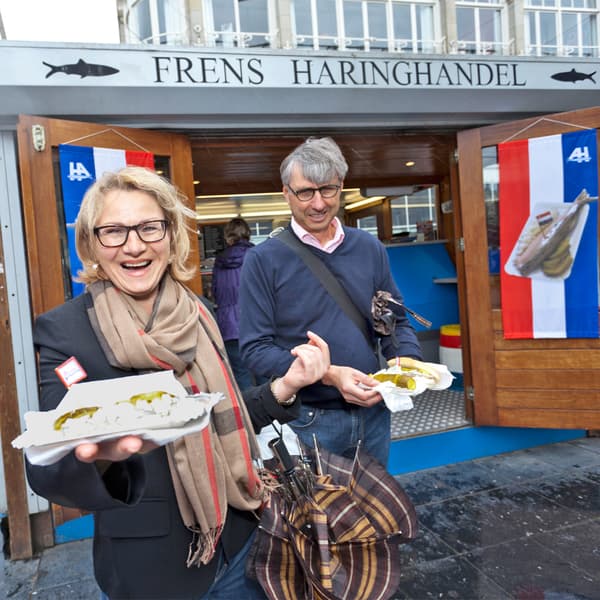
Koningsplein, Herring and Leidestrott. This pleasant square called King's Square or Koningsplein comes with a popular outdoor herring stand. This is a great place to choke down a raw herring. I can't wait!
Herring. It has a special place in every Dutch heart. After all, herring was the commodity that first put Amsterdam on the trading map. It's also what Dutch sailors ate for protein on those long cross-global voyages.
Read more...Show less
Today, throughout the Netherlands, old-fashioned fish stands like this one sell herring sandwiches and other fishy treats. Step up and see what's on ice. Do I have to? Yes.
While herring's the star, you'll also see garnelen, it's a little shrimp, zalm, salmon, mackerel, mackerel, and paling, that's eel. Most are available as broodje, sandwiches. And every Dutch kid's favorite is kibbeling, deep-fried breaded cod with a tasty sauce. As long as I don't have to eat eel, I'll have a herring.
That's the classic. For herring, you have choices. The easiest and most practical for novices is the sandwich or broodje. Tucked into a soft roll with pickles and raw onions.
Purists prefer their herring unadulterated. If you go with a straight herring, you have two choices. There's Rotterdam style, where you pick it up by the tail, dredge it in the chopped raw onions, and then lower it into your mouth all in one go. And Amsterdam style, that's cut up in toothpick-friendly hunks, also with onions.
Between the raw fish and the onions, they ought to come with breath mint. Lisa, while you're savoring your herring, here's a little info. Herring thrive in the shallow North Sea waters surrounding the Netherlands, and they're a delicacy here. While it seems the Dutch eat their herring raw, the fish is actually cured in salt.
It's soaked for five days in an oak cask filled with a mild brine solution. Herring is caught fresh during the May-June fishing season and then immediately preserved. Before the days of deep freezing, that was a big deal. But now, Dutch herring lovers admit that you can't really tell what's fresh or frozen, and you can get great herring all year long.
You know, it isn't half bad. And now, you've had a true Dutch experience. Let's take a moment to get oriented. Walk a few steps back to the tram tracks and look to the right or south up the street.
From here in King Square, you've got options. Gazing up the tram tracks, you're looking up the main thoroughfare that becomes Leidsestraat. It's lined with lots of touristy shops and leads to Leidsaplan, a popular square for cafes and nightlife. Past that is the museum zone, home to the Rijksmuseum, Van Gogh, and the Stedelijk Modern Art Museum.
But we won't be going there on this tour. Nope. Leidsestraat is pretty noisy and congested. In fact, if you're going to the museum zone, here's a better route.
Go up about 100 yards. Crossing the next canal, that's Herrengracht, and then take a left for a block. Then go right at Neuespiegelstraat, which is lined with inviting art galleries and charming shops, and it leads directly to the Rijksmuseum. Or, from here in King Square, you could catch tram 2 or 12, either to the museums or back to the central station.
But before you go anywhere, our tour has one more stop to go. It's that convivial square Spau, a place where you can get refreshed and plan your next move. So let's go there. With your back to the flower market, head down the single canal with the canal on your left.
You're basically following the curve of the tram tracks, keeping the canal on your left. We'll sightsee as we walk. © transcript Emily Beynon
Finishing at Spui
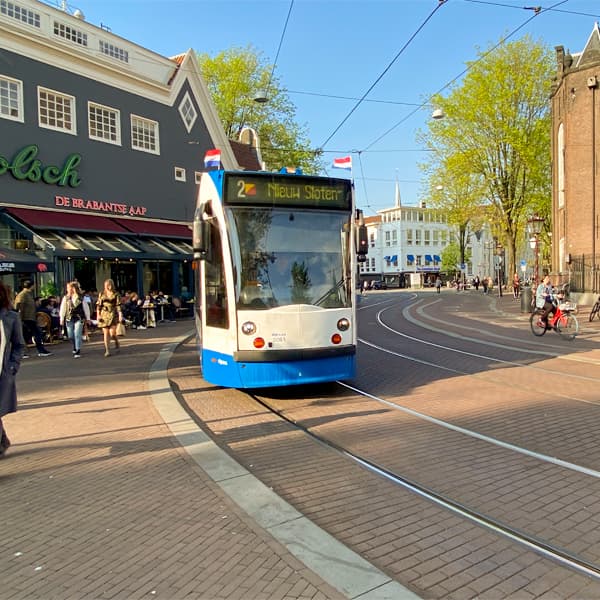
Finishing at Spau. As you walk with the canal on your left, our final stop is a long block away. We're walking along the dividing line between Old Amsterdam on your right and Newer Amsterdam on your left. This road used to be the city wall back in the 14th century, and the single canal was the moat.
Then around 1620, during the Golden Age, a period of building and expansion, the wall was torn down in the city expansion, and the single was the innermost of the four new canals known as the Canal Belt. Keep walking to the end of the block, where we'll curve to the right to our destination. As you walk, notice the street you're enjoying. No cars.
Read more...Show less
The lanes are for bikes and trams and people. Amsterdam's vision is a world with no more fossil-fuel-powered traffic. By the way, the Dutch take biking, seriously. They may not wear helmets, but they're adamant about road safety.
Little kids grow up on bikes. Around the age of 10, they take a biking exam, where they're expected to know the rules of the road. In the city, bikes are equal with cars on the road and are expected to follow the same rules. Stiff fines are given to bikers violating traffic laws, like biking in pedestrian zones or looking at their phones while pedaling.
When a fifth grader passes this exam, it's a kind of coming-of-age. Their world just got bigger and more real. Hey, Lisa, what's a Dutch person call the most dangerous thing on two wheels? I don't know.
A tourist. At the end of the block, turn right, where you enter our final stop, that long, friendly square called Spouw. Remember, we were here earlier, though at the other end. It's a weird name, Spouw.
Spouw. It means spew. Spouw. Back when, when the single canal was a moat, this is where Amsterdam spewed out its excess water.
In the 1800s, this area got filled in to form the square. Today, it's a great place to stroll around or get a beverage at a café. A number of bookstores are nearby. There's a book market on Fridays and an art market on Sundays.
And the Begeinhof, though hidden from view, is just next door. A statue of a young boy with his hands on his hips symbolizes the Amsterdam spirit, both playful and feisty. And the stop for the Handy Trams 1 and 2 is just down the street. Before we say goodbye, let's pause for a moment and listen to the city.
People talking over drinks at a café. The gears of bikes changing. The bring of handlebar bells. The chatter of the birds.
Does the square seem spacious? Rather than 200 noisy cars, within view are very likely 200 bikes. Nice. Seriously, imagine it, because, at least for the Dutch, this is the urban environment of the future.
We hope you've enjoyed this city walk through Amsterdam. Thanks to Jean Openshaw, the co-author of this tour. If you're doing more sightseeing in Amsterdam, check out our other audio tours. There's one of the Red Light District and of the Jordaan.
This tour was excerpted from the Rick Steves' Amsterdam, Bruges, and Brussels Guidebook. For more details on eating, sleeping, and sightseeing in those cities, refer to the most recent edition of that guidebook. For more free audio tours and podcasts, and for information about our guidebooks, TV shows, bus tours, and travel gear, visit our website at ricksteves.com. This tour was produced by Cedar House Audio Productions.
Thanks! Dank u wel! Tot ziens! And goodbye for now. music music music music music music music music music music music music music music music music music
Free
GPS-guided walking tour
No account needed. Walk at your own pace.
Free
13 stops · 3 km