22 stops
GPS-guided
3.5 km
Walking
2 hours
Duration
Free
No tickets
About this tour
A 3.5 km GPS-guided walk through the heart of Spain. Visit Barcelona City Walk, The Ramblas, Carrer de Santa Anna, Church of Santa Anna, and Avinguda del Portal de l’Angel — with narrated stories at every stop.
22 stops on this tour
Barcelona City Walk
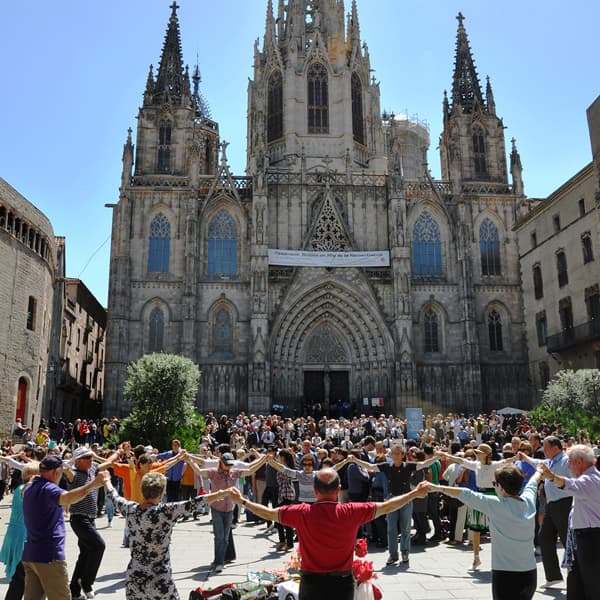
The Barcelona City Walk. As the capital of the Catalan people and Spain's second city, Barcelona bubbles with life. You'll find it in its atmospheric alleyways, bustling cafes, offbeat boutiques, and vibrant people. If you're in the mood to surrender to a city's charms, let it be Barcelona.
Hi, I'm Rick Steves. Thanks for joining me on this walk through the historic core of Barcelona. We'll start in Plaza de Catalunya, the dynamic city center. We'll ramble down the Ramblas, one of Europe's grandest promenades and a 24-7 parade of humanity.
Read more...Show less
Then we wind through the Gothic Quarter, a quiet neighborhood of narrow lanes with a bohemian vibe. We'll see some of Barcelona's most historic elements, including reminders of Christopher Columbus and even 2,000-year-old Roman ruins. A highlight of this walk is going inside the historic cathedral. The church is only open during the day and often requires a ticket.
But you could easily do the church portion of this tour when it's open and do the rest of the walk anytime. Now, let's get going as we lace together the essential elements of Barcelona's old center. A city where the tapas bars are packed, locals are joining hands to dance the sardana, and neighborhood festivals are about to erupt without notice. And it's all happening in Spain's most European and cosmopolitan corner, Barcelona.
To help us along the way, I've invited a good friend and virtual travel buddy. Welcome, Lisa. Buon dia, Ricardo. Lisa will give us helpful directions and sightseeing tips throughout the tour.
And my first tip is to be sure you get our tour updates. Just press the icon at the lower right of your device. You'll find any updates and helpful instructions unique to this tour. Things like closures, opening hours, and reservation requirements.
There's also a lot of information about the tour. There's also tips on how to use this audio tour and even the full printed script. Yes, so pause for just a moment right now to review our updates and special tips. It's okay. We'll wait. And then... Let the tour begin!
Tour Begins: Plaça de Catalunya
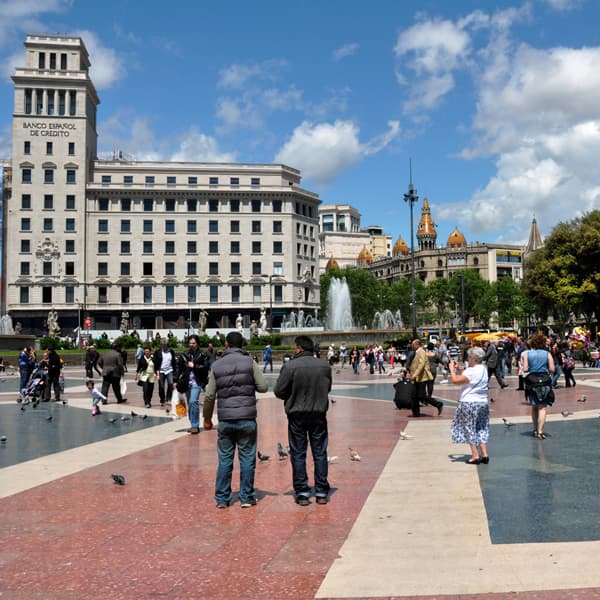
The tour begins. Plaza de Catalunya. Start on Plaza de Catalunya, Barcelona's main square. Find a spot near the center, standing atop the mosaic star in the pavement.
The square is huge, covering 12 acres, more than 10 football fields. The plaza is dotted with fountains, statues, and pigeons, and ringed by grand art deco buildings. Rick? You're standing at the center of Barcelona.
Read more...Show less
Four great thoroughfares radiate from here. The metro and bus system converges on this main hub. And Plaza de Catalunya is home to the region's biggest banks and banks. And El Corte Inglés, the huge department store with nine floors of goods, kind of like Macy's Plus.
Feel free to browse around the square while Rick points out a few things. This place, Plaza de Catalunya, is where locals gather. On important occasions, they arrive by the thousands for political demonstrations or to celebrate festivals. Almost 5 million people live in greater Barcelona, and for them, this is their Times Square.
Get oriented by facing downhill with El Corte Inglés on your left. Geographically, Plaza de Catalunya connects Old and New Barcelona. Below the square on the downhill side is the historic core, or Old City. It consists of the Gothic Quarter, called the Barri Gàtic, and the Ramblas Boulevard, which we'll be touring.
For nearly 17 centuries, that was the extent of Barcelona. That historic district slopes from here to the Barri Gàtic, here, where we're standing, gently downhill, all the way to the Mediterranean. That's where this sea-trading city got its start. Now turn 180 degrees and look toward the uphill side.
Above Plaza de Catalunya is New Barcelona. This is the neighborhood called the Eixample. Built in the late 1800s, it's a district with broad boulevards, apartment houses, fashionable cafes, and noisy traffic. The Plaza de Catalunya, laid out around 1850, connected that new city, with the old one below.
By the way, the Eixample has one element definitely worth a visit on your own, and that's its colorful architecture. Is that what I'm seeing over there in the upper right corner of the plaza? Those buildings with the fanciful domes and cone-shaped turrets? Exactly.
Though these particular buildings aren't really famous, it's a taste of what you'd see further up the street. The style is called Modernisme. That is, they built modern buildings, but decorated with medieval motifs. The most famous modernist was Antoni Gaudí, known for his huge Sagrada Familia church.
In comparison, the buildings here on Plaza de Catalunya are pretty, well, like kind of Squaresville, man. Yes, Plaza de Catalunya was done in the Art Deco style, popular back in the 1920s when this plaza took shape. It has buildings with square lines, square windows, a tower with an old-time clock, This Art Deco style was Barcelona's way of turning the page on the earlier era of Modernisme. Plaza de Catalunya also links the city in another way.
Historically, Barcelona's history spans 2,000 years. It began in the Old City, downhill from here. As that city expanded beyond its walls, Plaza de Catalunya was the first area to be developed. Today, it sits midway between the Old City and the forward-looking Eixample.
Plaza de Catalunya is the center of Barcelona, and it's also the cultural heart of the entire region of Catalunya. Lisa, let's walk. Let's. Face the downhill side of the plaza with El Corte Inglés on your left.
We'll be exiting the plaza from the downhill right corner, so start walking toward the downhill right corner. As you walk, keep your eye out for a weird-looking monument. It's a big, freestanding hunk of concrete that looks kind of like an inverted staircase. Yes, I see it.
It's right there, directly in front, on the way to the corner of the square. It's sure an odd-looking monument, but it's become a powerful symbol of the region of Spain we're in right now, Catalunya. Catalunya has 8 million inhabitants, and Barcelona is its capital. Though they're Spaniards and they do speak Spanish, Catalunians also speak their own distinct language, Catalan.
For example, instead of por favor, or please, they say, si es plau. The Catalans also have their own distinct culture, and many here even think Catalunia should be a separate nation, independent from Spain. This monument serves as a rallying point for that Catalan pride. Read the inscription.
Catalunia a Francesc Macia. The monument honors that Catalunian leader. He boldly declared independence from Spain back in 1931. Obviously, it didn't quite stick then.
But many Catalans today keep the flame of freedom alive. They gather here to remember. On occasion, there are huge demonstrations. They come here by the thousands.
And even tens of thousands. To demand independence from Spain. They shout as one, Visca Catalunya! Long live Catalunia!
Visca Catalunya! The monument is by the sculptor Josep Maria Subarachs. You see his work at the Sagrada Familia. Supposedly, the angular monument he created here is meant to represent the shape of Catalunia on a map.
Um, I guess I see that. But I've also heard it symbolizes something else. How Catalunia's future is still unfinished and must be built one step at a time. I like that better.
All along our walk, you'll see the Catalan flag with its nine red and gold horizontal stripes. It's more popular here than the Spanish one, which has only three wide stripes. People hang the Catalan flag from their apartment balconies as a show of local pride. Let's move on.
Continue toward the downhill right corner. We're headed to those trees where the tree-lined Ramblas Boulevard begins. You'll need to cross some busy streets to get there. Don't worry, we won't leave you behind.
As you make your way there, glance to the right. You'll see the Café Zurich, long a popular rendezvous spot for locals. Though it's in the middle of the city, encased in a modern building, the café itself is old and venerable. Locals of a younger age are more likely to hang out just opposite the café at the giant Apple Store. When you reach the head of the Ramblas, stop. Gaze down this wide and mostly pedestrian boulevard. The Ramblas
The Ramblas
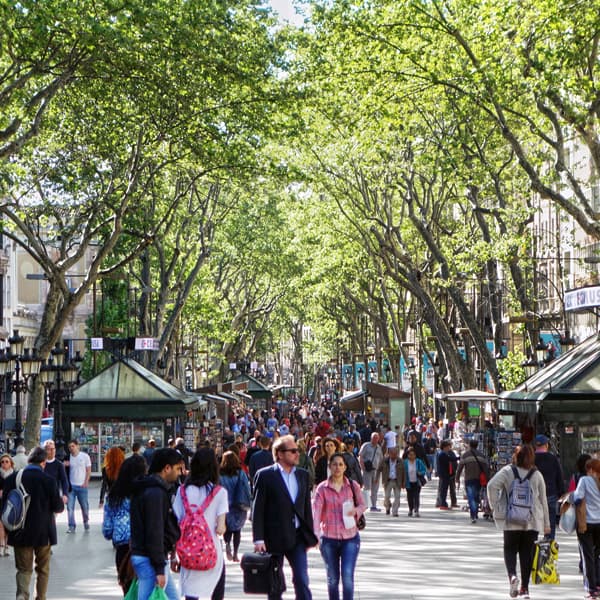
The street called the Ramblas stretches before you. It slopes gently downhill from here to the waterfront, about three-quarters of a mile in all. It's dotted with trees, lined with fanciful buildings, paved with colorful mosaics, and washed by a constant river of humanity both day and night. A good place to view the Ramblas is about 30 yards down on the right.
Head there and find the ornate black-and-gold lamppost with a fountain at its base. As you walk, you'll be treading upon colorful mosaics in the pavement. The wavy pattern is meant to represent a stream. That's what the Ramblas was back in medieval times, a stream located just outside the city walls.
Read more...Show less
Stop at the fountain and take in the scene around you. This elegant fountain was one of the first attractions built after the stream was transformed into a city. It was a stylish new street. That was about a century ago.
The new promenade was christened Rambla, meaning stream. So is it Rambla, singular, or Ramblas, plural? Well, street signs treat it as a single long street, La Rambla, singular. But the street actually consists of five separately named segments, so people tend to call it Las Ramblas, plural.
It's clear that the fountain is a popular place. To get a drink of water or just hang out. Sure is. For more than a century, this place has been Barcelona's meet-me-at-the-fountain rendezvous spot.
It's also a rallying point for the local soccer team, FC Barcelona, known as Barça. Fans converge here to party after a big match. In fact, the fountain has actually been toppled several times by happy fans climbing it. All around town, you'll see T-shirts with Barça colors, scarlet and blue.
Barcelona loves its soccer team. It's not owned by billionaires, but by its 170,000 members, namely fans who buy season tickets. Their motto? More than a club.
And it's become a symbol of Catalan pride. By the way, legend says that a drink from this fountain ensures that you'll come back to Barcelona one day. You can fill your water bottle here. But watch out for the ridiculously high water pressure.
Psh! Now let's start strolling a short ways down the Ramblas. Watch for pickpockets along here. We're only going as far as the first intersection on the left, about 100 yards down.
For more than a century, this walk down Barcelona's main boulevard was known for its characteristic charm. Locals flocked here to buy flowers, lottery tickets, their daily newspaper, and bringing their kids to buy their household pets. They still come to enjoy the shade and just watch the world go by. The street's trees are called plane trees.
They're known for their beautiful colors. They're appealing bark and toughness in urban settings. They're deciduous, so they provide maximum shade in the summer and maximum light in the winter. Unfortunately, much of the local charm of the Ramblas has been taken over by hordes of tourists, tacky trinkets, and cafes that sell expensive beers in one size only, gigante.
Still, if you come to Barcelona, you've got to ramble the Ramblas. Our walk only includes a short bit of the Ramblas. So stop when you reach the first intersection on the left at the street called Carré de Santa Ana. You've gotten just a taste of the Ramblas.
Later, you may want to stroll the other 90%. It's an easy, gradual, downhill stroll all the way to the harbor. Along the way, you'd see more colorful mosaics, elegant cafes, the lively Boqueria Market, and lots of sharp-dressing pickpockets. You'd also find fine architecture, like that building just ahead on the right side, about 30 yards down.
But we won't go there. Right. But just enjoy the view from here. That building is the venerable Royal Academy of Science and Arts.
Its fine façade is another example of modernisme, a functional, modern building decorated with fancy ornamentation. This is just one style of the many we'll see in this city of great architecture. In the center of the façade, find the clock in the arched window. That clock marks Barcelona's official time.
Synchronize, Lisa. And... got it. The Ramblas is quite a show, but we're now exiting that scene stage left.
So turn left on Carré de Santa Anna. This is a Y intersection. Take the left fork. ¶¶ ¶¶
Carrer de Santa Anna, Church of Santa Anna
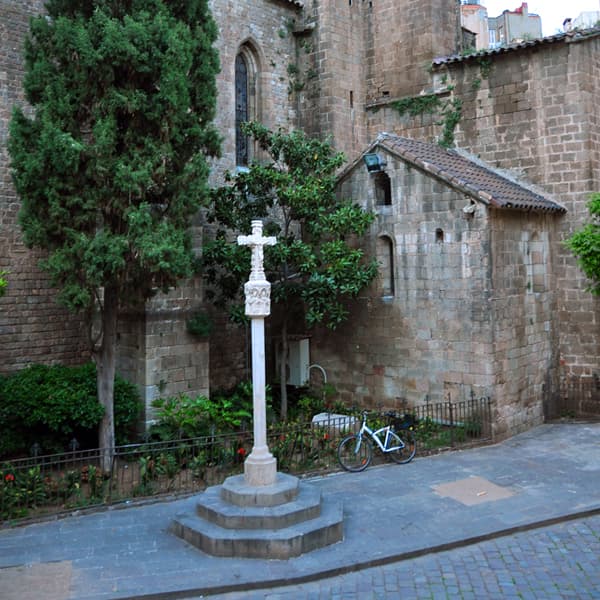
As you walk up this narrow street, you're now entering the Barri Gatic, or Gothic Quarter. This neighborhood is Barcelona's birthplace. As we'll see, it's where the ancient Romans built a city and where medieval Christians built their cathedral. It's where Jews gathered together and where Barcelonans lived within a ring of protected cities.
walls. That lasted until the 1850s, when the walls came down and the growing city expanded. As you continue strolling down the street, you'll get a sense of medieval life, of narrow lanes with people living in close quarters. Look up at some of today's apartments.
Read more...Show less
See the characteristic balconies, made of elaborate wrought iron. The apartments were very small, but they're functional, with windows opening from floor to ceiling. This lets in more light and more air into these cramped old buildings. As you walk, keep an eye out for a turnoff on the left.
It's about three-quarters of the way down the street, on the left, at number 32. Look up at the pulleys on the roof lines. These are handy in buildings with no elevators to pull up that sofa. Notice the touches of elegance that mask otherwise ugly buildings.
The fine entrances, the plasterwork with fake columns. By the way, all the buildings are the same height. They all maxed out on their late 1800s building code limits. Stop when you reach number 32 on the left.
Go through the small gate. This leads into a courtyard with a small and old church. Enjoy this pleasant oasis of fragrant flowers. The courtyard is home to the Church of Santa Ana.
Start by finding the column with the stone cross on top. This cross dates from around 1300. The stone church, with its tall bell tower, is even older, from the mid-1100s. Back then, the church was actually outside the city walls.
This austere Catalan Gothic church was part of a convent. You can sneak a peek at the convent's leafy courtyard or cloister to the left of the church. You can see the columns of its peaceful, arcaded walkway. If the church is open, you could pause the audio tour, pay a small fee, and step in inside.
You'd find a bare Romanesque interior with an octagonal wooden roof. Here in the little square, you can also climb those modern stairs across from the church for great views of the bell tower. Otherwise, we're moving on. Return to Carre de Santa Ana, turn left, and start heading to the end.
Hey Rick, is that a condom shop a couple of doors down on the left? Sure is. I go there all the time. Number 35.
It's a condom shop. Notice the sign. It advertises, Para los pequeños placeres de la vida. For the little pleasures in life.
Apparently appealing to men with ample self-esteem. Keep going to the end of the block. One more thing about those condoms. Spain, though thoroughly Catholic, is a surprisingly freewheeling country.
After years of repression under Franco, more on him later, the pendulum has swung the other way. Spain is now strongly liberal on such issues as premarital sex, abortion, divorce, and contraception. And they've also embraced the cosmopolitan world of international commerce as we'll see now. Carre de Santa Ana spills out on a big pedestrian cross street. Avinguda del Portal del Angel. Avinguda del
Avinguda del Portal de l’Angel
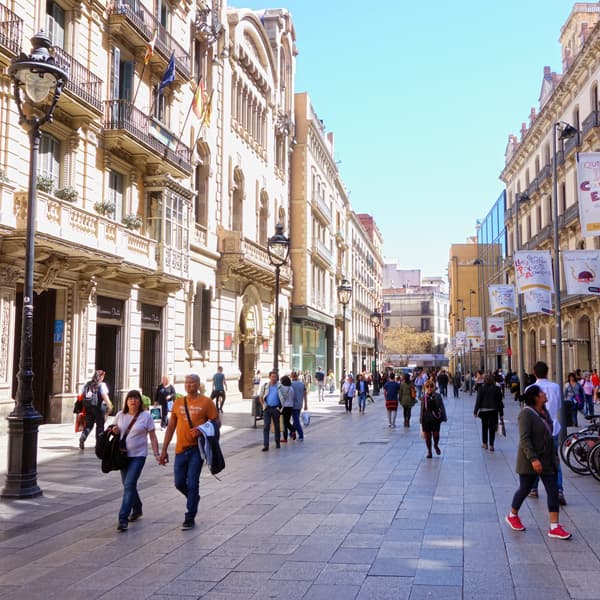
Porto del Angel. This popular pedestrian-only street caters to the modern shopper. Start by looking to your left, uphill. That's Plaza de Catalunya in the distance, where we started with El Corte Inglés department store.
Now, return your attention to where we stand. Immediately on your right is another El Corte Inglés. Notice its fine Art Nouveau awning. Now, turn right and, and start strolling downhill.
Read more...Show less
We're making our way one block to Carre de Monchaux on the left. You'll pass name-brand international chain stores. Zara, Oixo, Bershka, and Massimo Dutti. All those happen to be owned by the same man, a Spaniard.
He was the founder of Zara, and it helped make him the world's second-richest man. This street has always been a kind of showpiece to the world. Back in medieval times, this was how visitors entered the city after passing through a gate in the city wall, the Gate of the Angel. That gives the street its name.
In more recent times, it's gotten several makeovers. First, for the 1888 World's Fair. Another one for the exposition of 1929. And again for the 1992 Barcelona Olympic Games.
Barcelona has a history of inviting the world for big events and transforming its cityscape in the process. In the 1980s, cars were banned on this street, a radical idea at the time. But that controversial experiment paid off. And today, this is some of the most expensive retail space in all of Barcelona.
At the end of the block, turn left on Carre de Mancho. Head about 30 yards up Carre de Mancho to a restaurant on the left at number 3, El's Quatre Gats. El's Quatre Gats.
Els Quatre Gats
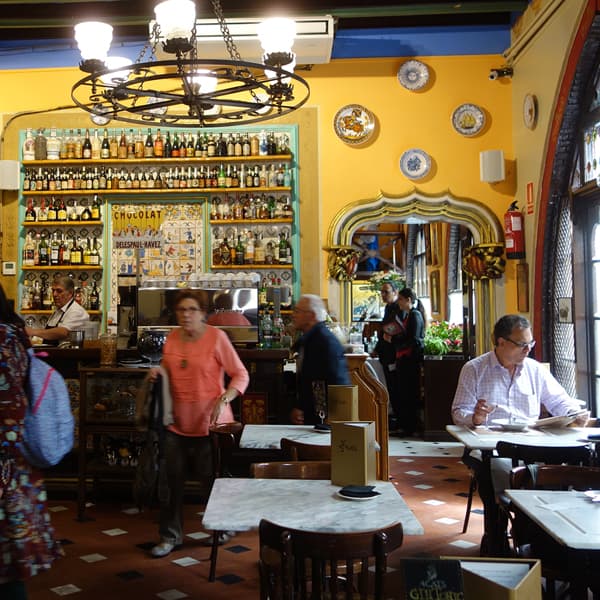
This place is a popular restaurant and night spot. It's also an historic monument. It's famous as the hangout for bohemian artists back around 1900, including Pablo Picasso. Here, young Pablo, just a poor, struggling teenager, nursed drinks with his other penniless friends.
It was here in the year 1900 that he showed off his paintings in his first one-man show. That was also the year he traveled to Paris, where he'd soon become the most celebrated artist of the 20th century. More on Picasso later, as this whole neighborhood was his home during those formative years. For now, check out the building itself.
Read more...Show less
It looks like a medieval church or castle, actually from the side around the corner. Check it out. Pointed arches, windows with stone tracery, gargoyles peeking out from the stonework. This is that style I mentioned, modernisme.
It was popular in the late 1800s. It captures the dynamic spirit of the times. On the one hand, it was completely modern, made of cost-effective brick and with clean structural lines. But it's adorned with fanciful midges, medieval decoration, with imagery rooted in Catalan legend and lore.
Modernist architects were celebrating the rise of traditional Catalan culture after centuries of oppression under conservative Spanish kings. Ruling them from far-off Madrid. Exactly. This building is by the prominent architect, Josep Puig Catafalque.
Remember that name. I would, if I could pronounce it. All over Barcelona, you'll see his work, as well as buildings by other modernists, like Gaudí. Who's far more famous and more pronounceable.
If the café's open, you're welcome to step inside the entrance lobby and look around. Even without going into the dining rooms, you can still feel the turn-of-the-century vibe. Check out the old-style murals, the photos on the wall, the lanterns, colorful tilework. Yes, very Art Nouveau.
Indeed, modernismo is Barcelona's version of the Art Nouveau style of Paris. This place was clearly inspired by the whole Paris scene. Rich Barcelona elites and avant-garde artists, like Picasso, looked to Paris, not Madrid, for their cultural inspiration. The owner of this place patterned it after Paris' famous Le Chat Noir.
That was the hangout of Parisian artists and intellectuals, similar to its more famous neighbor, the Moulin Rouge. Like Le Chat Noir, Les Quatre Gats even published its own artsy magazine for a while. How did this place get its name? Well, the owner had worked at Le Chat Noir, the Black Cat.
His would be the Four Cats. That was Catalan slang, meaning just a few people. It was perfect. When the owner told his friends he'd create just as lively a scene as Paris, and even stay open all night long, they told him no one will come.
It'll just be you and four cats. And these days, just you and lots of tourists hoping to recreate the original ambiance. Let's continue on. Return to the street and backtrack to the big pedestrian boulevard.
When you get there, turn left and continue downhill. We're heading down that street a couple of blocks. About a hundred yards. That's a couple of blocks, to where there's a fork in the road.
As we walk, we're plunging deeper and deeper into Barcelona's 2,000-year history. We'll be seeing elements from every layer. We'll see ancient Roman ruins. The city's foundation goes back to ancient times when it was an important capital of the Roman Empire.
After Rome fell around the year 500, Barcelona remained vibrant while much of Europe floundered in darkness. We'll see the impressive cathedral and walk the twisty lanes of the Gothic Quarter. Or Barri Gatic, the neighborhood we're beginning to explore. Barcelona, thrived in the 12 and 1300s as a cosmopolitan seaport.
And later, that tradition of international trade made it a natural port of call for none other than Christopher Columbus. We'll see reminders of him later in the walk. By the late 1800s, the city had boomed into an industrial powerhouse. It became the cradle of a new artistic style.
Modernisme. Like the four cats. Yes, and other work by architects like Gaudi and Giuseppe uh, Giuseppe, uh, Giuseppe uh, yeah, like the other guy. They remade the city's skyline with curvy, playful, fantasy buildings.
That progressive spirit is still alive today. It's obvious in the shops along this street, in the Catalan independence movement, and in the 24-7 energy of Barcelona's café culture. The pedestrian street leads into a Y intersection, a wide fork in the road. Directly ahead is a big stone building. On its right side is a colorful fountain decorated in tile mosaic.
The Fountain
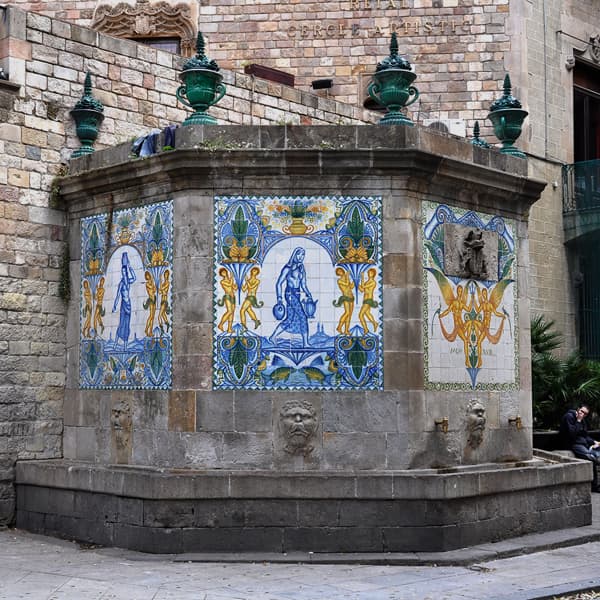
The Fountain The Fountain For nearly 400 years, this has been a public fountain, freely providing water to the citizens. Check out the blue and yellow tile work with scenes of local life done in the early 1900s. They depict lovely maidens with big jugs. Of water.
Yes, big jugs of water. Picture the scene here back in the 17th century. The neighborhood ladies would gather to fill their big jugs and take them home. No one had indoor plumbing back then.
Read more...Show less
This particular fountain was especially important as the last watering stop for horses, before leaving town. As recently as 1940, about 10% of the people of Barcelona still got their water from public fountains like this. Let's move on. From this intersection, we'll take the left fork.
So, circle left around the stone building and start heading down Carré dels Arcs. Rick, tell us a bit more about Picasso's Barcelona roots. Picasso, of course, was a Spaniard, though he lived most of his adult life in France. He spent his teens and early twenties in Barcelona right around the year 1900.
His dad was an art teacher here in the old city. Young Pablo lived and studied in the Barri Gatic. As we saw, he drank with fellow Bohemians at El's Quatre Gats. He frequented the brothels a few blocks from here on Carré d'Avignon.
This was the infamous Avignon Street that would inspire his influential Cubist painting called Les Demoiselles d'Avignon. Young Pablo soaked it all up as he forged his unique style. At age 23, Picasso packed up all that Barcelona energy and moved to Paris. There, he set about revolutionizing what came to be called modern art.
And there's a work by Picasso just ahead. Carré dels Arcs opens up into a spacious square called Plaza Nova. Oh, yeah Oh, yeah
Plaça Nova
It was done in 1962 and has his distinctive simplified style. With just a few squiggly stick figures, Picasso captures traditional Catalan activities. If you check out all three sides of the building, you'll see scenes suggesting music, bullfighting, the sea trade, and the Sardana dance. The branch-waving kings and children are celebrating one of the city's many local festivals.
Barcelona sure produced a lot of modernism, and modern art. You can add Salvador Dali and Joan Miró to that list of world-changing 20th century artists with ties to the city. And the best museum anywhere of Picasso's early art is right here in Barcelona, just a 10-minute walk away. Now turn 180 degrees to check out some other sights on Plaza Nova.
Read more...Show less
Head towards those seven bronze letters on the ground. They spell out Barcino. B-A-R-C-I-N-O Barcino, is Barcelona's earliest name 2,000 years ago. It may have come from Barca, the name of one of Hannibal's generals.
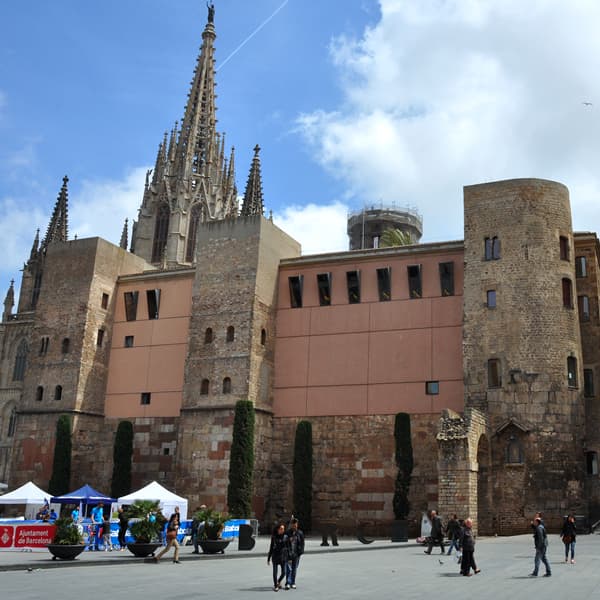
It's said that Hannibal passed through here with his army of men and elephants on his way to attacking Italy. Two centuries later, the Romans arrived in Spain, and the city they established came to be known around Europe as Barcino. Near the letters, find two mighty stone towers. These are the two round towers that flank the main street.
These towers date from Roman times. They once guarded the entrance gate of the ancient Roman city of Barcino. The towers are actually reconstructed from ruins, but some original stones have been incorporated into the bases. Focus your attention on the left tower.
To the left of that tower is a stretch of the old Roman wall. Originally, that wall was 25 feet high. It stretched a mile around, with 74 towers, similar to the ones you see here. At Barcino's peak, under Roman rule, this wall enclosed a population of 4,000 people.
It was a cosmopolitan collection of Latin-speaking Romans, Celtic-speaking natives, and international traders from all over the Mediterranean. Now, take a closer look at that left tower. At its base, it has a bridge of stone jutting out. That was part of the Roman aqueduct system.
Notice the streambed on the top. This bridge of stone carried fresh water from the distant hillsides into the walled city, feeding public fountains where locals could draw water. In Roman times, this was not the center of the town. We'll see that later.
We're standing outside the city walls. Even after Rome fell, for the next 500 years, most of the populace still lived inside the Roman walls. But starting around the year 1000, the counts of Barcelona unified Catalonia. Barcelona, as the capital, prospered and expanded.
As it grew, they had to build new walls to enclose the larger city, which stretched all the way up to Plaza Catalunya, where we started this walk. Let's head into the oldest part of the old city. Pass between the two Roman towers. Head up Carré del Bisbe and take an immediate left.
After turning left, you'll immediately see the ramped entrance to our next site. It's an old stone building called the Casa de l'Ardiaca. It's free to enter.
Casa de l’Ardiaca
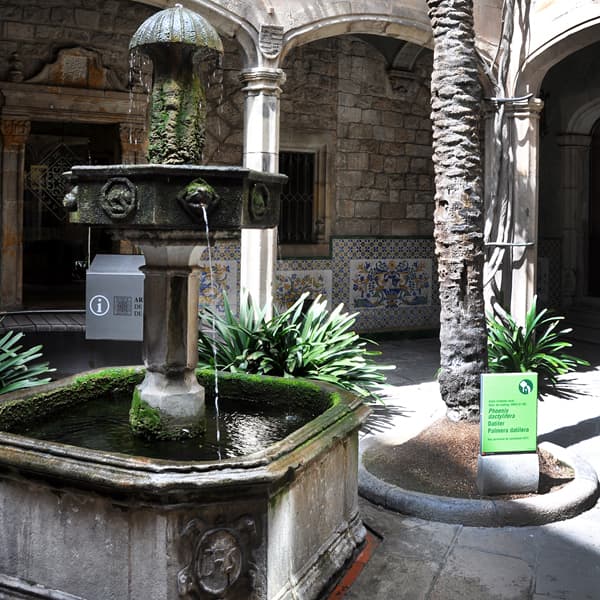
The Casa de l'Ardiaca. Start by taking in the exterior. This mansion was once the home of the archdeacon, the right-hand man of the cathedral's bishop. The elaborately carved doorway is Renaissance.
To the right of the doorway is a carved mail slot, done in the late 1800s, in the modernismo style. Step inside. Again, it's free. You enter a small courtyard with a fountain.
Read more...Show less
Notice how the century-old palm tree seems to be held captive here by urban man. Now, step inside the reception lobby. Really? Yes.
The building now functions as the city's historic archives, and the whole place is open to the public. Ooh, it's air-conditioned. Inside, locate the ancient Roman wall. Along its backside, there are often free temporary exhibits.
If you wanted to explore further, there's more Roman ruins at the left end of the lobby. But for now, we're returning to the mansion's courtyard. From the courtyard, you could climb up to the balcony. It makes for a nice photo-op.
From up there, you have great views of the cathedral steeple. And the gargoyles. So, you could pause the audio tour at this point and continue exploring the Casa de l'Ardiaca. Otherwise, let's start for the exit.
We're headed now for the cathedral. That should be easy enough to find. As you exit the Casa de l'Ardiaca, turn left. Head for the big square in front of the cathedral.
Once there, find a comfortable spot far enough back to where you can take in the cathedral's entire facade. The Cathedral of Barcelona.
Cathedral of Barcelona: Exterior
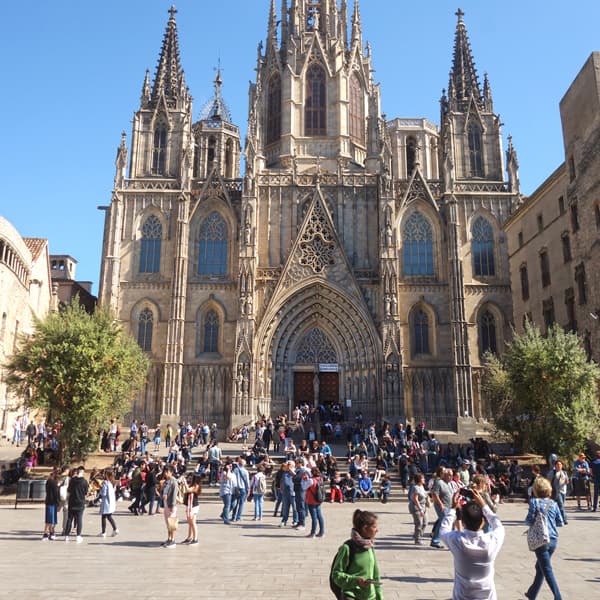
The exterior. The facade is a virtual catalog of Gothic motifs. There's the pointed arch over the entrance. The stained glass windows have elaborate stone tracery.
The facade is decorated with statues of saints in robes. There are octagonal bell towers with winged angels. And the whole thing is topped with three tall steeples. These prickly spires are meant to give the impression of a church flickering with spiritual fires.
Read more...Show less
This was the Gothic style called flamboyant, meaning flame-like. This has been Barcelona's holiest spot for 2,000 years. The Romans built their Temple of Jupiter right here. In A.D.
343, that pagan temple was replaced by a Christian cathedral. Around the year 1,000, that building was replaced again, this time by a Romanesque-style church. The current Gothic structure was started around 1300 and finished in 1450. That is, most of the church was built in the 1300s, during the medieval glory days of the Catalan nation.
But the facade is much newer. It dates from the 1800s, done in a neo-Gothic style. That part of the construction was capped in 1913 with the central spire, 230 feet tall. So, in a way, the cathedral represents Barcelona's two golden ages, the 1300s, when it was constructed, and the 1800s, when the facade was added.
Exactly. In the 1300s, Barcelona was a thriving seaport under strong Catalan kings, independent from Spain. With their money, they built this huge church. Then, in the 1800s, after several centuries of oppressive rule by Spanish kings, Barcelona was thriving again.
It was an industrial-age powerhouse. with a modern outlook, and they were chafing under the rule of Madrid. Like many other freedom-loving nationalists of 19th-century Europe, the Catalans were longing for a nation to call their own. They were rediscovering their proud Catalan heritage from that earlier medieval golden age.
That spirit is reflected in the cathedral facade, which is neo-Gothic and in the style called modernisme. Like the medieval-looking statues we saw at El's Quatre Gats. They also revived long-lost Catalan cultural traditions. Things like the Catalan language and patriotic dances.
Like the Sardana. Yes, the Sardana. It's danced right here in front of the cathedral every Sunday at noon. Locals join hands, form a circle, and do a Zorba the Greek-style dance while a traditional band plays.
Tourists are welcome to join in. For locals, it's a fervent display of their Catalan pride. It's so tied to Catalan independence that the dance was actually banned during the 20th century by Spain under the dictator Franco. But now, it's back.
Just like the movement for Catalan independence, Visca Catalunya! Before we go into the church, let me point something out from here. Here in the square. Glance 90 degrees to your left.
In the distance there, you can just make out a colorful, wavy roofline. See it? This is the Santa Caterina Market. It's a favorite with local shoppers.
They go there to buy produce, cheese, and jamón. You mean ham. Yes, jamón. It's well worth a visit.
But after our tour is done, of course. Of course. And that market is a jumping-off point for the lively neighborhood known as Elborn. That's where you'd find more local color, fewer tourists, lots of trendy upcoming restaurants, nightlife, and a funkier vibe.
At this point in our tour, we'll go inside the cathedral. It's sometimes free to enter, sometimes requires a ticket. If you'd rather skip the cathedral or see it another time, you can pick up the rest of this tour on Track 16, the Monument to the Martyrs of Independence. You'll find that monument around the right side of the cathedral, a few steps up Carré del Bizet, where you'll find the cathedral's cathedral and the cathedral.
So buy your ticket, if necessary, and enter the church. On the next track, Rick and I will direct you from there. See you inside. Music Music Music Music Music The Cathedral Interior,
Cathedral Interior: Nave
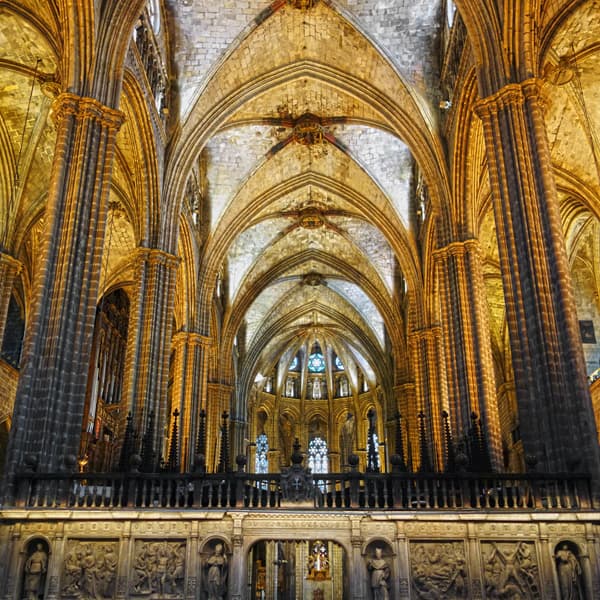
the nave. As you enter the main door, stop at the rear of the nave to take it all in. Allow a moment or two to let your eyes adjust to the dark. Oh!
Sorry, Lisa. Oh, my goodness. I said let your eyes adjust to the dark. Oh.
Read more...Show less
Okay. Wow. Look at how spacious the nave is. The cathedral is 300 feet long, and 130 feet wide.
There are many classically gothic features, like the stained glass and ironwork chandeliers. The support pillars here in the nave are somber and unadorned, made of stone blocks mortared together. The pillars rise a full 50 feet before spanning out into pointed arches. On the ceiling, the crisscross arches support the masonry vaults.
Look closely at the round keystones where the arches come together and cross. Each one features a carved relief depicting a different saint. Saints are big in Barcelona, especially homegrown saints. They're one reason why Barcelona has so many local festivals throughout the year, to honor the special days of the local saints.
Yes, and we'll see plenty of saints celebrated right here in the Barcelona Cathedral. Now, turn your attention back to ground level. Sitting in the middle of the nave is a marble wall. which encloses the choir.
The part of a church called the choir is an enclosed area for smaller, more intimate services. Choirs are particularly common in Spanish churches. And in English churches, but not so much in France and Italy. The nave is ringed with 28 chapels.
Notice how solid these chapels look. The walls that divide these chapels are an essential load-bearing part of the cathedral structure. They serve as interior buttresses supporting the roof. That's why, from the outside, Barcelona Cathedral has few of the buttresses and flying buttresses you'd expect to see in a Gothic church.
These chapels serve as intimate worship spaces. Many are dedicated to a particular saint. Worshippers can kneel here, light a candle, and pray for that particular saint's help. Let's check out some of these chapels.
Our first stop is a little bit is along the left side. So as you stand near the main entrance, face the far end of the church. Our first chapel will be behind you, over your left shoulder. Inside the chapel stands a baptismal font.
Side Chapels
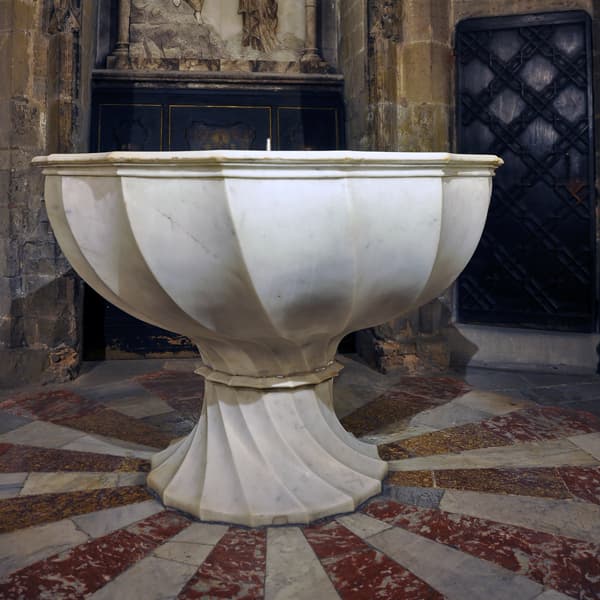
The side chapels. Find the big white baptismal font located not far from the church's main entrance. This font is more than 1,600 years old. It stood in the original 4th century church.
In these side chapels, we'll see other historic artifacts like this. And there are still more chapels in the cloisters outside, which we'll see later. They make the cathedral a kind of museum of the city's long history. Or like a Westminster Abbey of Barcelona.
Read more...Show less
Yes. The cathedral celebrates the homegrown bishops and saints who've become part of the cultural history, the cultural fabric of today's Barcelona. This baptismal font has been used to baptize countless Barcelonans through the centuries. In the late 1400s, it was used to baptize some of the very first Americans to set foot on the continent of Europe.
It was six Native American Indians brought to Barcelona by none other than Christopher Columbus. Let's move on. Work your way up to the next chapel along the left wall. This chapel has an incredible elaborate golden altarpiece.
In the center is a statue of a bishop with his tall hat and bishop's staff. The statue depicts St. Severus, whose relics are buried here. Severus takes us all the way back to Barcelona's ancient Roman roots.
He was bishop here back in the year 290. By then, Christianity was finding a home here among the pagan Romans. But when the Roman emperor Diocletian suddenly revived the persecution of Christians, he was able to find a home here. He was able to find a home here.
He was able to find a home here. He was able to find a home here. He was able to find a home here. He was able to find a home here.
Severus was tortured and killed. But his memory lives on, and today, Severus' altarpiece reminds Barcelonans of their deep roots. Now let's continue to the next chapel on the left. This chapel honors St.
Mark, whose symbol was the winged lion. Mark is also the patron saint of shoemakers. This chapel was paid for by the local shoe guild. Notice the two painted doors with shoes above them.
In fact, many of these chapels were sponsored and donated by the local shoe guild. and decorated by business organizations. In medieval times, chapels like these were big moneymakers for the church. The church rented them out to guilds for their private offices.
Here in this chapel, notice how there are two painted doors. Those led to the back office. The office was equipped with the medieval equivalent of safety deposit boxes. And a notary public could sign documents backed by the force of God.
Notice how the iron gates are more than decorative. They were protective. The rich ornamentation was sponsored by local guilds. Think of it.
The church was the community's most high-profile space. And these chapels were a kind of billboard, advertising their guild to the worshiping public. Our next chapel is across the nave, on the right side of the church. So start crossing, heading for the large chapel in the back right corner.
By the way, this cathedral is still fundraising. They're constantly struggling to maintain this huge building and stay in the black. The candles at the various chapels aren't free. You'll see both real candles and electric ones.
The faithful pop in a coin to power their prayers. Start with the large chapel in the back right corner. It features a large wooden crucifix. This is the beloved Christ of Lepanto crucifix.
Back in 1571, this very crucifix, was carried into battle in the eastern Mediterranean aboard the flagship of Catholic forces as they battled the Ottoman Turks. The figure of Jesus looks a little crooked. Yes, it is. They say that's because during the heat of battle, Christ had to lean to the left to dodge a Turkish cannonball.
This artful dodge inspired the Christian forces, who were sure Christ was on their side. They went on to win that pivotal Battle of Lepanto, which stopped the advance of Israel's and the advance of Islam into Europe. Now head to the next chapel along the right-hand side. The next chapel has a statue of St.
Anthony holding baby Jesus. Anthony is one of many saints that have a special place in the hearts of Barcelonians. Even today, they honor them with festivals. So, every January 17th, Anthony's special day, the locals parade through the streets.
They might have a street fair, horse races, and a blessing of pets. Some festivals feature the Jagons. You mean those giant statues carried around in big parades? Some are nearly 20 feet tall.
Yeah, they're huge. They feature famous saints, kings, queens, and other historical figures. Continue to the next chapel. The third chapel honors another local saint, Josep Oriel, who survived an assassination attempt in the cathedral cloister.
Continue to the next chapel. The golden fourth chapel, depicts St. Roc. He's not the main statue, but the smaller one, up on top.
What's that on his leg? St. Roc points to a lesion on his thigh. He's honored for his work among victims of the plague.
As plagues were a constant scourge here in Barcelona, Roc is a popular saint. Even today, his feast day in mid-August is celebrated joyously here on the streets of the Barri Gàtic. Take a few steps, to the next chapel. The fifth chapel has a reclining black-and-white statue.
This is St. Raymond of Penafort, the bishop of this church back in the 1200s. He became famous throughout Europe as a great legal mind. He established a code of church laws that guided the Catholic faith for centuries.
He's the patron saint of lawyers. St. Raymond's feast today is still celebrated with great fanfare. It culminates with a spectacular fireworks show.
The biggest in the city. Skip over the next few chapels. Stop at the one with the completely over-the-top golden altarpiece. This altar's decor nearly crowds out the statue of the bishop it honors.
This is St. Passien. He brings our tour of side chapels full circle, returning us to Barcelona's ancient Roman roots. Passien was bishop of Barcelona back in the late 4th century, as imperial Rome was falling and Christianity was taking its place.
Because of his profound writings, he's often considered one of the so-called church fathers who helped establish the Christian faith. Our next stop is the choir. Again, the choir is the walled enclosure in the middle of the nave. We'll go inside, which may or may not require a ticket.
Cheapskates can get a glimpse of the choir interior for free from the far end. Either way, on the next track, we'll be visiting the choir.
Choir
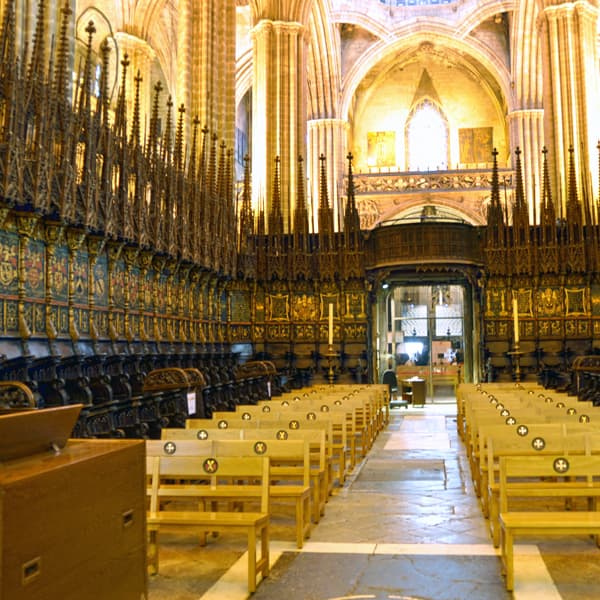
The choir. Step into this walled enclosure and enjoy its ornately carved woodwork. It's like a little church inside the big church. Admire the elaborate Gothic pinnacles on top and the finely carved chairs.
These chairs, with their high backings, are more precisely called choir stalls. Nearby, there's an impressive wood-carved pulpit supported by flying angels. The detail work in these carvings is incredible. This choir was made back in the 1400s when Barcelona was rich with the lucrative sea trade.
Read more...Show less
Again, a choir provides a more intimate, intimate space for worship in this vast cathedral. It was mainly for the church officials and society's elite. Seated here, they could get close to the altar and actually hear the service. Because the choir was also used for singing the liturgy, the word choir also came to mean a group of singers.
In 1518, Barcelona's cathedral hosted a very special occasion. In preparation, the choir stalls were painted with the coats of arms of Europe's nobility. Nobles from all around Europe gathered here as members of the prestigious Knights of the Golden Fleece. Yes, I can see in the coat of arms that there's a golden lamb dangling below.
The knights came to honor the great Charles V. Though he was born of a German dynasty, he was the king of Spain, and now he was making his first trip to the country he ruled. He was about to be crowned Holy Roman Emperor. All Europe was counting on Charles to defend the continent from the looming threat of the Ottoman Turks from the east.
Here they gathered, like a proto-United Nations, to discuss how best to confront the Islamic threat. Take a closer look at the chairs in the choir stalls. In olden days, common people had no chairs or even pews. They knelt on the floor or stood.
Only church officials had chairs like these. Notice that these chairs can fold up. That was for the parts of the service when all worshipers were expected to stand. But even then, notice that the VIPs still had those little wooden ledges to lean on.
Get even closer to see some of the details carved into these stalls beneath the chairs. Some of the scenes are a bit risqué. They sure are, and there's a reason. They couldn't portray the usual saints and angels here because you couldn't sit on sacred things.
So the artists were free to enjoy a little secular and naughty fun. When you're ready to leave the choir, our next stop is the high altar. So head for the curved far end of the church. There you'll see the altar, a table where the Mass is said.
It sits beneath a big crucifix. From here, you can also look down beneath the altar into an open-walled room with a tomb inside. ¶¶
High Altar and Tomb of Eulàlia
The high altar and the tomb of Aeulalia. Start by looking behind the altar. Find the bishop's chair, called the cathedra. The bishop presides here from his throne, or cathedra, inside the church that serves as his headquarters, the cathedral.
Now, turn your attention 90 degrees to the left, to the left wall. There you'll see the church's impressive organ. Now turn to the right wall of the church, to the right of the altar. That wall is decorated with Catalonia's yellow and red coat of arms.
Read more...Show less
These traditional colors date back to that golden age of medieval times when Catalonia was independent from Spain. Speaking of which, under that coat of arms, displayed on the wall, are two wooden coffins. These are the two powerful counts of Barcelona who founded Catalonia, Ramon Berenguer I and his wife, Almodis. Back around the year 1050, they established Catalonia as a major player in the Mediterranean.
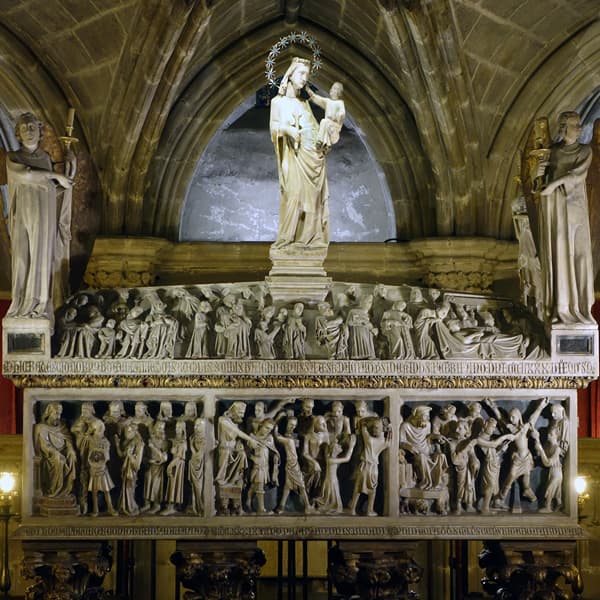
They also laid the cornerstone for the Romanesque cathedral that preceded today's Gothic structure. Descend the steps beneath the altar into the crypt to see the tomb of Aeulalia. You'll see a marble and alabaster sarcophagus dating back to the early 1300s. A stone coffin stands atop elaborately carved columns.
This contains the remains of Barcelona's most beloved saint, Saint Aeulalia. Locals call her by an affectionate and easier-to-pronounce nickname, Laia. The cathedral is dedicated to Saint Aeulalia. Aeulalia lived here, in Barcelona, back in Roman times, around the year 300.
She was the daughter of a prominent Barcelona family, a Christian living peacefully under Roman rule. Then, under Emperor Diocletian, things turned bad, and... Well, take a close look at the coffin. The carved reliefs tell Aeulalia's story in three episodes.
In the relief on the left, we see Emperor Diocletian. He's the guy in the far left, seated on his throne. He's listening intently as a young girl in the middle of the crowd raises her hand to speak. It's Aeulalia.
Though only 13 years old, she boldly professes her Christian faith and courageously refuses to bow down to the pagan gods. In the middle scene, Diocletian orders her to be tortured until she recants. Aeulalia drops to her knees to plead for mercy. Legend says she was submitted to 13 tortures.
She was stripped naked, and then she was rolled down the street in a barrel full of sharp objects. But miraculously, none of these killed her or even shook her faith. In the final scene, Diocletian condemns her to death by crucifixion. She was crucified on an X-shaped cross.
As a result, the X is Laia's symbol. You'll find it carved into chapels, walls, and pews throughout the church. Today, Aeulalia is one of Barcelona's two patron saints. She's honored every February with a festival, and they pull out all the stops.
With gegants, fireworks, and groups of athletic men who stand on top of each other to create acrobatic human towers. Sounds more fun than a barrel of daggers. Now we head into the cloister, or open-air courtyard. To get there, start heading into the right transept.
Most medieval churches had a cloister like the one you're about to step into. In the right transept, you'll find a door leading outside. Go through the door, and you'll emerge into this courtyard.
Cloister
The cloister. Pause at the entrance and take in the tranquil medieval atmosphere. Ahh. Ahh.
Enjoy this shady, arcaded walkway of simple arches atop stately columns. This surrounds a lush courtyard. It's an almost tropical atmosphere. You'll see palm trees, orange trees, magnolias.
Read more...Show less
There's a fish pond, trickling fountains, even a flock of geese. This courtyard, or cloister, was part of the cathedral's monastery. Here was where monks would gather. They could get out of their tiny cells, socialize a bit, stretch their legs, commune with nature.
Check out some of the unique architecture. Start by looking behind you at the arch you just came through. This entry arch has an impressive mix of the two styles popular around the year 1450 when the cloister was built. You'll see elements of the earlier Romanesque style, like the rounded arches with the V-shaped chevrons.
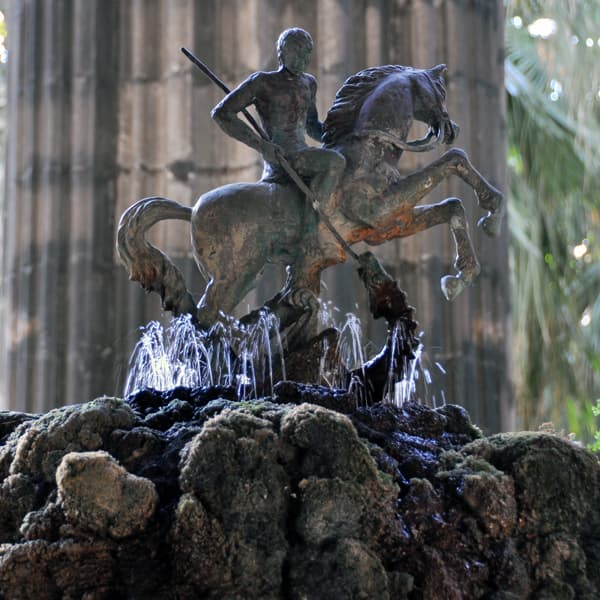
These are leftovers from the earlier Romanesque church. Mixed in are arches with pointy tops from the newer Gothic style. Now, check out the fountain near the entry. On top is a tiny statue of St.
George slaying the dragon, or, as he's called here in Catalan, San Jordi. Jordi is one of the patron saints of Catalunya. It's by far the most popular boy's name around here. During the Corpus Christi festival in June, kids come here to watch a hollow egg dance atop the fountain's spray.
Let's stroll around the cloister, walking clockwise. Make your way to the first corner. As you wander, look down at the pavement. You'll see stones carved with coats of arms as well as some tombs.
These were for rich merchants. Check out some of the symbols that tell you their trade. I see scissors. That must be for tailors.
Bakers. And there's those shoemakers. The church sold these burial plots to make money, and rich merchants were glad to pay for a chance to be buried in this holy space. After all the burial plots were sold inside the church, the cloisters were opened up to raise more funds.
When you reach the first corner, turn right and keep your eye out for a doorway on your left. Next to that door is a very popular chapel. It usually has the most candles. This is the chapel of St.
Rita. She's one of the patron saints of impossible causes, similar to the more well-known St. Jude. No wonder people light so many candles here.
Candles power their prayers of desperation. By the way, take note of the doorway near here. We'll use this as our exit from the church when our visit here is done. For now, keep going to the next corner.
Find the chapel with a barrel-vaulted ceiling. This is the chapel of Santa Lucia. It's one of the oldest places in the cathedral, from the 1200s. In fact, it's actually a small remnant of the church that preceded this one.
Notice that it's pretty dark. That's because Romanesque churches lacked the big windows of Gothic churches. Coincidentally or not, people who pray at this chapel are asking for help with Santa Lucia's specialty, eyesight. Yeah, notice her striking eyes in the chapel painting.
Before we leave, pause here while Rick points out a few final things. There's a small museum of altar pieces in the next corner of the courtyard. But we won't go there. No, but if you did, you'd see a few ornate gold and jewel-encrusted religious objects.
But before we exit, there is one thing we can't overlook. That's the cathedral's most famous residence, the geese. These geese have been here for at least 500 years. Gee, they don't look that old.
There are always 13 geese. Lisa, you know why? Uh, because Aeolalia was 13 years old? Exactly.
It's in memory of both her 13 years and her 13 tortures. Other traditions insist that the geese must always be white as a symbol of Laia's virginity. And the geese were expected to earn their keep. Before modern security systems, they acted as alarms.
Any commotion would get them honking, alerting the monk in charge. Faithful to tradition, they honk to this very day. When you're ready to leave, return to that doorway by the Chapel of the Saint of Lost Causes. Once you go out this exit, you're outside the church and back onto the streets of Barcelona.
So now, let's go out that exit. You emerge onto Carré del Bisbe. Almost exactly in front of you is our next site, a wall with a group of five bronze statues, the Monument to the Martyrs.
Monument to the Martyrs of Independence
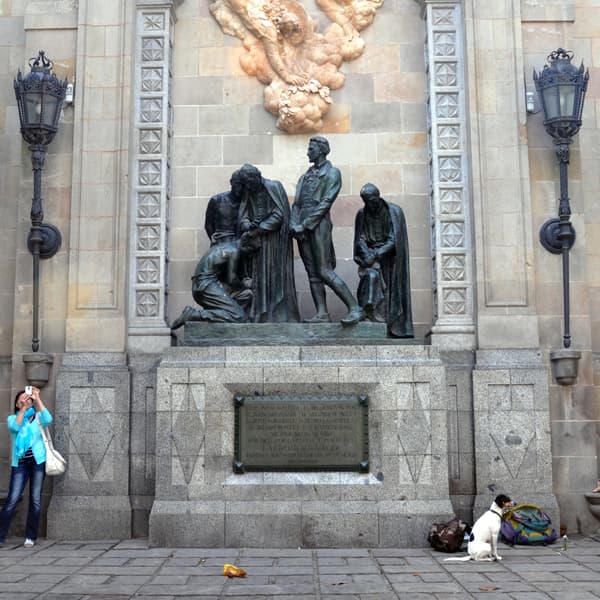
The Monument to the Martyrs of Independence. The Monument honors a sad but proud moment in the nation of Spain's history. It's a time when Barcelonans rose above their traditional resistance to the government in Madrid to fight a common enemy. The year is 1809.
Spain has been invaded by France and is now ruled by the tyrant Napoleon. These five men are brave Barcelonans who spoke out against the oppression. They represent a cross-section of Barcelona society. One is a well-dressed gentleman.
Read more...Show less
Two are common laborers wearing rags. The other two are priests. They're the ones wearing capes. They decided to speak out against French soldiers committing horrible atrocities in Madrid.
Was that the slaughter depicted in Goya's famous Third of May painting in Madrid's Prado Museum? Precisely. Because of their brave stand, these men were arrested and sentenced to death. The statue depicts the night before their execution when they calmly received their last rites.
The two doomed priests had to perform the sacrament for their fellow doomed prisoners. Now turn your attention to the ceramic tiles that flank the monument. Start with the tile to the far left and read them left to right. These scenes tell how this sad story played out.
In the far left scene, the Patriots have been arrested and imprisoned. Here they receive their last communion while in prison. Move a few steps to the right to the next tile. Here they're escorted out of the prison.
The prison was the Barcelona Citadel, which for centuries stood atop Montjuic Hill. This citadel became a hated symbol of foreign occupation. Continue past the statues to the next tile. Here the stage is set for the execution.
The three doomed men huddle together along with their priests. On the farthest tile to the right, you'll see ropes and a ladder, the instruments of execution. The three commoners were hanged by a rope until dead. The priests held a privileged position, so they got a supposedly more humane form of death.
They were garroted, that is, strangled to death. All five of the rebels are buried across the way in the cathedral cloister. And why did they die? Return to the statues and read the plaque below.
It tells everyone that these martyrs to independence gave their lives in 1809 por Dios, por la Patria y por el Rey for God, country, and for their King. At this point in our tour, we'll go on a little wander through some of the Barri Gatik's back streets. Our walk will end up right back here, so remember this monument. Now, face the monument and exit the square by veering to the right of the monument.
Go down the tiny street called Carre de Montjuic del Bisbe. Keep going to our next stop, a small square called Plaza San Filipe Neri. As you walk, you get a taste of Barcelona's Gothic Quarter, the Barri Gatik's tangle of narrow lanes. In medieval times, people lived packed together inside the protection of city walls.
Buildings and lanes sprouted up without zoning codes. About the only open spaces were cemeteries, which were around the churches. In the 19th century, when those graves were removed outside of town for hygienic reasons, many former cemeteries became neighborhood squares, like the one just ahead. Carre de Montjuic del Bisbe opens up into a small square called Plaza San Filipe Neri. ¶¶
Plaça Sant Felip Neri
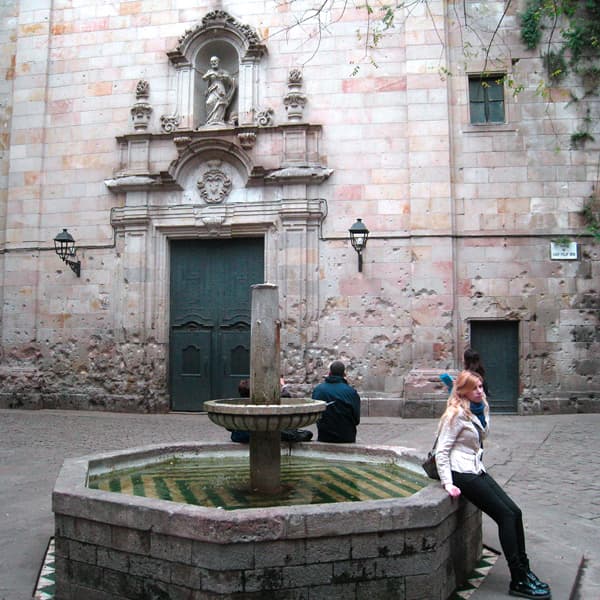
Plaza San Filipe Neri. This pleasant little square is shaded by trees and cooled by a small fountain in the center. The tallest building is the church of San Filipe Neri. It's nearly three centuries old, done in the Baroque style.
In the 18- and 1900s, this was the neighborhood church the architect Gaudí attended religiously. This square is a nice place to just wander around while Rick talks. Adjoining the church, to the right, is an elementary school. The square serves as the school's playground, and it's often bursting with energetic kids.
Read more...Show less
Schools are required by law to conduct all classes in the local language, Catalan. Most children learn Catalan first at home, and learn Spanish second. While all Barcelonans still speak Spanish, nearly all can at least understand Catalan. About three-quarters can actually speak Catalan, and half can write it.
Got that, Lisa? Not quite, but that's what the 20-second rewind button is for. Get a close look at the church facade, especially near ground level. It's pockmarked.
This was from bomb damage in the Spanish Civil War. Back in the 1930s, Spain was split in two in a bitter civil war. It pitted the democratic government against fascists under Francisco Franco. The war would last three years and kill some half a million Spaniards.
Franco emerged as the victor. Throughout the war, Barcelona was strongly anti-Franco. On January 30, 1938, Franco ordered an aerial bombardment of the city. He was actually aimed at Franco, aiming for the Catalan government building, which is nearby.
And we'll see later on this walk. But the bombs landed here. The church was damaged, and other buildings nearby were destroyed. While survivors combed the rubble for lost loved ones, a second wave of bombs followed.
That was a typical fascist tactic in order to kill the most people. The plaque on the wall to the left of the church door tells the sad story. All in all, these bombs killed 42 people, mostly children. After the war, when it came time to repair the church, the pockmarks from the shrapnel were purposely left here as a reminder of that horrific civil war.
As a postscript, Franco won the war and went on to rule Spain with an iron fist for the next four decades. He punished Barcelona by forbidding anyone to even speak their native tongue of Catalan. In the generation since Franco, Catalan culture has rebounded with a vengeance. Before we move on, turn your attention to some of the other buildings in the square.
The buildings here were paid for by guilds. The guilds were unions of skilled workers whose traditions stretched all the way back to medieval times. These proud workers powered the neighborhood economy. Turn your attention to the building 90 degrees down.
That was the home of the Shoemakers' Guild. They put their symbol on the building. Look above the window frames at the curlicue carvings. Ah, yes.
I can make out some shoes. And, Lisa, those shoes were made for walking, and that's just what we'll do. Then I guess we're moving on. We'll exit the square from the other end.
So exit and start heading down Carré de San Felipe Neri. Up ahead, you'll see the church of San Felipe Neri, which was built in the 12th century. Up ahead, you'll see a T-intersection. Get ready for some quick directions.
When you reach the T-intersection, turn right onto Carré de San Sever. Then turn immediately left on Carré de San Dominique del Cal. You'll recognize it by the blue sign that reads El Cal. Once on Carré de San Dominique, stop. Rick and I will direct you from here on the next track. The Jewish Quarter.
Jewish Quarter
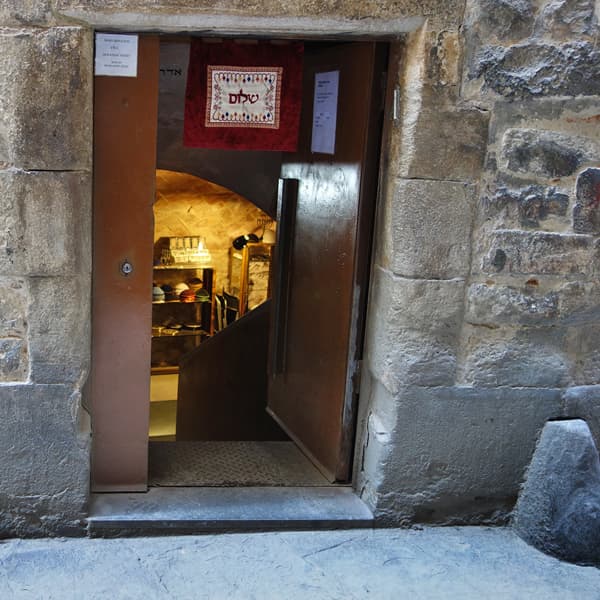
We've entered what was traditionally the neighborhood of Barcelona's Jewish community. Take a dozen steps farther down Carré de San Dominique to where the narrow street widens a bit. Here you'll find a small square that stretches to the right. In medieval times, many European cities forced their Jewish population to live in a designated neighborhood or ghetto like this.
Christians were suspicious of Jews and forced them to live under the watchful eyes of the authorities and the nearby cathedral. At the peak of Barcelona's El Cal, some 4,000 Jews were crammed into just a few alleys in this neighborhood. In Catalan, a Jewish ghetto goes by the name El Cal, literally, Narrow Passage. It was named for the cramped conditions where Jews were forced to live.
Read more...Show less
I've heard another version, that the name El Cal comes from the Hebrew kahal, which means congregation. Could be. Check out some features of this small square. You'll see the Zoan Leather Workshop and showroom.
It's on the right at number 15. Here, everything is made right on the spot in the traditional way. Nearby, find a small, rust-colored sign. This has a map of the Jewish Quarter.
The main synagogue once stood near this small square. The square itself is actually quite recent. It was only created when another Civil War bomb hit here and opened up a gap in the dense medieval street plan. Let's wander some more narrow lanes.
Continue ahead, down Corre de San Dominic. We're headed for the next intersection, about 30 yards ahead. As you can see by the modern shops, the neighborhood is no longer a particularly Jewish quarter. But it's still charming.
At the intersection, turn right on Corre de Marlet. A few steps along Corre Marlet, stop at number 5 on the right. This stone building with the low-profile entrance was once Barcelona's main synagogue. During the Middle Ages, this was where the community gathered for worship.
The structure itself is ancient, dating as far back as the 3rd century, though it's not clear yet exactly when it became a synagogue. It was destroyed during a brutal pogrom in 1391 and was forgotten for centuries. Then, in the 1980s, a historian tracked down the synagogue using old tax collection records. Another clue that this was the main synagogue was that it stubbornly faces east toward Jerusalem, at odds with surrounding structures.
If you wanted to, you could pay a small admission to go inside the synagogue. There are a couple of small, underground rooms dating back to ancient times and some old dyeing vats used by Jewish shop owners. But we're moving on. From the synagogue, start back the way you came.
But when you reach the intersection, continue straight ahead. This puts you along what is now called Corre de la Fruita. You'll see another T-intersection 50 yards ahead. As you walk, imagine life here centuries ago.
The place was filled with life, with people hauling water, selling goods from small carts, kids running around, carriages banging against the stony corners. These tight lanes are like deep canyons, in the shade for all but a few minutes a day. At the T-intersection, turn left, up Corre de San Honorat. Head up that street about 70 yards to the next intersection.
The Jewish Quarter thrived from Roman times until the early Middle Ages. But by the 1300s, a climate of anti-Semitism was settling over all of Spain. To escape persecution, many Jews converted to Christianity. Or at least pretended to.
But then came that pogrom of 1391. The synagogue was destroyed and thousands of Barcelona Jews were either massacred or forced to convert. The few Jews who remained were expelled in that fateful year. 1492.
Yes, in 1492, Columbus sailed the ocean blue and Jews were evicted from Spain, too. And so ended the Jewish Quarter's unique existence. At the intersection, turn right on Corre de San Sever. Go about half a block and what do you know, you're back at a familiar place.
We're back at the Monument to the Martyrs of Independence. Right next to the Cathedral Cloister. And also at the start of our next sight. The street called Corre del Bisbe. On the next track, Rick and I will guide you from here. Corre del Bisbe and its sky bridge.
Carrer del Bisbe and Its Sky Bridge
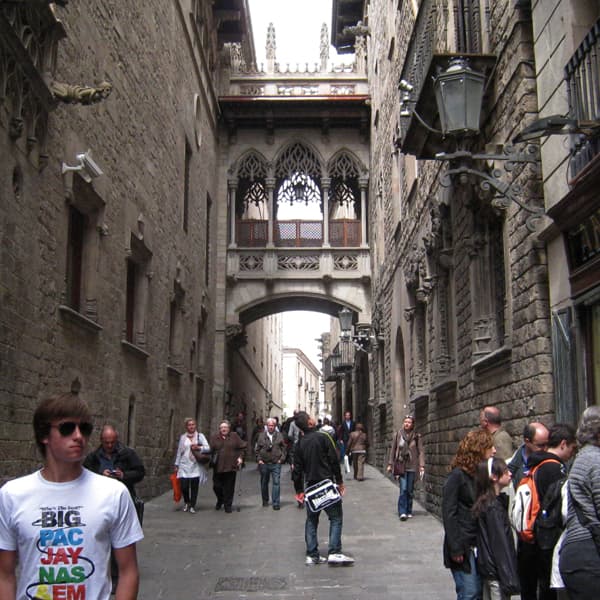
Start heading uphill on Corre del Bisbe toward the ornate bridge up ahead that arches over the narrow street. As you walk, you may pass a street musician. The city gives special permits for quality buskers to perform at set points like this one. You're walking in between two important buildings.
On your right is the Catalan government building. More on that in a moment. On the left is a mansion that, until recently, served as the Catalan president's ceremonial residence. Pause when you reach the bridge over the street that connects the two buildings.
Read more...Show less
This elaborately carved stone structure has been compared with Venice's famed Bridge of Sighs. Though the bridge looks medieval, it was actually constructed in the 1920s in the neo-Gothic style. Check out the intricate carved details. There's angels jutting outward.
I see monsters, some skulls. I spy some goddesses and some old men with beards. It's a forest of climbing vines and intertwined coats of arms. The ornamentation on the bridge and the nearby buildings was done by the Catalan architect Joan Rubio.
He was a follower of Gaudí. Like Gaudí, Rubio was proud of Catalonia's medieval traditions and art styles and wanted to incorporate them into this new bridge. Continue down Carré del Bisbe, another 30 yards. A few steps along, on the right, you'll pass another delicately carved façade.
But this one is much older and marks the 15th-century entry to the government palace. Let's go see that palace. We're headed now to the heart of the Catalonian state. Continue a few steps more down Carré del Bisbe to where it spills out into a large rectangular-shaped plaza. ¶¶
Plaça de Sant Jaume
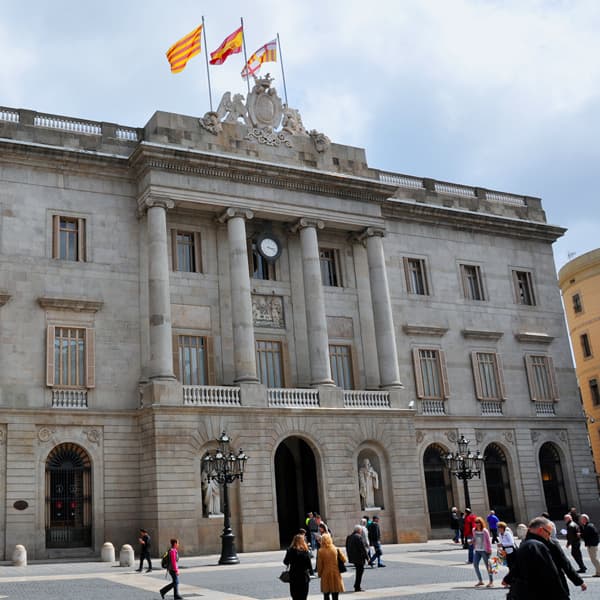
Plaza de Sant Jaume. After so many narrow lanes, emerging into this spacious square feels liberating. Take in the impressive buildings, the grid-patterned pavement, the wrought-iron balconies and elegant lanterns, and the buzz of Barcelonans going about their business. This stately plaza has been Barcelona's seat of government for 2,000 years.
In ancient times, this square was the forum of Roman Barcino. Rome's two main streets converged here, and they're still here today. The Carré del Bisbe, which we just walked down, and the Carré del Cal, running 90 degrees perpendicular to it. As the forum, this was where all the important temples, businesses, and government buildings were located.
Read more...Show less
And it's still the center of government. Let's focus on the square's two main buildings. Two very similar-looking buildings, they face each other on the square. Start with the one on the downhill slope.
It's the one with the larger balcony of the two. This is Barcelona's city hall. Remember, Barcelona has always thought of itself as proudly self-governing. There's a reminder of that here, the statue in the niche to the left of the door.
This is King Jaume I, James the Conqueror. In the 1200s, he freed Barcelona from French control and granted it safety. This kicked off that medieval Golden Age, when Barcelona was a major player all across the Mediterranean. Jaume established the first Catalonian parliament, and he built the nearby royal palace, which we'll see a little later.
So that's the seat of government for Barcelona City. Now turn 180 degrees to see the government building for the region of Catalunya. This is the Palau de Generalitat. It's the biggest city in the world.
It's the building on the uphill side of the square, the one with the smaller balcony. For more than six centuries, this building has housed the offices of the autonomous government of Catalunya. The building's symbolism reflects that long tradition. Look above the doorway.
The statue of the guy on the horse is... ...is San Jordi, Saint George, slaying the dragon of oppression. As we know, Jordi is Catalunya's patron saint. And you'll see dragons and Georges all over town.
Remember, Catalunya is a part of Spain. Though largely self-governing. Yes. This government building rules the Spanish region of Catalunya, but under the watchful eye of the national government in Madrid.
The palace flies both flags. The Catalan flag has nine red and gold horizontal stripes. Next to that flag is the obligatory Spanish one. Elsewhere in Barcelona, you'll likely see a third flag, the so-called Estelada.
It has the red and gold Catalan flag with a blue and white star on the left. This is the symbol of Catalan separatists who hope that someday Catalunya can be a completely separate nation, independent of Spain. Visca Catalunya and all that. The star in the flag's design comes from a former Spanish colony that succeeded in breaking free from Spain.
Cuba. That makes it an especially provocative image to Spaniards today. Even after 2,000 years, this square is still the heart of government. The balconies on these two palaces are often seen on the TV news.
It's from here that Catalonian leaders greet the people on momentous days. It's where soccer heroes are paraded in triumph. The square itself is often the site of demonstrations. These can be small, like a single grouchy citizen with a megaphone.
Hey, the phone company is overcharging me. Or it can be thousands of spirited citizens. Imagine this square packed with locals shouting, Visca Catalunya, and demanding independence from Spain. Locals treasure the independence this square represents.
For much of its history, it's been self-governing. But it's also suffered from long stretches of oppression, by Spanish kings, by the French. Older locals still remember the 40 years of repression in the 20th century under the dictator Franco. He punished the rebellious Catalans by abolishing the regional government.
He effectively outlawed Catalan customs and even made it illegal to speak the Catalan language. After Franco died in 1975, joyous citizens packed this square to celebrate the return of self-rule. We should move on. But before we do, take a moment to get oriented.
Our tour is nearing its end. After we're done, it's easy to return to this square to plan your next move. Get oriented by facing the city hall. That's the building on the downhill side.
Now, look right. This long street is Carre de Ferran. It's lined with ironwork street lamps and balconies draped with plants. Classic Barcelona.
Carre de Ferran leads directly to the Ramblas and to the metro stop, Liceu. Looking left, this same street, now called Carre de Jaume I, leads to the metro stop, also called Jaume. A few blocks further in that direction is the Picasso Museum. Now, take one last look around Plaza de San Jaume.
2,000 years ago, when this was the town's forum, its biggest building was a massive temple of Augustus. Let's go see it. Let's. Face the Generalitat, that is, the building on the uphill side.
From here, we'll exit on a street in the upper right-hand corner of the square. Start heading for that corner of the square. Don't go back up Carre del Bisbee, but up the street in the very corner, the tiny Carre del Paradis. Go uphill on Carre del Paradis.
Follow this street as it turns right. I'm with you. After a few more steps, where the road starts to turn left, stop. Stop at No. 10 Carre del Paradis. This is the entrance to the Temple of Augustus.
Roman Temple of Augustus
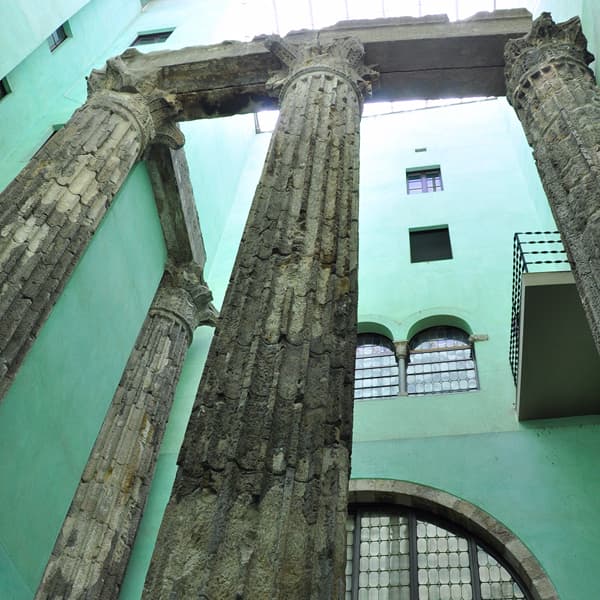
The Roman Temple of Augustus. Before going in, find the plaque on the wall. Mount Tabor, 16.9 meters. You're standing at the summit of Mount Tabor, the Barigatik's highest spot.
Elevation, 55 feet. Whoa, I'm getting lightheaded. At your feet is a millstone inlaid in the pavement at the doorstep of No. 10.
Read more...Show less
This marks a momentous spot. It was here that the ancient Romans founded the town of Barsino. Around 15 B.C., they built a fort right here on the highest hilltop to protect the harbor. Let's go inside.
15 B.C. By then, Augustus had defeated his rivals, Mark Antony and Pompey, consolidated the government, declared himself Rome's first emperor, and begun conquering the rest of Europe. Inside, you'll see the last vestiges of a once imposing building of the Roman temple dedicated to this landmark figure in world history, Augustus. All that's left now are four huge columns.
These columns date from the late 1st century B.C., so they're as old as Barcelona itself. This temple of Augustus was the ancient town's biggest structure. It was officially dedicated to Augustus as emperor, who was worshiped as a god on Earth. These are Corinthian columns, with deep fluting and topped with leafy capitals.
These four were just the back corner of a 120-foot-long temple that extended from here to Barsino's Forum. Today's Plaza de Jaume. Before we move on, check out a few other small fragments of that temple. These were part of the temple's transept and its plinth, or platform.
There's good English information on site to help you piece it all together. Let's leave and head for the final stop on our tour. Return to the street and turn right. Continue down Carre del Paradis.
After one short block, you'll reach a Y intersection. Stop here. Boom. We've just bumped into the back end of the cathedral.
Pause here to admire the church's heavy stone walls, the stained-glass windows, the jutting buttresses, and the gargoyles. Hey, I even spot a unicorn gargoyle! A unigoyle! The cityscape here is amazingly well-preserved.
In fact, it's a popular movie location for films set in Barcelona. Face the church and turn right on Carre de la Pietat. Our next stop is about 75 yards ahead. Keep going, directly ahead, even as the street changes names to Carre de Baixada de Santa Clara.
You go gently downhill to our final stop. Appropriately, we end our tour at the place where Barcelona's 2,000-year history intersects with modern history. Continue gently downhill until you emerge into a rectangular-shaped plaza surrounded by impressive stone buildings, the Plaza del Rey. ¶¶ ¶¶ ¶¶ ¶¶
Plaça del Rei
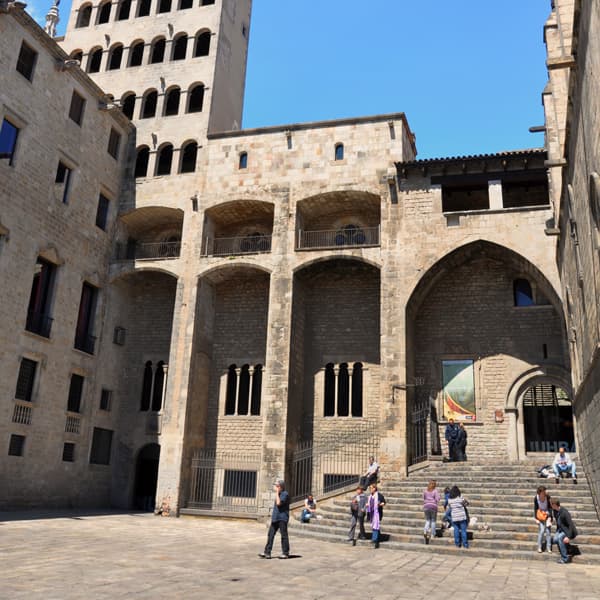
The Plaza del Rey. This square is a great place to end our tour as it calls up Barcelona's Golden Age. Zero in on the central building, the structure topped by a five-story addition. This was the royal palace.
It was not for Spanish kings, but for Catalunya's kings. In medieval times, Catalunya was part of the powerful kingdom of Aragon. Barcelona was Aragon's capital, and this building was its seat of government. If you went inside the royal palace, you'd see its vast hall.
Read more...Show less
This served as the throne room and reception room. It's where the kings of Aragon ruled and partied. And they worshiped in the palace's church. That's to the right.
The Chapel of St. Agatha. That church dates from the 1300s, but it sits atop an even older structure, the foundations of the old Roman wall. By the way, if you'd like to see more Roman ruins and much more from Barcelona's history, check out the Barcelona History Museum.
It's housed in the building that closes off this square. But for now, turn your attention again to the royal palace. By 1450, the Crown of Aragon ruled a rich empire of seagoing merchants. Their influence stretched across the Mediterranean, from Spain to Italy all the way to Greece.
Barcelona flourished. But then, in 1469, came a fateful marriage. What marriage isn't, in one way or another? The king of Aragon, named Ferdinand, married the queen of Castile, Isabel.
Ferdinand and Isabel, the Iberian power couple called the Catholic monarchs. When they got married, it united the peninsula's two largest kingdoms. During their reign, they expelled the Jews, drove the last Moors out of Granada, and created a unified and powerful Catholic nation-state, Spain. And Ferdi and Isi did another significant thing.
They financed Christopher Columbus to explore new lands in the name of Spain. In 1492, Columbus sailed off to America. When he returned, where did he come first? To Barcelona.
Exactly. In fact, to this very spot. It was here, in the royal palace, that, in 1493, Columbus returned a hero. King Ferdinand and Queen Isabella actually rose from their royal thrones to welcome Columbus home.
He presented the monarchs with several statues made of pure gold. He also introduced six strangers to the royals. These were New World natives. Who were baptized in Barcelona, and who came to Barcelona's cathedral?
Ferdinand and Isabella honored Columbus with the title, Admiral of the Oceans. Today, a statue of Columbus faces the Barcelona harbor, the place where he sailed in in triumph. It was Columbus's discoveries that launched the golden age of a new European superpower, Spain. Ironically, that triumph for Spain spelled doom for Catalonia.
Pay attention to the building to the left of the royal palace. This is known as the Viceroy's Palace. It was built in the 1500s by the Viceroy, that is, the servant of the new power in town, Spain. So, in a way, this building represents the rise of Spain and the decline of Aragon, Catalonia, and the city of Barcelona.
Catalonia became swallowed up into greater Spain, and Barcelona ceased to be a capital city. The monarchy moved their residents from Barcelona first to Toledo and eventually to Madrid. Barcelona's royal palace was demoted to a small, regional residence. Meanwhile, power in Barcelona went to the Spanish king's viceroy, and Catalonian money went to build his lavish new residence.
Step into the courtyard. Inside is a delightful Renaissance courtyard, fit for a Spanish viceroy. To the right, gaze up at a staircase with a fine coffered wood ceiling. This building has been important through the years.
As well as serving the viceroy, it also became a powerful center for the Catholic Church as the headquarters of the local Inquisition. It currently houses the historical archives of the Crown of Aragon. Among the treasures in their collection are the so-called Santa Fe capitulations. This was the 1492 contract between Columbus and the monarchs that set the terms for his upcoming sea voyage.
The document is rarely on display, but there's often a poster of it on the wall outside, at the base of the staircase. Our walk is almost over. As you consider your next move, it's easy to get your bearings. Two landmarks are nearby, and you know them well.
You could backtrack the way we came to either Plaza de San Jaume or the cathedral. Columbus's discoveries changed Barcelona forever. It caused Spain to shift its focus to the New World, and that meant away from Barcelona and its Mediterranean trade routes. The political center moved to Madrid.
While Spain enjoyed its golden age, Barcelona was spiraling downward. By the 1700s, it was a dirty, cramped city crowded within a medieval wall. The Barri Gàtic. Whenever Catalunya tried to reassert its independence, the Spanish crown sent in troops to suppress it.
But Catalunya would rise again. In the 1800s, Barcelona became Spain's industrial powerhouse. The rising economy sparked the resurgent art movement called Modernisme. Barcelona expanded and Barcelona beautified.
There was a renewed interest in language and culture. Today, Barcelona is a vibrant international metropolis of 5 million people. And the proud spirit of Catalunya lives on. As they say here in Barcelona, Visca Catalunya!
Visca Catalunya! We hope you've enjoyed our Barcelona City Walk. Thanks to Jean Openshaw, the co-author of this tour. If you're doing more sightseeing in Spain and Portugal, check out our walking tours of Madrid and Lisbon.
Remember, this tour was excerpted from the Rick Steves Barcelona Guidebook. For more details on eating, sleeping, and sightseeing in Barcelona, refer to this year's edition of that guidebook. For more free audio tours and podcasts, and for information about our TV shows, bus tours, and travel gear, visit our website at ricksteves.com. This tour was produced by Cedar House Audio Productions.
For more information, visit Cedar House Audio Productions. Gracias. Adeu. And happy travels.
Free
GPS-guided walking tour
No account needed. Walk at your own pace.
Free
22 stops · 3.5 km