18 stops
GPS-guided
44 min
Duration
Free
No tickets
About this tour
A 18-stop walking tour through the heart of Turkey. Visit Stoa Basilica, Odeon, Prytaneion (Minerva), and View of Ephesus — with narrated stories at every stop.
18 stops on this tour
Welcome to Ephesus
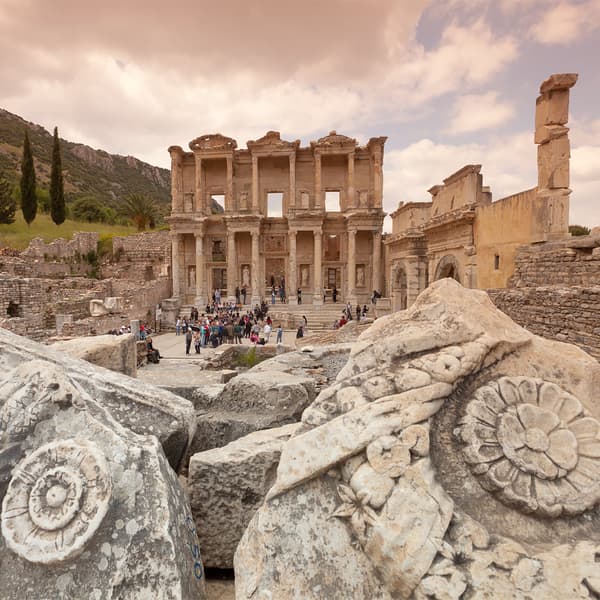
Ancient Ephesus. Welcome to Ephesus. Ephesus, one of the most important cities of the Roman Empire, is among the world's best ancient sites. Hi, I'm Rick Steves.
Thanks for joining me on this walk as we explore the fascinating ruins of this once-bustling metropolis. We'll stroll its broad boulevards and shopping centers, visit the town hall and nightlife district, and we'll test the acoustics in the theater where the Apostle Paul confronted the pagans. There are glorious temples where Ephesians worshipped, bathhouses where they soaked and schmoozed, and public latrines where they carried on the same everyday business as people today. One major highlight is the Library of Celsus with its much-photographed facade.
Read more...Show less
Along the way, we'll enjoy breathtaking views of the city and the Aegean Sea. With this tour, you'll peel back the layers of dust to see the everyday lifestyles of the city and the Aegean Sea. Allow about 90 minutes for this tour of Ephesus, the perfect place to time travel back to the glory of Greece and the grandeur of Rome. To help us along the way, I've invited a good friend and virtual travel buddy.
Welcome, Lisa. Hi, Rick. Lisa will give us helpful directions and sightseeing tips throughout the tour. And my first tip is to be sure you get our tour updates.
Just click on the link in the description and press the icon at the lower right of your device. You'll find any updates and helpful instructions unique to this tour. Things like closures, opening hours, and reservation requirements. There's also tips on how to use this audio tour and even the full printed script.
Yes, so pause for just a moment right now to review our updates and special tips. It's okay. We'll wait. And then... Let the tour begin!
Tour Begins: State Agora
The tour begins. The State Agora. Ephesus has an upper entrance and a lower entrance. This tour starts at the upper entrance.
You can get there directly by taxi. If arriving by public minibus or tour bus, you'll arrive at the lower entrance. From there, you'll have to hike 15 minutes uphill through the site to the upper entrance where this tour begins. Our tour covers the heart of ancient Ephesus, the downtown of this sprawling city.
Read more...Show less
From the upper entrance gate, we'll work our way downhill to the lower gate. From there, you can see more sites or catch a taxi, your tour bus, or public minibus to Selçuk or Kusadasi. From the turnstile at the upper entrance, walk about 50 yards into the site. You'll reach a large rectangular space ringed with ruins, the State Agora.
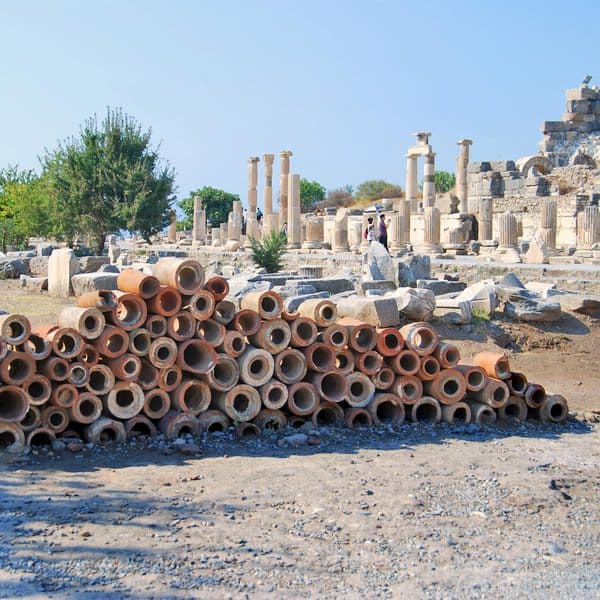
Survey the scene from the statue, and you'll see a rack of terracotta pipes on the edge of the square. Standing here at the top of the site, with your back to the modern upper gate, get a sense of the grandeur of the ancient city. The State Agora, or Upper Agora, was once an open-air courtyard surrounded by covered arcades. Here, shoppers could get out of the sun and rain, catch up with their neighbors, and talk politics.
This Agora, about 500 feet long and 240 feet wide, originally had a temple to the goddess Isis in the center. The Agora is only a small slice of this once-bustling city. In fact, only a fraction has been excavated. Look to your right and to your left on the ridges high above you.
These areas were once sprawling residential neighborhoods. It made perfect sense to put this Agora, or marketplace, right here between them. At its peak around 100 A.D., Ephesus was one of the grandest cities of the ancient world. With a staggering quarter of a million residents, Ephesus was the second biggest city in the Roman Empire, exceeded only by the city of Rome itself.
It held its own with other great cities, like Alexandria and Antioch. It had temples, baths, palaces, homes, and, as these pipes suggest, a sophisticated plumbing system. You can see evidence of the extensive plumbing in the dirt near this stack of pipes. Runoff from the surrounding hills was funneled into the city across four major aqueducts.
The water flowed here, to the main reservoir, located, logically, at the high end of the city. From here, it flowed downhill, through clay pipes like those piled here, to feed the public fountains and the homes of the wealthy. While Ephesus was at its peak under the Romans, it has a much longer history. On this walk, we'll see remnants of many great civilizations that passed through here -- Greek, Persian, Roman, and Christian.
As you tour, think of all the ancient celebrities that may have walked these same roads, the ancient marble roads: Julius Caesar, Anthony and Cleopatra, St. Paul, and, possibly, even St. John and the Virgin Mary. Now we'll look at some of the buildings that once ringed the Agora.
With your back to the turnstile, head across the Agora to the ruins at the base of the hillside, ahead of you to the right. There you'll find what looks like a ceremonial road lined with columns. ♪♪
Stoa Basilica
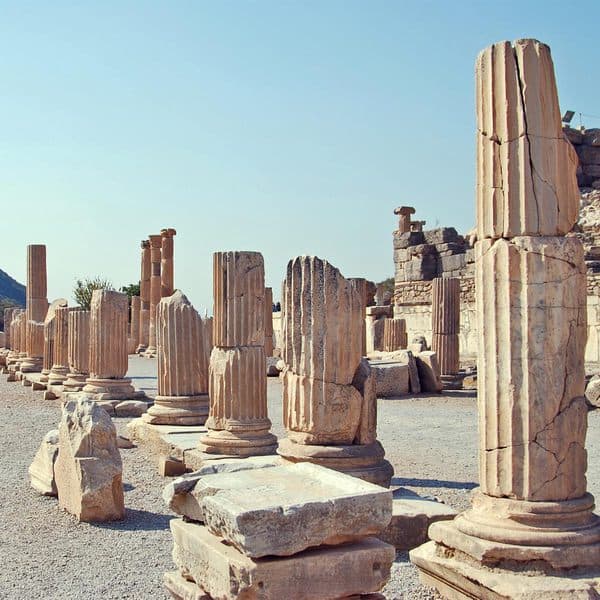
The Stoa Basilica. The columns along the northern side of the Agora once formed a covered walkway lined with columns -- that is, a stoa. This was eventually remodeled and turned into a basilica. The double row of pillars in the middle of the field mark the footprint of that basilica.
It has the typical basilica floor plan -- a large central hall flanked by two narrower side aisles. The columns are ionic -- slender, fluted -- and topped with scroll-like capitals, though these capitals are mostly missing. While today the word "basilica" signifies a church, back then, long before the first Christian church, it was a hall -- in this case, where merchants met and goods were traded. Above the Stoa Basilica are semicircular rows of seats cut into the hillside. This, the largest structure on the hillside, is a theater, or odeon. The odeon.
Odeon
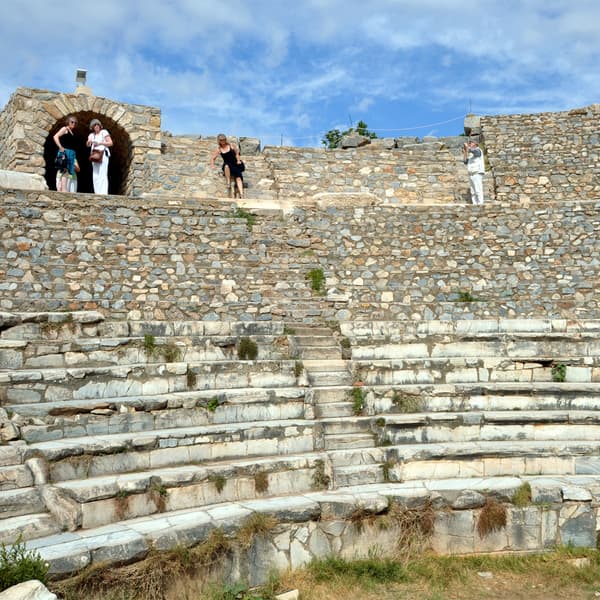
The semicircular rows of seats were part of the city's indoor theater. Built around 150 A.D., the odeon was once topped with a wooden roof and seated about 1,500. Compared with the huge open-air theater we'll see later, this was an intimate venue for plays and concerts. Also, this is where the Ephesus City Council met.
According to records, every Thursday morning, 450 aristocrats would hash out the civic business of Ephesus right here. Some of the lower marble seats are original, with elegant lion-foot armrests. The upper seats were restored on the cheap in the 1950s. By the way, to get a sense of how much this site has been excavated, note that the theater was once buried all the way up to its top seats.
Read more...Show less
At the end of the Stoa Basilica, on the right, find two big Doric columns. These mark a temple called the Praetanion. ♪ The Praetanion.
Prytaneion (Minerva)
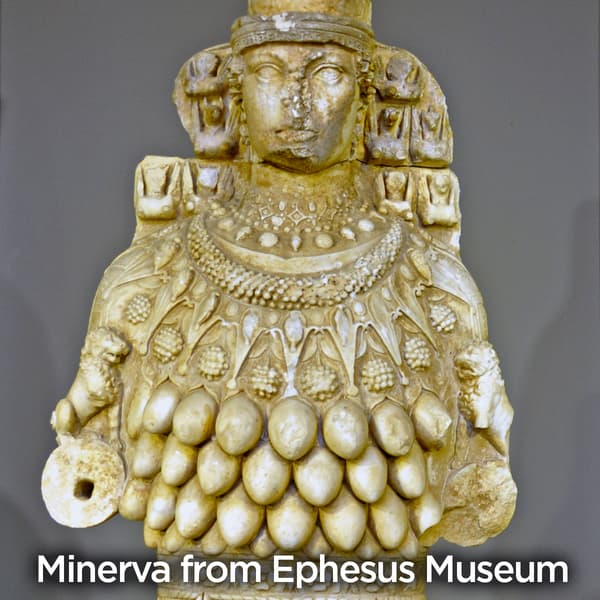
The two standing pillars, just beyond the Odeon, are all that's left of one of the city's most important buildings. The Praetanion was a kind of combination temple and town hall. It was the meeting place of six high officials called curates, who were a combination of priests and civic administrators. Here is where the eternal flame was kept.
It burned in the rectangular pit, you see. Just as Rome had its eternal flame tended by the Vestal Virgins, the curates of Ephesus made sure this fire always flickered. As long as the fire was kept alive, Ephesus would prosper. Originally, the Praetanion had a large statue of the goddess Artemis.
Read more...Show less
The statue's now a few miles away in the Ephesus Museum in Selchuk. In its day, Ephesus, with its huge Temple of Artemis, was the Eurasian center for the worship of this Greek goddess. Artemis was the daughter of Zeus, the sister of Apollo, and a dedicated virgin. But in Ephesus, she was associated not with virginity, but with fertility.
Her impressive and fascinating statue showed her chest covered with dozens of bulbous shapes. These shapes might have symbolized many female breasts, a sign of fertility. Another interpretation is that they're stylized testicles, since they used to sacrifice bulls at the Temple of Artemis, cut off the testicles, and drape them over the statues. Still another interpretation says they're eggs.
But whether eggs, breasts, or breasts or bull's balls, they signify the life-sustaining power of this mother goddess, Artemis of Ephesus. For centuries, Artemis stood here, alongside the eternal flame of Ephesus. Finally, the fire was snuffed out in 395 A.D., when Christians outlawed pagan worship. Just next to the Praetanion, pause to enjoy an excellent viewpoint. It's near the top of a lane called the Sacred Way. ♪♪
View of Ephesus
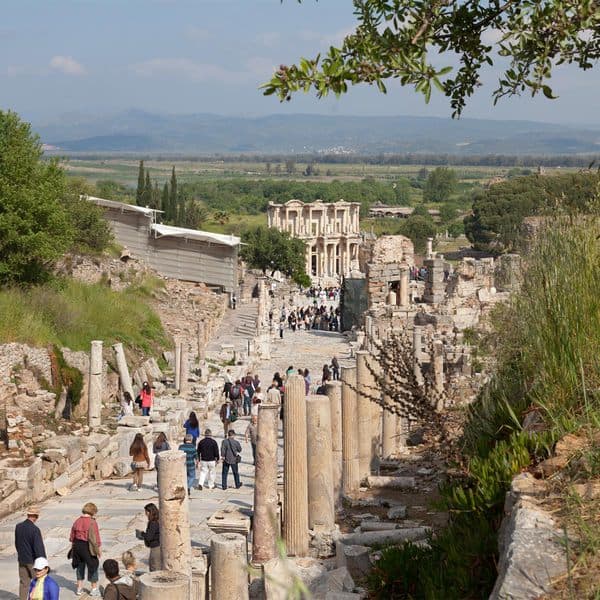
View of Ephesus. From the top of the street, the excavated city lies at your feet. It spills down the hillside toward the Aegean Sea. If you look far into the distance, you can just make out a bit of the Aegean.
The area was first settled around 1,000 B.C. According to legend, the city was founded by a Greek prince named Androklos. The Oracle of Delphi had prophesied that a wild boar would lead Androklos to the exact spot where he should build the city. In fact, Ephesus grew up as a Greek city.
Read more...Show less
By 500 B.C., it was a bustling seaport and famous as the worship center of the goddess Artemis. Pilgrims flocked to the enormous Temple of Artemis, one of the seven ancient wonders of the world. The temple stood a few miles from here. Unfortunately, today it's entirely ruined, and there's very little to see.
Early Ephesus was part of the sophisticated Ionian world located along the west coast of today's Turkey. Their culture inspired the rise of Golden Age Greece just across the pond. The Ephesians spoke Greek but with an Ionian dialect. They produced Greek philosophers such as Heraclitus, who once said, "The only constant is change." And they popularized the style of Greek columns called Ionic -- that is, topped with scroll-like capitals.
From time to time over the centuries, more warlike people -- Lydians, Persians, Athenians, Alexander the Great, and Romans -- overran Ephesus, but everyday life went on mostly unchanged in this cosmopolitan city. As you gaze over the city, think of how the physical location of Ephesus has changed over time. Its river was the Meander River, whose circuitous path gave us the word "Meander." The river's course changed constantly. Like Heraclitus said...
Its silt steadily clogged up the harbor. 1,500 years ago, the Aegean Sea lapped right at the gates of the city. But as you look in the distance, notice how far the sea is now from Ephesus. Centuries of silt and big-city drainage eventually left the Ephesus harbor high and dry, spelling its ultimate doom.
Walk down the sacred way toward Domitian Square, about 50 yards ahead. Walk slowly, as Rick points a few things out. ♪♪ ♪♪
Walking Down the Sacred Way
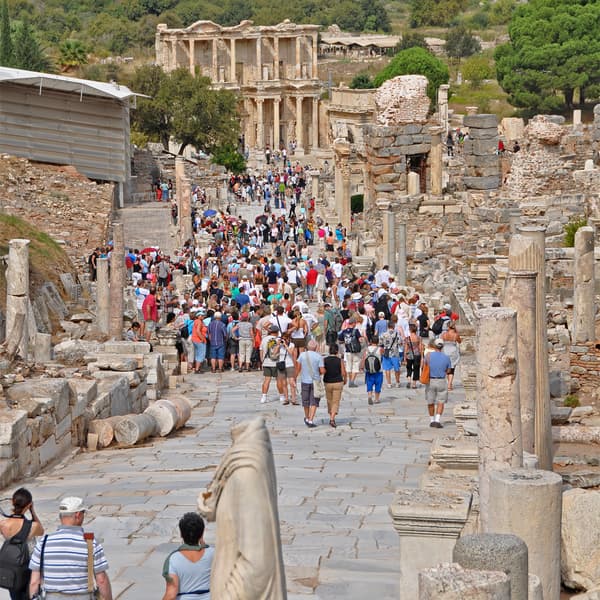
Walking down the sacred way. Strolling downhill, notice hints of Roman engineering. Drainage pipes under the road kept sewage and runoff flowing. But the runoff of a quarter million Ephesians contributed to the silting up of the harbor, which eventually spelled the end of the city.
Also, keep an eye out for metal rings in the road. These were likely for guy lines to hold up street lamp poles that were set up each night. The street stones were hatched to give sandals a better grip when wet. Eventually, you'll come to two stone pillars with carved reliefs.
Read more...Show less
These were directional aids. One, facing the market, is a statue of Hermes, god of merchants. The other, facing a pharmacy, is a carving of Asclepios, symbolizing medicine. Cosmopolitan Ephesus was filled with traders, merchants, sailors, and pilgrims who spoke a babel of languages.
And these pictograms helped those arriving from distant lands find their way. Just past the two stone pillars with carved reliefs is Domitian Square. Turn left and enter the square. Domitian Square and Temple
Domitian Square and Temple
Domitian Square was ringed by important buildings and monuments. On the left, the highest surviving arch marks what was a public water fountain. The centerpiece of this quarter, straight ahead of you, was the Temple of Domitian. Though little remains today, the temple was large, two stories tall, as the ruins suggest, and covering the area of a football field.
A bit of the temple façade still stands, with statues capping a couple of columns. Domitian, a Roman emperor from the first century A.D., is portrayed by historians as a cruel lunatic. It's believed he sent St. John into exile to the nearby island of Patmos.
Read more...Show less
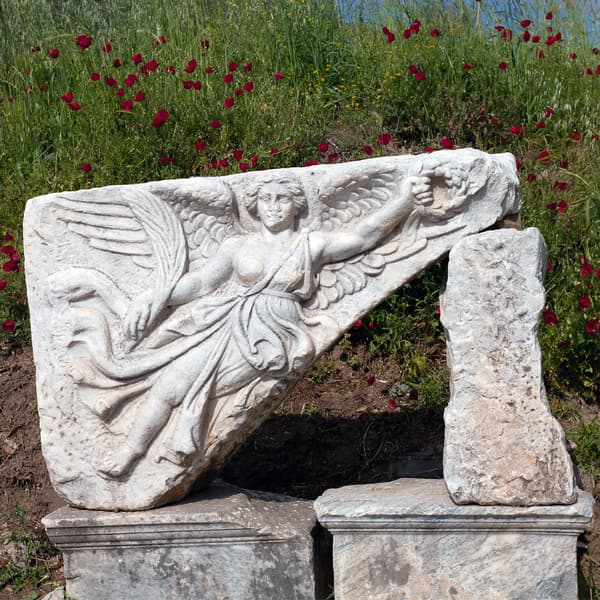
There, John worked in a rock quarry and wrote the Book of Revelations. Opposite the Temple of Domitian, stands the ruins of a monument honoring the hero, Memmius, with a carved relief describing his great deeds. Resting on the ground across from the temple site, look for an impressively carved piece of stone, the Nike frieze, which once topped a gate. It depicts the Greek goddess of victory giving a triumphal wreath to the conquering Romans. Return to the Sacred Way. Continue 30 yards further downhill to the Hercules Gate. ♪♪ The Hercules Gate.
Hercules Gate
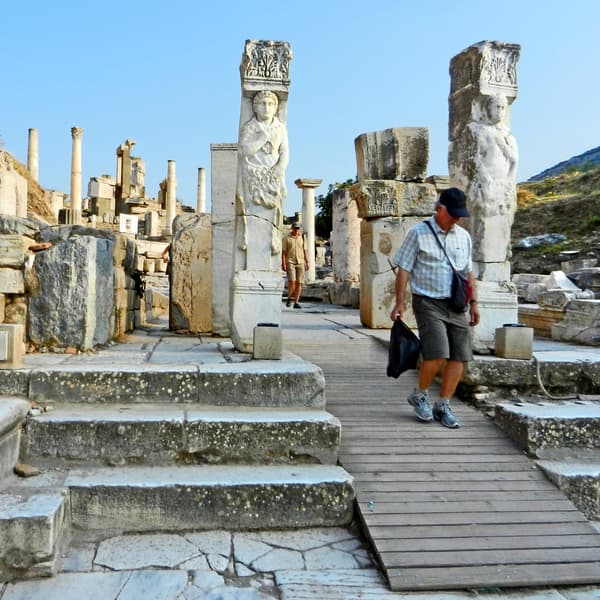
This gate marks the point where the Sacred Way becomes Curit's Road. The gate is intentionally too narrow for chariots to go through, since the road became pedestrian-only at this point. Just before the gate, notice the remains of a road branching off to the left. That was the ancient equivalent of a truck route detour leading to the harbor.
Looking around, you might see pieces of the original arch which once welcomed those pedestrians and which archaeologists hope will soon be reassembled. Just to the right of the gate, a couple steps up, is a little perch that provides a commanding view and a great photo op. It's worth pausing your audio guide now for a few moments to simply enjoy this beautiful view. The Hercules Gate dates from Roman times.
Read more...Show less
It was under Roman rule that Ephesus reached its peak. In 27 A.D., Emperor Augustus made the city the capital of the Roman province of Asia. Back then, the Asian province meant roughly today's Turkish West Coast. The Romans expanded the harbor's commercial trade, which included the slave trade, extending it throughout the vast Roman Empire.
By the year 100, Ephesus had become a rich city of marble buildings and grand monuments, like the Hercules Gate. It had an infrastructure that could support hundreds of thousands of toga-clad citizens. Most of the ruins you'll see today date from the city's Roman heyday -- those first two centuries after Christ. The prominence of Ephesus attracted some of the earliest followers of Christ.
St. Paul came to Ephesus in about 52 A.D., where he conducted missionary work and wrote his first epistle to the Corinthians. "Love is patient, love is kind. It does not envy.
It does not boast. It is not proud." St. John also may have come to Ephesus in about 90 A.D. His mission?
Spreading Christianity to the Roman province of Asia. And even the Virgin Mary, supposedly retired here in Ephesus. Brought here by John. Pass through the Hercules Gate and start heading downhill on Kyrites Road.
Take a glance back at the downhill side of the Hercules Gate. You can see its namesake, the great hero of Greek and Roman history, complete with his lion skins. Stroll slowly down Kyrites Road toward a big water basin about 50 yards ahead on the right. Listen while Rick paints the scene.
This lane gives you a glimpse of the epic scale of Ephesus at its peak. Mentally replace the tourists in shorts with Romans in togas and imagine life here in the Roman metropolis. Shops lined the street, with homes above on the second story. You'll see a row of pedestals.
These once supported statues honoring leading citizens. You'd see bubbling fountains and archways. Columns supported a covered sidewalk for pedestrians. In the shade of the arcades, people could hang out and play games, like backgammon. On your right, you'll reach a large basin, Trajan's Fountain. This was a public fountain
Trajan’s Fountain
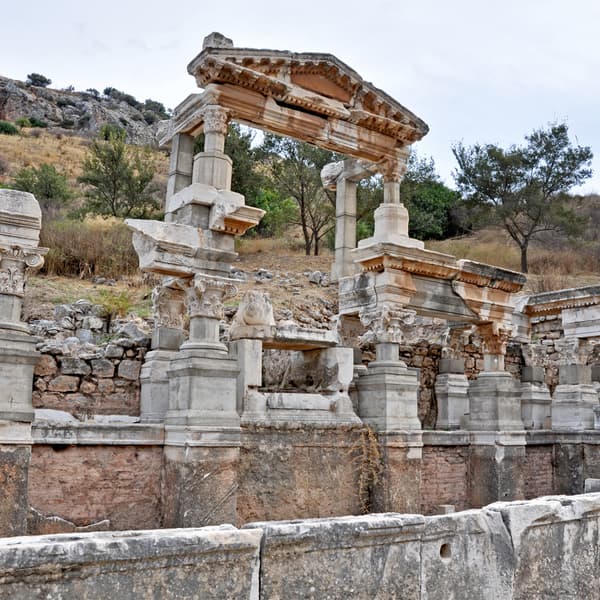
where citizens got their water. It's a huge reservoir basin, 66 by 33 feet, topped by a pediment. Beneath the pediment once stood a statue of the powerful Roman Emperor Trajan, proudly gazing over the pond. While the wealthy had indoor plumbing, fountains like this were the sole source of water for everyone else.
Check out the carving of Trajan, one of the most popular works of art in the world. Trajan is the most famous artist for carving of Trajan with his foot on an orb. The inscription reads, "Trajan ruled the world with his right foot." Clear evidence that ancient Romans just assumed the world was round. Notice the little holes on the lower left of the fountain.
Read more...Show less
To let loose a stream of water to cool and clean their town, Ephesians would simply uncork the fountain. Before moving on, cross the street and step up to the banister. Notice the fine mosaic sidewalk. This was part of a stoa once lined with shops that likely catered to the fancier aristocracy.
Continue down Curiats Road about 30 more yards. On the right, take a little detour through a bath complex. The public baths.
Public Baths
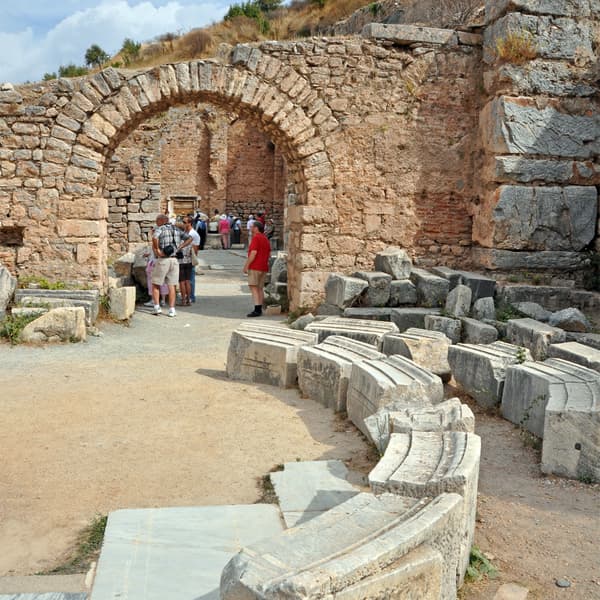
The Scholastica Baths complex, like all Roman baths, was divided into rooms. The complex is complex. Without worrying about which room is which, wander around while I describe the system in general. Each room had a special purpose.
First, there was a changing room where you'd strip down. Next, you'd head into a hot steam room, or caldarium, to work up a sweat. Then, plunge into a cold pool in the frigidarium. The lukewarm room, or tepidarium, was where you could relax and chat with friends.
Read more...Show less
The baths were more than washrooms. They were health clubs with exercising areas, equipment, and swimming pools. They had gardens for socializing. There were libraries, shops, bars, even fast food vendors, pedicurists, depilatories, and brothels.
The baths catered to every Ephesian need. Most important, perhaps, the baths offered a spacious, convivial place that was cool in summer and warm in winter. Ephesians could get out of their stuffy apartments and schmooze or simply hang out. Admission was virtually free, requiring only the smallest coin.
Most Ephesians went every day. The tradition of large public baths continues in Mediterranean lands to this day. From the Romans to Byzantines to Ottomans to today's Turks. Back in Kusadasi, contemporary locals are enjoying the steamy descendants of bath complexes just like this.
Return to Kyriez Road. By the way, Rick, did women go to the public baths? Yes, they did, but it wasn't co-ed. There were either separate rooms for men and women or separate bathing times.
Oh, okay. Once on the main street again, turn right. The next building down is one of the most photographed in all of Ephesus. The Temple of Hadrian.
Temple of Hadrian
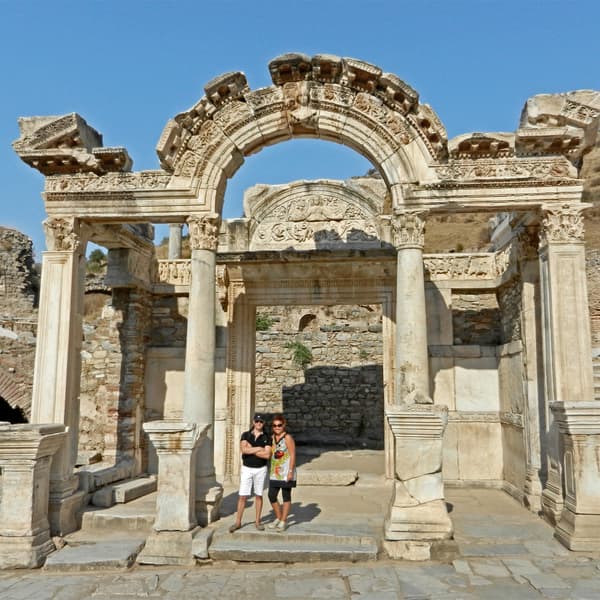
The temple sports Corinthian columns, that is, with leafy capitals, and a lone surviving curved arch. The central relief carved over the door likely depicts Hadrian's lover, a boy named Antinous. With his captivating beauty, Antinous was considered the most ravishing in all the realm. When Antinous drowned in the Nile at age 19, a broken-hearted Emperor Hadrian had him deified.
Curly-haired statues of Antinous are found all over the former Roman Empire. Symbolism abounds on this arch. The eggs on the doorframe and the little flowers carved into the stone likely represent fertility. Notice the swastika-like geometric pattern on the ground.
Read more...Show less
This could have either represented the Meander River, which brought life and prosperity to the city, or the rising sun, the promise of good fortune. A few steps further down Curiats Road, look on the right, near marker number 143. Go through the little doorway to find the public toilets. The public toilets.
Public Toilets
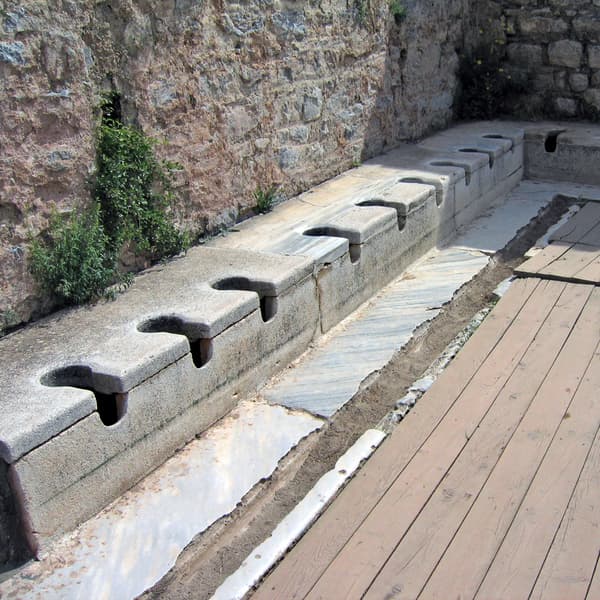
The U-shaped latrine room features marble seating surrounding an open-air courtyard with a fountain. Few Ephesians could afford private bathrooms, so most people took care of business at a public restroom like this one. Visiting the loo evolved into a social event, and this room had seats for a rollicking party of about 40. Think of it.
Forty people sitting here, just -- Rick, please, no fart jokes. Well, how about -- No, Rick. This is a Heritage Landmark site. Yeah, but even Heritage Landmarks occasionally have to just let one -- No, I'm sorry.
Read more...Show less
Talk about something else. Very well. I won't mention anything about flatulent or constipated Ephesians. Thank you.
'Cause if I did -- Rick! Okay, okay, moving on. Above the seating area, there would have been a wooden roof. Rather than toilet paper, they used tiles, and they used sponges on sticks.
You can see how the toilet seat is actually cut away to accommodate the stick. Beneath the seats, a stream of water ran in a constant flush, whisking away waste to a sewer line. Along the floor was a second stream with clean water for washing up. The Ephesians, who lived together in such a dense urban area, knew the importance of sanitation.
Make your way back to Curitz Road. When you get there, cross to the other side of the street. There you'll find a separate site which requires its own ticket -- the Terrace Houses. It's well worth the few extra lira to visit, though this audio tour won't walk you through the interior. Rick, tell us about the homes and what they'd see if they went inside. The Terrace Houses.
Terrace Houses
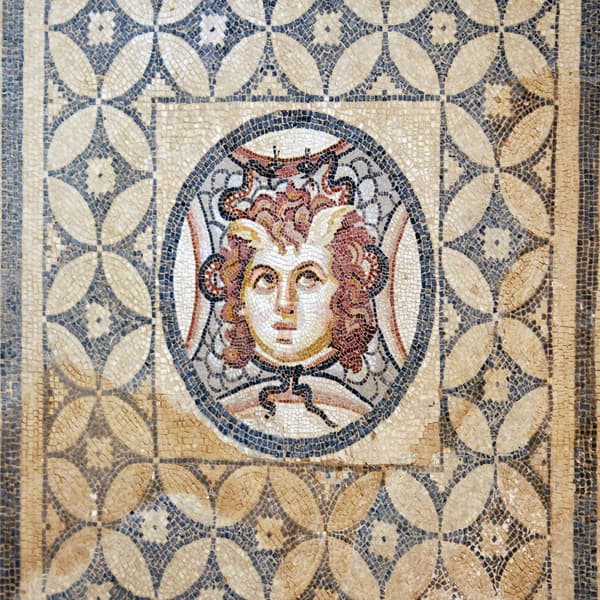
This modern complex protects seven homes of wealthy Ephesians. Each is three stories tall with its own courtyard and elaborate decorations. It presents a vivid picture of the lifestyle of the upper class. Its discovery was big news in the world of archaeology, excavated in 1999 and opened to visitors in 2006.
You'll likely see archaeologists still at work. Visitors follow a one-way route through the complex. There are carefully restored mosaic floors and beautifully frescoed walls. Consult the handy floor plans and room descriptions displayed throughout the complex to get oriented.
Read more...Show less
Though this audio tour doesn't cover the inside in detail, let me mention a few things you'd see if you went inside. The homes and their decor date from the early Roman imperial period, roughly the first two centuries after Christ. They follow the traditional Roman floor plan -- an open courtyard lined by columns with rooms arranged around it. Typically, the living rooms and dining rooms were on the ground floor with the bedrooms upstairs.
The exterior, facing the street, had no windows to keep out the dust, noise, and sun. The inner courtyard was open to the sky, creating an oasis and ventilating the house. That ancient system is still used today in hot climates all around the world. A cistern beneath the courtyard floor collected rainwater to supply the house.
As you tour, you'll see dining rooms, bedrooms, storage rooms, and a private bathroom. The walls today are bare brick, but you'll see a few original mosaics, and faded frescoes of gladiators, animals, and scenes from mythology. From the terrace houses, continue down Curitz Road to the Library of Celsus. When you reach the library, face its commanding façade.
Before approaching the library, look to your right for a nice view down Marble Road. Little survives along this road, but it was the main thoroughfare on the way to the harbor. Now set your sights on one of the iconic Roman ruin images in the world. The Library of Celsus.
Library of Celsus
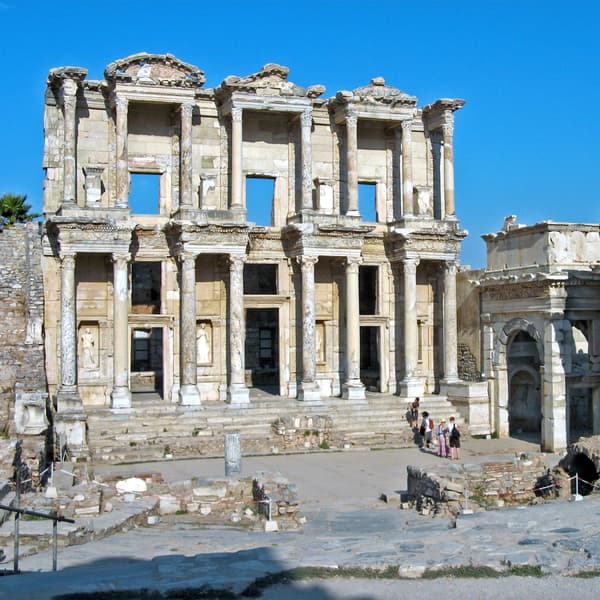
This breathtaking structure epitomizes Ephesus at its peak. It was the third largest library of the ancient world, with some 12,000 volumes. Only the libraries of Alexandria and Pergamon were bigger. The library was named for Celsus, a well-read governor of this province, whose son built the library as a mausoleum in his honor in 123 AD.
The library's façade is two monumental stories tall. It features a distinctive grid of columns and recessed niches. Those columns on the ground floor are 40 feet tall. The style is Corinthian, with leafy capitals.
Read more...Show less
There were three grand doorways, each matched by windows above. The four statues in the niches represent the traits of Celsus: wisdom, knowledge, intelligence, and bravery. An optical illusion causes this grand façade to seem even bigger than it is. Notice that the outer columns are actually shorter than the central ones.
This makes the façade appear to bulge in the middle. Hmm, pretty nifty. Now climb the steps and enter what was the library. As you step into the small interior, picture it in its prime.
The walls and floors were once gleaming marble. All we see today is the brick understructure. Light poured in through big east-facing windows, which caught the morning sun. The niches that you see once held scrolls.
A three-foot-wide gap between the inner and outer walls helped to circulate air to preserve the library's delicate documents. The earliest scrolls were made of Egyptian papyrus, a plant material. But soon the Egyptians, who didn't want any library to be bigger than their own in Alexandria, jealously refused to export any more papyrus. The Romans, limited only by their ingenuity, simply invented a different material -- parchment made of dried-out animal skin.
Eventually, the sheets of parchment, rather than being rolled in a scroll, were stacked and bound at one end, creating something entirely new -- books. The book was the primary knowledge medium for the next 2,000 years. Then came the dawn of the 21st century, when the printed book became just another obsolete relic of history. Don't speak too soon.
I'm using a guidebook right now. And it hasn't run out of batteries yet. Head back outside. As you're leaving, look to the left.
Find the metal box. It's on the second step from the top. That metal box protects an image of a menorah, a Jewish candlestick that's carved into the step. Besides the cult of Artemis and other Greco-Roman gods, Ephesus had a large Jewish population.
The synagogue was probably near here, though archaeologists have yet to find it. The Jews of Ephesus got along just fine in pagan Ephesus, unlike the Christians. As we'll see in a bit, Christians, always looking to convert pagans to their own faith, clashed with the followers of Artemis. Descend the rest of the library steps.
At the bottom, turn left and face the triple-arched gate. The three arches mark part of another library complex that once included a lecture hall. The gate is inscribed in bronze letters with two names, Mizeus and Mithridates. These were slaves who were freed by their master, Emperor Augustus.
They eventually became wealthy citizens who built this gate in appreciation of their liberty. Let's move on from the Library of Celsus. Step through the three-arched gate. You'll enter a huge, empty chapel. You'll enter a huge, empty square. This was once the Commercial Agora. The Commercial Agora.
Commercial Agora
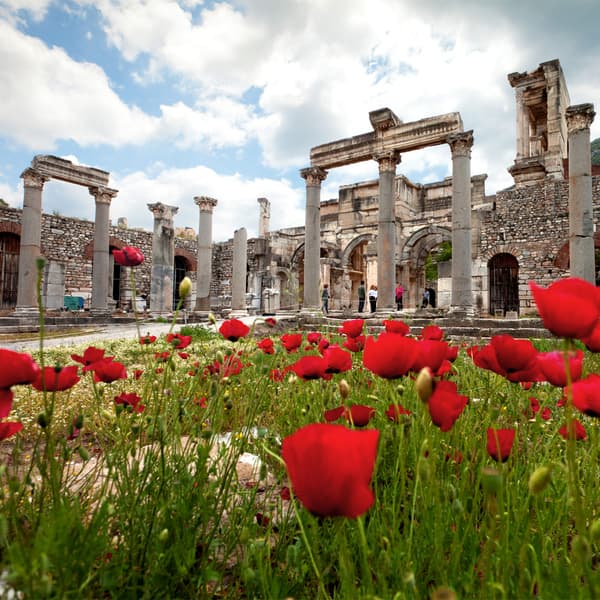
This large marketplace was the main supermarket and shopping mall of Ephesus. It has the layout of so many agoras all across the ancient Mediterranean. There is an open courtyard -- this one is 360 feet square -- surrounded by columns. These supported a portico to shade businesses.
The shops that ringed the square were stocked with goods from all over the known world. Check out the engraved marble slabs in the sidewalks around the square. These have pictures of what each shop sold. Lisa, what do you see?
Read more...Show less
There's a cleaver. Hmm. That would be for the butcher. Right.
And there's an olive branch. For the man that sold olive oil. You got it. And there's a fish.
That must be for Sea World Ephesus? No, that's the local seafood store. There were many more. Check them out.
In the center of the square, the raised island of pine trees shows how two meters of dirt had to be removed to uncover this part of Ephesus. Walk across the agora. Parallel the marble road above you to the right. Follow the crowd's upper ramp that leads to Harbor Road and the Great Theater.
As you walk, let Rick paint a picture. Remember that Ephesus was a port town. This neighborhood was one of the busiest, most crowded, and often the seediest section of town. Imagine the commotion.
Besides the curates, politicians, and currency exchangers, there were even sleazier types: souvenir hawkers, pickpockets, fortune tellers, gamblers, slave marketers, drunks, hookers, lawyers, and even tour guides. The agora is now rubble, but imagine it in its prime, surrounded by blindingly brilliant marble buildings with tall columns and shining metal roofs. Statues were painted in realistic colors. Chariots rattled down the marble road up above you on the right.
If the agora still looks like just a pile of rubble, at least tell yourself, "But Julius Caesar might have once walked across these very stones." Head up the ramp. This leads to Harbor Road, the ancient boulevard that led from Marble Road out to the port. To your right, fanning out across the hill, is the Great Theater. The Great Theater
Great Theater
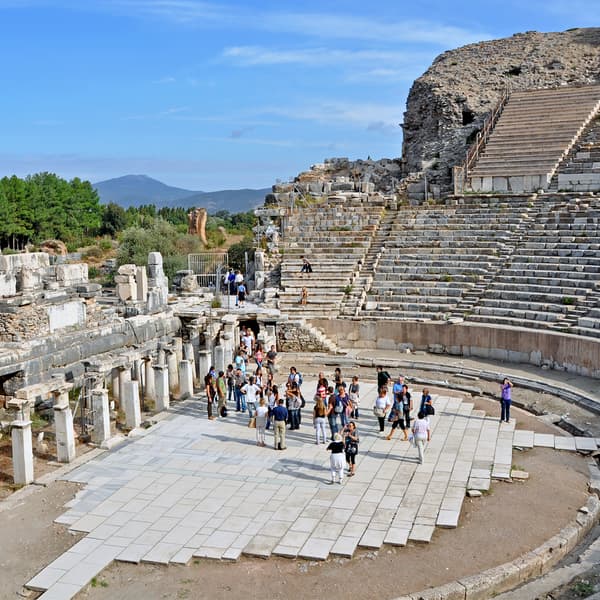
Before climbing the steps and entering the theater, notice the stones lined up, identified and awaiting reconstruction. As you approach the steps, notice also just to the right, there's a lovely Greek fountain with two graceful columns. It's in the Ionic style -- fluted columns with scroll-like capitals. This fountain was once an elegant place for theatergoers to stop for water.
Dating from Hellenistic Greece at least a century before Christ, this is one of the oldest structures you'll see here at Ephesus. Its original Greek elegance was obscured when the more pragmatic Romans expanded it centuries later. Now start climbing the stairs. Halfway up the stairs on your right, you'll find a tunnel-like gallery.
Read more...Show less
This may have been the actors' entry. Follow the tunnel-like gallery to the right. This deposits you right on the stage floor. Standing on the stage, take in the theater.
It's huge. The theater held about 25,000 spectators, possibly the largest anywhere in the ancient world. Since a Roman theater was typically designed to accommodate 10% of a city's population, archaeologists derive that ancient Ephesus had 250,000 residents. Although the theater is partly ruined, the acoustics are still so good that performers don't need microphones to be heard, even up in the cheap seats.
Tour guides and would-be divas love to demonstrate this to the delight of sightseers. As Rick describes the theater, grab a comfortable seat or explore, climb around. Check out the 66 rows. They're divided into the classes of Roman society.
The lower level was reserved for VIPs and the emperor's box. Many seats were covered in marble with comfy seat backs. The middle level held Roman citizens, which was most middle-class Ephesians. And the upper level was bleacher seating for the lower classes, free men and women, and foreigners.
The theater was begun by the Greeks in the 3rd century B.C. When the Romans came, they enlarged and modified it for their particular brand of entertainment. Romans used a raised stage and added a backdrop. They enlarged the stage wall to 60 feet high.
This improved acoustics and framed the stage area with pillars, creating a proscenium. Now turn your attention to the orchestra. By "orchestra," I mean the area in front of the stage. This is where musicians and actors originally performed in Greek theater.
The wall around the orchestra was added by the Romans. When they held gladiator fights here, the wall protected spectators from the action. It's hard to get splattered blood out of a toga. In modern times, the theater is still a popular venue.
It's hosted concerts by Sting and Diana Ross. Luciano Pavarotti sang with no microphone, a performance people still talk about. By the way, concerts have been suspended in recent years while the theater is retrofitted to prevent vibrations caused by big crowds from damaging the structure. This theater played a dramatic role in early Christian history.
The Apostle Paul lived in Ephesus from about 52 to 54 A.D. He preached in the local synagogue. Throughout his ministry, he wrote much of the New Testament. He wrote letters, or epistles, to budding Christian communities all over the Roman world -- to Corinthians, to Philippians, and to the Ephesians.
His Christian message resonated with ordinary Ephesians, but it threatened the society's elites. Paul strongly denounced the worship of false idols. Remember that the cult of the goddess Artemis was big business in Ephesus. Artemis' idol carvers didn't like Paul's interference one bit.
According to the Bible, in Acts 19, they stirred up an angry mob. These rabble-rousers grabbed some of Paul's Christian companions. Shouting, "Artemis is great!" the mob dragged the captured Christians into this theater. Paul wanted to storm into the theater and save his friends, but cooler-headed colleagues held him back.
Fortunately, the enraged crowd inside calmed down, and they eventually released the Christians without harm. The worship of Artemis survived -- for the time being. Within a couple of centuries, Christianity would come to dominate in Ephesus, as it did throughout the Roman world. Ephesus always had a strong Christian community.
In fact, it may have been the home to two major Christian figures -- the Apostle John and the Virgin Mary herself. According to the Bible, from the cross, Jesus told John to care for his mother after his death. Some early traditions say that John came to Ephesus to preach the gospel, so he may have brought Jesus' mother with him. And she may have settled down on a hillside near Ephesus, in what's now known as the House of the Virgin Mary.
Is such a story possible? Yes. Is it probable? I don't know.
But pilgrims come here in droves. Some historians believe that it's no coincidence that this ancient site, so connected with the cult of a mother goddess, Artemis, was later believed to be the final home of the Mother of Christ. Hmm. That gives me something to ponder as we make our way out of the theater.
Step back outside the theater. Stop at the top of the steps that we climbed earlier to enter the theater. Look down the big road that once led to the sea. Harbor Road
Harbor Road
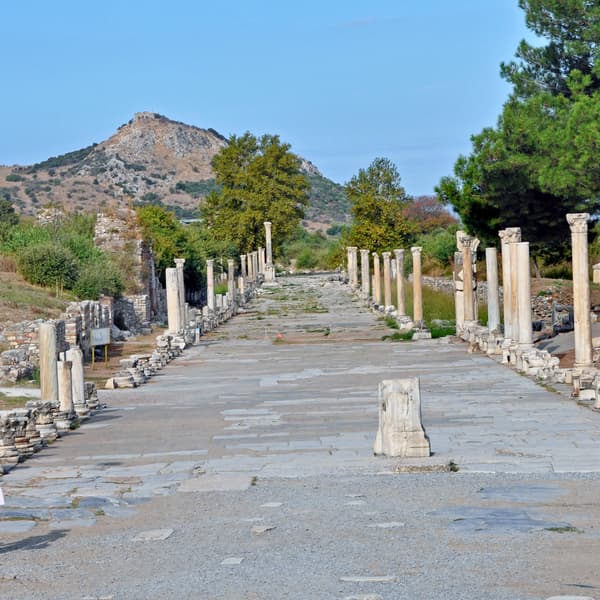
In ancient times, most visitors entered Ephesus on this road, which linked the city and the harbor. It made a powerful first impression: marble-paved, 35 feet wide, lined with covered sidewalks, and lit with 50 street lamps, a luxury rare in the ancient world. Like the Strip in today's Las Vegas, this was the city's glitzy main drag. The shops along the way sold a dazzling array of goods from all around the world.
Even today, this showcase boulevard is in great condition without the usual ruts made by wagon wheels. This was the street for ceremonial processions. It was also the place in town to promenade, just as families all around the Mediterranean still enjoy an evening stroll. Far in the horizon, a third of a mile away, lay the original harbor.
Read more...Show less
It was located on an inlet of the distant Aegean Sea. As this was the west end of the famous Silk Road trade route to Asia, it was a very important port in its day. Gaze into the distance and consider the rest of the story of Ephesus. As we've learned, Ephesus peaked around 100 AD under the Romans.
But as the Roman Empire fell, so fell Ephesus. In the year 263, a horde of barbarians invaded and looted the city, and it never really recovered. After the fall of Rome, Ephesus limped along under the wing of the Byzantine Empire, that was the Christian empire ruled from Constantinople to today's Istanbul. But the city was plagued by the same old problem.
The harbor kept silting up. By the 7th century, the harbor was closed for good. Trade dried up along with the harbor, and the city declined. The area became marshland, which bred mosquito-borne malaria that decimated the population.
The survivors relocated nearby to today's town of Selçuk. The impressive buildings were scavenged for their conveniently pre-cut stones. Earthquakes further leveled the monuments. Once-great Ephesus was literally buried and forgotten.
Today's waterfront is three miles away. Fortunately for us, this cultural time capsule has now been reopened. In the 1860s, British, German, and Austrian archaeologists excavated Ephesus. It's one of the largest excavated areas in the world, yet only 15% of the city has currently been unearthed.
This brings our walk full circle. Ephesus was born as a Greek center of Artemis. It rose to prominence as a seaport under the Romans. Then it was buried under centuries of silt and neglect.
But thanks to modern science, the precious treasures of ancient Ephesus are once again being brought back to life. Thanks for joining me on this walk through Ephesus. And thanks also to the co-authors of this tour, Jean Openshaw and Cameron Hewitt. If you're up for more sightseeing, the excellent Ephesus Museum is nearby in the town of Selchuk.
It shows off the mosaics, statues, and artifacts excavated from this site. Outside the lower gate, you'll find taxis, tour buses, and public minibuses to Kusadasi and to Selchuk. Remember, this tour was excerpted from the Rick Steves' Mediterranean Cruise Ports Guidebook. For more details on eating, sleeping, and sightseeing, refer to the most recent edition of that guidebook.
For more free audio tours and podcasts, and for information about our guidebooks, TV shows, bus tours, and travel gear, visit our website at ricksteves.com. This tour was produced by Cedar House Audio Productions. Thanks, Lisa. My pleasure. And have a good trip. Thank you.
Free
GPS-guided walking tour
No account needed. Walk at your own pace.
Free
18 stops ·