26 stops
GPS-guided
67 min
Duration
Free
No tickets
About this tour
A guided tour of British Museum in UK with 26 stops. Highlights include The British Museum, Egypt: The Rosetta Stone, and King Ramesses II.
26 stops on this tour
The British Museum
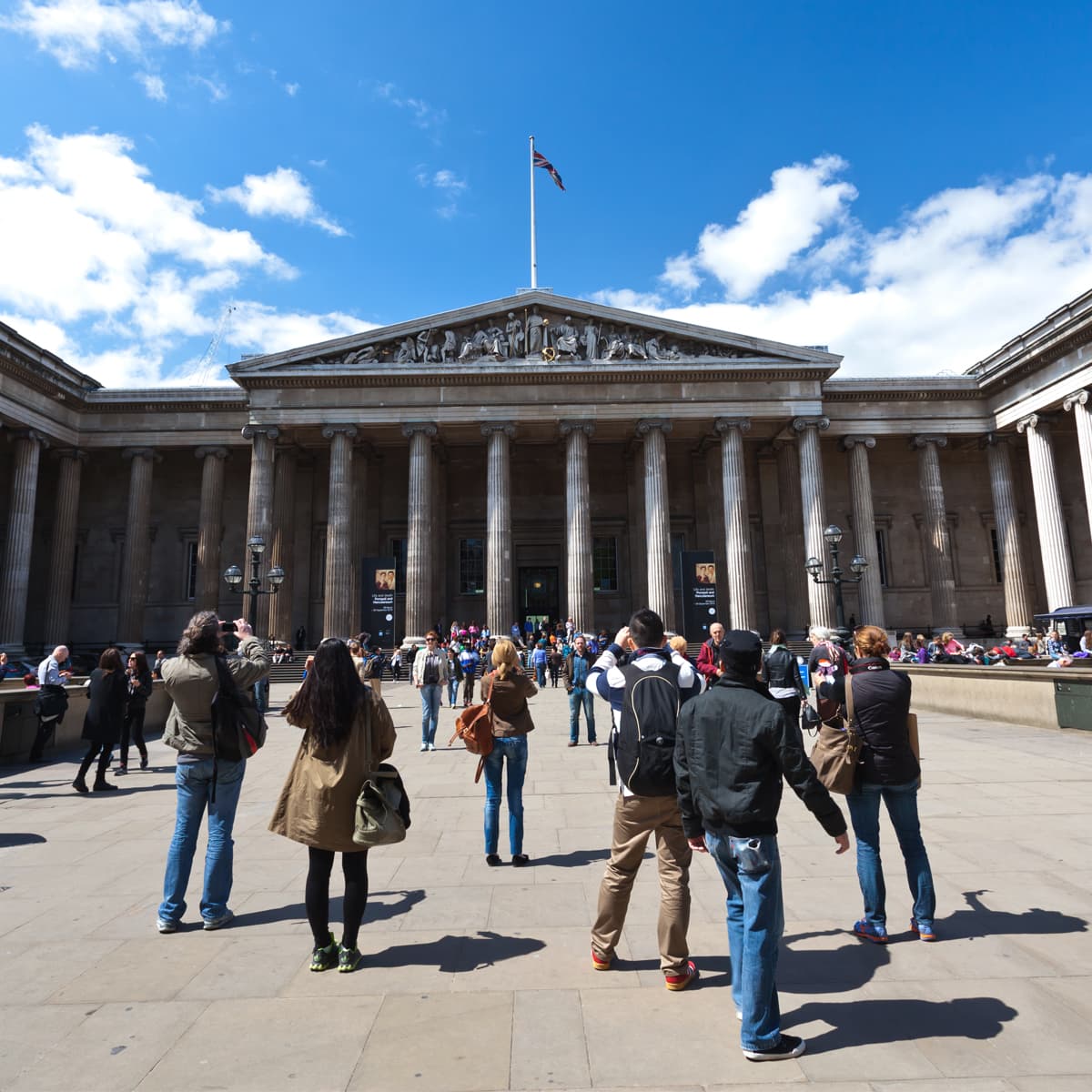
The British Museum. The British Museum is the chronicle of Western civilization, where you can follow the rise and fall of three great ancient cultures in a few hours with a coffee break in the middle. Hi, I'm Rick Steves. Thanks for joining me on a guided walk through the highlights of the British Museum.
We'll see pharaohs and their mummies from ancient Egypt, colossal statues from mighty Assyria, and the famous Elgin marbles, which once decorated the Parthenon of Golden Age Greece. In the 19th century, the British flag flew over one-fourth of the world, and Britain collected ancient art as fast as it collected colonies. While the sun never set on the British Empire, it will on you. So allow yourself about 90 minutes to do justice to this audio tour, as we focus only on the very best of the British Museum.
Read more...Show less
To help us along the way, I've invited a good friend and virtual travel buddy. Welcome, Lisa. Hi, Rick. Lisa will give us helpful directions and sightseeing tips throughout the tour.
And my first tip is to be sure you get our tour updates. Just press the icon at the lower right of your device. You'll find any updates and helpful instructions unique to this tour. Things like closures, opening hours, and reservation requirements.
There's also tips on how to use this audio tour and even the full printed script. Yes, so pause for just a moment right now to review our updates and special tips. It's okay. We'll wait. And then... Let the tour begin!
Tour Begins: The Great Court
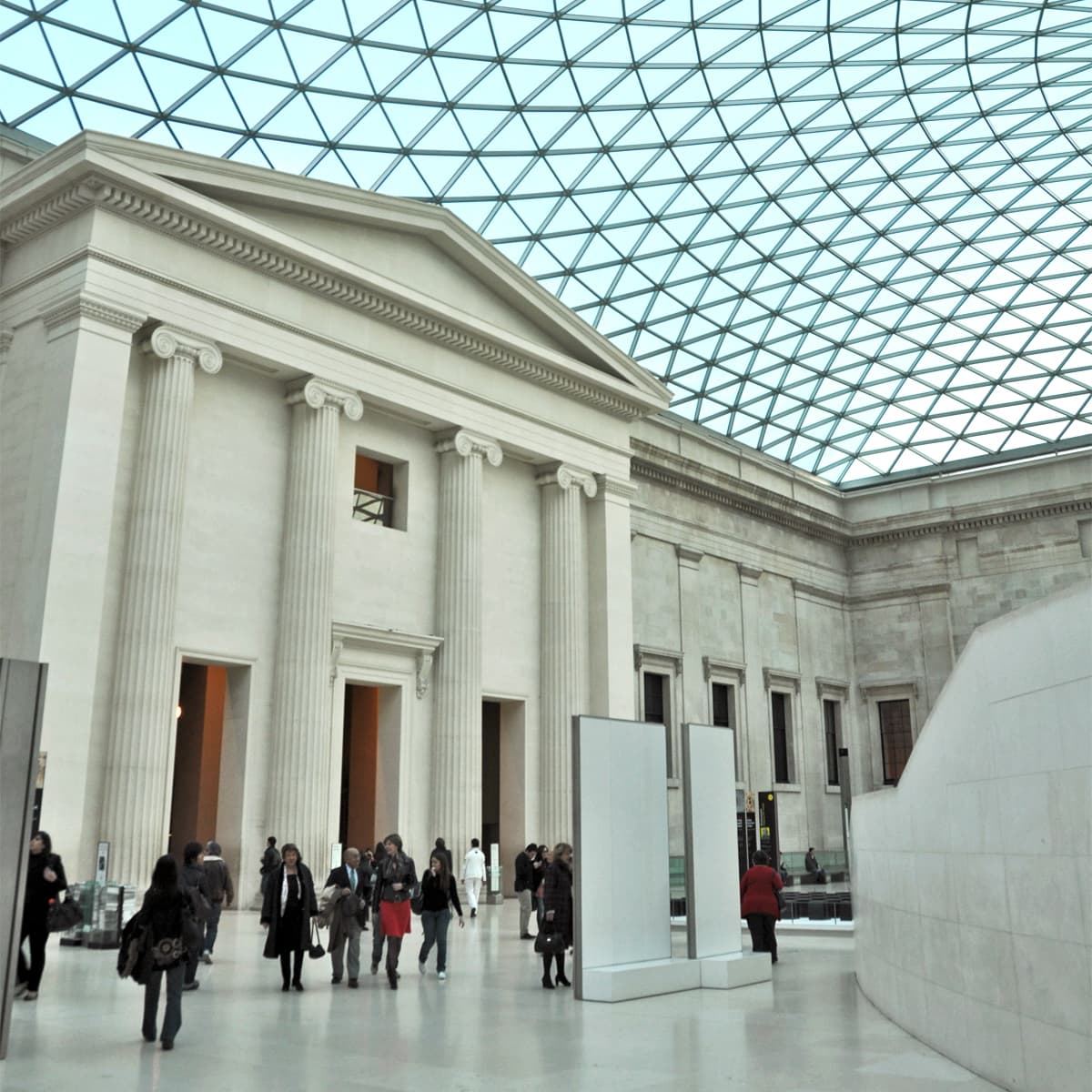
The tour begins. The Great Court. The main entrance spills you into the Great Court, a glass-domed space with the round reading room in the center. Enjoy the Great Court, Europe's largest covered square, bigger than a football field.
Here you'll find information desks, tours, a bookstore, and eateries. This people-friendly court, delightfully spared from the London rain, was for 150 years one of London's great lost spaces, closed off and gathering dust. Since its renovation and grand reopening in the year 2000, it's been the 140-foot-wide hub of a two-acre cultural complex. From the Great Court, doorways lead to all wings of this vast museum.
Read more...Show less
To the left are the exhibits on Egypt, Assyria, and Greece, and that's what our tour covers. Start heading to the left side of the round reading room, where you'll find the entrance to the Egyptian Gallery. As you pass by the reading room, consider its esteemed history. That library served as a study hall for great thinkers.
Oscar Wilde, Rudyard Kipling, Arthur Conan Doyle, T.S. Eliot, Virginia Woolf, W.B. Yeats, Mark Twain, Vladimir Lenin, and, for Karl Marx, while he was writing his communist masterwork, Das Kapital. Enter the Egyptian Gallery. Directly ahead of you is one of civilization's great treasures, the Rosetta. The Rosetta Stone.
Egypt: The Rosetta Stone
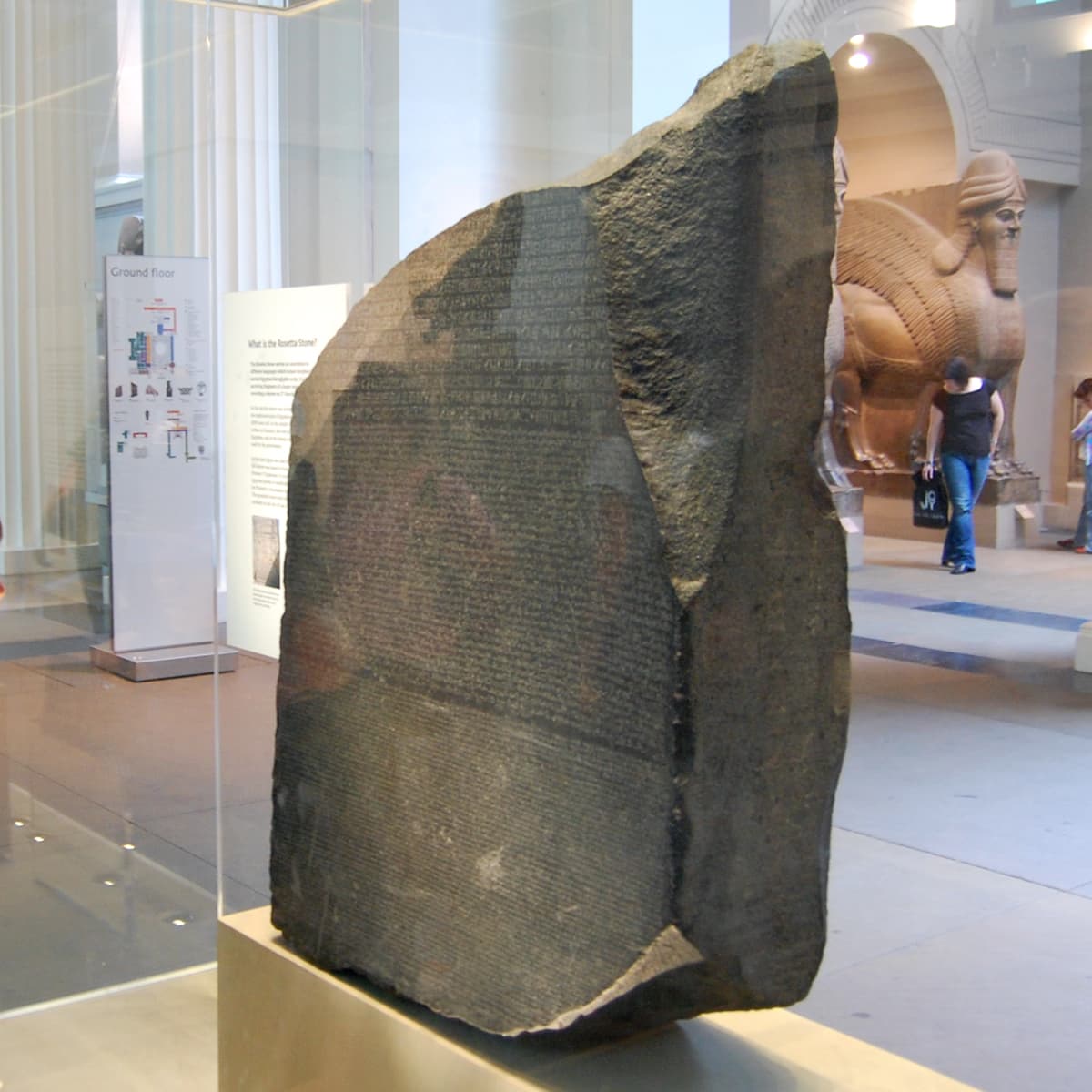
Egypt, the Rosetta Stone. When this rock was unearthed in the Egyptian desert in 1799, it was a sensation in Europe. This black slab caused a quantum leap in the evolution of history. Finally, ancient Egyptian writing could be decoded.
Egypt was one of the world's first civilizations, that is, a group of people with a government, religion, art, a written language, and with enough free time to explore those pursuits. The Egypt we think of, pyramids, mummies, pharaohs, and Geizu Wakfani, lasted from about 3,000 B.C. until about 1,000 B.C., with hardly any change in government, religion, or arts. Imagine two millennia, and you'll see the Rosetta Stone in three different scripts.
Read more...Show less
The upper part is known as hieroglyphics, the ancient written language whose meaning was lost over time. For centuries, scholars wondered, did a picture of a bird mean bird, or was it a sound forming part of a larger word, like burden? As it turned out, hieroglyphics are a complex combination of the two, surprisingly, more phonetic than symbolic. For example, the hieroglyph that looks like a human eye is actually a sound, like the letter R.
The Rosetta Stone allowed scientists to break the code. It contains a single inscription repeated in three languages. The bottom third is plain old Greek. Find your favorite frat or sorority.
The middle script is medieval Egyptian. By comparing the two known languages with the one they didn't know, ancient Egyptian, translators figured out the hieroglyphics. There was one particular clue that solved the mystery. Get as close as you can to the rock and see if you can find it.
It's near the top, the sixth line down. There, among all the hieroglyphs, find several large ovals. It turns out that those ovals were the name of the pharaoh, Ptolemy. Once they knew that part of the puzzle, they could begin translating all the rest.
Simple. The Rosetta Stone sits in the middle of the long Egyptian gallery. The Egyptian part of this tour is in this long room, plus a side trip upstairs to see the mummies. Our next stop is a few steps to the right of the Rosetta Stone, where you'll find the huge head of Ramses. ¶¶ King Ramses II, from around 1270 B.C.
King Ramesses II
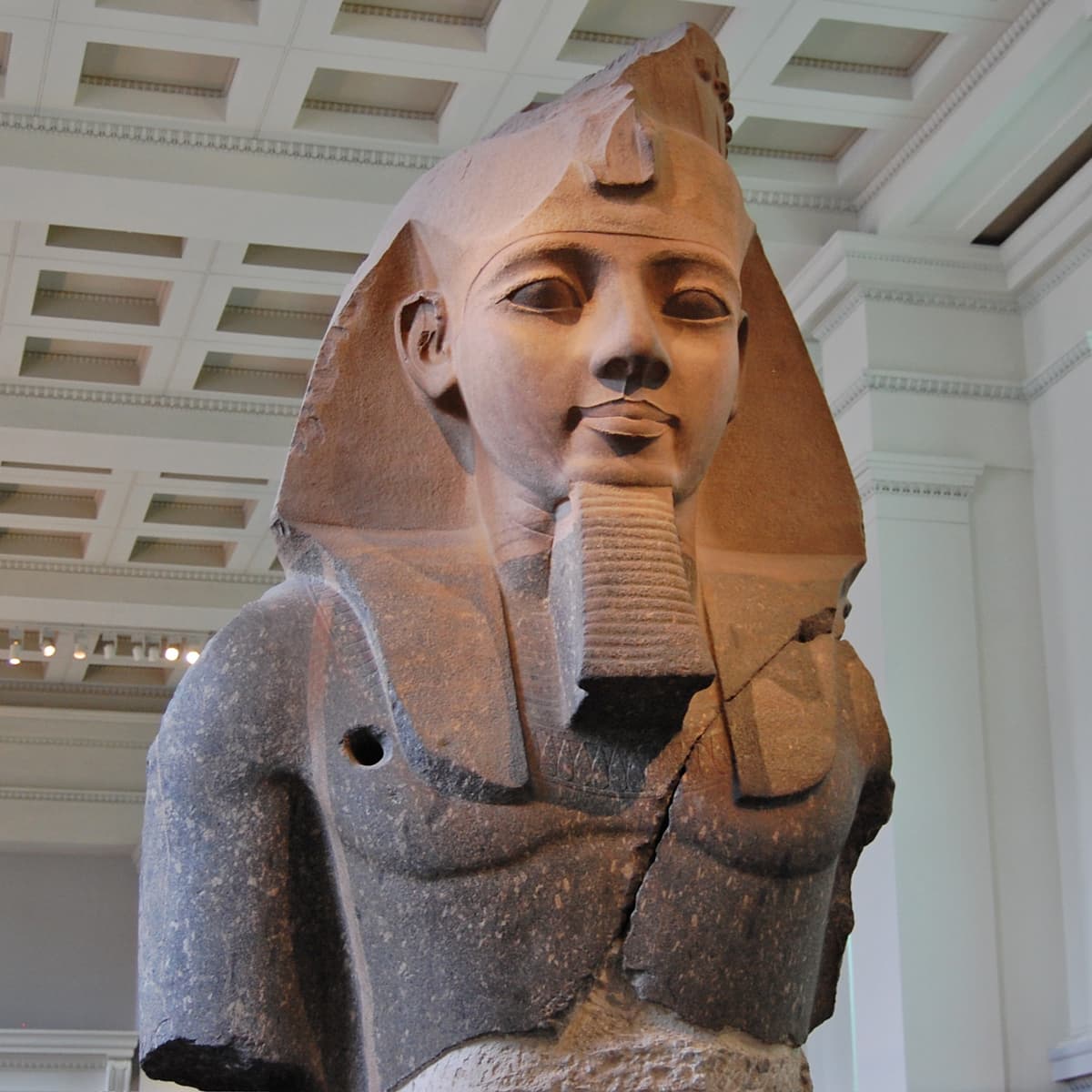
Let my people go. When Moses said those words to the king of Egypt, this may have been the stony-faced look he got in return. Ramses II ruled 66 years, from roughly 1290 to 1290, of 23 B.C. He may have been the pharaoh in power when the Israelites were enslaved in Egypt.
Their leader, Moses, cursed Egypt with plagues, freed the Israeli slaves, and led them out of Egypt to their homeland in Israel. That's what the Bible says, though it's not exactly corroborated by Egyptian chronicles. This seven-ton statue fragment, made from two different colors of granite, was part of a huge statue that once guarded a temple in Thebes. It shows Ramses with the traditional features of a pharaoh, goatee, cloth headdress, and cobra diadem on his forehead.
Read more...Show less
Ramses is known to history as the last great pharaoh before Egypt's thousand-year decline. He was a great builder of temples, palaces, tombs, and statues of himself. There are probably more statues of Ramses in the world than there are cheesy fake Davids. He was so concerned about leaving a lasting legacy that he even chiseled his own name on other people's statues.
Very cheeky. Picture what the archaeologists saw when they came upon this, a colossal head and torso separated from its enormous legs and toppled into the sand, all that remained of the work of a once mighty pharaoh. Kings, megalomaniacs, and workaholics, take note. Ooh, heavy. Now, climb the ramp behind Ramses, looking for animals. EGYPTIAN GODS AS ANIMALS Egyptian gods as animals.
Egyptian Gods as Animals
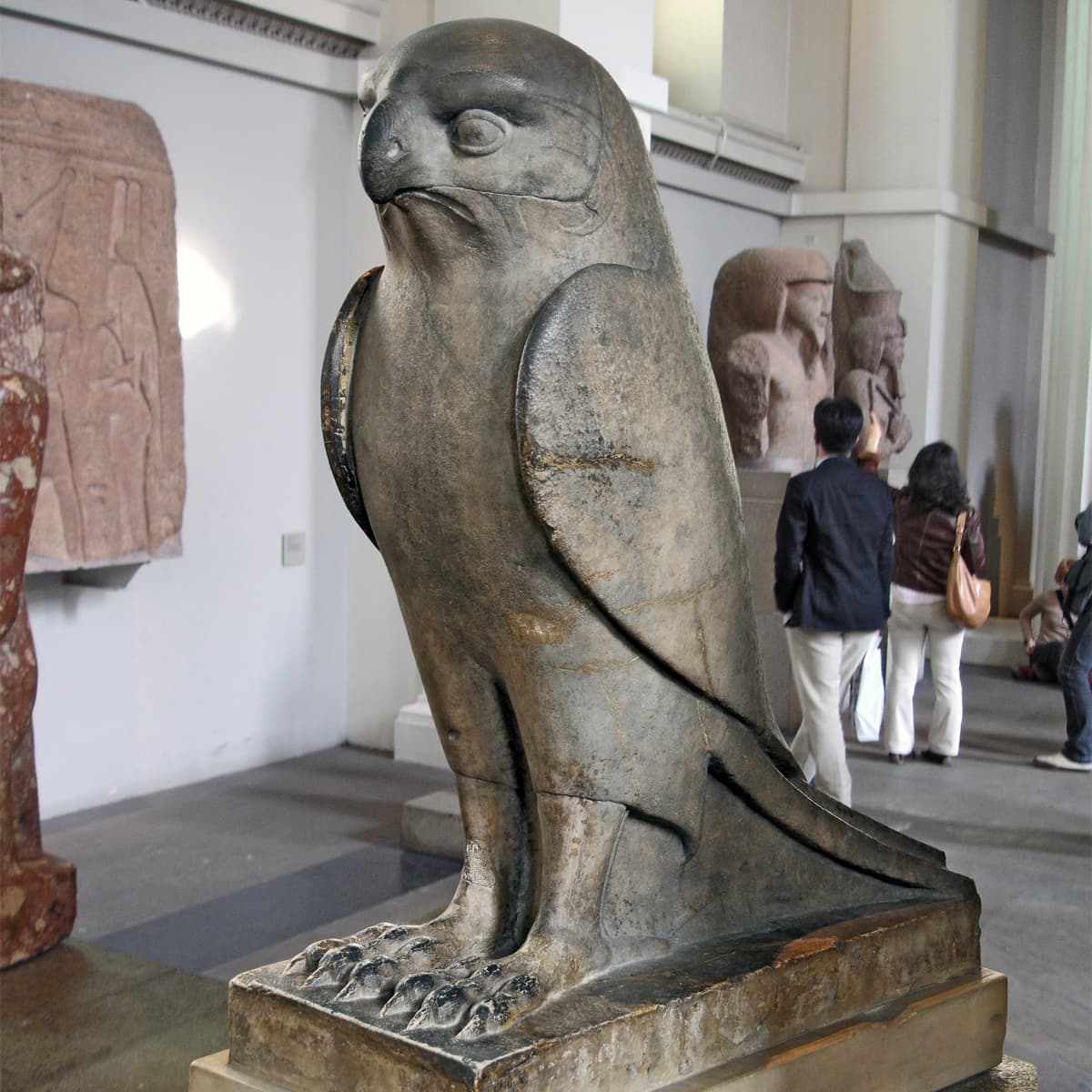
Before technology made humans the alpha animal on Earth, it was easier to appreciate our fellow creatures. Animals were stronger, swifter, and fiercer than puny Homo sapiens. Consequently, the Egyptians worshipped animals as incarnations of the gods. Stroll up the ramp, and try to recognize, first, what the animal is, and, second, what Egyptian god it represents.
Be aware that the menagerie on display often changes. The powerful ram is the god Amun, king of the gods. He's shown protecting a fragile pharaoh under his powerful chin. The falcon is Horus, the god of the living.
Read more...Show less
The speckled-standing hippopotamus with the lion's head is Tawaret, protectress of childhood, her stylized breasts and pregnant belly are supported by ankhs, symbols of life. Hmm, is Tawaret grinning with joy or grimacing in labor? Finally, there's the cat, accessorized with both earrings and nose rings. The cat served Bastet, the popular goddess of stress relief.
The goddess of what? Well, it was one of her many duties as protector of the happy home. Bastet was also the fierce protector of pharaohs in Bastet. Ferocious yet docile.
And her symbol is the cat? Perfect. Perfect. Walk back down the ramp and start heading for the far end of the gallery.
Scattered around this part of the gallery are huge stone boxes. The famous mummies of ancient Egypt were wrapped in linen, then encased in finely decorated wooden coffins, which were finally placed inside these massive stone coffins. Imagine the pallbearers. Continue toward the far end of the Egyptian gallery where you'll find a big stone beetle.
Colossal Scarab
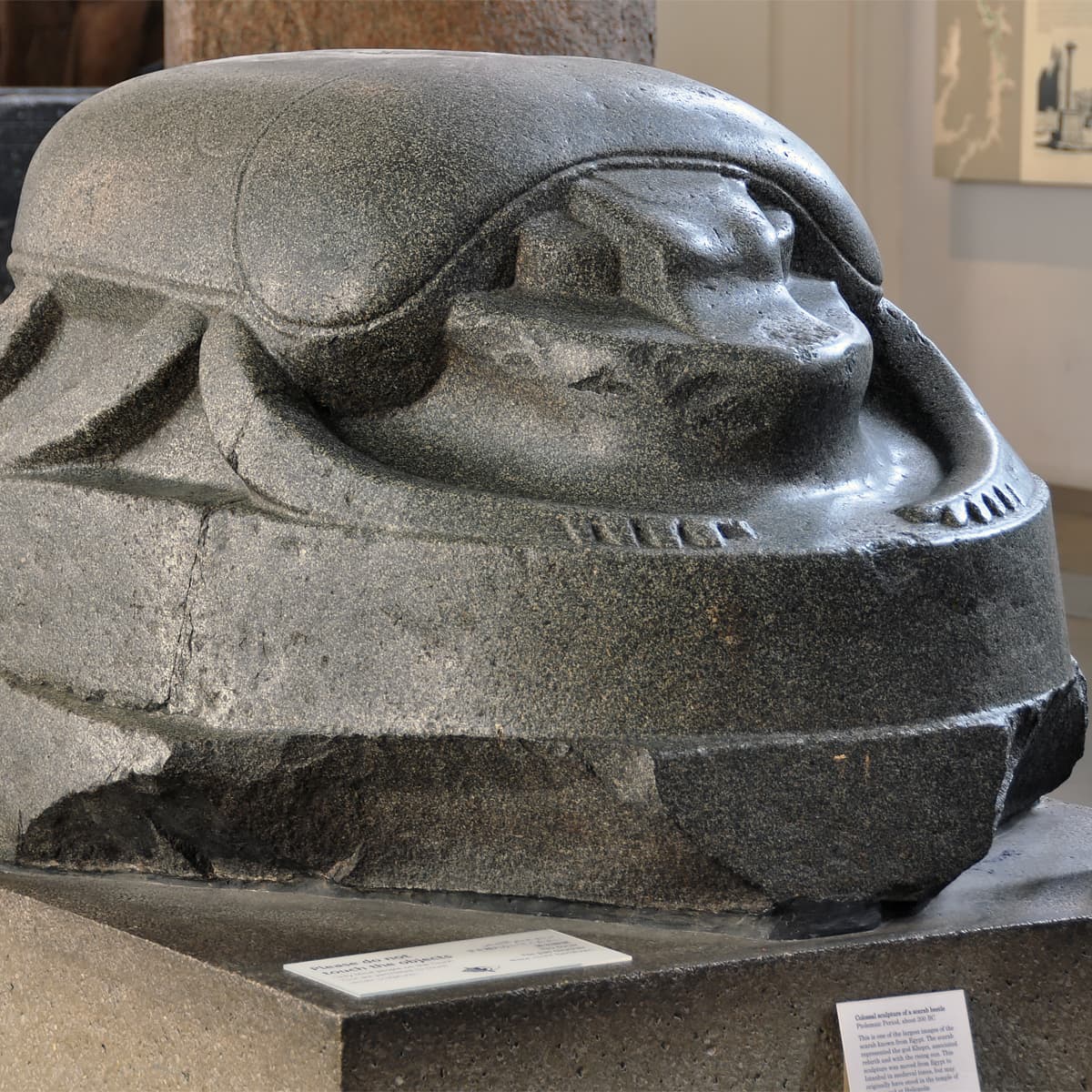
A colossal scarab from around 200 B.C. This scarab, or species of beetle, would burrow into the ground then reappear like the sun rising and setting or dying and rebirth. The scarab was a symbol of resurrection. Pharaohs wore the symbol of the beetle.
Tombs and temples were decorated with them, and the scarab hieroglyph meant to come into being. Scarab amulets were placed on mummies' chests to protect the spirit's heart from acting impulsively. Until you see the mummies, you can't call Egypt a wrap. You'll find the mummies upstairs.
Read more...Show less
To get there, continue to the end of the gallery past the giant stone scarab and up the west stairs. Four flights. As you climb the stairs, admire the ancient Roman mosaics in the stairwell. The colors are typical of what was popular in Rome back then.
Red, black, brown, white, light green. Romans loved to portray nature inside their homes, on the floors and on the walls. Let's see. There's some dogs.
And they're hunting lions. There's dolphins. Those are dolphins? They're kind of weird-looking.
Yeah, but dolphins nevertheless. Oh, there's a wild boar. I can see an antelope, some pheasants, and a few other birds. There's also vases with flower designs, geometric patterns.
Hey, even some portraits of Roman citizens. And they're all made from the same small cubes of colored stone or glass pressed into cement. Romans really perfected the art of mosaics, but they were pioneered by the Egyptians. Egypt was conquered first by the Greeks, then by the Romans.
As societies conquer, they also borrow from the people they conquer. One talent that got passed from civilization to civilization was the art of mosaics. Egyptians had decorated their walls and floors with mosaics. Greeks learned the art form from the Egyptians, then passed it on to the Romans, who did the mosaics you see here.
Like the scarab beetle, ancient Egypt was buried, but continues to live on in the cultures that have followed. By now, you should be at the top of the stairs. Oof! Speak for yourself, Captain Fitness.
Huh. Actually, I was just, uh, stopping to admire the wild boar. Yes, it was breathtaking. When you reach the top of the stairs, take a left into Room 61.
As you enter Room 61, ankle slightly to the left and head toward the far wall. There, you'll find the painting Rick describes next.
Painting of Nebamun Hunting in Marshes
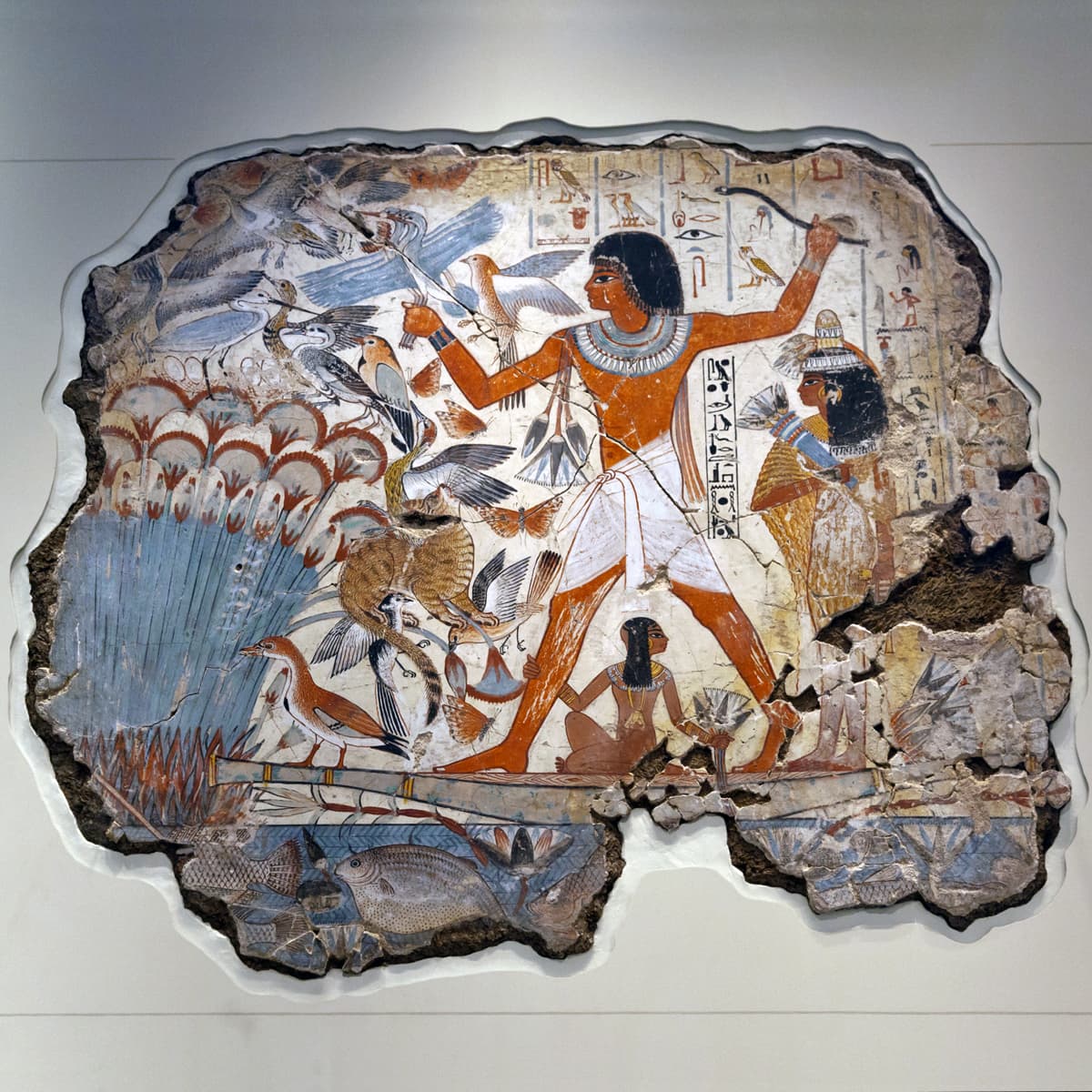
Painting of Nebamun Hunting in the Marshes Nebamun stands in a reed-bound room. He's in a boat, gliding through the marshes. He raises his arm, ready to bean a bird with his snake-like hunting stick. On the right, his wife looks on, while his daughter crouches between his legs, a symbol of fatherly protection.
This nobleman walks like an Egyptian statue looks, stiff and flat, like he was just run over by a pyramid. We see the torso from the front and everything else, arms, legs, and face, in profile. This creates the funny walk that's become an Egyptian cliché. The stiff pose is softened by a human touch.
Read more...Show less
It's a family snapshot of loved ones from a happy time. The birds, fish, and plants are painted realistically, like encyclopedia entries. By the way, the bush on the left is a papyrus plant, which gave us the first paper. The only unrealistic element here is the house cat.
You'll find it thigh-high, in front of the man. The cat's acting like a retriever, possibly the only cat in history that ever did anything useful. As Nebamun passed into the afterlife, his awakening soul could look at this painting on the tomb wall and think of his wife and daughter doing what they loved for all eternity. Head for the next room, room 62.
Rooms 62 and 63 are filled with displays in glass cases. Rooms 62 and 63 are filled with displays in glass cases. Browse around these two rooms while Rick describes what you see.
Rooms 62 and 63: Egyptian Funeral
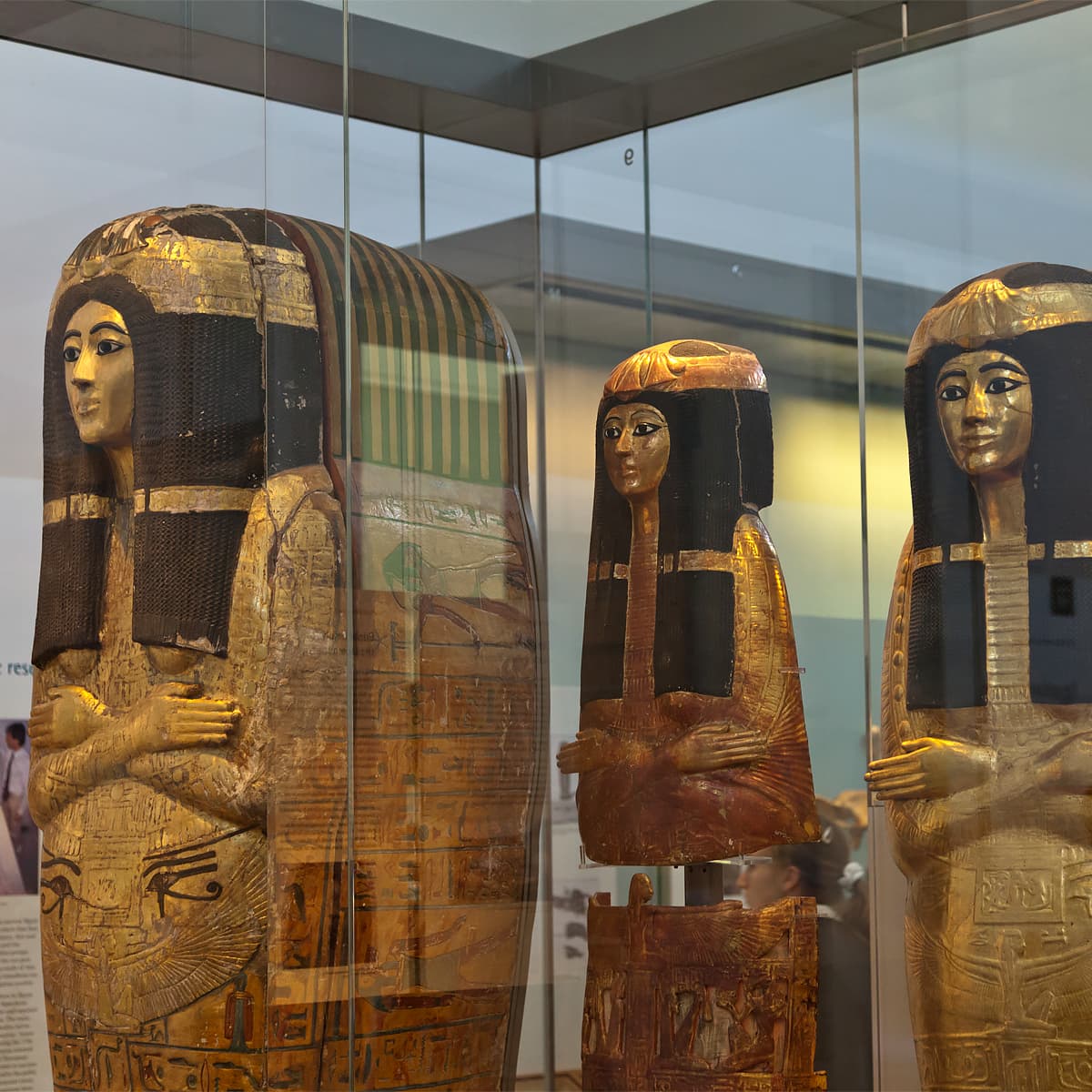
Rooms 62 and 63, the Egyptian funeral. There are several corpses in this room. Go ahead, find yourself a mummy. The museum usually has several on display in these rooms.
Get close and take a good look at one of these well-preserved bodies. Then, glance around at the other glass cases. In these rooms, you'll find coffins, tomb paintings, canopic jars, statuettes, even animal mummies. These objects all have something to do with Egyptian funeral practices.
Read more...Show less
Mummifying a body is much like following a recipe. Imagine the joy of embalming. Take it, Julia Child. Take it, Julia Child.
Mummify a body, disembowel it, but leave the heart inside, pack the cavities with pitch, and dry it with natron, a natural form of sodium carbonate, which I believe is also the active ingredient in Twinkies. Then carefully bandage the body from head to toe with hundreds of yards of linen strips. Let it sit 2,000 years, and voila! Or just dump the corpse in the desert and let the hot, dry, bacteria-killing Egyptian sand do the work.
With all due respect, you'll get the same results. The mummy was placed in a wooden coffin, which was put in a stone coffin, which was then placed in a tomb. By the way, the pyramids were basically just supersized tombs to protect the mummies of the rich and famous. Don't miss the animal mummies in Room 62.
Surveying the exhibits in this room, you'll notice that cats must have been popular pets. Remember, cats were considered incarnations of the goddess Bastet. Worshipped in life as the sun god's allies, preserved in death, and memorialized with statues for eternity, Egyptian cats were given the adulation they've come to expect ever since. Keep browsing.
Room 63 has more funerary objects. You'll see canopic jars displayed in these rooms. The eternal organs of the deceased were preserved in these urns alongside the mummy. And small statuettes of the deceased, called shabtis, were scattered all around the gravesite.
Notice the hieroglyphs on the coffins and on the tomb walls. These were written burial rites from the Book of the Dead. They were essentially magical spells designed to protect the body and crib notes for the waking soul. The soul needed to know secret passwords to get past the guardians of eternity.
Many of the mummies here are from the time of the Roman occupation, when they painted a fine portrait in wax on the wrapping. X-ray photos in the display cases tell us more about these ancient people. Our next stop is in room 64. Browse the displays along the way.
But remember that eternity is about the amount of time it takes to see this entire museum. Thank you, Rick. We'll meet up with you next time. We'll meet up again in room 64, where you'll find a glass case containing a body.
It's the remains of a tourist who tried to see it all. The glass case in room 64 contains the preserved corpse of a man known to scientists as Ginger.
Gebelein Man, a.k.a. “Ginger”
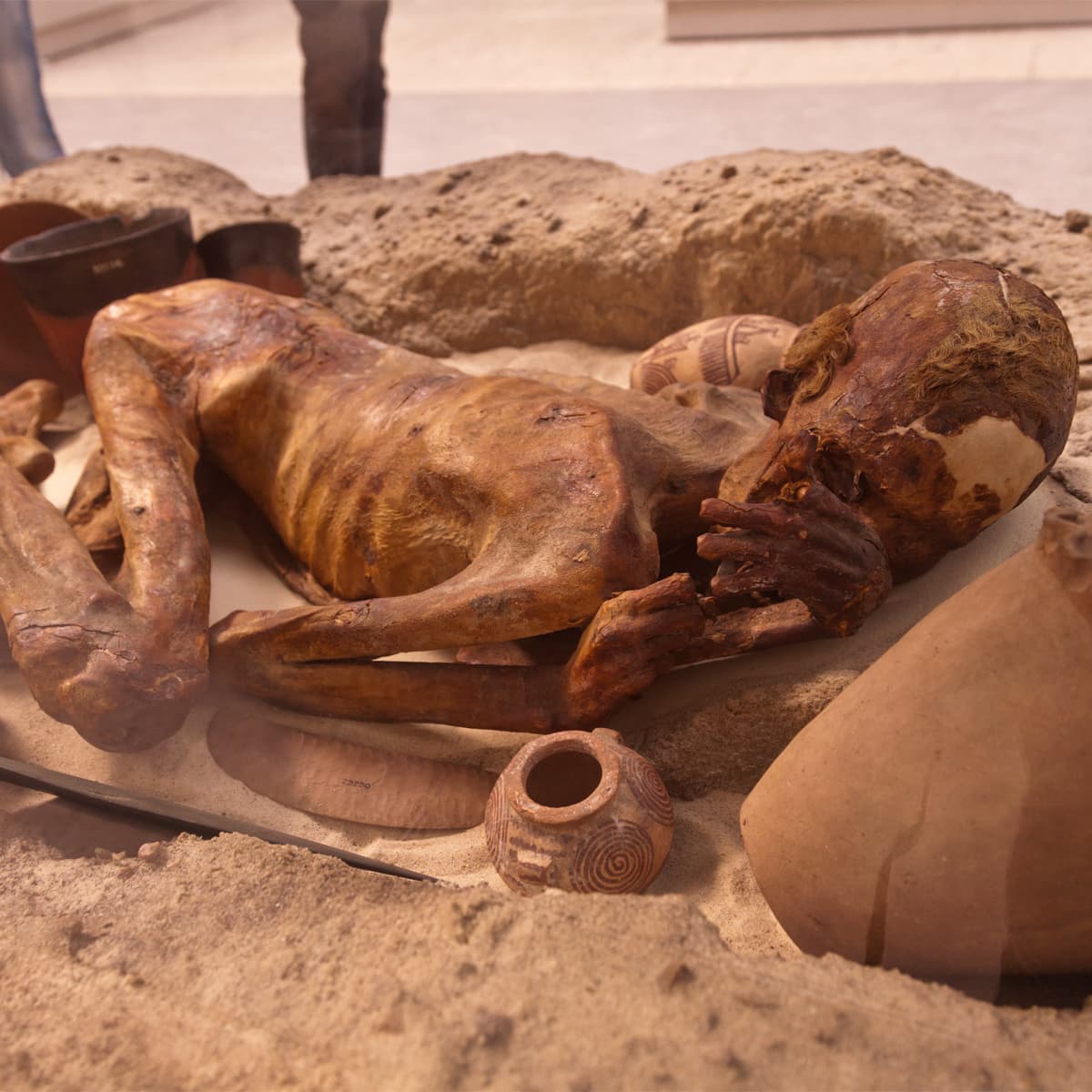
Gebelein Man, also known as Ginger. This man died 5,400 years ago. That's a thousand years before the first pyramid. His people buried him in the fetal position where he could sleep for eternity.
The hot sand naturally dehydrated and protected his body. Buried with him are a few of his possessions. Bowls, beads, and next to his arm, a flint blade. His grave was covered with stones.
Read more...Show less
Named Ginger by scientists for his wisps of red hair, this man, from a distant time, seems very human. We'll continue our tour downstairs near the Rosetta Stone, where our next statue is located. So start backtracking the same way you came, back through rooms 63, 62, 61, back to the staircase. As you walk back, passing all the display cases again, it's a good chance for a review.
Let's see here. You got your mummies. Check. These were preserved with salts and wrapped in linen.
Um, you got your coffins. Check. These were decorated with hieroglyphs from the Book of the Dead. Shabtis.
Check. Those were the statuettes of the deceased. Canopic jars. Check.
They preserved the innards. Oh, and Lisa, we can never forget cat mummies! Perfectly preserved. When you reach rooms 61, say farewell to Nebamoon.
Then exit to the left. You'll find yourself at the top of the same stairs we came up, the ones with the mosaics. Start heading back down the stairs to the Egyptian gallery and the Rosetta Stone. If you'd like some traveling music while you walk like an Egyptian, Nyan nyan nyan nyan nyan nyan nyan nyan nyan nyan nyan nyan nyan nyan No, you don't have to listen to that.
Here's a piece of music heard in Egypt today. This is a song that features a kind of hammered dulcimer called the santur. Listen while you walk, or you can pause the audio tour now, and we'll meet again downstairs near the Rosetta Stone. Thank you.
© transcript Emily Beynon Downstairs, make your way back through the Egyptian gallery to the Rosetta Stone. Passing the Scarab again, the huge stone coffins, the animal gods, and past that pharaoh with the big head, Ramses. Our next stop is just beyond the Rosetta Stone, a few steps past it. Look for another huge head he's facing away from you. This pharaoh has a hat shaped like a bowling pin. © transcript Emily Beynon
Head and Arm of Statue of Amenhotep
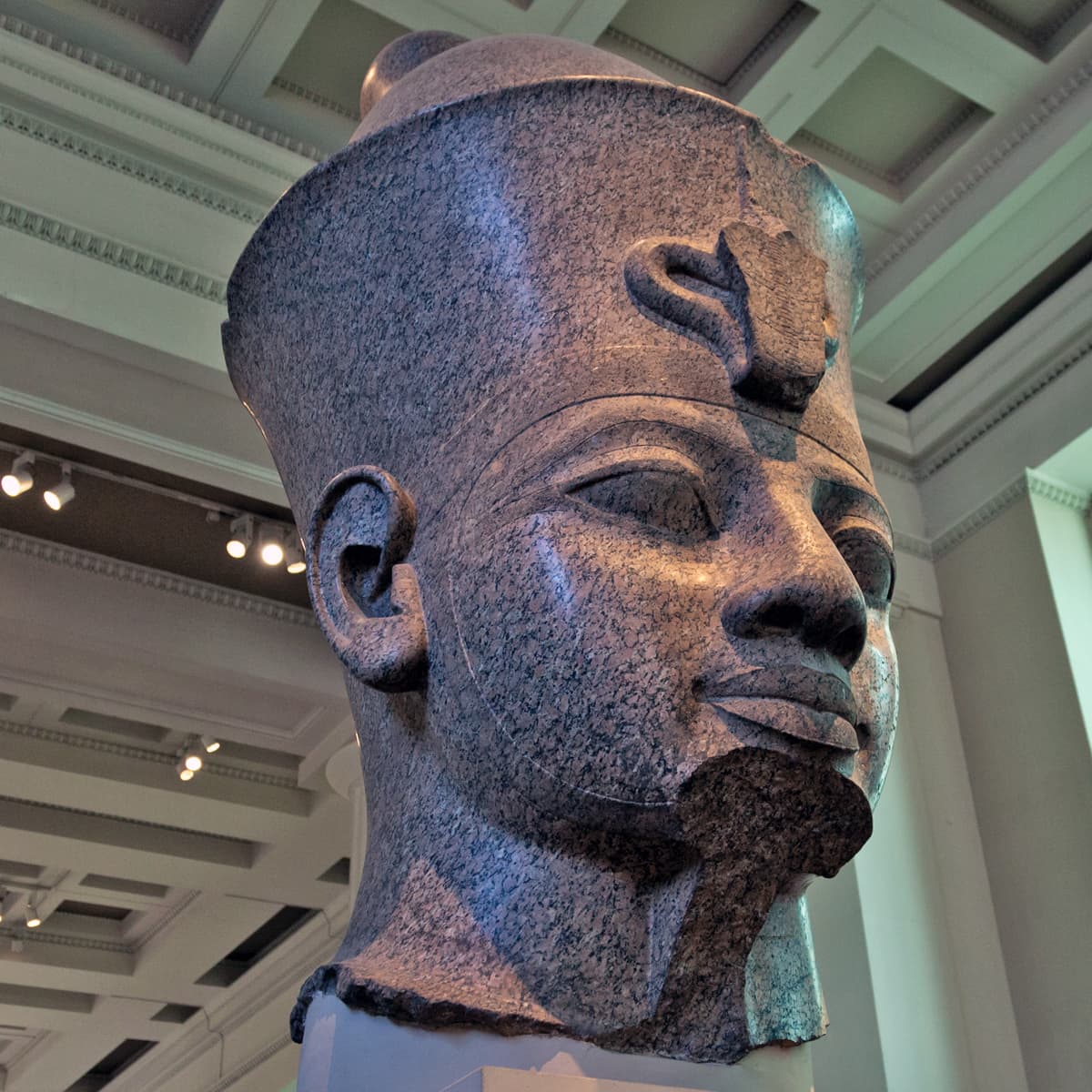
This is, appropriately, the pharaoh's powerful fist, the long arm of the law, Egyptian style. The crown is actually two crowns in one. The pointed upper half is the royal cap of Upper Egypt. This rests on the flat, fez-like crown symbolizing Lower Egypt.
A pharaoh wearing both crowns together is bragging that he rules a unified Egypt. As both lord of the two lands and high priest of every temple, the pharaoh united both. Church and state. As you face the red granite head, look to the left. Along the wall are four black, lion-headed statues.
Goddess Sakhmet
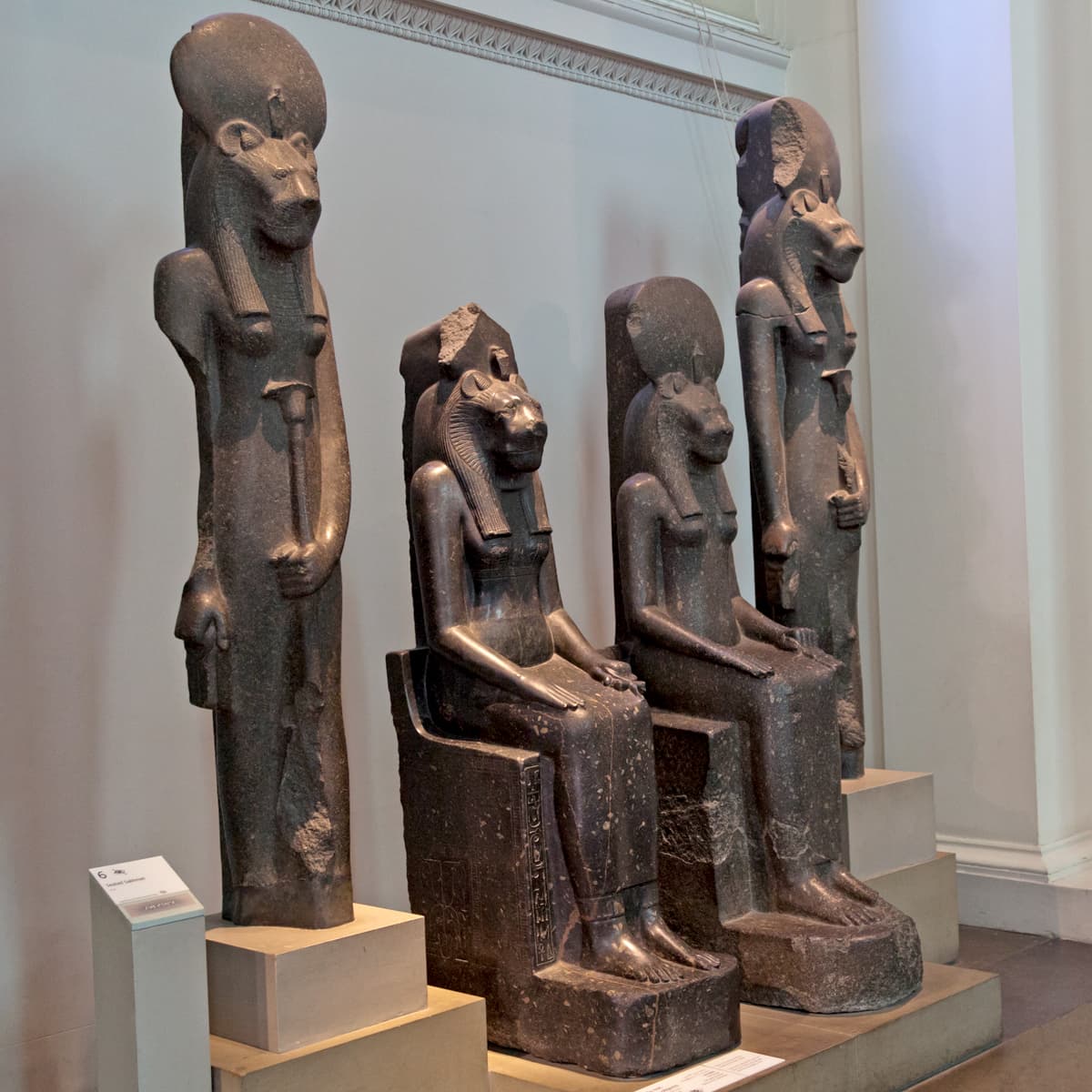
The goddess Sakmet, from 1400 B.C. This lion-headed goddess looks pretty sedate here. But she could spring into a fierce crouch when crossed. Sakmet was the pharaoh's personal bodyguard who could burn his enemies to a crisp with flaming arrows.
Gods like Sakmet ruled the Egyptian cosmos like dictators in a big banana republic. Egyptians bribed their gods for favors, offering food, animals, or money, or by erecting statues like these. Notice that Sakmet holds an ankh. This key-shaped cross was the hieroglyph meaning life.
Read more...Show less
It symbolized eternal life. Later, it was adopted as a Christian symbol because of its cross shape and religious overtones. Continue down the Egyptian gallery. A few paces along, near the middle of the hall, find a glass case containing a two-and-a-half-foot hunk of stone from the Great Sphinx. Limestone Fragment of the Beard of the Sphinx
Limestone Fragment Beard of Sphinx
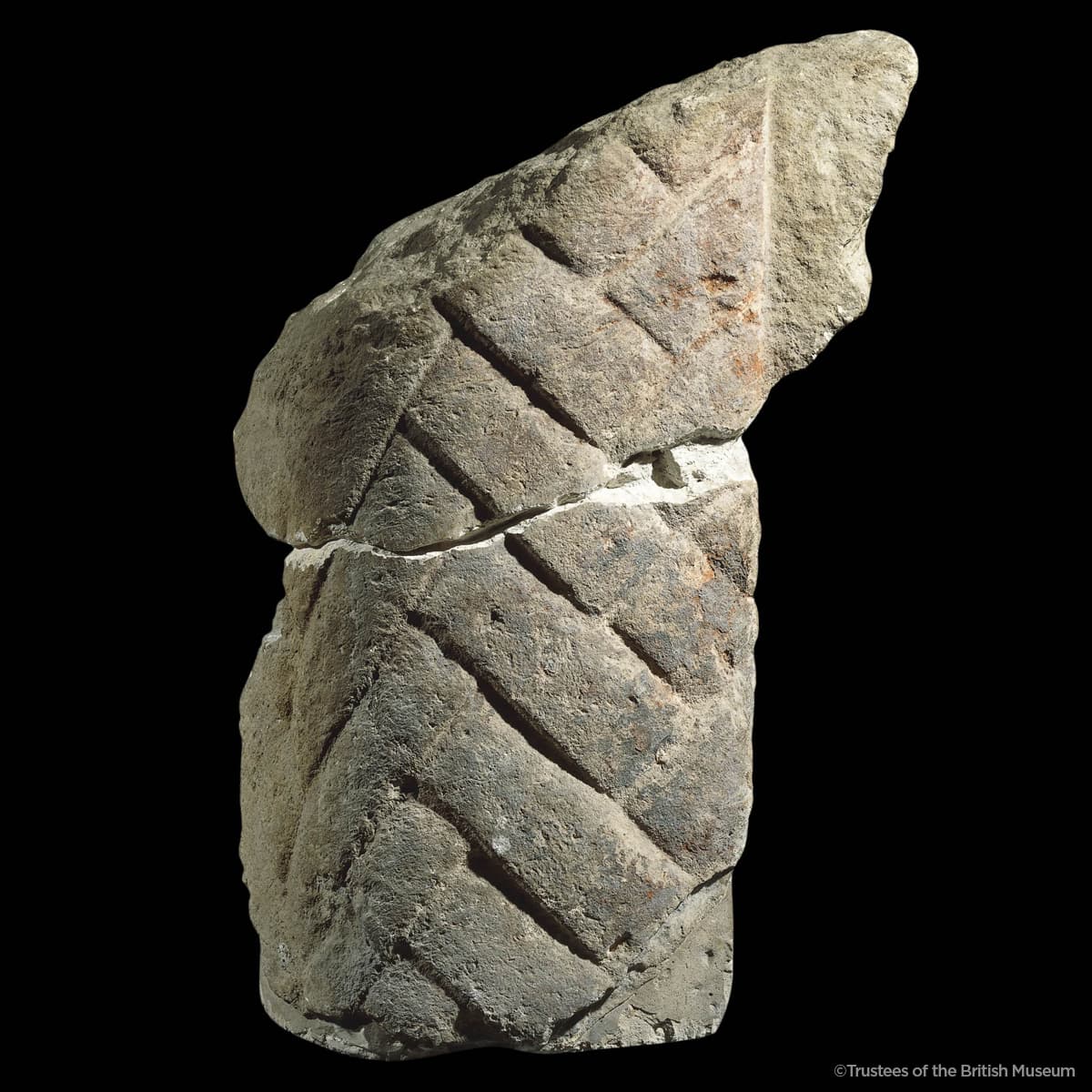
The Great Sphinx, a statue of a pharaoh-headed lion, crouches in the shadow of the Great Pyramids in Cairo. Time shaved off the Sphinx's soft, sandstone, goatee-like beard, and a piece of it is now preserved here in a glass case. This hunk of stone is only about 3% of the massive beard, giving an idea of the scale of the whole statue. Six stories tall and nearly 250 feet long.
The Sphinx is as old as the pyramids, built during the time known to historians as the Old Kingdom, probably around 2500 B.C. But the beard may have been added later, around 1400 B.C., to give the Sphinx the ceremonial beard of a pharaoh. From the Sphinx's soul patch, continue 10 paces down the gallery to a 10-foot-tall building tinted red and covered in hieroglyphics.
Limestone False Door, Architrave
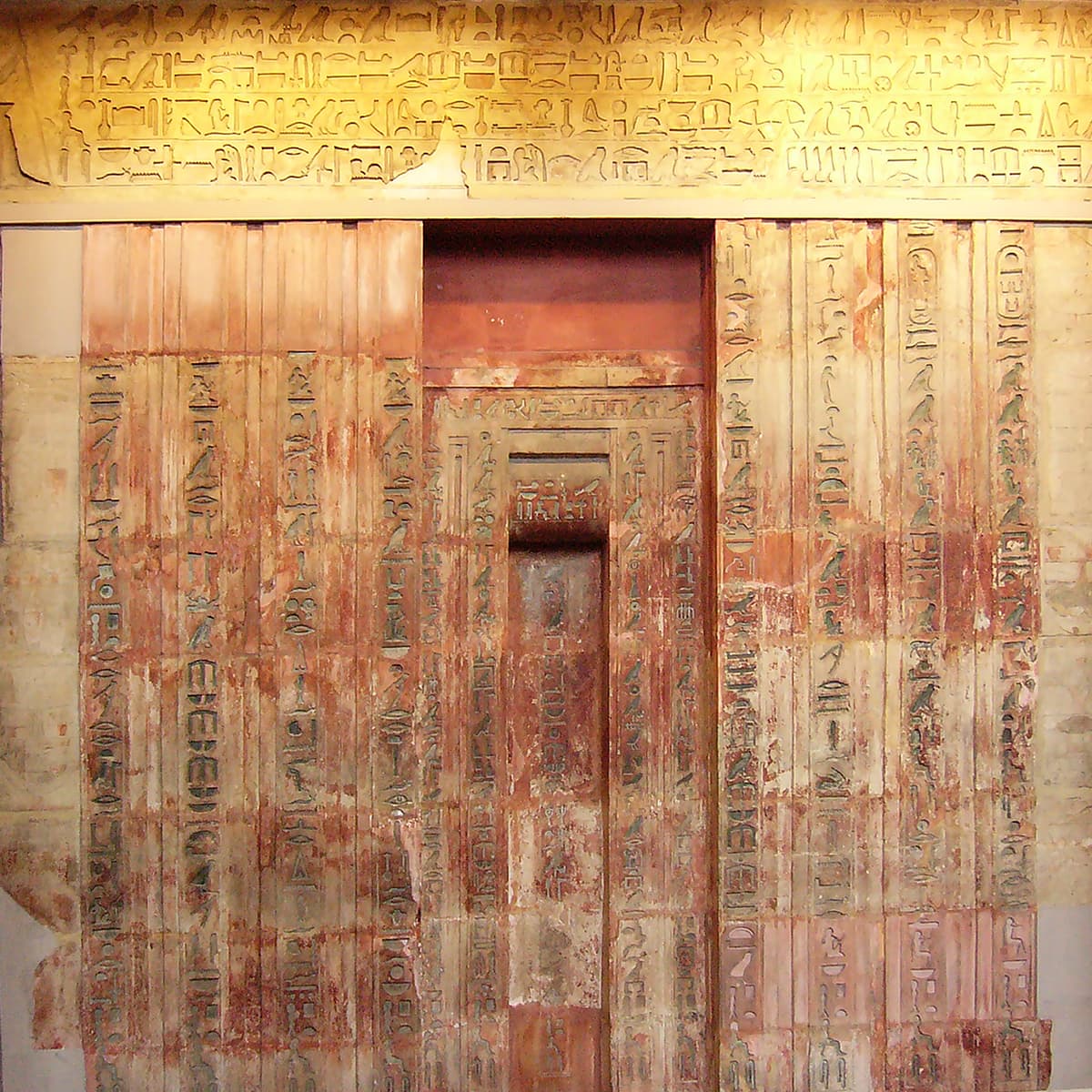
Limestone False Door and the Architrave of Patashepsis This false door was a ceremonial entrance never meant to actually open for this sealed building called Amastaba. This building marked the grave of a man named Patashepsis. The hieroglyphs on the building, of eyes broad, birds and rabbits, served as his epitaph. They tell his life story, how he went to school with the pharaoh's kids, became one of the pharaoh's honored advisors, and married the pharaoh's daughter.
The deceased was mummified and placed in a wooden coffin. That was encased in a stone coffin, which was, in turn, placed in a large stone sarcophagus. There's an example of a sarcophagus right in front of Patashepsis' door. This would then be buried 50 feet beneath the mastaba in an underground chamber, where the deceased would be buried for the rest of his life.
Read more...Show less
Mastabas, like Patashepsis, were decorated inside and out with statues and frescoes like those displayed nearby. These pictured the things that the soul would find useful in the next life. Magical spells, lists of the dearly departed's accomplishments, snapshots of the deceased and his family while alive, and secret passwords from the Egyptian Book of the Dead. False doors like this allowed the soul, but not grave robbers or unwanted in-laws, to come and go at will for eternity. Just past Patashepsis' false door is a glass case containing a statue.
Statue of Nenkheftka
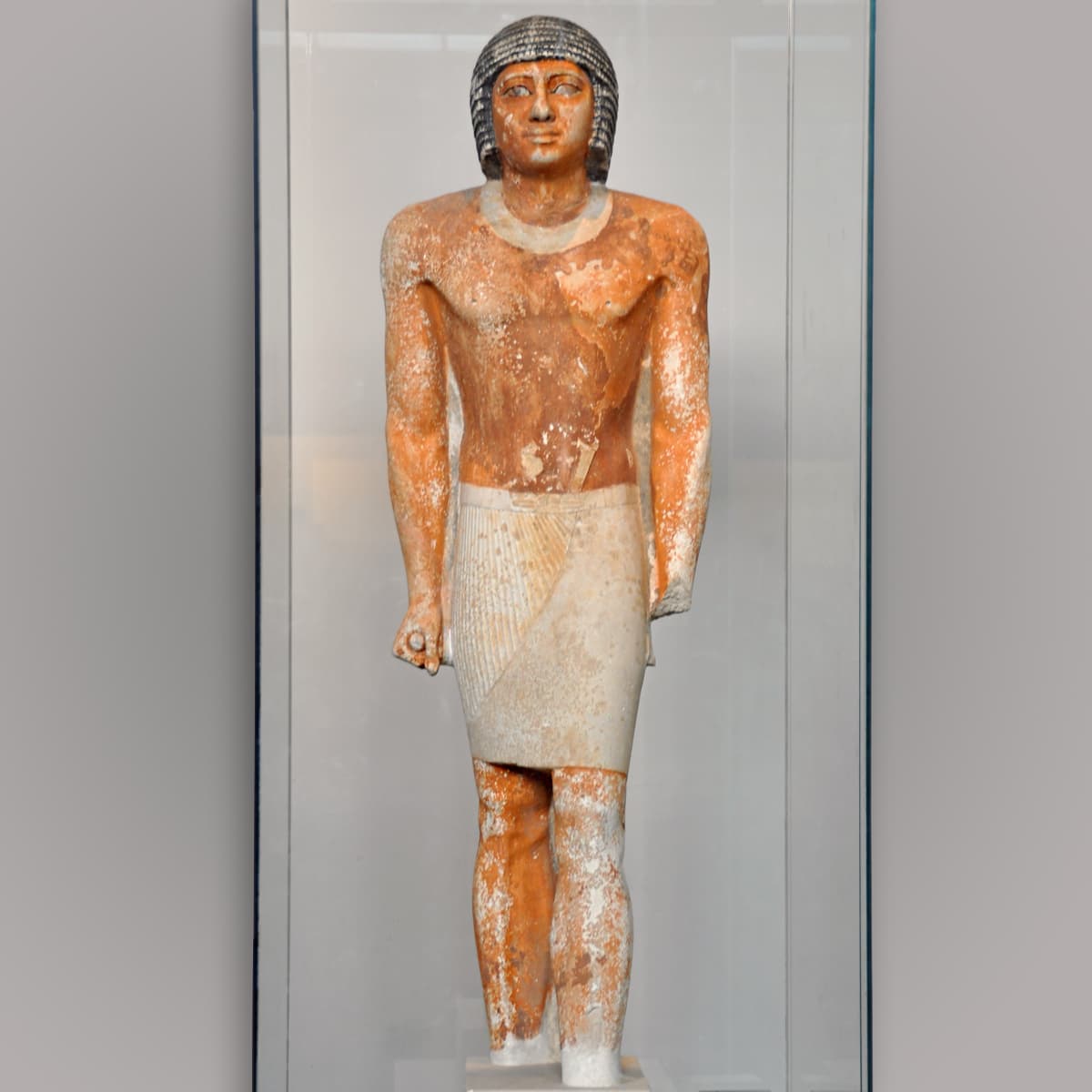
Statue of Nenkeftka This statue originally stood in the false door of a mastaba. It represented the soul of the deceased, still active, coming in and going out of his burial place. This was the image of the departed that greeted his loved ones when they brought food offerings to place at the statue's feet, hoping to nourish his soul. In the mummification rites, the mouth was ritually opened to prepare it to eat what you might call soul food.
In ancient Egypt, you could take it with you. They believed that after you died, your soul lived on, enjoying its earthly possessions, sometimes even including servants, who might actually be walled up alive with their entombed master. Statues served as a kind of refuge for the soul on its journey after death. The rich scattered statues of themselves everywhere just in case.
Read more...Show less
Statues needed to be simple and easy to recognize, mug shots for eternity, arms down, chin up, nothing fancy. Though stiff, this particular statue has all the essential features. It's like the simplified human figures on international traffic signs. To a soul caught in the fast lane of astral travel, this simple symbolic statue would be easier to spot and recognize.
With their fervent hope for life after death, Egyptians created calm, dignified art that seems built for eternity. From ancient Egypt, it's time to move on to... to... to...
to... to... to... Rick, it's time to move on to the next great civilization, Assyria.
Near the end of the Egyptian gallery are two huge Assyrian lions with wings and bearded human heads. They stand guard over the Assyrian exhibit halls. Assyria, two human-headed winged lions.
Assyria: Two Human-Headed Winged Lions
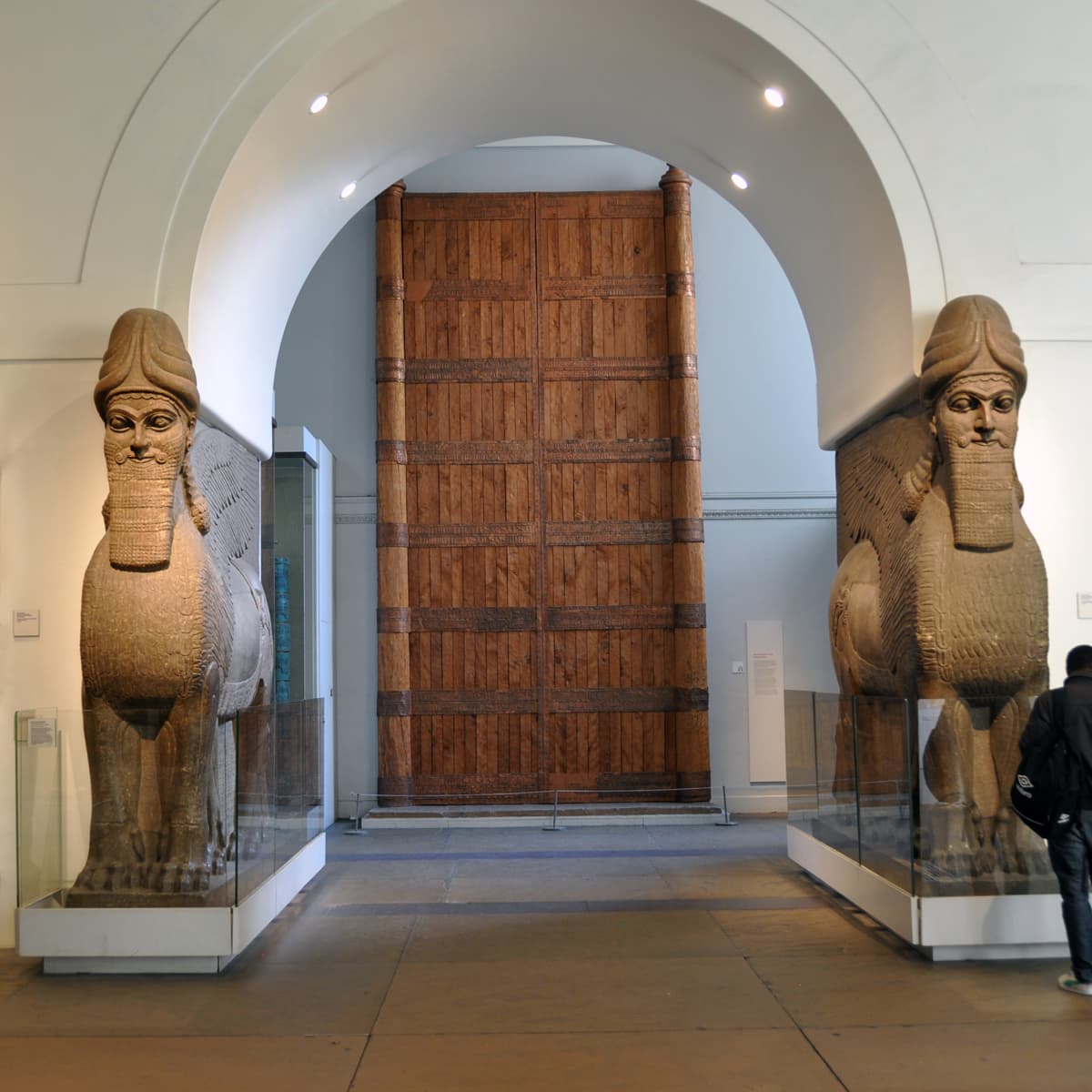
Long before Saddam Hussein, Iraq was home to other palace-building, iron-fisted rulers, like the Assyrians. These lions guarded an Assyrian palace in what is now Iraq back in 860 B.C. With the strength of a lion, the wings of an eagle, the brain of a man, and the beard of Zizi Top, they protected the Assyrian king from evil spirits, and scared the heck out of foreign ambassadors and left-wing newspaper reporters. Metaphorically speaking, Assyria was the lion, the king of beasts of early Middle Eastern civilizations.
The Assyrians, from their home in what is now northern Iraq, dominated the Middle East for three centuries, from 900 to 600 B.C. Hey, Lisa, what has five legs and flies? Hmm, I don't know, Rick. What?
Read more...Show less
Take a close look at the big winged lions. These quintipeds, appear complete both from the front and from the side, so they could guard both directions at once. Carved into the stone between the bearded lions' loins, you can see one of civilization's most impressive achievements, writing. This wedge-shaped script, called cuneiform, is the world's first written language, invented 5,000 years ago by the Sumerians of southern Iraq.
They passed it down to their less civilized descendants, the Assyrians. Now, walk between the lions, glance at the large, reconstructed wooden gates from an Assyrian palace, and turn right into the long, narrow, red gallery, Room 7. It's lined with brown relief panels. By the way, if the Assyrian rooms happen to be closed during your visit, just pick the tour up again on Track 20 with Greek Art. Now, enter the Assyrian rooms. The Nimrud Gallery,
Nimrud Gallery: Palace of Ashurnasirpal II
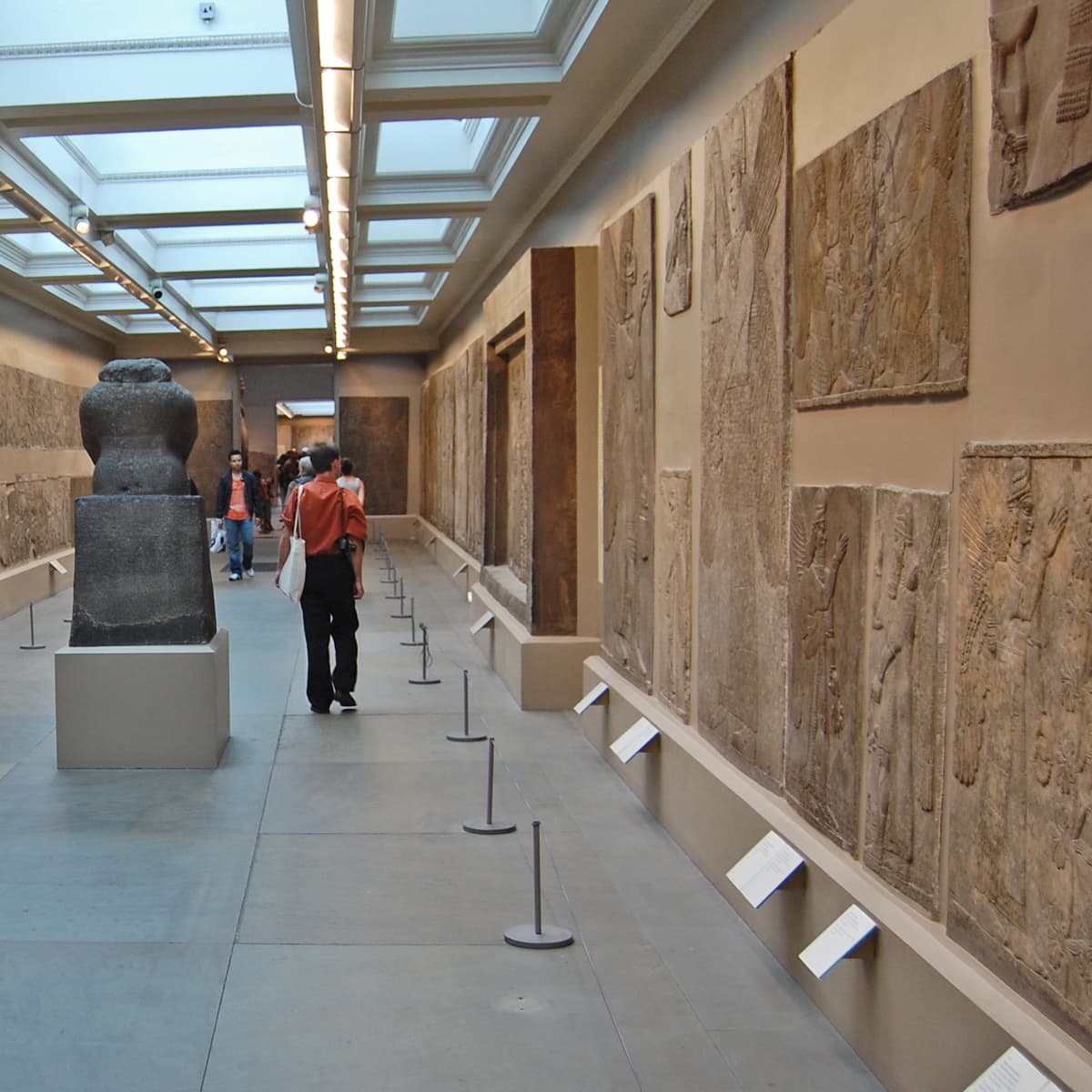
Palace of Ashur-Nazir-Paul II, 9th century B.C. This gallery is a mini version of the throne room of King Ashur-Nazir-Paul II's palace at Nimrud. As you enter, imagine what you would have seen nine centuries before Christ. The king would be sitting on his throne at the far end, shaded by a parasol and flanked by winged lions.
He'd be surrounded by these relief panels, which were originally painted in bright colors and finished with a shiny varnish. Find the king himself in the first panel on your right. He's the one with the braided beard, earring, and fez-like crown. He's flanked by his supernatural hawk-headed henchmen.
Read more...Show less
They sprinkle incense on their king with pine cones. The bulging forearms hint at Ashur-Nazir-Paul's reputation as a merciless warrior who used torture and humiliation as part of his life. As a result, of his distinct management style. Under his reign in the early 9th century B.C., the Assyrians dominated the Mideast from their capital at Nineveh in present-day northern Iraq.
Ashur-Nazir-Paul II proved his power by building a brand-new palace decorated by these panels in nearby Nimrud. The cuneiform inscription running through the center of the panel is Ashur-Nazir-Paul's resume. It reads, The king who has enslaved all mankind, the mighty warrior who steps on the necks of his enemies, tramples all foes, shatters the enemy, the weapon of the gods, the mighty king, the king of Assyria, king of the world, B.A., M.B.A., Ph.D., vice president of marketing. The relief panels in this gallery chronicle the bloody career of King Ashur-Nazir-Paul II.
Vice president of torture. Ahem. A dozen paces farther down on the left wall, you'll find an upper panel labeled Attack on an Enemy Tanker. And all-around good guy.
Attack on an Enemy Town, Other Reliefs
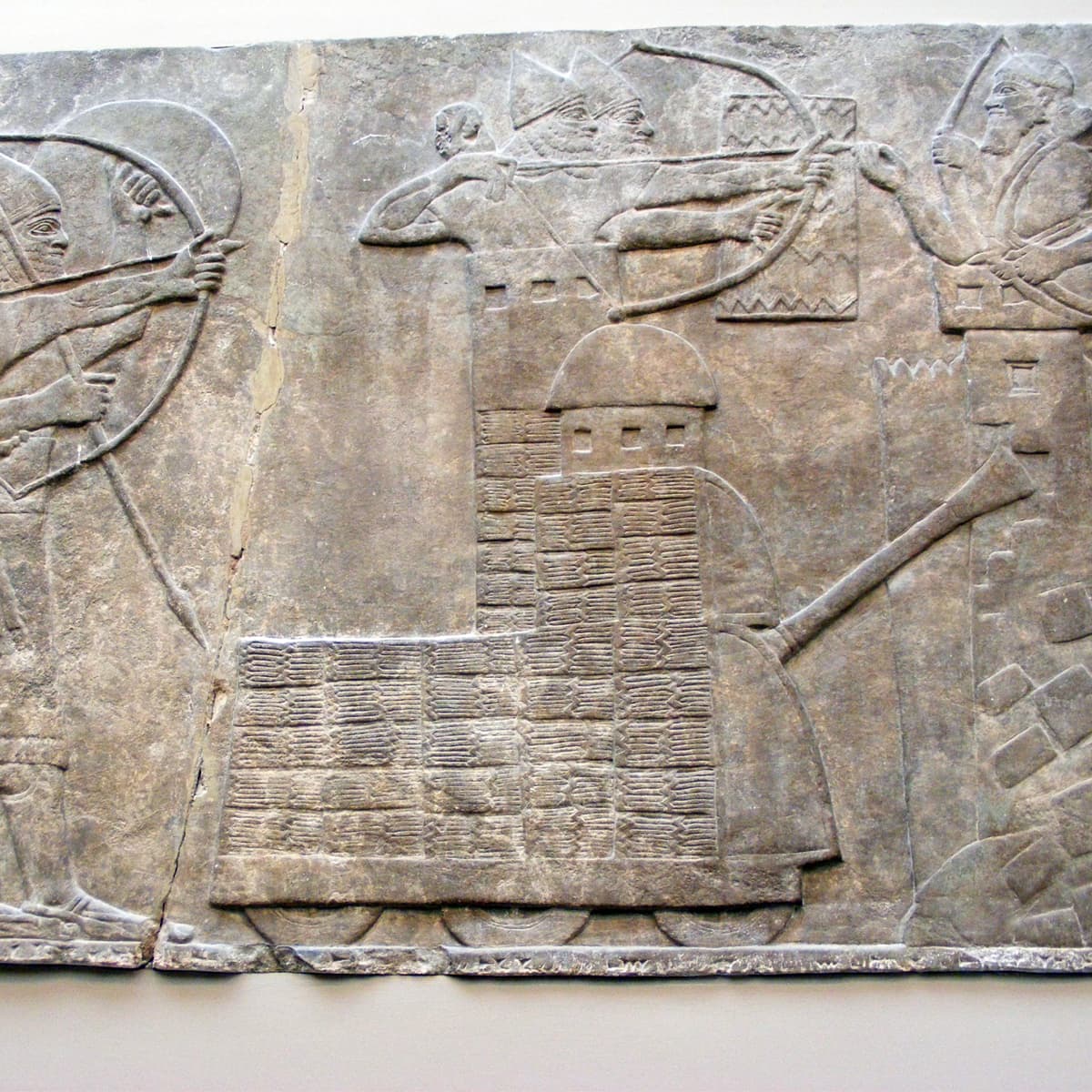
Attack on an Enemy Town and other relief panels. Focus your attention on several relief panels here on the left wall that show Assyria at war. Start with the panel that seems to depict what looks like a military tank attacking a city gate. Many nations conquered by the Assyrians consisted of little more than a single-walled city.
Here, the Assyrians attack with a crude tank, actually a siege engine, that shields them as they advance to the city walls to smash down the gate with a battering ram. The king stands a safe distance away behind the juggernaut and, looking braver than he actually is, shoots arrows. The Assyrian army was both fierce and efficient, equipped with high-tech siege engines like this one, with chariots, and with mounted cavalry. Now, turn to another panel nearby.
Read more...Show less
It shows people swimming. It's labeled Enemy Escape. Soldiers flee the slings and arrows of Assyrians by swimming across the Euphrates River. They use inflated animal bladders as life preservers.
Their friends in the castle downstream applaud their ingenuity. The Assyrians were ruthless. They intimidated enemies with a policy of brutality. One conqueror boasted after subduing a nation, I tied their...
their heads to tree trunks all around the city. Find a third panel nearby. This one shows a parade of Assyrians, including a chariot, some soldiers, and a king under an umbrella. It's labeled Review of Prisoners.
The Assyrian economy depended on booty. Here, a conquered nation is paraded before the Assyrian king, who's shaded by his parasol. Esher Nazarpal II sneers and tells the captured chief, drop and give me 50 push-ups. Above the prisoners' heads, we see images of rich spoils of war, elephant tusks, metal pots, and so on.
The Assyrians depopulated conquered lands by making slaves of the locals, mass deportations, and ethnic cleansing. Then, they repopulated those lands with Assyrian settlers. On the opposite wall, a few steps further along, is an artist's rendering of what the Nimrod Palace would have looked like. The 30,000-year-old palace, a 1,000-square-foot palace, was built atop a 50-acre artificial mound.
An inscription of the time tells us the new palace was inaugurated with a 10-day banquet where the king picked up the tab for 69,574 of his closest friends. Continue browsing more panels as you make your way to the far end of the gallery. Consider that, despite their ruthless reputation, the Assyrians have left a legacy as builders rather than destroyers. Once they'd conquered a place, the Assyrians proved to be steady and capable administrators.
They built public works and a vast system of roads served by an express postal service. For their combination of military might and efficient rule, the Assyrians have been called the Romans of the East. When you're ready to move on, exit the Nimrod Gallery at the far end. As you exit, hang a U-turn left.
Rounding the corner, you'll see two huge winged bulls guarding the entrance to Room 10C. ¶¶ ¶¶ ¶¶ ¶¶ Two winged bulls from Khorsabad,
Two Winged Bulls from Khorsabad
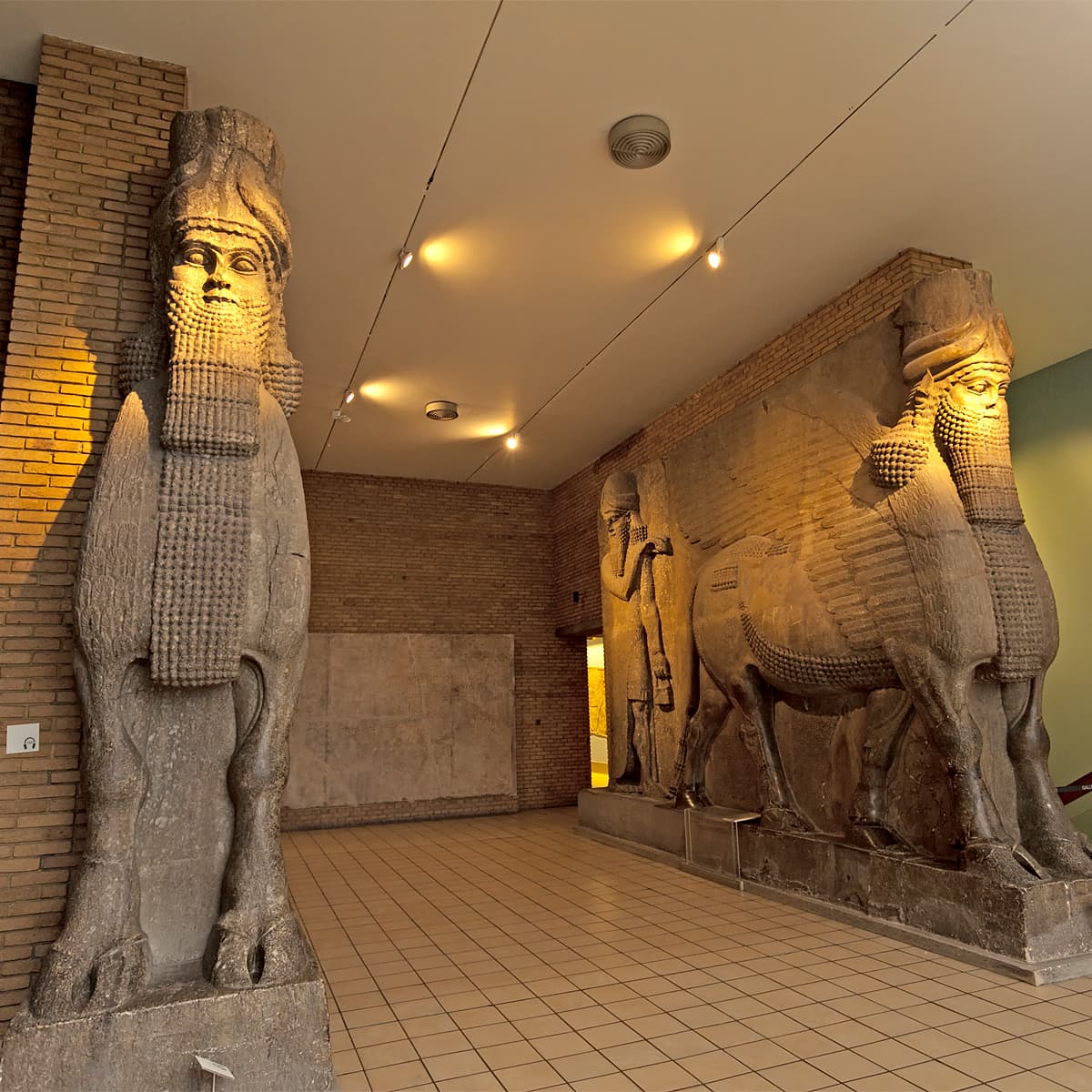
¶¶ the Palace of Sargon. These marble bulls guarded the entrance to the city of Dur-Sharakin, which means Sargonsville. This was a new capital near Nineveh in the modern city of Mosul. It boasted vast palaces built by Sargon II around 700 B.C.
The 30-ton bulls were cut from a single block, tipped on their sides, then dragged to their place by POWs. In modern times, when the British transported those statues here, they had to cut them in half. You can see the horizontal cracks through the bulls' chests. Sargon II gained his reputation as a fierce general by subduing the Israelites after a three-year siege of Jerusalem.
Read more...Show less
The Bible tells us that when the Israelite king refused to pay the annual tribute, Sargon invaded and ethnically cleansed the area. He deported many Israelites to Assyria, thus inspiring legends of the Lost Ten Tribes. These winged bulls, also celebrate another of Sargon II's triumphs over the rebellious Babylonians to the south. In 710 B.C., Sargon marched victorious through the streets of Babylon, the predecessor to the capital we now call modern Baghdad.
Sneak between these bulls and veer right into room 10. There you'll find more relief panels showing preparations for a big hunt. Royal Lion Hunts
Royal Lion Hunts (Palace of Ashurbanipal)
from the Palace of Ashurbanipal Lion hunting was Assyria's sport of kings. On the right wall are horses. On the left, you'll find hunting dogs, and next to them, lions resting peacefully in a garden. They're unaware that shortly they'll be rousted, stampeded, and slaughtered.
Lions lived in Mesopotamia, up until modern times, and it was the king's duty to keep the lion population down to protect farmers and herdsmen. This duty soon became a sport with staged hunts and zoo-bred lions. And lion hunting was a political statement, enabling the kings of men to prove their power by taking on the king of beasts. Continue a few steps ahead into the larger room of the lion hunt.
Read more...Show less
Reading the panels like a comic strip, start on the right and stroll counterclockwise. They released the lions from their cages. Then soldiers on horseback herded them into an enclosed arena. The king, eager to show his stuff, has them cornered.
Let the slaughter begin. The chariot carries King Ashurbanipal, the great-grandson of Sargon II. By the way, don't confuse Ashurbanipal with Ashurnazirpal II. He ruled 200 years earlier.
The king leaves half a dozen dead lions in his wake. Then moves on. Meanwhile, spearmen hold off more lions attacking from the rear. Keep going a few more steps.
At about the middle of the long wall, the panels show lions fleeing from the hunters. Cornered by hounds, shot through with arrows, and weighed down by fatigue, they begin to fall. The lead lion carries on, even while vomiting blood. This low point in Assyrian cruelty is perhaps the high point of the lion hunt.
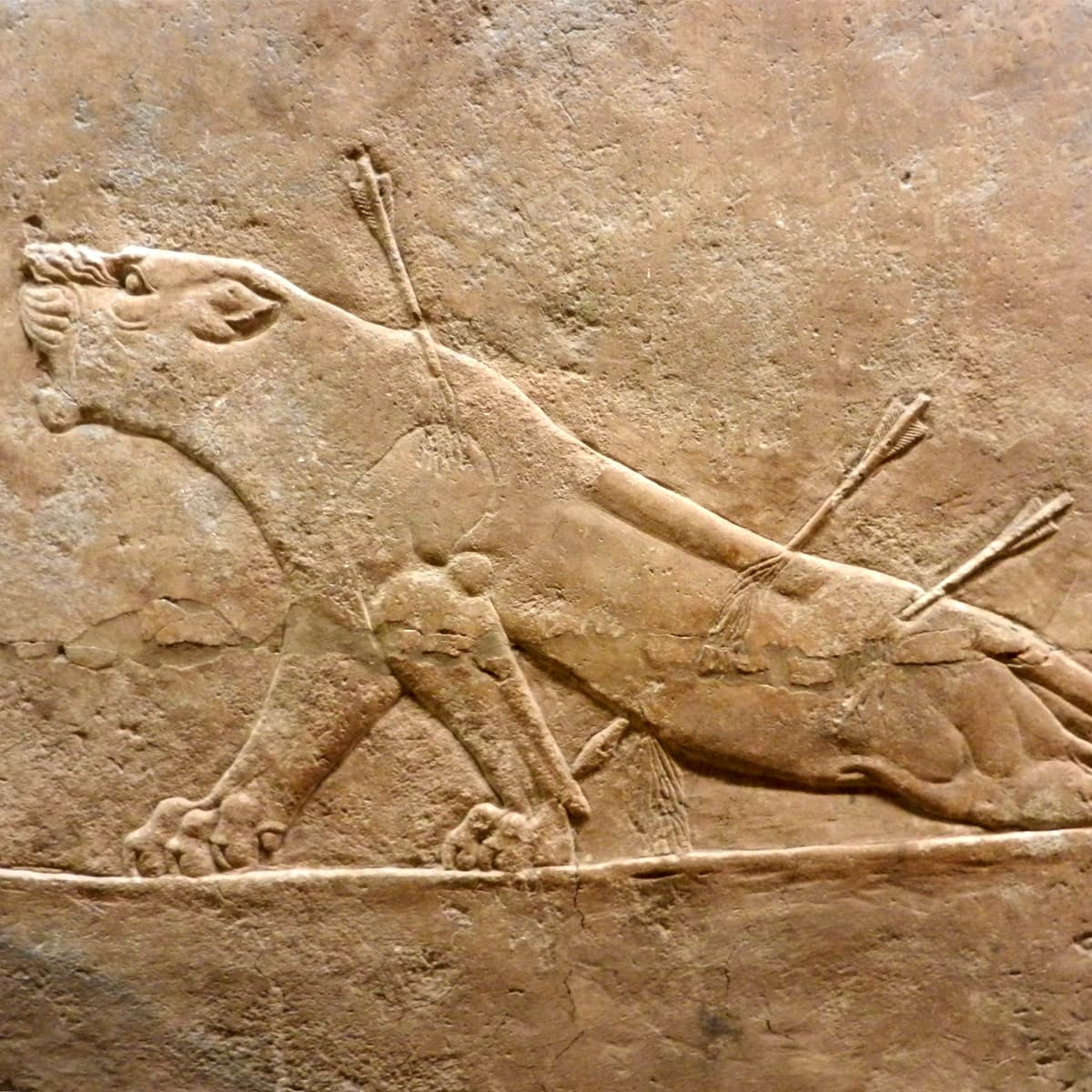
It's a curious coincidence that civilizations often produce their greatest art in their declining years. Now turn your attention to the wall directly opposite the vomiting lion. You'll find a panel known as The Dying Lioness. The lioness roars in pain and frustration.
She tries to run, but her body is too heavy. Her muscular hind legs, once the source of her power, are now paralyzed. Like these brave lions, Assyria's once-great warrior nation was eventually slain. Ashurbanipal, the last of Assyria's great kings, reigned for 50 years.
But shortly after his death, Assyria was conquered, and in 612 B.C., their capital at Nineveh was sacked and looted by their neighbors to the south, Babylon. They left us these lion hunt panels. With their mood of tragedy and proud struggle in a hopeless cause, they are some of the most beautiful of human creations. Our next stop is Ancient Greece in Room 13.
If your legs feel like the dying lioness, then you need a break. There's a cafe just ahead. Exit the lion hunt room at the far end. Keep going straight, and you'll spill out back in the Nimrud Gallery.
Say hello again to King Ashur-Nazarpal. You just love saying that word. From there, turn right and make your way back to the huge winged lions, the ones we saw at the start of the Assyrian exhibit. Exit Assyria between the winged lions and make a U-turn to the right.
That'll take you into Room 11. You'll walk past glass cases of small figurines. These prehistoric Greek Barbian Ken dolls date from the Cycladic period. That's from about 2500 B.C.
Continue into Room 12. The hungry can go straight to the gallery cafe from here. Turn right into Room 13. It's filled with Greek faces in glass cases. ¶¶ Ancient Greece
Ancient Greece: Black-Figured Amphora
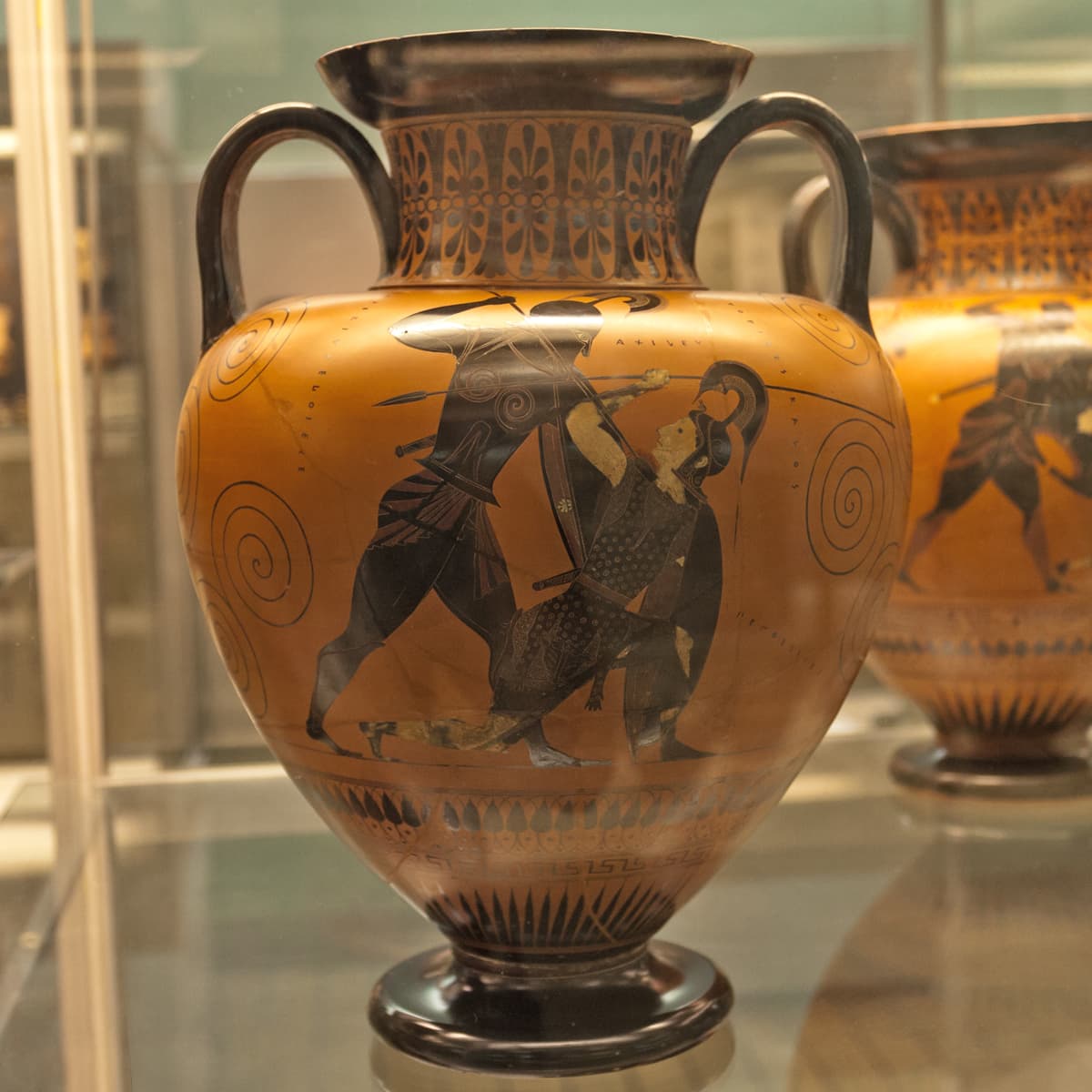
A Black-Figured Amphora of Achilles and Penthesilea Browse the cases of vases from Ancient Greece. You'll see lots of ceramics painted in red and black with geometric patterns and a few crudely done human figures. As you marvel at these beautiful creations, think of the people who made them. The history of Ancient Greece could be subtitled Making Order, Out of Chaos.
While Assyria was dominating the Middle East, what we think of as Greece was a gaggle of warring tribes roaming the Greek peninsula, floundering in darkness. But by about 700 B.C., these tribes began settling down, experimenting with democracy, forming self-governing city-states, and making ties with other city-states. Scarcely two centuries later, they would be a united community and the center of the civilized, modernized world. During its golden age, roughly 500 to 400 B.C., Greece set the tone for all of Western civilization to follow.
Read more...Show less
Democracy, theater, literature, mathematics, philosophy, science, art, and architecture, all these were invented or at least forever changed by a single generation of Greeks in a small town of perhaps 80,000 citizens. Pottery, like the pieces in this room, usually painted red and black, was a popular export product for the sea-trading Greeks. The earliest style, around the 8th century B.C., featured geometric patterns. Next came painted black silhouettes on the natural orange clay.
Then, a red figure on a black background. Now, find one of the finest pieces. It's roughly in the middle of room 13. It's in the long, zigzag-shaped glass case on the upper level at the far end.
In that display case, find a jar painted with a man stabbing a woman. Find it? It's labeled Black-Figured Amphora, Achilles, and Penthesilea. Greeks poured wine from jars like this one.
It's decorated with a scene from the Trojan War, the legendary conflict that symbolized Greece's long struggle to rise above war and chaos. Achilles of Greece faces off against the Queen of the Amazons, Penthesilea, who is fighting for Troy. The Amazons were a legendary race of warrior women. They cut off one breast to facilitate their archery skills.
The artist catches the action as Achilles bears down, plunging a spear through her neck and blood spurts. In her dying moment, Penthesilea looks up. Her gaze locks on Achilles. His eyes bulge wide, and he falls instantly in love with her.
She dies, and Achilles is smitten. Ah, how sweet. Continue to room 15, filled with statues and more vases and glass cases. On the left side of the room, find a nude male statue. ¶¶
An Idealized Youth, Wine Cooler
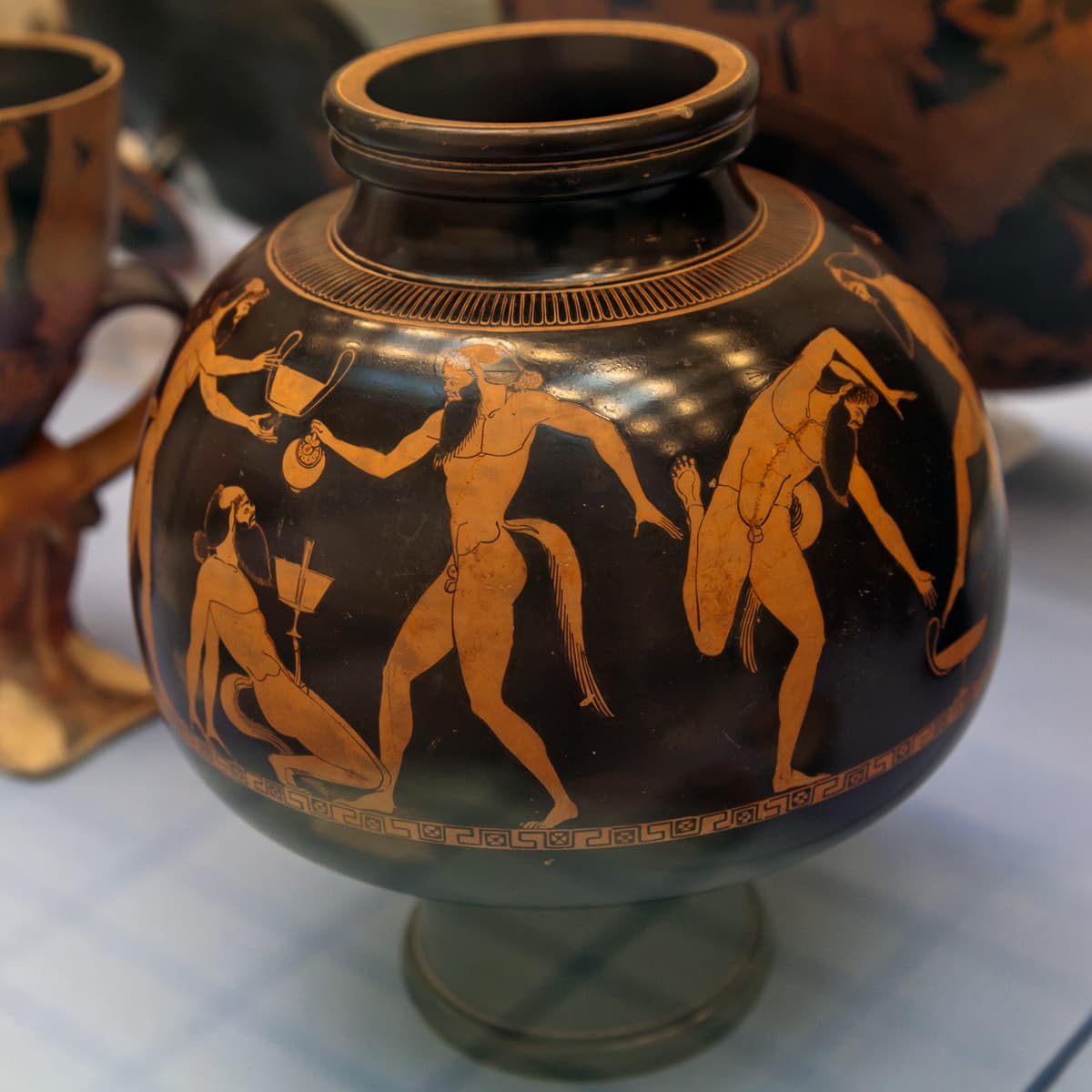
A wine cooler. The Greeks saw their gods in human form, and human beings were godlike. This room has an early example of this. Find the statue of a young man.
With his perfectly round head, symmetrical pecs, and navel right in the center, this young man exemplifies the divine orderliness of the universe. Statues like this were simply called kouros, or boy. As the features were idealized, it shows no one in particular, just an idealized body. The ideal man was geometrically perfect, a balance of opposites, the golden mean.
Read more...Show less
In a statue, that meant finding the right balance between movement and stillness, between realistic human anatomy with human flaws, and the perfection of a Greek god. This kouros is still a bit uptight, stiff as the rock from which he's carved. Contrast this statue with another work in the room. A few steps farther along, about two-thirds of the way down, on the left, you'll find a glass case containing a vase.
It's labeled number seven and faces the center of the room. The vase is painted in red on black. The label reads Wine Cooler, or Sichter, signed by Douris the Painter, 490 B.C. This clay vase was designed to float in a bowl of cooling water.
It shows satyrs at a symposium or drinking party. These half-man, half-animal creatures notice their tails, had a reputation for lewd behavior. They reminded the balanced and moderate Greeks of their rude roots. The reveling figures on this wine cooler are more realistic, more three-dimensional, and suggest more natural movements than even the literally three-dimensional but quite stiff kouros we just saw.
And speaking of stiff, notice how the Greeks are beginning to conquer the natural world in art, creating realistic figures that seem to move like real humans. The art, like life, is more in balance. And speaking of balance, if that's a Greek sobriety test, party on. Exit room 15 at the far end.
Pass through the next small room and continue into room 17. Grab a bench, sit facing the Greek temple, at the far end. To be more accurate, the temple is actually a temple-shaped tomb. It's called the Nereid Monument.
Nereid Monument from Xanthos
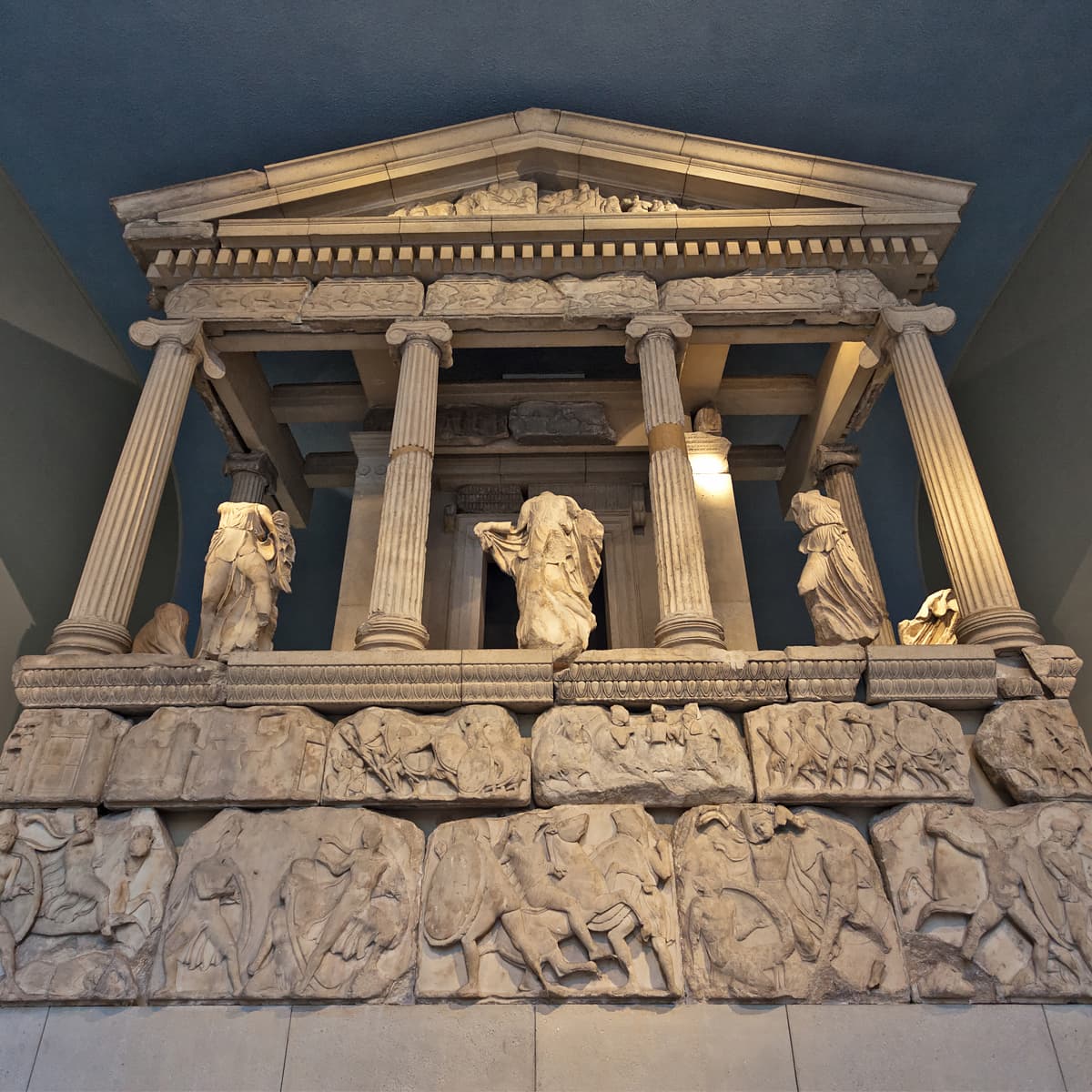
Nereid Monument from Xanthos Greek temples were rectangular buildings surrounded by rows of columns and topped by slanted roofs. They housed a statue of a god or goddess. Unlike Christian churches, which serve as meeting places, Greek temples were the gods' homes. Worshippers gathered outside.
That's why the most impressive part of the temple was its exterior. The triangle-shaped section under the roof, filled in with sculpture, is called the pediment. The crossbeams that support the pediment hold what are called metopes. Now look through the columns to the building itself.
Read more...Show less
Above the doorway is another set of relief panels running around the building under the eaves. It's called the frieze. Standard Greek temples had these same features. Pediment, metopes, and frieze.
Take a moment to appreciate the female statues that were placed between the columns. They're dubbed nereids, which means friendly sea nymphs, because of their dramatic wave-like poses and wind-blown clothes, and because some appear to be born aloft by sea animals. Notice the sculptor's delight in capturing the body in motion and the way the wet clothes cling to the figure's anatomy. Next, we'll see pediment, frieze, metope decorations, and statues from Greece's greatest temple.
Our tour continues through the glass doors to your right... Wait, wait, wait, Lisa. Before we go there, I've got a slight detour. Okay, everybody, here we go.
Leave the British Museum, hop on the tube to Heathrow, and fly to Athens. In the center of the old town, high atop the flat hill known as the Acropolis, you'll find the temple called the Parthenon. Okay, but you'll still need to pass through the glass doors labeled the Parthenon Galleries. As you first step inside, the long, narrow rooms branching left and right off the entryway usually lead you to the Parthenon Galleries.
We'll eventually have helpful exhibits that reconstruct the Parthenon and its once-colorful sculpture. But we'll continue straight into the huge main hall. It's lined with carved reliefs and statues. These are the famous sculptures from the Parthenon called the Elgin Marbles. Admire these treasures while Rick describes the famous building in Athens they once decorated.
Parthenon
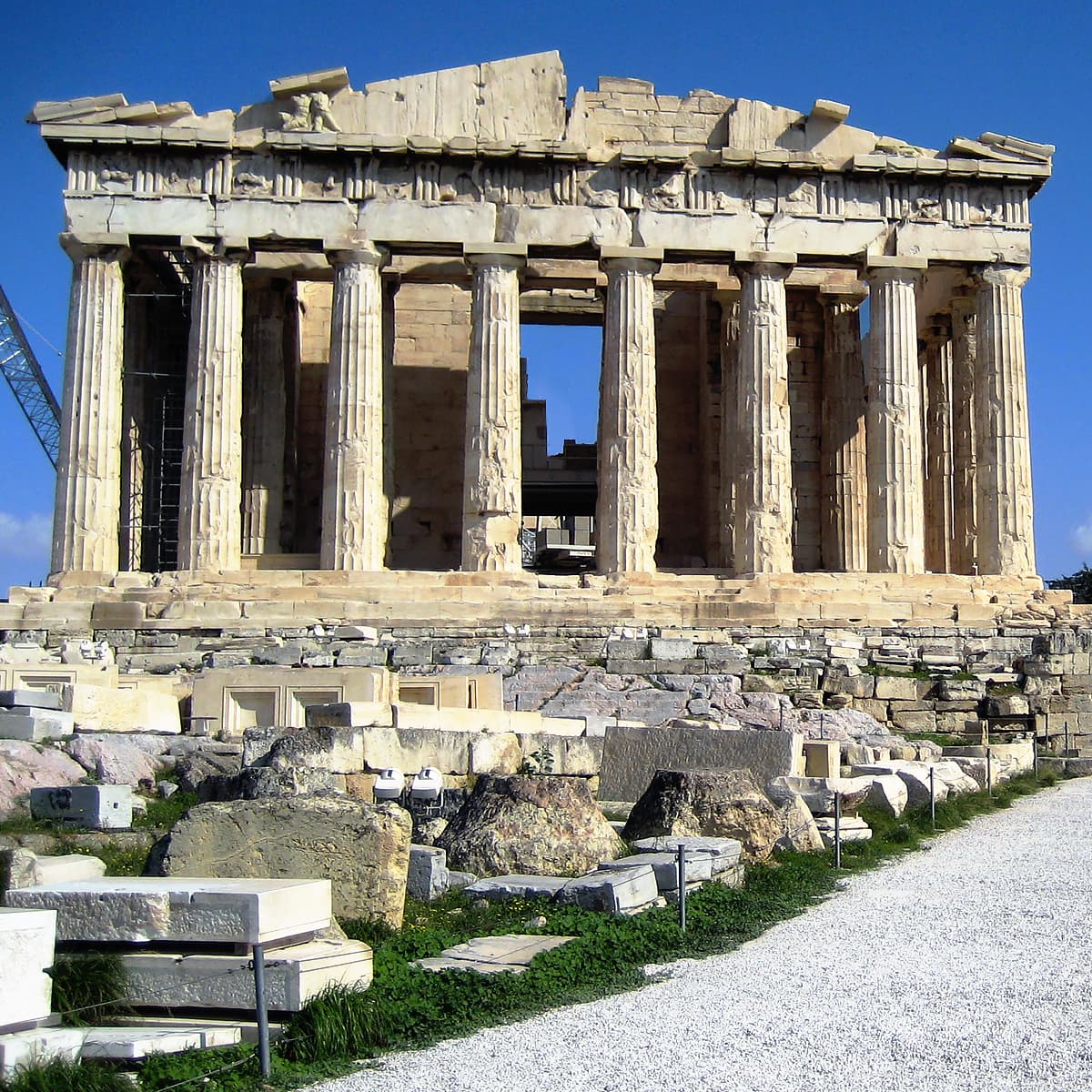
The Parthenon This temple, dedicated to Athena, goddess of wisdom and patroness of Athens, was the crowning glory of an enormous urban renewal plan during Greece's Golden Age. After Athens was ruined in a war with Persia, the city, under the bold leadership of Pericles, constructed the greatest building of its day. The temple was a model of balance, simplicity, and harmonious elegance, the symbol of the Golden Age. Phidias, the greatest Greek sculptor, decorated the Parthenon exterior with statues and relief panels.
These are the sculptures you see displayed all around you here in this vast hall of the British Museum, the so-called Elgin Marbles. The marbles were named for the British ambassador to Greece, Lord Elgin. Back in the early 1800s, he had the sculptures hammered, chiseled, and sawed off the Parthenon. They were then shipped to London, where they've remained ever since.
Read more...Show less
Though the Greek government complains about losing its marbles, the Brits feel they rescued and preserved these precious sculptures. The often bitter controversy continues. The Parthenon has the same features as the Nereid Monument we just saw, columns, crossbeams, metopes, frieze, and triangular pediment, but on a much bigger scale. The Parthenon is about 100 feet wide, and 230 feet long.
Its columns are 34 feet high and 6 feet in diameter. In its heyday, the statues and reliefs were all painted in vivid colors. Inside was a legendary 40-foot-tall statue of Athena, famous throughout the ancient world, but now lost to history. The Parthenon, then and now, was the iconic symbol of the Golden Age, when Athens dominated the Greek-speaking world and established what we think of as Western history.
As you enjoy the Elgin Marbles, keep in mind that they once decorated this greatest of Greek temples. Let's get a closer look at some of the marbles, starting with the frieze that lines the museum walls.
Elgin Marbles: The Frieze
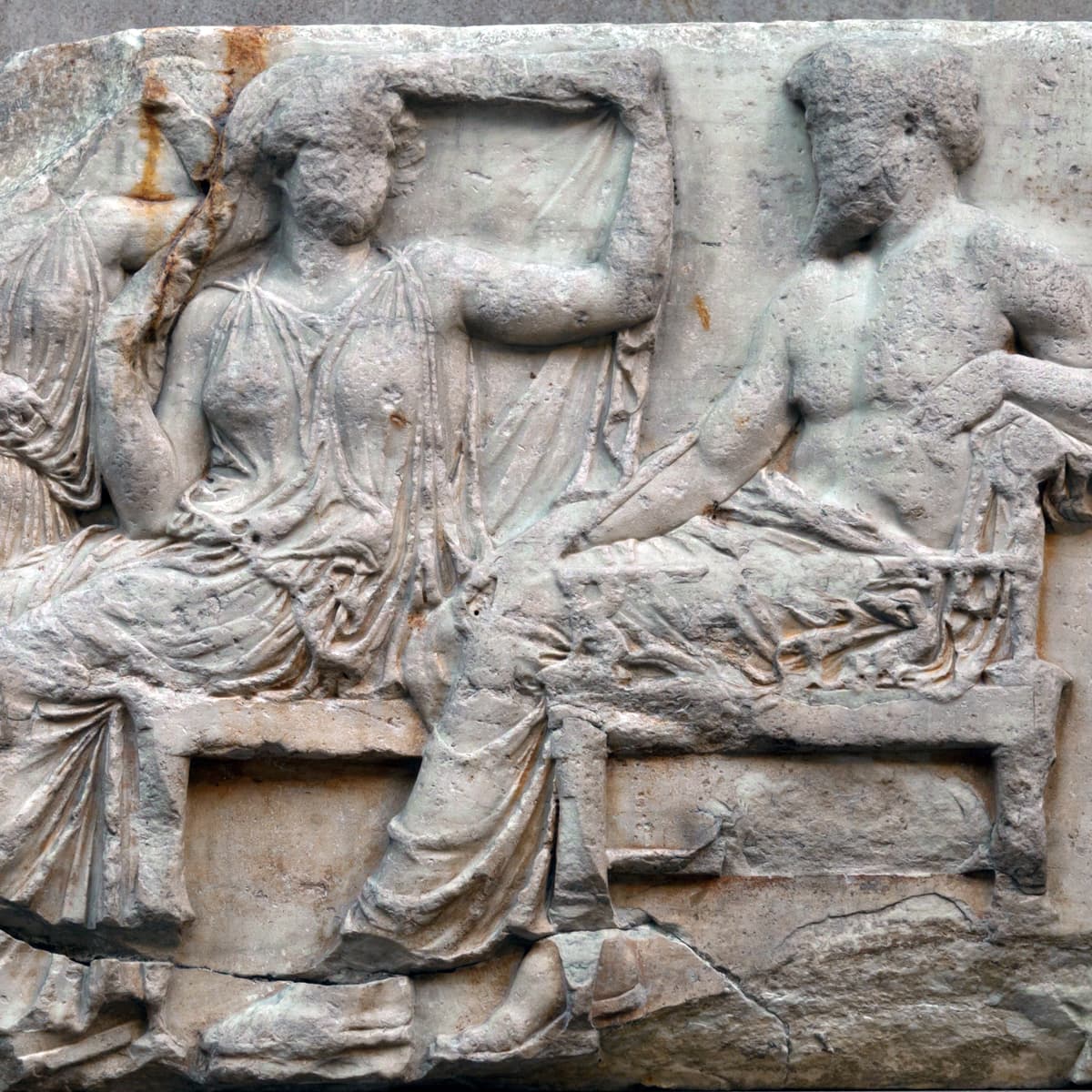
The Elgin Marbles, the frieze. The Elgin Marbles include the frieze, the frieze reliefs, metopes, and pediment statues that once decorated the Parthenon temple. Lining the walls of the main hall where you're now standing are the marble panels of the frieze. The statues in the adjacent rooms at either end of the hall once filled the Parthenon's triangular-shaped pediments.
Near these pediment sculptures will also find the relief panels known as metopes. Let's start with the frieze here in the main hall. The 56 reliefs and relief panels lining this main gallery are part of the frieze that originally ran all around the exterior of the Parthenon, under the eaves. Panning the room, you'll see that the panels depict a parade of people.
Read more...Show less
Men on horseback, chariots, ladies in long robes, dignitaries seated on thrones. They show Athens' version of a Fourth of July parade celebrating the birth of the city. On this festive day, citizens, marched up to the Acropolis to symbolically present a new robe to the 40-foot-tall golden ivory statue of Athena housed in the Parthenon. Start at the panels by the entrance.
Find the first one, labeled number 136. It shows men and horses. One naked man seems to be gesturing, hey, this way. So let's join the parade.
Stroll leisurely, working slowly counterclockwise around the room. Along this wall, the parade is all about men and horses. The horses rear back and chomp at their bits as the men try to rein in their restless steeds. Notice the muscles and veins in the horses' legs and the intricate folds in the cloaks and dresses.
Some panels have holes drilled in them. That was where gleaming bronze reins were fitted to heighten the festive look. Of course, all these panels were originally painted in bold colors. As you move along, notice that despite the bustle of figures posed every which way, the frieze has one unifying element.
All the people's heads are at the same level, creating a single ribbon around the Parthenon. They're all part of the grand parade, all heading in the same direction, gradually uphill. Prance on. Cross to the opposite wall, directly across find panel number 67.
This three-horse chariot cut out of only a couple inches of marble is more lifelike and three-dimensional than anything the Egyptians achieved, even in a freestanding statue. Soon the horsemen in the parade give way to musicians, children, animals ready for sacrifice, and young maidens with offerings. Keep going slowly counterclockwise. Stop at panel number 61, showing maidens in long robes.
These were the parades. These were the girls who were the heart of the procession. Dressed in pleated robes, they shuffle past the parade marshals. They carry incense burners, jugs of wine, and bowls to pour out an offering to the thirsty gods.
It's girls like these who were entrusted with the most important task, bringing the sacred robe. The procession culminates a few steps further on in panel number 35. It depicts the ceremonial presentation of the robe to Athena. The gods have assembled, seated on their thrones, and waited on by servants.
Find the central scene, number 35. A man and a child fold the sacred robe of Athena and hold it up for the gods' stamp of approval. Just to the left, find panel 29. That's Zeus and Hera, the king and queen of the gods, just kicking back and enjoying the scene, as if out of fashion, and probably wondering what length hemlines will be this year.
Now head for the group of pediment sculptures. They're in the adjacent room at the far right end of the hall.
Pediment Sculptures
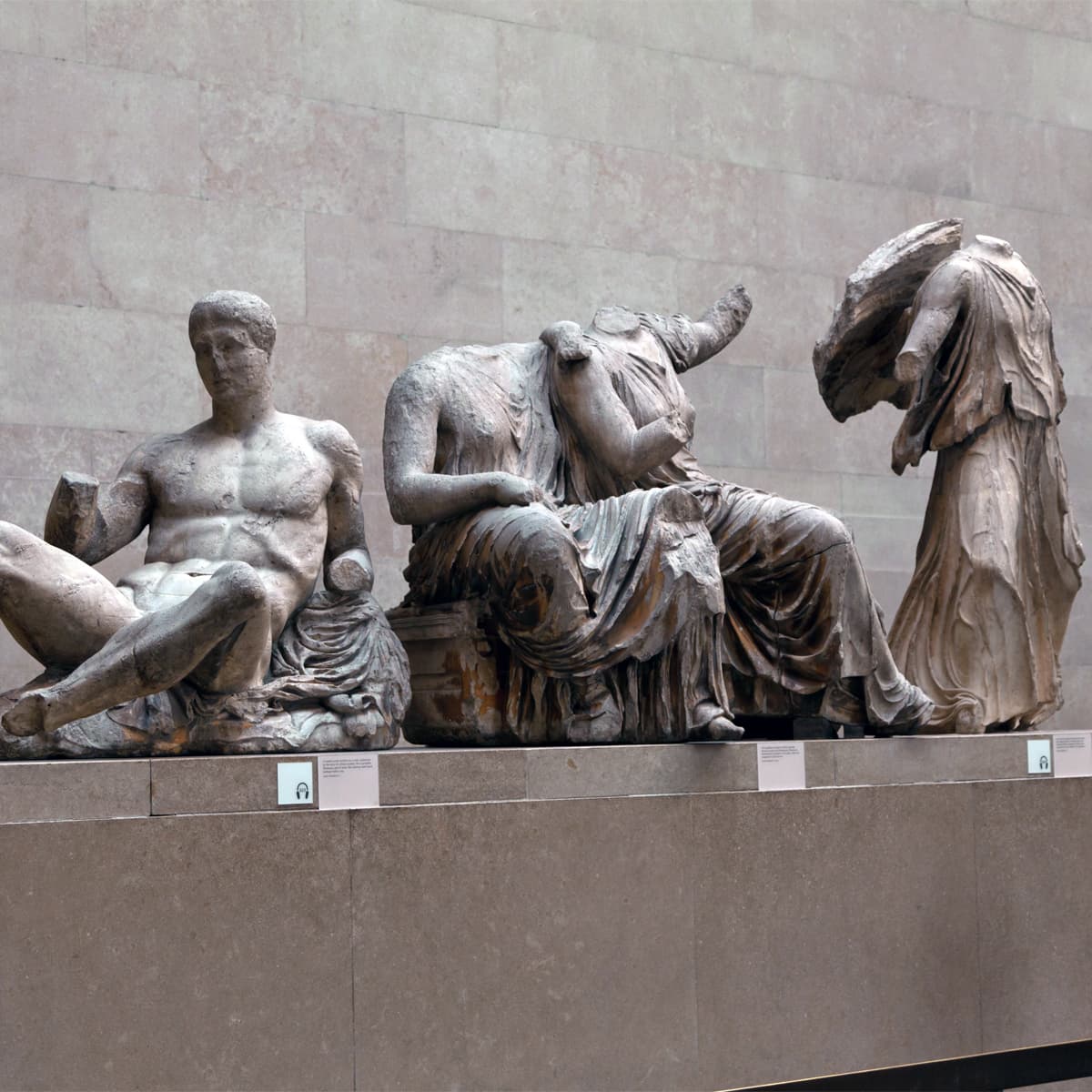
The Pediment Sculptures These statues were originally nestled nicely in the triangular pediment above the columns at the Parthenon's main or east entrance. They depict the legendary moment when the city of Athens was born. The Greek gods are lounging around, gathered at an Olympian banquet. Suddenly, there's a stir of activity.
Hebe, the cupbearer of the gods, has seen something amazing. She's the tallest surviving statue near the center. Frightened, she runs to tell the others, her dress whipping behind her. A startled Demeter, just to the left, turns toward Hebe.
Read more...Show less
What's the big news? It's the miraculous birth of Athena. According to legend, Zeus had his head split open, allowing Athena, the goddess of wisdom, to rise from his brain, fully grown and fully armed, inaugurating the golden age of Athens. Unfortunately, that key scene is missing.
It's the empty space in the middle, at the peak of the triangle. The only one who hasn't lost his head is laid-back Dionysus. He's the cool guy further left. He just raises another glass of wine to his lips.
Over on the right, Aphrodite, goddess of love, leans back into her mother's lap, too busy admiring her own beautiful bare shoulder to even notice the hubbub. A chess-set horse's head screams, These people are nuts! Let me out of here! No!
This exciting scene came with a message. Just as wise Athena rose above lesser gods who were scared, drunk, or vain, so would her city, Athens, rise above her lesser rivals. This is amazing workmanship. Compare Dionysus with his natural, relaxed, reclining pose to all those stiff Egyptian statues we saw standing eternally at attention.
Appreciate the folds of the clothes on the female figures, especially Aphrodite's clinging, rumpled robe. Some sculptors would first build a nude model of their figure, put real clothes on it, and study how the clothes hung down before actually sculpting in marble. Others found inspiration at the taverna on Wet Toga night. Wander behind.
The statues originally sat 40 feet above the ground. The backs of the statues, which were never intended to be seen, are almost as detailed as the fronts. Even without their heads, these statues, with their detailed anatomy and expressive poses, speak volumes. The metopes are the square panels on the walls to either side.
Start on the right wall with three panels of men fighting centaurs. Hey, Lisa, why do you think the Elgin marbles are so treasured? Well, it's been said that the British of the 19th century, the most powerful nation on Earth, saw themselves as the successors of those empires of old. Maybe these rocks made them stop and wonder, will our great civilization also turn to rubble? Hmm. The Metopes
Metopes: Battle of Lapiths, Centaurs
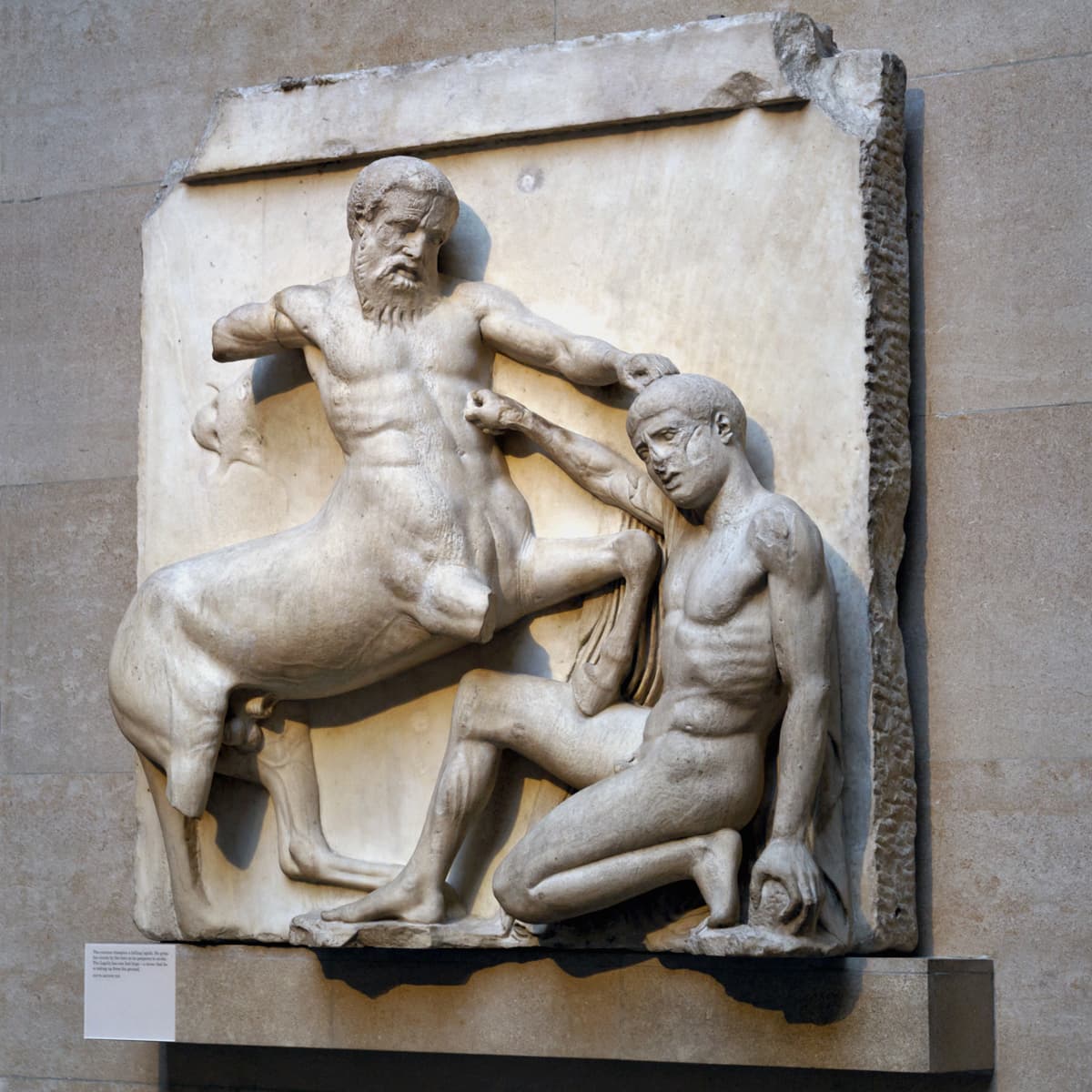
The Battle of Lapiths and Centaurs The Metopes once decorated the gaps between the crossbeams above the Parthenon's columns. Here's the scene. The humans have invited some centaurs, barbarian half-men, half-horse creatures, to a wedding feast. All goes well until the brutish centaurs, the original party animals, get too drunk and try to carry off the women.
A brawl breaks out. Focus on a few individual scenes. On the right wall, find the panel in the middle. It's labeled number 31 in Roman numerals.
Read more...Show less
The fight begins. A centaur grabs a man by the throat. The man responds by reaching out and pulling the centaur's hair. Meanwhile, the man tries fending off the centaur with his knee while the centaur wraps his forelegs around the man's leg.
The two stand eye to eye and, at this point, the battle seems pretty evenly matched. But soon, chaos ensues. Now, cross to the opposite wall to see what happens next. Remember, the Greeks prided themselves on creating order out of chaos.
Within just a few generations, they went from nomadic barbarism to the pinnacle of early Western civilization. These metopes tell the symbolic story of this struggle between the forces of human civilization and animal-like barbarism. The fight resumes. In panel number 28, the centaurs start to get the upper hand as one rears back and prepares to trample a helpless man.
The leopard skin draped over the centaur's arm roars a taunt. The humans lose face. Actually, literally. To the left, in number 27, the humans finally rally and drive off the centaurs.
A centaur tries to run, but the man grabs him by the neck. The centaur raises his right hand and sword, now missing, to run him through. Notice how the folds in the man's cloak set off his smooth skin, emphasizing his graceful figure. The centaurs have been defeated, and humanity triumphs.
In fact, these reliefs represent a turning point for global humanity. Around the year 500 B.C., when this art was made, bold new ideas were exploding simultaneously all around the world. Socrates in Greece, Confucius in China, Buddha in India. These thinkers and others were independently discovering a non-material, unseen order in nature.
They talked of a rational mind or soul and saw humans as separate from nature and different from the other animals. In the Greek Golden Age, civilization finally triumphed over barbarism. Rational thought over animal urges and order over chaos. And you've now conquered the British Museum.
We hope you've enjoyed it. Thanks to Jean Openshaw, the co-author of this tour, we've seen the legacy of three great civilizations. Egyptian art that seems built for eternity, the fierce lions of a Syrian civilization, and the beautiful balance of Golden Age Greece. If you have time and energy, there's much, much more to the British Museum.
And if you're doing more, or sightseeing in London, we also have audio tours for Westminster, the city, St. Paul's, and the British Library. Remember, this tour was excerpted from the Rick Steves London Guidebook, co-authored with Jean Openshaw. For more details on eating, sleeping, and sightseeing in London, refer to this year's edition of that guidebook.
For more free audio tours and podcasts, and for information about our TV shows, bus tours, and travel gear, visit our website, at ricksteves.com. This tour was produced by Cedar House Audio Productions. Thanks for joining me. Cheers! And goodbye for now. ¶¶
Free
GPS-guided walking tour
No account needed. Walk at your own pace.
Free
26 stops ·