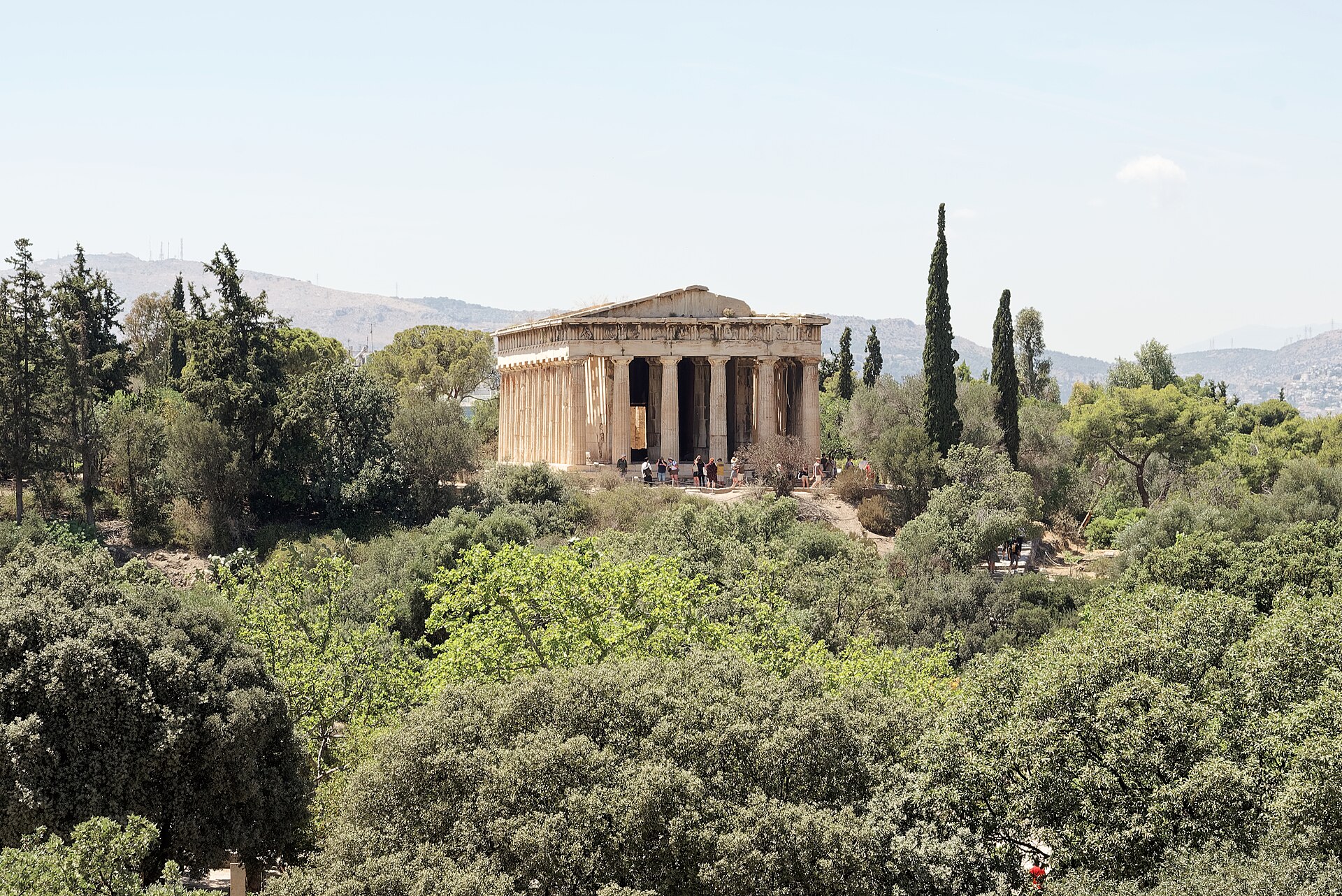
While the Parthenon gets all the postcards, this temple quietly holds a much more impressive record: it's the best-preserved ancient Greek temple in the world. The roof is intact. The columns are standing. The walls are whole. After 2,500 years, it looks like someone could unlock the front door and start worshipping Hephaestus again tomorrow.
Construction began in 449 BC — two years before the Parthenon — and it was dedicated to Hephaestus, god of metalworking, and Athena Ergane, patroness of crafts. The location wasn't random: this corner of the Agora was the metalworkers' quarter, where blacksmiths and bronze-casters plied their trade. Archaeologists have found casting molds, metal slag, and pottery shards left as offerings by ancient artisans who treated the area as sacred to their profession.
Built entirely of Pentelic marble with architectural sculptures in Parian marble, the temple features Doric columns — six across and thirteen along each side. The metopes on the eastern facade depict the labors of Heracles, while the north and south sides show the exploits of Theseus. The sculptural program subtly linked Athens' mythical hero-king with the greatest hero of Greek mythology.
The temple's survival is partly thanks to its conversion into the Church of Saint George around the seventh century AD, which kept it maintained and roofed through the medieval period. In the nineteenth century, the church served as a burial place for Protestants and European philhellenes who died fighting in the Greek War of Independence. King Otto attended one of the last services held here in 1834, just before it was decommissioned and recognized as an ancient monument.
Verified Facts
The Temple of Hephaestus is the best-preserved ancient Greek temple in the world, with its roof, columns, and walls largely intact
Construction began in 449 BC, two years before the Parthenon, and it was built entirely of Pentelic marble
The temple was converted into the Church of Saint George around the 7th century AD, which helped preserve it through the medieval period
In the 19th century the church was used as a burial place for Protestants and European philhellenes who died in the Greek War of Independence
Get walking directions
24 Adrianou, 1st Municipal Community, Athens, 105 55, Greece