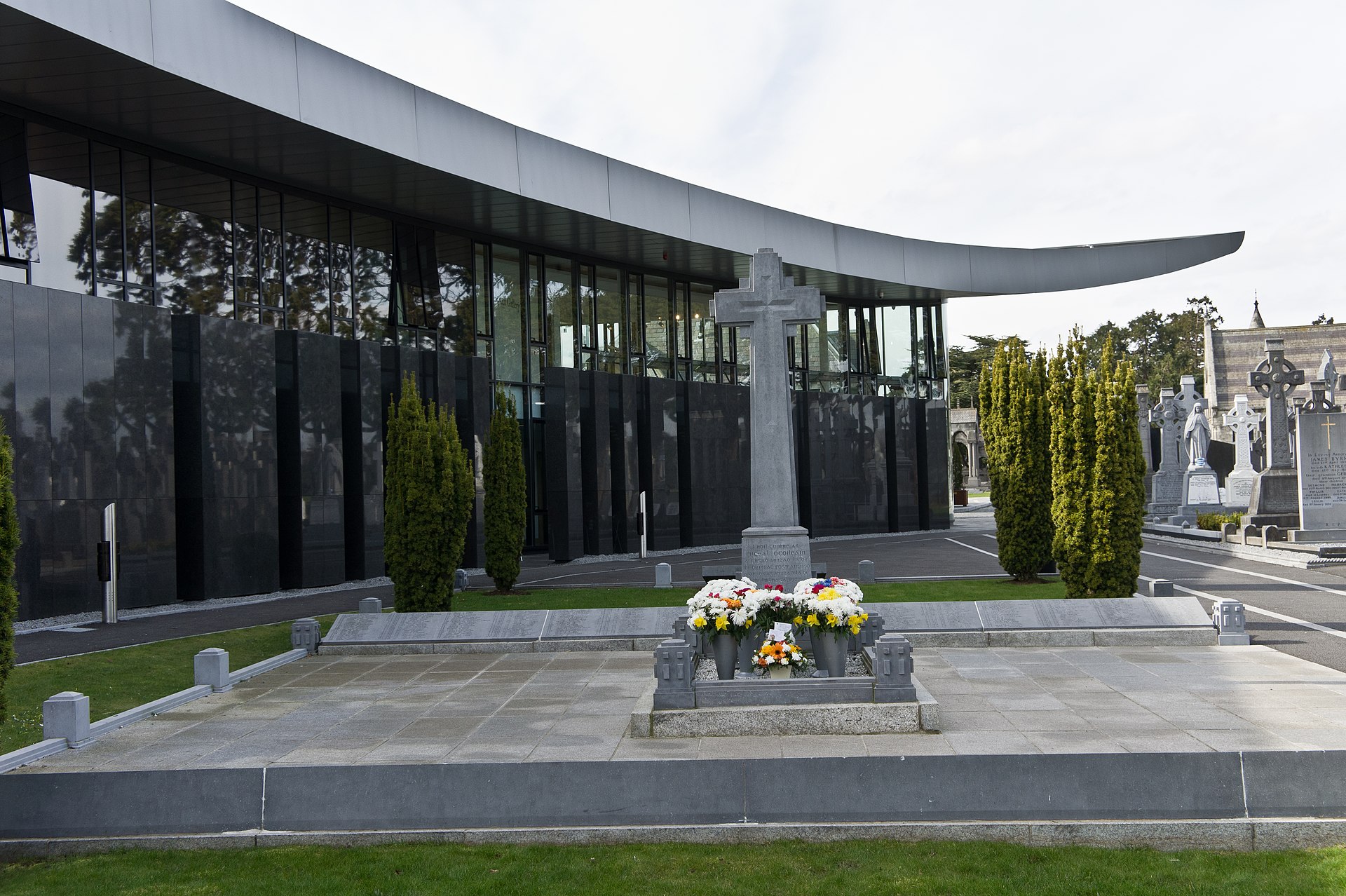
Ireland's national cemetery began as an act of defiance. Before Daniel O'Connell established Glasnevin in 1832, Ireland's Penal Laws made it effectively illegal for Catholics to conduct burials with any ceremony. Catholic funerals were routinely disrupted, and the dead were buried in unmarked graves. O'Connell created Glasnevin as Ireland's first non-denominational cemetery — a place where anyone, regardless of religion, could be buried with dignity.
The first burial was Michael Carey, an eleven-year-old boy from Francis Street, on February 22, 1832. Since then, over 1.5 million people have been interred across the 124-acre grounds, making it one of the largest cemeteries in Europe. The roll call of the buried reads like an encyclopedia of Irish history: Daniel O'Connell himself, Charles Stewart Parnell, Michael Collins, Eamon de Valera, Constance Markievicz, Roger Casement, Brendan Behan, and Luke Kelly of the Dubliners.
Michael Collins' funeral in August 1922 was the largest in the cemetery's history. An estimated 500,000 people — one-fifth of Ireland's entire population — lined the streets of Dublin as his coffin passed. He was 31 years old. Nearly 800,000 people are buried in Glasnevin in unmarked mass graves, many from the Great Famine of the 1840s and later cholera epidemics.
The 51-metre O'Connell Tower — a round tower modeled on ancient Irish examples — dominates the landscape. You can climb it for views over the entire cemetery and north Dublin. The museum runs guided tours that bring the stories of the dead vividly to life, which is a strange thing to say about a cemetery but entirely accurate.
Verified Facts
Founded by Daniel O'Connell in 1832 as Ireland's first non-denominational cemetery
Over 1.5 million people are buried across the 124-acre grounds
Michael Collins' funeral in 1922 drew an estimated 500,000 mourners — one-fifth of Ireland's population
Nearly 800,000 people are buried in unmarked mass graves from the Great Famine and cholera epidemics
Get walking directions
Finglas Road, Botanic A, Dublin 9, Ireland