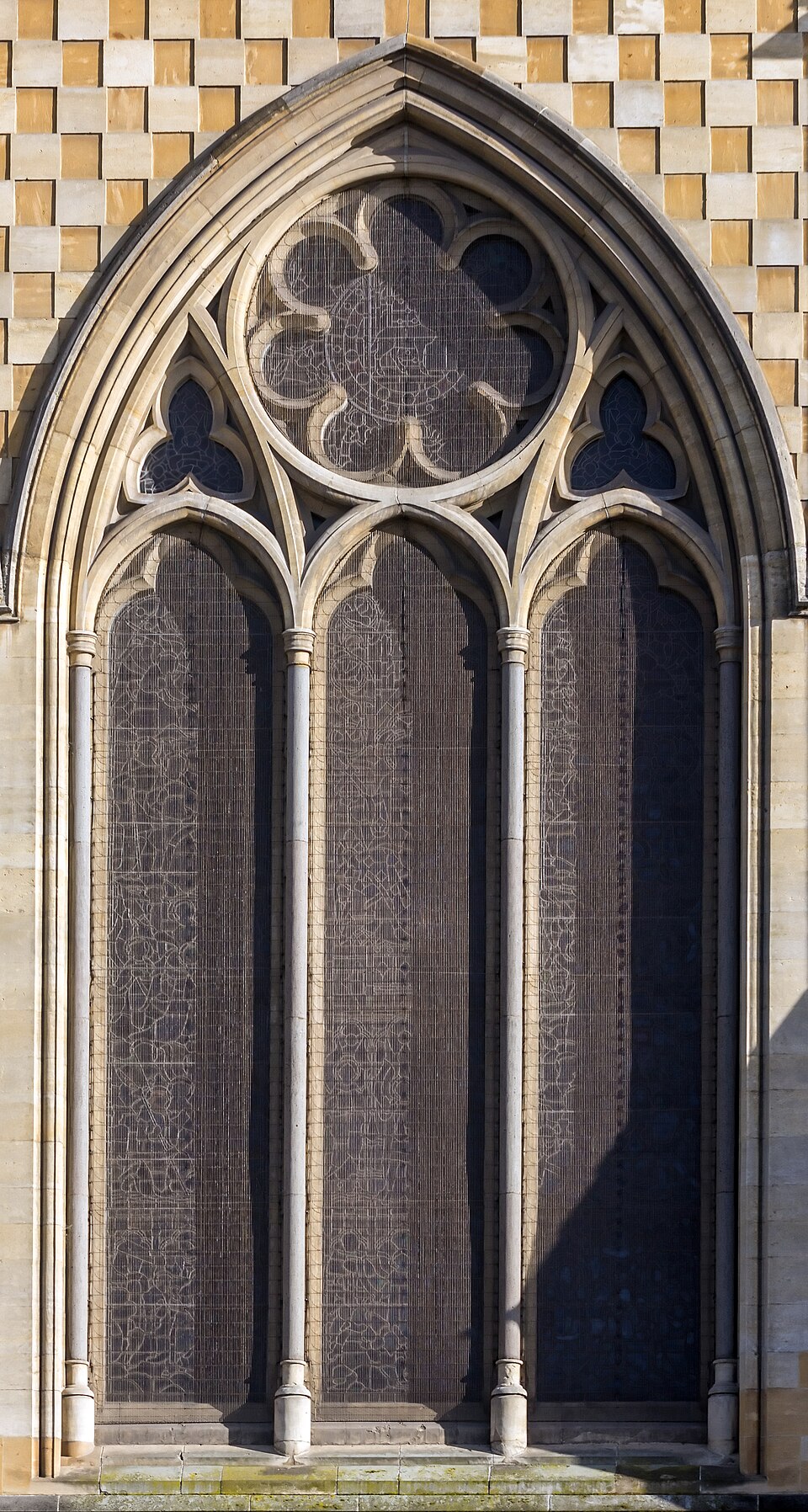
This Gothic Revival cathedral stands on the exact spot where the first public Christian service in Melbourne was conducted in eighteen thirty-five, right at the founding of the settlement. But the building you see now was not the original. The first St Paul's was a modest bluestone church consecrated in eighteen fifty-two. It was demolished in eighteen eighty-five to make way for this far grander structure, designed by the English architect William Butterfield, one of the most important Gothic Revival architects of the Victorian era.
Butterfield never actually came to Melbourne. He designed the entire cathedral from England, which led to some spectacular disagreements with the local builders. The original design called for a single spire, but Butterfield fell out so badly with the cathedral committee that he resigned from the project. The spires you see today were completed between nineteen twenty-six and nineteen thirty-two to a different design by the local architect Joseph Reed. So the top does not quite match the bottom, architecturally speaking.
Step inside if you get a chance. The floor is paved with encaustic tiles imported from the English firm of Maw and Company, featuring intricate geometric patterns. The walls use alternating bands of cream Waurn Ponds limestone and dark local bluestone, creating those dramatic stripes that are Butterfield's signature polychromatic style. He used the same technique in churches across England. The organ is one of the finest in Australia, built by T. C. Lewis of London. And here is a detail most people miss: the cathedral sits slightly below street level because Swanston Street was raised around it over the decades. The city literally grew up around this building.
Verified Facts
Built on site of first public Christian service in Melbourne, 1835
Designed by William Butterfield who never visited Melbourne
Original bluestone church demolished 1885 for current cathedral
Spires completed 1926-1932 by Joseph Reed to different design after Butterfield resigned
Floor paved with encaustic tiles from Maw & Co of England
Walls use alternating Waurn Ponds limestone and local bluestone
Get walking directions
209 Flinders Lane, Melbourne