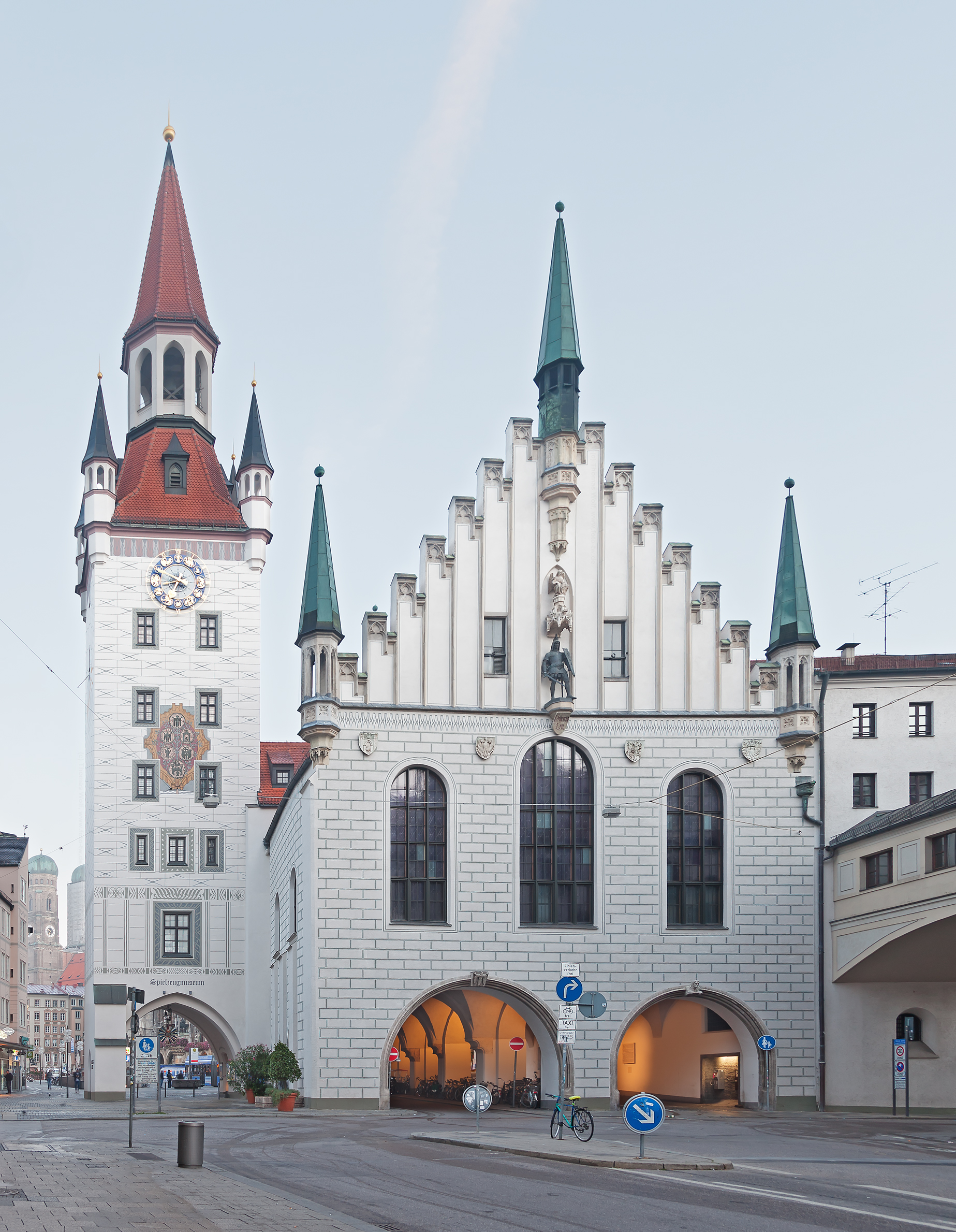
Most tourists walk under the Altes Rathaus's tower gate without realising they're passing through a building where one of the 20th century's worst atrocities was set in motion. On the evening of November 9, 1938, Joseph Goebbels stood in the Grand Hall upstairs and delivered the speech that triggered Kristallnacht — the night of broken glass, when Nazi mobs destroyed thousands of Jewish businesses and synagogues across Germany and Austria. The building itself had been documented since 1310 and rebuilt in Gothic style by Jörg von Halsbach between 1470 and 1480. Halsbach also built the Frauenkirche, making him responsible for two of Munich's most recognisable structures.
The Grand Hall — the Festsaal — is the architectural star: a cavernous Gothic room with a wooden barrel-vaulted ceiling and a frieze of 96 coats of arms. After being destroyed by lightning in 1460 and rebuilt by Halsbach, it served as the city council's meeting chamber for over 400 years before the council moved to the Neues Rathaus in 1874. The hall has hosted celebrations, political assemblies, and at least one speech that led to murder on an industrial scale.
Allied bombing in 1944 devastated the building. When restorers began work after the war, they chose to reconstruct based on Halsbach's original Gothic design rather than the Neo-Gothic renovation that architect Arnold Zenetti had applied in the 1860s. It was a deliberate archaeological decision: go back to the original, not the renovation.
Today the tower houses a toy museum — the Spielzeugmuseum — which occupies the same structure that Goebbels spoke from. Children climb the spiral staircase to see teddy bears and model trains in rooms that once amplified hatred. The contrast isn't accidental; it's the kind of layered history that Munich does better than almost any city in Europe, even when it hurts.
Verified Facts
Goebbels delivered the speech triggering Kristallnacht in the Grand Hall on November 9, 1938
First documented in 1310; rebuilt in Gothic style by Jörg von Halsbach between 1470 and 1480
The post-war restoration chose to reconstruct Halsbach's original Gothic design rather than the 1860s Neo-Gothic renovation
The tower now houses the Spielzeugmuseum (Toy Museum)
Get walking directions
15 Marienplatz, Altstadt-Lehel, Munich, 80331, Germany