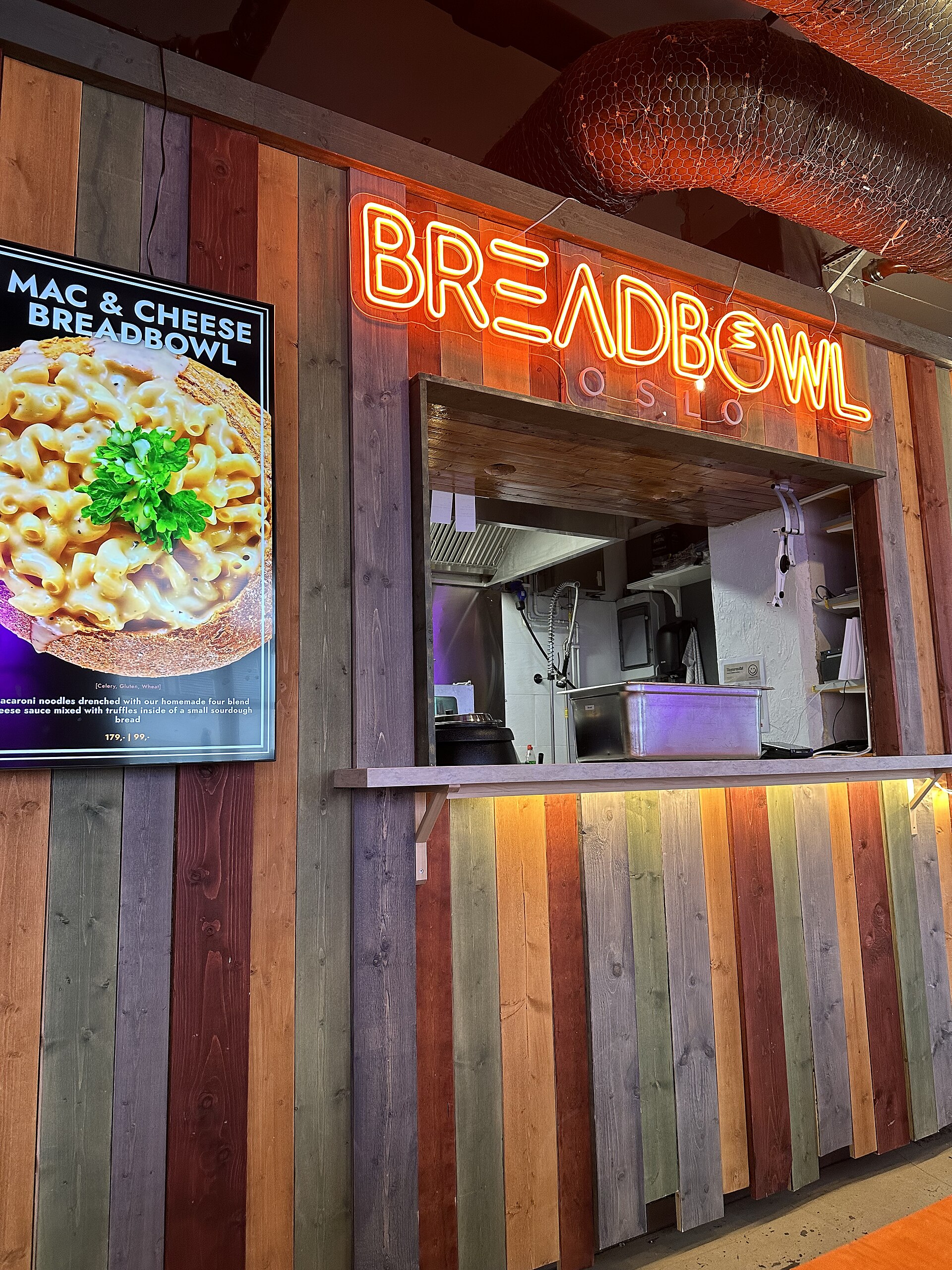
The building used to be a swimming pool. Torggata Bad was once the largest indoor pool in Oslo, and the space that held lanes of chlorinated water now holds sixteen food stalls, four bars, and over six hundred seats. It's the kind of adaptive reuse that makes you wonder what other civic infrastructure is hiding under Oslo's food halls.
Oslo Street Food opened on Torggata — one of the city's most eclectic streets, a formerly gritty corridor that has gentrified into a nightlife and food destination while keeping some of its edge. The vendor lineup reflects Oslo's growing diversity: Vietnamese pho, Mexican tacos, Argentine empanadas, smash burgers, Middle Eastern platters, and more. Prices are lower than most Oslo restaurants, which in a city this expensive counts as a genuine public service.
On weeknights it's a casual dinner spot where you can sample three cuisines in one sitting. On Friday and Saturday nights it transforms into something else entirely — the food stalls stay open and the space becomes a nightclub, running until three in the morning. The transition from taco stand to dance floor happens organically, lubricated by the four bars spread across the hall.
Torggata itself deserves a wander. The street has been through several identity crises — working-class neighborhood, red-light district, immigrant corridor, and now nightlife strip — but it retains the kind of energy that polished waterfront developments can't manufacture. Oslo Street Food sits right in the middle of it, serving cheap pho and expensive cocktails in a former swimming pool. Norway in a nutshell.
Verified Facts
Housed in the former Torggata Bad, once Oslo's largest indoor swimming pool
Contains 16 food stalls, 4 bars, and over 600 seats
Transforms into a nightclub on Friday and Saturday nights, open until 3:00 AM
Get walking directions
Torggata 16, 0181 Oslo