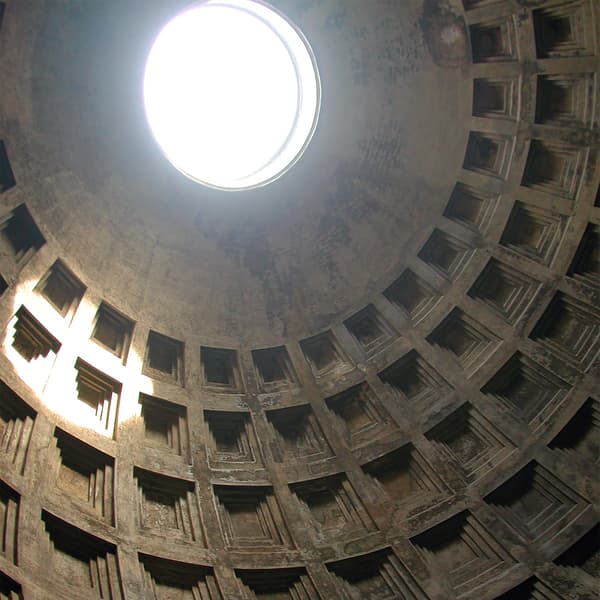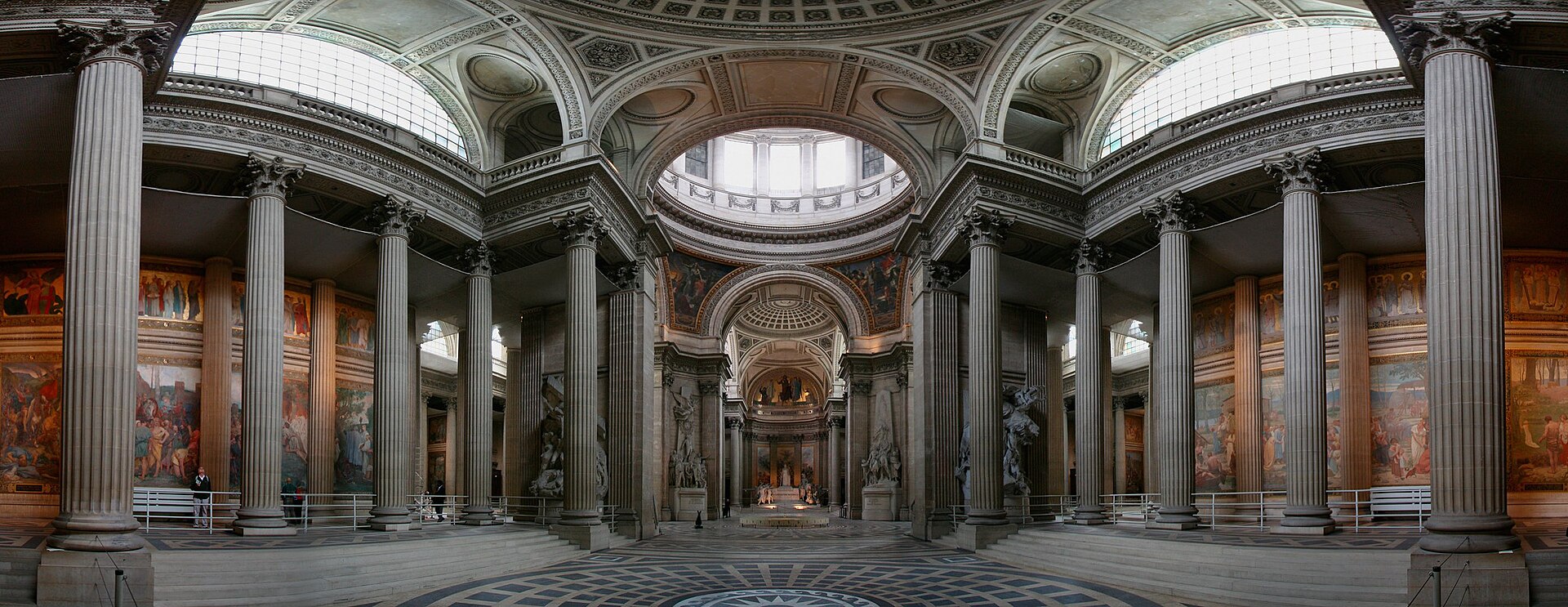
The dome above your head is still, after nearly nineteen hundred years, the largest unreinforced concrete dome ever built. That fact alone should make you furious at the concept of planned obsolescence. The Romans poured this thing around 125 AD under Emperor Hadrian, and it has never collapsed, never been significantly repaired structurally, and it still works exactly as designed. Meanwhile, the concrete in a modern parking garage starts crumbling after about fifty years.
The secret is in the recipe. Roman concrete used volcanic ash — specifically pozzolana from the fields near Pozzuoli — mixed with lime and seawater. Recent research has shown that seawater, far from weakening the concrete, actually triggers a mineral growth process that makes it stronger over time. The crystals of aluminous toite that form in the matrix effectively heal cracks. The Romans stumbled onto a self-repairing building material and we forgot how to make it for sixteen centuries.
The oculus — that nine-metre-wide hole in the top — is the only source of light. There is no glass. Rain falls straight in and hits the slightly convex marble floor, which has twenty-two nearly invisible drain holes. On April twenty-first, the traditional founding date of Rome, the noon sun hits the entrance doorway perfectly. Hadrian apparently used this alignment to make a dramatic imperial entrance, bathed in a shaft of sunlight. It is architectural theatre on a cosmic scale.
Raphael is buried here. So are two Italian kings. When Michelangelo first saw it, he reportedly said it looked like the work of angels, not men. Every major dome built since — Florence Cathedral, St Peter's, the Capitol Building in Washington — has been measured against this one. They are all smaller.
Verified Facts
The Pantheon dome remains the largest unreinforced concrete dome ever built at 43.3 metres in diameter
Roman concrete used volcanic ash (pozzolana) mixed with lime and seawater, which triggers mineral growth that strengthens over time
The oculus is 9 metres wide with no glass; the floor has 22 drain holes for rainwater
On April 21 (Rome founding date), noon sunlight aligns perfectly with the main entrance
Raphael is buried inside the Pantheon, along with two Italian kings (Vittorio Emanuele II and Umberto I)
Get walking directions
I Municipio, Rome, Italy