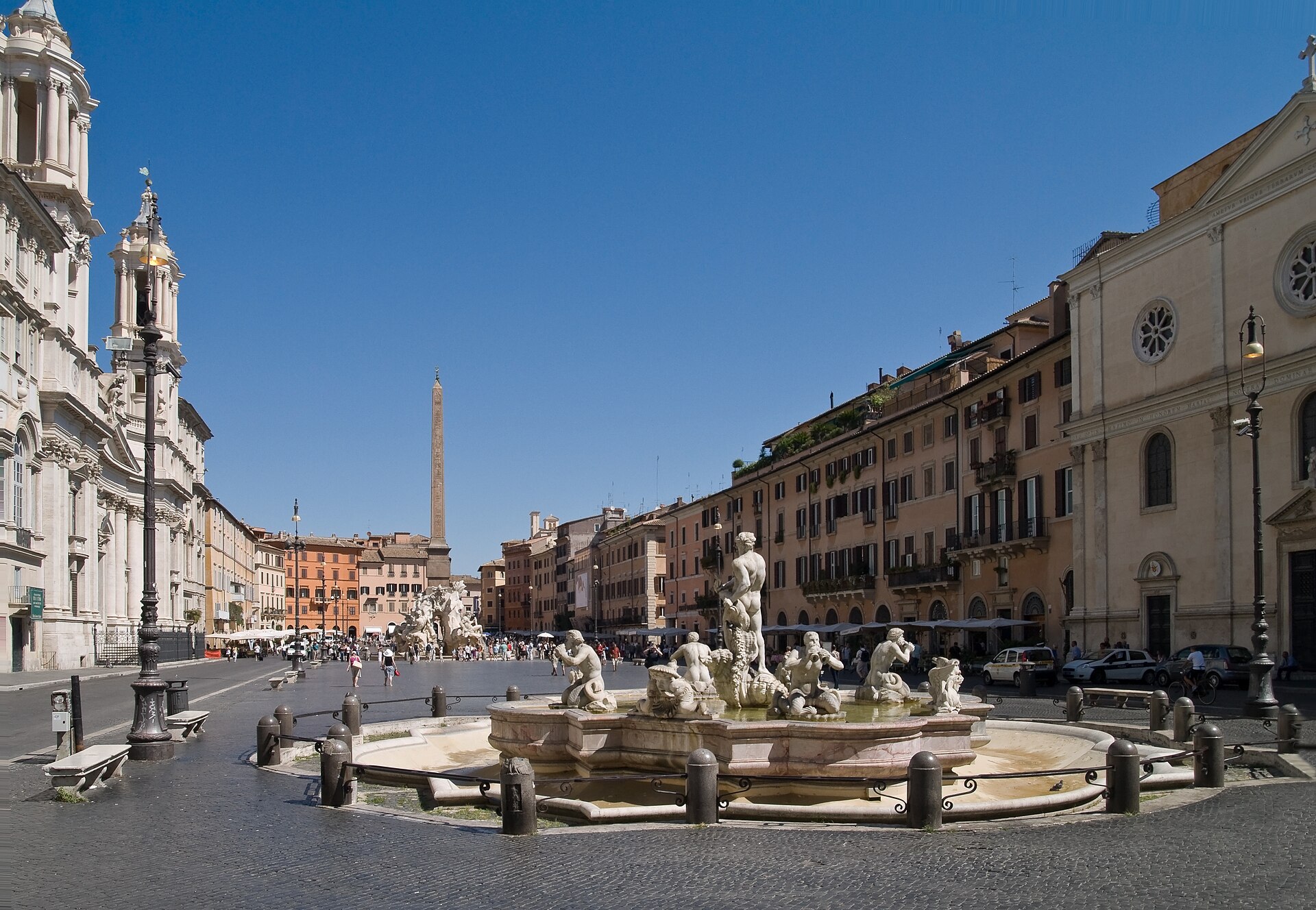
The reason this piazza is shaped like a racetrack is that it was a racetrack. The Emperor Domitian built his Stadium here around 80 AD — the Stadio di Domiziano — with seating for thirty thousand spectators who came to watch Greek-style athletic competitions. The exact footprint of that stadium defines the piazza you see today. If you go to the north end and look down through a modern building at Piazza Tor Sanguigna, you can actually see sections of the original arched seating preserved beneath street level.
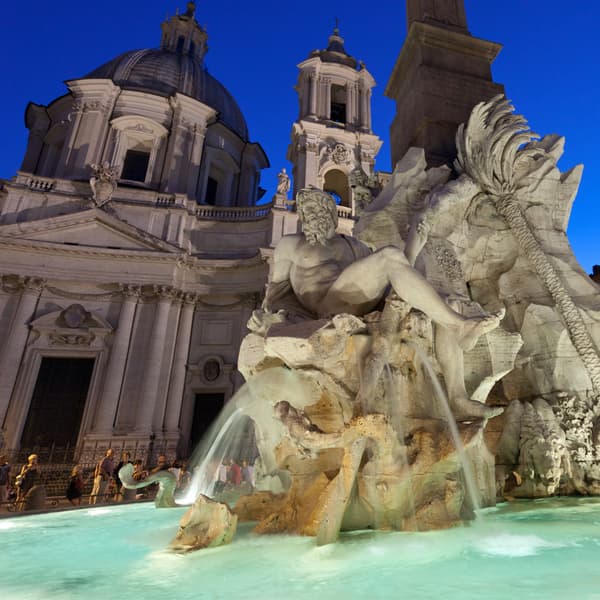
The centrepiece is Bernini's Fountain of the Four Rivers, completed in 1651, showing the four great rivers of the known continents: the Nile, Ganges, Danube, and Rio de la Plata. Each river is personified by a massive figure. There is a famous story that the Rio de la Plata figure is shielding his eyes in horror at the facade of Sant'Agnese in Agone, designed by Bernini's rival Borromini. Beautiful story. Completely false. The fountain was finished before Borromini even started on the church. Bernini was a genius self-promoter, but he was not a time traveller.
For two centuries, the piazza was deliberately flooded every August weekend. The drains were plugged, water filled the concave space to about a metre deep, and Romans would wade through it, drive carriages through it, and generally treat the whole piazza as a wading pool. Aristocrats sent their gilded coaches splashing through while commoners cooled off on foot. The practice was finally stopped in 1866.
Caravaggio lived around the corner from here for most of his time in Rome, and the piazza's bars and restaurants were part of his territory. He got into a brawl in this neighbourhood in 1606 that ended with him killing a man named Ranuccio Tomassoni — possibly over a gambling debt, possibly over a woman, possibly both. He fled Rome that night and never came back.
Verified Facts
The piazza follows the exact footprint of Domitian's Stadium (c. 80 AD), which seated 30,000 for athletic competitions
Bernini's Fountain of the Four Rivers was completed in 1651, before Borromini started the Sant'Agnese church facade — debunking the rivalry story
The piazza was deliberately flooded each August for two centuries as a public wading pool, ending in 1866
Caravaggio killed Ranuccio Tomassoni in a brawl near the piazza in 1606 and fled Rome permanently
Get walking directions
Piazza Navona, I Municipio, Rome, 00186, Italy