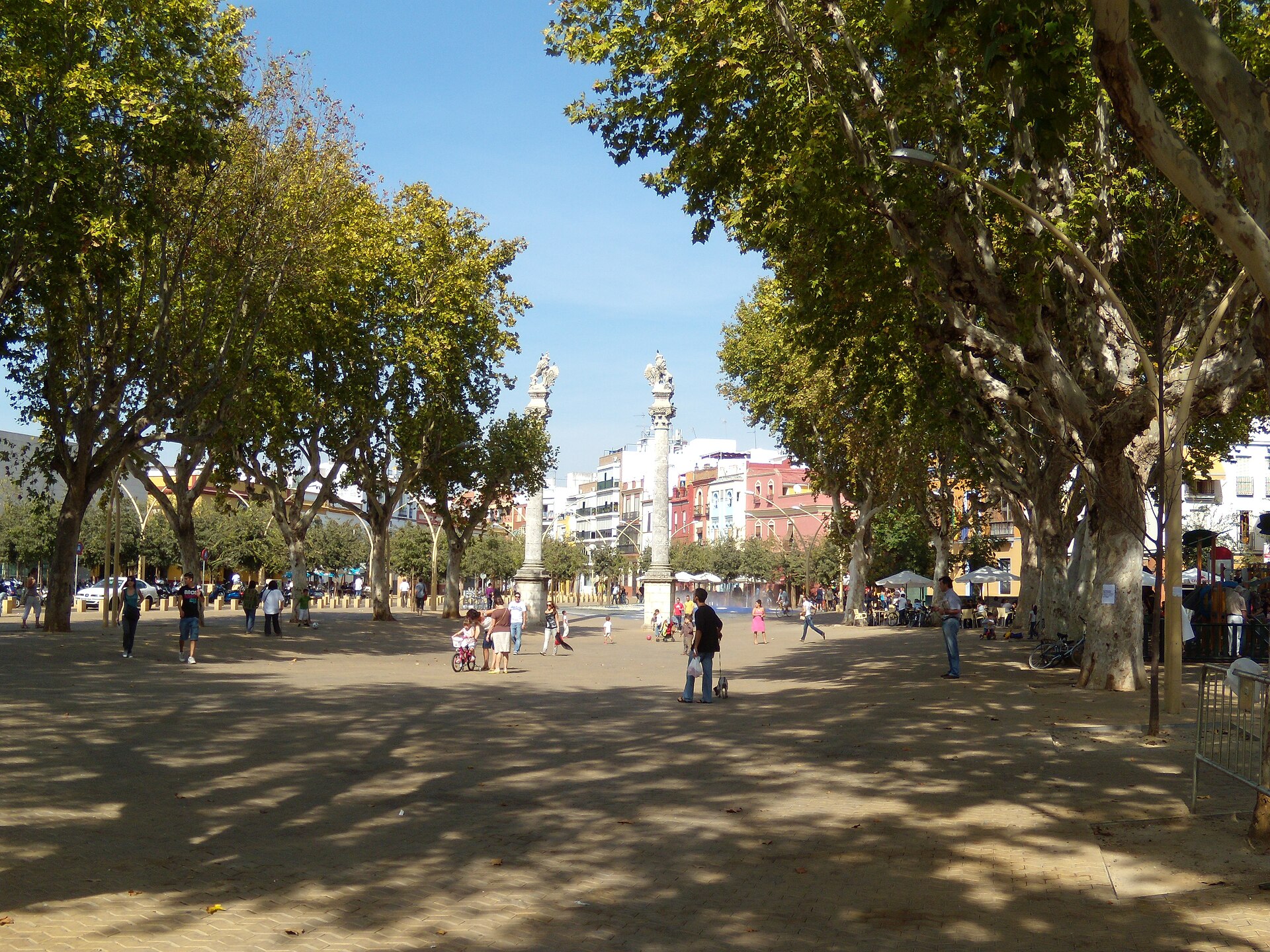
Laid out in 1574, this is the oldest public garden in Spain and one of the oldest in all of Europe. That statistic alone would make it noteworthy, but the Alameda's real story is about reinvention. The site was originally a marshy flood plain along the Guadalquivir that the Count of Barajas drained by building channels and planting rows of white poplar trees — "alamos" in Spanish, which gave the promenade its name. Two Roman columns were hauled from a temple on nearby Calle Marmoles and erected at the southern end, topped with statues of Hercules (mythological founder of Seville) and Julius Caesar (credited with restoring the city during Roman rule).
For centuries the Alameda was a fashionable promenade, then it became a market, then in the twentieth century it slid into decline and became one of Seville's roughest neighborhoods — a no-go zone of drugs and prostitution that respectable Sevillanos avoided. The turnaround began slowly in the 1990s, and a major city-funded renovation between 2006 and 2008 repaved the boulevard, added fountains, and turned it into the most vibrant plaza in modern Seville.
Today the Alameda is the heart of Seville's alternative scene. It is the center of the city's LGBTQ nightlife, home to independent bookshops and vintage stores, and ringed by terrace bars that fill every evening with a crowd that skews younger and more bohemian than the tourist zones across the old town. On Sunday mornings, a flea market takes over part of the square.
The northern columns are modern reproductions, but the two southern ones are genuinely Roman — roughly 2,000 years old and still standing exactly where the sixteenth-century engineers placed them. They are easy to miss in the bustle of the evening crowd, which is part of the Alameda's charm: ancient history hiding in plain sight.
Verified Facts
Laid out in 1574, it is the oldest public garden in Spain and one of the oldest in Europe
The two southern columns are genuinely Roman, taken from a temple on Calle Marmoles and topped with statues of Hercules and Caesar
A major city renovation between 2006 and 2008 transformed it from a neglected area into Seville's most vibrant plaza
The name comes from "alamos" (poplar trees) planted by the Count of Barajas when the marshy floodplain was drained
Get walking directions
Plaza Alameda de Hercules, Casco Antiguo, Seville, 41002, Spain