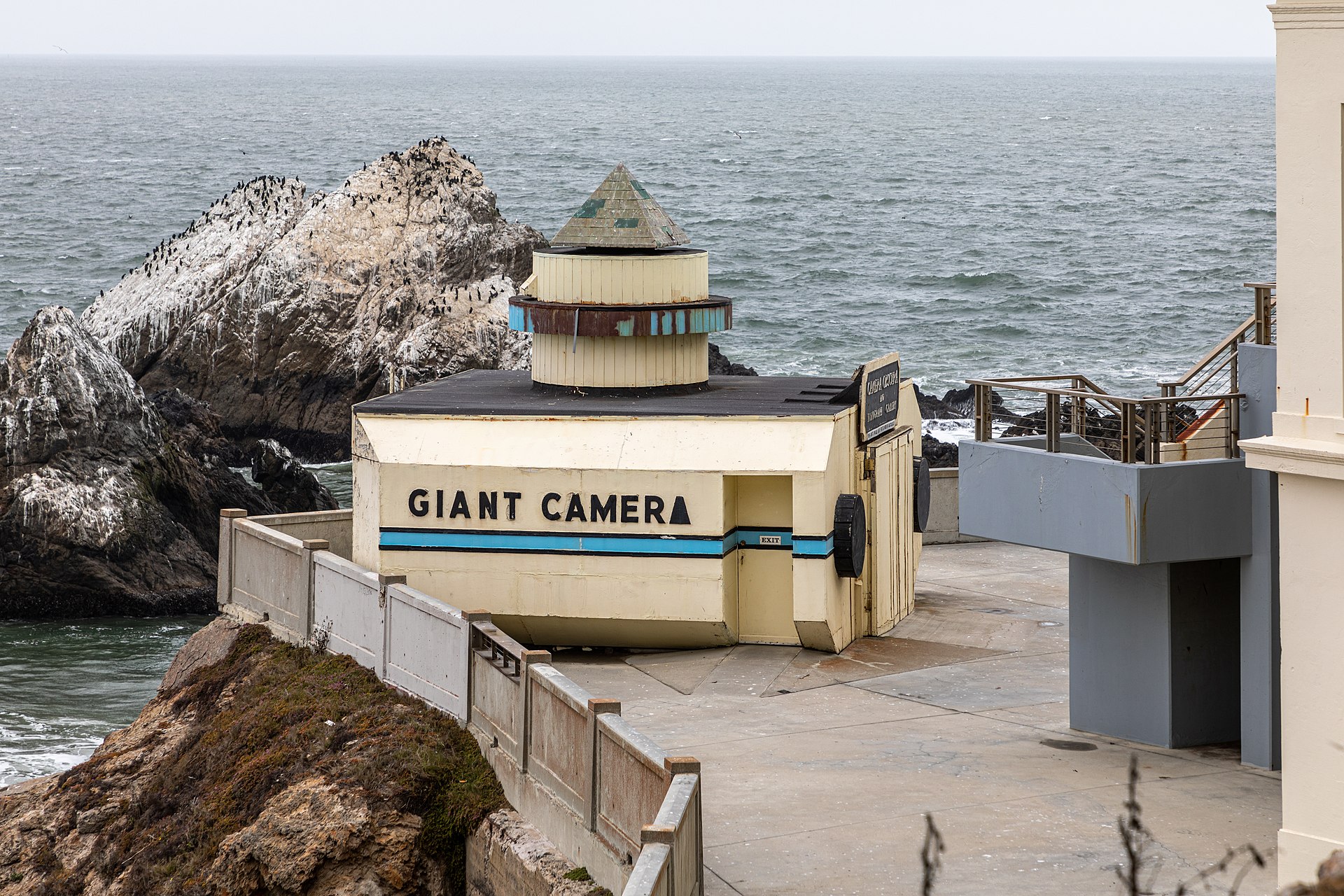
That giant camera-shaped building next to the Cliff House ruins is exactly what it looks like — a camera obscura, and it's one of the last functioning ones in the United States. Built in nineteen forty-six, it's the sole surviving structure from Playland at the Beach, an amusement park that once stretched along this coastline and was demolished in the early seventies.
The principle is ancient. Leonardo da Vinci described the camera obscura in detail in the fifteenth century, though the concept goes back even further. Here's how it works: a small opening at the top of the building lets in light, which passes through a rotating lens and mirror system and projects a live, full-color, three-hundred-and-sixty-degree image of the surrounding landscape onto a large parabolic dish inside the dark room. No electricity. No screens. No digital trickery. Just optics and light.
Step inside on a clear day and you'll see the ocean, the rocks, Seal Rock with its barking sea lions, and the coastline stretching north — all projected in real time onto a white dish about six feet across, as if someone painted the world in miniature right in front of you. It's the slowest, most analog way to look at a view, and there's something unexpectedly moving about it.
The Camera Obscura was added to the National Register of Historic Places in two thousand and one, recognizing both the building and the optical instrument inside it. It's a tiny, easy-to-miss structure sitting in the shadow of the much more famous Sutro Baths ruins and Cliff House site. Most visitors walk right past it. But if you've got a few dollars and five minutes of curiosity, step inside. It's like looking at the world through the eye of a sixteenth-century scientist.
Verified Facts
Built 1946, last surviving structure from Playland at the Beach
Based on camera obscura principle described by Leonardo da Vinci
Added to National Register of Historic Places in 2001
Get walking directions
1096 Point Lobos Avenue, San Francisco