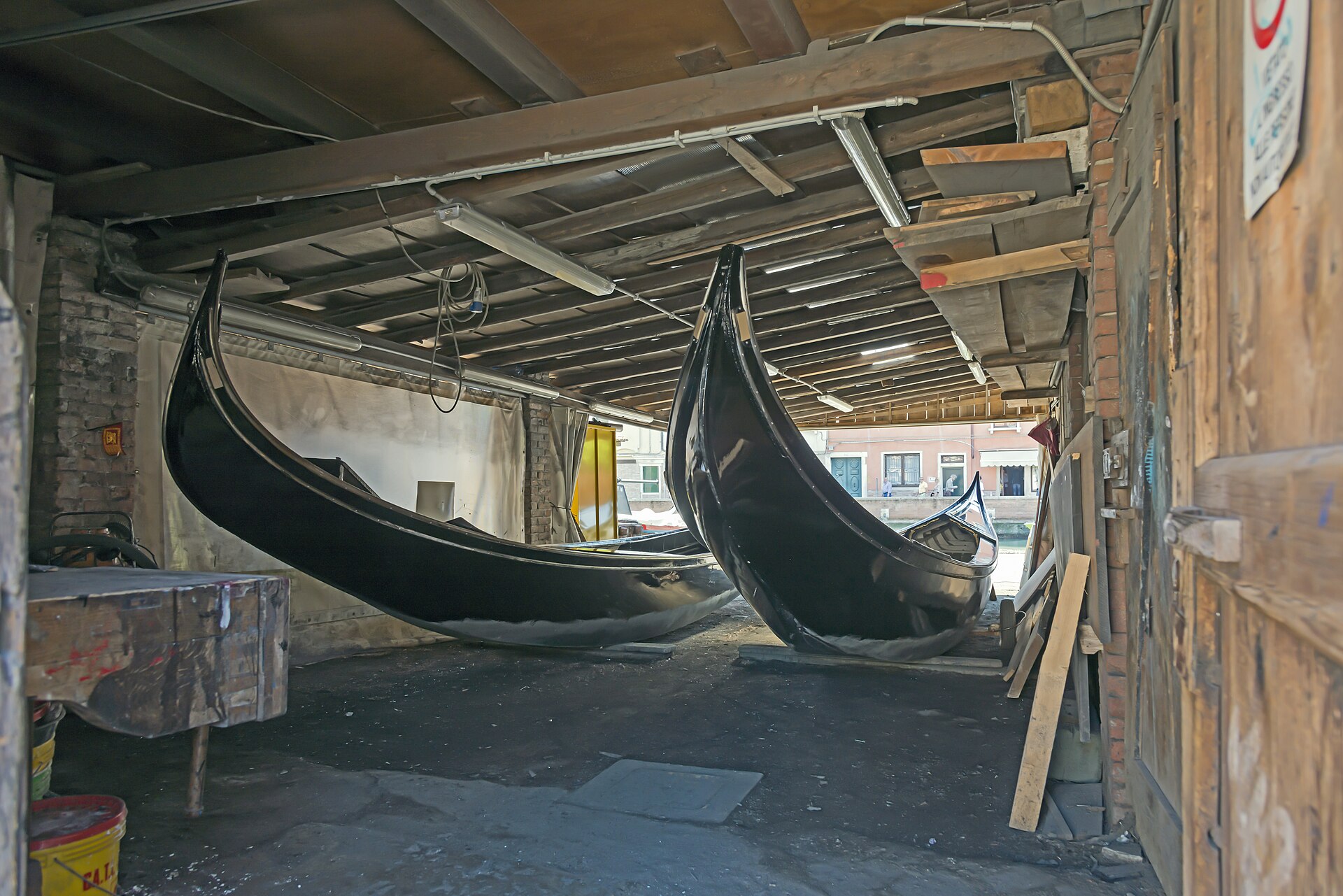
In the 16th century, ten thousand gondolas navigated Venice's canals. Today there are about 350, and this tiny workshop in Dorsoduro is one of only five squeri — gondola boatyards — still operating in the city. The Squero di San Trovaso has been building and repairing gondolas since the 17th century, and the craft hasn't changed much. Eight types of wood, no blueprints, and hands that know what they're doing.
The workshop building itself is an oddity. It looks like an Alpine chalet, not a Venetian palazzo — sloping wooden roof, timber construction, a wide slipway leading to the water. The reason is practical: both the carpenters and the wood traditionally came from the mountain region of Cadore in the Dolomites, and they built their workshop in the style they knew. The design also protected the workers from rain and provided covered storage for tools and timber.
Each gondola is built entirely by hand from mahogany, cherry, fir, walnut, oak, elm, larch, and lime — eight woods chosen for their specific properties of strength, flexibility, and water resistance. There are no plans; the squero master works from memory and instinct, shaping the asymmetric hull by eye. A gondola is deliberately built with the left side wider than the right, so that a single oarsman standing on the right can propel it in a straight line. The finished boat weighs about 350 kilograms and lasts 15 to 20 years with regular maintenance.
You can't go inside — the squero is closed to the public — but you can watch from across the canal on Fondamenta Nani, preferably with a glass of wine from the bar on the corner. It's one of the few places in Venice where you can watch a medieval craft being practiced in real time, and the workshop, with its wood shavings and half-built hulls, is as photogenic as any palazzo.
Verified Facts
One of only five working squeri (gondola boatyards) remaining in Venice
Eight types of wood are used: mahogany, cherry, fir, walnut, oak, elm, larch, and lime
A gondola is built asymmetrically — the left side wider than the right — so a single oarsman can row straight
In the 16th century there were 10,000 gondolas in Venice; today there are approximately 350
Get walking directions
Dorsoduro 1097, Venice