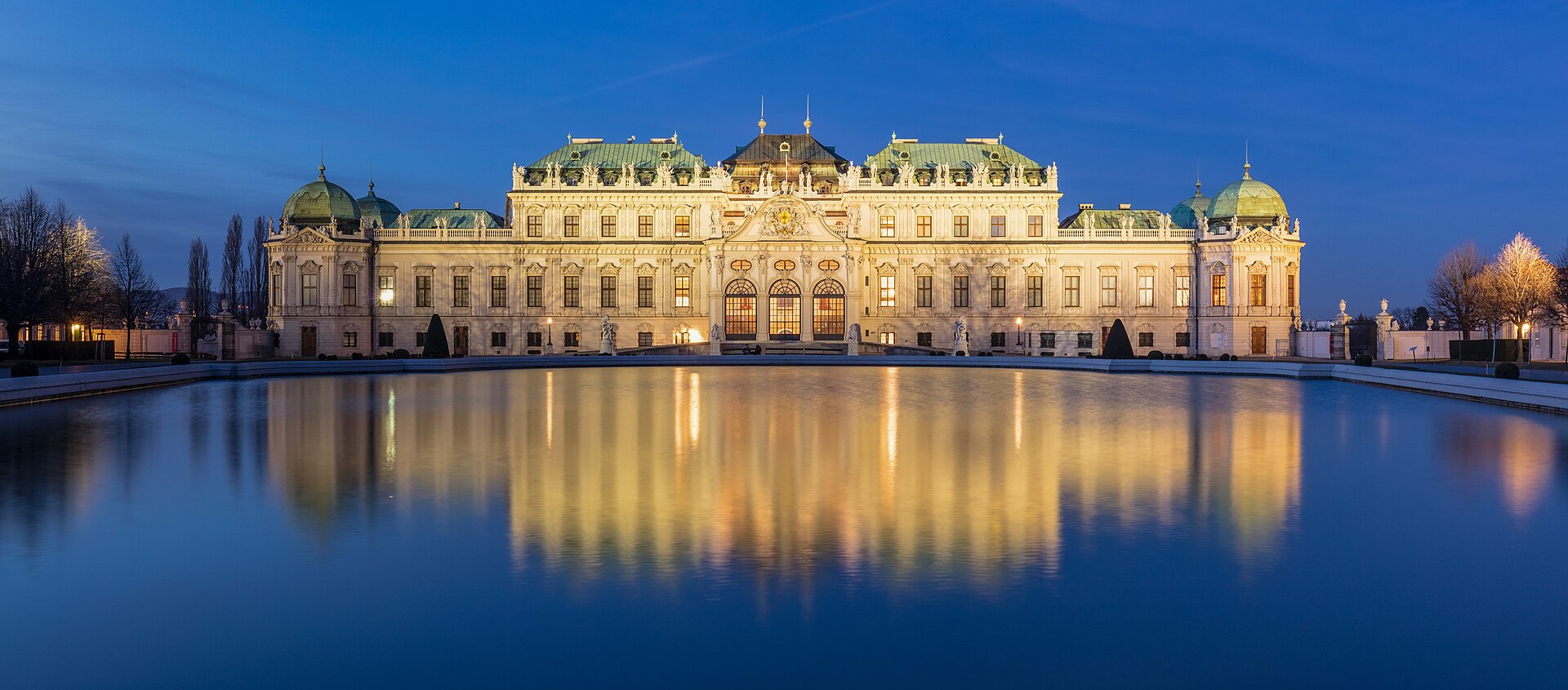
Prince Eugene of Savoy was one of Europe's greatest military commanders, and he spent his war spoils on one of Europe's greatest palaces. The Upper Belvedere, completed in 1723 by architect Johann Lukas von Hildebrandt, was built purely for entertaining — Eugene lived in the Lower Belvedere down the hill and walked up through the manicured gardens when he felt like throwing a party. The man literally built a separate palace for his social life.
After Eugene died in 1736, the Habsburgs snapped up the property. Maria Theresa acquired it in 1752 and did something revolutionary: she opened part of it to the public as an Imperial Picture Gallery, making it one of the earliest public art museums in the world. The building has been showing art to ordinary people for nearly three centuries.
Today the Upper Belvedere is home to Gustav Klimt's "The Kiss" — a painting so famous it's become shorthand for Vienna itself. Completed in 1908, the gold-leaf-draped image of two lovers was controversial when first exhibited: critics called it merely decorative. The Austrian state purchased it immediately for what was then a record sum, and it hasn't left the Belvedere since. The museum houses the world's largest collection of Klimt paintings — twenty-four in total — alongside works by Schiele and Kokoschka.
The Marble Hall of the Upper Belvedere hosted one of the most significant moments in modern Austrian history. On May 15, 1955, the Austrian State Treaty was signed here, ending ten years of Allied occupation. Foreign Minister Leopold Figl stepped onto the balcony, held up the signed treaty, and said simply: "Austria is free." The balcony is still there, and the view over the gardens toward the city skyline hasn't changed.
Verified Facts
The Upper Belvedere was completed in 1723, designed by Johann Lukas von Hildebrandt for Prince Eugene of Savoy
The museum houses 24 Klimt paintings, the world's largest single collection, including "The Kiss" (1908)
The Austrian State Treaty was signed in the Marble Hall on May 15, 1955, ending Allied occupation
Maria Theresa acquired the palace in 1752 and opened it as one of the world's earliest public art museums
Get walking directions
27 Prinz-Eugen-Straße, Landstraße, Vienna, 1030, Austria