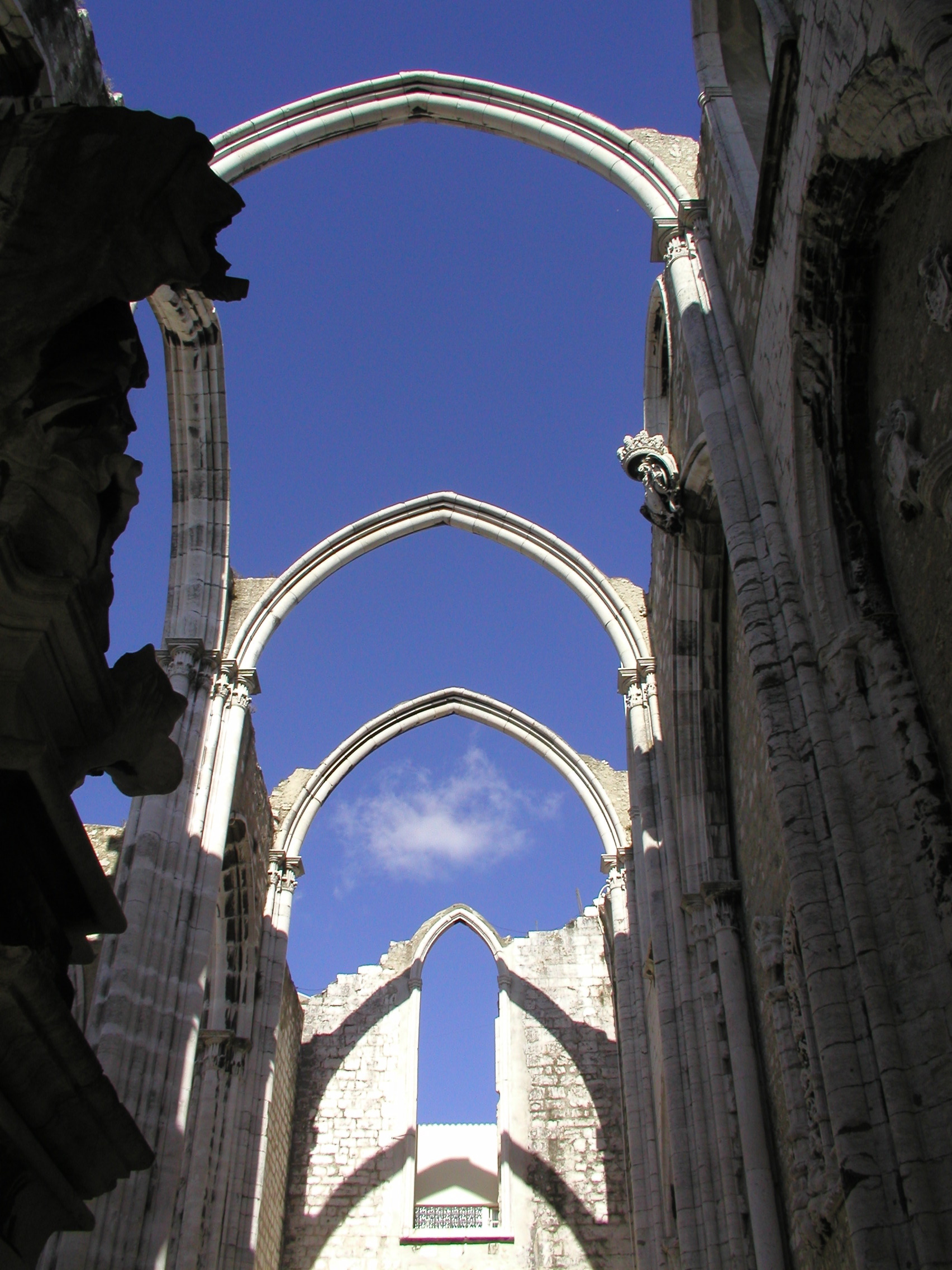
Most ruins get rebuilt. These were kept broken on purpose. The Convento do Carmo was once the largest Gothic church in Lisbon, built starting in 1389 by Nuno Álvares Pereira, the military commander who secured Portuguese independence at the Battle of Aljubarrota. He spent his final years here as a monk, and the church became one of the most important religious houses in the city. Then came All Saints' Day, 1755. The congregation was packed inside for morning mass when the earthquake struck. The roof collapsed, killing nearly everyone beneath it.
After the disaster, there was talk of rebuilding. Pombal's new city plan could have restored the church to its former glory. Instead, Lisbon made the unusual decision to leave the nave roofless — a permanent scar in the cityscape, open to the sky. The Gothic arches still stand, framing clouds and blue sky where vaulted ceilings once were. It's one of the most haunting spaces in any European city: a church that became its own memorial without anyone having to add a plaque or a monument. Rain falls on the nave floor. Pigeons nest in the capitals. The silence inside has a quality you don't find in intact buildings.
The convent also played a starring role in the most dramatic moment of modern Portuguese history. On April 25, 1974, the headquarters of the GNR (National Republican Guard) was located here, and it was where Marcelo Caetano, the dictator who succeeded Salazar, made his last stand during the Carnation Revolution. Captain Salgueiro Maia surrounded the building with tanks and negotiated Caetano's surrender. The dictator agreed to hand power to General Spínola rather than to "the rabble in the street." Today a small archaeological museum occupies the surviving chapels, housing pre-Columbian mummies, medieval tombs, and Roman artifacts — a grab bag of history in a building that is itself the most eloquent artifact of all.
Verified Facts
The church was founded in 1389 by Nuno Álvares Pereira, the hero of the Battle of Aljubarrota, who became a monk here.
The roof collapsed during the 1755 earthquake while the church was full of worshippers for All Saints' Day mass.
The ruins were deliberately left unrestored as a permanent memorial to the earthquake.
Dictator Marcelo Caetano surrendered here during the 1974 Carnation Revolution after Captain Salgueiro Maia surrounded the building with tanks.
Get walking directions
Santa Maria Maior, Lisboa, Portugal