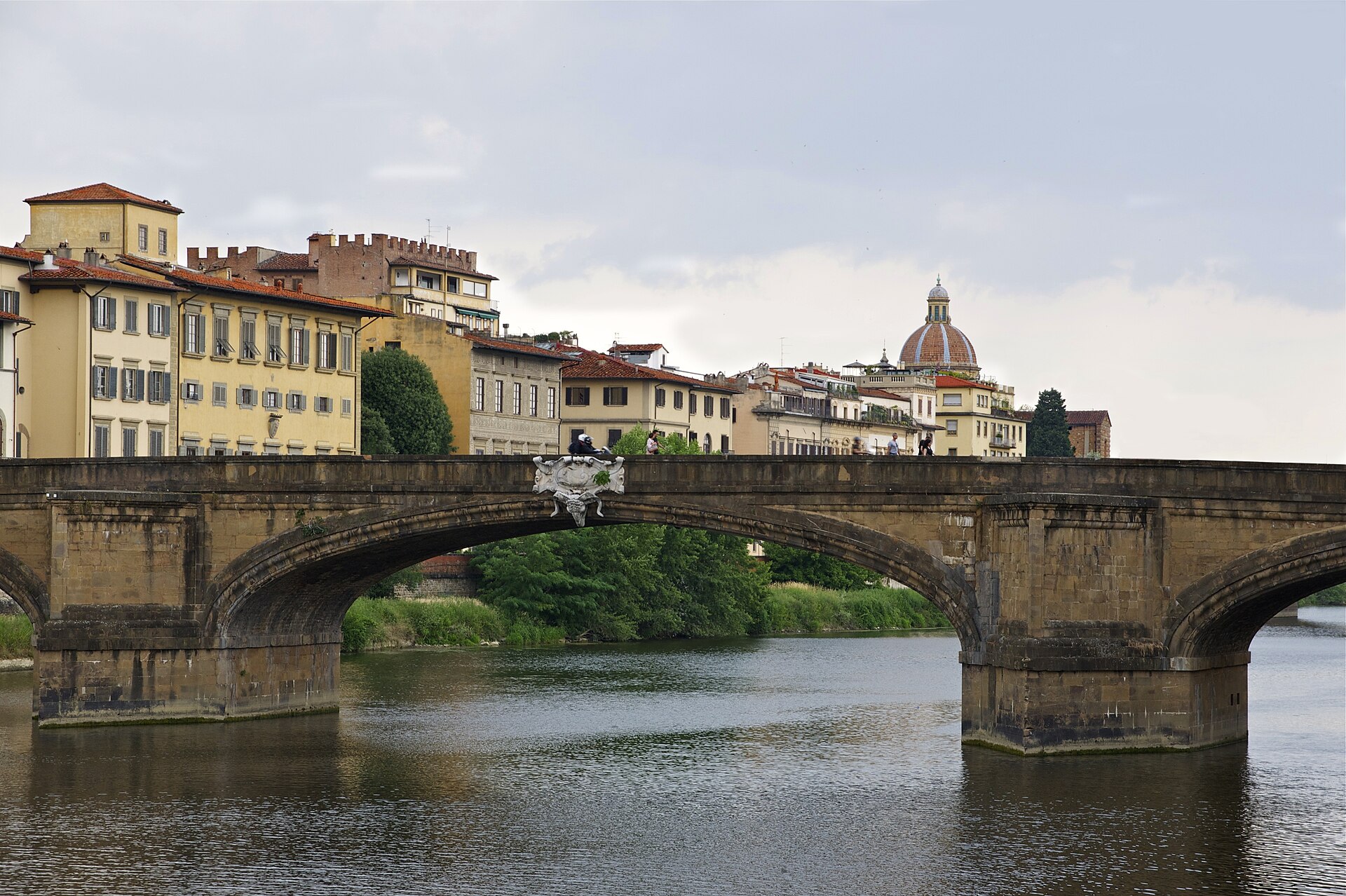
The most beautiful bridge in Florence isn't the Ponte Vecchio — it's this one, fifty meters upstream. Ponte Santa Trinita's three elliptical arches are so graceful that Renaissance architects debated for centuries how Bartolomeo Ammanati achieved their curve. Some credited Michelangelo with secretly providing the design. The mathematical answer — they're not semicircles but sections of an ellipse — wasn't confirmed until modern computer analysis.
The original bridge was built in 1252 and rebuilt multiple times after flood damage. Ammanati's version, completed in 1569, stood for nearly four centuries until August 1944, when retreating German forces blew it up along with every other bridge in Florence except the Ponte Vecchio. The Florentines were devastated — not by the military loss, but by the aesthetic one.
After the war, the city made the remarkable decision to rebuild it exactly as it was, using the original technique: pietra forte sandstone from the same quarries, no reinforced concrete, authentic Renaissance construction methods. Fragments of the original bridge were painstakingly fished from the Arno. The rebuilding was completed in 1958, but a crucial piece was missing — the original head of the statue of Primavera (Spring) that decorated one of the bridge piers had been lost in the river. It wasn't found until 1961, when a dredger pulled it from the mud. The statue was made whole and the bridge was finally complete — sixteen years after its destruction.
Stand in the middle at sunset and look downriver toward the Ponte Vecchio. This is the view that appears on every postcard and in every movie set in Florence, and you're standing on the engineering that makes the photograph possible.
Verified Facts
Ammanati completed the bridge in 1569, and it stood until German forces destroyed it in August 1944
It was rebuilt using original materials and techniques, completed in 1958 without reinforced concrete
The lost head of the Primavera statue was recovered from the Arno in 1961 by a dredger
The elliptical arches were long attributed to a secret design by Michelangelo
Get walking directions
Ponte Santa Trinita, Centro Storico, Florence, 50125, Italy