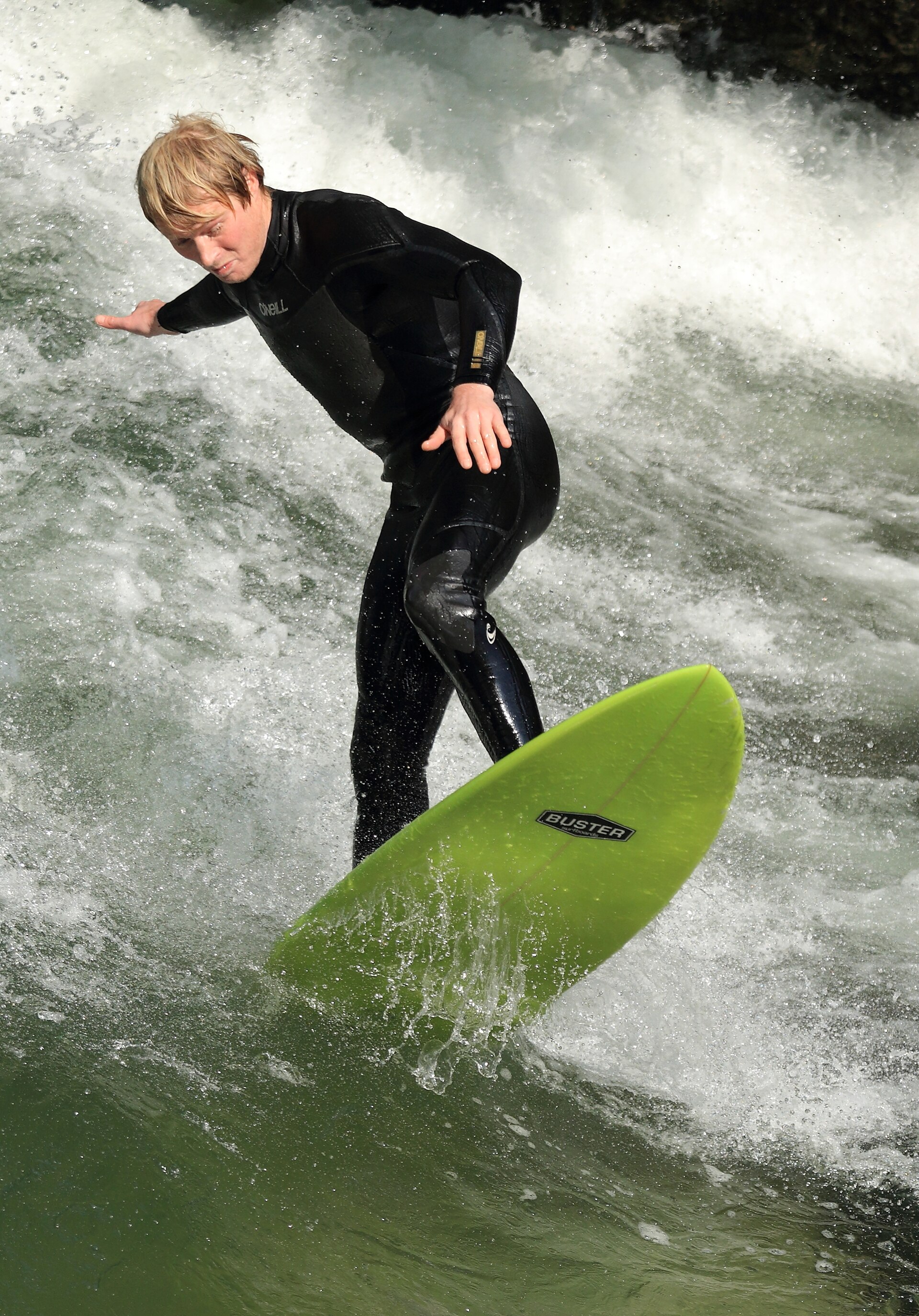
There's a standing wave in the middle of Munich, and people surf it year-round. The Eisbachwelle forms where a man-made canal called the Eisbach — "ice brook" — emerges from underground near the Haus der Kunst art museum and crashes over a concrete ledge. The result is a roughly one-metre-high wave that never stops breaking, creating what may be the world's most famous river surfing spot in a city that's 500 kilometres from the nearest ocean.
Surfers discovered the wave in the 1970s, and for decades the practice was technically illegal. The water is cold, shallow — sometimes only 40 centimetres deep — and powerful enough to pin an inexperienced swimmer against the bottom. The current is relentless. Despite the dangers, surfers kept coming, developing a distinctive style adapted to a wave you can't paddle into. You jump in, land on the wave, and ride until you fall off or pull out. There's an unwritten queue system, and cutting the line will earn you a verbal thrashing in Bavarian dialect.
The city finally legalised Eisbach surfing in 2010, effectively acknowledging what Münchners had known for decades: you can't stop people from doing something this fun. On any given day, especially in summer, a crowd gathers on the bridge and along the banks to watch wetsuit-clad surfers carve turns on water that runs about 300 metres before it disappears under another bridge. The spectator sport is almost as good as the surfing itself.
There's a second, gentler wave a few hundred metres downstream — the E2 or Kleine Eisbachwelle — where beginners can practice without the intimidation factor of the main wave and its audience. The whole scene is peak Munich: athletic, outdoorsy, slightly defiant, and happening in a park designed in the 18th century by a man who could never have imagined neoprene.
Verified Facts
The standing wave is approximately one metre high, formed where the Eisbach canal passes over a concrete ledge
Surfing on the Eisbach was technically illegal until the city legalised it in 2010
Surfers have been riding the wave since the 1970s, making it one of the world's oldest river surfing spots
The water can be as shallow as 40 centimetres; between 2007 and 2017, eight people drowned in the Eisbach
Get walking directions
Prinzregentenstraße, Altstadt-Lehel, Munich, 80538, Germany