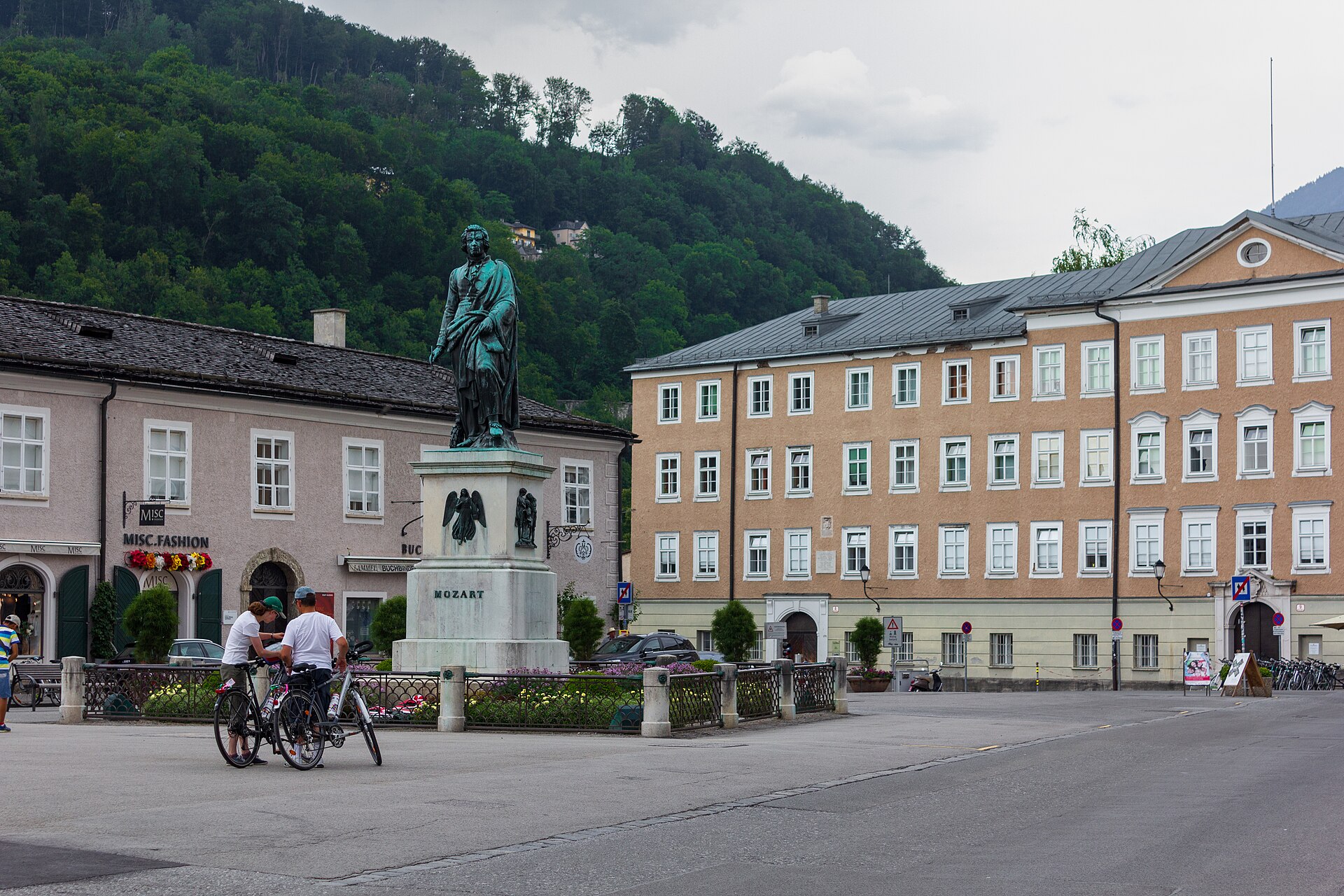
This elegant square in the heart of Salzburg's old town was not always dedicated to Mozart. Originally called Michaelsplatz, it was renamed in honour of the city's most famous son — who, let's remember, despised living here and fled at the earliest opportunity. The centrepiece is a bronze statue by Bavarian sculptor Ludwig Schwanthaler, erected in 1842 to mark what should have been the 50th anniversary of Mozart's death. It was a year late because during foundation excavation, workers discovered a Roman mosaic in the ground, and the whole project had to pause for archaeology.
The mosaic, still visible beside the statue's marble base, bears the inscription "hic habitat felicitas, nihil intret mali" — "here lives happiness, may nothing evil enter." Whether this referred to a Roman home, a bathhouse, or something else entirely remains debated, but it's a strangely fitting motto for a square dedicated to a man who created some of the most joyful music ever written.
King Ludwig I of Bavaria — the same Ludwig whose grandson would go on to build the fairy-tale castles — donated the marble pedestal for the statue. The original centrepiece of the square was a Baroque fountain topped with a statue of Saint Michael, which was removed in 1841 to make way for Mozart. The Archangel was, essentially, evicted to make room for a composer. In Salzburg, art outranks heaven.
Mozart himself would have had complicated feelings about the tribute. He was born two streets away, baptised in the cathedral around the corner, and grew up playing concerts in the nearby Residenz. But by his mid-twenties he was writing furious letters about Salzburg's cultural backwardness and couldn't wait to leave. The statue gazes thoughtfully into the middle distance — perhaps wondering why the city that drove him away now can't stop celebrating him.
Verified Facts
The Mozart statue was unveiled on September 4, 1842, a year late due to the discovery of a Roman mosaic during excavation
The statue was sculpted by Ludwig Schwanthaler, with the marble pedestal donated by King Ludwig I of Bavaria
A Roman mosaic beneath the square bears the inscription "hic habitat felicitas, nihil intret mali"
The square was originally called Michaelsplatz and featured a Baroque fountain with a statue of Saint Michael
Get walking directions
Altstadt, Salzburg, Austria