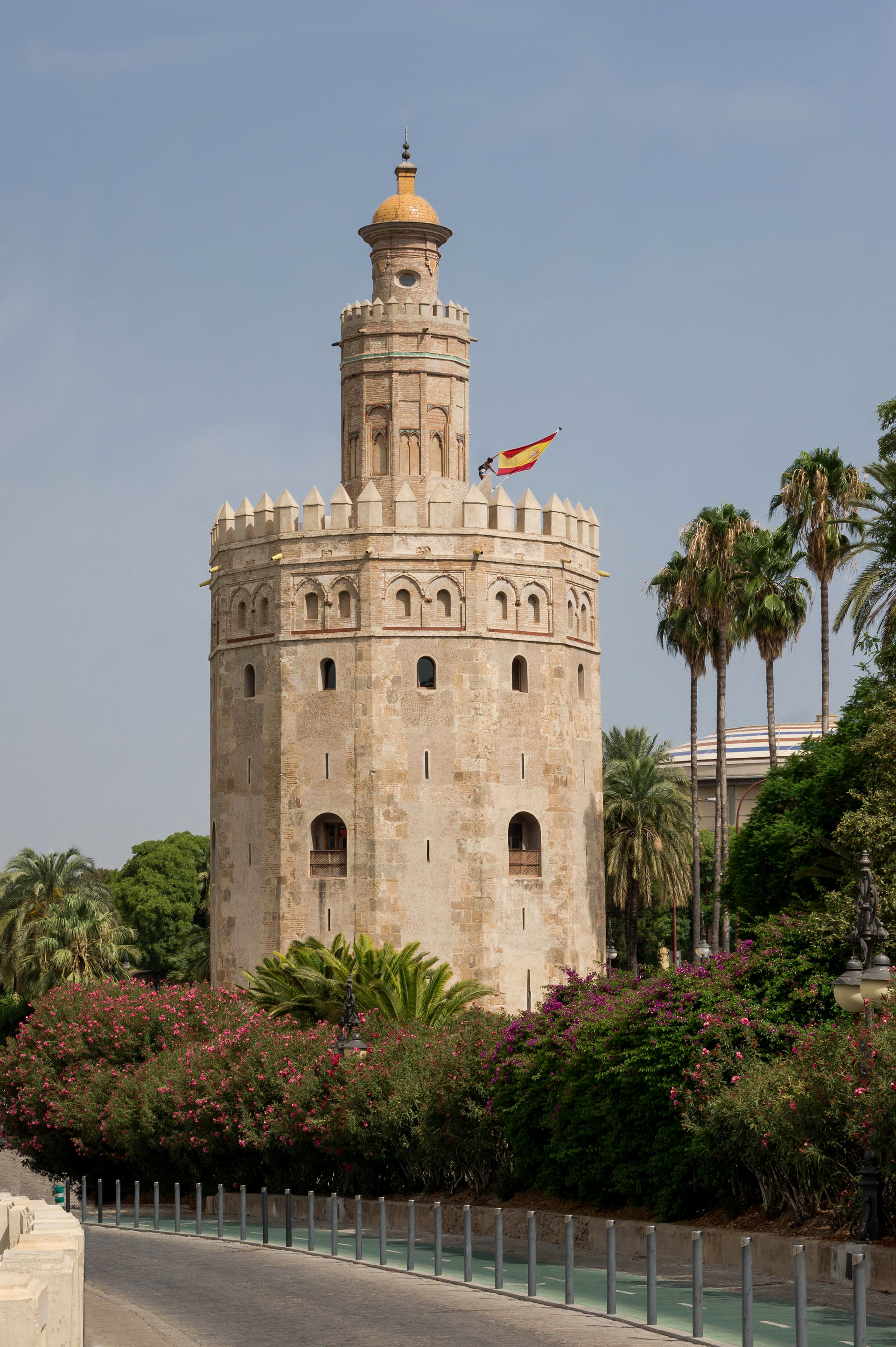
For eight centuries this twelve-sided tower has watched over the Guadalquivir River, and for most of that time its job was making sure nobody got in without permission. Built between 1220 and 1221 by the Almohad governor Abu al-Ulaa, the tower was part of a defensive system that included a massive iron chain stretched across the river to a matching tower on the opposite bank. Any enemy ship trying to reach the city would hit the chain and stall under a rain of arrows. The system worked until 1248, when the Castilian fleet under Admiral Ramon de Bonifaz smashed through it during the Reconquest of Seville.
The name "Tower of Gold" has sparked debate for centuries. Some say it comes from the golden tiles that once covered the exterior, glinting in the Andalusian sun. Others claim it refers to the gold unloaded here from treasure ships returning from the Americas. The most prosaic explanation is that the tower's dodecagonal shape and limestone construction simply catch the sunset in a way that makes the whole thing glow. Whatever the reason, the name stuck.
Today the tower houses a small but charming Naval Museum spread over three floors, documenting Seville's improbable career as a major port despite being 80 kilometres from the ocean. The Guadalquivir was navigable all the way to the city until the eighteenth century, making Seville the gateway to the New World. Every ship carrying gold, silver, and exotic goods from the Americas had to dock here and register its cargo.
The third section at the top was added in 1760 and offers panoramic views of the river, Triana, and the city skyline. Visit at sunset for the full golden effect that gave the tower its name.
Verified Facts
Built between 1220 and 1221 by the Almohad governor, the tower is a twelve-sided (dodecagonal) military watchtower
An iron chain was stretched from the tower across the Guadalquivir to block enemy ships until the Castilian fleet broke through in 1248
The tower now houses a Naval Museum documenting Seville's history as Spain's gateway port to the Americas
The upper cylindrical section was added in 1760, roughly 540 years after the original construction
Get walking directions
Paseo de Cristóbal Colón, 41001 Sevilla