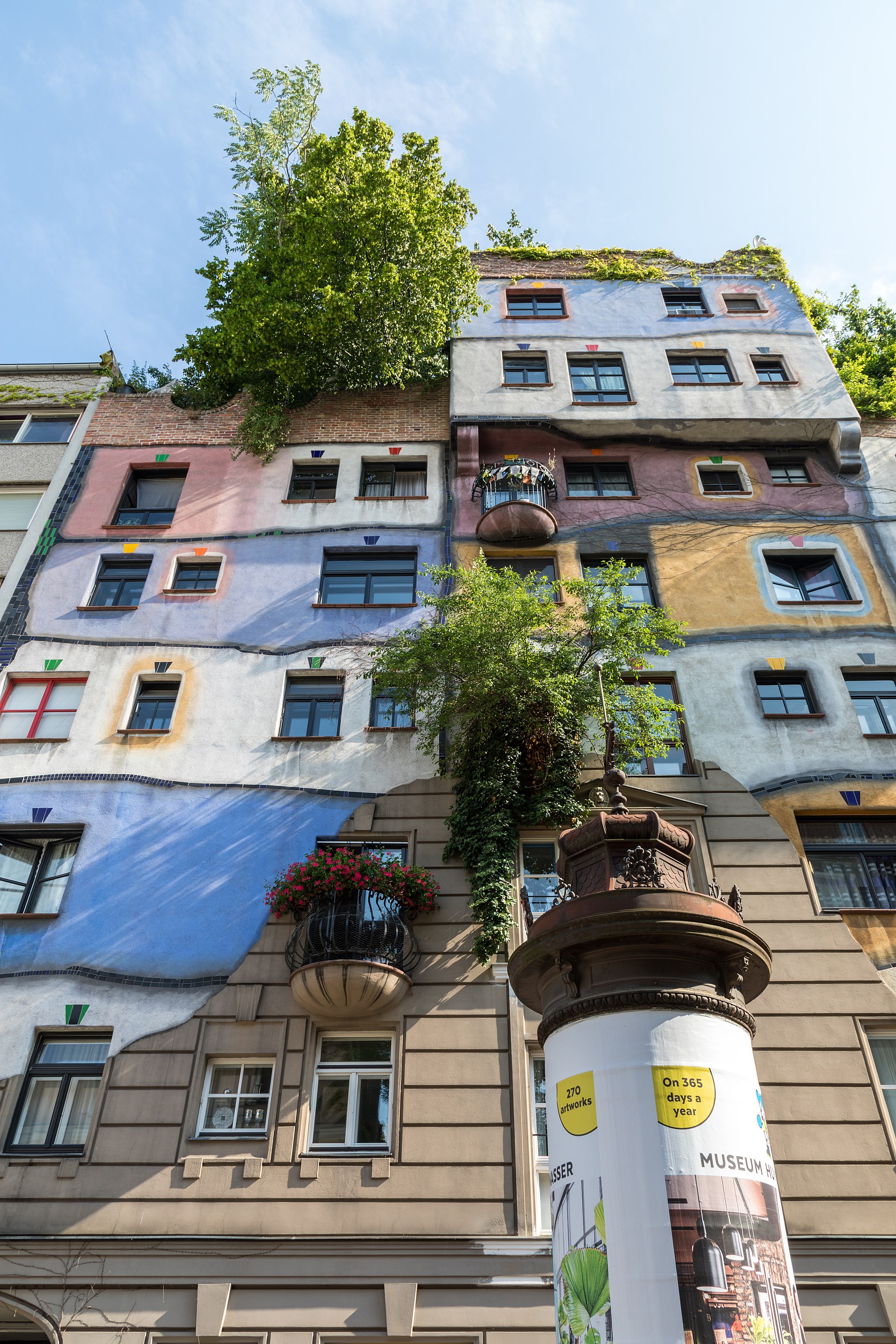
Friedensreich Hundertwasser hated straight lines. He called them "the devil's tools" and spent his career waging war against what he saw as the soul-crushing uniformity of modern architecture. In 1977, Austrian Chancellor Bruno Kreisky gave him the chance to put his money where his manifesto was: design a social housing block for the city of Vienna. The result, completed between 1983 and 1985, looks like a building designed by a child with access to unlimited paint — and that's meant as the highest compliment.
Not a single window is the same size or shape. The floors undulate like gentle hills. More than 200 trees and shrubs grow from the balconies and rooftop terraces, their roots pushing through the architecture as if nature is slowly reclaiming the building from the inside. Tenants have the contractual right to decorate the façade around their windows however they choose, meaning the building's appearance changes as its residents change — a living, evolving piece of art.
The building is public housing. Real people live here, paying subsidised rents, which means the most photographed residential building in Austria is also one of its most affordable. This tension — between tourist attraction and social infrastructure — is something Hundertwasser would have loved. He believed architecture should serve the people who live in it, not the ego of the architect. The fact that his most famous building is social housing, not a museum or a corporate headquarters, is the most Hundertwasser thing about it.
You can't go inside — it's someone's home — but the Hundertwasser Village across the street has a museum and shop in the same distinctive style, and the KunstHausWien nearby displays his paintings and photography in a building he also designed. Vienna's most rebellious architect left his fingerprints all over the third district.
Verified Facts
Built between 1983 and 1985 as a public housing project commissioned by Chancellor Bruno Kreisky
More than 200 trees and shrubs grow on the balconies and rooftop terraces
Tenants have the contractual right to decorate the façade around their windows to their own taste
Josef Krawina was ruled co-creator of the building by Austria's Supreme Court in 2010
Get walking directions
36 Kegelgasse, Landstraße, Vienna, 1030, Austria