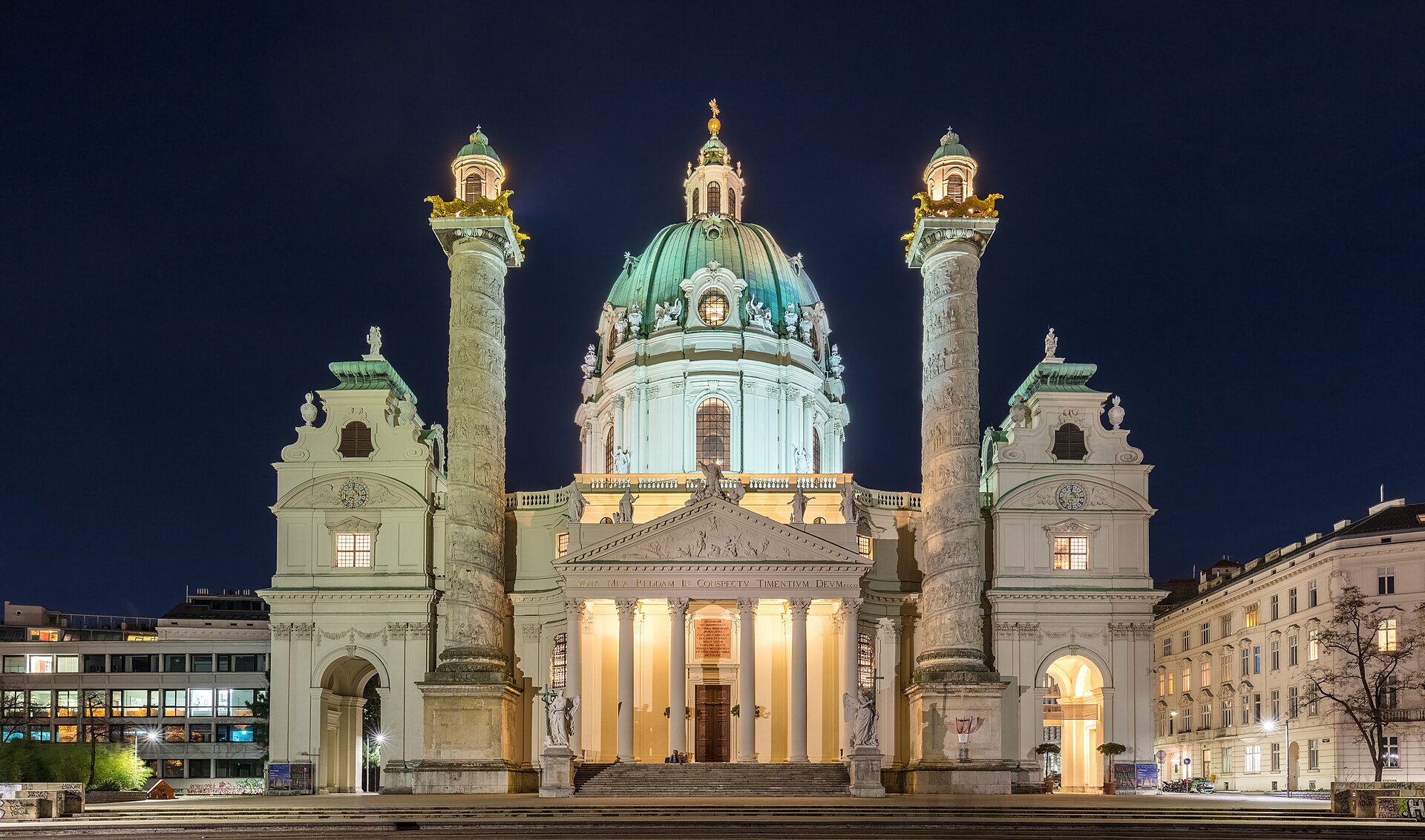
In 1713, with the last great plague epidemic barely over, Emperor Charles VI made a promise to his namesake saint: end the suffering, and I'll build you the most impressive church in Vienna. He kept his word. The Karlskirche is Baroque architecture pushed to its absolute limit — a building that combines a Greek temple portico, Roman triumphal columns, and an enormous copper dome into something that shouldn't work aesthetically but somehow does.
The two free-standing columns flanking the entrance are the building's masterstroke. Modelled on Trajan's Column in Rome, they're covered in spiralling bas-reliefs depicting the life of St. Charles Borromeo, the 16th-century bishop who ministered to plague victims in Milan. The columns serve no structural purpose — they're pure theatre, designed to make the church visible from across the Ringstrasse and to announce that the Habsburgs could out-Rome Rome.
Johann Bernhard Fischer von Erlach began construction in 1716 but died in 1723, leaving his son Joseph Emanuel to complete the project in 1737 with some alterations to the original plans. The dome's interior fresco by Johann Michael Rottmayr depicts St. Charles Borromeo's intercession before the Holy Trinity. An elevator and walkway now take visitors up to the fresco level, letting you see brushstrokes that were designed to be viewed from 70 metres below — it's like reading an artist's diary.
Antonio Vivaldi was buried at the Karlskirche on July 28, 1741, though his grave has been lost to time. In an appropriately musical twist, the church now hosts regular Vivaldi concerts. His music fills the space where his bones presumably rest, which is either poetic or slightly macabre, depending on your sensibility.
Verified Facts
Emperor Charles VI commissioned the church in 1713 after the last great plague epidemic in Vienna
Designed by Johann Bernhard Fischer von Erlach, begun 1716, completed by his son Joseph Emanuel in 1737
The two free-standing columns are modelled on Trajan's Column in Rome, depicting the life of St. Charles Borromeo
Antonio Vivaldi was buried at the Karlskirche on July 28, 1741, but his exact grave site has been lost
Get walking directions
1 Kreuzherrengasse, Wieden, Vienna, 1040, Austria