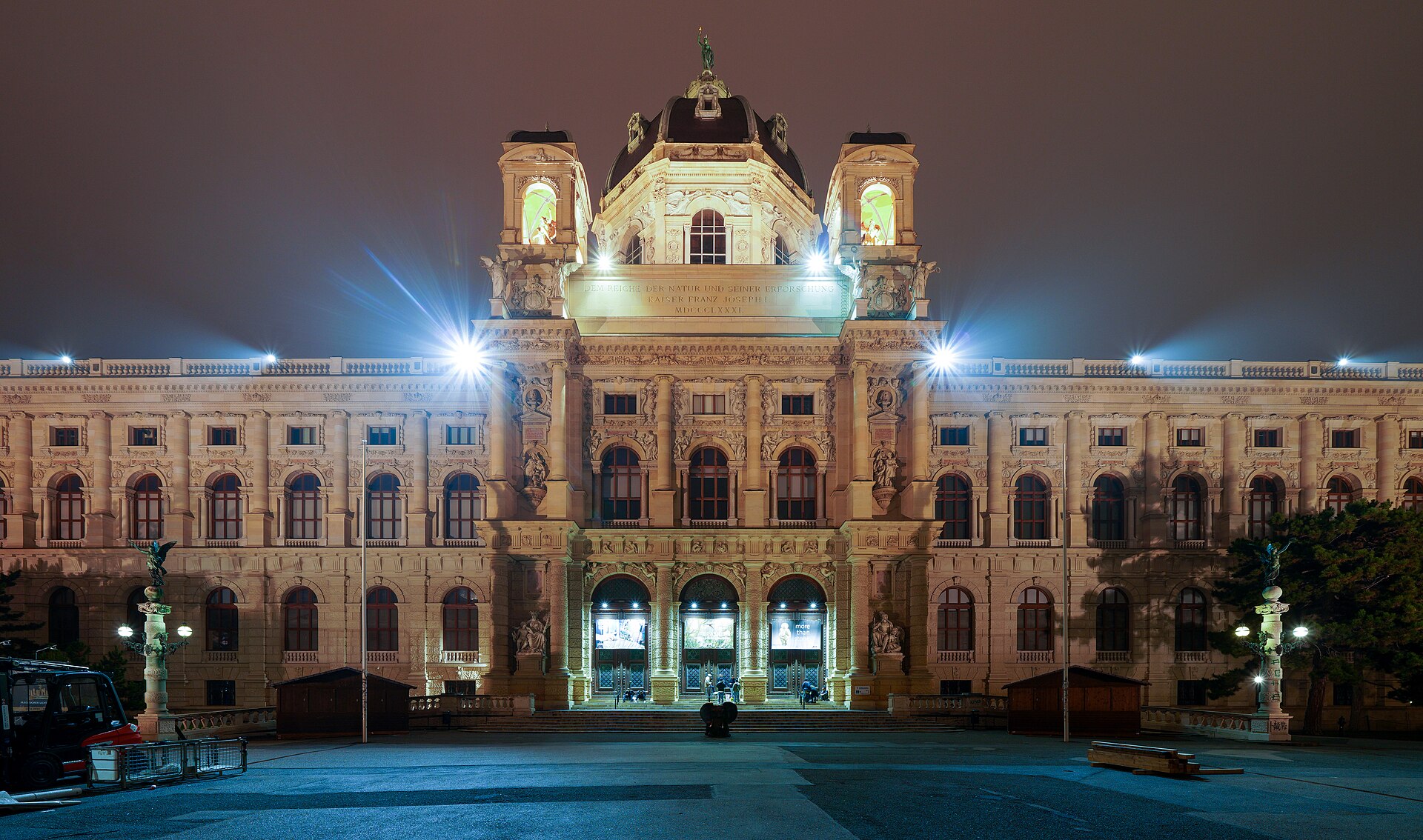
The Habsburgs spent centuries hoarding art the way other families collect holiday photos, and in 1891 Emperor Franz Joseph finally gave their collection a proper home. The Kunsthistorisches Museum is one of the world's great art museums, built by Gottfried Semper and Karl von Hasenauer in an Italian Renaissance Revival style so lavish that the building itself competes with the art inside. The staircase alone, with its ceiling paintings by Mihály Munkácsy and marble columns, is worth the entrance fee.
The jewel of the collection is the world's largest group of paintings by Pieter Bruegel the Elder — roughly a third of his entire surviving output hangs here. "The Tower of Babel" is the headliner, a dizzyingly detailed vision of human ambition and chaos that feels more relevant every year. "Hunters in the Snow" is quietly devastating in person — a winter landscape so cold you can almost see your breath.
Across the hall, Vermeer's "The Art of Painting" sits behind glass, purchased by the Habsburgs and then seized by the Nazis before being recovered from an Austrian salt mine after the war. Velázquez's portraits of the Spanish Infanta — those children with their enormous skirts and world-weary eyes — fill an entire room. Arcimboldo's vegetable portraits of the seasons prove that surrealism existed four centuries before anyone gave it a name.
The Kunstkammer — the cabinet of curiosities — is the museum's secret weapon: 2,100 objects ranging from Benvenuto Cellini's golden salt cellar (once stolen and buried in a forest by a museum worker, then recovered in 2006) to automata, astronomical instruments, and a rhinoceros horn goblet. The Egyptian collection, with over 17,000 objects spanning four millennia, fills an entire wing. You could spend a week here and still miss rooms.
Verified Facts
The museum houses the world's largest collection of Pieter Bruegel the Elder paintings, roughly a third of his surviving works
Opened in 1891 by Emperor Franz Joseph, designed by Gottfried Semper and Karl von Hasenauer
The Kunstkammer contains 2,100 objects including Cellini's golden salt cellar, stolen in 2003 and recovered in 2006
The Egyptian collection contains over 17,000 objects spanning four thousand years
Get walking directions
Maria-Theresien-Platz, Innere Stadt, Vienna, 1010, Austria